Jeremiah 4:13

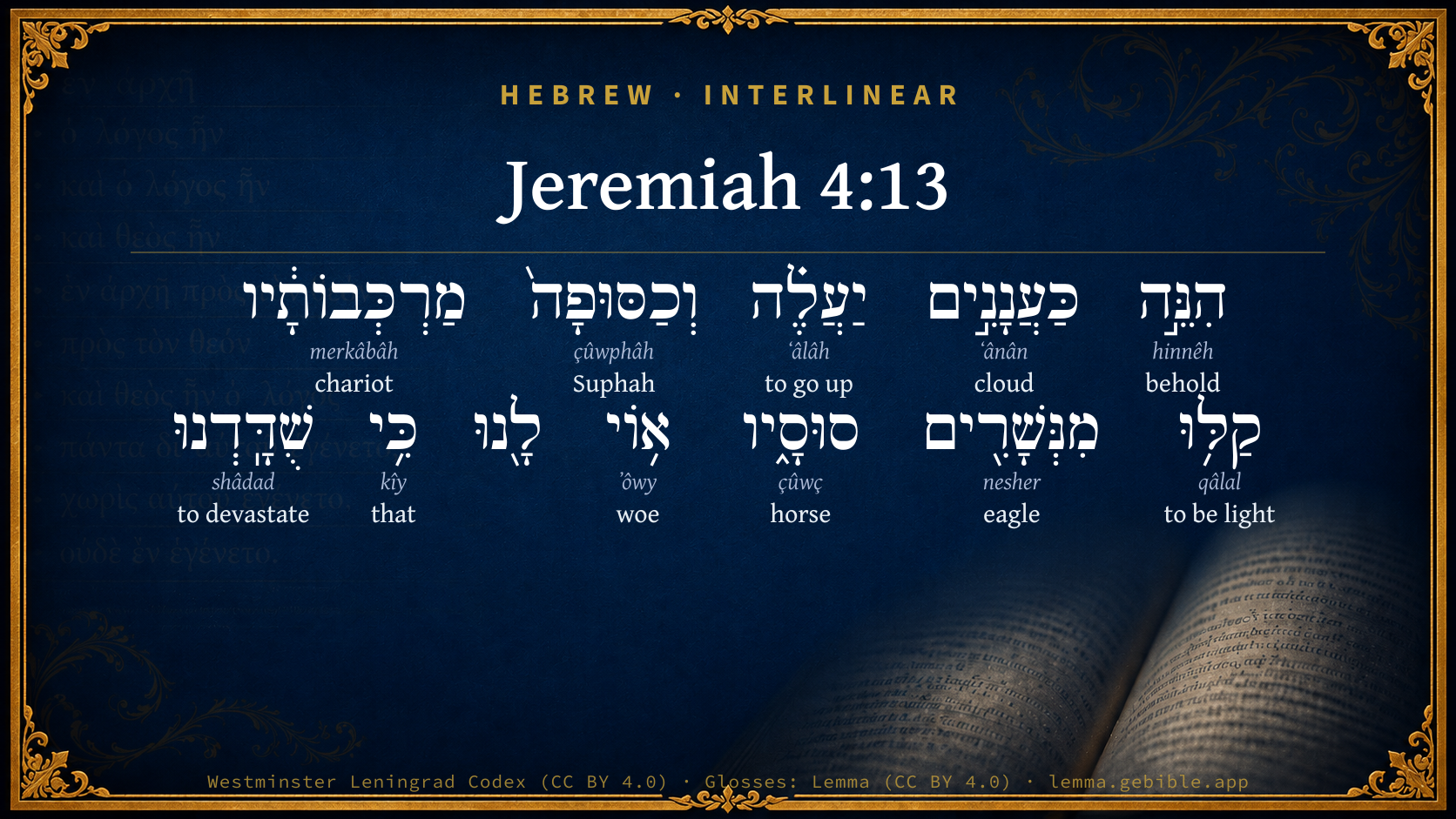
Hebrew (Westminster Leningrad Codex) Jeremiah 4:13 appears in the Hebrew Old Testament. The text above is from the Westminster Leningrad Codex. Each word links to its Strong’s number, a concise gloss, and parsing drawn from the Open Scriptures Hebrew Bible morphology. Click any word for its full Brown-Driver-Briggs (BDB) entry.
Download image
Cite this verse

Jeremiah 4:13 (World English Bible). Public Domain. Lemma interlinear Bible study tool, https://lemma.gebible.app/v/jeremiah/4/13.

Show BibTeX & RIS
BibTeX
RIS
English Translation
Behold, he shall come up as clouds, and his chariots [shall be] as the whirlwind: his horses are swifter than eagles. Woe to us! for we are ruined.
World English Bible · Public Domain
Download a study sheet

One document with this verse’s original text, its word-by-word gloss line, the meaning frame, cross-references with their text, attributed commentary, and full source and license credits — printable, and it pastes into notes with its structure intact.

This verse Autodidact and up

Study sheet (.html) Plain text (.txt)

A passage Seminary Student

Up to 50 verses in one chapter. A passage sheet keeps up to 6 commentary sources and 12 cross-references per verse, in the order this page ranks them, and says so on the sheet whenever that leaves anything out. Ask for a single verse and you get the Autodidact verse sheet above.

Everything on this page stays free to read, with no account — the sheet is a download of what is already on screen, not access to it.

Want to remove ads? Support Godless Engineer
Compare translations 3

The same verse in 3 English versions, stacked beneath the original-language interlinear above. Click any original word for its lexicon entry.

Each is an independent rendering of the whole verse — the interlinear is not word-aligned to these translations.

Highlighted words mark where these versions differ — a whole-verse word diff, not a word-by-word alignment.

  • World English Bible Public Domain
    Behold, he shall come up as clouds, and his chariots [shall be] as the whirlwind: his horses are swifter than eagles. Woe to us! for we are ruined.
  • King James Version Public Domain
    Behold, he shall come up as clouds, and his chariots shall be as a whirlwind: his horses are swifter than eagles. Woe unto us! for we are spoiled.
  • unfoldingWord Literal Text CC BY-SA 4.0
    Behold, like clouds he comes up, and his chariots like the storm. His horses are faster than eagles. Woe to us, for we are devastated!

unfoldingWord Literal Text — © unfoldingWord, licensed CC BY-SA 4.0. Word-aligned USFM3 via Door43 (git.door43.org/unfoldingWord/en_ult).

Versions to compare (up to 4)

3 of 4 selected

Show all 18 translations

Every available English version of this verse, each an independent rendering of the whole verse.

  • World English Bible Public Domain
    Behold, he shall come up as clouds, and his chariots [shall be] as the whirlwind: his horses are swifter than eagles. Woe to us! for we are ruined.
  • Berean Standard Bible Public Domain
    Behold, he advances like the clouds, his chariots like the whirlwind. His horses are swifter than eagles. Woe to us, for we are ruined!
  • Majority Standard Bible Public Domain
    Behold, he advances like the clouds, his chariots like the whirlwind. His horses are swifter than eagles. Woe to us, for we are ruined!
  • King James Version Public Domain
    Behold, he shall come up as clouds, and his chariots shall be as a whirlwind: his horses are swifter than eagles. Woe unto us! for we are spoiled.
  • American Standard Version (1901) Public Domain
    Behold, he shall come up as clouds, and his chariots `shall be' as the whirlwind: his horses are swifter than eagles. Woe unto us! for we are ruined.
  • Revised Version (1885) Public Domain
    Behold, he shall come up as clouds, and his chariots shall be as the whirlwind: his horses are swifter than eagles. Woe unto us! for we are spoiled.
  • Geneva Bible (1599) Public Domain
    Beholde, he shall come vp as the cloudes, and his charets shalbe as a tempest: his horses are lighter then eagles. Woe vnto vs, for wee are destroyed.
  • Douay-Rheims (1899) Public Domain
    Behold he shall come up as a cloud, and his chariots as a tempest: his horses are swifter than eagles: woe unto us, for we are laid waste.
  • Young's Literal Translation Public Domain
    Lo, as clouds he cometh up, And as a hurricane his chariots, Lighter than eagles have been his horses, Wo to us, for we have been spoiled.
  • Literal Standard Version CC BY-SA 4.0
    “Behold, he comes up as clouds, || And his chariots as a windstorm, || His horses have been lighter than eagles, || Woe to us, for we have been spoiled.”
  • Unlocked Literal Bible CC BY-SA 4.0
    See, he is attacking like clouds, and his chariots are like a storm. His horses are faster than eagles. Woe to us, for we will be devastated!
  • unfoldingWord Literal Text CC BY-SA 4.0
    Behold, like clouds he comes up, and his chariots like the storm. His horses are faster than eagles. Woe to us, for we are devastated!
  • Darby Bible Public Domain
    Behold, he cometh up as clouds, and his chariots are as a whirlwind; his horses are swifter than eagles. Woe unto us! for we are destroyed.
  • World Messianic Bible Public Domain
    Behold, he will come up as clouds, and his chariots will be as the whirlwind. His horses are swifter than eagles. Woe to us! For we are ruined.
  • Webster's Bible Public Domain
    Behold, he shall come up as clouds, and his chariots shall be as a whirlwind: his horses are swifter than eagles. Woe to us! for we are laid waste.
  • Free Bible Version CC BY-SA 4.0
    Look, he's rushing in like storm clouds; his chariots are like a whirlwind. His horses fly faster than eagles. “What a disaster! We're ruined!”
  • Bible in Basic English Public Domain
    See, he will come up like the clouds, and his war-carriages like the storm-wind: his horses are quicker than eagles. Sorrow is ours, for destruction has come on us.
  • JPS Tanakh (1917) Public Domain
    Behold, he cometh up as clouds, and his chariots are as the whirlwind; his horses are swifter than eagles. — 'Woe unto us! for we are undone.' —

Literal Standard Version (2020), Covenant Press — licensed CC BY-SA 4.0. Text via the HelloAO Bible API (eBible.org). Unlocked Literal Bible (unfoldingWord) — licensed CC BY-SA 4.0. Text via the HelloAO Bible API (eBible.org). unfoldingWord Literal Text — © unfoldingWord, licensed CC BY-SA 4.0. Word-aligned USFM3 via Door43 (git.door43.org/unfoldingWord/en_ult). Free Bible Version, Dr. Jonathan Gallagher — licensed CC BY-SA 4.0. Text via the HelloAO Bible API (eBible.org).

Word by word

More ways to search: Search by grammar → Find every occurrence → Compare this word →

Practice this passage: Drill this verse → Learn its vocabulary →

וְכַסּוּפָה֙
çûwphâh
H5492
“and · like/as the · Suphah”
Conjunction + Preposition, Determined + Noun, Common, Feminine, Singular, Absolute
Part of Speech
Conjunction + Preposition + Noun
Type
Common
Gender
Feminine
Number
Singular
State
Absolute
Full BDB Definition

Origin: from H5486

TWOT: 1478b

Suphah = "honeycomb: overflow" - storm-wind (noun feminine) - a place east of the Jordan (noun proper locative)
  1. הִנֵּ֣ה hinnêh H2009 “behold” Particle, Demonstrative
  2. כַּעֲנָנִ֣ים ʻânân H6051 “like/as · clouds” Preposition + Noun, Common, Masculine, Plural, Absolute
  3. יַעֲלֶ֗ה ʻâlâh H5927 “to go up” Verb, Qal, Imperfect, 3rd Person, Masculine, Singular
  4. מַרְכְּבוֹתָ֔יו merkâbâh H4818 “chariots · his” Noun, Common, Feminine, Plural, Construct + Suffix, Personal, 3rd Person, Masculine, Singular
  5. קַלּ֥וּ qâlal H7043 “to be light” Verb, Qal, Perfect, 3rd Person, Common, Plural
  6. מִנְּשָׁרִ֖ים nesher H5404 “from · eagles” Preposition + Noun, Common, Masculine, Plural, Absolute
  7. סוּסָ֑יו çûwç H5483 “horses · his” Noun, Common, Masculine, Plural, Construct + Suffix, Personal, 3rd Person, Masculine, Singular
  8. א֥וֹי ʼôwy H188 “woe” Particle, Interjection
  9. כִּ֥י kîy H3588 “that” Conjunction
  10. שֻׁדָּֽדְנוּ shâdad H7703 “to devastate” Verb, Pual, Perfect, 1st Person, Common, Plural

About this verse

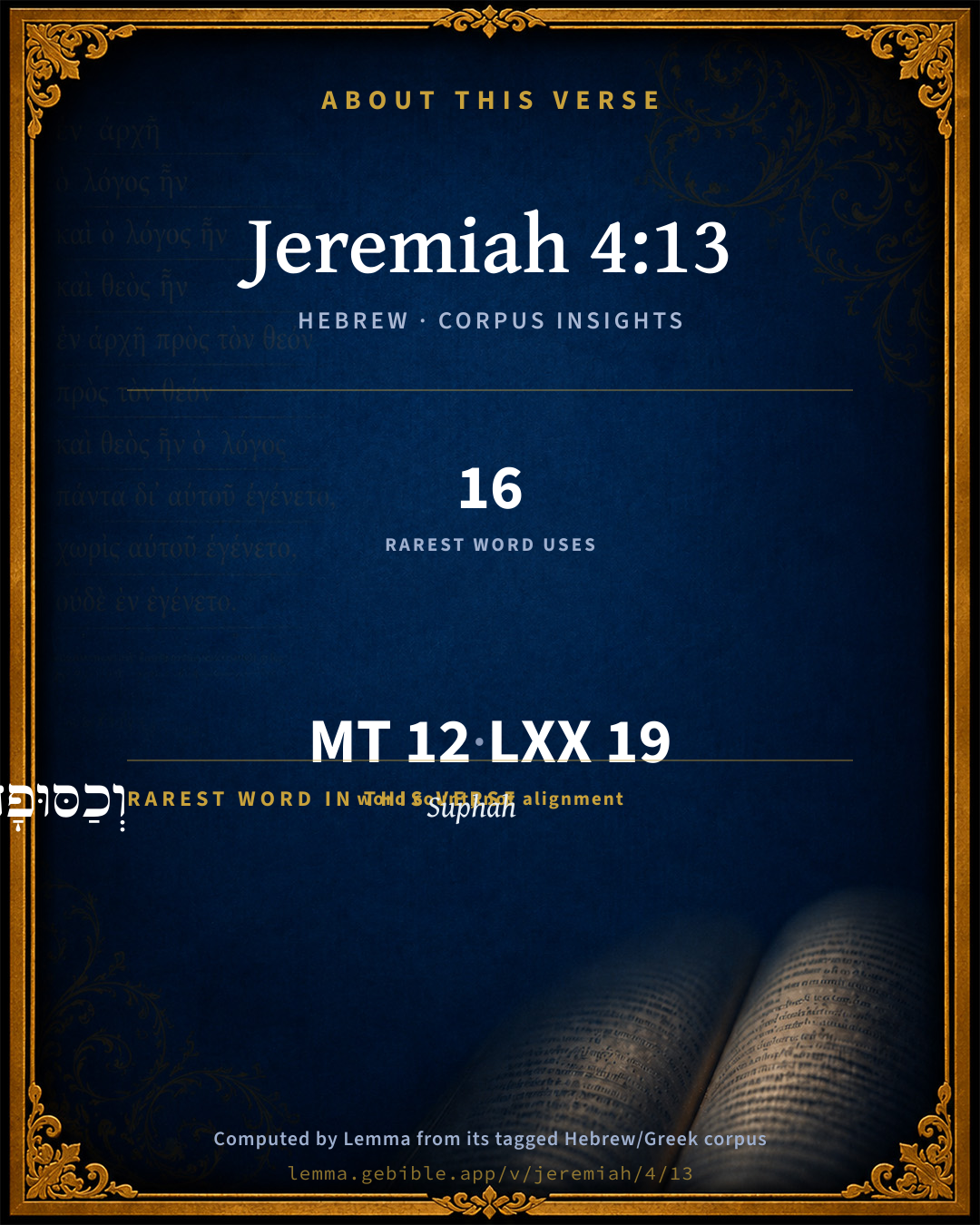
These counts appear in no published source. They are computed here, from the morphology-tagged text and Lemma’s own curated glosses. What Lemma adds →

12
words
11
distinct lemmas
Prophets
section

Notable vocabulary

The rarest word here is וְכַסּוּפָה֙ Suphah H5492 — appearing just 16 times in the whole Hebrew Bible.

Shared distinctive vocabulary

וְכַסּוּפָה֙ Suphah H5492 occurs in 16 verses of the Hebrew Bible. Also found in:

Grammatical profile

  • 3 verbs
  • 5 nouns
  • 1 preposition
  • 1 conjunction
  • 2 particles

Verb forms

  • יַעֲלֶ֗ה Qal · Imperfect
  • קַלּ֥וּ Qal · Perfect
  • שֻׁדָּֽדְנוּ Pual · Perfect

Hebrew & Septuagint length

In the original languages it is 12 Hebrew tokens and 19 Greek tokens — but the two are counted differently (Hebrew bundles its prefixes and suffixes into one token; the Greek is in lemma form), so that isn’t a like-for-like length.

Cross-references

15

Topical passages linked to Jeremiah 4:13 in the Treasury of Scripture Knowledge — connected by theme and wording, ordered by reader-vote popularity; previews shown in the World English Bible.

  • Isaiah 19:1 The burden of Egypt. Behold, Yahweh rides on a swift cloud, and comes to Egypt: and the idols of Egypt shall tremble at his presence; and the heart of Egypt shall melt in the midst of it.
  • Isaiah 66:15 For, behold, Yahweh will come with fire, and his chariots shall be like the whirlwind; to render his anger with fierceness, and his rebuke with flames of fire.
  • Isaiah 5:28 Whose arrows are sharp, And all their bows bent. Their horses' hoofs will be like flint, And their wheels like a whirlwind.
  • Lamentations 4:19 Our pursuers were swifter than the eagles of the sky: They chased us on the mountains, they laid wait for us in the wilderness.
  • Habakkuk 1:8 Their horses also are swifter than leopards, and are more fierce than the evening wolves. Their horsemen press proudly on. Yes, their horsemen come from afar. They fly as an eagle that hurries to devour.
  • Deuteronomy 28:49 Yahweh will bring a nation against you from far, from the end of the earth, as the eagle flies; a nation whose language you shall not understand;
  • Isaiah 13:5 They come from a far country, from the uttermost part of heaven, even Yahweh, and the weapons of his indignation, to destroy the whole land.
  • Nahum 1:3 Yahweh is slow to anger, and great in power, and will by no means leave the guilty unpunished. Yahweh has his way in the whirlwind and in the storm, and the clouds are the dust of his feet.
  • Jeremiah 4:31 For I have heard a voice as of a woman in travail, the anguish as of her who brings forth her first child, the voice of the daughter of Zion, who gasps for breath, who spreads her hands, [saying], Woe is me now! for my soul faints before the murderers.
  • Revelation 1:7 Behold, he is coming with the clouds, and every eye will see him, including those who pierced him. All the tribes of the earth will mourn over him. Even so, Amen.
  • Jeremiah 10:19 Woe is me because of my hurt! my wound is grievous: but I said, Truly this is [my] grief, and I must bear it.
  • Daniel 7:4 The first was like a lion, and had eagle's wings: I saw until the wings of it were plucked, and it was lifted up from the earth, and made to stand on two feet as a man; and a man's heart was given to it.
  • Hosea 8:1 "Put the trumpet to your lips! Something like an eagle is over Yahweh's house, Because they have broken my covenant, And rebelled against my law.
  • Nahum 2:3–4 The shield of his mighty men is made red. The valiant men are in scarlet. The chariots flash with steel in the day of his preparation, and the pine spears are brandished.
  • Matthew 24:30 and then the sign of the Son of Man will appear in the sky. Then all the tribes of the earth will mourn, and they will see the Son of Man coming on the clouds of the sky with power and great glory.

Cross-references courtesy of OpenBible.info (CC BY 4.0).

Hebrew and Greek witnesses Masoretic Hebrew ↔ Greek Septuagint

The same verse in the two great witnesses to the Old Testament, shown verse-for-verse.

These are two independent witnesses, not word-aligned to each other, and the Septuagint is shown in lemma (dictionary) form.

Hebrew Jeremiah 4:13 Masoretic · Westminster Leningrad Codex

הִנֵּ֣ה כַּעֲנָנִ֣ים יַעֲלֶ֗ה וְכַסּוּפָה֙ מַרְכְּבוֹתָ֔יו קַלּ֥וּ מִנְּשָׁרִ֖ים סוּסָ֑יו א֥וֹי לָ֖נוּ כִּ֥י שֻׁדָּֽדְנוּ

Behold, he shall come up as clouds, and his chariots [shall be] as the whirlwind: his horses are swifter than eagles. Woe to us! for we are ruined.

World English Bible · Public Domain

Greek LXX Structure differs

In the Septuagint, Jeremiah is about an eighth shorter than the Hebrew and arranges its material differently — the Oracles Against the Nations (Hebrew chapters 46–51) appear in the middle of the Greek book, after 25:13. Because the chapter and verse boundaries do not line up, a verse-for-verse comparison with the Hebrew is not shown.

A verse-for-verse comparison isn’t shown here because the chapters and verses don’t line up. Switch to the LXX edition with the MT / LXX toggle above to read the Greek directly.

Hebrew: Westminster Leningrad Codex (CC BY 4.0). Greek: Septuagint (public domain); English from a public-domain English Septuagint. How the Septuagint differs from the Hebrew →

Targum (Aramaic paraphrase)

1

The Targum is the ancient Jewish Aramaic paraphrase of the Hebrew Scriptures — an interpretive translation, not the Hebrew text itself. Onkelos (literal) and Pseudo-Jonathan (expansive) render the Torah, and Jonathan the Prophets. Coverage is partial: where no permissively-licensed English translation exists for a verse, only the Aramaic is shown. This is verse-level text, not a word-by-word alignment to the Hebrew.

  1. Targum Jonathan Prophets (Joshua–Malachi)
    הָא מְלַךְ בְּמַשִׁרְיָתֵיהּ יִסֹק עֲלֵיהוֹן כַּעֲנָנָא דְסָלֵיק וְחָפֵי יַת אַרְעָא וּכְעַלְעוֹלִין רְתִיכוֹהִי קַלִילִין מִנִשְׁרַיָא סוּסְוָתֵיהּ וַי לָנָא אֲרֵי אֲתֵי לְמִבְזָנָא:

    (no public-domain English translation for this verse)

    Targum Jonathan — Aramaic: “Mikraot Gedolot” (public domain). English: “Sefaria Community Translation” (CC0 1.0 (public-domain dedication)); “London "Chaldee Paraphrase," 1871” (public domain). Text via Sefaria.

Commentary

Notes on Jeremiah 4:13 from classic Christian and Jewish commentators (each source and its license shown beneath its notes). The classic Christian expositions comment on the surrounding passage and are grouped to its opening verse, so a note may address several verses; the Jewish commentaries on the Tanakh (Rashi and others) are per-verse, so they appear only where the commentator wrote on this verse.

Lemma curates 59 commentaries, every one of them public domain or Creative Commons licensed, each selected and text-cleaned for this edition rather than reprinted as found. About our sources →

Trapp's Complete Commentary

John Trapp

Jer 4:13 Behold, he shall come up as clouds, and his chariots [shall be] as a whirlwind: his horses are swifter than eagles. Woe unto us! for we are spoiled.

Ver. 13. Behold, he shall come up as clouds.] Swiftly and numerously.

His horses are swifter than eagles.] Which, though the biggest of all fowls, yet fly with greatest speed.

Woe unto us, for we are spoiled.] This he premiseth fitly to his exhortation to repentance; {Jer 4:14} q.d., We are utterly undone, if repentance prevent not.

“ Currat ergo paenitentia, ne praecurrat sententia. ”

John Trapp, A Commentary or Exposition upon All the Books of the Old and New Testament (1647–1656) — public domain. Text from a community e-Sword module.

Tyndale Open Study Notes

Tyndale Open Resources

4:13 Like his countrymen, Jeremiah was fearful when he heard that the invasion from the north had begun (Deut 28:49; Isa 5:28; Lam 4:19; Hos 8:1; Hab 1:8).

Tyndale Open Study Notes — © Tyndale Open Resources, licensed CC BY-SA 4.0. Text via the HelloAO Bible API.

Geneva Bible (1599)

Geneva Bible translators

Meaning, that Nebuchadnezzar should come as suddenly, as a cloud that is carried with the wind.

This is spoken in the person of all the people, who in their affliction should cry thus.

Geneva Bible (1599) marginal notes — public domain. Text via Bolls.life.

Jamieson, Fausset & Brown

Robert Jamieson, A. R. Fausset & David Brown

clouds--continuing the metaphor in Jer 4:11-12. Clouds of sand and dust accompany the simoom, and after rapid gyrations ascend like a pillar.

eagles-- (Deu 28:49; Hab 1:8).

Woe unto us--The people are graphically presented before us, without it being formally so stated, bursting out in these exclamations.

Jamieson, Fausset & Brown — Commentary Critical and Explanatory on the Whole Bible (1871) — public domain (CC PDM 1.0). Text via the HelloAO Bible API.

Adam Clarke's Commentary

Verse 13. See Clarke on Jer 4:11. Ver. 13. Wo unto us!] The people, deeply affected with these threatened judgments, interrupt the prophet with the lamentation - Wo unto us, for we are spoiled! The prophet then resumes: -

Adam Clarke's Commentary on the Bible (1810–1826) — public domain. Text from a community e-Sword/MySword module.

John Calvin's Commentaries

The Prophet here concludes the prediction which referred to the dreadful vengeance that was coming; and he mentions here several similitudes, such as might rouse the Jews and constrain them to fear. He says, that the chariots of God would come as clouds and as a whirlwind; and then that his horses would be swifter than eagles

As to the clouds, the whirlwind, and the eagles, (for the import of the three similitudes is the same,) the Prophet no doubt intended thus to set forth the quickness of God’s vengeance; but yet there is some difference. We see how clouds suddenly arise and spread over the whole heaven; and thus it happens when a whirlwind is in the air. Hence when he compares God’s chariots to clouds and the whirlwind, it is the same as if he had said, that the beginning of the calamity would be sudden, because God would unexpectedly arise, after having been apparently asleep for a long time. But when he says, that God’s horses would be swifter than eagles, he means, that it would be easy for God, when once he had begun, to destroy the whole of Judea, as it were in a moment, or at least in a very short time; for we know how swift is the flying of the eagle; but he says, that the horses of God would be swifter than the eagles.

We now understand the Prophet’s meaning: for when the Jews derided the threatenings of the Prophets, they tauntingly used such a language as this, — “O! we shall, at least in the meantime, feast cheerfully and joyfully; these Prophets will not allow us a truce for one hour; but yet many years will pass away before the evil overtakes us.” We find profane men in our day, who in like manner trifle with God: and when they cannot wholly despise what God threatens, they yet delay the time, and think that they gain something by putting off the day of vengeance. This, then, was the reason why the Prophet said, that God’s chariots would ascend, as clouds arise suddenly, and then as a whirlwind in clear sky, and lastly, in a manner swifter than the eagles, even in their swiftest course.

The Prophet, in the last place, exclaims, in the name of the whole people, Woe to us! for we are lost He speaks here concisely, that he might shew that the false prophets, as well as the people, were going astray to their own ruin, while they were asleep in their vices, and thought their insensibility would escape punishment. He hence exclaims, that though all were then seized with stupor, the people themselves were yet lost. It at length follows —

John Calvin's Commentaries (1540-1563) — public domain. Text from the Calvin Translation Society English edition (1840s-50s) via the Christian Classics Ethereal Library (ccel.org). Calvin's coverage is partial (roughly two-thirds of the Bible); uncommented books and verses are honest gaps, never fabricated. The 19th-century editor's footnotes and remarks are omitted so the notes are faithfully Calvin's own voice.

Ellicott's Commentary for English Readers

(13) He shall come up as clouds.—He, the destroyer of nations, with armies that sweep like storm-clouds over the land they are going to destroy. (Comp. Eze_38:16.)

Swifter than eagles.—A possible quotation from David’s lament over Saul and Jonathan (2Sa_1:23). The fact that another phrase is quoted in Jer_4:30 (“clothest thyself with crimson,” where the Hebrew is the same as the “scarlet” of 2Sa_1:24), makes the possibility something like a certainty. It was natural that one who himself wrote two sets of lamentations, one early (2Ch_35:25), the other late, in life, should have been a student of earlier elegies. For the flight of the eagle as representing the swift march of the invader, comp. Lam_4:19; Hos. viii 1; Hab_1:8.

Woe unto us! for we are spoiled.—Probably the cry of the terrified crowds of Jerusalem, with which the prophet, with dramatic vividness, as in Jer_9:18-19, interrupts his description.

A Bible Commentary for English Readers, edited by Charles John Ellicott (1878–1897) — public domain. Text from a community e-Sword module.

The Cambridge Bible for Schools and Colleges

gen. ed. J. J. S. Perowne

13. as clouds] a further simile for the invader. Cp. Eze_38:16, and Joe_2:2.

his chariots shall be as the whirlwind] Cp. Isa_5:28; Isa_66:15.

eagles] rather, griffons (gypsi fulvus), a species of vulture. Cp. ch. Jer_48:40, Jer_49:22; 2Sa_1:23; Lam_4:19; Hab_1:8.

The Cambridge Bible for Schools and Colleges (gen. ed. J. J. S. Perowne; Cambridge University Press, 1878–1918) — public domain. Text from a community e-Sword module.

John Gill's Exposition

Behold, he shall come up as clouds,.... Meaning the lion, Nebuchadnezzar, Jer 4:7,

"the king with his army (as the Targum paraphrases it); he shall come up against them as a cloud that ascendeth and covers the earth.''

"come up against them as a cloud that ascendeth and covers the earth.''

The metaphor denotes the swiftness of his coming, and the multitudes he should come with, and that darkness and distress he should bring with him upon the people of the Jews:

and his chariots shall be as a whirlwind; for swiftness, power, and violence: chariots for war are intended; see Isa 5:28,

his horses are swifter than eagles: the swiftest of birds. The same thing is designed as by the other metaphors; the swiftness and suddenness of the Jews' destruction:

woe unto us, for we are spoiled; their destruction was inevitable, there was no escaping it; and therefore their case was woeful and miserable.

John Gill's Exposition of the Whole Bible (1746–1763) — public domain (CC PDM 1.0). Text via the HelloAO Bible API.

Albert Barnes' Notes on the Bible

His troops move on in large masses like dark threatening clouds Joe 2:2.

Woe unto us! for we are spoiled - Jeremiah’s own cry of grief.

Albert Barnes' Notes on the Bible (1834–1885) — public domain. Text from a community e-Sword/MySword module.

Matthew Poole's English Annotations

He shall come up as clouds; either noting the vast number of them, Isa 60:8; Heb 12:1; or the suddenness of them, when not expected, clouds often rising on a sudden, and overspreading the whole face of the heavens; or rather, the great speed and swiftness with which Nebuchadnezzar shall march against them, Isa 19:1, hyperbolically described by the swiftness of eagles in this verse, Jer 48:8.

His chariots shall be as a whirlwind; which beside the swiftness, notes also the confusion and amazement that they will cause, Isa 66:15.

Woe unto us! for we are spoiled: the dreadful apprehensions that the people have of their woeful condition, or possibly the words of the prophet lamenting their misery.

Matthew Poole's English Annotations on the Holy Bible (1683–1685) — public domain. Text from a community e-Sword/MySword module.

Whedon's Commentary on the Bible

Daniel D. Whedon

13. Behold — Prophetic vision.

Clouds… whirlwind… eagles — Located in the same region as that before suggested in the figure of the dry wind. The dark, angry, swiftly moving masses of clouds, the destructive sweep of the tornado, and the sudden and resistless swoop of the birds of prey, constitute the terrible imagery by which the great danger of the nation is set forth.

Daniel D. Whedon (gen. ed.), Commentary on the Old and New Testaments (1874–1909) — public domain. Text from a community e-Sword module.

The Pulpit Commentary

He shall come up as clouds, etc. It is needless to name the subject; who can it be but the host of Jehovah"s warlike instruments? (For the first figure, comp. Eze_38:16; for the second, Isa_5:28 Isa_66:15; and for the third, Hab_1:8 Deu_28:49) Woe unto us! etc. The cry of lamentation of the Jews. (comp. ver. 20; Jer_9:18)

The Pulpit Commentary (1880–1919), ed. H.D.M. Spence-Jones & Joseph S. Exell — public domain. Text from a community e-Sword module.

John Wesley's Explanatory Notes

As clouds - Denoting the suddenness of them, when not expected, clouds often rising on a sudden, and overspread the whole face of the heavens; or the great swiftness with which Nebuchadnezzar should march against them. As a whirlwind - Which, besides the swiftness, denotes also the confusion and amazement that they will cause.

John Wesley, Explanatory Notes Upon the Whole Bible (1754–1765) — public domain. Text via the GEBible commentary corpus.

unfoldingWord translationNotes

Door43 World Missions Community

See, he is attacking like clouds

The word "he" refers to the enemy king and his army. The great size of the army is spoken of as if they were giant storm clouds. AT: "See, great armies like giant clouds are gathering to attack" or "See, great armies are gathering to attack" (See: Simile)

his chariots are like a storm

The enemies' chariots are spoken of as if they were like a storm. Storms can be noisy, destructive, and fast-moving. AT: "the roar of their chariots coming is like a fierce storm" (See: Simile)

Woe to us

"This is terrible"

for we will be devastated

This can be stated in active form. AT: "for they will devastate us" or "for they will destroy us all" (See: Active or Passive)

Cleanse your heart from wickedness, Jerusalem

This is a warning to the people living in Jerusalem to repent. "Cleanse your heart" is a metaphor for removing evil from their lives. AT: "People of Jerusalem, stop being evil" or "People of Jerusalem, stop living wickedly" (See: Metaphor)

How long will your deepest thoughts be about how to sin?

This question is used to rebuke the people for always planning how to sin. AT: "Your deepest thoughts are about how to sin!" or "You are always thinking about how to sin!" (See: Rhetorical Question)

a voice is bringing news from Dan

Here "a voice" represents a messenger. AT: "a messenger comes and tells about what is happening in Dan" (See: Synecdoche)

Dan

This probably refers to the region of Dan, which was west of Jerusalem.

the coming disaster is heard from the mountains of Ephraim

This can be stated in active form. AT: "people hear about the disaster that is coming from Ephraim" (See: Active or Passive)

from Dan ... mountains of Ephraim

By hearing that the enemies had gotten to Dan and Ephraim, people in Jerusalem would understand that the enemies were getting closer to them.

translationWords

chariot

horse

eagle

devastate

clean

evil

save

sin

voice

Dan

Ephraim

unfoldingWord translationNotes — © Distant Shores Media and the Door43 World Missions Community, licensed CC BY-SA 4.0. Source: git.door43.org/Door43/en_tn.

Rashi

Rabbi Shlomo Yitzchaki (Rashi)

and like the whirlwind (comme tourbillon in O.F.)

Rashi on the Tanakh — English translations: “The Judaica Press complete Tanach with Rashi, translated by A. J. Rosenberg” (CC BY 4.0); “Pentateuch with Rashi's commentary by M. Rosenbaum and A.M. Silbermann, 1929-1934” (public domain); “The Metsudah Tanach series, Lakewood, N.J” (CC BY 4.0); and “The Book of Joshua, Metsudah Publications, 1997” (CC BY 4.0). Text via Sefaria.

Lesson kit

Teaching starters — assembled from the data on this page, not authored interpretation. Every prompt links to the verse data it draws on. Edit before teaching.

Jeremiah, in the Prophets, opens this verse with 12 words (11 distinct Hebrew lemmas). Its most distinctive word is çûwphâh (“Suphah”). A historical commentator’s framing appears above. Read the whole chapter for the surrounding context.

Discussion questions

  1. What does “Suphah” (çûwphâh) contribute to the verse as a whole?
  2. How does Numbers 21:14, which shares the word «Suphah», read alongside this verse?
  3. These translations render this verse differently; the difference is in the English rendering, not the original. What questions does that raise?
  4. «יַעֲלֶ֗ה» is a Qal Imperfect verb. How does that grammatical form shape the action described?
  5. Compare how Trapp's Complete Commentary and Tyndale Open Study Notes read this verse. Where do they agree or differ?

Things to notice

Reading settings

Reading text

Shown beneath each verse's original-language words.

Old Testament
Old Testament edition

Read the OT as the Masoretic Hebrew (MT) or the Greek Septuagint (LXX).

English shown for the Greek Septuagint (in the Hebrew ↔ Greek comparison).

Comparing translations? Open the Compare panel on any verse page to stack up to four side by side.