Luke 6:24

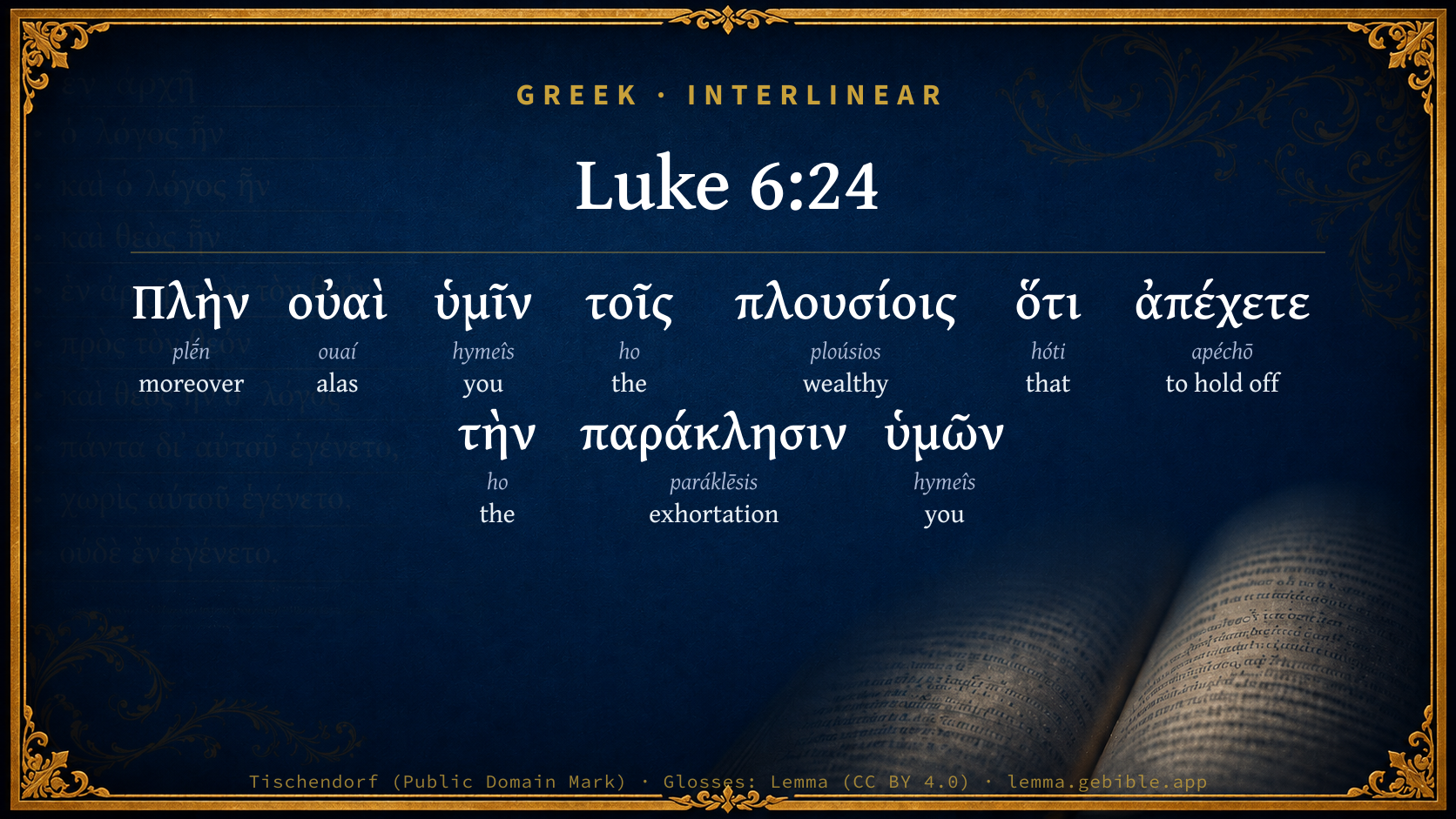
Greek (Tischendorf 8th ed.) Luke 6:24 appears in the Greek New Testament. The text above is from the Tischendorf 8th edition. Each word links to its Strong’s number and a concise gloss. Click any word for its full Thayer’s Greek Lexicon entry.
Download image
Cite this verse

Luke 6:24 (World English Bible). Public Domain. Lemma interlinear Bible study tool, https://lemma.gebible.app/v/luke/6/24.

Show BibTeX & RIS
BibTeX
RIS
English Translation
"But woe to you who are rich! For you have received your consolation.
World English Bible · Public Domain
Download a study sheet

One document with this verse’s original text, its word-by-word gloss line, the meaning frame, cross-references with their text, attributed commentary, and full source and license credits — printable, and it pastes into notes with its structure intact.

This verse Autodidact and up

Study sheet (.html) Plain text (.txt)

A passage Seminary Student

Up to 50 verses in one chapter. A passage sheet keeps up to 6 commentary sources and 12 cross-references per verse, in the order this page ranks them, and says so on the sheet whenever that leaves anything out. Ask for a single verse and you get the Autodidact verse sheet above.

Everything on this page stays free to read, with no account — the sheet is a download of what is already on screen, not access to it.

Want to remove ads? Support Godless Engineer
Compare translations 3

The same verse in 3 English versions, stacked beneath the original-language interlinear above. Click any original word for its lexicon entry.

Each is an independent rendering of the whole verse — the interlinear is not word-aligned to these translations.

Highlighted words mark where these versions differ — a whole-verse word diff, not a word-by-word alignment.

  • World English Bible Public Domain
    "But woe to you who are rich! For you have received your consolation.
  • King James Version Public Domain
    But woe unto you that are rich! for ye have received your consolation.
  • unfoldingWord Literal Text CC BY-SA 4.0
    But woe to you, the rich, for you have received your comfort.

unfoldingWord Literal Text — © unfoldingWord, licensed CC BY-SA 4.0. Word-aligned USFM3 via Door43 (git.door43.org/unfoldingWord/en_ult).

Versions to compare (up to 4)

3 of 4 selected

Show all 19 translations

Every available English version of this verse, each an independent rendering of the whole verse.

  • World English Bible Public Domain
    "But woe to you who are rich! For you have received your consolation.
  • Berean Standard Bible Public Domain
    But woe to you who are rich, for you have already received your comfort.
  • Majority Standard Bible Public Domain
    But woe to you who are rich, for you have already received your comfort.
  • King James Version Public Domain
    But woe unto you that are rich! for ye have received your consolation.
  • American Standard Version (1901) Public Domain
    But woe unto you that are rich! for ye have received your consolation.
  • Revised Version (1885) Public Domain
    But woe unto you that are rich! for ye have received your consolation.
  • Geneva Bible (1599) Public Domain
    But wo be to you that are rich: for ye haue receiued your consolation.
  • Douay-Rheims (1899) Public Domain
    But woe to you that are rich: for you have your consolation.
  • Young's Literal Translation Public Domain
    `But wo to you -- the rich, because ye have got your comfort.
  • Literal Standard Version CC BY-SA 4.0
    But woe to you—the rich, because you have gotten your comfort.
  • Unlocked Literal Bible CC BY-SA 4.0
    But woe to you who are rich, for you have already received your comfort.
  • unfoldingWord Literal Text CC BY-SA 4.0
    But woe to you, the rich, for you have received your comfort.
  • Darby Bible Public Domain
    But woe to you rich, for ye have received your consolation.
  • World Messianic Bible Public Domain
    “But woe to you who are rich! For you have received your consolation.
  • Webster's Bible Public Domain
    But woe to you that are rich! for ye have received your consolation.
  • Free Bible Version CC BY-SA 4.0
    But how sad are you who are rich, for you have already received your reward.
  • Bible in Basic English Public Domain
    But unhappy are you who have wealth: for you have been comforted now.
  • Text-Critical English NT CC BY 4.0
    But woe to you who are rich, for you have received your comfort.
  • Tyndale New Testament (1534) Public Domain
    But wo be to you that are ryche: for ye have therin youre consolacion.

Literal Standard Version (2020), Covenant Press — licensed CC BY-SA 4.0. Text via the HelloAO Bible API (eBible.org). Unlocked Literal Bible (unfoldingWord) — licensed CC BY-SA 4.0. Text via the HelloAO Bible API (eBible.org). unfoldingWord Literal Text — © unfoldingWord, licensed CC BY-SA 4.0. Word-aligned USFM3 via Door43 (git.door43.org/unfoldingWord/en_ult). Free Bible Version, Dr. Jonathan Gallagher — licensed CC BY-SA 4.0. Text via the HelloAO Bible API (eBible.org).

Word by word

More ways to search: Search by grammar → Find every occurrence → Compare this word →

Practice this passage: Drill this verse → Learn its vocabulary →

ἀπέχετε
apéchō
G568
“to hold off”
Verb, Present, Active, Indicative, 2nd person, Plural
Part of Speech
Verb
Tense
Present
Voice
Active
Mood
Indicative
Person
2nd person
Number
Plural
Full Thayer's Definition

Origin: from G575 and G2192

TDNT: 15:48,3

1. have a. to hold back, keep off, prevent b. to have wholly or in full, to have received c. it is enough, sufficient 2. to be away, absent, distant 3. to hold one's self off, abstain "have" in Mat. 6. 2 , is modified with a prefix which changes itsmeaning to "have in full" and was commonly used on business receiptsto mean "paid in full". No payment or service was expected to followthe close of the transaction.
  1. Πλὴν plḗn G4133 “moreover” Adverb
  2. οὐαὶ ouaí G3759 “alas” Interjection
  3. ὑμῖν hymeîs G5210 “you” Personal pronoun, 2nd person, Dative, Plural
  4. τοῖς ho G3588 “the” Article, Dative, Plural, Masculine
  5. πλουσίοις ploúsios G4145 “wealthy” Adjective, Dative, Plural, Masculine
  6. ὅτι hóti G3754 “that” Conjunction
  7. τὴν ho G3588 “the” Article, Accusative, Singular, Feminine
  8. παράκλησιν paráklēsis G3874 “exhortation” Noun, Accusative, Singular, Feminine
  9. ὑμῶν hymeîs G5210 “you” Personal pronoun, 2nd person, Genitive, Plural

About this verse

These counts appear in no published source. They are computed here, from the morphology-tagged text and Lemma’s own curated glosses. What Lemma adds →

10
words
8
distinct lemmas
Gospels
section

Notable vocabulary

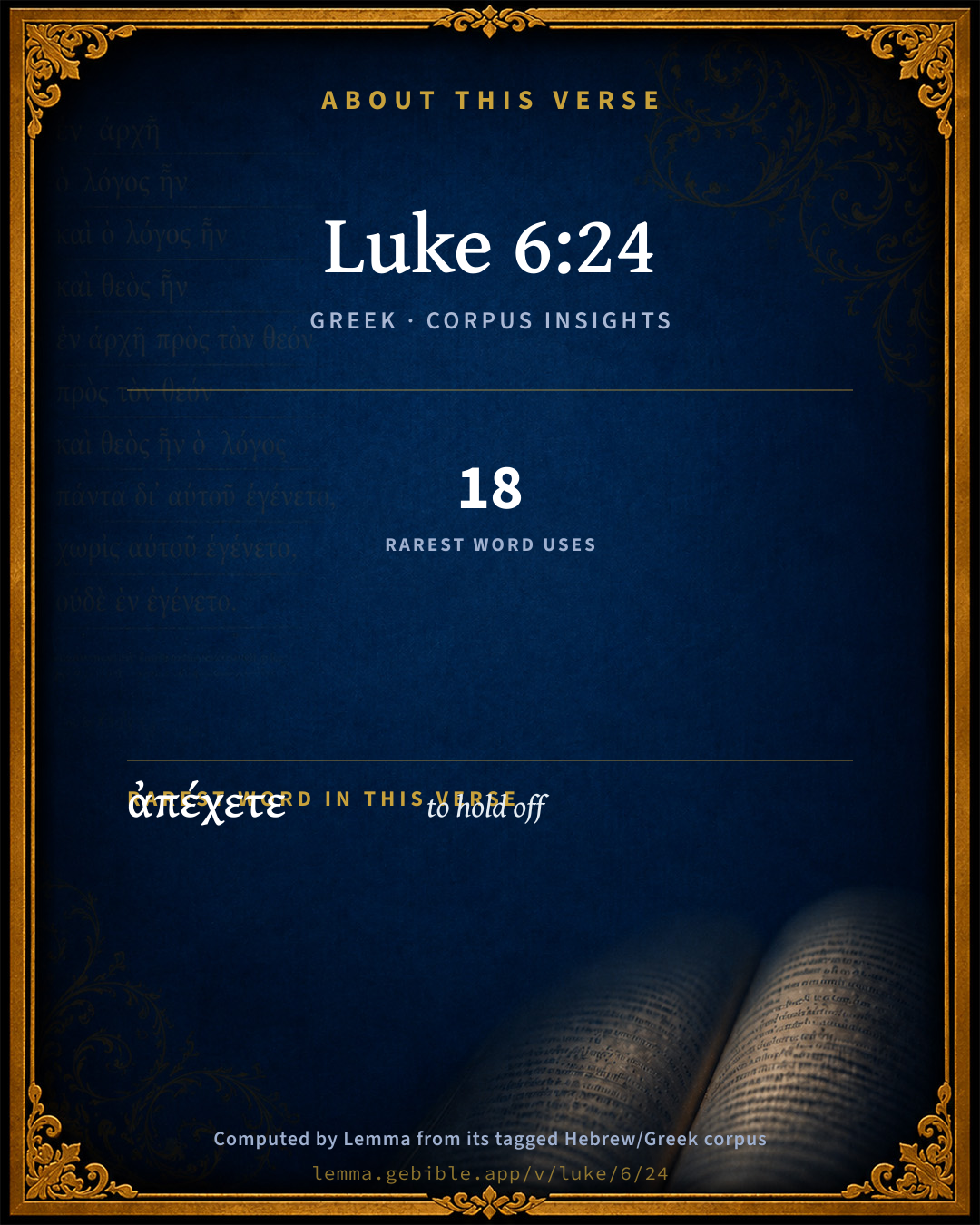
The rarest word here is ἀπέχετε to hold off G568 — appearing just 18 times in the whole Greek New Testament.

Shared distinctive vocabulary

ἀπέχετε to hold off G568 occurs in 18 verses of the Greek New Testament. Also found in:

Repetition

Words recur within this verse:

  • ὑμῖν you G5210 ×2
  • τοῖς the G3588 ×2

Cross-references

19

Topical passages linked to Luke 6:24 in the Treasury of Scripture Knowledge — connected by theme and wording, ordered by reader-vote popularity; previews shown in the World English Bible.

  • Matthew 6:2 Therefore when you do merciful deeds, don't sound a trumpet before yourself, as the hypocrites do in the synagogues and in the streets, that they may get glory from men. Most assuredly I tell you, they have received their reward.
  • Psalms 49:6–7 Those who trust in their wealth, And boast in the multitude of their riches--
  • 1 Timothy 6:17 Charge those who are rich in this present world that they not be haughty, nor have their hope set on the uncertainty of riches, but on the living God, who richly provides us with everything to enjoy;
  • James 5:1–6 Come now, you rich, weep and howl for your miseries that are coming on you.
  • Psalms 49:16–19 Don't be afraid when a man is made rich, When the glory of his house is increased.
  • Luke 18:23–25 But when he heard these things, he became very sad, for he was very rich.
  • James 2:6 But you have dishonored the poor man. Don't the rich oppress you, and personally drag you before the courts?
  • Proverbs 1:32 For the backsliding of the simple will kill them. The careless ease of fools will destroy them.
  • Amos 6:1–6 Woe to those who are at ease in Zion, And to those who are secure on the mountain of Samaria, The notable men of the chief of the nations, To whom the house of Israel come!
  • Job 21:7–15 "Why do the wicked live, Become old, yes, and grow mighty in power?
  • Psalms 73:3–12 For I was envious of the arrogant, When I saw the prosperity of the wicked.
  • Amos 4:1–3 Listen to this word, you cows of Bashan, who are on the mountain of Samaria, who oppress the poor, who crush the needy, who tell their lords, "Bring, and let us drink."
  • Matthew 6:5 "When you pray, you shall not be as the hypocrites, for they love to stand and pray in the synagogues and in the corners of the streets, that they may be seen by men. Most assuredly, I tell you, they have received their reward.
  • Matthew 6:16 "Moreover when you fast, don't be like the hypocrites, with sad faces. For they disfigure their faces, that they may be seen by men to be fasting. Most assuredly I tell you, they have received their reward.
  • Luke 12:15–21 He said to them, "Beware! Keep yourselves from covetousness, for a man's life doesn't consist of the abundance of the things which he possesses."
  • Luke 16:19–25 "Now there was a certain rich man, and he was clothed in purple and fine linen, living in luxury every day.
  • Jeremiah 5:4–6 Then I said, Surely these are poor; they are foolish; for they don't know the way of Yahweh, nor the law of their God:
  • Haggai 2:9 'The latter glory of this house will be greater than the former,' says Yahweh of Hosts; 'and in this place will I give peace,' says Yahweh of Hosts."
  • Revelation 18:6–8 Return to her just as she returned, and repay her double as she did, and according to her works. In the cup which she mixed, mix to her double.

Cross-references courtesy of OpenBible.info (CC BY 4.0).

Commentary

Notes on Luke 6:24 from classic Christian and Jewish commentators (each source and its license shown beneath its notes). The classic Christian expositions comment on the surrounding passage and are grouped to its opening verse, so a note may address several verses; the Jewish commentaries on the Tanakh (Rashi and others) are per-verse, so they appear only where the commentator wrote on this verse.

Lemma curates 59 commentaries, every one of them public domain or Creative Commons licensed, each selected and text-cleaned for this edition rather than reprinted as found. About our sources →

The Biblical Illustrator

Joseph S. Exell

Luk_6:24

But woe unto you that are rich! for ye have received your consolation

The danger of riches

Unless we were accustomed to read the New Testament from our childhood, I think we should be very much struck with the warnings it contains, not only against the love of riches, but the very possession of them.

That our Lord meant to speak of riches as being in some sense a calamity to the Christian is plain from His praises and recommendations of poverty.

1. The most obvious danger which worldly possessions present to our spiritual welfare is that they become practically a substitute in our hearts for that one object to which our supreme devotion is due. They are present; God is unseen. They are means at hand of effecting what we want; whether God will hear our petitions for these wants is uncertain. Thus they minister to the corrupt inclinations of our nature.

2. This, then, was some part of our Saviours meaning, when He connects together the having with the trusting in riches.

3. The danger of possessing riches is the carnal security to which they lead; that of desiring or pursuing them is that an object of this world is thus set before us as the end and aim of life. It is a part of Christian caution to see to it that our engagements do not become pursuits. Engagements are oar portion, but pursuits are for the most part of our own choosing.

4. Money is a sort of creation, and gives the acquirer, even more than the possessor, an imagination of his own power; and tends to make him idolize self. And if such be the result of gain on an individual, doubtless it will be the same on a nation; and if the peril be so great in the one case, why should it be less in the other? (J. H. Newman, D. D.)

The perils of rich men

1. One of the principal perils of rich men arises from their very exemption from many temptations to gross sin. Hence they are apt to think too well of themselves.

2. The rich man finds it very easy to do many kindly acts. It is very natural, therefore, that he should regard his own character and life complacently, and that he should think severely of the selfishness of these less fortunate than himself.

3. The rich mans Bible, with its morocco binding and gilt edges, has very much less in it than the poor mans Bible, bound in sheep. Pages which are read and re-read, which are marked, and scored, and thumbed in the one, are virtually mere blank paper in the other.

4. As the rich man loses many of the revelations of Gods sympathy, compassion, and care, which inspire the poor with intense and passionate gratitude, so he loses some of the most urgent motives to communion with God, which often make the poor man devout. (R. IV. Dale, LL. D.)

Danger of rich men

A holy woman was wont to say of the rich: They are hemmed round with no common misery; they go down to hell without thinking of it, because their staircase thither is of gold and porphyry. ( C. H. Spurgeon.)

Riches; or, a knife for the canker

To the love of money we trace the melancholy apostasy of Demas, the awful perfidity of Judas, the fatal lie of Ananias and Sapphira--all, and some of them distinguished, professors of religion. Be on your guard. Watch and pray. Their history is written for our instruction. Nor need any of His people who allow the love of money to entwine itself around their hearts, expect that in saving them God will do otherwise than the woodman, who, seeking to save a tree, applies his knife to the canker thai eats into its heart, or the ivy that has climbed its trunk and is choking it in its close embraces. (T. Guthrie, D. D.)

Smothered by wealth

Many of you are in imminent peril God is multiplying the sources of your power. Your resources are becoming numerous as the sands of the sea. I am not sorry, I am glad; but I am anxious that you should rise up in the midst of these things, and show yourselves greater than prosperity, and stronger and better on account of it. I dread to see a man smothered under his wealth. When a man, driving from the meadow, sits and sings cheerily upon his vast load of fragrant hay, how every one, looking upon him, thinks of his happiness and content l But by and by, at an unlucky jog, down goes the wheel and over goes the load, and the man is at the bottom, with all the hay upon him. Just in that way rich men are in danger of being smothered. The whole wain of your prosperity may capsize, and the superincumbent mass may hide from you the air and the sun of a true life. (H. W. Beecher.)

Ye have received your consolation

Let the full force of the word consolation be observed. It is used by way of contrast to the comfort which is promised to the Christian in the Beatitudes. Comfort, in the fulness of that word, as including help, guidance, encouragement, and support, is the peculiar promise of the gospel. There is then something very fearful in the intimation of the text, that those who have riches thereby receive their portion, such as it is, in full, instead of the heavenly gift of the gospel. The same doctrine is implied in our Lords words in the parable of Dives and Lazarus: Son, remember that thou in thy lifetime receivedst thy good things, and likewise Lazarus evil things; but now he is comforted, and thou art tormented. (J. H. Newman, D. D.)

Conjunction and separation of woe and riches

We will therefore show--

I. In what conjunction these two, woe and riches, do stand.

II. How they may be sundered: find out why riches are so dangerous to receive, and how we may receive them without any danger. And with these we shall exercise your devotion at this time. Woe to rich men; which cannot be literally and generally true: for all rich men are not accursed. But it is the safest way to remove men as far from danger as may be. It is safest for some men to conceive feasting unlawful, that they may avoid gluttony; or sports unlawful, that they may not be wantons; to be afraid of an oath, that they may not be perjured; not to flatter themselves too much in the lawfulness of war, that they delight not in blood, but rather remember the lesson of Moses, or indeed of God: When thou goest out with the host against thine enemies, then keep thee from all wickedness (Deu_23:9).

1. But so far is the world from having that opinion of riches, that they have goodly and glorious titles bestowed upon them. They commend themselves unto us under the honest names of thrift, and frugality, and wisdom. What poor glass is a diamond, to him that is familiar with virtue! What trash is riches, to him who is filled with grace! What nicknames are the empty titles of secular honours, to him that knoweth the glory of a saint l What a nothing is the world, to him that hath studied heaven!

2. Further yet: Riches are accounted as necessaries, and as ornaments of virtue; and under that name we receive and entertain them.

3. Again: Riches are not only not necessary to religion and virtue, but rather a hindrance. They take us down from our third heaven, and take us off from the contemplation of future happiness, and bind our thoughts to the vanities of the earth, which so press them down and weary them that they cannot aspire. They are retinacula spei, fetters of our hope. For now where is our hope? (Job_17:15.) Even in the bowels of the earth.They are degraders of our faith. For whilst we walk in this vain shadow, how many degrees doth our faith fall back! The more we trust in uncertain riches the less we trust in God (1Ti_6:17). They are coolers and abaters of our charity: for, they make us ungrateful to God, severe to ourselves, and cruel to our brethren.

4. Further yet: As riches are a hindrance and obstacle to good, so are they instrumental to evil. They facilitate and help it forward, and are as the midwife to bring it to its birth, which otherwise peradventure had died in the womb, in the thought, and never seen the sun. If sin make our members the weapons of unrighteousness, riches are the handle without which they cannot well be managed. Every man cannot grind the face of the poor, every man cannot take his brother by the throat, every man cannot go into the foolish womans house, every man cannot bribe a judge, every man cannot be as wicked as he would. And it may seem to be a part of Gods restraining grace, to take riches from some men, as he took off the wheels of Pharaohs chariots, that they may not pursue their brethren. But when the purse is full, the heart will more easily vent all the poison it hath, in a reproach, in contempt, in a blow, in an injury, in oppression.

II. You have seen the rich and woe in a sad conjunction, a most malignant one as any astrology hath discovered. I am unwilling to leave them so; and therefore, in the last place, I must find out some means to put them asunder, that we may receive riches without danger; which is indeed to lead the camel through the needles eye.

1. We must bring riches into a subordination, nay, into a subjection, to Christianity. We may be rich, if we can be poor.

2. That the mind may be rightly affected, we must root out of it all love of riches. For if we set our hearts upon them, the love of them will estrange us from Christ, and make us idolaters.

3. I must bring you yet further, from not loving, not desiring riches, to contemning of them. For though I have emptied my store, and cast it before the wind, yet till I have made riches the object of my fear, till I can say within myself, This lordship may undo me, These riches may beggar me, This money may destroy me--till in this respect I make it the object of my contempt, and look upon it as a bait of Satan, I am not so far removed but that still the woe hangeth over me. For as, when a man taketh a wedge of lead upon his shoulders, it presseth and boweth his body to the earth; but if he put it under his feet, it will lift and keep him from the ground: so, when we place riches above us, and look upon them as upon our heaven; when we prefer them before salvation, and make gain our godliness; it must needs be that they will press us down to hell: but if we keep them below as slaves, and tread them under our feet, and contemn them as dung in comparison of Christ, they will then lift us up as high as heaven.

4. Therefore, in the last place, let me commend unto you a godly jealousy of yourselves. Suspicion in such a case as this is very useful.

5. I am unwilling to leave the rich and the woe so near together, but would set them at that distance that they may never meet. To conclude then: Let us not be too familiar with riches, lest whilst we embrace them we take the plague, and the woe enter into our very bowels. The love of the world is a catching disease, and it is drawn on with dallying, with a very look. We do not traffic for gold where there are no mines: nor can we find God in the world. He that maketh Him his purchase, will find business enough to take up his thoughts, and little time left for conference and commerce in the world, scarce any time to look upon it, but by the by and in the passage, as we use to look upon a stranger. A look is dangerous; a look of liking is too much: but a look Of love will bury us in the world, where we are sown in power, but are raised in weakness; sown in glory, but are raised in dishonour. We rest and sleep in this dust; and when we awake, the woe which hung over our heads falleth upon us. (A. Farindon, D. D.)

The Biblical Illustrator, edited by Joseph S. Exell (c. 1880s–1900s) — public domain. Text from a community e-Sword module.

Joseph Benson's Commentary

Luk 6:24-25. But wo, &c. — Here we see that this discourse differs very materially from the sermon on the mount; there our Lord pronounced blessings only, here he denounces curses; or, to speak more properly, he compassionately bewails the condition of persons of a contrary character to that of those pronounced happy in the preceding verses. For, as Grotius justly observes, the expression, ουαι υμιν, wo unto you, “vox est dolentis, non irâ incensi,” is the expression of one lamenting, [or bewailing the unhappy condition of another,] not of one inflamed with anger. It is like that used by our Lord, Mat 24:19, wo to them that are with child, &c., in those days; an expression which no one can understand otherwise than as a declaration of the unhappiness of women in these circumstances, at such a time of general calamity as is referred to. The parallel passage in Luk 23:29 where we have the same prophecy, makes this evident. As our Lord, therefore, in the former sentences, pronounces the poor, the needy, the mournful, and the persecuted happy, so he here pronounces the rich, the jovial, and the applauded, miserable; the circumstances in which such are placed being peculiarly insnaring, and the danger being great lest they should be so taken up with the transient pleasures of time, as to forget and forfeit everlasting happiness. His words may be thus paraphrased: Miserable are ye rich — If ye have received or sought your consolation or happiness in your riches. Miserable are you that are full — Of meat and drink, and worldly goods, and take up with these things as your portion; for you shall ere long hunger — Shall fall into a state of great indigence and misery, aggravated by all the plenty which you enjoyed and abused. Miserable are you that laugh — That spend your lives in mirth and gayety, or are of a light, trifling spirit; for you shall mourn and weep — You have reason to expect a portion in those doleful regions, where, without intermission and without end, you shall be abandoned to weeping, and wailing, and gnashing of teeth. “Our Lord’s malediction,” [declaration,] says a modern author, “is not inconsistent with the apostle’s precepts, which command Christians always to rejoice. Neither is the mirth against which the wo is here denounced to be understood of that constant cheerfulness of temper, which arises to true Christians from the comfortable and cheerful doctrines with which they are enlightened by the gospel, the assurance they have of reconciliation with God, the hope they have of everlasting life and the pleasure they enjoy in the practice of piety and the other duties of religion. But it is to be understood of that turbulent, carnal mirth, that levity and vanity of spirit, which arises, not from any solid foundation, but from sensual pleasure, or those vain amusements of life by which the giddy and the gay contrive to make away their time; that sort of mirth which dissipates thought, leaves no time for consideration, and gives them an utter aversion to all serious reflections.” Persons who continue to indulge themselves in this sort of mirth through life, shall weep and mourn eternally, when they are excluded from the joys of heaven, and banished for ever from the presence of God, by the light of whose countenance all the blessed are enlightened, and made transcendently happy.

Joseph Benson's Commentary on the Old and New Testaments (1811–1818) — public domain. Text from a community e-Sword module.

Tyndale Open Study Notes

Tyndale Open Resources

6:24-26 Promises of blessing for the poor and oppressed are balanced in Luke with predictions of sorrow for the rich and powerful. Those who trust in themselves will be humbled, while those who depend on God will be blessed. The Old Testament prophets often pronounced woes against nations and rulers who oppressed God’s people and rejected his sovereignty (e.g., Isa 3:11; 5:8; Jer 50:27; Zech 11:17).

Tyndale Open Study Notes — © Tyndale Open Resources, licensed CC BY-SA 4.0. Text via the HelloAO Bible API.

Bengel's Gnomon

Johann Albrecht Bengel

Luk 6:24. [Οὐαὶ ὑμῖν, woe is [not be] unto you) This is a denunciation, not an imprecation.—V. g.]—παράκλησιν, consolation) Psa 49:7; Psa 49:19; Psa 17:14.

Bengel's Gnomon of the New Testament — English translation (T&T Clark, Edinburgh, 1860) — public domain. Text from a community e-Sword module.

Meyer's Critical & Exegetical Commentary

Heinrich August Wilhelm Meyer

Luk_6:24-25. The woes of the later tradition closely corresponding to the beatitudes. Comp. on Luk_6:20.

πλήν] on the other hand, verumtamen, so that ἀλλά also might be used as at Luk_6:35; Luk_11:41, and elsewhere. See Klotz, ad Devar. p. 725.

ὑμῖν] Conceive Jesus here extending His glance beyond the disciples (Luk_6:20) to a wider circle.

ἀπέχετε] see on Mat_6:2.

τὴν παράκλ. ὑμῶν] Instead of receiving the consolation which you would receive by possession of the Messiahs kingdom (comp. Luk_2:25), if you belonged to the πτωχοί, you have by anticipation what is accounted to you instead of that consolation! Comp. the history of the rich man, ch. 16. Here the Messianic retributive punishment is described negatively, and by πεινάσετε, πενθ. κ. κλαύσ., positively.

ἐμπεπλησμένοι] ye now are filled up, satisfied, Herod. i. 112. Comp. on Col_2:23. For the contrast, Luk_1:53. On the nominative, Buttmann, Neut. Gr. p. 123 [E. T. 141].

Meyer — Critical and Exegetical Commentary on the New Testament — English translation by Peter Christie, edited by Frederick Crombie (T&T Clark, 1880) — public domain. Text from a community e-Sword module.

Expositor's Greek Testament

ed. W. Robertson Nicoll

Luk 6:24-26 . πλὴν , but, used here adversatively, a favourite word with Lk., suggesting therefore the hypothesis that he is responsible for the “woes” following, peculiar to his version of the sermon. ἀπέχετε , ye have in full; riches and nothing besides your reward ( cf. Mat 6:2 ).

The Expositor's Greek Testament, edited by W. Robertson Nicoll (1897–1910) — public domain. Text from a community e-Sword module.

Vincent's Word Studies in the New Testament

Marvin R. Vincent

Woe. These woes are not noted by Matthew.

Have received [απεχετε] . In Mt 6:5, 16, the Rev. has properly changed "they have their reward" to "they have received." The verb, compounded of ajpo, off or from, and ecw, to have, literally means to have nothing left to desire. Thus in Phi 4:18, when Paul says, "I have all things [απεχω παντα] ," he does not mean merely an acknowledgment of the receipt of the Church 's gift, but that he is fully furnished. "I have all things to the full."

Consolation [παρακλησις] . From para, to the side of, and kalew, to call or summon. Literally, a calling to one's side to help; and therefore entreaty, passing on into the sense of exhortation, and thence into that of consolatory exhortation; and so coming round to mean that which one is summoned to give to a suppliant - consolation. Thus it embodies the call for help, and the response to the call. Its use corresponds with that of the kindred verb parakalew, to exhort or console. In its original sense of calling for aid the noun appears in the New Testament only in 2Co 8:4 : with much entreaty. The verb appears frequently in this sense, rendered beseech, pray (Mt 8:34; Mt 14:36; Mr 1:40; Mr 5:12, etc.). In the sense of consolation or comfort the noun occurs, in Luk 2:25; Luk 6:24; 2Co 1:3; 2Co 7:4; Phl 1:7. The verb, in Mt 2:18; Mt 5:4; Luk 16:25; 2Co 1:4. In some instances, however, the meaning wavers between console and exhort. In the sense of exhortation or counsel, the noun may be found in Act 2:40; Act 11:23; Act 14:22; Rom 12:8; Tit 2:15. Neither the noun nor the verb appear in the writings of John, but the kindred word paraklhtov, the Paraclete, Comforter, or Advocate, is peculiar to him. On this word, see on Joh 14:16. It should be noted, however, that the word comfort goes deeper than its popular conception of soothing. It is from the later Latin confortare, to make strong. Thus Wycliffe renders Luk 1:80, "the child waxed, and was comforted in spirit" (A. V., waxed strong); and Tyndale, Luk 22:43, "there appeared an angel from heaven comforting him" (A. V., strengthening). The comfort which Christ gives is not always soothing. The Holy Spirit, the Comforter, is to convince of sin and of judgment. Underlying the word is the sense of a wise counsel or admonition which rouses and braces the moral nature and encourages and strengthens it to do and to endure. When, therefore, Christ says "they that mourn shall be comforted," he speaks in recognition of the fact that all sorrow is the outcome of sin, and that true comfort is given, not only in pardon for the past, but in strength to fight and resist and overcome sin. The atmosphere of the word, in short, is not the atmosphere of the sick chamber, but the tonic breath of the open world, of moral struggle and victory; the atmosphere for him that climbs and toils and fights.

Marvin R. Vincent, Word Studies in the New Testament (1887–1900) — public domain. Text from a community e-Sword/MySword module.

Godet's Commentaries

Frédéric Louis Godet

Vers. 24-26.—“But woe unto you that are rich! for ye have received your consolation. 25. Woe unto you that are full! for ye shall hunger. Woe unto you that laugh now! for ye shall mourn and weep. 26. Woe unto you when all men shall speak well of you! for so did their fathers to the false prophets.”

Jesus here contemplates in spirit those adversaries who were sharpening against Him only just before (Luk 6:11) the sword of persecution: the rich and powerful at Jerusalem, whose emissaries surrounded Him in Galilee. Perhaps at this very moment He perceives some of their spies in the outer ranks of the congregation. Certainly it is not the rich, as such, that He curses, any more than He pronounced the poor as such blessed. A Nicodemus or a Joseph of Arimathea will be welcomed with open arms as readily as the poorest man in Israel. Jesus is dealing here with historical fact, not with moral philosophy. He takes the fact as it presented itself to Him at that time. Were not the rich and powerful, as a class, already in open opposition to His mission? They were thus excluding themselves from the kingdom of God. The fall of Jerusalem fulfilled only too literally the maledictions to which Jesus gave utterance on that solemn day.

The πλήν, except, only, which we can only render by but (Luk 6:24), makes the persons here designated an exception as regards the preceding beatitudes.

The term rich refers to social position, full to mode of living; the expression, you that laugh, describes a personal disposition. All these outward conditions are considered as associated with an avaricious spirit, with injustice, proud self-satisfaction, and a profane levity, which did indeed attach to them at that time. It was to the Pharisees and Sadducees more particularly that these threatenings were addressed.

The word νῦν, now, which several MSS. read in the first proposition, is a faulty imitation of the second, where it is found in all the documents. It is in place in the latter; for the notion of laughing contains something more transient than that of being full.

The expression ἀπέχετε, which we have rendered by ye have received, signifies: you have taken and carried away everything; all therefore is exhausted. Comp. Luk 16:25.

The terms hunger, weeping, were literally realized in the great national catastrophe which followed soon after this malediction; but they also contain an allusion to the privations and sufferings which await, after death, those who have found their happiness in this world.

In Luk 6:26 it is more particularly the Pharisees and scribes, who were so generally honoured in Israel, that Jesus points out as continuing the work of the false prophets. These four woes would be incompatible with the spiritual sense of the terms poor, hungry, etc., in the beatitudes.

The second part of the discourse: Luk 6:27-45. The New Law.

Here we have the body of the discourse. Jesus proclaims the supreme law of the new society. The difference from Matthew comes out in a yet more striking manner in this part than in the preceding. In the first Gospel, the principal idea is the opposition between legal righteousness and the new righteousness which Jesus came to establish. He Himself announces the text of the discourse in this saying (Luk 6:20): “Except your righteousness exceed the righteousness of the scribes and Pharisees, ye shall in no case enter into the kingdom of heaven.” The law, in the greater number of its statutes, seemed at first sight only to require outward observance. But it was evident to every true heart, that by these commandments the God of holiness desired to lead His worshippers, not to hypocritical formalism, but to spiritual obedience. The tenth commandment made this very clear, as far as respected the decalogue. Israelitish teaching should have laboured to explain the law in this truly moral sense, and to have carried the people up from the letter to the spirit, as the prophets had endeavoured to do. Instead of that, Pharisaism had taken pleasure in multiplying indefinitely legal observances, and in regulating them with the minutest exactness, urging the letter of the precept to such a degree as sometimes even to make it contradict its spirit. It had stifled morality under legalism. Comp. Mat 15:1-20; Mat 15:23. In dealing with this crying abuse, Jesus breaks into the heart of the letter with a bold hand, in order to set free its spirit, and displaying this in all its beauty, casts aside at once the letter, which was only its imperfect envelope, and that Pharisaical righteousness, which rested on nothing else than an indefinite amplification of the letter. Thus Jesus finds the secret of the abolition of the law in its very fulfilment. Paul understood and developed this better than anybody. What in fact, is the legislator’s intention in imposing the letter? Not the letter, but the spirit. The letter, like the thick calyx under the protection of which the flower, with its delicate organs, is formed, was only a means of preserving and developing its inward meaning of goodness, until the time came when it could bloom freely. This time had come. Jesus on the mountain proclaims it. And this is why this day is the counterpart of the day of Sinai. He opposes the letter of the divine commandment, understood as letter, to the spirit contained in it, and developes this contrast, Matthew 5, in a series of antitheses so striking, that it is impossible to doubt either their authenticity, or that they formed the real substance, the centre of the Sermon on the Mount. Holtzmann will never succeed in persuading any one to the contrary; his entire critical hypothesis as to the relations of the Syn. will crumble away sooner than this conviction. The connection of the discourse in Matthew is this: 1. Jesus discloses wherein the Pharisaical righteousness fails, its want of inward truth (Luk 6:13-48). 2. He judges, by this law, the three positive manifestations of this boasted righteousness: almsgiving, prayer, and fasting (Luk 6:1-18). 3. He attacks two of the most characteristic sins of Pharisaism: covetousness and censoriousness (Luk 6:19-34, Luk 7:1-5). 4. Lastly there come various particular precepts on prayer, conversion, false religious teaching, etc. (Luk 7:6-20). But between these precepts it is no longer possible to establish a perfectly natural connection. Such is the body of the Sermon in Matthew: at the commencement, an unbroken chain of thought; then a connection which becomes slighter and slighter, until it ceases altogether, and the discourse becomes a simple collection of detached sayings. But the fundamental idea is still the opposition between the formalism of the ancient righteousness and the spirituality of the new.

In Luke also, the subject of the discourse is the perfect law of the new order of things; but this law is exhibited, not under its abstract and polemical relation of spirituality, but under its concrete and positive form of charity. The plan of this part of the discourse, in Luke, is as follows: 1 st. Jesus describes the practical manifestations of the new principle (Luk 6:27-30); then, 2 d. He gives concise expression to it (Luk 6:31); 3 d. He indicates the distinctive characteristics of charity, by contrasting this virtue with certain natural analogous sentiments (Luk 6:32-35 a); 4 th. He sets forth its model and source (Luk 6:35 b and 36); 5 th. Lastly, He exhibits this gratuitous, disinterested love as the principle of all sound judgment and salutary religious teaching, contrasting in this respect the new ministry, which He is establishing in the earth in the presence of His disciples, with the old, which, as embodied in the Pharisees, is vanishing away (Luk 6:37-45).

At the first glance, there seems little or nothing in common between this body of the discourse, and that which, as we have just seen, Matthew gives us. We can even understand, to a certain extent, the odd notion of Schleiermacher, that these two versions emanated from two hearers, of whom one was more favourably situated for hearing than the other! The difference, however, between these two versions may be accounted for by connecting the fully-developed subject in Luke with the subject of the last two of the six antitheses, by which Jesus describes (Matthew 5) the contrast between legal righteousness and true righteousness. Jesus attacks, Luk 6:38-48, the Pharisaical commentary on these two precepts of the law: an eye for an eye...; and, thou shalt love thy neighbour as thyself. This commentary, by applying the lex talionis, which had only been given as a rule for the judges of Israel, to private life, and by deducing from the word neighbour this consequence: therefore thou mayest hate him who is not thy neighbour, that is to say, the foreigner, or thine enemy, had entirely falsified the meaning of the law on these two points. In opposition to these caricatures, Jesus sets forth, in Matthew, the inexhaustible and perfect grace of charity, as exhibited to man in the example of his heavenly Benefactor; then He proceeds to identify this charity in man with the divine perfection itself: “Be ye perfect [through charity], as your Father which is in heaven is perfect.” Now it is just at this point that Luke begins to appropriate the central part of the discourse. These last two antitheses, which terminate in Matthew in the lofty thought (Luk 6:48) of man being elevated by love to the perfection of God, furnish Luke with the leading idea of the discourse as he presents it, namely, charity as the law of the new life. Its theme is in this way modified in form, but it is not altered in substance. For if, as St. Paul says, Rom 13:10, “charity is the fulfilling of the law;” if perfect spirituality, complete likeness to God, consists in charity; the fundamental agreement between these two forms of the Sermon on the Mount is evident. Only Luke has deemed it advisable to omit all that specially referred to the ancient law and the comments of the Pharisees, and to preserve only that which has a universal human bearing, the opposition between charity and the natural selfishness of the human heart.

The two accounts being thus related, it follows, that as regards the original structure of the discourse, in so far as this was determined by opposition to Pharisaism, Matthew has preserved it more completely than Luke. But though this is so, Matthew’s discourse still contains many details not originally belonging to it, which Luke has very properly assigned to entirely different places in other parts of his narrative. We find here once more the two writers following their respective bent: Matthew, having a didactic aim, exhibits in a general manner the teaching of Jesus on the righteousness of the kingdom, by including in this outline many sayings spoken on other occasions, but bearing on the same subject; Luke, writing as a historian, confines himself more strictly to the actual words which Jesus uttered at this time. Thus each of them has his own kind of superiority over the other.

1 st. The manifestations of charity: Luk 6:27-30. — To describe the manifestations of this new principle, which is henceforth to sway the world, was the most popular and effectual way of introducing it into the consciences of his hearers. Jesus describes, first of all, charity in its active form (Luk 6:27-28) then in its passive form of endurance (Luk 6:29-30).

Frédéric Louis Godet — Commentaries on Luke, John, Romans, and 1 Corinthians — English translation (T&T Clark, Edinburgh, 1870s–1890s) — public domain. Text from a community e-Sword module.

Geneva Bible (1599)

Geneva Bible translators

That is, you reap now of your riches, all the commodities and blessings you are ever likely to have, and therefore, you have not to look for any other reward, Matt. 6:2.

Geneva Bible (1599) marginal notes — public domain. Text via Bolls.life.

Jamieson, Fausset & Brown

Robert Jamieson, A. R. Fausset & David Brown

rich . . . full . . . laugh--who have all their good things and joyous feelings here and now, in perishable objects.

received your consolation--(see on Luk 16:25).

shall hunger--their inward craving strong as ever, but the materials of satisfaction forever gone.

Jamieson, Fausset & Brown — Commentary Critical and Explanatory on the Whole Bible (1871) — public domain (CC PDM 1.0). Text via the HelloAO Bible API.

Adam Clarke's Commentary

Verse 24. - 26. But wo unto you that are rich!] The Pharisees, who were laden with the spoils of the people which they received in gifts, c. These three verses are not found in the sermon, as recorded by Matthew. They seem to be spoken chiefly to the scribes and Pharisees, who, in order to be pleasing to all, spoke to every one what he liked best and by finesse, flattery, and lies, found out the method of gaining and keeping the good opinion of the multitude.

Adam Clarke's Commentary on the Bible (1810–1826) — public domain. Text from a community e-Sword/MySword module.

Ellicott's Commentary for English Readers

(24) But woe unto you that are rich!—Better, woe for you, the tone being, as sometimes (though, as Matthew 23 shows, not uniformly) with this expression, one of pity rather than denunciation. (Comp. Mat_23:13; Mar_13:17; Luk_21:23.) We enter here on what is a distinct feature of the Sermon on the Plain—the woes that, as it were, balance the beatitudes. It obviously lay in St. Luke’s purpose, as a physician of the soul, to treasure up and record all our Lord’s warnings against the perilous temptations that wealth brings with it. The truth thus stated in its naked awfulness is reproduced afterwards in the parable of the Rich Man and Lazarus (Luk_16:19).

Ye have received your consolation.—Better, simply, ye have your consolation—i.e., all that you understand or care for, all, therefore, that you can have. The thought appears again in the words of Abraham, “Thou in thy lifetime receivedst thy good things” (Luk_16:25). The verb is the same as in “they have their reward,” in Mat_6:2; Mat_6:5.

A Bible Commentary for English Readers, edited by Charles John Ellicott (1878–1897) — public domain. Text from a community e-Sword module.

The Cambridge Bible for Schools and Colleges

gen. ed. J. J. S. Perowne

24. But woe] While sin lasts, there must still be woes over against Beatitudes, as Ebal stands for ever opposite to Gerizim. In St Matthew also we find (Matthew 23) eight woes as well as eight Beatitudes. See too Jer_17:5-8, but there the “cursed” precedes the “blessed.”

woe unto you that are rich] The ‘woe !’ is not necessarily or wholly denunciatory; it is also the cry of compassion, and of course it only applies—not to a Chuzas or a Nicodemus or a Joseph of Arimathaea,—but to those rich who are not poor in spirit, but trust in riches (Mar_10:24), or are not rich towards God (Luk_12:21) and have not got the true riches (Luk_16:11; Amo_6:1; Jas_5:1). Observe the many parallels between the Epistle of St James and the Sermon on the Mount, Jas_1:2; Jas_1:4-5; Jas_1:9; Jas_1:20; Jas_2:13-14; Jas_2:17-18; Jas_4:4; Jas_4:10-11; Jas_5:2; Jas_5:10; Jas_5:12.

ye have received your consolation] Rather, ye have to the full, Php_4:18; comp. Luk_16:25, “Son, remember that thou in thy lifetime receivedst good things.”

The Cambridge Bible for Schools and Colleges (gen. ed. J. J. S. Perowne; Cambridge University Press, 1878–1918) — public domain. Text from a community e-Sword module.

John Gill's Exposition

Woe unto you that are full,.... Not so much with the plenty and affluence of the things of this life, as of themselves, and their own righteousness, and so with conceit, vanity, and pride, and have no appetite for spiritual things, nor do they hunger and thirst after Christ, and the grace that is in him:

for ye shall hunger; not that they shall truly and spiritually desire an interest in Christ, and his righteousness, or heaven and eternal life hereafter; but they shall be in starving and famishing circumstances; and whilst the saints are feeding upon the joys and glories of the other world, compared to a banquet, they shall be without, and have no share in these things; Isa 65:13.

Woe unto you that laugh now; at sin, rejoice in iniquity, make a mock at it, instead of mourning for it; or that glory in themselves, and in their righteousness, and rejoice in their boastings:

for ye shall mourn and weep; shall be cast into outer darkness, where are weeping, waiting, and gnashing of teeth; and for all the fire they have kindled, and sparks they have encompassed themselves with, and danced in and about, this they shall have at the hand of God, they shall lie down in sorrow, and ever continue in it.

John Gill's Exposition of the Whole Bible (1746–1763) — public domain (CC PDM 1.0). Text via the HelloAO Bible API.

Trapp's Complete Commentary

John Trapp

24 But woe unto you that are rich! for ye have received your consolation.

Ver. 24. But woe unto you that are rich] sc. In this world only, and not to Godward. {See Trapp on "Jas 5:1"} {See Trapp on "Jas 5:3"} {See Trapp on "Jas 5:3"} Every grain of riches hath a vermin of pride and ambition in it.

John Trapp, A Commentary or Exposition upon All the Books of the Old and New Testament (1647–1656) — public domain. Text from a community e-Sword module.

Haydock's Catholic Bible Commentary

Jesus Christ having declared how meritorious poverty of spirit was to eternal life, proceeds to denounce heavy chastisements upon the rich and proud. (St. Cyril in St. Thomas Aquinas) --- Although in great riches there are great inducements to sin, yet there are not wanting even in that state great incitements to virtue; neither is this woe aimed against those who abound in affluence; but against "those who abuse that affluence which Providence has bestowed upon them: Non enim census, sed affectus, in crimine est." (St. Ambrose)

George Leo Haydock (1774–1849), Haydock's Catholic Family Bible and Commentary, 1859 edition — public domain. Excludes Psalms (Douay-Rheims chapter numbering differs from Protestant) and Deuterocanonical books (Catholic canon only).

Matthew Poole's English Annotations

Not because you are rich, but because you are not rich towards God, because you look upon your riches as your portion, as your consolation; or, you that are rich in the opinion of your own righteousness.

Matthew Poole's English Annotations on the Holy Bible (1683–1685) — public domain. Text from a community e-Sword/MySword module.

Whedon's Commentary on the Bible

Daniel D. Whedon

24-26. We have no hesitation still to assume, as in the notes of the parallel passage in Matthew, that our Saviour pronounced for each Blessed an antithetical Woe, which Matthew wholly omits and Luke but partially supplies. And if these are two reports of the same discourse, then what we have noted in Matthew holds good, namely, that the limitation of the objects and sphere of both benedictions and woes are within the compass of religious things, it of course follows that the riches, the laughter, the fulness condemned by the woes, are things adverse in spirit to right and holiness. It is not riches or laughter in themselves, but the wantonness of spirit, the revelry of heart, in the spirit of a wicked and riotous age, against which our Lord threatens a future destitution and mourning.

The contrast between these blessings and woes coincides with the great antithesis between right and wrong, between religion and irreligion, between holiness and wickedness, between the kingdom of God and the kingdom of Satan, which must ever appear to the pure eye in the entire history, temporal and eternal, of God and man.

The term woe is indeed softer than the term cursed, pronounced by Jesus, as judge, in the sentence of the final day, in Mat_25:41. This word woe blends compassion with judgment; for it is pronounced in the day of grace and mercy; yet it indicates a destiny as terrible and as irrevocable, though uttered in a tone of genuine pathos, as that final Depart ye cursed. From that unmitigated finality, though pronounced by the same lips, all pathos has departed; for the era of judgment without mercy has arrived.

Daniel D. Whedon (gen. ed.), Commentary on the Old and New Testaments (1874–1909) — public domain. Text from a community e-Sword module.

The Pulpit Commentary

But woe unto you that are rich! for ye have received your consolation. These "rich" referred to here signify men of good social position. These, as a class, opposed Jesus with a bitter and unreasoning opposition. Again the same warning cry to the so-called fortunate ones of this world is re-echoed with greater force in the parable of the rich man and Lazarus. "Thou in thy lifetime," said Abraham, speaking from Paradise to the poor lost Dives, "receivedst thy good things;" and yet the very characters represented in that most awful of the parable-stories of the pitiful Lord correct any false notion which, from words like these, men may entertain respecting the condemnation of the rich and great because they are rich and great. Abraham, who speaks the grave stern words, was himself a sheik of great power and consideration, and at the same time very rich. Prophets and apostles, as well as the Son of God, never ceased to warn men of the danger of misusing wealth and power; but at the same time they always represented these dangerous gifts as gifts from God, capable of a noble use, and, if nobly used, these teachers sent by God pointed out, these gifts would bring to the men who so used them a proportional reward.

The Pulpit Commentary (1880–1919), ed. H.D.M. Spence-Jones & Joseph S. Exell — public domain. Text from a community e-Sword module.

John Wesley's Explanatory Notes

Miserable are ye rich - If ye have received or sought your consolation or happiness therein.

John Wesley, Explanatory Notes Upon the Whole Bible (1754–1765) — public domain. Text via the GEBible commentary corpus.

Kretzmann's Popular Commentary

Paul E. Kretzmann

A threefold woe:

v. 24. But woe unto you that are rich! for ye have received your consolation.

v. 25. Woe unto you that are full! for ye shall hunger. Woe unto you that laugh now! for ye shall mourn and weep.

v. 26. Woe unto you when all men shall speak well of you! for so did their fathers to the false prophets.

Woe unto you rich people! for you have your solace in advance. This is spoken, as often in Scripture, Mar 10:23; 1Ti 6:9, of those that place their trust in their money. The Christian that is rich does not think of putting his faith in mammon. He knows that he is not in reality the owner of the goods entered under his name, but the steward of God, with the greater responsibilities, the greater the amount of riches which men call his. And he must give an account on the last day. Those people, therefore, that consider their wealth their own to do with as they please, and who use it with this idea in mind, to receive their good things in the present lifetime, Luk 16:25, have the only solace that they will ever get, Job 31:24. They may seem satisfied and try to persuade themselves and others that they are happy; but what about the world to come? Woe unto you that are filled up; for ye shall hunger. Those that seek the satisfaction of all their desires in this life and are rewarded in such a way that they get all that they have longed for, have their ambition realized. But they will have to suffer hunger throughout eternity. Woe unto you that laugh now; for ye shall mourn and weep. Those that have the motto: Let us eat, drink, and be merry, for tomorrow we shall be dead, and live in accordance with it, may assume a boisterous happiness in the enjoyment of the pleasures of this world. But the time is coming when they must render account of every moment foolishly spent in the lust of the flesh, in the lust of the eyes, in the pride of life. Then there will be weeping and gnashing of teeth. The last woe is one directed especially to the apostles. If every one speaks well of them, praises them, the chances are that they have omitted some part of their duty, that pertaining to the fearless denunciation of sin. That has ever been a special feature of the false prophet’s work that they preach to the itching ears of the people, 2Ti 4:3; Eze 13:18-20; Isa 56:10. That is no recommendation, but the strongest censure that could be spoken upon a pastor’s work, that he hurts no one, and that no one hurts him.

Paul E. Kretzmann, Popular Commentary of the Bible (1921–1924) — public domain. Text from a community e-Sword module.

Burkitt's Expository Notes on the New Testament

William Burkitt

Observe here, 1. That though St. Luke omits divers of the beatitudes mentioned by St. Matthew, chap. 5, yet he recites the woes which St. Matthew omitted. If we will understand our Saviour’s doctrine fully, we must consult all the evangelists thoroughly.

Observe, 2. These woes are not to be understood absolutely, but restrainedly: the woes do not belong to men because they are rich, because they are full, because they do laugh; but because they place their happiness in these things; take up with them for their portions, and rejoice in them as their chief good, valuing themselves by what they have in hand, not by what they have in hope.

He that is rich and righteous, he that is great and gracious, he that has his hands full of this world, and his heart empty of pride and vain confidence; he that laughs when God smiles, he that expresses himself joyfully when God expresses himself graciously, such a man is rich in grace, who is thus gracious in the midst of riches. For to be rich and holy, argues much riches of holiness.

William Burkitt's Expository Notes on the New Testament (1700–1703) — public domain. Text from a community e-Sword module.

The People's New Testament

B. W. Johnson

24–26. Woe unto you that are rich! Matthew omits these woes. Woe unto all whose heart is set upon their riches and who take their delight and consolation in them. The woe rests upon all who are engaged in the greedy chase after wealth, or make it their great good. See Mark 10:24 and 1 Tim. 6:9, 10, 17.

Woe unto ye that are full now! Because, satisfied, they do not hunger after righteousness (Matt. 5:6). Such shall hunger when stripped of all that is earthly. Woe unto you, ye that laugh now! Give themselves to merriment, seeking fun and enjoyment instead of preparation.

When all men shall speak well of you! Those who seek to be universally popular. Whoever does his duty will meet those who oppose him. Christ was reviled and slandered. These four woes are addressed to four classes: (1) Those who worship wealth; (2) those satisfied with their present life; (3) those who live for present enjoyment; (4) those whose aim is human praise and adulation.

B. W. Johnson's The People's New Testament with Notes (1889–1891) — public domain. Electronic text from the Christian Classics Ethereal Library (CCEL) ThML edition.

unfoldingWord translationNotes

Door43 World Missions Community

woe to you

"how terrible it is for you." This phrase is repeated three times. It is the opposite of "blessed are you." Each time, it indicates that God's anger is directed at the people, or that something negative or bad awaits them.

woe to you who are rich

"how terrible it is for you who are rich" or "trouble will come to you who are rich"

your comfort

"what comforts you" or "what satisfies you" or "what makes you happy"

who are full now

"whose stomachs are full now" or "who eat much now"

who laugh now

"who are happy now"

translationWords

woe

unfoldingWord translationNotes — © Distant Shores Media and the Door43 World Missions Community, licensed CC BY-SA 4.0. Source: git.door43.org/Door43/en_tn.

Cambridge Greek Testament for Schools and Colleges

24. πλὴν οὐαί. While sin lasts, there must still be Woes over against Beatitudes, as Ebal stands for ever opposite to Gerizim. In St Matthew also we find (Matthew 23) eight Woes as well as eight Beatitudes. See too Jer 17:5-8, but there the “cursed” precedes the “blessed.”

ὑμῖν τοῖς πλουσίοις. The ‘woe!’ is not necessarily or wholly denunciatory; it is also the cry of compassion, and of course it only applies—not to a Chuzas or a Nicodemus or a Joseph of Arimathaea,—but to those rich who are not poor in spirit, but trust in riches (Mar 10:24), or are not rich towards God (Luk 12:21), and have not got the true riches (Luk 16:11; Amo 6:1; Jas 5:1). Observe the many parallels between the Epistle of St James and the Sermon on the Mount, Jas 1:2; Jas 1:4-5; Jas 1:9; Jas 1:20; Jas 2:13-14; Jas 2:17-18; Jas 4:4; Jas 4:10-11; Jas 5:2; Jas 5:10; Jas 5:12.

ἀπέχετε. ‘Ye have to the full,’ Php 4:18; comp. Luk 14:25, “Son, remember that thou in thy lifetime receivedst good things.”

Cambridge Greek Testament for Schools and Colleges (Cambridge University Press, 1896; 21 vols, various authors incl. Carr, Maclear, Plummer, Farrar, Lumby, Moule, M. R. James, Simcox) — public domain. Text from a community e-Sword module.

Alford’s Greek Testament

Henry Alford

24.] Of course (see Prolegg. ch. 1.) I cannot assent to any such view as that taken by Meyer and others, that these ‘woes’ are inserted from later tradition (gehdren zur Formation der spatern Mberlieferung); in other words, were never spoken by our Lord at all:—either we must suppose that they ought to follow Mat 5:12, which is from the context most improbable,—or that they, and perhaps the four preceding beatitudes with them, were on some occasion spoken by our Lord in this exact form, and so have been here placed in that form.

Henry Alford, The Greek Testament (1849–1861) — public domain. Text from a community e-Sword module.

International Critical Commentary

24-26. Four Woes corresponding to the four Beatitudes. There is no evidence that these were not part of the original discourse. Assuming that Mt. and Lk. report the same discourse, Mt. may has omitted them. But they may have been spoken on some other occasion. Schleiermacher and Weiss would have it that they are mere glosses added by Lk. to emphasize and explain the preceding blessings. Cheyne thinks that some of them were suggested to Lk. by Isa 65:13-16. We have no right to assume that no persons were present to whom these words would be applicable. Even if there were none present, yet these Woes might have been uttered as warnings both to those who heard them and to others who would learn them from those who heard. Just as the Beatitudes express the qualifications of those who are to enter the Kingdom, so these show the qualities which exclude men from it. It is possible that some of the spies and adversaries from Judæa were among the audience, and thus Jesus warns them of their condition. When the discourse as placed by Mt. was spoken there was less opposition to Christ, and hence no Woes (Pastor Pastorum, p. 256).

24. πλήν. Curtius makes πλήν an adverbial form of πλέον, so that its radical meaning would be “more than, beyond” (Gr. Etym. 282); but Lft. (Php 3:16) connects it with πέλας, in the meaning “besides, apart from this, only.” For the accusatival form comp. δίκην, ἐπίκλην, clam, coram. It sometimes restricts, sometimes expands, what precedes. It is a favourite word with Lk., in the Gospel as an adv. (ver. 35, 10:11, 14, 20, 11:41, 12:31, 13:33, 17:1, 18:8, 19:27, 22:21, 22, 42, 23:28), in the Acts as a prep. (8:1, 15:28, 27:22). “But” is the only possible rendering here.

οὐαὶ ὑμῖν τοῖς πλουσίοις. As a matter of fact the opponents of Christ came mostly from the wealthy classes, like the oppressors of the first Christians (Jas 5:1-6). see Renan, L’Antechrist, p. 12; Ewald, Hist. of Israel, 7. p. 451. But the cases of Nicodemus and Joseph of Arimathea show that the rich as such were not excluded from the kingdom.—ἀπέξετε. “Ye have to the full”; so that there is nothing more left to have. The poor consolation derived from the riches in which they trusted is all that they get: they have no treasure in heaven. Comp. Mat 6:2, Mat 6:5, Mat 6:16; Phm 1:15; and see Lft. on Php 4:18. This meaning is classical: comp. ἀπολαμβάνω, ἀπεγάζομαι. Deissmann, Bible Studies, p. 229, For παράκλησιν see on 2:25, and comp. 16:25 of Lazarus.

International Critical Commentary — older volumes (1896–1929), various authors — public domain. Text from a community e-Sword module.

Lesson kit

Teaching starters — assembled from the data on this page, not authored interpretation. Every prompt links to the verse data it draws on. Edit before teaching.

Luke, in the Gospels, opens this verse with 10 words (8 distinct Greek lemmas). Its most distinctive word is apéchō (“to hold off”). A historical commentator’s framing appears above. Read the whole chapter for the surrounding context.

Discussion questions

  1. What does “to hold off” (apéchō) contribute to the verse as a whole?
  2. How does Matthew 6:2, which shares the word «to hold off», read alongside this verse?
  3. What does the repetition of “you” (2× in this one verse) do in this verse?
  4. These translations render this verse differently. What is at stake in choosing one wording over another?
  5. Compare how The Biblical Illustrator and Joseph Benson's Commentary read this verse. Where do they agree or differ?

Things to notice

  • These translations choose different wording for 3 words in this verse.
  • “you” occurs 2× in this single verse.
  • 8 distinct Greek lemmas span 10 words in this verse.

Reading settings

Reading text

Shown beneath each verse's original-language words.

Old Testament
Old Testament edition

Read the OT as the Masoretic Hebrew (MT) or the Greek Septuagint (LXX).

English shown for the Greek Septuagint (in the Hebrew ↔ Greek comparison).

Comparing translations? Open the Compare panel on any verse page to stack up to four side by side.