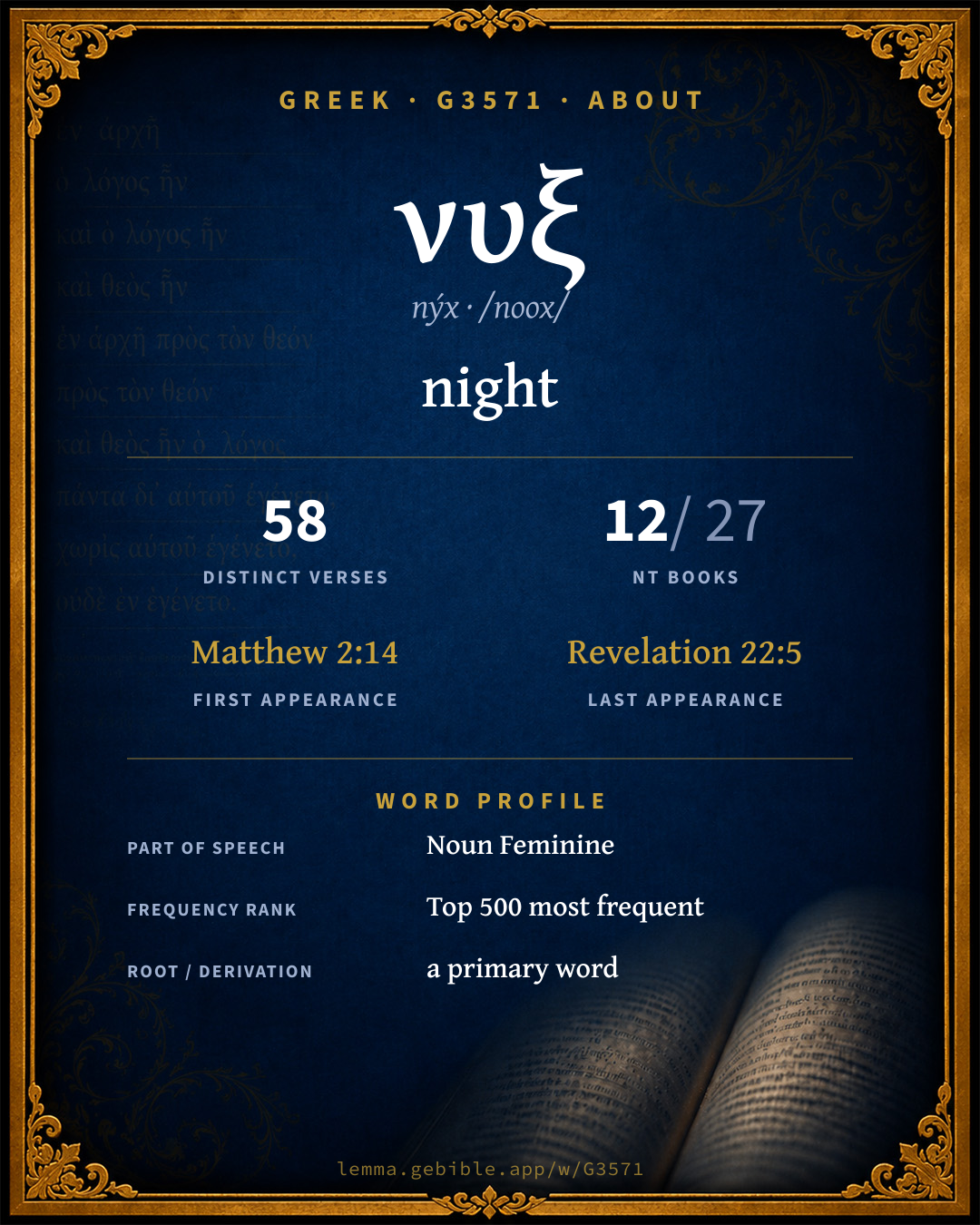
νύξ
night
‘night’ is one of 2 main senses fuller range ↓
Full lexicon entry — Thayer's Greek Lexicon
From Thayer's Greek Lexicon
Where this word appears
See every Dative-case word in the Greek New Testament →
Grammar key — what these labels mean
Part of speech
- Noun
- A naming word — a person, place, thing, or idea.
Case
- Genitive
- The case of source, possession, or “of” — answers “whose / from what.”
- Dative
- The case of the indirect object, means, or location — “to / for / with / in.”
- Nominative
- The case of the subject (and the predicate nominative).
- Accusative
- The case of the direct object and of extent.
Gender
- Feminine
- Grammatically feminine.
Number
- Singular
- One.
- Plural
- More than one.
2 verses where G3571 appears in the Nominative case in the Book of John. Filtered view — show all forms. Click any verse to open its interlinear word-by-word view. Verse text shown in the World English Bible for context — . Each verse’s Greek form is shown with its reference; the English is not keyword-highlighted, since the data carries no word-level English alignment. Use “Compare translations” on any verse to read it across multiple English versions. This concordance covers the Greek New Testament; Septuagint (Greek Old Testament) occurrences of this word are not indexed here.
John
About this entry
At a glance — auto-summarized from this page’s data, not written by a person. Every figure links to its source below. This summary describes the numbers; it doesn’t interpret them.
The Greek noun νυξ centers on the idea of “night.” Its earliest occurrence is Matthew 2:14. It appears 58 verses across 12 books of the Greek New Testament, among its moderately common vocabulary. The word gravitates to Acts (26%), then Matthew and Revelation. Lexicons map it across 2 senses. Dig into 58-verse concordance and the renderings breakdown below.
Gloss history
Strong's 1890 vs modern scholarship
About this word
Strong's G3571 catalogs a Greek word from the Greek New Testament.
These counts are not copied from any lexicon or concordance. They are computed here, from the morphology-tagged Greek New Testament. What Lemma adds →
- 58
- distinct verses
- The word appears in 58 distinct verses.
- 12 / 27
- NT books
- The word appears in 12 of 27 New Testament books.
- #267
- by frequency
- Top 500 most frequent Greek words (rank 267 of 5,347 Greek words by occurrence).
View all 58 occurrences in the concordance →
Most concentrated in
- Acts 15 verses 26%
- Matthew 8 verses 14%
- Revelation 8 verses 14%
By section of the New Testament
By traditional corpus
Conventional, traditional groupings — biblical authorship is debated, so this is a traditional corpus grouping, not an authorship claim. Some books belong to more than one corpus (Luke is in both the Gospels and the Lukan corpus, and so on), so these shares overlap and need not total 100%. Each figure is a share of the word’s 58 distinct verses.
- Gospels 25 verses · 43%
- Lukan (Luke–Acts) 22 verses · 38%
- Johannine 14 verses · 24%
- Pauline corpus 10 verses · 17%
- Revelation 8 verses · 14%
How translations render this word
Counts come from each version’s own published word-to-Strong’s tagging or interlinear alignment — an approximate guide to how each version renders this word, not a word-level alignment the data otherwise carries. Because each total is that version’s own tagged count, the per-version totals vary from one another and need not match the appearance or distinct-verse counts above. These counts may also differ from a printed concordance because Lemma counts each distinctly tagged rendering and does not collapse phrase taggings into a single head-word total. This is a fixed set of word-tagged versions (KJV, ASV, BSB, ULT) and does not change with the reading translation you choose elsewhere. Each version’s license is shown beside its name below (and on Sources).
- King James Version: Night 59×, Nights 3×
- American Standard Version: Night 54×, Nights 3×
- Berean Standard Bible: Night 54×, Nights 3×
- unfoldingWord Literal Text: Night 57×, The 4×, Nights 3×
King James Version Public Domain
Renders G3571 across 63 tagged occurrences — most commonly:
Plus 1 rendering that appears only once — usually multi-word phrases or single function words the recovered tagging swept in, not distinct renderings. Not rendered by a distinct English word in 2 further occurrences.
American Standard Version Public Domain
Renders G3571 across 62 tagged occurrences — most commonly:
Plus 5 renderings that appear only once — usually multi-word phrases or single function words the recovered tagging swept in, not distinct renderings.
Berean Standard Bible Public Domain
Renders G3571 across 59 tagged occurrences — most commonly:
Plus 2 renderings that appear only once — usually multi-word phrases or single function words the recovered tagging swept in, not distinct renderings. Not rendered by a distinct English word in 2 further occurrences.
unfoldingWord Literal Text CC BY-SA 4.0
Renders G3571 across 66 tagged occurrences — most commonly:
Plus 2 renderings that appear only once — usually multi-word phrases or single function words the recovered tagging swept in, not distinct renderings.
Senses in Thayer's
The 2 senses Thayer's distinguishes for this word, in lexicon order (not ranked by frequency or importance). The full entry — with sub-senses — is in the Lexicon Entry tab.
- night
- metaph. the time when work ceases
Word origin
Origin: a primary word
A primary word; night (literally or figuratively): - (mid-) night.
— Strong’s Exhaustive Concordance (1890), public domain.
Forms in the corpus
The 8 distinct written forms G3571 takes in the Greek New Testament, most frequent first — each parse links to that case’s occurrences in the concordance.
| Form | Parsing | Example | Uses |
|---|---|---|---|
| νυκτὸς nyktòs | Noun, Genitive, Singular, Feminine | Matthew 2:14 | 29 |
| νυκτὶ nyktì | Noun, Dative, Singular, Feminine | Matthew 26:31 | 12 |
| νὺξ nỳx | Noun, Nominative, Singular, Feminine | John 9:4 | 6 |
| νυκτός nyktós | Noun, Genitive, Singular, Feminine | Luke 18:7 | 4 |
| νύκτα nýkta | Noun, Accusative, Singular, Feminine | Mark 4:27 | 4 |
| νύκτας nýktas | Noun, Accusative, Plural, Feminine | Matthew 4:2 | 4 |
| νυκτί nyktí | Noun, Dative, Singular, Feminine | John 11:10 | 1 |
| νύξ nýx | Noun, Nominative, Singular, Feminine | John 13:30 | 1 |
Same root — word family
Other Thayer's entries built from the same root as G3571, grouped by Strong’s listed origin. These share a root / origin per the lexicon — not necessarily a shared meaning. Each links to that word’s own entry.
Derived from this word
Compare all same-root words → They share a root, not necessarily a meaning.
Septuagint usage
The same Greek word νυξ appears 220 times in the Greek Old Testament (Septuagint), across 211 verses in 31 books.
- 220
- LXX occurrences
- Tagged occurrences of this Greek word in the Septuagint.
- 211
- verses
- Distinct Septuagint verses containing this word.
- 31 / 39
- OT books
- The word appears in 31 of the 39 Old Testament books.
Sample Septuagint occurrences
- Genesis 1:5 νύξ
- Exodus 10:13 νύξ
- Leviticus 6:2 νύξ
- Numbers 9:16 νύξ
- Deuteronomy 1:33 νύξ
- Joshua 1:8 νύξ
- Judges 6:25 νύξ
- Ruth 3:2 νύξ
- 1 Samuel 14:36 νύξ
- 2 Samuel 2:29 νύξ
- 1 Kings 3:5 νύξ
- 2 Kings 6:14 νύξ
Septuagint occurrences (same lexeme)
Every verse where the same Strong’s number (G3571) appears in the Greek Septuagint — showing the first 50 of 211. Verse text shown in the World English Bible for context; the Greek form is the matched word — the English is not keyword-highlighted.
- Genesis 1:5 νύξ God called the light Day, and the darkness he called Night. There was evening and there was morning, one day.
- Genesis 1:14 νύξ God said, "Let there be lights in the expanse of sky to divide the day from the night; and let them be for signs, and for seasons, and for days and years;
- Genesis 1:16 νύξ God made the two great lights: the greater light to rule the day, and the lesser light to rule the night. He also made the stars.
- Genesis 1:18 νύξ and to rule over the day and over the night, and to divide the light from the darkness. God saw that it was good.
- Genesis 7:4 νύξ In seven days, I will cause it to rain on the earth for forty days and forty nights. Every living thing that I have made, I will destroy from the surface of the ground."
- Genesis 7:12 νύξ The rain was on the earth forty days and forty nights.
- Genesis 7:17 νύξ The flood was forty days on the earth. The waters increased, and lifted up the ark, and it was lifted up above the earth.
- Genesis 8:22 νύξ While the earth remains, seed time and harvest, and cold and heat, and summer and winter, and day and night shall not cease."
- Genesis 14:15 νύξ He divided himself against them by night, he and his servants, and struck them, and pursued them to Hobah, which is on the left hand of Damascus.
- Genesis 19:5 νύξ They called to Lot, and said to him, "Where are the men who came in to you this night? Bring them out to us, that we may have sex with them."
- Genesis 19:33 νύξ They made their father drink wine that night: and the firstborn went in, and lay with her father. He didn't know when she lay down, nor when she arose.
- Genesis 19:34 νύξ It came to pass on the next day, that the firstborn said to the younger, "Behold, I lay last night with my father. Let us make him drink wine again, tonight. You go in, and lie with him, that we may preserve our father's seed."
- Genesis 19:35 νύξ They made their father drink wine that night also. The younger arose, and lay with him. He didn't know when she lay down, nor when she arose.
- Genesis 20:3 νύξ But God came to Abimelech in a dream of the night, and said to him, "Behold, you are a dead man, because of the woman whom you have taken. For she is a man's wife."
- Genesis 26:24 νύξ Yahweh appeared to him the same night, and said, "I am the God of Abraham your father. Don't be afraid, for I am with you, and will bless you, and multiply your seed for my servant Abraham's sake."
- Genesis 30:15 νύξ She said to her, "Is it a small matter that you have taken away my husband? Would you take away my son's mandrakes, also?" Rachel said, "Therefore he will lie with you tonight for your son's mandrakes."
- Genesis 30:16 νύξ Jacob came from the field in the evening, and Leah went out to meet him, and said, "You must come in to me; for I have surely hired you with my son's mandrakes." He lay with her that night.
- Genesis 31:24 νύξ God came to Laban, the Syrian, in a dream of the night, and said to him, "Take heed to yourself that you don't speak to Jacob either good or bad."
- Genesis 31:39 νύξ That which was torn of animals, I didn't bring to you. I bore the loss of it. Of my hand you required it, whether stolen by day or stolen by night.
- Genesis 31:40 νύξ Thus I was; in the day the drought consumed me, and the frost by night; and my sleep fled from my eyes.
- Genesis 32:14 νύξ two hundred female goats and twenty male goats, two hundred ewes and twenty rams,
- Genesis 32:22 νύξ He rose up that night, and took his two wives, and his two handmaids, and his eleven sons, and passed over the ford of the Jabbok.
- Genesis 32:23 νύξ He took them, and sent them over the stream, and sent over that which he had.
- Genesis 40:5 νύξ They both dreamed a dream, each man his dream, in one night, each man according to the interpretation of his dream, the cupbearer and the baker of the king of Egypt, who were bound in the prison.
- Genesis 41:11 νύξ We dreamed a dream in one night, I and he. We dreamed each man according to the interpretation of his dream.
- Genesis 46:2 νύξ God spoke to Israel in the visions of the night, and said, "Jacob, Jacob!" He said, "Here I am."
- Exodus 10:13 νύξ Moses stretched forth his rod over the land of Egypt, and Yahweh brought an east wind on the land all that day, and all the night; and when it was morning, the east wind brought the locusts.
- Exodus 11:4 νύξ Moses said, "This is what Yahweh says: 'About midnight I will go out into the midst of Egypt,
- Exodus 12:8 νύξ They shall eat the flesh in that night, roasted with fire, and unleavened bread. They shall eat it with bitter herbs.
- Exodus 12:12 νύξ For I will go through the land of Egypt in that night, and will strike all the firstborn in the land of Egypt, both man and animal. Against all the gods of Egypt I will execute judgments: I am Yahweh.
- Exodus 12:29 νύξ It happened at midnight, that Yahweh struck all the firstborn in the land of Egypt, from the firstborn of Pharaoh who sat on his throne to the firstborn of the captive who was in the dungeon; and all the firstborn of cattle.
- Exodus 12:30 νύξ Pharaoh rose up in the night, he, and all his servants, and all the Egyptians; and there was a great cry in Egypt, for there was not a house where there was not one dead.
- Exodus 12:31 νύξ He called for Moses and Aaron by night, and said, "Rise up, get out from among my people, both you and the children of Israel; and go, serve Yahweh, as you have said!
- Exodus 12:42 νύξ It is a night to be much observed to Yahweh for bringing them out from the land of Egypt. This is that night of Yahweh, to be much observed of all the children of Israel throughout their generations.
- Exodus 13:21 νύξ Yahweh went before them by day in a pillar of cloud, to lead them on their way, and by night in a pillar of fire, to give them light, that they might go by day and by night:
- Exodus 13:22 νύξ the pillar of cloud by day, and the pillar of fire by night, didn't depart from before the people.
- Exodus 14:20 νύξ It came between the camp of Egypt and the camp of Israel; and there was the cloud and the darkness, yet gave it light by night: and the one didn't come near the other all the night.
- Exodus 14:21 νύξ Moses stretched out his hand over the sea, and Yahweh caused the sea to go back by a strong east wind all the night, and made the sea dry land, and the waters were divided.
- Exodus 24:18 νύξ Moses entered into the midst of the cloud, and went up on the mountain; and Moses was on the mountain forty days and forty nights.
- Exodus 34:28 νύξ He was there with Yahweh forty days and forty nights; he neither ate bread, nor drank water. He wrote on the tablets the words of the covenant, the ten commandments.
- Exodus 40:35 νύξ Moses wasn't able to enter into the tent of meeting, because the cloud stayed on it, and Yahweh's glory filled the tent.
- Leviticus 6:2 νύξ "If anyone sins, and commits a trespass against Yahweh, and deals falsely with his neighbor in a matter of deposit, or of bargain, or of robbery, or has oppressed his neighbor,
- Leviticus 8:35 νύξ At the door of the Tent of Meeting you shall stay day and night seven days, and keep the charge of Yahweh, that you don't die: for so I am commanded."
- Numbers 9:16 νύξ So it was continually. The cloud covered it, and the appearance of fire by night.
- Numbers 9:21 νύξ Sometimes the cloud was from evening until morning; and when the cloud was taken up in the morning, they traveled: or by day and by night, when the cloud was taken up, they traveled.
- Numbers 11:9 νύξ When the dew fell on the camp in the night, the manna fell on it.
- Numbers 11:32 νύξ The people rose up all that day, and all the night, and all the next day, and gathered the quails: he who gathered least gathered ten homers: and they spread them all abroad for themselves round about the camp.
- Numbers 14:1 νύξ All the congregation lifted up their voice, and cried; and the people wept that night.
- Numbers 14:14 νύξ and they will tell it to the inhabitants of this land. They have heard that you Yahweh are in the midst of this people; for you Yahweh are seen face to face, and your cloud stands over them, and you go before them, in a pillar of cloud by day, and in a pillar of fire by night.
- Numbers 22:8 νύξ He said to them, Lodge here this night, and I will bring you word again, as Yahweh shall speak to me: and the princes of Moab abode with Balaam.
These are occurrences of the same Greek lexeme (G3571) in the Septuagint — not a translation of any one Hebrew word. The store carries no word-level Hebrew↔Greek alignment, so no Hebrew original is asserted here. Counts come from the recovered LXX Strong's tagging — high-frequency vocabulary is well covered, while rare or late forms may be untagged — so they reflect tagged occurrences and may slightly undercount.