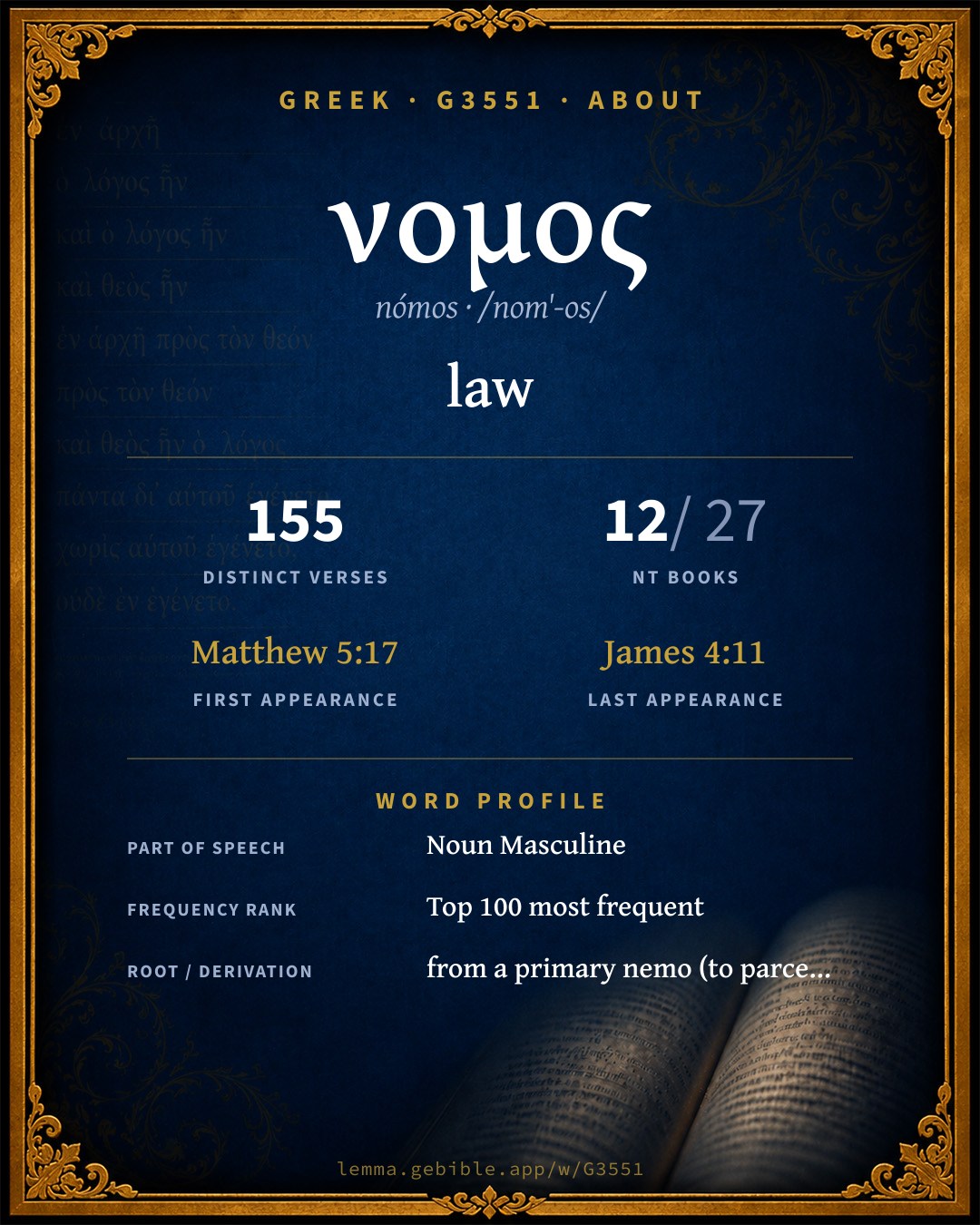
νόμος
law
Full lexicon entry — Thayer's Greek Lexicon
From Thayer's Greek Lexicon
Where this word appears
See every Accusative-case word in the Greek New Testament →
Grammar key — what these labels mean
Part of speech
- Noun
- A naming word — a person, place, thing, or idea.
Case
- Genitive
- The case of source, possession, or “of” — answers “whose / from what.”
- Accusative
- The case of the direct object and of extent.
- Nominative
- The case of the subject (and the predicate nominative).
- Dative
- The case of the indirect object, means, or location — “to / for / with / in.”
Gender
- Masculine
- Grammatically masculine.
Number
- Singular
- One.
- Plural
- More than one.
Every verse where G3551 appears in the Book of Philippians — 3 distinct verses. Click any verse to open its interlinear word-by-word view. Verse text shown in the World English Bible for context — . Each verse’s Greek form is shown with its reference; the English is not keyword-highlighted, since the data carries no word-level English alignment. Use “Compare translations” on any verse to read it across multiple English versions. This concordance covers the Greek New Testament; Septuagint (Greek Old Testament) occurrences of this word are not indexed here.
Philippians
- Philippians 3:5 νόμον n acc sg masc circumcised the eighth day, of the stock of Israel, of the tribe of Benjamin, a Hebrew of Hebrews; concerning the law, a Pharisee;
- Philippians 3:6 νόμῳ n dat sg masc concerning zeal, persecuting the assembly; concerning the righteousness which is in the law, found blameless.
- Philippians 3:9 νόμου n gen sg masc and be found in him, not having a righteousness of my own, that which is of the law, but that which is through faith in Christ, the righteousness which is from God by faith;
About this entry
At a glance — auto-summarized from this page’s data, not written by a person. Every figure links to its source below. This summary describes the numbers; it doesn’t interpret them.
“law” is the headline sense of the Greek noun νομος (nómos). First canonically at Matthew 5:17, it enters the text early. The Greek New Testament uses it across 155 verses — common. More than a quarter of its appearances fall in Romans. It shares a root with νομη, νομιζω and νομικος. The sections below give every sense, occurrence, and version rendering.
Gloss history
Strong's 1890 vs modern scholarship
About this word
Strong's G3551 catalogs a Greek word from the Greek New Testament.
These counts are not copied from any lexicon or concordance. They are computed here, from the morphology-tagged Greek New Testament. What Lemma adds →
- 155
- distinct verses
- The word appears in 155 distinct verses.
- 12 / 27
- NT books
- The word appears in 12 of 27 New Testament books.
- #81
- by frequency
- Top 100 most frequent Greek words (rank 81 of 5,347 Greek words by occurrence).
View all 155 occurrences in the concordance →
By section of the New Testament
By traditional corpus
Conventional, traditional groupings — biblical authorship is debated, so this is a traditional corpus grouping, not an authorship claim. Some books belong to more than one corpus (Luke is in both the Gospels and the Lukan corpus, and so on), so these shares overlap and need not total 100%. Each figure is a share of the word’s 155 distinct verses.
- Pauline corpus 87 verses · 56%
- Gospels 31 verses · 20%
- Lukan (Luke–Acts) 26 verses · 17%
- Johannine 13 verses · 8%
- Hebrews 13 verses · 8%
- General (Catholic) Epistles 7 verses · 5%
How translations render this word
Counts come from each version’s own published word-to-Strong’s tagging or interlinear alignment — an approximate guide to how each version renders this word, not a word-level alignment the data otherwise carries. Because each total is that version’s own tagged count, the per-version totals vary from one another and need not match the appearance or distinct-verse counts above. These counts may also differ from a printed concordance because Lemma counts each distinctly tagged rendering and does not collapse phrase taggings into a single head-word total. This is a fixed set of word-tagged versions (KJV, ASV, BSB, ULT) and does not change with the reading translation you choose elsewhere. Each version’s license is shown beside its name below (and on Sources).
- King James Version: Law 188×, Is the law 3×, Laws 2×
- American Standard Version: Law 179×, Is the law 4×, Laws 2×
- Berean Standard Bible: Law 184×, Laws 2×, Principle 2×
- unfoldingWord Literal Text: Law 193×, Of 5×, The 3×
King James Version Public Domain
Renders G3551 across 197 tagged occurrences — most commonly:
Plus 4 renderings that appear only once — usually multi-word phrases or single function words the recovered tagging swept in, not distinct renderings.
American Standard Version Public Domain
Renders G3551 across 193 tagged occurrences — most commonly:
Plus 8 renderings that appear only once — usually multi-word phrases or single function words the recovered tagging swept in, not distinct renderings.
Berean Standard Bible Public Domain
Renders G3551 across 189 tagged occurrences — most commonly:
Plus 1 rendering that appears only once — usually multi-word phrases or single function words the recovered tagging swept in, not distinct renderings. Not rendered by a distinct English word in 5 further occurrences.
unfoldingWord Literal Text CC BY-SA 4.0
Renders G3551 across 206 tagged occurrences — most commonly:
Plus 1 rendering that appears only once — usually multi-word phrases or single function words the recovered tagging swept in, not distinct renderings.
Senses in Thayer's
The 1 sense Thayer's distinguishes for this word, in lexicon order (not ranked by frequency or importance). The full entry — with sub-senses — is in the Lexicon Entry tab.
- anything established, anything received by usage, a custom, a law, a command
Word origin
Origin: from a primary nemo (to parcel out, especially food or grazing to animals)
From a primary word νέμω nemō (to parcel out especially food or grazing to animals); law (through the idea of prescriptive usage ) generally ( regulation ) specifically (of Moses [including the volume]; also of the Gospel) or figuratively (a principle ): - law.
— Strong’s Exhaustive Concordance (1890), public domain.
Forms in the corpus
The 5 distinct written forms G3551 takes in the Greek New Testament, most frequent first — each parse links to that case’s occurrences in the concordance.
| Form | Parsing | Example | Uses |
|---|---|---|---|
| νόμου nómou | Noun, Genitive, Singular, Masculine | Matthew 5:18 | 67 |
| νόμον nómon | Noun, Accusative, Singular, Masculine | Matthew 5:17 | 60 |
| νόμος nómos | Noun, Nominative, Singular, Masculine | Matthew 7:12 | 34 |
| νόμῳ nómō | Noun, Dative, Singular, Masculine | Matthew 12:5 | 32 |
| νόμους nómous | Noun, Accusative, Plural, Masculine | Hebrews 8:10 | 2 |
Same root — word family
Other Thayer's entries built from the same root as G3551, grouped by Strong’s listed origin. These share a root / origin per the lexicon — not necessarily a shared meaning. Each links to that word’s own entry.
Derived from this word
- νομη nomḗ G3542 pasturage
- νομιζω nomízō G3543 to hold custom
- νομικος nomikós G3544 learned in law
- νομιμως nomímōs G3545 lawfully
- νομοδιδασκαλος nomodidáskalos G3547 law teacher
- νομοθετης nomothétēs G3550 lawgiver
Compare all same-root words → Showing 4 of 7 — not the complete family. They share a root, not necessarily a meaning.
Septuagint usage
The same Greek word νομος appears 243 times in the Greek Old Testament (Septuagint), across 230 verses in 28 books.
- 243
- LXX occurrences
- Tagged occurrences of this Greek word in the Septuagint.
- 230
- verses
- Distinct Septuagint verses containing this word.
- 28 / 39
- OT books
- The word appears in 28 of the 39 Old Testament books.
Sample Septuagint occurrences
- Exodus 12:43 νόμος
- Leviticus 6:2 νόμος
- Numbers 5:29 νόμος
- Deuteronomy 1:5 νόμος
- Joshua 1:8 νόμος
- 2 Samuel 7:19 νόμος
- 1 Kings 2:3 νόμος
- 2 Kings 10:31 νόμος
- 1 Chronicles 16:40 νόμος
- 2 Chronicles 6:16 νόμος
- Ezra 3:2 νόμος
- Esther 1:8 νόμος
Septuagint occurrences (same lexeme)
Every verse where the same Strong’s number (G3551) appears in the Greek Septuagint — showing the first 50 of 230. Verse text shown in the World English Bible for context; the Greek form is the matched word — the English is not keyword-highlighted.
- Exodus 12:43 νόμος Yahweh said to Moses and Aaron, "This is the ordinance of the Passover. There shall no foreigner eat of it,
- Exodus 12:49 νόμος One law shall be to him who is born at home, and to the stranger who lives as a foreigner among you."
- Exodus 13:9 νόμος It shall be for a sign to you on your hand, and for a memorial between your eyes, that the law of Yahweh may be in your mouth; for with a strong hand Yahweh has brought you out of Egypt.
- Exodus 13:10 νόμος You shall therefore keep this ordinance in its season from year to year.
- Exodus 16:4 νόμος Then said Yahweh to Moses, "Behold, I will rain bread from the sky for you, and the people shall go out and gather a day's portion every day, that I may test them, whether they will walk in my law, or not.
- Exodus 16:28 νόμος Yahweh said to Moses, "How long do you refuse to keep my commandments and my laws?
- Exodus 18:16 νόμος When they have a matter, they come to me, and I judge between a man and his neighbor, and I make them know the statutes of God, and his laws."
- Exodus 18:20 νόμος You shall teach them the statutes and the laws, and shall show them the way in which they must walk, and the work that they must do.
- Exodus 24:12 νόμος Yahweh said to Moses, "Come up to me on the mountain, and stay here, and I will give you the tables of stone with the law and the commands that I have written, that you may teach them."
- Leviticus 6:2 νόμος "If anyone sins, and commits a trespass against Yahweh, and deals falsely with his neighbor in a matter of deposit, or of bargain, or of robbery, or has oppressed his neighbor,
- Leviticus 6:7 νόμος The priest shall make atonement for him before Yahweh, and he will be forgiven concerning whatever he does to become guilty."
- Leviticus 6:15 νόμος He shall take from there his handful of the fine flour of the meal offering, and of its oil, and all the frankincense which is on the meal offering, and shall burn it on the altar for a sweet savor, as its memorial, to Yahweh.
- Leviticus 6:18 νόμος Every male among the children of Aaron shall eat of it, as their portion forever throughout your generations, from the offerings of Yahweh made by fire. Whoever touches them shall be holy.'"
- Leviticus 7:1 νόμος "'This is the law of the trespass offering. It is most holy.
- Leviticus 7:7 νόμος "'As is the sin offering, so is the trespass offering; there is one law for them. The priest who makes atonement with them shall have it.
- Leviticus 7:11 νόμος "'This is the law of the sacrifice of peace offerings, which one shall offer to Yahweh.
- Leviticus 7:37 νόμος This is the law of the burnt offering, of the meal offering, and of the sin offering, and of the trespass offering, and of the consecration, and of the sacrifice of peace offerings;
- Leviticus 11:46 νόμος "'This is the law of the animal, and of the bird, and of every living creature that moves in the waters, and of every creature that creeps on the earth,
- Leviticus 12:7 νόμος and he shall offer it before Yahweh, and make atonement for her; and she shall be cleansed from the fountain of her blood. "'This is the law for her who bears, whether a male or a female.
- Leviticus 13:59 νόμος This is the law of the plague of mildew in a garment of wool or linen, either in the warp, or the woof, or in anything of skin, to pronounce it clean, or to pronounce it unclean.
- Leviticus 14:2 νόμος "This shall be the law of the leper in the day of his cleansing. He shall be brought to the priest,
- Leviticus 14:32 νόμος This is the law for him in whom is the plague of leprosy, who is not able to afford the sacrifice for his cleansing.
- Leviticus 14:54 νόμος This is the law for any plague of leprosy, and for an itch,
- Leviticus 14:57 νόμος to teach when it is unclean, and when it is clean. This is the law of leprosy.
- Leviticus 15:3 νόμος This shall be his uncleanness in his discharge: whether his body runs with his discharge, or his body has stopped from his discharge, it is his uncleanness.
- Leviticus 15:32 νόμος This is the law of him who has a discharge, and of him who has an emission of semen, so that he is unclean thereby;
- Leviticus 19:19 νόμος "'You shall keep my statutes. "'You shall not crossbreed different kinds of animals. "'you shall not sow your field with two kinds of seed; "'neither shall there come upon on you a garment made of two kinds of material.
- Leviticus 19:37 νόμος You shall observe all my statutes, and all my ordinances, and do them. I am Yahweh.'"
- Leviticus 26:46 νόμος These are the statutes, ordinances and laws, which Yahweh made between him and the children of Israel in Mount Sinai by Moses.
- Numbers 5:29 νόμος "This is the law of jealousy, when a wife, being under her husband, goes astray, and is defiled;
- Numbers 5:30 νόμος or when the spirit of jealousy comes on a man, and he is jealous of his wife; then he shall set the woman before Yahweh, and the priest shall execute on her all this law.
- Numbers 6:13 νόμος "This is the law of the Nazirite: when the days of his separation are fulfilled, he shall be brought to the door of the Tent of Meeting,
- Numbers 6:21 νόμος "This is the law of the Nazirite who vows, and of his offering to Yahweh for his separation, besides that which he is able to get. According to his vow which he vows, so he must do after the law of his separation."
- Numbers 9:3 νόμος On the fourteenth day of this month, at evening, you shall keep it in its appointed season-- according to all its statutes, and according to all its ordinances, you shall keep it."
- Numbers 9:12 νόμος They shall leave none of it until the morning, nor break a bone of it. According to all the statute of the Passover they shall keep it.
- Numbers 9:14 νόμος If a foreigner lives among you, and desires to keep the Passover to Yahweh; according to the statute of the Passover, and according to its ordinance, so shall he do. You shall have one statute, both for the foreigner, and for him who is born in the land.'"
- Numbers 15:15 νόμος For the assembly, there shall be one statute for you, and for the stranger who lives as a foreigner [with you], a statute forever throughout your generations: as you are, so shall the foreigner be before Yahweh.
- Numbers 15:16 νόμος One law and one ordinance shall be for you, and for the stranger who lives as a foreigner with you.
- Numbers 15:29 νόμος You shall have one law for him who does anything unwittingly, for him who is home-born among the children of Israel, and for the stranger who lives as a foreigner among them.
- Numbers 19:2 νόμος This is the statute of the law which Yahweh has commanded, saying, Speak to the children of Israel, that they bring you a red heifer without spot, in which is no blemish, [and] on which never came yoke.
- Numbers 19:14 νόμος This is the law when a man dies in a tent: everyone who comes into the tent, and everyone who is in the tent, shall be unclean seven days.
- Numbers 31:21 νόμος Eleazar the priest said to the men of war who went to the battle, This is the statute of the law which Yahweh has commanded Moses:
- Deuteronomy 1:5 νόμος Beyond the Jordan, in the land of Moab, began Moses to declare this law, saying,
- Deuteronomy 4:8 νόμος What great nation is there, that has statutes and ordinances so righteous as all this law, which I set before you this day?
- Deuteronomy 4:44 νόμος This is the law which Moses set before the children of Israel:
- Deuteronomy 17:11 νόμος according to the tenor of the law which they shall teach you, and according to the judgment which they shall tell you, you shall do; you shall not turn aside from the sentence which they shall show you, to the right hand, nor to the left.
- Deuteronomy 24:8 νόμος Take heed in the plague of leprosy, that you observe diligently, and do according to all that the priests the Levites shall teach you: as I commanded them, so you shall observe to do.
- Deuteronomy 27:3 νόμος and you shall write on them all the words of this law, when you are passed over; that you may go in to the land which Yahweh your God gives you, a land flowing with milk and honey, as Yahweh, the God of your fathers, has promised you.
- Deuteronomy 27:8 νόμος You shall write on the stones all the words of this law very plainly.
- Deuteronomy 27:26 νόμος Cursed be he who doesn't confirm the words of this law to do them. All the people shall say, Amen.
These are occurrences of the same Greek lexeme (G3551) in the Septuagint — not a translation of any one Hebrew word. The store carries no word-level Hebrew↔Greek alignment, so no Hebrew original is asserted here. Counts come from the recovered LXX Strong's tagging — high-frequency vocabulary is well covered, while rare or late forms may be untagged — so they reflect tagged occurrences and may slightly undercount.