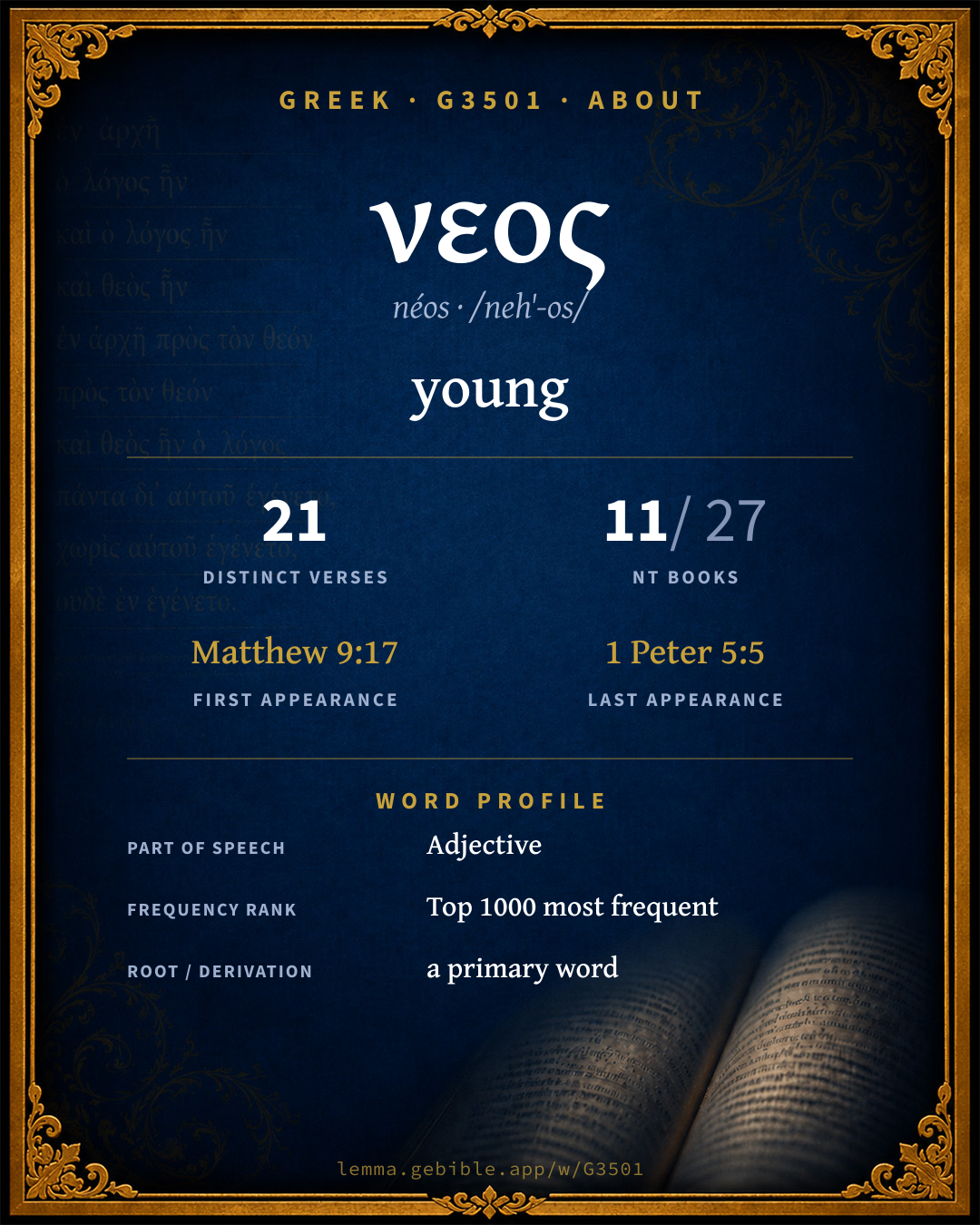
νεος
young
also: recently born, youthful fuller range ↓
Full lexicon entry — Thayer's Greek Lexicon
From Thayer's Greek Lexicon
Where this word appears
See every Nominative-case word in the Greek New Testament →
Grammar key — what these labels mean
Part of speech
- Adjective
- A word that describes or qualifies a noun.
Case
- Accusative
- The case of the direct object and of extent.
- Nominative
- The case of the subject (and the predicate nominative).
- Genitive
- The case of source, possession, or “of” — answers “whose / from what.”
Gender
- Masculine
- Grammatically masculine.
- Feminine
- Grammatically feminine.
- Neuter
- Grammatically neuter.
Number
- Singular
- One.
- Plural
- More than one.
Degree
- Comparative
- Expresses a greater degree (“greater,” “more”).
4 verses where G3501 appears in the Nominative case in the Book of Luke. Filtered view — show all forms. Click any verse to open its interlinear word-by-word view. Verse text shown in the World English Bible for context — . Each verse’s Greek form is shown with its reference; the English is not keyword-highlighted, since the data carries no word-level English alignment. Use “Compare translations” on any verse to read it across multiple English versions. This concordance covers the Greek New Testament; Septuagint (Greek Old Testament) occurrences of this word are not indexed here.
Luke
- Luke 5:37 νέον νέος adj acc sg masc adj nom sg masc No one puts new wine into old wineskins, or else the new wine will burst the skins, and it will be spilled, and the skins will be destroyed.
- Luke 15:12 νεώτερος adj nom sg masc comp The younger of them said to his father, 'Father, give me my share of your property.' He divided his livelihood between them.
- Luke 15:13 νεώτερος adj nom sg masc comp Not many days after, the younger son gathered all of this together and traveled into a far country. There he wasted his property with riotous living.
- Luke 22:26 νεώτερος adj nom sg masc comp But not so with you. But one who is the greater among you, let him become as the younger, and one who is governing, as one who serves.
About this entry
At a glance — auto-summarized from this page’s data, not written by a person. Every figure links to its source below. This summary describes the numbers; it doesn’t interpret them.
νεος — transliterated néos — is a Greek adjective carrying the sense “young.” Debuting at Matthew 9:17, it then recurs through the corpus. It appears 21 verses across 11 books of the Greek New Testament, among its uncommon vocabulary. More than a quarter of its appearances fall in Luke. The lexical range runs to 2 senses — “young” plus “recently born” and “youthful”. Each statement above links to its evidence; the full detail follows below.
Gloss history
Strong's 1890 vs modern scholarship

About this word
Strong's G3501 catalogs a Greek word from the Greek New Testament.
These counts are not copied from any lexicon or concordance. They are computed here, from the morphology-tagged Greek New Testament. What Lemma adds →
- 21
- distinct verses
- The word appears in 21 distinct verses.
- 11 / 27
- NT books
- The word appears in 11 of 27 New Testament books.
- #563
- by frequency
- Top 1000 most frequent Greek words (rank 563 of 5,347 Greek words by occurrence).
View all 21 occurrences in the concordance →
By section of the New Testament
By traditional corpus
Conventional, traditional groupings — biblical authorship is debated, so this is a traditional corpus grouping, not an authorship claim. Some books belong to more than one corpus (Luke is in both the Gospels and the Lukan corpus, and so on), so these shares overlap and need not total 100%. Each figure is a share of the word’s 21 distinct verses.
- Gospels 9 verses · 43%
- Lukan (Luke–Acts) 8 verses · 38%
- Pauline corpus 8 verses · 38%
- Johannine 1 verse · 5%
- Hebrews 1 verse · 5%
- General (Catholic) Epistles 1 verse · 5%
How translations render this word
Counts come from each version’s own published word-to-Strong’s tagging or interlinear alignment — an approximate guide to how each version renders this word, not a word-level alignment the data otherwise carries. Because each total is that version’s own tagged count, the per-version totals vary from one another and need not match the appearance or distinct-verse counts above. These counts may also differ from a printed concordance because Lemma counts each distinctly tagged rendering and does not collapse phrase taggings into a single head-word total. This is a fixed set of word-tagged versions (KJV, ASV, BSB, ULT) and does not change with the reading translation you choose elsewhere. Each version’s license is shown beside its name below (and on Sources).
- King James Version: New 12×, Younger 5×, Young men 2×
- American Standard Version: New 10×, Younger 6×, Younger men 2×
- Berean Standard Bible: New 11×, Younger 7×, Young 3×
- unfoldingWord Literal Text: New 10×
King James Version Public Domain
Renders G3501 across 24 tagged occurrences — most commonly:
Plus 5 renderings that appear only once — usually multi-word phrases or single function words the recovered tagging swept in, not distinct renderings.
American Standard Version Public Domain
Renders G3501 across 21 tagged occurrences — most commonly:
Plus 3 renderings that appear only once — usually multi-word phrases or single function words the recovered tagging swept in, not distinct renderings.
Berean Standard Bible Public Domain
Renders G3501 across 24 tagged occurrences — most commonly:
Plus 3 renderings that appear only once — usually multi-word phrases or single function words the recovered tagging swept in, not distinct renderings.
unfoldingWord Literal Text CC BY-SA 4.0
Renders G3501 across 13 tagged occurrences — most commonly:
Plus 3 renderings that appear only once — usually multi-word phrases or single function words the recovered tagging swept in, not distinct renderings.
Senses in Thayer's
The 2 senses Thayer's distinguishes for this word, in lexicon order (not ranked by frequency or importance). The full entry — with sub-senses — is in the Lexicon Entry tab.
- recently born, young, youthful
- new
Word origin
Origin: a primary word
A primary word including the comparative (second form); new that is (of persons) youthful or (of things) fresh ; figuratively regenerate : - new young.
— Strong’s Exhaustive Concordance (1890), public domain.
Forms in the corpus
The 8 distinct written forms G3501 takes in the Greek New Testament, most frequent first — each parse links to that case’s occurrences in the concordance.
| Form | Parsing | Example | Uses |
|---|---|---|---|
| νέον néon | Adjective, Accusative, Singular, Masculine | Matthew 9:17 | 8 |
| νεώτερος neṓteros | Adjective, Nominative, Singular, Masculine, Comparative | Luke 15:12 | 4 |
| νεωτέρας neōtéras | Adjective, Accusative, Plural, Feminine, Comparative | 1 Timothy 5:2 | 3 |
| νέας néas | Adjective, Accusative, Plural, Feminine | Titus 2:4 | 2 |
| νεωτέρους neōtérous | Adjective, Accusative, Plural, Masculine, Comparative | 1 Timothy 5:1 | 2 |
| νεώτεροι neṓteroi | Adjective, Nominative, Plural, Masculine, Comparative | Acts 5:6 | 2 |
| Νέαν Néan | Adjective, Accusative, Singular, Feminine | Acts 16:11 | 1 |
| νέος néos | Adjective, Nominative, Singular, Masculine | Luke 5:37 | 1 |
Same root — word family
Other Thayer's entries built from the same root as G3501, grouped by Strong’s listed origin. These share a root / origin per the lexicon — not necessarily a shared meaning. Each links to that word’s own entry.
Derived from this word
- νεανιας neanías G3494 young man
- νεοσσος neossós G3502 young creature
- νεοτης neótēs G3503 youth
- νεοφυτος neóphytos G3504 newly planted
- νεωτερικος neōterikós G3512 youthful
- νουμηνια noumēnía G3561 new moon
Proper names from this root
People and places named from this root — a name, not an additional meaning of the word.
Compare all same-root words → Showing 4 of 8 — not the complete family. 1 of the same-root words is a proper name (a person or place). They share a root, not necessarily a meaning.
Septuagint usage
The same Greek word νεος appears 83 times in the Greek Old Testament (Septuagint), across 79 verses in 19 books.
- 83
- LXX occurrences
- Tagged occurrences of this Greek word in the Septuagint.
- 79
- verses
- Distinct Septuagint verses containing this word.
- 19 / 39
- OT books
- The word appears in 19 of the 39 Old Testament books.
Sample Septuagint occurrences
- Genesis 9:24 νέος
- Exodus 13:4 νέος
- Leviticus 2:14 νέος
- Numbers 14:23 νέος
- Deuteronomy 1:39 νέος
- Joshua 5:11 νέος
- Judges 1:13 νέος
- 1 Kings 16:34 νέος
- 1 Chronicles 12:29 νέος
- 2 Chronicles 10:14 νέος
- Job 24:5 νέος
- Psalms 36:25 νέος
Septuagint occurrences (same lexeme)
Every verse where the same Strong’s number (G3501) appears in the Greek Septuagint — showing the first 50 of 79. Verse text shown in the World English Bible for context; the Greek form is the matched word — the English is not keyword-highlighted.
- Genesis 9:24 νέος Noah awoke from his wine, and knew what his youngest son had done to him.
- Genesis 19:31 νέος The firstborn said to the younger, "Our father is old, and there is not a man in the earth to come in to us after the manner of all the earth.
- Genesis 19:34 νέος It came to pass on the next day, that the firstborn said to the younger, "Behold, I lay last night with my father. Let us make him drink wine again, tonight. You go in, and lie with him, that we may preserve our father's seed."
- Genesis 19:35 νέος They made their father drink wine that night also. The younger arose, and lay with him. He didn't know when she lay down, nor when she arose.
- Genesis 19:38 νέος The younger also bore a son, and called his name Ben Ammi. The same is the father of the children of Ammon to this day.
- Genesis 27:15 νέος Rebekah took the good clothes of Esau, her elder son, which were with her in the house, and put them on Jacob, her younger son.
- Genesis 27:42 νέος The words of Esau, her elder son, were told to Rebekah. She sent and called Jacob her younger son, and said to him, "Behold, your brother Esau comforts himself about you by planning to kill you.
- Genesis 29:16 νέος Laban had two daughters. The name of the elder was Leah, and the name of the younger was Rachel.
- Genesis 29:18 νέος Jacob loved Rachel. He said, "I will serve you seven years for Rachel, your younger daughter."
- Genesis 29:26 νέος Laban said, "It is not done so in our place, to give the younger before the first born.
- Genesis 37:2 νέος This is the history of the generations of Jacob. Joseph, being seventeen years old, was feeding the flock with his brothers. He was a boy with the sons of Bilhah and Zilpah, his father's wives. Joseph brought an evil report of them to their father.
- Genesis 42:13 νέος They said, "We, your servants, are twelve brothers, the sons of one man in the land of Canaan; and, behold, the youngest is this day with our father, and one is no more."
- Genesis 42:15 νέος Hereby you shall be tested. By the life of Pharaoh you shall not go forth from here, unless your youngest brother come here.
- Genesis 42:20 νέος Bring your youngest brother to me; so will your words be verified, and you won't die." They did so.
- Genesis 42:34 νέος Bring your youngest brother to me. Then I will know that you are not spies, but that you are honest men. So I will deliver your brother to you, and you shall trade in the land.'"
- Genesis 43:3 νέος Judah spoke to him, saying, "The man solemnly warned us, saying, 'You shall not see my face, unless your brother is with you.'
- Genesis 43:5 νέος but if you will not send him, we will not go down, for the man said to us, 'You shall not see my face, unless your brother is with you.'"
- Genesis 43:29 νέος He lifted up his eyes, and saw Benjamin, his brother, his mother's son, and said, "Is this your youngest brother, of whom you spoke to me?" He said, "God be gracious to you, my son."
- Genesis 43:33 νέος They sat before him, the firstborn according to his birthright, and the youngest according to his youth, and the men marveled one with another.
- Genesis 44:2 νέος Put my cup, the silver cup, in the sack's mouth of the youngest, with his grain money." He did according to the word that Joseph had spoken.
- Genesis 44:12 νέος He searched, beginning with the eldest, and ending at the youngest. The cup was found in Benjamin's sack.
- Genesis 44:20 νέος We said to my lord, 'We have a father, an old man, and a child of his old age, a little one; and his brother is dead, and he alone is left of his mother; and his father loves him.'
- Genesis 44:23 νέος You said to your servants, 'Unless your youngest brother comes down with you, you will see my face no more.'
- Genesis 44:26 νέος We said, 'We can't go down. If our youngest brother is with us, then will we go down: for we may not see the man's face, unless our youngest brother is with us.'
- Genesis 48:14 νέος Israel stretched out his right hand, and laid it on Ephraim's head, who was the younger, and his left hand on Manasseh's head, guiding his hands knowingly, for Manasseh was the firstborn.
- Genesis 48:19 νέος His father refused, and said, "I know, my son, I know. He also will become a people, and he also will be great. However, his younger brother will be greater than he, and his seed will become a multitude of nations."
- Genesis 49:22 νέος "Joseph is a fruitful vine, A fruitful vine by a spring; His branches run over the wall.
- Exodus 13:4 νέος This day you go forth in the month Abib.
- Exodus 23:15 νέος You shall observe the feast of unleavened bread. Seven days you shall eat unleavened bread, as I commanded you, at the time appointed in the month Abib (for in it you came out from Egypt), and no one shall appear before me empty.
- Exodus 33:11 νέος Yahweh spoke to Moses face to face, as a man speaks to his friend. He turned again into the camp, but his servant Joshua, the son of Nun, a young man, didn't depart out of the Tent.
- Exodus 34:18 νέος "You shall keep the feast of unleavened bread. Seven days you shall eat unleavened bread, as I commanded you, at the time appointed in the month Abib; for in the month Abib you came out from Egypt.
- Leviticus 2:14 νέος "'If you offer a meal offering of first fruits to Yahweh, you shall offer for the meal offering of your first fruits grain in the ear parched with fire, bruised grain of the fresh ear.
- Leviticus 23:14 νέος You shall eat neither bread, nor roasted grain, nor fresh grain, until this same day, until you have brought the offering of your God. This is a statute forever throughout your generations in all your dwellings.
- Leviticus 23:16 νέος even to the next day after the seventh Sabbath you shall number fifty days; and you shall offer a new meal offering to Yahweh.
- Leviticus 26:10 νέος You shall eat old store long kept, and you shall move out the old because of the new.
- Numbers 14:23 νέος surely they shall not see the land which I swore to their fathers, neither shall any of those who despised me see it:
- Numbers 28:26 νέος Also in the day of the first fruits, when you offer a new meal-offering to Yahweh in your [feast of] weeks, you shall have a holy convocation; you shall do no servile work;
- Deuteronomy 1:39 νέος Moreover your little ones, whom you said should be a prey, and your children, who this day have no knowledge of good or evil, they shall go in there, and to them will I give it, and they shall possess it.
- Deuteronomy 16:1 νέος Observe the month of Abib, and keep the Passover to Yahweh your God; for in the month of Abib Yahweh your God brought you forth out of Egypt by night.
- Deuteronomy 28:50 νέος a nation of fierce facial expressions, that shall not regard the person of the old, nor show favor to the young,
- Joshua 5:11 νέος They ate of the produce of the land on the next day after the Passover, unleavened cakes and parched grain, in the same day.
- Joshua 15:17 νέος Othniel the son of Kenaz, the brother of Caleb, took it: and he gave him Achsah his daughter as wife.
- Judges 1:13 νέος Othniel the son of Kenaz, Caleb's younger brother, took it: and he gave him Achsah his daughter as wife.
- Judges 3:9 νέος When the children of Israel cried to Yahweh, Yahweh raised up a savior to the children of Israel, who saved them, even Othniel the son of Kenaz, Caleb's younger brother.
- Judges 8:20 νέος He said to Jether his firstborn, Up, and kill them. But the youth didn't draw his sword; for he feared, because he was yet a youth.
- Judges 9:5 νέος He went to his father's house at Ophrah, and killed his brothers the sons of Jerubbaal, being seventy persons, on one stone: but Jotham the youngest son of Jerubbaal was left; for he hid himself.
- Judges 15:2 νέος Her father said, I most assuredly thought that you had utterly hated her; therefore I gave her to your companion: isn't her younger sister more beautiful than she? Please take her, instead.
- 1 Kings 16:34 νέος In his days did Hiel the Bethelite build Jericho: he laid the foundation of it with the loss of Abiram his firstborn, and set up the gates of it with the loss of his youngest son Segub, according to the word of Yahweh, which he spoke by Joshua the son of Nun.
- 1 Chronicles 12:29 νέος Of the children of Benjamin, the brothers of Saul, three thousand: for hitherto the greatest part of them had kept their allegiance to the house of Saul.
- 1 Chronicles 24:31 νέος These likewise cast lots even as their brothers the sons of Aaron in the presence of David the king, and Zadok, and Ahimelech, and the heads of the fathers' [houses] of the priests and of the Levites; the fathers' [houses] of the chief even as those of his younger brother.
These are occurrences of the same Greek lexeme (G3501) in the Septuagint — not a translation of any one Hebrew word. The store carries no word-level Hebrew↔Greek alignment, so no Hebrew original is asserted here. Counts come from the recovered LXX Strong's tagging — high-frequency vocabulary is well covered, while rare or late forms may be untagged — so they reflect tagged occurrences and may slightly undercount.