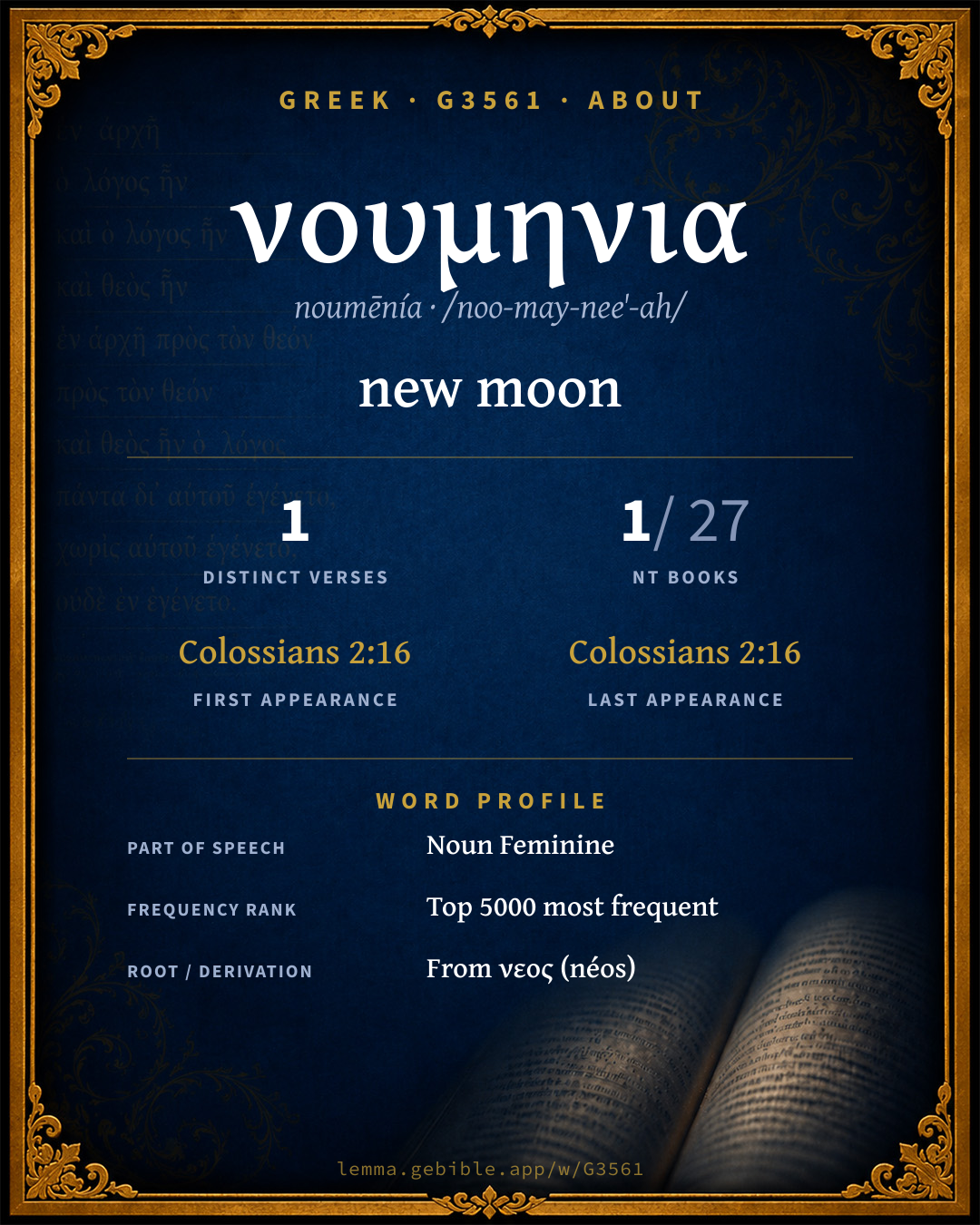
νουμηνία
new moon
Full lexicon entry — Thayer's Greek Lexicon
From Thayer's Greek Lexicon
Where this word appears
Grammar key — what these labels mean
Part of speech
- Noun
- A naming word — a person, place, thing, or idea.
Case
- Genitive
- The case of source, possession, or “of” — answers “whose / from what.”
Gender
- Feminine
- Grammatically feminine.
Number
- Singular
- One.
Every verse where G3561 appears — 1 distinct verse across 1 book. Click any verse to open its interlinear word-by-word view. Verse text shown in the World English Bible for context — . Each verse’s Greek form is shown with its reference; the English is not keyword-highlighted, since the data carries no word-level English alignment. Use “Compare translations” on any verse to read it across multiple English versions. This concordance covers the Greek New Testament; Septuagint (Greek Old Testament) occurrences of this word are not indexed here.
Colossians 1 verse
About this entry
At a glance — auto-summarized from this page’s data, not written by a person. Every figure links to its source below. This summary describes the numbers; it doesn’t interpret them.
At its core, νουμηνια (noumēnía) means “new moon.” The Greek New Testament uses it only 1 verse. The word gravitates to Colossians (100%). A true hapax — its single appearance is Colossians 2:16. It shares a root with νεος, νεανιας and νεοσσος. Dig into 1-verse concordance and the renderings breakdown below.
Gloss history
Strong's 1890 vs modern scholarship
About this word
Strong's G3561 catalogs a Greek word from the Greek New Testament.
These counts are not copied from any lexicon or concordance. They are computed here, from the morphology-tagged Greek New Testament. What Lemma adds →
- 1
- distinct verses
- The word appears in 1 distinct verse.
- 1 / 27
- NT books
- The word appears in 1 of 27 New Testament books.
- #3,503
- by frequency
- Top 5000 most frequent Greek words (rank 3,503 of 5,347 Greek words by occurrence).
View all 1 occurrence in the concordance →
Most concentrated in
- Colossians 1 verse 100%
By section of the New Testament
By traditional corpus
Conventional, traditional groupings — biblical authorship is debated, so this is a traditional corpus grouping, not an authorship claim. Some books belong to more than one corpus (Luke is in both the Gospels and the Lukan corpus, and so on), so these shares overlap and need not total 100%. Each figure is a share of the word’s 1 distinct verse.
- Pauline corpus 1 verse · 100%
How translations render this word
Counts come from each version’s own published word-to-Strong’s tagging or interlinear alignment — an approximate guide to how each version renders this word, not a word-level alignment the data otherwise carries. Because each total is that version’s own tagged count, the per-version totals vary from one another and need not match the appearance or distinct-verse counts above. These counts may also differ from a printed concordance because Lemma counts each distinctly tagged rendering and does not collapse phrase taggings into a single head-word total. This is a fixed set of word-tagged versions (KJV, ASV, BSB, ULT) and does not change with the reading translation you choose elsewhere. Each version’s license is shown beside its name below (and on Sources).
- King James Version: New moon 1×
- American Standard Version: New moon 1×
- Berean Standard Bible: New moon 1×
- unfoldingWord Literal Text: New moon 1×
King James Version Public Domain
Renders G3561 across 1 tagged occurrence — most commonly:
American Standard Version Public Domain
Renders G3561 across 1 tagged occurrence — most commonly:
Berean Standard Bible Public Domain
Renders G3561 across 1 tagged occurrence — most commonly:
unfoldingWord Literal Text CC BY-SA 4.0
Renders G3561 across 1 tagged occurrence — most commonly:
Senses in Thayer's
The 1 sense Thayer's distinguishes for this word, in lexicon order (not ranked by frequency or importance). The full entry — with sub-senses — is in the Lexicon Entry tab.
- new moon
Word origin
Derived from νεος (néos) (G3501) — young.
Same root — word family
Other Thayer's entries built from the same root as G3561, grouped by Strong’s listed origin. These share a root / origin per the lexicon — not necessarily a shared meaning. Each links to that word’s own entry.
Derives from
Shares the same root
- νεανιας neanías G3494 young man
- νεοσσος neossós G3502 young creature
- νεοτης neótēs G3503 youth
- νεοφυτος neóphytos G3504 newly planted
- νεωτερικος neōterikós G3512 youthful
Proper names from this root
People and places named from this root — a name, not an additional meaning of the word.
Compare all same-root words → Showing 4 of 8 — not the complete family. 1 of the same-root words is a proper name (a person or place). They share a root, not necessarily a meaning.
Septuagint usage
The same Greek word νουμηνια appears 18 times in the Greek Old Testament (Septuagint), across 18 verses in 10 books.
- 18
- LXX occurrences
- Tagged occurrences of this Greek word in the Septuagint.
- 18
- verses
- Distinct Septuagint verses containing this word.
- 10 / 39
- OT books
- The word appears in 10 of the 39 Old Testament books.
Sample Septuagint occurrences
- Exodus 40:2 νουμηνία
- Numbers 10:10 νουμηνία
- 1 Samuel 20:5 νουμηνία
- 2 Kings 4:23 νουμηνία
- 1 Chronicles 23:31 νουμηνία
- 2 Chronicles 2:3 νουμηνία
- Ezra 3:5 νουμηνία
- Psalms 80:4 νουμηνία
- Isaiah 1:13 νουμηνία
- Ezekiel 23:34 νουμηνία
Septuagint occurrences (same lexeme)
Every verse where the same Strong’s number (G3561) appears in the Greek Septuagint. Verse text shown in the World English Bible for context; the Greek form is the matched word — the English is not keyword-highlighted.
- Exodus 40:2 νουμηνία "On the first day of the first month you shall raise up the tent of the Tent of Meeting.
- Exodus 40:17 νουμηνία It happened in the first month in the second year, on the first day of the month, that the tent was raised up.
- Numbers 10:10 νουμηνία Also in the day of your gladness, and in your set feasts, and in the beginnings of your months, you shall blow the trumpets over your burnt offerings, and over the sacrifices of your peace-offerings; and they shall be to you for a memorial before your God: I am Yahweh your God.
- Numbers 28:11 νουμηνία In the beginnings of your months you shall offer a burnt offering to Yahweh: two young bulls, and one ram, seven he-lambs a year old without blemish;
- Numbers 29:6 νουμηνία besides the burnt offering of the new moon, and the meal-offering of it, and the continual burnt offering and the meal-offering of it, and their drink-offerings, according to their ordinance, for a sweet savor, an offering made by fire to Yahweh.
- 1 Samuel 20:5 νουμηνία David said to Jonathan, Behold, tomorrow is the new moon, and I should not fail to sit with the king at meat: but let me go, that I may hide myself in the field to the third day at evening.
- 1 Samuel 20:18 νουμηνία Then Jonathan said to him, Tomorrow is the new moon: and you will be missed, because your seat will be empty.
- 2 Kings 4:23 νουμηνία He said, Why will you go to him today? it is neither new moon nor Sabbath. She said, It shall be well.
- 1 Chronicles 23:31 νουμηνία and to offer all burnt offerings to Yahweh, on the Sabbaths, on the new moons, and on the set feasts, in number according to the ordinance concerning them, continually before Yahweh;
- 2 Chronicles 2:3 νουμηνία Solomon sent to Huram the king of Tyre, saying, As you dealt with David my father, and sent him cedars to build him a house in which to dwell, [even so deal with me].
- 2 Chronicles 29:17 νουμηνία Now they began on the first [day] of the first month to sanctify, and on the eighth day of the month came they to the porch of Yahweh; and they sanctified the house of Yahweh in eight days: and on the sixteenth day of the first month they made an end.
- 2 Chronicles 31:3 νουμηνία [He appointed] also the king's portion of his substance for the burnt-offerings, [to wit], for the morning and evening burnt offerings, and the burnt offerings for the Sabbaths, and for the new moons, and for the set feasts, as it is written in the law of Yahweh.
- Ezra 3:5 νουμηνία and afterward the continual burnt-offering, and [the offerings] of the new moons, and of all the set feasts of Yahweh that were consecrated, and of everyone who willingly offered a freewill-offering to Yahweh.
- Ezra 20:34 νουμηνία
- Psalms 80:4 νουμηνία Yahweh God of hosts, How long will you be angry against the prayer of your people?
- Isaiah 1:13 νουμηνία Bring no more vain offerings. Incense is an abomination to me; New moons, Sabbaths, and convocations: I can't bear with evil assemblies.
- Isaiah 1:14 νουμηνία My soul hates your New Moons and your appointed feasts; They are a burden to me. I am weary of bearing them.
- Ezekiel 23:34 νουμηνία You shall even drink it and drain it out, and you shall gnaw the broken pieces of it, and shall tear your breasts; for I have spoken it, says the Lord Yahweh.
These are occurrences of the same Greek lexeme (G3561) in the Septuagint — not a translation of any one Hebrew word. The store carries no word-level Hebrew↔Greek alignment, so no Hebrew original is asserted here. Counts come from the recovered LXX Strong's tagging — high-frequency vocabulary is well covered, while rare or late forms may be untagged — so they reflect tagged occurrences and may slightly undercount.