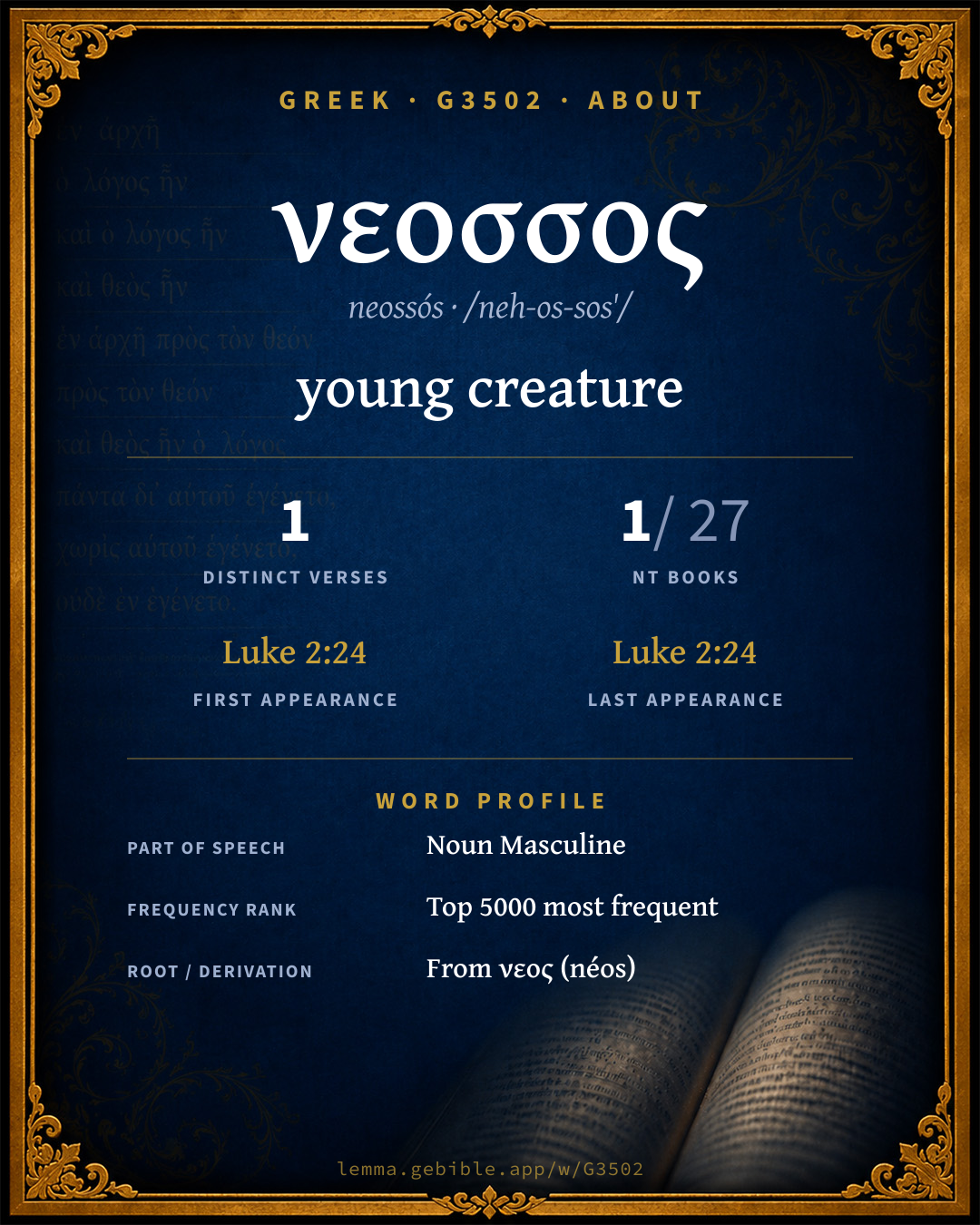
νεοσσός
young creature
Full lexicon entry — Thayer's Greek Lexicon
From Thayer's Greek Lexicon
Where this word appears
Grammar key — what these labels mean
Part of speech
- Noun
- A naming word — a person, place, thing, or idea.
Case
- Accusative
- The case of the direct object and of extent.
Gender
- Masculine
- Grammatically masculine.
Number
- Plural
- More than one.
Every verse where G3502 appears — 1 distinct verse across 1 book. Click any verse to open its interlinear word-by-word view. Verse text shown in the World English Bible for context — . Each verse’s Greek form is shown with its reference; the English is not keyword-highlighted, since the data carries no word-level English alignment. Use “Compare translations” on any verse to read it across multiple English versions. This concordance covers the Greek New Testament; Septuagint (Greek Old Testament) occurrences of this word are not indexed here.
Luke 1 verse
About this entry
At a glance — auto-summarized from this page’s data, not written by a person. Every figure links to its source below. This summary describes the numbers; it doesn’t interpret them.
“young creature” is the headline sense of the Greek noun νεοσσος (neossós). It occurs a mere 1 verse across Scripture. More than three-quarters of its appearances fall in Luke. Scripture uses it exactly once, at Luke 2:24. It shares a root with νεος, νεανιας and νεοτης. See the sense tree, 1-verse concordance, and the renderings breakdown below.
Gloss history
Strong's 1890 vs modern scholarship
About this word
Strong's G3502 catalogs a Greek word from the Greek New Testament.
These counts are not copied from any lexicon or concordance. They are computed here, from the morphology-tagged Greek New Testament. What Lemma adds →
- 1
- distinct verses
- The word appears in 1 distinct verse.
- 1 / 27
- NT books
- The word appears in 1 of 27 New Testament books.
- #3,503
- by frequency
- Top 5000 most frequent Greek words (rank 3,503 of 5,347 Greek words by occurrence).
View all 1 occurrence in the concordance →
Most concentrated in
- Luke 1 verse 100%
By section of the New Testament
By traditional corpus
Conventional, traditional groupings — biblical authorship is debated, so this is a traditional corpus grouping, not an authorship claim. Some books belong to more than one corpus (Luke is in both the Gospels and the Lukan corpus, and so on), so these shares overlap and need not total 100%. Each figure is a share of the word’s 1 distinct verse.
- Gospels 1 verse · 100%
- Lukan (Luke–Acts) 1 verse · 100%
How translations render this word
Counts come from each version’s own published word-to-Strong’s tagging or interlinear alignment — an approximate guide to how each version renders this word, not a word-level alignment the data otherwise carries. Because each total is that version’s own tagged count, the per-version totals vary from one another and need not match the appearance or distinct-verse counts above. These counts may also differ from a printed concordance because Lemma counts each distinctly tagged rendering and does not collapse phrase taggings into a single head-word total. This is a fixed set of word-tagged versions (KJV, ASV, BSB, ULT) and does not change with the reading translation you choose elsewhere. Each version’s license is shown beside its name below (and on Sources).
- King James Version: Young 1×
- American Standard Version: Young 1×
- Berean Standard Bible: Young 1×
- unfoldingWord Literal Text: Young 1×
King James Version Public Domain
Renders G3502 across 1 tagged occurrence — most commonly:
American Standard Version Public Domain
Renders G3502 across 1 tagged occurrence — most commonly:
Berean Standard Bible Public Domain
Renders G3502 across 1 tagged occurrence — most commonly:
unfoldingWord Literal Text CC BY-SA 4.0
Renders G3502 across 1 tagged occurrence — most commonly:
Senses in Thayer's
The 1 sense Thayer's distinguishes for this word, in lexicon order (not ranked by frequency or importance). The full entry — with sub-senses — is in the Lexicon Entry tab.
- a young (creature), young bird
Word origin
Derived from νεος (néos) (G3501) — young.
From G3501 ; a youngling ( nestling ): - young.
— Strong’s Exhaustive Concordance (1890), public domain.
Same root — word family
Other Thayer's entries built from the same root as G3502, grouped by Strong’s listed origin. These share a root / origin per the lexicon — not necessarily a shared meaning. Each links to that word’s own entry.
Derives from
Shares the same root
- νεανιας neanías G3494 young man
- νεοτης neótēs G3503 youth
- νεοφυτος neóphytos G3504 newly planted
- νεωτερικος neōterikós G3512 youthful
- νουμηνια noumēnía G3561 new moon
Derived from this word
Proper names from this root
People and places named from this root — a name, not an additional meaning of the word.
Compare all same-root words → Showing 4 of 10 — not the complete family. 1 of the same-root words is a proper name (a person or place). They share a root, not necessarily a meaning.
Septuagint usage
The same Greek word νεοσσος appears 20 times in the Greek Old Testament (Septuagint), across 19 verses in 7 books.
- 20
- LXX occurrences
- Tagged occurrences of this Greek word in the Septuagint.
- 19
- verses
- Distinct Septuagint verses containing this word.
- 7 / 39
- OT books
- The word appears in 7 of the 39 Old Testament books.
Sample Septuagint occurrences
- Leviticus 5:7 νεοσσός
- Numbers 6:10 νεοσσός
- Deuteronomy 22:6 νεοσσός
- Job 5:7 νεοσσός
- Psalms 146:9 νεοσσός
- Proverbs 24:22 νεοσσός
- Isaiah 16:2 νεοσσός
Septuagint occurrences (same lexeme)
Every verse where the same Strong’s number (G3502) appears in the Greek Septuagint. Verse text shown in the World English Bible for context; the Greek form is the matched word — the English is not keyword-highlighted.
- Leviticus 5:7 νεοσσός "'If he can't afford a lamb, then he shall bring his trespass offering for that in which he has sinned, two turtledoves, or two young pigeons, to Yahweh; one for a sin offering, and the other for a burnt offering.
- Leviticus 5:11 νεοσσός "'But if he can't afford two turtledoves, or two young pigeons, then he shall bring his offering for that in which he has sinned, the tenth part of an ephah of fine flour for a sin offering. He shall put no oil on it, neither shall he put any frankincense on it, for it is a sin offering.
- Leviticus 12:6 νεοσσός "'When the days of her purification are completed, for a son, or for a daughter, she shall bring to the priest at the door of the Tent of Meeting, a year old lamb for a burnt offering, and a young pigeon, or a turtledove, for a sin offering:
- Leviticus 12:8 νεοσσός If she cannot afford a lamb, then she shall take two turtledoves, or two young pigeons; the one for a burnt offering, and the other for a sin offering: and the priest shall make atonement for her, and she shall be clean.'"
- Leviticus 14:22 νεοσσός and two turtledoves, or two young pigeons, such as he is able to afford; and the one shall be a sin offering, and the other a burnt offering.
- Leviticus 14:30 νεοσσός He shall offer one of the turtledoves, or of the young pigeons, such as he is able to afford,
- Leviticus 15:14 νεοσσός "'On the eighth day he shall take two turtledoves, or two young pigeons, and come before Yahweh to the door of the Tent of Meeting, and give them to the priest:
- Leviticus 15:29 νεοσσός On the eighth day she shall take two turtledoves, or two young pigeons, and bring them to the priest, to the door of the Tent of Meeting.
- Numbers 6:10 νεοσσός On the eighth day he shall bring two turtledoves or two young pigeons to the priest, to the door of the Tent of Meeting.
- Deuteronomy 22:6 νεοσσός If a bird's nest chance to be before you in the way, in any tree or on the ground, with young ones or eggs, and the hen sitting on the young, or on the eggs, you shall not take the hen with the young:
- Deuteronomy 32:11 νεοσσός As an eagle that stirs up her nest, That flutters over her young, He spread abroad his wings, he took them, He bore them on his feathers.
- Job 5:7 νεοσσός But man is born to trouble, As the sparks fly upward.
- Job 38:41 νεοσσός Who provides for the raven his prey, When his young ones cry to God, And wander for lack of food?
- Job 39:30 νεοσσός His young ones also suck up blood. Where the slain are, there he is."
- Psalms 146:9 νεοσσός Yahweh preserves the foreigners. He upholds the fatherless and widow, But the way of the wicked he turns upside down.
- Proverbs 24:22 νεοσσός For their calamity will rise suddenly; The destruction from them both--who knows?
- Proverbs 30:17 νεοσσός The eye that mocks at his father, And scorns obedience to his mother: The ravens of the valley shall pick it out, The young eagles shall eat it.
- Isaiah 16:2 νεοσσός For it shall be that, as wandering birds, as a scattered nest, so shall the daughters of Moab be at the fords of the Arnon.
- Isaiah 60:8 νεοσσός Who are these who fly as a cloud, and as the doves to their windows?
These are occurrences of the same Greek lexeme (G3502) in the Septuagint — not a translation of any one Hebrew word. The store carries no word-level Hebrew↔Greek alignment, so no Hebrew original is asserted here. Counts come from the recovered LXX Strong's tagging — high-frequency vocabulary is well covered, while rare or late forms may be untagged — so they reflect tagged occurrences and may slightly undercount.