1 Chronicles 12:29

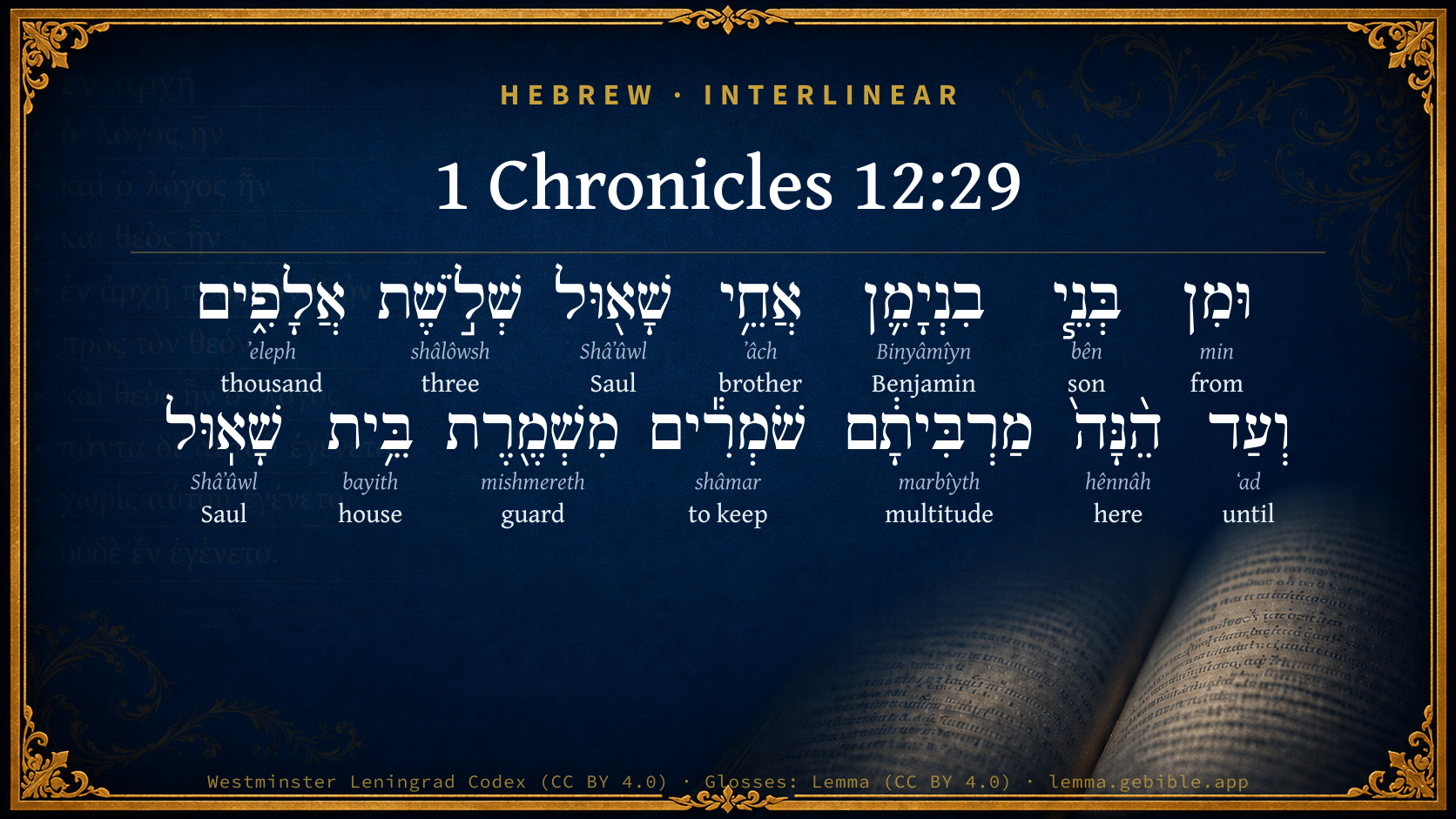
Hebrew (Westminster Leningrad Codex) 1 Chronicles 12:29 appears in the Hebrew Old Testament. The text above is from the Westminster Leningrad Codex. Each word links to its Strong’s number, a concise gloss, and parsing drawn from the Open Scriptures Hebrew Bible morphology. Click any word for its full Brown-Driver-Briggs (BDB) entry.
Download image
Cite this verse

1 Chronicles 12:29 (World English Bible). Public Domain. Lemma interlinear Bible study tool, https://lemma.gebible.app/v/1-chronicles/12/29.

Show BibTeX & RIS
BibTeX
RIS
English Translation
Of the children of Benjamin, the brothers of Saul, three thousand: for hitherto the greatest part of them had kept their allegiance to the house of Saul.
World English Bible · Public Domain
Download a study sheet

One document with this verse’s original text, its word-by-word gloss line, the meaning frame, cross-references with their text, attributed commentary, and full source and license credits — printable, and it pastes into notes with its structure intact.

This verse Autodidact and up

Study sheet (.html) Plain text (.txt)

A passage Seminary Student

Up to 50 verses in one chapter. A passage sheet keeps up to 6 commentary sources and 12 cross-references per verse, in the order this page ranks them, and says so on the sheet whenever that leaves anything out. Ask for a single verse and you get the Autodidact verse sheet above.

Everything on this page stays free to read, with no account — the sheet is a download of what is already on screen, not access to it.

Want to remove ads? Support Godless Engineer
Compare translations 3

The same verse in 3 English versions, stacked beneath the original-language interlinear above. Click any original word for its lexicon entry.

Each is an independent rendering of the whole verse — the interlinear is not word-aligned to these translations.

Highlighted words mark where these versions differ — a whole-verse word diff, not a word-by-word alignment.

  • World English Bible Public Domain
    Of the children of Benjamin, the brothers of Saul, three thousand: for hitherto the greatest part of them had kept their allegiance to the house of Saul.
  • King James Version Public Domain
    And of the children of Benjamin, the kindred of Saul, three thousand: for hitherto the greatest part of them had kept the ward of the house of Saul.
  • unfoldingWord Literal Text CC BY-SA 4.0
    And from the sons of Benjamin, the brothers of Saul, 3,000. And until then the majority of them were keeping the keeping of the house of Saul.

unfoldingWord Literal Text — © unfoldingWord, licensed CC BY-SA 4.0. Word-aligned USFM3 via Door43 (git.door43.org/unfoldingWord/en_ult).

Versions to compare (up to 4)

3 of 4 selected

Show all 18 translations

Every available English version of this verse, each an independent rendering of the whole verse.

  • World English Bible Public Domain
    Of the children of Benjamin, the brothers of Saul, three thousand: for hitherto the greatest part of them had kept their allegiance to the house of Saul.
  • Berean Standard Bible Public Domain
    From Benjamin, the kinsmen of Saul: 3,000, most of whom had remained loyal to the house of Saul up to that time.
  • Majority Standard Bible Public Domain
    From Benjamin, the kinsmen of Saul: 3,000, most of whom had remained loyal to the house of Saul up to that time.
  • King James Version Public Domain
    And of the children of Benjamin, the kindred of Saul, three thousand: for hitherto the greatest part of them had kept the ward of the house of Saul.
  • American Standard Version (1901) Public Domain
    And of the children of Benjamin, the brethren of Saul, three thousand: for hitherto the greatest part of them had kept their allegiance to the house of Saul.
  • Revised Version (1885) Public Domain
    And of the children of Benjamin, the brethren of Saul, three thousand: for hitherto the greatest part of them had kept their allegiance to the house of Saul.
  • Geneva Bible (1599) Public Domain
    And of the children of Beniamin the brethren of Saul three thousande: for a great part of them vnto that time kept the warde of the house of Saul.
  • Douay-Rheims (1899) Public Domain
    And of the sons of Benjamin the brethren of Saul, three thousand: for hitherto a great part of them followed the house of Saul.
  • Young's Literal Translation Public Domain
    And of the sons of Benjamin, brethren of Saul, `are' three thousand, and hitherto their greater part are keeping the charge of the house of Saul.
  • Literal Standard Version CC BY-SA 4.0
    And of the sons of Benjamin, brothers of Saul, [are] three thousand, and until now their greater part are keeping the charge of the house of Saul.
  • Unlocked Literal Bible CC BY-SA 4.0
    From Benjamin, Saul's tribe, were three thousand. Most of them had remained loyal to Saul until this time.
  • unfoldingWord Literal Text CC BY-SA 4.0
    And from the sons of Benjamin, the brothers of Saul, 3,000. And until then the majority of them were keeping the keeping of the house of Saul.
  • Darby Bible Public Domain
    And of the children of Benjamin, the brethren of Saul, three thousand; but hitherto the greater part of them had adhered to the house of Saul.
  • World Messianic Bible Public Domain
    Of the children of Benjamin, Saul’s relatives: three thousand, for until then, the greatest part of them had kept their allegiance to Saul’s house.
  • Webster's Bible Public Domain
    And of the children of Benjamin, the kindred of Saul, three thousand: for hitherto the greatest part of them had kept the ward of the house of Saul.
  • Free Bible Version CC BY-SA 4.0
    From the tribe of Benjamin, from among Saul's relatives, 3,000, most of whom had remained loyal to Saul up until this time.
  • Bible in Basic English Public Domain
    And of the children of Benjamin, the brothers of Saul, three thousand; for up to that time the greater part of them had been true to Saul.
  • JPS Tanakh (1917) Public Domain
    (12-30) And of the children of Benjamin, the brethren of Saul, three thousand; for hitherto the greatest part of them had kept their allegiance to the house of Saul.

Literal Standard Version (2020), Covenant Press — licensed CC BY-SA 4.0. Text via the HelloAO Bible API (eBible.org). Unlocked Literal Bible (unfoldingWord) — licensed CC BY-SA 4.0. Text via the HelloAO Bible API (eBible.org). unfoldingWord Literal Text — © unfoldingWord, licensed CC BY-SA 4.0. Word-aligned USFM3 via Door43 (git.door43.org/unfoldingWord/en_ult). Free Bible Version, Dr. Jonathan Gallagher — licensed CC BY-SA 4.0. Text via the HelloAO Bible API (eBible.org).

Word by word

More ways to search: Search by grammar → Find every occurrence → Compare this word →

Practice this passage: Drill this verse → Learn its vocabulary →

מַרְבִּיתָ֔ם
marbîyth
H4768
“multitude · their”
Noun, Common, Feminine, Singular, Construct + Suffix, Personal, 3rd Person, Masculine, Plural
Part of Speech
Noun
Type
Common
Gender
Feminine
Number
Singular
State
Construct
Full BDB Definition

Origin: from H7235

TWOT: 2103d

increase, great number, multitude, greatness - increase - of family - increment, interest, usury - great number (of people) - greatness (of wisdom)
  1. וּמִן min H4480 “and · from” Conjunction + Preposition
  2. בְּנֵ֧י bên H1121 “sons of” Noun, Common, Masculine, Plural, Construct
  3. בִנְיָמִ֛ן Binyâmîyn H1144 “Benjamin” Noun, Proper
  4. אֲחֵ֥י ʼâch H251 “brothers of” Noun, Common, Masculine, Plural, Construct
  5. שָׁא֖וּל Shâʼûwl H7586 “Saul” Noun, Proper
  6. שְׁלֹ֣שֶׁת shâlôwsh H7969 “three” Adjective, Cardinal number, Masculine, Singular, Construct
  7. אֲלָפִ֑ים ʼeleph H505 “thousand” Adjective, Cardinal number, Both, Plural, Absolute
  8. וְעַד ʻad H5704 “and · until” Conjunction + Preposition
  9. הֵ֨נָּה֙ hênnâh H2008 “here” Adverb
  10. שֹׁמְרִ֕ים shâmar H8104 “keeping” Verb, Qal, Participle Active, Masculine, Plural, Absolute
  11. מִשְׁמֶ֖רֶת mishmereth H4931 “guard of” Noun, Common, Feminine, Singular, Construct
  12. בֵּ֥ית bayith H1004 “house of” Noun, Common, Masculine, Singular, Construct
  13. שָׁאֽוּל Shâʼûwl H7586 “Saul” Noun, Proper

About this verse

These counts appear in no published source. They are computed here, from the morphology-tagged text and Lemma’s own curated glosses. What Lemma adds →

14
words
13
distinct lemmas
Historical
section

Notable vocabulary

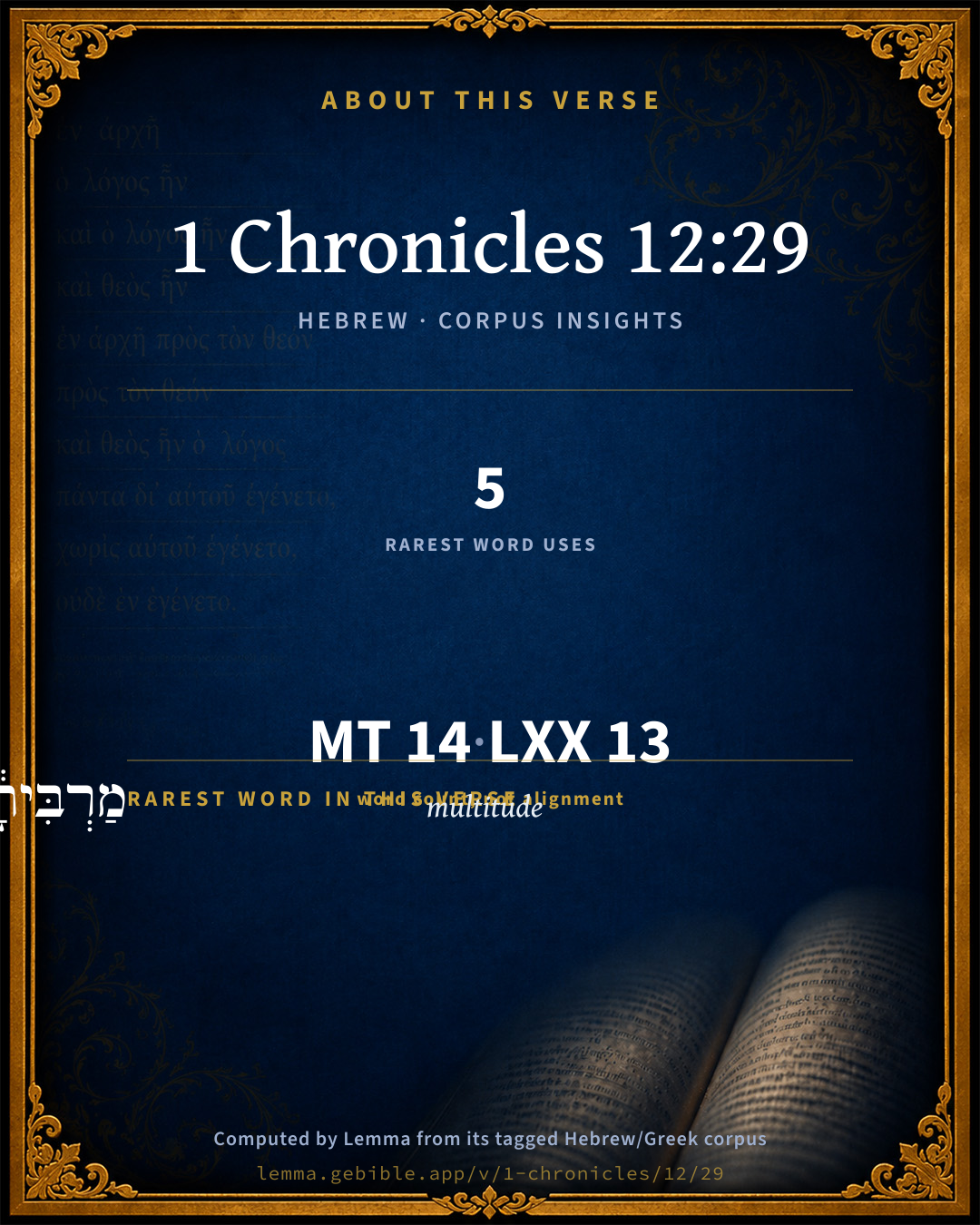
The rarest word here is מַרְבִּיתָ֔ם multitude H4768 — appearing just 5 times in the whole Hebrew Bible.

Shared distinctive vocabulary

מַרְבִּיתָ֔ם multitude H4768 occurs in 5 verses of the Hebrew Bible. Also found in:

Grammatical profile

  • 1 verb
  • 8 nouns
  • 2 adjectives
  • 2 prepositions
  • 1 adverb

Verb forms

  • שֹׁמְרִ֕ים Qal · Participle Active

Repetition

A word recurs within this verse — often emphatic in Hebrew:

  • שָׁא֖וּל Saul H7586 ×2

Hebrew & Septuagint length

In English translation the verse runs 27 words from the Hebrew and 27 from the Septuagint (LXX English) — the same length.

A rough comparison of the two English renderings, which tokenize alike — not a word-level alignment.

Word counts can differ between the Hebrew and the Greek without any difference in meaning — e.g. the Hebrew direct-object marker אֵת has no separate Greek word, and Greek often adds the article ὁ.

In the original languages it is 14 Hebrew tokens and 13 Greek tokens — but the two are counted differently (Hebrew bundles its prefixes and suffixes into one token; the Greek is in lemma form), so that isn’t a like-for-like length.

Cross-references

3

Topical passages linked to 1 Chronicles 12:29 in the Treasury of Scripture Knowledge — connected by theme and wording, ordered by reader-vote popularity; previews shown in the World English Bible.

  • 2 Samuel 2:8–9 Now Abner the son of Ner, captain of Saul's host, had taken Ish-bosheth the son of Saul, and brought him over to Mahanaim;
  • 1 Chronicles 12:2 They were armed with bows, and could use both the right hand and the left in slinging stones and in shooting arrows from the bow: they were of Saul's brothers of Benjamin.
  • Genesis 31:23 He took his relatives with him, and pursued after him seven days' journey. He overtook him in the mountain of Gilead.

Cross-references courtesy of OpenBible.info (CC BY 4.0).

Hebrew and Greek witnesses Masoretic Hebrew ↔ Greek Septuagint

The same verse in the two great witnesses to the Old Testament, shown verse-for-verse.

These are two independent witnesses, not word-aligned to each other, and the Septuagint is shown in lemma (dictionary) form.

Hebrew 1 Chronicles 12:29 Masoretic · Westminster Leningrad Codex

וּמִן בְּנֵ֧י בִנְיָמִ֛ן אֲחֵ֥י שָׁא֖וּל שְׁלֹ֣שֶׁת אֲלָפִ֑ים וְעַד הֵ֨נָּה֙ מַרְבִּיתָ֔ם שֹׁמְרִ֕ים מִשְׁמֶ֖רֶת בֵּ֥ית שָׁאֽוּל

Of the children of Benjamin, the brothers of Saul, three thousand: for hitherto the greatest part of them had kept their allegiance to the house of Saul.

World English Bible · Public Domain

Greek LXX 1 Chronicles 12:29 Septuagint · lemma form

καί σαδωκ νέος δυνατός ἰσχύς καί ὁ πατρικός οἰκία αὐτός ἄρχων εἴκοσι δύο

And of the sons of Benjamin, the brethren of Saul, three thousand: and still the greater part of them kept the guard of the house of Saul.

LXX2012 (modern English Septuagint) · Public Domain

Hebrew: Westminster Leningrad Codex (CC BY 4.0). Greek: Septuagint (public domain); English from LXX2012 (modern English Septuagint) (Public Domain). How the Septuagint differs from the Hebrew →

Commentary

Notes on 1 Chronicles 12:29 from classic Christian and Jewish commentators (each source and its license shown beneath its notes). The classic Christian expositions comment on the surrounding passage and are grouped to its opening verse, so a note may address several verses; the Jewish commentaries on the Tanakh (Rashi and others) are per-verse, so they appear only where the commentator wrote on this verse.

Lemma curates 59 commentaries, every one of them public domain or Creative Commons licensed, each selected and text-cleaned for this edition rather than reprinted as found. About our sources →

Trapp's Complete Commentary

John Trapp

1Ch 12:29 And of the children of Benjamin, the kindred of Saul, three thousand: for hitherto the greatest part of them had kept the ward of the house of Saul.

Ver. 29. Had kept the ward of the house of Saul.] Had done their utmost for Saul’s family, and to keep the royal dignity in their tribe, obeying before the commands of king Ishbosheth.

John Trapp, A Commentary or Exposition upon All the Books of the Old and New Testament (1647–1656) — public domain. Text from a community e-Sword module.

The Biblical Illustrator

Joseph S. Exell

1Ch_12:29

Until it was a great host.

The accumulation of power

It seems quite possible in the presence of this incident to find an easy statement of the law of the accumulation of power. The law may be stated thus: Persistent action in one direction brings, after a time, surprisingly added power for further action in that direction. Consider this--

1. In the accumulation of property.

2. As to the formation of habits.

3. As to increase in intellectual force.

4. As to advancing power in the spiritual life.

Lessons:

1. Be careful of the day. Day by day, because he day by day had been the man he was, they gathered to David. Especially towards the accumulation of any sort of power do not lose time in youth.

2. Have courage. Front towards such right accumulation of power, and this great law of its accumulation is steadily working for you.

3. This great law works as steadily the other way; e.g., King Saul, fronting and choosing wrong, was losing righteous power day by day, until at last he came to the sad wreck he made. (Wayland Hoyt, D. D.)

The Biblical Illustrator, edited by Joseph S. Exell (c. 1880s–1900s) — public domain. Text from a community e-Sword module.

Geneva Bible (1599)

Geneva Bible translators

That is, the greatest number took Saul’s part.

Geneva Bible (1599) marginal notes — public domain. Text via Bolls.life.

Jamieson, Fausset & Brown

Robert Jamieson, A. R. Fausset & David Brown

Benjamin . . . three thousand--This small number shows the unpopularity of the movement in this tribe; and, indeed, it is expressly stated that the mass of the population had, even after Ish-bosheth's death, anxiously endeavored to secure the crown in the family of Saul.

Jamieson, Fausset & Brown — Commentary Critical and Explanatory on the Whole Bible (1871) — public domain (CC PDM 1.0). Text via the HelloAO Bible API.

Ellicott's Commentary for English Readers

(29) Kindred.—Fellow-tribesmen.

Hitherto.—Up to that time. (Comp., same phrase, 1Ch_9:18.)

Had kept.—Were still keeping guard over the house of Saul. For the phrase comp. Num_3:38. The Benjamites, as a whole, were still jealously guarding the interests of their own royal house. This remark, as well as the preceding expression, “Saul’s fellow-tribesmen,” is intended to explain the comparative smallness of the contingent from Benjamin. The tribe’s reluctance to recognise David survived the murder of Ish-bosheth.

A Bible Commentary for English Readers, edited by Charles John Ellicott (1878–1897) — public domain. Text from a community e-Sword module.

The Cambridge Bible for Schools and Colleges

gen. ed. J. J. S. Perowne

29. hitherto] i.e. up to the time referred to in 2Sa_5:1.

kept the ward of the house of Saul] R.V. kept their allegiance to the house of Saul.

The Cambridge Bible for Schools and Colleges (gen. ed. J. J. S. Perowne; Cambridge University Press, 1878–1918) — public domain. Text from a community e-Sword module.

Albert Barnes' Notes on the Bible

For hitherto ... - Rather, “For still the greatest part of them maintained their allegiance to the house of Saul.” This is given as the reason for so few coming to Hebron. It shows us that, even after the death of Ishbosheth, the Benjamites had hopes of furnishing a third king to the nation.

Albert Barnes' Notes on the Bible (1834–1885) — public domain. Text from a community e-Sword/MySword module.

Haydock's Catholic Bible Commentary

Followed. Hebrew, "kept guard at the palace." These guards submitted to David, like the rest, after the death of Isboseth. (Calmet)

George Leo Haydock (1774–1849), Haydock's Catholic Family Bible and Commentary, 1859 edition — public domain. Excludes Psalms (Douay-Rheims chapter numbering differs from Protestant) and Deuterocanonical books (Catholic canon only).

Matthew Poole's English Annotations

i.e. Endeavoured to keep the crown in their own tribe, and in Saul’s family.

Matthew Poole's English Annotations on the Holy Bible (1683–1685) — public domain. Text from a community e-Sword/MySword module.

Whedon's Commentary on the Bible

Daniel D. Whedon

29. Benjamin… three thousand — A very great number could hardly be expected on this occasion from the tribe of Saul. Hence the writer adds, that hitherto, that is, up to that time, the greatest part of them had kept the ward (rather, were keeping charge) of the house of Saul. They still were adhering in sympathy and attachment to the house of their fallen king.

Daniel D. Whedon (gen. ed.), Commentary on the Old and New Testaments (1874–1909) — public domain. Text from a community e-Sword module.

The Pulpit Commentary

Had kept the ward; rather, had kept on the side of; the Hebrew, trmvmi Vulgate, adhuc sequebatur. The proposed translation of jnjeydz by "still" ("Speaker"s Commentary," in loc.) is very doubtful. The for hitherto of this verse explains the reason of the comparatively small number Of the Benjamites.

The Pulpit Commentary (1880–1919), ed. H.D.M. Spence-Jones & Joseph S. Exell — public domain. Text from a community e-Sword module.

John Wesley's Explanatory Notes

Kept the ward - endeavoured to keep the crown in Saul's family.

John Wesley, Explanatory Notes Upon the Whole Bible (1754–1765) — public domain. Text via the GEBible commentary corpus.

unfoldingWord translationNotes

Door43 World Missions Community

Connecting Statement:

This continues the list of the number of men who joined David from each tribe. (See: Numbers)

From Benjamin, Saul's tribe

"From Benjamin, the tribe to which Saul belonged"

three thousand ... eighteen thousand

"3,000 ... 18,000" (See: Numbers)

20,800 fighting men

"twenty thousand eight hundred fighting men" (See: Numbers)

From the Ephraimites

"From Ephraim" or "From the tribe of Ephraim"

translationWords

Benjamin

Saul (OT)

tribe

Ephraim

Manasseh

king

unfoldingWord translationNotes — © Distant Shores Media and the Door43 World Missions Community, licensed CC BY-SA 4.0. Source: git.door43.org/Door43/en_tn.

Rashi

Rabbi Shlomo Yitzchaki (Rashi)

And Zadok was a youth Therefore, do not wonder that he was not the ruler.

and his father’s house had twenty-two officers This is a great honor; therefore, they took the high priesthood from Ebiathar and gave it to Zadok the Priest.

Rashi on the Tanakh — English translations: “The Judaica Press complete Tanach with Rashi, translated by A. J. Rosenberg” (CC BY 4.0); “Pentateuch with Rashi's commentary by M. Rosenbaum and A.M. Silbermann, 1929-1934” (public domain); “The Metsudah Tanach series, Lakewood, N.J” (CC BY 4.0); and “The Book of Joshua, Metsudah Publications, 1997” (CC BY 4.0). Text via Sefaria.

Lesson kit

Teaching starters — assembled from the data on this page, not authored interpretation. Every prompt links to the verse data it draws on. Edit before teaching.

1 Chronicles, in the Historical, opens this verse with 14 words (13 distinct Hebrew lemmas). Its most distinctive word is marbîyth (“multitude”). A historical commentator’s framing appears above. Read the whole chapter for the surrounding context.

Discussion questions

  1. What does “multitude” (marbîyth) contribute to the verse as a whole?
  2. How does Leviticus 25:37, which shares the word «multitude», read alongside this verse?
  3. What does the repetition of “Saul” (2× in this one verse) do in this verse?
  4. These translations render this verse differently; the difference is in the English rendering, not the original. What questions does that raise?
  5. «שֹׁמְרִ֕ים» is a Qal Participle Active verb. How does that grammatical form shape the action described?
  6. Compare how Trapp's Complete Commentary and The Biblical Illustrator read this verse. Where do they agree or differ?

Things to notice

Reading settings

Reading text

Shown beneath each verse's original-language words.

Old Testament
Old Testament edition

Read the OT as the Masoretic Hebrew (MT) or the Greek Septuagint (LXX).

English shown for the Greek Septuagint (in the Hebrew ↔ Greek comparison).

Comparing translations? Open the Compare panel on any verse page to stack up to four side by side.