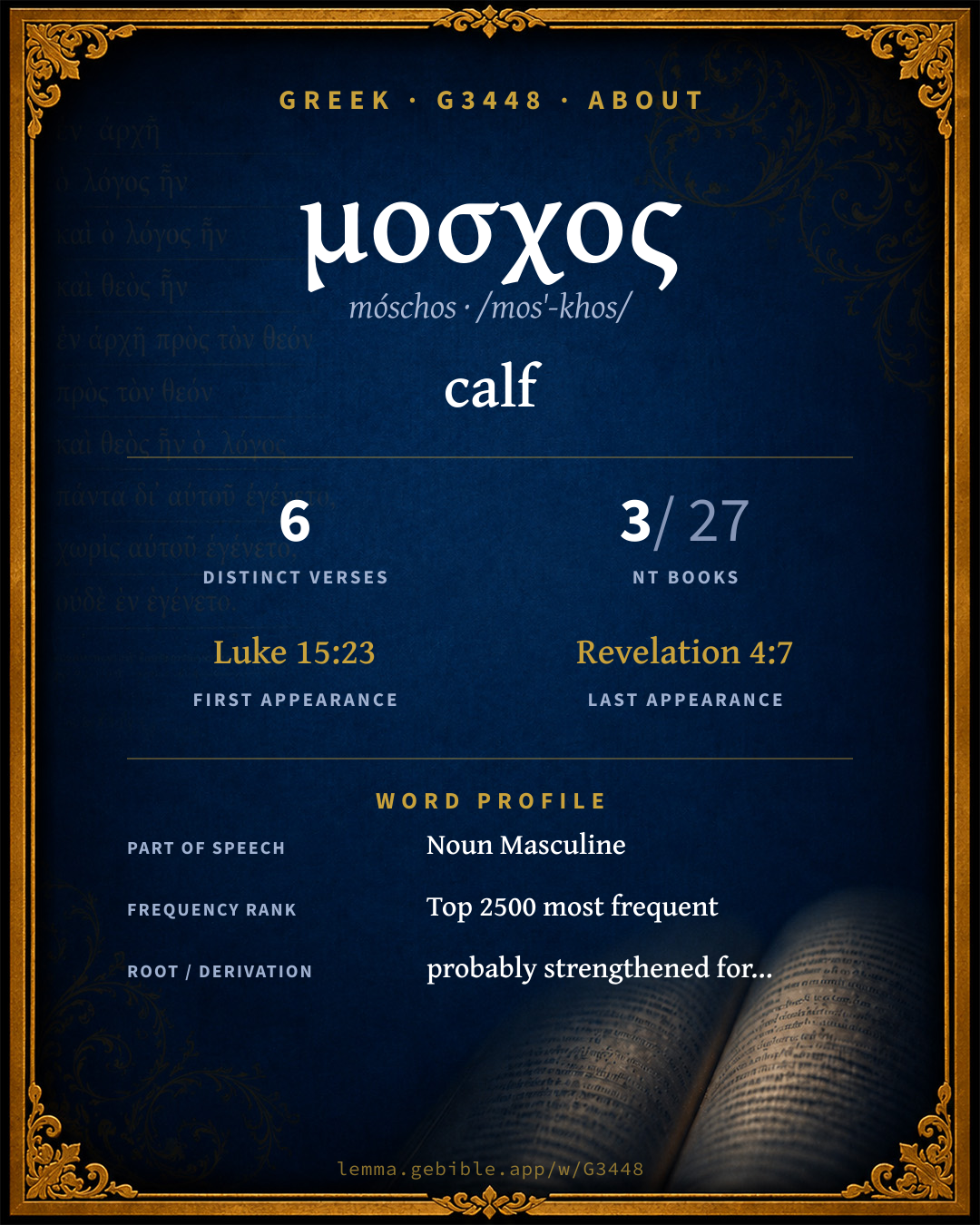
μόσχος
calf
‘calf’ is one of 3 main senses fuller range ↓
Full lexicon entry — Thayer's Greek Lexicon
From Thayer's Greek Lexicon
Where this word appears
See every Accusative-case word in the Greek New Testament →
Grammar key — what these labels mean
Part of speech
- Adjective
- A word that describes or qualifies a noun.
- Noun
- A naming word — a person, place, thing, or idea.
Case
- Accusative
- The case of the direct object and of extent.
- Genitive
- The case of source, possession, or “of” — answers “whose / from what.”
- Dative
- The case of the indirect object, means, or location — “to / for / with / in.”
Gender
- Masculine
- Grammatically masculine.
Number
- Singular
- One.
- Plural
- More than one.
2 distinct verses where G3448 appears in the Genitive case, across 1 book. Filtered view — show all forms. Click any verse to open its interlinear word-by-word view. Verse text shown in the World English Bible for context — . Each verse’s Greek form is shown with its reference; the English is not keyword-highlighted, since the data carries no word-level English alignment. Use “Compare translations” on any verse to read it across multiple English versions. This concordance covers the Greek New Testament; Septuagint (Greek Old Testament) occurrences of this word are not indexed here.
Hebrews 2 verses
- Hebrews 9:12 μόσχων n gen pl masc nor yet through the blood of goats and calves, but through his own blood, entered in once for all into the Holy Place, having obtained eternal redemption.
- Hebrews 9:19 μόσχων n gen pl masc For when every commandment had been spoken by Moses to all the people according to the law, he took the blood of the calves and the goats, with water and scarlet wool and hyssop, and sprinkled both the book itself and all the people,
About this entry
At a glance — auto-summarized from this page’s data, not written by a person. Every figure links to its source below. This summary describes the numbers; it doesn’t interpret them.
μοσχος (móschos) is a Greek noun most often rendered “calf.” Luke dominates its distribution — 3 of 6 verses. The Greek New Testament uses it across 6 verses — uncommon. Debuting at Luke 15:23, it then recurs through the corpus. Its lexical range runs to 3 senses. For the data behind this summary, explore the sense tree and the renderings breakdown below.
Gloss history
Strong's 1890 vs modern scholarship
About this word
Strong's G3448 catalogs a Greek word from the Greek New Testament.
These counts are not copied from any lexicon or concordance. They are computed here, from the morphology-tagged Greek New Testament. What Lemma adds →
- 6
- distinct verses
- The word appears in 6 distinct verses.
- 3 / 27
- NT books
- The word appears in 3 of 27 New Testament books.
- #1,476
- by frequency
- Top 2500 most frequent Greek words (rank 1,476 of 5,347 Greek words by occurrence).
View all 6 occurrences in the concordance →
Most concentrated in
- Luke 3 verses 50%
- Hebrews 2 verses 33%
- Revelation 1 verse 17%
By section of the New Testament
By traditional corpus
Conventional, traditional groupings — biblical authorship is debated, so this is a traditional corpus grouping, not an authorship claim. Some books belong to more than one corpus (Luke is in both the Gospels and the Lukan corpus, and so on), so these shares overlap and need not total 100%. Each figure is a share of the word’s 6 distinct verses.
- Gospels 3 verses · 50%
- Lukan (Luke–Acts) 3 verses · 50%
- Hebrews 2 verses · 33%
- Johannine 1 verse · 17%
- Revelation 1 verse · 17%
How translations render this word
Counts come from each version’s own published word-to-Strong’s tagging or interlinear alignment — an approximate guide to how each version renders this word, not a word-level alignment the data otherwise carries. Because each total is that version’s own tagged count, the per-version totals vary from one another and need not match the appearance or distinct-verse counts above. These counts may also differ from a printed concordance because Lemma counts each distinctly tagged rendering and does not collapse phrase taggings into a single head-word total. This is a fixed set of word-tagged versions (KJV, ASV, BSB, ULT) and does not change with the reading translation you choose elsewhere. Each version’s license is shown beside its name below (and on Sources).
- King James Version: Calf 4×, Calves 2×
- American Standard Version: Calf 4×, Calves 2×
- Berean Standard Bible: Calf 4×, Calves 2×
- unfoldingWord Literal Text: Calf 4×, Calves 2×
King James Version Public Domain
Renders G3448 across 6 tagged occurrences — most commonly:
American Standard Version Public Domain
Renders G3448 across 6 tagged occurrences — most commonly:
Berean Standard Bible Public Domain
Renders G3448 across 6 tagged occurrences — most commonly:
unfoldingWord Literal Text CC BY-SA 4.0
Renders G3448 across 6 tagged occurrences — most commonly:
Senses in Thayer's
The 3 senses Thayer's distinguishes for this word, in lexicon order (not ranked by frequency or importance). The full entry — with sub-senses — is in the Lexicon Entry tab.
- a sprout, of a plant or tree
- offspring
- a calf, a bullock, a heifer
Word origin
Origin: probably strengthened for oschos (a shoot)
Probably strengthened for ὄσχος oschos (a shoot ); a young bullock : - calf.
— Strong’s Exhaustive Concordance (1890), public domain.
Forms in the corpus
The 3 distinct written forms G3448 takes in the Greek New Testament, most frequent first — each parse links to that case’s occurrences in the concordance.
| Form | Parsing | Example | Uses |
|---|---|---|---|
| μόσχον móschon | Adjective, Accusative, Singular, Masculine | Luke 15:23 | 3 |
| μόσχων móschōn | Noun, Genitive, Plural, Masculine | Hebrews 9:12 | 2 |
| μόσχῳ móschō | Noun, Dative, Singular, Masculine | Revelation 4:7 | 1 |
Same root — word family
Other Thayer's entries built from the same root as G3448, grouped by Strong’s listed origin. These share a root / origin per the lexicon — not necessarily a shared meaning. Each links to that word’s own entry.
Derived from this word
Compare all same-root words → They share a root, not necessarily a meaning.
Septuagint usage
The same Greek word μοσχος appears 227 times in the Greek Old Testament (Septuagint), across 208 verses in 21 books.
- 227
- LXX occurrences
- Tagged occurrences of this Greek word in the Septuagint.
- 208
- verses
- Distinct Septuagint verses containing this word.
- 21 / 39
- OT books
- The word appears in 21 of the 39 Old Testament books.
Sample Septuagint occurrences
- Genesis 12:16 μόσχος
- Exodus 20:24 μόσχος
- Leviticus 1:5 μόσχος
- Numbers 7:3 μόσχος
- Deuteronomy 9:21 μόσχος
- Joshua 6:21 μόσχος
- Judges 6:25 μόσχος
- 1 Samuel 1:24 μόσχος
- 2 Samuel 6:6 μόσχος
- 1 Kings 1:9 μόσχος
- 1 Chronicles 12:41 μόσχος
- 2 Chronicles 4:3 μόσχος
Septuagint occurrences (same lexeme)
Every verse where the same Strong’s number (G3448) appears in the Greek Septuagint — showing the first 50 of 208. Verse text shown in the World English Bible for context; the Greek form is the matched word — the English is not keyword-highlighted.
- Genesis 12:16 μόσχος He dealt well with Abram for her sake. He had sheep, and oxen, and male donkeys, and men-servants, and maid-servants, and female donkeys, and camels.
- Genesis 20:14 μόσχος Abimelech took sheep and oxen, men-servants and women-servants, and gave them to Abraham, and restored Sarah, his wife to him.
- Genesis 21:27 μόσχος Abraham took sheep and oxen, and gave them to Abimelech. Those two made a covenant.
- Genesis 24:35 μόσχος Yahweh has blessed my master greatly. He has become great. He has given him flocks and herds, silver and gold, men-servants and maid-servants, and camels and donkeys.
- Exodus 20:24 μόσχος You shall make an altar of earth for me, and shall sacrifice on it your burnt offerings and your peace-offerings, your sheep and your oxen. In every place where I record my name I will come to you and I will bless you.
- Exodus 21:33 μόσχος "If a man opens a pit, or if a man digs a pit and doesn't cover it, and a bull or a donkey falls into it,
- Exodus 21:37 μόσχος
- Exodus 22:8 μόσχος If the thief isn't found, then the master of the house shall come near to God, to find out if he hasn't put his hand to his neighbor's goods.
- Exodus 22:9 μόσχος For every matter of trespass, whether it be for ox, for donkey, for sheep, for clothing, or for any kind of lost thing, about which one says, 'This is mine,' the cause of both parties shall come before God. He whom God condemns shall pay double to his neighbor.
- Exodus 22:29 μόσχος "You shall not delay to offer from your harvest and from the outflow of your presses. "You shall give the firstborn of your sons to me.
- Exodus 29:10 μόσχος "You shall bring the bull before the tent of meeting: and Aaron and his sons shall lay their hands on the head of the bull.
- Exodus 29:11 μόσχος You shall kill the bull before Yahweh, at the door of the tent of meeting.
- Exodus 29:12 μόσχος You shall take of the blood of the bull, and put it on the horns of the altar with your finger; and you shall pour out all the blood at the base of the altar.
- Exodus 29:14 μόσχος But the flesh of the bull, and its skin, and its dung, you shall burn with fire outside of the camp: it is a sin-offering.
- Exodus 32:4 μόσχος He received what they handed him, and fashioned it with an engraving tool, and made it a molten calf; and they said, "These are your gods, Israel, which brought you up out of the land of Egypt."
- Exodus 32:8 μόσχος They have turned aside quickly out of the way which I commanded them. They have made themselves a molten calf, and have worshiped it, and have sacrificed to it, and said, 'These are your gods, Israel, which brought you up out of the land of Egypt.'"
- Exodus 32:19 μόσχος It happened, as soon as he came near to the camp, that he saw the calf and the dancing: and Moses' anger grew hot, and he threw the tablets out of his hands, and broke them beneath the mountain.
- Exodus 32:20 μόσχος He took the calf which they had made, and burnt it with fire, ground it to powder, and scattered it on the water, and made the children of Israel drink of it.
- Exodus 32:24 μόσχος I said to them, 'Whoever has any gold, let them take it off:' so they gave it me; and I threw it into the fire, and out came this calf."
- Exodus 32:35 μόσχος Yahweh struck the people, because they made the calf, which Aaron made.
- Exodus 34:19 μόσχος All that opens the womb is mine; and all your cattle that is male, the firstborn of cow and sheep.
- Leviticus 1:5 μόσχος He shall kill the bull before Yahweh. Aaron's sons, the priests, shall present the blood and sprinkle the blood around on the altar that is at the door of the Tent of Meeting.
- Leviticus 4:3 μόσχος if the anointed priest sins so as to bring guilt on the people, then let him offer for his sin, which he has sinned, a young bull without blemish to Yahweh for a sin offering.
- Leviticus 4:4 μόσχος He shall bring the bull to the door of the Tent of Meeting before Yahweh; and he shall lay his hand on the head of the bull, and kill the bull before Yahweh.
- Leviticus 4:5 μόσχος The anointed priest shall take some of the blood of the bull, and bring it to the Tent of Meeting.
- Leviticus 4:7 μόσχος The priest shall put some of the blood on the horns of the altar of sweet incense before Yahweh, which is in the tent of meeting; and he shall pour out all the blood of the bull out at the base of the altar of burnt offering, which is at the door of the Tent of Meeting.
- Leviticus 4:8 μόσχος He shall take all the fat of the bull of the sin offering off of it; the fat that covers the innards, and all the fat that is on the innards,
- Leviticus 4:10 μόσχος as it is taken off of the ox of the sacrifice of peace offerings. The priest shall burn them on the altar of burnt offering.
- Leviticus 4:11 μόσχος The bull's skin, all its flesh, with its head, and with its legs, its innards, and its dung,
- Leviticus 4:12 μόσχος even the whole bull shall he carry forth outside the camp to a clean place, where the ashes are poured out, and burn it on wood with fire. Where the ashes are poured out it shall be burned.
- Leviticus 4:14 μόσχος when the sin in which they have sinned is known, then the assembly shall offer a young bull for a sin offering, and bring it before the Tent of Meeting.
- Leviticus 4:15 μόσχος The elders of the congregation shall lay their hands on the head of the bull before Yahweh; and the bull shall be killed before Yahweh.
- Leviticus 4:16 μόσχος The anointed priest shall bring of the blood of the bull to the Tent of Meeting:
- Leviticus 4:17 μόσχος and the priest shall dip his finger in the blood, and sprinkle it seven times before Yahweh, before the veil.
- Leviticus 4:20 μόσχος Thus shall he do with the bull; as he did with the bull of the sin offering, so shall he do with this; and the priest shall make atonement for them, and they shall be forgiven.
- Leviticus 4:21 μόσχος He shall carry forth the bull outside the camp, and burn it as he burned the first bull. It is the sin offering for the assembly.
- Leviticus 8:2 μόσχος "Take Aaron and his sons with him, and the garments, and the anointing oil, and the bull of the sin offering, and the two rams, and the basket of unleavened bread;
- Leviticus 8:14 μόσχος He brought the bull of the sin offering, and Aaron and his sons laid their hands on the head of the bull of the sin offering.
- Leviticus 8:17 μόσχος But the bull, and its skin, and its flesh, and its dung, he burned with fire outside the camp; as Yahweh commanded Moses.
- Leviticus 9:4 μόσχος and an ox and a ram for peace offerings, to sacrifice before Yahweh; and a meal offering mixed with oil: for today Yahweh appears to you.'"
- Leviticus 9:18 μόσχος He also killed the ox and the ram, the sacrifice of peace offerings, which was for the people: and Aaron's sons delivered to him the blood, which he sprinkled on the altar round about,
- Leviticus 9:19 μόσχος and the fat of the ox and of the ram, the fat tail, and that which covers the innards, and the kidneys, and the cover of the liver:
- Leviticus 16:3 μόσχος "Herewith shall Aaron come into the sanctuary: with a young bull for a sin offering, and a ram for a burnt offering.
- Leviticus 16:6 μόσχος "Aaron shall offer the bull of the sin offering, which is for himself, and make atonement for himself and for his house.
- Leviticus 16:11 μόσχος "Aaron shall present the bull of the sin offering, which is for himself, and shall make atonement for himself and for his house, and shall kill the bull of the sin offering which is for himself.
- Leviticus 16:14 μόσχος He shall take some of the blood of the bull, and sprinkle it with his finger on the mercy seat on the east; and before the mercy seat he shall sprinkle some of the blood with his finger seven times.
- Leviticus 16:15 μόσχος "Then he shall kill the goat of the sin offering, that is for the people, and bring his blood within the veil, and do with his blood as he did with the blood of the bull, and sprinkle it on the mercy seat, and before the mercy seat:
- Leviticus 16:18 μόσχος "He shall go out to the altar that is before Yahweh and make atonement for it, and shall take some of the bull's blood, and some of the goat's blood, and put it on the horns of the altar round about.
- Leviticus 16:27 μόσχος The bull for the sin offering, and the goat for the sin offering, whose blood was brought in to make atonement in the Holy Place, shall be carried forth outside the camp; and they shall burn their skins, their flesh, and their dung with fire.
- Leviticus 17:3 μόσχος Whatever man there is of the house of Israel, who kills an ox, or lamb, or goat, in the camp, or who kills it outside the camp,
These are occurrences of the same Greek lexeme (G3448) in the Septuagint — not a translation of any one Hebrew word. The store carries no word-level Hebrew↔Greek alignment, so no Hebrew original is asserted here. Counts come from the recovered LXX Strong's tagging — high-frequency vocabulary is well covered, while rare or late forms may be untagged — so they reflect tagged occurrences and may slightly undercount.