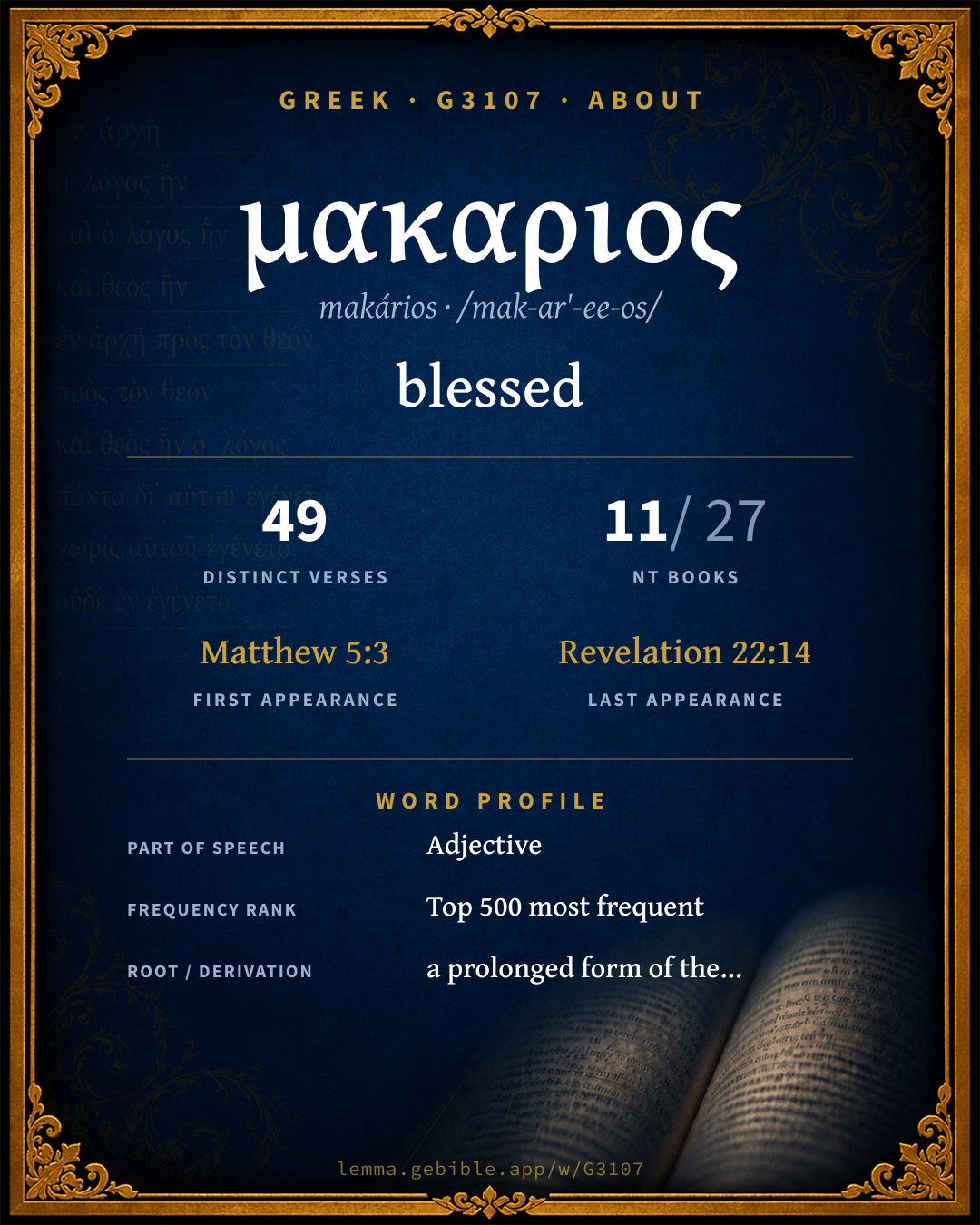
μακάριος
blessed
Full lexicon entry — Thayer's Greek Lexicon
From Thayer's Greek Lexicon
Where this word appears
See every Nominative-case word in the Greek New Testament →
Grammar key — what these labels mean
Part of speech
- Adjective
- A word that describes or qualifies a noun.
Case
- Nominative
- The case of the subject (and the predicate nominative).
- Accusative
- The case of the direct object and of extent.
- Genitive
- The case of source, possession, or “of” — answers “whose / from what.”
Gender
- Masculine
- Grammatically masculine.
- Feminine
- Grammatically feminine.
- Neuter
- Grammatically neuter.
Number
- Plural
- More than one.
- Singular
- One.
Degree
- Comparative
- Expresses a greater degree (“greater,” “more”).
Grammatical forms 9 distinct
- Adjective, Nominative, Plural, Masculine 26 times (52%)
- Adjective, Nominative, Singular, Masculine 16 times (32%)
- Adjective, Nominative, Singular, Feminine 2 times (4%)
- Adjective, Accusative, Singular, Feminine 1 time (2%)
- Adjective, Accusative, Singular, Masculine 1 time (2%)
- Adjective, Genitive, Singular, Masculine 1 time (2%)
- Adjective, Nominative, Plural, Feminine 1 time (2%)
- Adjective, Nominative, Singular, Feminine, Comparative 1 time (2%)
+1 more form (1 occurrence)
Parsed forms decoded from the imported morphology (Robinson–Tischendorf, public domain), counted across 50 parsed occurrences — not distinct verses.
Every verse where G3107 appears — 49 distinct verses across 11 books. Click any verse to open its interlinear word-by-word view. Verse text shown in the World English Bible for context — . Each verse’s Greek form is shown with its reference; the English is not keyword-highlighted, since the data carries no word-level English alignment. Use “Compare translations” on any verse to read it across multiple English versions. This concordance covers the Greek New Testament; Septuagint (Greek Old Testament) occurrences of this word are not indexed here.
Matthew 13 verses
- Matthew 5:3 μακάριοι adj nom pl masc "Blessed are the poor in spirit, For theirs is the Kingdom of Heaven.
- Matthew 5:4 μακάριοι adj nom pl masc Blessed are those who mourn, For they shall be comforted.
- Matthew 5:5 μακάριοι adj nom pl masc Blessed are the gentle, For they shall inherit the earth.
- Matthew 5:6 μακάριοι adj nom pl masc Blessed are those who hunger and thirst after righteousness, For they shall be filled.
- Matthew 5:7 μακάριοι adj nom pl masc Blessed are the merciful, For they shall obtain mercy.
- Matthew 5:8 μακάριοι adj nom pl masc Blessed are the pure in heart, For they shall see God.
- Matthew 5:9 μακάριοι adj nom pl masc Blessed are the peacemakers, For they shall be called children of God.
- Matthew 5:10 μακάριοι adj nom pl masc Blessed are those who have been persecuted for righteousness' sake, For theirs is the Kingdom of Heaven.
- Matthew 5:11 μακάριοί adj nom pl masc "Blessed are you when people reproach you, persecute you, and say all kinds of evil against you falsely, for my sake.
- Matthew 11:6 μακάριός adj nom sg masc Blessed is he who finds no occasion for stumbling in me."
- Matthew 13:16 μακάριοι adj nom pl masc "But blessed are your eyes, for they see; and your ears, for they hear.
- Matthew 16:17 μακάριος adj nom sg masc Jesus answered him, "Blessed are you, Simon Bar Jonah, for flesh and blood has not revealed this to you, but my Father who is in heaven.
- Matthew 24:46 μακάριος adj nom sg masc Blessed is that servant whom his lord finds doing so when he comes.
Luke 14 verses
- Luke 1:45 μακαρία adj nom sg fem Blessed is she who believed, for there will be a fulfillment of the things which have been spoken to her from the Lord!"
- Luke 6:20 μακάριοι adj nom pl masc He lifted up his eyes to his disciples, and said, "Blessed are you who are poor, For yours is the Kingdom of God.
- Luke 6:21 μακάριοι μακάριοι adj nom pl masc adj nom pl masc Blessed are you who hunger now, For you will be filled. Blessed are you who weep now, For you will laugh.
- Luke 6:22 μακάριοί adj nom pl masc Blessed are you when men shall hate you, and when they shall exclude and mock you, and throw out your name as evil, for the Son of Man's sake.
- Luke 7:23 μακάριός adj nom sg masc Blessed is he who is not offended by me."
- Luke 10:23 μακάριοι adj nom pl masc Turning to the disciples, he said privately, "Blessed are the eyes which see the things that you see,
- Luke 11:27 μακαρία adj nom sg fem It came to pass, as he said these things, a certain woman out of the multitude lifted up her voice, and said to him, "Blessed is the womb that bore you, and the breasts which nursed you!"
- Luke 11:28 μακάριοι adj nom pl masc But he said, "On the contrary, blessed are those who hear the word of God, and keep it."
- Luke 12:37 μακάριοι adj nom pl masc Blessed are those servants, whom the lord will find watching when he comes. Most assuredly I tell you, that he will dress himself, and make them recline, and will come and serve them.
- Luke 12:38 μακάριοί adj nom pl masc They will be blessed if he comes in the second or third watch, and finds them so.
- Luke 12:43 μακάριος adj nom sg masc Blessed is that servant whom his lord will find doing so when he comes.
- Luke 14:14 μακάριος adj nom sg masc and you will be blessed, because they don't have the resources to repay you. For you will be repaid in the resurrection of the righteous."
- Luke 14:15 μακάριος adj nom sg masc When one of those who sat at the table with him heard these things, he said to him, "Blessed is he who will feast in the Kingdom of God!"
- Luke 23:29 μακάριαι adj nom pl fem For behold, the days are coming in which they will say, 'Blessed are the barren, the wombs that never bore, and the breasts that never nursed.'
John 2 verses
Acts 2 verses
- Acts 20:35 μακάριόν adj nom sg neut In all things I gave you an example, that so laboring you ought to help the weak, and to remember the words of the Lord Jesus, that he himself said, 'It is more blessed to give than to receive.'"
- Acts 26:2 μακάριον adj acc sg masc "I think myself happy, King Agrippa, that I am to make my defense before you this day concerning all the things that I am accused by the Jews,
Romans 3 verses
- Romans 4:7 μακάριοι adj nom pl masc "Blessed are they whose iniquities are forgiven, Whose sins are covered.
- Romans 4:8 μακάριος adj nom sg masc Blessed is the man whom the Lord will by no means charge with sin."
- Romans 14:22 μακάριος adj nom sg masc Do you have faith? Have it to yourself before God. Happy is he who doesn't judge himself in that which he approves.
1 Corinthians 1 verse
1 Timothy 2 verses
Titus 1 verse
James 2 verses
- James 1:12 Μακάριος adj nom sg masc Blessed is the man who endures temptation, for when he has been approved, he will receive the crown of life, which the Lord promised to those who love him.
- James 1:25 μακάριος adj nom sg masc But he who looks into the perfect law, the law of freedom, and continues, not being a hearer who forgets but a doer of the work, this man will be blessed in what he does.
1 Peter 2 verses
- 1 Peter 3:14 μακάριοι adj nom pl masc But even if you should suffer for righteousness' sake, you are blessed. "Don't fear what they fear, neither be troubled."
- 1 Peter 4:14 μακάριοι adj nom pl masc If you are insulted for the name of Christ, blessed are you; because the Spirit of glory and of God rests on you. On their part he is blasphemed, but on your part he is glorified.
Revelation 7 verses
- Revelation 1:3 μακάριος adj nom sg masc Blessed is he who reads and those who hear the words of the prophecy, and keep the things that are written in it, for the time is at hand.
- Revelation 14:13 μακάριοι adj nom pl masc I heard the voice from heaven saying, "Write, 'Blessed are the dead who die in the Lord from now on.'" "Yes," says the Spirit, "that they may rest from their labors; for their works follow with them."
- Revelation 16:15 μακάριος adj nom sg masc "Behold, I come like a thief. Blessed is he who watches, and keeps his clothes, so that he doesn't walk naked, and they see his shame."
- Revelation 19:9 μακάριοι adj nom pl masc He said to me, "Write, 'Blessed are those who are invited to the marriage supper of the Lamb.'" He said to me, "These are true words of God."
- Revelation 20:6 μακάριος adj nom sg masc Blessed and holy is he who has part in the first resurrection. Over these, the second death has no power, but they will be priests of God and of Christ, and will reign with him one thousand years.
- Revelation 22:7 μακάριος adj nom sg masc "Behold, I come quickly. Blessed is he who keeps the words of the prophecy of this book."
- Revelation 22:14 μακάριοι adj nom pl masc Blessed are those who do his commandments, that they may have the right to the tree of life, and may enter in by the gates into the city.
About this entry
At a glance — auto-summarized from this page’s data, not written by a person. Every figure links to its source below. This summary describes the numbers; it doesn’t interpret them.
At its core, μακαριος (makários) means “blessed.” Scripture first uses it in Matthew 5:3. It turns up in 49 verses across 11 books, a moderately common footprint. The word gravitates to Luke (29%), then Matthew and Revelation. It shares a root with μακαριζω. Dig into 49-verse concordance and the renderings breakdown below.
Gloss history
Strong's 1890 vs modern scholarship
About this word
Strong's G3107 catalogs a Greek word from the Greek New Testament.
These counts are not copied from any lexicon or concordance. They are computed here, from the morphology-tagged Greek New Testament. What Lemma adds →
- 49
- distinct verses
- The word appears in 49 distinct verses.
- 11 / 27
- NT books
- The word appears in 11 of 27 New Testament books.
- #310
- by frequency
- Top 500 most frequent Greek words (rank 310 of 5,347 Greek words by occurrence).
View all 49 occurrences in the concordance →
Most concentrated in
- Luke 14 verses 29%
- Matthew 13 verses 27%
- Revelation 7 verses 14%
By section of the New Testament
By traditional corpus
Conventional, traditional groupings — biblical authorship is debated, so this is a traditional corpus grouping, not an authorship claim. Some books belong to more than one corpus (Luke is in both the Gospels and the Lukan corpus, and so on), so these shares overlap and need not total 100%. Each figure is a share of the word’s 49 distinct verses.
- Gospels 29 verses · 59%
- Lukan (Luke–Acts) 16 verses · 33%
- Johannine 9 verses · 18%
- Pauline corpus 7 verses · 14%
- Revelation 7 verses · 14%
- General (Catholic) Epistles 4 verses · 8%
How translations render this word
Counts come from each version’s own published word-to-Strong’s tagging or interlinear alignment — an approximate guide to how each version renders this word, not a word-level alignment the data otherwise carries. Because each total is that version’s own tagged count, the per-version totals vary from one another and need not match the appearance or distinct-verse counts above. These counts may also differ from a printed concordance because Lemma counts each distinctly tagged rendering and does not collapse phrase taggings into a single head-word total. This is a fixed set of word-tagged versions (KJV, ASV, BSB, ULT) and does not change with the reading translation you choose elsewhere. Each version’s license is shown beside its name below (and on Sources).
- King James Version: Blessed 42×, Happy 5×
- American Standard Version: Blessed 43×, Happy 2×
- Berean Standard Bible: Blessed 48×
- unfoldingWord Literal Text: Blessed 47×, Are 21×, Is 9×
King James Version Public Domain
Renders G3107 across 50 tagged occurrences — most commonly:
Plus 3 renderings that appear only once — usually multi-word phrases or single function words the recovered tagging swept in, not distinct renderings.
American Standard Version Public Domain
Renders G3107 across 49 tagged occurrences — most commonly:
Plus 4 renderings that appear only once — usually multi-word phrases or single function words the recovered tagging swept in, not distinct renderings.
Berean Standard Bible Public Domain
Renders G3107 across 50 tagged occurrences — most commonly:
Plus 2 renderings that appear only once — usually multi-word phrases or single function words the recovered tagging swept in, not distinct renderings.
unfoldingWord Literal Text CC BY-SA 4.0
Renders G3107 across 81 tagged occurrences — most commonly:
Plus 4 renderings that appear only once — usually multi-word phrases or single function words the recovered tagging swept in, not distinct renderings.
Senses in Thayer's
The 1 sense Thayer's distinguishes for this word, in lexicon order (not ranked by frequency or importance). The full entry — with sub-senses — is in the Lexicon Entry tab.
- blessed, happy
Word origin
Origin: a prolonged form of the poetical makar (meaning the same)
A prolonged form of the poetical μάκαρ makar (meaning the same); supremely blest ; by extension fortunate well off : - blessed happy (X -ier).
— Strong’s Exhaustive Concordance (1890), public domain.
Forms in the corpus
The 12 distinct written forms G3107 takes in the Greek New Testament, most frequent first — each parse links to that case’s occurrences in the concordance.
| Form | Parsing | Example | Uses |
|---|---|---|---|
| μακάριοι makárioi | Adjective, Nominative, Plural, Masculine | Matthew 5:3 | 22 |
| μακάριος makários | Adjective, Nominative, Singular, Masculine | Matthew 16:17 | 13 |
| μακάριοί makárioí | Adjective, Nominative, Plural, Masculine | Matthew 5:11 | 4 |
| μακάριός makáriós | Adjective, Nominative, Singular, Masculine | Matthew 11:6 | 2 |
| μακαρία makaría | Adjective, Nominative, Singular, Feminine | Luke 1:45 | 2 |
| Μακάριος Makários | Adjective, Nominative, Singular, Masculine | James 1:12 | 1 |
| μακάριαι makáriai | Adjective, Nominative, Plural, Feminine | Luke 23:29 | 1 |
| μακάριον makárion | Adjective, Accusative, Singular, Masculine | Acts 26:2 | 1 |
| μακάριόν makárión | Adjective, Nominative, Singular, Neuter | Acts 20:35 | 1 |
| μακαρίαν makarían | Adjective, Accusative, Singular, Feminine | Titus 2:13 | 1 |
| μακαρίου makaríou | Adjective, Genitive, Singular, Masculine | 1 Timothy 1:11 | 1 |
| μακαριωτέρα makariōtéra | Adjective, Nominative, Singular, Feminine, Comparative | 1 Corinthians 7:40 | 1 |
Same root — word family
Other Thayer's entries built from the same root as G3107, grouped by Strong’s listed origin. These share a root / origin per the lexicon — not necessarily a shared meaning. Each links to that word’s own entry.
Derived from this word
Compare all same-root words → They share a root, not necessarily a meaning.
Septuagint usage
The same Greek word μακαριος appears 42 times in the Greek Old Testament (Septuagint), across 40 verses in 10 books.
- 42
- LXX occurrences
- Tagged occurrences of this Greek word in the Septuagint.
- 40
- verses
- Distinct Septuagint verses containing this word.
- 10 / 39
- OT books
- The word appears in 10 of the 39 Old Testament books.
Sample Septuagint occurrences
- Genesis 30:13 μακάριος
- Deuteronomy 33:29 μακάριος
- 1 Kings 10:8 μακάριος
- 2 Chronicles 9:7 μακάριος
- Job 5:17 μακάριος
- Psalms 1:1 μακάριος
- Proverbs 3:13 μακάριος
- Ecclesiastes 10:17 μακάριος
- Isaiah 30:18 μακάριος
- Daniel 12:12 μακάριος
Septuagint occurrences (same lexeme)
Every verse where the same Strong’s number (G3107) appears in the Greek Septuagint. Verse text shown in the World English Bible for context; the Greek form is the matched word — the English is not keyword-highlighted.
- Genesis 30:13 μακάριος Leah said, "Happy am I, for the daughters will call me happy." She named him Asher.
- Deuteronomy 33:29 μακάριος Happy are you, Israel: Who is like you, a people saved by Yahweh, The shield of your help, The sword of your excellency! Your enemies shall submit themselves to you; You shall tread on their high places.
- 1 Kings 10:8 μακάριος Happy are your men, happy are these your servants, who stand continually before you, [and] who hear your wisdom.
- 2 Chronicles 9:7 μακάριος Happy are your men, and happy are these your servants, who stand continually before you, and hear your wisdom.
- Job 5:17 μακάριος "Behold, happy is the man whom God corrects: Therefore do not despise the chastening of the Almighty.
- Psalms 1:1 μακάριος Blessed is the man who doesn't walk in the counsel of the wicked, Nor stand in the way of sinners, Nor sit in the seat of scoffers;
- Psalms 2:12 μακάριος Kiss the son, lest he be angry, and you perish in the way, For his wrath will soon be kindled. Blessed are all those who take refuge in him.
- Psalms 31:1 μακάριος In you, Yahweh, I take refuge. Let me never be disappointed: Deliver me in your righteousness.
- Psalms 31:2 μακάριος Bow down your ear to me. Deliver me speedily. Be to me a strong rock, A house of defense to save me.
- Psalms 32:12 μακάριος
- Psalms 33:9 μακάριος For he spoke, and it was done. He commanded, and it stood firm.
- Psalms 39:5 μακάριος Behold, you have made my days handbreadths. My lifetime is as nothing before you. Surely every man stands as a breath." Selah.
- Psalms 40:2 μακάριος He brought me up also out of a horrible pit, Out of the miry clay. He set my feet on a rock, And gave me a firm place to stand.
- Psalms 64:5 μακάριος They encourage themselves in evil plans. They talk about laying snares secretly. They say, "Who will see them?"
- Psalms 83:5 μακάριος For they have conspired together with one mind. They form an alliance against you.
- Psalms 83:6 μακάριος The tents of Edom and the Ishmaelites; Moab, and the Hagrites;
- Psalms 83:13 μακάριος My God, make them like tumbleweed; Like chaff before the wind.
- Psalms 88:16 μακάριος Your fierce wrath has gone over me. Your terrors have cut me off.
- Psalms 93:12 μακάριος
- Psalms 105:3 μακάριος Glory in his holy name. Let the heart of those who seek Yahweh rejoice.
- Psalms 111:1 μακάριος Praise Yah! I will give thanks to Yahweh with my whole heart, In the council of the upright, and in the congregation.
- Psalms 118:1 μακάριος Give thanks to Yahweh, for he is good, For his loving kindness endures forever.
- Psalms 118:2 μακάριος Let Israel now say That his loving kindness endures forever.
- Psalms 126:5 μακάριος Those who sow in tears will reap in joy.
- Psalms 127:1 μακάριος Unless Yahweh builds the house, They labor in vain who build it. Unless Yahweh watches over the city, The watchman guards it in vain.
- Psalms 127:2 μακάριος It is vain for you to rise up early, To stay up late, Eating the bread of toil; For he gives sleep to his loved ones.
- Psalms 136:8 μακάριος The sun to rule by day; For his loving kindness endures forever;
- Psalms 136:9 μακάριος The moon and stars to rule by night; For his loving kindness endures forever:
- Psalms 143:15 μακάριος
- Psalms 145:5 μακάριος Of the glorious majesty of your honor, Of your wondrous works, I will meditate.
- Proverbs 3:13 μακάριος Happy is the man who finds wisdom, The man who gets understanding.
- Proverbs 8:34 μακάριος Blessed is the man who hears me, Watching daily at my gates, Waiting at my door posts.
- Proverbs 20:7 μακάριος A righteous man walks in integrity. Blessed are his children after him.
- Proverbs 28:14 μακάριος Blessed is the man who always fears; But one who hardens his heart falls into trouble.
- Ecclesiastes 10:17 μακάριος Happy are you, land, when your king is the son of nobles, And your princes eat in due season, For strength, and not for drunkenness!
- Isaiah 30:18 μακάριος Therefore will Yahweh wait, that he may be gracious to you; and therefore will he be exalted, that he may have mercy on you: for Yahweh is a God of justice; blessed are all those who wait for him.
- Isaiah 31:9 μακάριος His rock shall pass away by reason of terror, and his princes shall be dismayed at the ensign, says Yahweh, whose fire is in Zion, and his furnace in Jerusalem.
- Isaiah 32:20 μακάριος Blessed are you who sow beside all waters, who send forth the feet of the ox and the donkey.
- Isaiah 56:2 μακάριος Blessed is the man who does this, and the son of man who holds it fast; who keeps the Sabbath from profaning it, and keeps his hand from doing any evil.
- Daniel 12:12 μακάριος Blessed is he who waits, and comes to the one thousand three hundred thirty-five days.
These are occurrences of the same Greek lexeme (G3107) in the Septuagint — not a translation of any one Hebrew word. The store carries no word-level Hebrew↔Greek alignment, so no Hebrew original is asserted here. Counts come from the recovered LXX Strong's tagging — high-frequency vocabulary is well covered, while rare or late forms may be untagged — so they reflect tagged occurrences and may slightly undercount.