
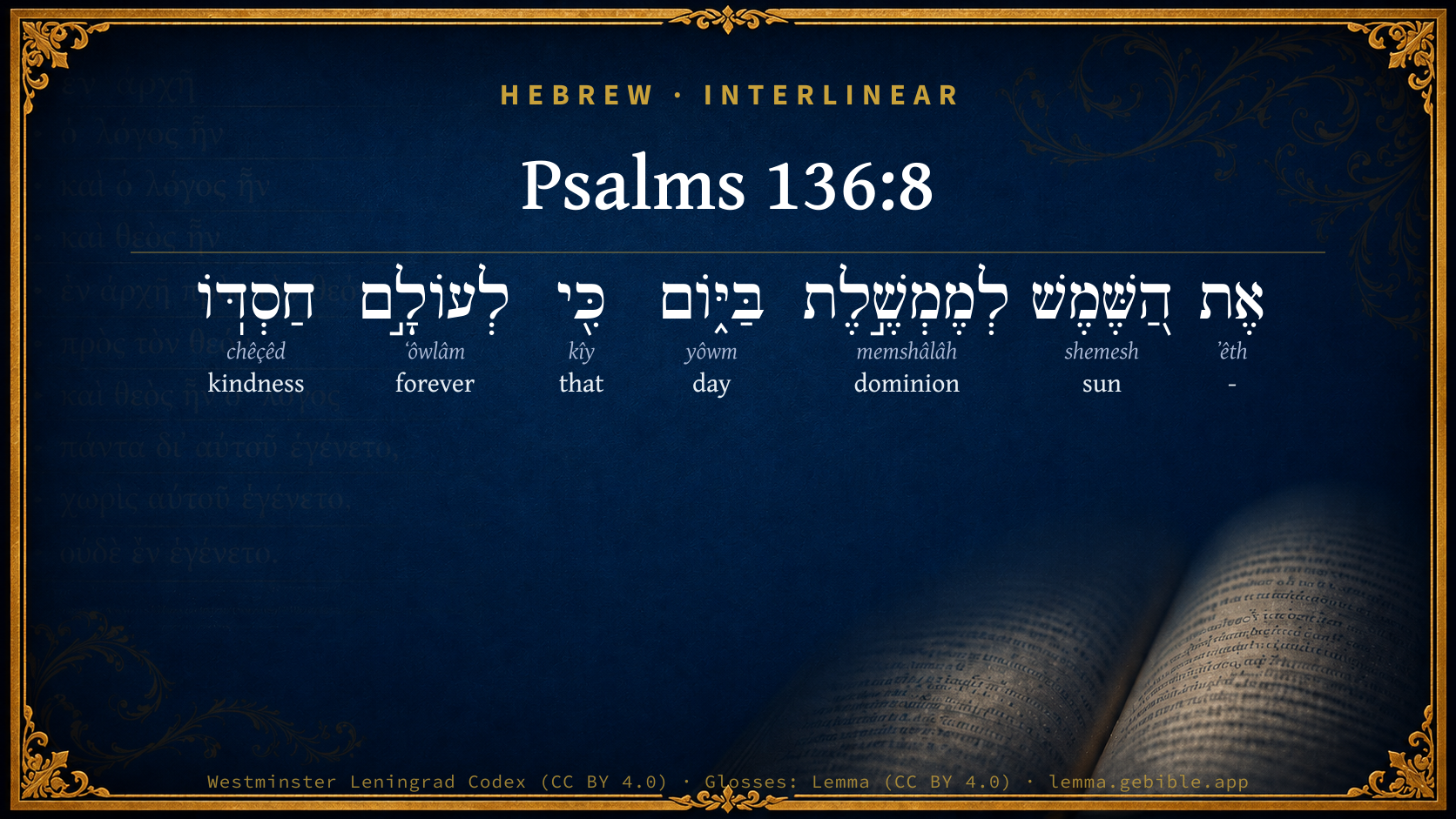
Psalms 136:8

Hebrew (Westminster Leningrad Codex) Psalms 136:8 appears in the Hebrew Old Testament. The text above is from the Westminster Leningrad Codex. Each word links to its Strong’s number, a concise gloss, and parsing drawn from the Open Scriptures Hebrew Bible morphology. Click any word for its full Brown-Driver-Briggs (BDB) entry.
Download image
Cite this verse

Psalms 136:8 (World English Bible). Public Domain. Lemma interlinear Bible study tool, https://lemma.gebible.app/v/psalms/136/8.

Show BibTeX & RIS
BibTeX
RIS
English Translation
The sun to rule by day; For his loving kindness endures forever;
World English Bible · Public Domain
Download a study sheet

One document with this verse’s original text, its word-by-word gloss line, the meaning frame, cross-references with their text, attributed commentary, and full source and license credits — printable, and it pastes into notes with its structure intact.

This verse Autodidact and up

Study sheet (.html) Plain text (.txt)

A passage Seminary Student

Up to 50 verses in one chapter. A passage sheet keeps up to 6 commentary sources and 12 cross-references per verse, in the order this page ranks them, and says so on the sheet whenever that leaves anything out. Ask for a single verse and you get the Autodidact verse sheet above.

Everything on this page stays free to read, with no account — the sheet is a download of what is already on screen, not access to it.

Want to remove ads? Support Godless Engineer
Compare translations 3

The same verse in 3 English versions, stacked beneath the original-language interlinear above. Click any original word for its lexicon entry.

Each is an independent rendering of the whole verse — the interlinear is not word-aligned to these translations.

Highlighted words mark where these versions differ — a whole-verse word diff, not a word-by-word alignment.

  • World English Bible Public Domain
    The sun to rule by day; For his loving kindness endures forever;
  • King James Version Public Domain
    The sun to rule by day: for his mercy endureth for ever:
  • unfoldingWord Literal Text CC BY-SA 4.0
    the sun for dominion in the day, for his covenant faithfulness to forever,

unfoldingWord Literal Text — © unfoldingWord, licensed CC BY-SA 4.0. Word-aligned USFM3 via Door43 (git.door43.org/unfoldingWord/en_ult).

Versions to compare (up to 4)

3 of 4 selected

Show all 18 translations

Every available English version of this verse, each an independent rendering of the whole verse.

  • World English Bible Public Domain
    The sun to rule by day; For his loving kindness endures forever;
  • Berean Standard Bible Public Domain
    the sun to rule the day, His loving devotion endures forever.
  • Majority Standard Bible Public Domain
    the sun to rule the day, His loving devotion endures forever.
  • King James Version Public Domain
    The sun to rule by day: for his mercy endureth for ever:
  • American Standard Version (1901) Public Domain
    The sun to rule by day; For his lovingkindness `endureth' for ever;
  • Revised Version (1885) Public Domain
    The sun to rule by day: for his mercy endureth for ever:
  • Geneva Bible (1599) Public Domain
    As the sunne to rule the day: for his mercie endureth for euer:
  • Douay-Rheims (1899) Public Domain
    He slew the firstborn of Egypt from man even unto beast.
  • Young's Literal Translation Public Domain
    The sun to rule by day, For to the age `is' His kindness.
  • Literal Standard Version CC BY-SA 4.0
    The sun to rule by day, || For His kindness [is] for all time.
  • Unlocked Literal Bible CC BY-SA 4.0
    Give thank to him who gave the sun to rule by day, for his covenant faithfulness endures forever—
  • unfoldingWord Literal Text CC BY-SA 4.0
    the sun for dominion in the day, for his covenant faithfulness to forever,
  • Darby Bible Public Domain
    The sun for rule over the day, for his loving-kindness [endureth] for ever,
  • World Messianic Bible Public Domain
    the sun to rule by day, for his loving kindness endures forever;
  • Webster's Bible Public Domain
    The sun to rule by day: for his mercy endureth for ever:
  • Free Bible Version CC BY-SA 4.0
    The sun to rule the day. For his trustworthy love lasts forever.
  • Bible in Basic English Public Domain
    The sun to have rule by day: for his mercy is unchanging for ever.
  • JPS Tanakh (1917) Public Domain
    The sun to rule by day, for His mercy endureth for ever;

Literal Standard Version (2020), Covenant Press — licensed CC BY-SA 4.0. Text via the HelloAO Bible API (eBible.org). Unlocked Literal Bible (unfoldingWord) — licensed CC BY-SA 4.0. Text via the HelloAO Bible API (eBible.org). unfoldingWord Literal Text — © unfoldingWord, licensed CC BY-SA 4.0. Word-aligned USFM3 via Door43 (git.door43.org/unfoldingWord/en_ult). Free Bible Version, Dr. Jonathan Gallagher — licensed CC BY-SA 4.0. Text via the HelloAO Bible API (eBible.org).

Word by word

More ways to search: Search by grammar → Find every occurrence → Compare this word →

Practice this passage: Drill this verse → Learn its vocabulary →

About this verse

These counts appear in no published source. They are computed here, from the morphology-tagged text and Lemma’s own curated glosses. What Lemma adds →

7
words
7
distinct lemmas
Wisdom
section

Notable vocabulary

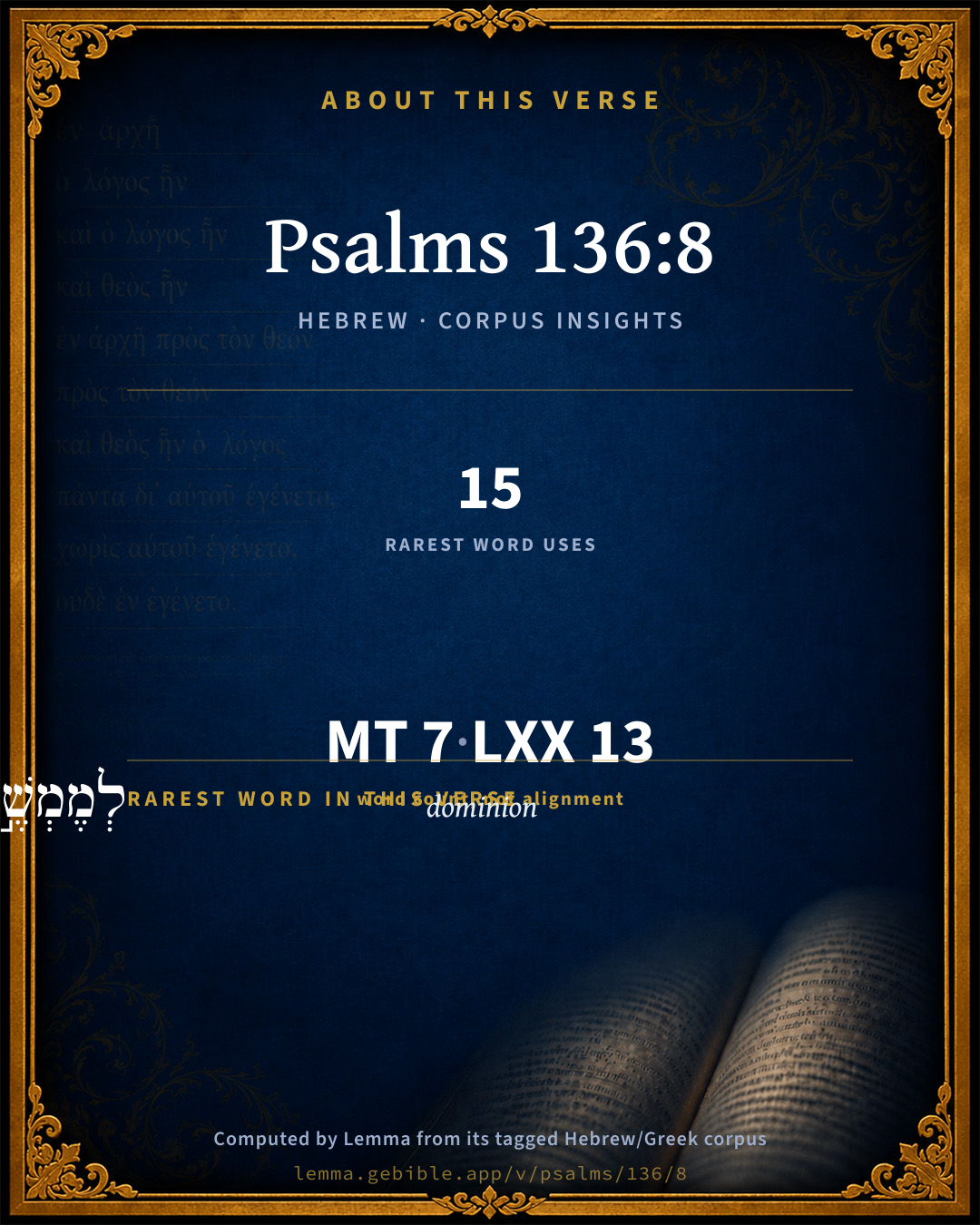
The rarest word here is לְמֶמְשֶׁ֣לֶת dominion H4475 — appearing just 15 times in the whole Hebrew Bible.

Shared distinctive vocabulary

לְמֶמְשֶׁ֣לֶת dominion H4475 occurs in 14 verses of the Hebrew Bible. Also found in:

Grammatical profile

  • 5 nouns
  • 1 conjunction
  • 1 particle

Hebrew & Septuagint length

In English translation the verse runs 12 words from the Hebrew and 12 from the Septuagint (LXX English) — the same length.

A rough comparison of the two English renderings, which tokenize alike — not a word-level alignment.

Word counts can differ between the Hebrew and the Greek without any difference in meaning — e.g. the Hebrew direct-object marker אֵת has no separate Greek word, and Greek often adds the article ὁ.

In the original languages it is 7 Hebrew tokens and 13 Greek tokens — but the two are counted differently (Hebrew bundles its prefixes and suffixes into one token; the Greek is in lemma form), so that isn’t a like-for-like length.

Cross-references

4

Topical passages linked to Psalms 136:8 in the Treasury of Scripture Knowledge — connected by theme and wording, ordered by reader-vote popularity; previews shown in the World English Bible.

  • Psalms 148:3 Praise him, sun and moon! Praise him, all you shining stars!
  • Genesis 1:16 God made the two great lights: the greater light to rule the day, and the lesser light to rule the night. He also made the stars.
  • Jeremiah 31:35 Thus says Yahweh, who gives the sun for a light by day, and the ordinances of the moon and of the stars for a light by night, who stirs up the sea, so that the waves of it roar; Yahweh of hosts is his name:
  • Matthew 5:45 that you may be children of your Father who is in heaven. For he makes his sun to rise on the evil and the good, and sends rain on the just and the unjust.

Cross-references courtesy of OpenBible.info (CC BY 4.0).

Hebrew and Greek witnesses Masoretic Hebrew ↔ Greek Septuagint

The same verse in the two great witnesses to the Old Testament, shown verse-for-verse.

You’re reading Greek Psalm 135 (Hebrew Psalm 136). The Septuagint counts the superscription, so verse numbers can differ from the Hebrew — chapter-level alignment, not verse-by-verse. Numbering follows Rahlfs.

These are two independent witnesses, not word-aligned to each other, and the Septuagint is shown in lemma (dictionary) form.

Hebrew Psalms 136:8 Masoretic · Westminster Leningrad Codex

אֶת הַ֭שֶּׁמֶשׁ לְמֶמְשֶׁ֣לֶת בַּיּ֑וֹם כִּ֖י לְעוֹלָ֣ם חַסְדּֽוֹ

The sun to rule by day; For his loving kindness endures forever;

World English Bible · Public Domain

Greek LXX Greek Psalm 135:8 Septuagint · lemma form

ὁ ἥλιος εἰς ἐξουσία ὁ ἡμέρα ὅτι εἰς ὁ αἰών ὁ ἔλεος αὐτός

The sun to rule by day; for his mercy endures for ever.

LXX2012 (modern English Septuagint) · Public Domain

Hebrew: Westminster Leningrad Codex (CC BY 4.0). Greek: Septuagint (public domain); English from LXX2012 (modern English Septuagint) (Public Domain). How the Septuagint differs from the Hebrew →

Commentary

Notes on Psalms 136:8 from classic Christian and Jewish commentators (each source and its license shown beneath its notes). The classic Christian expositions comment on the surrounding passage and are grouped to its opening verse, so a note may address several verses; the Jewish commentaries on the Tanakh (Rashi and others) are per-verse, so they appear only where the commentator wrote on this verse.

Lemma curates 59 commentaries, every one of them public domain or Creative Commons licensed, each selected and text-cleaned for this edition rather than reprinted as found. About our sources →

Trapp's Complete Commentary

John Trapp

Psa 136:8 The sun to rule by day: for his mercy [endureth] for ever:

Ver. 8. The sun to rule by day] Heb. for the rulings by day, sc. by his light, heat, motion, and influences, whereby he worketh upon these inferior bodies, being a servant to all, as his name importeth, notwithstanding his ruledom; and therefore in no wise to have been worshipped.

John Trapp, A Commentary or Exposition upon All the Books of the Old and New Testament (1647–1656) — public domain. Text from a community e-Sword module.

J. A. Alexander on Psalms

Joseph Addison Alexander

8. (Psa 136:8) The sun to rule by day--for unto eternity (is) his mercy. The musical design of the composition is especially observable where the burden or chorus is interposed between inseparable parts of the same sentence, as in this one, the substance of which is borrowed from Gen 1:16, but with some change both in the words and the construction.

Joseph Addison Alexander, The Psalms Translated and Explained (1850) — public domain. Text from a community e-Sword module.

The Cambridge Bible for Schools and Colleges

gen. ed. J. J. S. Perowne

8. O give thanks unto him that maketh a horn to sprout for the house of David (Psa_132:17), for &c.

The Cambridge Bible for Schools and Colleges (gen. ed. J. J. S. Perowne; Cambridge University Press, 1878–1918) — public domain. Text from a community e-Sword module.

John Gill's Exposition

The sun to rule by day,.... Which is the greater light, Gen 1:16;

for his mercy endureth for ever: this great light, so beneficial to the earth and the inhabitants of it, which was made near six thousand years ago, still continues, and will to the end of time; enlightening the world, warming the air and earth, imparting its light and heat to all creatures on it, and influencing the earth to bring forth a variety of things for the use and delight of mankind, called "the precious things brought forth by the sun", Deu 33:14; an emblem of a more beneficial light, in which the rich grace and mercy of God appear, and for which we have reason to give thanks; even the sun of righteousness, the Messiah, the light of the world, the author of the light of nature, grace, and glory; and who will continue as long as the sun, and when that shall be no more, Mal 4:2.

John Gill's Exposition of the Whole Bible (1746–1763) — public domain (CC PDM 1.0). Text via the HelloAO Bible API.

Albert Barnes' Notes on the Bible

The sun to rule by day - Gen 1:16. Margin, as in Hebrew, for the ruling of the day. That is, to control, as it were, the day; to determine its length - its beginning - its ending - to make it what it is.

For his mercy ... - By all the blessings of day as distinguished from night and darkness - by all that the sun in his daily course does to diffuse life, joy, peace, comfort, happiness on the earth - by all that are warmed by its beams, cheered by its light, guided in labor, guarded from dangers - do we derive an argument for the mercy of God; by all this there is laid a foundation for his praise.

Albert Barnes' Notes on the Bible (1834–1885) — public domain. Text from a community e-Sword/MySword module.

Matthew Poole's English Annotations

The sun to rule by day; of which phrase and the like in the next verse, See Poole "Gen 1:16".

Matthew Poole's English Annotations on the Holy Bible (1683–1685) — public domain. Text from a community e-Sword/MySword module.

The Treasury of David

Charles H. Spurgeon

Ver. 8. The sun to rule by day. We cannot be too specific in our praises; after mentioning great lights, we may sing of each of them, and yet not outwear our theme. The influences of the sun are too many for us to enumerate them all, but untold benefits come to all orders of beings by its light, warmth, and other operations. Whenever we sit in the sunshine, our gratitude should be kindled. The sun is a great ruler, and his government is pure beneficence, because by God's mercy it is moderated to our feebleness; let all who rule take lessons from the sun which rules to bless. By day we may well give thanks, for God gives cheer. The sun rules because God rules; it is not the sun which we should worship, like the Parsees; but the Creator of the sun, as he did who wrote this sacred song.

For his mercy endureth for ever. Day unto day uttereth speech concerning the mercy of the Lord; every sunbeam is a mercy, for it falls on undeserving sinners who else would sit in doleful darkness, and find earth a hell. Milton puts it well:

"He, the golden tressed sun

Caused all day his course to run;

For his mercy shall endure

Ever faithful, ever sure."

Ver. 8. The sun to rule by day. This verse showeth that the sun shineth in the day, by the order which God hath set, and not for any natural cause alone, as some imagine and conjecture. Thomas Wilcocks.

Ver. 8. The sun. The lantern of the world (lucerna Mundi), as Copernicus names the sun, enthroned in the centreaccording to Theon of Smyrna, the all vivifying, pulsating heart of the universe, is the primary source of light and of radiating heat, and the generator of numerous terrestrial, electromagnetic processes, and indeed of the greater part of the organic vital activity upon our planet, more especially that of the vegetable kingdom. In considering the expression of solar force, in its widest generality, we find that it gives rise to alterations on the surface of the earth, partly by gravitative attraction, as in the ebb and flow of the ocean (if we except the share taken in the phenomenon by lunar attraction), partly by light and heat generating transverse vibrations of ether, as in the fructifying admixture of the aerial and aqueous envelopes of our planet, from the contact of the atmosphere with the vaporizing fluid element in seas, lakes, and rivers. The solar action operates, moreover, by differences of heat, in exciting atmospheric and oceanic currents; the latter of which have continued for thousands of years (though in an inconsiderable degree) to accumulate or waste away alluvial strata, and thus change the surface of the inundated land; it operates in the generation and maintenance of the electromagnetic activity of the earth's crust, and that of the oxygen contained in the atmosphere; at one time calling forth calm and gentle forces of chemical attraction, and variously determining organic life in the endosmose of cell walls and in tissue of muscular and nervous fibres; at another time evoking light processes in the atmosphere, such as the coloured coruscations of the polar light, thunder and lightning, hurricanes and waterspouts.

Our object in endeavouring to compress in one picture the influences of solar action, in as far as they are independent of the orbit and the position of the axis of our globe, has been clearly to demonstrate, by an exposition of the connection existing between great, and at first sight heterogeneous, phenomena, how physical nature may be depicted in the History of the Cosmos as a whole, moved and animated by internal and frequently self adjusting forces. But the waves of light not only exert a decomposing and combining action on the corporeal world; they not only call forth the tender germs of plants from the earth, generate the green colouring matter (chlorophyll) within the leaf, and give colour to the fragrant blossom they not only produce myriads of reflected images of the Sun in the graceful play of the waves, as in the moving grass of the fieldbut the rays of celestial light, in the varied gradations of their intensity and duration, are also mysteriously connected with the inner life of man, his intellectual susceptibilities, and the melancholy or cheerful tone of his feelings. This is what Pliny the elder referred to in these words, "Caeli tristram discutit sol, et humani nubila animi serenat." ("The sun chases sadness from the sky, and dissipates the clouds which darken the human heart.") F.H. Alexandar Von Humboldt (1769-1859), "Cosmos."

Ver. 8. The sun.

O sun! what makes thy beams so bright?

The word that said, "Let there be light." James Montgomery.

Ver. 8-9.

1. The glory of the day of joy.

2. The comforts of the night of sorrow.

3. The hand of God in each.

Psalms 136:9*

Charles H. Spurgeon's The Treasury of David (1869–1885) — public domain. Psalms only. Text from a community e-Sword/MySword module.

The Pulpit Commentary

The sun to rule by day. (comp. Gen_1:16) For his mercy, etc.

The Pulpit Commentary (1880–1919), ed. H.D.M. Spence-Jones & Joseph S. Exell — public domain. Text from a community e-Sword module.

unfoldingWord translationNotes

Door43 World Missions Community

to rule by day ... to rule by night

The sun, moon, and stars are spoken of as if they were kings. AT: "to mark the time of day ... to mark the time of night" (See: Metaphor and Personification)

for his covenant faithfulness endures forever

The abstract noun "faithfulness" can be translated with an adjective. See how you translated this in Psalms 136:1. AT: "because he remains faithful to his covenant forever" (See: Abstract Nouns)

translationWords

covenant faithfulness

eternity

unfoldingWord translationNotes — © Distant Shores Media and the Door43 World Missions Community, licensed CC BY-SA 4.0. Source: git.door43.org/Door43/en_tn.

Lesson kit

Teaching starters — assembled from the data on this page, not authored interpretation. Every prompt links to the verse data it draws on. Edit before teaching.

Psalms, in the Wisdom, opens this verse with 7 words (7 distinct Hebrew lemmas). Its most distinctive word is memshâlâh (“dominion”). A historical commentator’s framing appears above. Read the whole chapter for the surrounding context.

Discussion questions

  1. What does “dominion” (memshâlâh) contribute to the verse as a whole?
  2. Genesis 1:16 shares the word «dominion» with this verse. How do the two illuminate each other?
  3. These translations render this verse differently; the difference is in the English rendering, not the original. What questions does that raise?
  4. Reading how Trapp's Complete Commentary and J. A. Alexander on Psalms read this verse, where do the two commentators agree and where do they part?

Things to notice

Reading settings

Reading text

Shown beneath each verse's original-language words.

Old Testament
Old Testament edition

Read the OT as the Masoretic Hebrew (MT) or the Greek Septuagint (LXX).

English shown for the Greek Septuagint (in the Hebrew ↔ Greek comparison).

Comparing translations? Open the Compare panel on any verse page to stack up to four side by side.