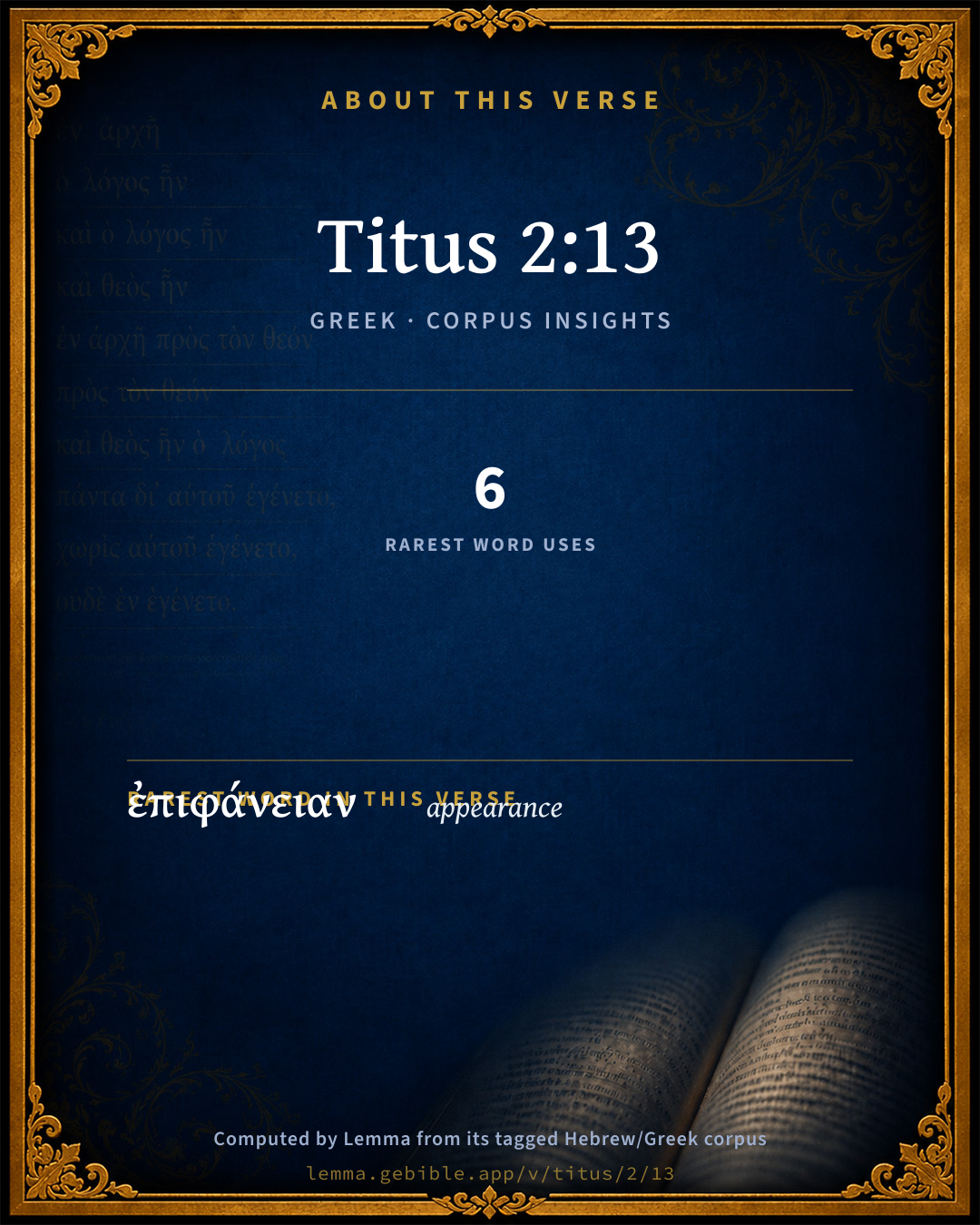
Titus 2:13

Greek (Tischendorf 8th ed.) Titus 2:13 appears in the Greek New Testament. The text above is from the Tischendorf 8th edition. Each word links to its Strong’s number and a concise gloss. Click any word for its full Thayer’s Greek Lexicon entry.
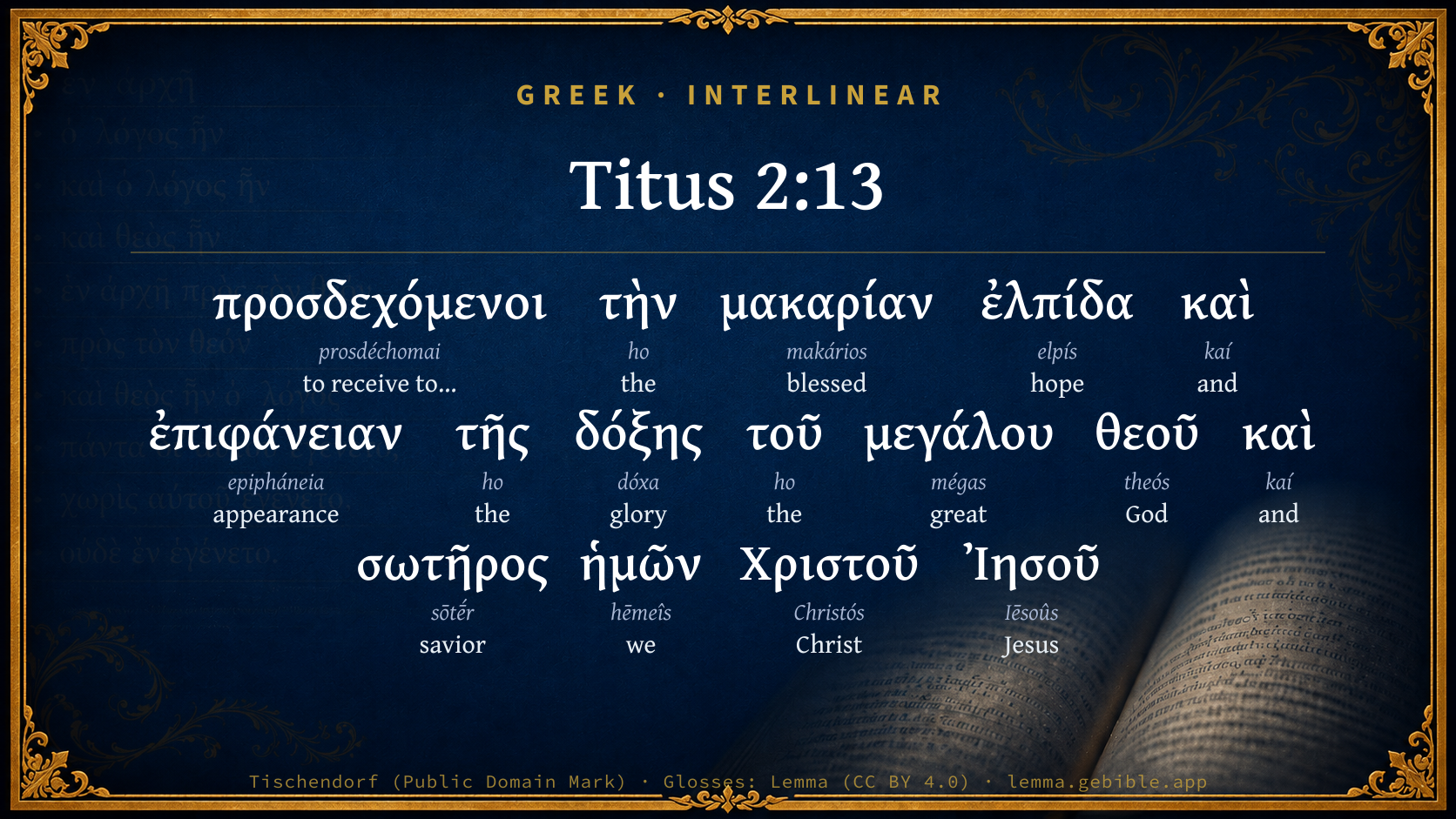
Download image
Cite this verse

Titus 2:13 (World English Bible). Public Domain. Lemma interlinear Bible study tool, https://lemma.gebible.app/v/titus/2/13.

Show BibTeX & RIS
BibTeX
RIS
English Translation
looking for the blessed hope and appearing of the glory of our great God and Savior, Jesus Christ;
World English Bible · Public Domain
Download a study sheet

One document with this verse’s original text, its word-by-word gloss line, the meaning frame, cross-references with their text, attributed commentary, and full source and license credits — printable, and it pastes into notes with its structure intact.

This verse Autodidact and up

Study sheet (.html) Plain text (.txt)

A passage Seminary Student

Up to 50 verses in one chapter. A passage sheet keeps up to 6 commentary sources and 12 cross-references per verse, in the order this page ranks them, and says so on the sheet whenever that leaves anything out. Ask for a single verse and you get the Autodidact verse sheet above.

Everything on this page stays free to read, with no account — the sheet is a download of what is already on screen, not access to it.

Want to remove ads? Support Godless Engineer
Compare translations 3

The same verse in 3 English versions, stacked beneath the original-language interlinear above. Click any original word for its lexicon entry.

Each is an independent rendering of the whole verse — the interlinear is not word-aligned to these translations.

Highlighted words mark where these versions differ — a whole-verse word diff, not a word-by-word alignment.

  • World English Bible Public Domain
    looking for the blessed hope and appearing of the glory of our great God and Savior, Jesus Christ;
  • King James Version Public Domain
    Looking for that blessed hope, and the glorious appearing of the great God and our Saviour Jesus Christ;
  • unfoldingWord Literal Text CC BY-SA 4.0
    while we look forward to receiving the blessed hope and appearing of the glory of our great God and Savior Jesus Christ.

unfoldingWord Literal Text — © unfoldingWord, licensed CC BY-SA 4.0. Word-aligned USFM3 via Door43 (git.door43.org/unfoldingWord/en_ult).

Versions to compare (up to 4)

3 of 4 selected

Show all 19 translations

Every available English version of this verse, each an independent rendering of the whole verse.

  • World English Bible Public Domain
    looking for the blessed hope and appearing of the glory of our great God and Savior, Jesus Christ;
  • Berean Standard Bible Public Domain
    as we await the blessed hope and glorious appearance of our great God and Savior Jesus Christ.
  • Majority Standard Bible Public Domain
    as we await the blessed hope and glorious appearance of our great God and Savior Jesus Christ.
  • King James Version Public Domain
    Looking for that blessed hope, and the glorious appearing of the great God and our Saviour Jesus Christ;
  • American Standard Version (1901) Public Domain
    looking for the blessed hope and appearing of the glory of the great God and our Saviour Jesus Christ;
  • Revised Version (1885) Public Domain
    looking for the blessed hope and appearing of the glory of our great God and Saviour Jesus Christ;
  • Geneva Bible (1599) Public Domain
    Looking for that blessed hope, and appearing of that glorie of that mightie God, and of our Sauiour Iesus Christ,
  • Douay-Rheims (1899) Public Domain
    Looking for the blessed hope and coming of the glory of the great God and our Savior Jesus Christ,
  • Young's Literal Translation Public Domain
    waiting for the blessed hope and manifestation of the glory of our great God and Saviour Jesus Christ,
  • Literal Standard Version CC BY-SA 4.0
    waiting for the blessed hope and appearing of the glory of our great God and Savior Jesus Christ,
  • Unlocked Literal Bible CC BY-SA 4.0
    while we look forward to receiving our blessed hope, the appearance of the glory of our great God and Savior Jesus Christ.
  • unfoldingWord Literal Text CC BY-SA 4.0
    while we look forward to receiving the blessed hope and appearing of the glory of our great God and Savior Jesus Christ.
  • Darby Bible Public Domain
    awaiting the blessed hope and appearing of the glory of our great God and Saviour Jesus Christ;
  • World Messianic Bible Public Domain
    looking for the blessed hope and appearing of the glory of our great God and Savior, Yeshua the Messiah,
  • Webster's Bible Public Domain
    Looking for that blessed hope, and the glorious appearing of the great God, and our Savior Jesus Christ;
  • Free Bible Version CC BY-SA 4.0
    as we look for the wonderful hope of the glorious appearing of our great God and Savior Jesus Christ.
  • Bible in Basic English Public Domain
    Looking for the glad hope, the revelation of the glory of our great God and Saviour Jesus Christ;
  • Text-Critical English NT CC BY 4.0
    as we wait for the blessed hope—the appearing of the glory of our great God and Savior, Jesus Christ.
  • Tyndale New Testament (1534) Public Domain
    lokinge for that blessed hope and glorious apperenge of the myghty god and of oure savioure Iesu Christ

Literal Standard Version (2020), Covenant Press — licensed CC BY-SA 4.0. Text via the HelloAO Bible API (eBible.org). Unlocked Literal Bible (unfoldingWord) — licensed CC BY-SA 4.0. Text via the HelloAO Bible API (eBible.org). unfoldingWord Literal Text — © unfoldingWord, licensed CC BY-SA 4.0. Word-aligned USFM3 via Door43 (git.door43.org/unfoldingWord/en_ult). Free Bible Version, Dr. Jonathan Gallagher — licensed CC BY-SA 4.0. Text via the HelloAO Bible API (eBible.org).

Word by word

More ways to search: Search by grammar → Find every occurrence → Compare this word →

Practice this passage: Drill this verse → Learn its vocabulary →

ἐπιφάνειαν
epipháneia
G2015
“appearance”
Noun, Accusative, Singular, Feminine
Part of Speech
Noun
Case
Accusative
Number
Singular
Gender
Feminine
Full Thayer's Definition

Origin: from G2016

TDNT: 09:07,1

1. an appearing, appearance
  1. προσδεχόμενοι prosdéchomai G4327 “to receive to oneself” Verb, Present, Middle or Passive deponent, Participle, Nominative, Plural, Masculine
  2. τὴν ho G3588 “the” Article, Accusative, Singular, Feminine
  3. μακαρίαν makários G3107 “blessed” Adjective, Accusative, Singular, Feminine
  4. ἐλπίδα elpís G1680 “hope” Noun, Accusative, Singular, Feminine
  5. καὶ kaí G2532 “and” Conjunction
  6. τῆς ho G3588 “the” Article, Genitive, Singular, Feminine
  7. δόξης dóxa G1391 “glory” Noun, Genitive, Singular, Feminine
  8. τοῦ ho G3588 “the” Article, Genitive, Singular, Masculine
  9. μεγάλου mégas G3173 “great” Adjective, Genitive, Singular, Masculine
  10. θεοῦ theós G2316 “God” Noun, Genitive, Singular, Masculine
  11. καὶ kaí G2532 “and” Conjunction
  12. σωτῆρος sōtḗr G4990 “savior” Noun, Genitive, Singular, Masculine
  13. ἡμῶν hēmeîs G2249 “we” Personal pronoun, 1st person, Genitive, Plural
  14. Χριστοῦ Christós G5547 “Christ” Noun, Genitive, Singular, Masculine
  15. Ἰησοῦ Iēsoûs G2424 “Jesus” Noun, Genitive, Singular, Masculine

About this verse

These counts appear in no published source. They are computed here, from the morphology-tagged text and Lemma’s own curated glosses. What Lemma adds →

16
words
13
distinct lemmas
Pauline Epistles
section

Notable vocabulary

The rarest word here is ἐπιφάνειαν appearance G2015 — appearing just 6 times in the whole Greek New Testament.

Shared distinctive vocabulary

ἐπιφάνειαν appearance G2015 occurs in 6 verses of the Greek New Testament. Also found in:

Repetition

Words recur within this verse:

Cross-references

37

Topical passages linked to Titus 2:13 in the Treasury of Scripture Knowledge — connected by theme and wording, ordered by reader-vote popularity; previews shown in the World English Bible.

  • 2 Timothy 4:8 From now on, there is stored up for me the crown of righteousness, which the Lord, the righteous judge, will give to me on that day; and not to me only, but also to all those who have loved his appearing.
  • 1 Corinthians 1:7 so that you come behind in no gift; waiting for the revelation of our Lord Jesus Christ;
  • Matthew 16:27 For the Son of Man will come in the glory of his Father with his angels, and then he will render to everyone according to his deeds.
  • Titus 1:2 in hope of eternal life, which God, who can't lie, promised before eternal times;
  • 2 Peter 3:12–14 looking for and earnestly desiring the coming of the day of God, by reason of which the heavens being on fire will be dissolved, and the elements will melt with fervent heat?
  • Mark 14:62 Jesus said, "I AM. You will see the Son of Man sitting at the right hand of Power, and coming with the clouds of the sky."
  • Hebrews 9:28 so Christ also, having been once offered to bear the sins of many, will appear a second time, without sin, to those who are eagerly waiting for him for salvation.
  • 1 John 3:2–3 Beloved, now we are children of God, and it is not yet revealed what we will be. But we know that, when he is revealed, we will be like him; for we will see him just as he is.
  • 2 Corinthians 4:4 in whom the god of this world has blinded the minds of the unbelieving, that the light of the Gospel of the glory of Christ, who is the image of God, should not dawn on them.
  • Romans 5:5 and hope doesn't disappoint us, because God's love has been poured out into our hearts through the Holy Spirit who was given to us.
  • Romans 15:13 Now may the God of hope fill you with all joy and peace in believing, that you may abound in hope, in the power of the Holy Spirit.
  • Philippians 3:20–21 For our citizenship is in heaven, from where we also wait for a Savior, the Lord Jesus Christ;
  • Titus 3:4 But when the kindness of God our Savior and his love toward mankind appeared,
  • 2 Peter 3:18 But grow in the grace and knowledge of our Lord and Savior Jesus Christ. To him be the glory both now and forever. Amen.
  • Isaiah 25:9 It shall be said in that day, Behold, this is our God; we have waited for him, and he will save us: this is Yahweh; we have waited for him, we will be glad and rejoice in his salvation.
  • Mark 8:38 For whoever will be ashamed of me and of my words in this adulterous and sinful generation, the Son of Man also will be ashamed of him, when he comes in the glory of his Father with the holy angels."
  • Acts 24:15 having hope toward God, which these also themselves look for, that there will be a resurrection of the dead, both of the just and unjust.
  • Romans 8:24–25 For we were saved in hope, but hope that is seen is not hope. For who hopes for that which he sees?
  • 2 Corinthians 4:6 seeing it is God who said, "Light will shine out of darkness," who has shone in our hearts, to give the light of the knowledge of the glory of God in the face of Jesus Christ.
  • Colossians 3:4 When Christ, our life, is revealed, then you will also be revealed with him in glory.
  • 2 Timothy 4:1 I charge you therefore before God and the Lord Jesus Christ, who will judge the living and the dead at his appearing and his Kingdom:
  • 1 Peter 1:3 Blessed be the God and Father of our Lord Jesus Christ, who according to his great mercy became our father again to a living hope through the resurrection of Jesus Christ from the dead,
  • 1 Peter 1:7 that the proof of your faith, which is more precious than gold that perishes even though it is tested by fire, may be found to result in praise, glory, and honor at the revelation of Jesus Christ--
  • 2 Peter 1:1 Simon Peter, a servant and apostle of Jesus Christ, to those who have obtained a like precious faith with us in the righteousness of our God and Savior, Jesus Christ:
  • 1 John 4:14 We have seen and testify that the Father has sent the Son as the Savior of the world.
  • Colossians 1:23 if it is so that you continue in the faith, grounded and steadfast, and not moved away from the hope of the Gospel which you heard, which is being proclaimed in all creation under heaven; of which I, Paul, was made a servant.
  • 1 Timothy 6:13–14 I charge you before God, who gives life to all things, and before Christ Jesus, who before Pontius Pilate testified the good confession,
  • Titus 3:6–7 which he poured out on us richly, through Jesus Christ our Savior;
  • Revelation 1:7 Behold, he is coming with the clouds, and every eye will see him, including those who pierced him. All the tribes of the earth will mourn over him. Even so, Amen.
  • Job 19:25–27 But as for me, I know that my Redeemer lives. In the end, he will stand upon the earth.
  • Matthew 25:31 "But when the Son of Man comes in his glory, and all the holy angels with him, then he will sit on the throne of his glory.
  • Matthew 26:64 Jesus said to him, "You have said it. Nevertheless, I tell you, henceforth you will see the Son of Man sitting at the right hand of Power, and coming on the clouds of the sky."
  • Colossians 1:5 because of the hope which is laid up for you in the heavens, of which you heard before in the word of the truth of the Gospel,
  • Colossians 1:27 to whom God was pleased to make known what are the riches of the glory of this mystery among the Gentiles, which is Christ in you, the hope of glory;
  • 2 Thessalonians 2:8 Then the lawless one will be revealed, whom the Lord will kill with the breath of his mouth, and bring to nothing by the brightness of his coming;
  • 2 Thessalonians 2:16 Now our Lord Jesus Christ himself, and God our Father, who loved us and gave us eternal comfort and good hope through grace,
  • Hebrews 6:18–19 that by two immutable things, in which it is impossible for God to lie, we may have a strong encouragement, who have fled for refuge to take hold of the hope set before us.

Cross-references courtesy of OpenBible.info (CC BY 4.0).

Commentary

Notes on Titus 2:13 from classic Christian and Jewish commentators (each source and its license shown beneath its notes). The classic Christian expositions comment on the surrounding passage and are grouped to its opening verse, so a note may address several verses; the Jewish commentaries on the Tanakh (Rashi and others) are per-verse, so they appear only where the commentator wrote on this verse.

Lemma curates 59 commentaries, every one of them public domain or Creative Commons licensed, each selected and text-cleaned for this edition rather than reprinted as found. About our sources →

Joseph Benson's Commentary

Tit 2:13-14. Looking — With eager desire and lively expectation; for the blessed hope — That is, for the blessedness for which we hope; the grace of hope being here put for the object of it, future and eternal felicity. And the glorious appearing — Very different from his former appearance in a state of poverty, reproach, and suffering; of the great God and our Saviour — The original expression, επιφανειαν της δοξης του μεγαλου Θεου και Σωτηρος ημων, are literally, the appearing, or manifestation, of the glory of the great God and our Saviour Jesus Christ: or, of the great God, even our Saviour Jesus Christ. If the words be taken in the former sense, the apostle may be considered as alluding to our Lord’s words, Luk 9:26, where the Lord Jesus is spoken of as coming in his own glory and in his Father’s, and of his holy angels; and, (Mat 16:27,) the Son of man shall come in the glory of the Father with his angels. Beza, however, is of opinion, that one person only is spoken of, namely, Jesus Christ, to whom he thinks the title of the great God is given in this verse; and with him Whitby agrees, both because the article is wanting before Σωτηρος, Saviour, and because, as God the Father is not said properly to appear, so the word επιφανεια, appearing, never occurs in the New Testament but when it is applied to Jesus Christ. But to this Macknight answers, “1st, That the article wanting before Saviour may be supplied, as our translators have done here before επιφανεια, appearing, and elsewhere, particularly Eph 5:5, In the kingdom, του Χριστου και Θεου, of Christ and of God. and, 2d, That the apostle does not speak of the appearing of the Father, but of the appearing of the glory of the Father; agreeably to what Christ himself declared, that at his return to judgment he will appear surrounded with the glory of his Father.” Whitby, however, as an additional reason for thinking that Christ is only spoken of, observes, that “not only all the ancient commentators on the place do so interpret this text, but the Ante-Nicene Fathers also; Hippolytus speaking of the appearance of our God and Saviour Jesus Christ, and Clemens of Alexandria proving Christ to be both God and man, our Creator, and the Author of all our good things, from these very words of St. Paul.” Who gave himself for us — Namely, to die in our stead; that he might redeem us — Miserable bond-slaves; from all iniquity — As well from the power and the very being, as from the guilt of our sins; and purify to himself — From all pollution of flesh and spirit, (see on 2Co 7:1,) a peculiar people — Who should thankfully own themselves his property, and express their gratitude for such inestimable favours, by being not only careful to avoid the practice of evil, but zealous of good works — Active in all the duties of life, and in every office of righteousness and goodness to each other. “This is said in allusion to Exo 19:5; Deu 7:6, where God calls the Jews a peculiar and a special people to himself, because he had made them his property by redeeming them from the bondage of Egypt, and had distinguished them from the rest of mankind as his, by rites and ordinances of his own appointment. Christ hath made believers his peculiar people by giving himself for them, to redeem them from all iniquity, and to purify them to himself, a people zealous, not of rites and ceremonies, but of good works. This being the great end of Christ’s death, how dare any person, pretending to be one of Christ’s people, either speak or think lightly of good works, as not necessary to salvation? — Macknight.

Joseph Benson's Commentary on the Old and New Testaments (1811–1818) — public domain. Text from a community e-Sword module.

MacLaren's Expositions of Holy Scripture

Alexander MacLaren

Titus

THE HAPPY HOPE

Tit 2:13.

THERE are two appearances spoken of in this context - the appearance of ‘the grace of God that bringeth salvation’; and parallel with that, though at the same time contrasted with it, as being in very important senses one in nature and principle, though diverse in purpose and diverse in manner, is what the Apostle here calls ‘the glorious appearing of the great God.’

The antithesis of contrast and of parallel is still more striking in the original than in our version, where our translators have adopted a method of rendering of which they are very fond, and which very often obscures the full meaning of the text. Paul wrote, ‘Looking for that blessed [or ‘happy’] hope, even the appearing of the glory of the great God and our Saviour,’ where you see he contrasts, even more sharply than our Bible makes him do, the past appearance of the grace, and the future appearance of the glory.

Then, further, this appearance of the glory; however bright with the terrible beauty and flashing lustre of divine majesty it may be, seems to the Apostle to be infinitely desirable, and becomes to him a happy hope. The reality, when it comes, will be pure joy. The irradiation of its approach shines from afar on his brightening face, and lightens his heart with a hope which is a prophetic joy. And the attitude of the Christian soul towards it is to be that of glad expectation, watching the dawning east and ready to salute the sun. And yet further, this attitude of happy expectation of the glory is one chief object to be attained by the grace that has appeared. It came ‘teaching,’ or rather {as the word more accurately means} ‘disciplining, that we should live looking for that happy hope.’

So, then, we have here for our consideration three points embodied in these words - The grace of God has appeared, the glory of God is to appear; the appearance of the glory is a blessed hope; the disciplining of the grace prepares us for the expectation of the glory.

I. First, then, take that thought - The appearance of the grace leads to the appearance of the glory.

The identity of the form of expression in the two clauses is intended to suggest the likeness of and the connection between the two appearances. In both there is a visible manifestation of God, and the latter rests upon the former, and completes and crowns it.

But the difference between the two is as strongly marked as the analogy; and it is not difficult to grasp distinctly the difference which the Apostle intends. While both are manifestations of the divine character in exercise, the specific phase {so to speak} of that character which appears is in one ease ‘grace,’ and in the other ‘glory.’ If one might venture on any illustration in regard to such a subject, it is as when the pure white light is sent through glass of different colours, and at one moment beams mild through refreshing green, and at the next flames in fiery red that warns of danger.

The two words which are pitted against each other here have each a very wide range of meaning. But, as employed in this place, their antithetical force is clear enough. ‘Grace’ is active love, exercised towards. inferiors, and towards those who deserve something else. So the grace of God is the active energy of His love, which stoops from the throne to move among men, and departing from the strict ground of justice and retribution, deals with us not according to our sins, nor rewards us according to our iniquities!

And then the contrasted word ‘glory’ has not only a very wide meaning, but also a definite and specific force, which the very antithesis suggests. The ‘glory of God,’ I believe, in one very important sense, is His ‘grace.’ The highest glory of God is the exhibition of forgiving and long-suffering love. Nothing can be grander. Nothing can be more majestic. Nothing, in the very profoundest sense of the word, can be more truly divine - more lustrous with all the beams of manifest deity, than the gentle raying forth of His mercy and His goodness.

But then, while that is the profoundest thought of the glory of God, there is another truth to be taken in conjunction with it. The phrase has, in scripture, a well marked and distinct sense, which may be illustrated from the Old Testament, where it generally means not so much the total impression of majesty and · power made upon men by the whole revealed divine character, but rather the visible light which shone between the cherubim and proclaimed the present God. Connected with this more limited sense is the wider one of that which the material light above the mercy-seat symbolised - and which we have no better words to describe than to call it the ineffable and inaccessible brightness of that awful Name. The contrast between the two will be suggested by a passage to which I may refer. The ancient lawgiver said, ‘I beseech thee show me thy glory.’ The answer was ‘I will make all my goodness pass before thee.’ The eye of man is incapable of apprehending the uncreated divine lustrousness and splendour of light, but capable of receiving some dim and partial apprehensions of the goodness, not indeed in its fulness, but in its consequences. And that goodness, though it be the brightest of ‘the glories that compose His Name,’ is not the only possible, nor the only actual manifestation of the glory of God. The prayer was unfulfilled when offered; for to answer it, as is possible for earth, would have been to antedate the slow evolution of the counsels of God. But answered it will be, and that on this globe. ‘Every eye shall see Him.’

The grace has appeared, when Divine Love is incarnate among us. The long-suffering gentleness we have seen. And in it we have seen, in a very real sense, the glory, for ‘we beheld His glory, full of grace.’ But beyond that lies ready to be revealed in the last time the glory, the lustrous light, the majestic splendour, the flaming fire of manifest Divinity.

Again, the two verses thus bracketed together, and brought into sharp contrast, also suggest how like, as well as how unlike, these manifestations are to be.

In both cases there is an appearance, in the strictest sense of the word, that is to say, a thing visible to men’s senses. Can we see the grace of God? We can see the love in exercise, cannot we? How? ‘He that hath seen Me hath seen the Father; and how sayest thou then, Shew us the Father?’ The appearance of Christ was the making visible, in human form, of the love of God.

My brother, the appearance of the glory will be the same - the making visible in human form of the light of throned and sovereign Deity. The one was incarnation; the other will be incarnation. The one was patent to men’s senses - so will the other be. The grace has appeared. The glory is to appear. ‘Why stand ye gazing up into heaven? This same Jesus shall so come in like manner as ye have seen Him go.’ An historical fact, a bodily visibility, a manifestation of the divine nature and character in human form upon earth, and living and moving amongst men i As ‘ Christ was once offered to bear the sins of many, ‘so unto them that look for Him shall He appear the second time without sin unto salvation.’ The two are strictly parallel. As the grace was visible in action by a Man among men, so the glory will be. What we look for is an actual bodily manifestation in a human form, on the solid earth, of the glory of God.

And then I would notice how emphatically this idea of the glory being all sphered and embodied in the living person of Jesus Christ proclaims His divine nature. It is ‘the appearance of the glory’ - then mark the next words - ‘of the great God and our Saviour.’

I am not going to enter upon the question of the interpretation of these words, which by many very competent authorities have been taken as all referring to Jesus Christ, and as being a singular instance in scripture of the attribution to Him directly, and without any explanation or modification, of the name, ‘the great God!’ I do not think that either grammar or dogma require that interpretation here. But I think that, if we take the words to refer distinctly to the Father and to the Son, the inference as to Christ’s true and proper divinity which comes from. them, so understood, is no less strong than the other interpretation would make it. For, in that case, the same one and indissoluble glory is ascribed to God the Father and to Christ our Lord, and the same act is the appearance of both. The human possesses the divine glory in such reality and fulness as it would be insanity if it were not blasphemy, and blasphemy if it were not absurdity, to predicate of any single man. The words coincide with His own saying, ‘The Son of Man shall come in His glory and of the Father,’ and point us necessarily and inevitably to the wonderful thought that the glory of God is capable of being fully imparted to, possessed by, and revealed through Jesus Christ; that the glory of God is Christ’s glory, and the glory of Christ is God’s. In deep, mysterious, real, eternal Union the Father and the Son, the light and the ray, the fountain and the source, pour themselves out in loving- kindness on the world, and shall flash themselves in splendour at the last, when the Son of Man ‘ shall be manifested in His own glory and of the Father!’

And then I must touch very briefly another remarkable and plain contrast indicated in our text between these two ‘appearings.’ They are not only unlike in the subject {so to speak} or substance of the manifestation, but also in the purpose. The grace comes, patient, gentle, sedulous, labouring for our training and discipline. The glory comes - there is no word of training there! What does the glory come for? The one rises upon a benighted world - lambent and lustrous and gentle, like the slow, silent, climbing of the silvery moon through the darkling sky. But the other blazes out with a leap upon a stormy heaven - ‘as the lightning cometh out of the east, and shineth even unto the west,’ writing its fierce message across all the black page of the sky in one instant, ‘so shall also the coming of the Son of Man be.’ Like some patient mother, the ‘grace of God’ has moved amongst men, with entreaty, with loving rebuke, with loving chastisement. She has been counsellor and comforter. She has disciplined and fostered with more than maternal wisdom and love. ‘Her ways are ways of pleasantness, and all her paths are peace.’ But the glory appears for another purpose and in another guise - ‘Who is this that cometh with dyed garments? I that speak in righteousness, mighty to save. Wherefore art Thou red in thine apparel? I have trodden the winepress alone - for the day of vengeance is in Mine heart, and the year of My redeemed is come.’

II. But we have now to look at the second thought which is involved in these words, and that is, the appearing of the glory is a blessed hope.

The hope is blessed; or as we have already remarked, the word ‘happy’ may perhaps be substituted with advantage. Because it will be full of blessedness when it is a reality, therefore it is full of joy, while it is but a hope.

The characteristics of that future manifestation of glory are not such that its coming is wholly and universally a joy. There is something terrible in the beauty, something menacing in the brightness. But it is worth noticing that, notwithstanding all that gathers about it of terror, all that gathers about it of awful splendour, all that is solemn and heart shaking in the thought of judgment and retribution for the past, the irreversible and irrevocable past, yet to Paul it was the very crown of all his expectations of, and the very shining summit of all his desires for, the future - that Christ should appear.

The primitive Church thought a great deal more about the coming of Jesus Christ than about death - thought a great deal more about His coming than about ‘Heaven.’ To them the future was not so much a time of rest for themselves as the manifestation of their Lord. To them the way of passing out of life was not so much seeing corruption as being caught up together in the air.

And how far the darkness, which our Lord declared to be the divine counsel in regard to that future coming, enwrapped even those who, upon all other points, received the divine inspiration which made and makes them for evermore the infallible teachers and authorities for the Christian Church, is a moot question. If it were certain that the Apostle expected Christ’s coming during his own lifetime, I do not know that we need be troubled at that as if it shook their authority, seeing that almost the last words which Christ spoke to His Apostles were a distinct declaration that He had not to reveal to them, and they were not to know’ the times and the seasons which the Father has put in His own power,’ and seeing that the office of that Holy Spirit, as whose organs Paul and the other writers of the New Testament are our authoritative teachers, is expressly declared to be the bringing all things to their remembrance, whatsoever Christ had revealed. If, then, He expressly excepts from the compass of His revelation this point, it can be no derogation from the completeness of an inspired writer’s authority, if he knows it not.

And if one takes into account the whole of Paul’s words on the subject, they seem to express rather the same double anticipation, which we too have to cherish, desiring and looking, on the one hand, for the Saviour from heaven; desiring on the other hand to depart and be with Christ, which is far better. The numerous places in which Paul speaks of his own decease, sometimes as longed for, sometimes as certain; and, latterly, as near, are inconsistent with the theory that he looked for Christ’s coming as certain in his own lifetime. So, too, are other anticipations which he expresses as to the future course of the Church, and progress of the Gospel in the world. He, like us, would appear to have had before his expectations the alternative. He knew not when the glory might burst upon the world, therefore he was ever standing as one that waits for his Lord. He knew not when he might have to die, therefore he laboured that, ‘whether present or absent, he might be pleasing to Him.’

But that is not the point upon which I want to say · a word. Dear brethren, the hope is a happy one. If we know the grace, we shall not be afraid of the glory.’ If the grace has disciplined in any measure, we may be sure that we shall partake in its perfection They that have seen the face of Christ looking down, as it were, upon them from the midst of the great darkness of the cross, and beneath the crown of thorns, need not be afraid to see the same face looking down upon them from amidst the blaze of the light, and from beneath the many crowns of the kingdoms of the world and the royalties of the heavens. Whosoever hath learnt to love and believe in the manifestation of the grace, he, and he only, can believe and hope for the manifestation of the glory.

And, Christian men and women, whilst thus the one ground upon which that assurance, ‘The Lord cometh,’ can be anything to us except a dread, if it is a belief at all, is the simple reliance upon his past work - let me urge the further consideration upon you and myself, how shamefully all of us neglect and overlook that blessed expectation! We live by hope. God, indeed, is above all hope. To that infinite eye, before which all things that were, and are, and are to come, lie open and manifest, or, rather, are ensphered in His own person and self; to Him, who is the living past, the abiding present, the present future, there is no expectation. The animal creation is below hope. But for us that live on the central level - half-way between a beast and God, if I may so say - for us our lives are tossed about between memory and expectation.

We all of us possess, and most of us prostitute that wonderful gift - of shaping out some conception of the future. And what do we do with it? It might knit us to God, bear us up amid the glories of the abysses of the skies. We use it for making to ourselves pictures of fools’ paradises of present pleasures or of successful earthly joys. The folly of men is not that they live by hope, but that they set their hopes on such things.

‘They build too low

Who build beneath the stars!’

As for every other part of human nature, so for this strange faculty of our being, the gospel points to its true object, and the gospel gives its only consecration.

Dear brethren, is it true of us that into our hearts there steals subtle, impalpable, but quickening as the land breeze laden with the fragrance of flowers to the sailor tossing on the barren sea, a hidden but yet mighty hope of an inheritance with Him - when He shall appear? With eye lifted above and fixed upon the heavens do I look beyond the clouds to the stars? Alas! alas! the world drives that hope out of our hearts It is with us as with the people in some rude country fair and scene of riot, where the booths and the shows and the drinking-places are pitched upon the edge of the common, and one step from the braying of the trumpets brings you into the solemn stillness of the night; and high above the stinking flare of the oil lamps there is the pure light of the stars in the sky, and not one amongst the many clowns that are stumbling about in the midst of sensual dissipation ever looks up to see that calm home that is arched above them! We live for the present, do not we? And there, if only we would lift our eyes, there, even now, is the sign of the Son of Man in the heavens. My friend, it is as much an element of a Christian’s character, and a part of his plain, imperative duty, to look for His appearing as it is to live’ soberly, righteously, and godly in this present world!’

III. Well then, finally, one word about the last consideration here, viz., The grace disciplines us to hope for the glory.

The very idea of discipline involves the notion that it is a preparatory stage, a transient process for a permanent result. It carries with it the idea of immaturity, of apprenticeship, so to speak. If it is discipline, it is discipline for some condition which is not yet reached. And so if the grace of God comes ‘disciplining,’ then there must be something beyond the epoch and era within which the discipline is confined.

And that just runs out into two considerations, upon which I have not time to dwell Take the characteristics of the grace - clearly enough, it is preparing men for something beyond itself. Yield to the discipline and the hope will grow.

Take the characteristics of the grace. Here is a great system, based upon a stupendous and inconceivable act of divine sacrifice, involving a mysterious identification of the whole race of sinful men with the Saviour, embodying the most wonderful love of God, and being the propitiation for the sins of the whole world. Here is a life perfectly innocent, perfectly stainless, brought to the extremity of evil, and having never swerved one inch from the divine commandments, yet dying at last under a consciousness of separation and desertion from God! Here are a cross, a resurrection, an ascension, an omnipotent Spirit, an all-guiding Word, a whole series of powers and agencies brought to bear! Does any man believe that such a wealth of divine energy and resource would he put forth and employed for purposes that break short off when a man is put into his coffin, and that have nothing beyond this world for their field?

Here is a perfect instrument for making men perfect, and what does it do? It makes men so good and leaves them so bad that unless they are to be made still better and perfected, God’s work on the soul is at once an unparalleled success and a confounding failure - a puzzle, in that having done so much it does not do more; in that having done so little it has done so much. The achievements of Christianity upon single souls, and its failures upon those for whom it has done most, when measured against, and compared with, its manifest adaptation to a loftier issue than it has ever reached here on earth, all coincide to say - the grace {because its purpose is discipline, and because its purpose is but partially achieved here on earth} demands a glory, when they whose darkness has been partially made ‘light in the Lord,’ by the discipline of grace, shall ‘blaze forth as the sun’ in the Heavenly Father’s Kingdom of Glory.

Yield to the discipline, and the hope will be strengthened. You will never entertain in any vigour and operative power upon your lives the expectation of that coming of the glory unless you live soberly, righteously, and godly in this present world.

That discipline submitted to is, if I may so say, like that great apparatus which you find by the side of an astronomer’s biggest telescope, to wheel it upon its centre and to point ‘its tube to the star on which he would look.

So our anticipation and desire, the faculty of expectation which we have, is wont to be directed along the low level of earth, and it needs the pinions and levers of that gracious discipline, making us sober, righteous, godly, in order to heave it upwards, full-front against the sky, that the stars may shine into it.

The speculum, the object-glass, must be polished and cut by many a stroke and much friction ere it will reflect ‘the image of the heavenly’; so grace disciplines us, patiently, slowly, by repeated strokes, by much rubbing, by much pain - disciplines us to live in self-restraint, in righteousness and godliness, and then the cleared eye beholds the heavens, and the purged heart grows towards ‘ the Coming’ as its hope and its life.

Dear brethren, let us not fling away the treasures of our hearts’ desires upon trifles and earth. Let us not set our hopes on that which is not, nor paint that misty wall that rings round our present with evanescent colours like the landscapes of a dream. We may have a hope which is a certainty, as sure as a history, as vivid as a present fact. Let us love and trust Him who has been manifested to save us from our sins, and in whom we behold all the grace and truth of God. If our eyes have learnt to behold and our hearts to love Him whom we have not seen, amid all the bewildering glares and false appearances of the present, our hopes will happily discern Him and be at rest, amid the splendours of that solemn hour when He shall come in His glory to render to every man according to His works.

With that hope the future, near or far, has no fears hidden in its depths. Without it, there is no real anchorage for our trembling hearts, and nothing to hold by when the storm comes. The alternative is before each of us, ‘having no hope,’ or ‘looking for that blessed hope.’ God help us all to believe that Christ has come for me! Then I shall be glad when I think that Christ will come again to receive me unto Himself!

Alexander MacLaren, Expositions of Holy Scripture (1904–1910) — public domain. Text from a community e-Sword module.

Tyndale Open Study Notes

Tyndale Open Resources

2:13 we look forward: This implies hope as well as future accountability, both of which stimulate godly conduct in the present. • will be revealed: This phrase translates a prominent Greek word in the letters to Timothy and Titus (“epiphany” or “appearing”; also 2:11; see study note on 1 Tim 6:14). • great God and Savior: This is one of the few places in the New Testament where Jesus Christ is called “God” outright (see also John 1:1; 20:28; Rom 9:5; Heb 1:8; 2 Pet 1:1; possibly John 1:18). Yet this claim is entirely consistent with the roles and attributes of Christ and the worship that he receives. Possibly this designation is used here to insist that Christ is not a mere human promoted to membership in the pantheon of gods (see study note on Titus 1:12). At the time of this letter, Christians were insisting more and more that Christ alone, rather than rulers and emperors, should be called divine.

Tyndale Open Study Notes — © Tyndale Open Resources, licensed CC BY-SA 4.0. Text via the HelloAO Bible API.

Bengel's Gnomon

Johann Albrecht Bengel

Tit 2:13. Προσδεχόμενοι, looking for) with joy.—ἐλπίδα—Θεοῦ, hope—of God) This may be referred to Christ.[11]—σωτῆρος, Saviour) ch. Tit 3:4; Tit 3:6, where the mention of the Father and of the Son is made in very close connection, as here, ch. Tit 2:11; Tit 2:13. [Hope corresponds to the name of Saviour; the appearance of the glory, to that of God.—V. g.]

[11] See my note on 1Ti 5:21. This must refer to Christ; for ἐπιφάνεια, is never applied to God the Father, but always to the Son. And when two compatible attributives joined by a copula are thus preceded by but one article, they must refer to the one and the same person: of Him who is at once the great God and our Saviour: τοῦ, viz. ὄντος μεγ, Θεοῦ καὶ ωτ.—ED.

Bengel's Gnomon of the New Testament — English translation (T&T Clark, Edinburgh, 1860) — public domain. Text from a community e-Sword module.

Meyer's Critical & Exegetical Commentary

Heinrich August Wilhelm Meyer

Tit_2:13. Προσδεχόμενοι τὴν μακαρίαν ἐλπίδα] The strange collocation of προσδεχ. and ἐλπίδα is found also in Act_24:15 : ἐλπίδα ἔχων … ἣν καὶ αὐτοὶ οὗτοι προσδέχονται; so, too, in Gal_5:5 : ἐλπίδα … ἀπεκδεχόμεθα. The reason of it is that ἐλπίς not only denotes actively the hope, but also passively the thing hoped for, the subject of the hope; comp. Col_1:5 : ἡ ἐλπὶς ἡ ἀποκειμένη ἐν τ. οὐρανοῖς; comp., too, Rom_8:24.

μακαρίαν] Paul thus describes the ἐλπίδα in so far as the expectation of it blesses the believer. Wolf wrongly interprets ἡ μακ. ἐλπίς as equivalent to ἡ ἐλπιζομένη μακαριότης.

This ἐλπίς is further defined by the epexegesis: καὶ ἐπιφάνειαν τῆς δόξης τοῦ μεγάλου Θεοῦ καὶ σωτῆρος ἡμῶν Ἰ. Χριστοῦ] According to Hofmann, the adjective μακαρίαν as well as the genitive τῆς δόξης κ.τ.λ. belongs to both substantives, to ἐλπίδα and to ἐπιφάνειαν, because, as he thinks, ἡ μακαρία ἐλπίς is not a conception complete in itself. But Rom_15:4 shows this to be wrong. The genitive could only be construed with the two substantives by giving it a different reference in each case. Hofmann, indeed, maintains that this presents no difficulty, as it occurs elsewhere; but he is wrong in his appeal to Rom_15:4 (comp. Meyer on the passage) and to 1Pe_1:2 and 2Pe_3:11 (comp. my commentary on the passages).

Beyond doubt, the ἐπιφάνεια τῆς δόξης κ.τ.λ. denotes Christs second coming (1Ti_6:14); it may, however, be asked whether μεγάλου Θεοῦ is an independent subject or an attribute of Ἰησ. Χρ. The older expositors are of the latter opinion; the orthodox even appealed to this passage against the Arians. Ambrosius, however, distinguishes here between Christus and Deus Pater.[5] Erasmus, too, says: simul cum Patre apparebit eadem gloria conspicuus Dominus ac Servator noster J. Chr.; and Bengel says of ΘΕΟῦ simply: referri potest ad Christum. Among more recent expositors, Flatt, Mack, Matthies, Wiesinger, van Oosterzee, Hofmann, adopt the former view; while de Wette, Plitt, Winer, pp. 123 f.[E. T. p. 162], adopt the latter. Heydenreich leaves the question undecided.[6] It cannot be decided on purely grammatical grounds, for μεγ. Θεοῦ and σωτῆρος ἡμ. may be two attributes referring to Ἰησ. Χριστοῦ; still it may be also that σωτῆρ. ἡμῶν Ἰησ. Χρ. is a subject distinct from μεγ. Θεοῦ, even although only one article is used.[7] The question can only be answered by an appeal to N. T. usage, both for this passage and others like it: 2Pe_1:1; Jud_1:4; 2Th_1:12. In 2Pe_1:11; 2Pe_3:18, the unity of the subject is beyond doubt. The following points may be urged in favour of distinguishing two subjects:(1) In no single, passage is Θεός connected directly with Ἰησοῦς Χριστός as an attribute (see my commentary on 2Pe_1:1); i.e. there never occurs in the N. T. the simple construction ὁ Θεὸς ἡμῶν Ἰησ. Χρ., or ὁ Θεὸς Ἰησοῦς Χρ., or Ἰησ. Χρ. ὁ Θεὸς ἡμῶν, whereas κύριος and σωτήρ are often enough construed in this way. (2) The collocation of God (Θεός) and Christus as two subjects is quite current, not only in the Pastoral Epistles (1Ti_1:1-2; 1Ti_5:21; 1Ti_6:13; 2Ti_1:2; 2Ti_4:1; Tit_1:4), but also in all the epistles of the N. T., Pauline or not, so much so, that when in some few passages the turn of the expression is such as to make Θεός refer grammatically to Christ also, these passages have to be explained in accordance with the almost invariable meaning of the expression. (3) The addition of the adjective μεγάλου indicates that Θεοῦ is to be taken as an independent subject, especially when it is observed how Paul in the First Epistle to Timothy uses similar epithets to exalt Gods glory; comp. 1Ti_1:17; 1Ti_4:10; 1Ti_6:15-16, especially Tit_1:11 : ἡ δόξα τοῦ μακαρίου Θεοῦ. It is true the expression ὁ μέγας Θεός is not found in the N. T., except in the Rec. of Rev_19:17, but it occurs frequently in the O. T.: Deu_6:21; Deu_10:17; Neh_9:32; Dan_2:45; Dan_9:4.[8]

For the unity of the subject only one reason can be urged with any show of force, viz. that elsewhere the word ἘΠΙΦΆΝΕΙΑ is only used in reference to Christ; but Erasmus long ago pointed out that it does not stand here ἘΠΙΦ. ΤΟῦ ΘΕΟῦ, but Τῆς ΔΌΞΗς ΤΟῦ ΘΕΟῦ. Wiesinger, too, has to admit that, according to passages like Mat_16:27, Mar_8:38, Christ appears in the glory of the Father and at the same time in His own glory (Mat_25:31), and His appearance may therefore be called the appearance both of Gods glory and of His own. Wiesinger, indeed, tries to weaken this admission by remarking that in reality it is Christ Himself who will appear ἘΝ ΔΌΞῌ ΤΟῦ ΠΆΤΡΟς, and not God, that therefore ΔΌΞΑ would be construed with the genitives in quite different relations, and that on grammatico-logical principles it must mean either ἘΝ ΣΩΤῆΡΙ ἩΜῶΝ ἸΗΣ. ΧΡΙΣΤῷ, or ΤΟῦ ΣΩΤῆΡΟς ἩΜῶΝ ἘΝ Τῇ ΔΌΞῌ ΤΟῦ ΜΕΓΆΛΟΥ ΘΕΟῦ (Matthies). But his remark is wrong. Even if the subjects be distinct, the genitive ΤΟῦ ΜΕΓ. ΘΕΟῦ stands in the same relation to Τῆς ΔΌΞΗς as does the genitive ΣΩΤῆΡΟς ἩΜ. Ι. ΧΡ. Nor is the form of expression necessary on which Matthies insists, because in the N. T. God and Christ are often enough connected simply by καὶ without marking their mutual relations. Wiesinger further remarks that no reason whatever can be found in the context for connecting ΘΕΌς here as well as Christ with the ἘΠΙΦΆΝΕΙΑ, but he has manifestly overlooked the relation of ΠΡΟΣΔΕΧΌΜΕΝΟΙ ΤῊΝ ἘΠΙΦΆΝΕΙΑΝ Τῆς ΔΌΞΗς ΤΟῦ ΜΕΓ. ΘΕΟῦ to ἘΠΕΦΆΝΗ Ἡ ΧΆΡΙς ΤΟῦ ΘΕΟῦ.[9]

Chrysostom rightly says: δύο δείκνυσιν ἐνταῦθα ἐπιφανείας· καὶ γάρ εἰσι δύο· ἡ μὲν πρότερα χάριτος, ἡ δὲ δευτέρα ἀνταποδόσεως. The χάρις of God has already appeared; the δόξα of God appears only at the day of completion, when Christ is made manifest in His δόξα, which is the δόξα of God. Though not so directly as it would have been if the subjects were identical, this passage is still a testimony in favour of the truth of the doctrine of Christs divinity.[10]

Matthies suggests that in the expression τοῦ μεγάλου Θεοῦ there is an allusion to the great Zeus worshipped in Crete, but that is more than improbable.

The genitive σωτῆρος is not dependent on ἐπιφάνειαν, but on τῆς δόξης. In 1Pe_4:13 also Christs second coming is called the revelation of His δόξα.

[5] The words of Ambrosius are: hanc esse dicit beatam spem credentium, qui exspectant adventum gloriae magni Dei, quod revelari habet judice Christo, in quo Dei patris videbitur potestas et gloria, ut fidei suae praemium consequantur. Ad hoc enim redemit nos Christus, ut, puram vitam sectantes, repleti bonis operibus, regni Dei haeredes esse possimus.

[6] Heydenreich wrongly supposes that δόξα here is the glory which God and Christ will give to believers.

[7] Hofmann wrongly asserts that because σωτῆρος ἡμῶν stands before Ἰησοῦ Χριστοῦ, and with μεγάλου Θεοῦ under one and the same article, therefore ἡμῶν must belong to μεγάλου Θεοῦ as much as to σωτῆρος, and μεγάλου to σωτῆρος as much as to Θεοῦ, and both together to Ἰησοῦ Χριστοῦ as predicate. There are instances enough of two distinct subjects standing under one article only, and we cannot see why these instances should not be quoted here. It cannot indeed be said that σωτῆρος ἡμῶν Ἰ. Χρ. needs no article; for, although σωτήρ as well as κύριος may be construed with Ἰ. Χρ. without the article, still there is no instance of κύριος ἡμῶν being without the article when construed with Ἰ. Χρ. But the article before μεγ. Θεοῦ may, according to N. T. usage, be also referred to σωτῆρος Ἰ. Χρ. without making it necessary to assume a unity of subject; comp. Buttm. pp. 84 ff.; Winer, pp. 118 ff. [E. T. p. 158]. Hofmann is no less wrong in what he says regarding the necessity of the reference of μεγάλου and of ἡμῶν Paul, indeed, might have written: τοῦ μεγ. Θεοῦ καὶ Ἰησ. Χρ. τοῦ σωτῆρος ὑμῶν, but he could also express the same thought in the way he has written it.

[8] Usteri (Paul. Lehrb. 5th ed. p. 326) says: God the Father did not need the extolling epithet μέγας; to which it may be replied: Did Christ need such an epithet?If Hofmann be right in remarking that Christ is not ὁ Θεός, which is the subject-name of the Father, then it is very questionable that Paul would Call Him ὁ μέγας Θεός.

[9] Van Oosterzee has advanced nothing new in support of the view disputed above. The appeal to 2Pe_1:11 is of no use, unless it be proved in passages beyond dispute that Θεός, like κύριος, is joined with Ἰησοῦς Χριστός as an attribute.

[10] Calvin: Verum brevius et certius repellere licet Arianos, quia Paulus, de revelatione magni Dei locutus, mox Christum adjunxit, ut sciremus, in hujus persona fore illam gloriae revelationem, ac si diceret, ubi Christus apparuerit, tunc patefactum nobis iri divinae gloriae magnitudinem.

Meyer — Critical and Exegetical Commentary on the New Testament — English translation by Peter Christie, edited by Frederick Crombie (T&T Clark, 1880) — public domain. Text from a community e-Sword module.

Expositor's Greek Testament

ed. W. Robertson Nicoll

Tit 2:13 . προσδεχόμενοι κ . τ . λ ., as already stated, describes the glad expectancy which is the ruling and prevailing thought in the lives of men looking for their Lord’s return (Luk 12:36 ), προσδεχόμενοι τὸ ἔλεος τοῦ Κυρίου ἡμῶν Ἰησοῦ χριστοῦ (Jud 1:21 ). Cf. Rom 8:19 ; 1Co 1:7 ; Php 3:20 ; 1Th 1:10 ; Heb 9:28 ; 2Pe 3:12 .Isa 25:9Isa 25:9 is the basal passage. Cf. Act 24:15 , ἐλπίδα ἔχων εἰς τὸν Θεόν , ἣν καὶ αὐτοὶ οὗτοι προσδέχονται . In this quotation ἐλπίδα is the mental act, while the relative ἥν is the realisation of the hope. ἐλπίς is also passive the thing hoped for in Gal 5:5 ; Col 1:5 ; 1Ti 1:1 .

επιφάνειαν τῆς δόξης : The Second Coming of Christ will be, as we are assured by Himself, “in the glory of His Father” (Mat 16:27 ; Mar 8:38 ). “We rejoice in the hope of the glory of God” (Rom 5:2 , a passage which supports the view that δόξης here is dependent on ἐπλίδα as well as on ἐπιφάνειαν ). von Soden takes ἐπιφάνειαν as epexegetical of ἐλπίδα . The Second Coming of Christ may, therefore, be regarded as an ἐπιφάνεια τῆς δόξης Θεοῦ , even though we should not speak of an ἐπιφάνεια τοῦ Πατρός , while ἐπιφάνεια Ἰησοῦ Χριστοῦ is normal and natural (See on 1Ti 6:14 ). τῆς δόξης having then an intelligible meaning, we are not entitled to treat it as merely adjectival, the glorious appearing (A.V.). The genitival relation does not differ in this case from τῇ ἐπιφανείᾳ τῆς παρουσίας αὐτοῦ in 2Th 2:8 . See also note on 1Ti 1:11 . Again, there does not seem any reason why τοῦ σωτῆρος , κ . τ . λ ., here should not depend on ἐπιφάνειαν , on the analogy of 2Ti 1:10 . This may be thought too remote. In any case, the conception of the Second Coming as an occasion of manifestation of two δόξαι , that of the Father and of the Son, is familiar from Luk 9:26 , ὅταν ἔλθῃ ἑν τῇ δόξῃ αὐτοῦ καὶ τοῦ πατρὸς , κ . τ . λ . On the whole, then, we decide in favour of the R.V.m. in the rendering of this passage, appearing of the glory of the great God and our Saviour Jesus Christ . The grammatical argument “the identity of reference of two substantives when under the vinculum of a common article” is too slender to bear much weight, especially when we take into consideration not only the general neglect of the article in these epistles but the omission of it before σωτήρ in 1Ti 1:1 ; 1Ti 4:10 . Ellicott says that “ μεγάλου would seem uncalled for if applied to the Father”. To this it may be answered that ( a ) the epithet is not otiose here; as marking the majesty of God the Father it is parallel to the ὃς ἔδωκεν ἑαυτὸν , κ . τ . λ ., which recalls the self-sacrificing love of the Son; both constituting the double appeal to fear and to love of the Judgment to come. ( b ) Again, St. Paul is nowhere more emphatic in his lofty language about God the Father than in these epistles; see 1Ti 1:17 ; 1Ti 6:15-16 .

This is the only place in the N.T. in which μέγας is applied to the true God, although it is a constant predicate of heathen gods and goddesses, e.g. , Act 19:28 . (See Moulton and Milligan, Expositor , vii., vii. 563). In view of the fact that the most probable exegesis of Rom 9:5 is that ὁ ὢν ἐπὶ πάντων , Θεός εὐλογητὸς , κ . τ . λ . refers to Christ, it cannot be said that ὁ μέγας Θεός , as applied to Him, is un-Pauline. But the proofs that St. Paul held Christ to be God Incarnate do not lie in a few disputable texts, but in the whole attitude of his soul towards Christ, and in the doctrine of the relation of Christ to mankind which is set forth in his epistles. St. Paul’s “declarations of the divinity of the Eternal Son” are not studied , as Ellicott admits that this would be if the R.V. rendering ( our great God and Saviour, Jesus Christ ) be adopted. To this it may be added that the Versions, with the exception of the Aethiopic, agree with R.V.m. Ell. cites on the other side, of ante-Nicene writers, Clem. Alex., Protrept . § 7, and Hippolytus, quoted by Wordsworth besides the great bulk of the post-Nicene fathers. The text is one which would strike the eye of a reader to whose consciousness the Arian controversy was present; but it is safe to say that if it had read τοῦ σωτῆρος , the μεγάλου would have excited no comment. Consequently the papyri (all vii. A.D.) cited by J. H. Moulton ( Grammar , vol. i. p. 84) “which attest the translation our great God and Saviour as current among Greek-speaking Christians” are too late as guides to St. Paul’s meaning here. The similar problem in 2Pe 1:1 must be discussed independently. At least, even if it be granted that the R.V. there is correct, and that 2Pe 1:1 is an example of the transference to Christ of the language used of deified kings “in the papyri and inscriptions of Ptolemaic and Imperial times,” it does not follow that the same account must be given of Tit 2:13 .

The Expositor's Greek Testament, edited by W. Robertson Nicoll (1897–1910) — public domain. Text from a community e-Sword module.

Cambridge Greek Testament for Schools and Colleges

13. Χριστοῦ Ἰησοῦ. This order is supported by א*G g and the Bohairic version, a strong combination; but the rec. reading (adopted by the R.V. and placed in the margin by WH) has, seemingly, the weight of evidence in its favour, viz. אcACD2EKLP and all the other authorities (MSS., versions and Fathers). See exegetical note.

13. προσδεχόμενοι τὴν μακαρίαν ἐλπίδα κ.τ.λ., looking for the blessed hope, &c. Note that the connexion of this with what goes before shews that this attitude of expectation is not only a privilege and a consolation, but a duty. Hope ‘abides’ no less than faith and love (1Co 13:13). The ἐλπίς is almost regarded as something objective, not only spes but res sperata; cp. Act 24:15 ἐλπίδα … ἣν … προσδέχονται (in a speech of Paul’s). It is called μακάριος as containing in itself the fulness of bliss (see on 1Ti 1:11).

καὶ ἐπιφάνειαν τῆς δόξης, and appearing of the glory. The A.V. “glorious appearing” (derived from Tyndale, all the other English versions having preserved the true rendering) is a quite unjustifiable hendiadys, and impoverishes the sense. The absence of die article before ἐπιφάνεια requires us to connect it closely with ἐλπίδα; it is, indeed, the emphatic word in the sentence. The strength in which the Christian life is to be lived is the grace revealed in the First Advent (the Epiphany of Tit 2:11); the hope to which it presses is the glory of the Second Advent (the Epiphany of Tit 2:13).

τοῦ μεγάλου θεοῦ καὶ σωτῆρος ἡμῶν Χριστοῦ Ἰησοῦ. The rendering of this verse has been the subject of much dispute. (1) The older English versions distinguish two Persons in the clause to which we have come, and understand τοῦ μεγάλου θεοῦ of God the Father (cp. 2Pe 1:1). (2) On the other hand the R.V. (though placing the other rendering in the margin) translates of our great God and Saviour Jesus Christ (see, however, the critical note for the order). (a) Primâ facie, it might be thought (and it has often been urged) that the omission of the article before σωτῆρος requires us to think of θεοῦ and σωτῆρος as being part of one conception, and that therefore the rendering of the R.V. is demanded inexorably by the ordinary rules as to the use of the definite article. But, in fact, σωτήρ is one of those quasi-technical words which speedily became anarthrous (see on 1Ti 1:1); and further it might possibly be, that, as τοῦ μεγάλου qualifies θεοῦ, so σωτῆρος is qualified by the following ἡμῶν. The point cannot be decided on grammatical grounds alone, (b) Again it has been supposed by some that interpretation (2), as being that adopted (with fair unanimity) by the Greek Fathers and as being therefore the traditional interpretation of the early Eastern Church, has strong claims upon us on this ground alone. Against that, however, a fact of exactly opposite significance may be set, viz. that the early translations of the N.T., Latin, Syriac, Egyptian and Armenian, seem to adopt interpretation (1). Patristic interpretation is not decisive when the evidence of the Versions is the other way. And, again, we must always remember that the Fathers were far better theologians than critics. Their judgement on a point of doctrine may be trusted with much readier confidence than the arguments by which they support that judgement. That St Paul would not hesitate to call Christ by the awful title God need not be doubted (see Act 20:28; Rom 9:5 in particular), and the Fathers were right in asserting this quite plainly. But whether he does so at this point or not is a question of exegesis, not of doctrine; the dogma of our Lord’s Godhead does not rest only on one or on twenty texts.

Tradition, then, does not settle the problem before us any more than grammar, and we ask next (c) What is the general usage of the Pastoral Epistles as to the combination of the words θεός and Χριστός? To this there can be only one answer. From a comparison of 1Ti 1:1; Tit 1:4; Tit 3:4-6 (see also 1Ti 2:3-5) it will be perceived that the habit of the writer of these letters is to use θεός of God the Father (the epithet σωτήρ being frequently applied to Him: see on 1Ti 1:1); ἀπὸ θεοῦ πατρὸς καὶ χριστοῦ Ἰησοῦ τοῦ σωτῆρος ἡμῶν (Tit 1:4) is his usual method of coupling the Eternal Father and His Son our Lord. Hence there is some ground for distinguishing the terms in the same way in the verse before us. But (d) we have not yet examined the context, and this will lessen our confidence in the conclusion to which (c) would point. For (α) the application of the adj. μέγας to θεός is unique in the N.T. (cp. Neh 9:32 and esp. Dan 2:45); and this remarkable choice of epithet may suggest that θεός is used in a special connexion with special motive. In other words μέγας is somewhat pointless (in this context) if applied to God the Father; but τοῦ μεγάλου θεοῦ has remarkable significance if it be understood of God the Son, with whose Second Advent the verse is concerned. It calls attention to the glory of that Appearing which shall be. (β) ἐπιφάνεια is habitually used by Paul of our Lord Jesus Christ, and not of God the Father, as a rule. Against this the expression in this very Epistle (Tit 3:4) ἡ χρηστότης καὶ ἡ φιλανθρωπία ἐπεφάνη τοῦ σωτῆρος ἡμῶν θεοῦ (sc. God the Father), has been set; but this latter Epiphany was that of the First Advent, not of the Second, and in reference to the Second Advent (which is here in question) ἡ ἐπιφάνεια is exclusively and perpetually applied to Christ. (γ) The full phrase ἡ ἐπιφάνεια τῆς δόξης perhaps is more applicable to the glory of the Son (Mat 25:31) which shall be revealed at the Last Day (1Pe 4:13), than to the glory of the Father; but yet Mat 16:27 shews how easy it would be to press a consideration of this kind too far.

On the whole, then, though with great hesitation, we prefer the rendering of the Revised Version (2) for the reasons assigned under head (d); but it must not be supposed that the rendering of the Authorised Version is less doctrinally significant. In both cases our Lord’s equality in glory with the Eternal Father is asserted in a fashion which would be out of the question if the writer did not believe that He was in truth the Almighty and Infinite God; the only difference is that what is only implied, according to the one translation, is explicitly stated by the other.

Cambridge Greek Testament for Schools and Colleges (Cambridge University Press, 1896; 21 vols, various authors incl. Carr, Maclear, Plummer, Farrar, Lumby, Moule, M. R. James, Simcox) — public domain. Text from a community e-Sword module.

Geneva Bible (1599)

Geneva Bible translators

Christ is here most plainly called that mighty God, and his appearance and coming is called by the figure Metonymy, our hope.

Geneva Bible (1599) marginal notes — public domain. Text via Bolls.life.

Jamieson, Fausset & Brown

Robert Jamieson, A. R. Fausset & David Brown

(Phi 3:20-21).

Looking for--with constant expectation (so the Greek) and with joy (Rom 8:19). This will prove the antidote to worldly lusts, and the stimulus to "live in this present world" conformably to this expectation. The Greek is translated, "waiting for," in Luk 2:25.

that--Greek, "the."

blessed--bringing blessedness (Rom 4:7-8).

hope--that is, object of hope (Rom 8:24; Gal 5:5; Col 1:5).

the glorious appearing--There is but one Greek article to both "hope" and "appearing," which marks their close connection (the hope being about to be realized only at the appearing of Christ). Translate, "The blessed hope and manifestation (compare Note, see on Tit 2:11) of the glory." The Greek for "manifestation" is translated "brightness" in Th2 2:8. As His "coming" (Greek, "parousia") expresses the fact; so "brightness, appearing," or "manifestation" (epiphaneia) expresses His personal visibility when He shall come.

the great God and our Saviour Jesus--There is but one Greek article to "God" and "Saviour," which shows that both are predicated of one and the same Being. "Of Him who is at once the great God and our Saviour." Also (2) "appearing" (epiphaneia) is never by Paul predicated of God the Father (Joh 1:18; Ti1 6:16), or even of "His glory" (as ALFORD explains it): it is invariably applied to CHRIST'S coming, to which (at His first advent, compare Ti2 1:10) the kindred verb "appeared" (epephanee), Tit 2:11, refers (Ti1 6:14; Ti2 4:1, Ti2 4:8). Also (3) in the context (Tit 2:14) there is no reference to the Father, but to Christ alone; and here there is no occasion for reference to the Father in the exigencies of the context. Also (4) the expression "great God," as applied to Christ, is in accordance with the context, which refers to the glory of His appearing; just as "the true God" is predicated of Christ, Jo1 5:20. The phrase occurs nowhere else in the New Testament, but often in the Old Testament. Deu 7:21; Deu 10:17, predicated of Jehovah, who, as their manifested Lord, led the Israelites through the wilderness, doubtless the Second Person in the Trinity. Believers now look for the manifestation of His glory, inasmuch as they shall share in it. Even the Socinian explanation, making "the great God" to be the Father, "our Saviour," the Son, places God and Christ on an equal relation to "the glory" of the future appearing: a fact incompatible with the notion that Christ is not divine; indeed it would be blasphemy so to couple any mere created being with God.

Jamieson, Fausset & Brown — Commentary Critical and Explanatory on the Whole Bible (1871) — public domain (CC PDM 1.0). Text via the HelloAO Bible API.

Adam Clarke's Commentary

Verse 13. Looking for that blessed hope] Expecting the grand object of our hope, eternal life. See Tit 1:2. This is what the Gospel teaches us to expect, and what the grace of God prepares the human heart for. This is called a blessed hope; those who have it are happy in the sure prospect of that glory which shall be revealed.

The glorious appearing] Και επιφανειαν της δοξης του μεγαλου Θεου και σωτηρος ἡμων Ιησου Χριστου. This clause, literally translated, is as follows: And the appearing of the glory of the great God, even our Saviour Jesus Christ. On this passage I must refer the reader to the ESSAY ON THE GREEK ARTICLE, by H. S. Boyd, Esq., appended to the notes on the Epistle to the Ephesians, where both the structure and doctrine of this passage are explained at large.

Some think that the blessed hope and glorious appearing mean the same thing; but I do not think so. The blessed hope refers simply to eternal glorification in general; the glorious appearing, to the resurrection of the body; for when Christ appears he will change this vile body, and make it like unto his GLORIOUS BODY, according to the working by which he is able even to subdue all things to himself. See Phil 3:20-21.

Adam Clarke's Commentary on the Bible (1810–1826) — public domain. Text from a community e-Sword/MySword module.

John Calvin's Commentaries

13 Looking for that blessed hope From the hope of future immortality he draws an exhortation, and indeed, if that hope be deeply seated in our mind, it is impossible that it should not lead us to devote ourselves wholly to God. On the contrary, they who do not cease to live to the world and to the flesh never have actually tasted what is the worth of the promise of eternal life; for the Lord, by calling us to heaven, withdraws us from the earth.

Hope is here put for the thing hoped for, otherwise it would be an incorrect mode of expression. He gives this appellation to the blessed life which is laid up for us in heaven. At the same time he declares when we shall enjoy it, and what we ought to contemplate, when we desire or think of our salvation.

And the appearing of the glory of the great God and Savior I interpret the glory of God, to mean not only that by which he shall be glorious in himself, but also that by which he shall then diffuse himself on all sides, so as to make all his elect partakers of it. He calls God great, because his greatness — which men, blinded by the empty splendor of the world, now extenuate, and sometimes even annihilate, as far as lies in their power — shall be fully manifested on the last day. The luster of the world, while it appears great to our eyes, dazzles them so much that “the glory of God” is, as it were, hidden in darkness. But Christ, by his coming, shall chase away all the empty show of the world — shall no longer obscure the brightness, shall no longer lessen the magnificence, of his glory. True the Lord demonstrates his majesty every day by his works; but because men are prevented by their blindness from seeing it, it is said to be hidden in obscurity. Paul wishes that believers may now contemplate by faith that which shall be manifested on the last day, and therefore that God may be magnified, whom the world either despises, or; at least, does not esteem according to his excellence.

It is uncertain whether these words should be read together thus, “the glory of our Lord Jesus Christ, the great God and our Savior,” or separately, as of the Father and the Son, “the glory of the great God, and of our Savior, the Lord Jesus Christ.” The Arians, seizing on this latter sense, have endeavored to prove from it, that the Son is less than the Father, because here Paul calls the Father “the great God” by way of distinction from the Son. The orthodox teachers of the Church, for the purpose of shutting out this slander, eagerly contended that both are affirmed of Christ. But the Arians may be refuted in a few words and by solid argument; for Paul, having spoken of the revelation of the glory of “the great God,” immediately added “Christ,” in order to inform us, that that revelation of glory will be in his person; as if he had said that, when Christ shall appear, the greatness of the divine glory shall then be revealed to us.

Hence we learn, first, that there is nothing that ought to render us more active or cheerful in doing good than the hope of the future resurrection; and, secondly, that believers ought always to have their eyes fixed on it, that they may not grow weary in the right course; for, if we do not wholly depend upon it, we shall continually be carried away to the vanities of the world. But, since the coming of the Lord to judgment might excite terror in us, Christ is held out to us as our “Savior,” who will also be our judge.

John Calvin's Commentaries (1540-1563) — public domain. Text from the Calvin Translation Society English edition (1840s-50s) via the Christian Classics Ethereal Library (ccel.org). Calvin's coverage is partial (roughly two-thirds of the Bible); uncommented books and verses are honest gaps, never fabricated. The 19th-century editor's footnotes and remarks are omitted so the notes are faithfully Calvin's own voice.

Ellicott's Commentary for English Readers

(13) Looking for that blessed hope, and the glorious appearing.—The Greek should here be rendered, looking for the blessed hope and manifestation of the glory. And that holy life, just urged on the believer, of quiet self-restraint, of love to others, of piety towards God, must be lit up by a blessed hope, by a hope which is far more than a hope; that holy life of the faithful must be a continued waiting for a blessed hope—“the hope laid up for us in heaven” (Col_1:5). It may be asked, What is this hope? We answer, it is “the hope of glory” which we shall share with the Son of God, when we behold Him as He is. So for us the hope of glory is intimately bound up with the second coming of the Lord. Then the life of the lover of the Lord must be one continued looking for, waiting for, the coming of the Lord in glory—must be a looking for that hour when we shall see in all His divine majesty, Him who redeemed us. In that life and light, in that majesty and glory, His own will share.

Of the great God and our Saviour Jesus Christ.—The translation here should run, of our great God and Saviour Jesus Christ. From the English version, it would seem that Paul’s idea was that the Christian should live waiting for the glorious appearing of the great God, accompanied with our Lord Jesus Christ. The rendering we have adopted, on what seems conclusive grounds, speaks of a Christian life, as a life ever looking for the glorious appearing of our great God and Saviour Jesus Christ.

In this sublime passage the glory of the only begotten Son alone finds mention. Taken thus, it is a studied declaration of the divinity of the Eternal Son, who is here styled “our great God and Saviour.” Reasoning merely on grammatical principles, either translation would be possible, only even then there is a presumption in favour of the translation we have adopted. (See Ellicott’s Note on this verse.) But other considerations are by no means so nearly equally balanced. The word “manifestation” (epiphany), the central thought of the sentence, is employed by St. Paul in his Epistles five times, and in every one of them to describe the manifestation of Christ, and in four of them to designate the future manifestation of His coming in glory, as here. The term epiphany is never applied to the Father.

Again, the whole of the context of the passage specially relates to the “Son of God.” The introduction of the epiphany “of the Father” would be a thought not merely strange to the whole New Testament, but would bring quite a new idea into this statement, which sets forth so sublimely the epiphany of Christ as the ground of the Christian’s hope—an idea, too, no sooner suggested than dropped, for the passage goes on to speak only of the Son. Perhaps, however, the weightiest argument that can be adduced is the consensus of the Greek orthodox fathers, who, with scarcely an exception, concur in the interpretation which understands the expression “of our great God” as used of Jesus Christ. To select two examples out of the long chain of fathers reaching from the apostolic age who have thus understood this text: “St. Paul here calls Christ the great God, and thus rebukes the heretical blasphemy which denies His Godhead” (Theodoret). “What can those persons say,” asks Chrysostom, referring to this passage, “who allege that the Son is inferior to the Father?” (See Wordsworth’s Note here.)

A Bible Commentary for English Readers, edited by Charles John Ellicott (1878–1897) — public domain. Text from a community e-Sword module.

The Cambridge Bible for Schools and Colleges

gen. ed. J. J. S. Perowne

13. looking for that blessed hope] The blessed hope, cf. Rom_8:24, where it is both the hope and the object of the hope; Col_1:5, ‘ “for the hope,” i.e. looking to the hope which is stored up; the sense of “hope,” as of the corresponding words in any language, oscillates between the subjective feeling and the objective realisation.’ Bp Lightfoot. Cf. 1Ti_1:1.

and the glorious appearing] So A.V., considering the two nouns as a Hebraism for a noun and an adjective; but R.V. better, literally, and appearing of the glory; this substantive, from the verb ‘hath appeared’ of Tit_2:11, is limited in N.T. use to St Paul, who has it six times, and always, except 2Ti_1:10, of the future appearing of Christ (see note on 1Ti_6:14). It comes three times in St Paul’s last letter, 2 Tim. The word has been adopted for all the epiphanies of the Son of God in O.T. days, as the angel of the covenant, at Bethlehem, to the Gentiles with ‘the doctors,’ in His miracles and parables, in the ‘infallible proofs’ of the ‘forty days,’ in ‘the powers of Pentecost,’ in the life of His Church and of each Christian soul by faith, until His ‘coming with power and great glory.’

the great God and our Saviour] So A.V., Winer, Alford, Conybeare, on the ground that St Paul’s usage is against ‘our great God Jesus Christ.’ Alford rightly says that it can be no objection to this that St Paul’s usage is also against ‘the manifestation of the Father God,’ because it is the appearing of the glory that St Paul speaks of, and this glory is certainly the Father’s and the Son’s, Mat_16:27 compared with Mat_25:31, ‘come in His Father’s glory,’ ‘come in His glory.’ Nor can the rule that the one article indicates the one subject, and that therefore the two expressions refer to one personality, be too strongly relied upon as decisive against this view. Bp Ellicott who opposes this A.V. rendering yet admits this, ‘there is a presumption in favour of it on this account, but on account of the defining genitive “of us,” nothing more;’ and in Aids to Faith (quoted in Winer, iii. § 19, 5, note), ‘the rule is sound in principle but in the case of proper names or quasi-proper names, cannot safely be pressed.’ The usage in 2Pe_1:1, and in Judges 4, is also doubtful: R.V. which renders there ‘our God and Saviour,’ ‘our only Master and Lord,’ but adds the marginal ‘Or, our God and the Saviour,’ ‘Or, the only Master, and our Lord,’ here too gives our great God and Saviour, but adds in the margin, ‘Or, of the great God and our Saviour.’ The early Fathers are with R.V. Ignatius, ad Ephes. i., seems to quote it ‘according to the will of the Father and Jesus Christ our God.’ See Bp Lightfoot’s note. Chrysostom asks ‘Where are they who say that the Son is less than the Father?’ Jerome, ‘Magnus Deus Jesus Christus salvator dicitur.’ Compare the long list in Bp Wordsworth’s note; Calvin, Ellicott, Fairbairn, &c. among moderns. The objection raised on the ground of St Paul’s usage will be less felt, when the strong language of 1Ti_3:15-16 with the reading ‘He who,’ and of Php_2:6-7, Col_1:15-20 is weighed; and when the connexion of this Epistle in its language and thought with St Peter and St Jude is remembered, it may well seem that the later mode of speaking of Christ, in the now settled faith and conviction of the Church, is beginning to find place.

The Cambridge Bible for Schools and Colleges (gen. ed. J. J. S. Perowne; Cambridge University Press, 1878–1918) — public domain. Text from a community e-Sword module.

John Gill's Exposition

These things speak and exhort,.... Sound doctrine, the doctrine of grace, the doctrines of salvation and redemption by Christ, of peace, pardon, and cleansing by his blood; these speak out clearly, plainly, publicly, boldly, and faithfully: and the things which become sound doctrine; the duties of religion suitable to every age and sex, a denying of ungodliness and worldly lusts, a sober, righteous, and godly life and conversation, exhort unto; and encourage the saints to be zealous of good works, and comfort them with the expectation of the blessed hope, and glorious appearance of Christ.

And rebuke with all authority; such as imbibe errors and heresies, or indulge to vice and wickedness, with the authority both of Christ and his church, in the name of the one, and by the order and vote of the other, that the reproof may come with the greater weight; and in a grave and solemn manner, suitable to the dignity of the ministerial office and character, and with that sharpness and severity the offence requires.

Let no man despise thee; as negligent in the discharge of his office, or as doing it in a pusillanimous manner, or as behaving in his life and conversation unworthy of the character he bore, and so is a direction to himself; or else it may be considered as designed for the churches in Crete, and the professors of religion, and to be an instruction to them to value Titus, and treat him with respect, and not with contempt; which shows that this epistle was not written for Titus only, or for his own use, but for the service of others. The Ethiopic version reads, "let no man deceive thee".

Next: Titus Chapter 3

John Gill's Exposition of the Whole Bible (1746–1763) — public domain (CC PDM 1.0). Text via the HelloAO Bible API.

Trapp's Complete Commentary

John Trapp

13 Looking for that blessed hope, and the glorious appearing of the great God and our Saviour Jesus Christ;

Ver. 13. Looking for] As with necks stretched out, or head put forth, αποκαραδοκια, Rom 8:19; as Sisera’s mother looked out of her lattice for her son’s happy return, Jdg 5:28.

John Trapp, A Commentary or Exposition upon All the Books of the Old and New Testament (1647–1656) — public domain. Text from a community e-Sword module.

Albert Barnes' Notes on the Bible

Looking for - Expecting; waiting for. That is, in the faithful performance of our duties to ourselves, to our fellow-creatures, and to God, we are patiently to wait for the coming of our Lord.

We are to believe that he will return; We are to be in a posture of expectation, not knowing when he will come; and, We are to be ready for him whenever he shall come; see the Mat 24:42-44 notes; 1Th 5:4 note; Phi 3:20 note.

That blessed hope - The fulfillment of that hope so full of blessedness to us.

The glorious appearing - Notes, 2Th 2:8; compare 1Ti 6:14; 2Ti 1:10; 2Ti 4:8.

Of the great God - There can be little doubt, if any, that by “the great God” here, the apostle referred to the Lord Jesus, for it is not a doctrine of the New Testament that God himself as such, or in contradistinction from his incarnate Son, will appear at the last day. It is said, indeed, that the Saviour will come “in the glory of his Father, with his angels” Mat 16:27, but that God as such will appear is not taught in the Bible. The doctrine there is, that God will be manifest in his Son; that the divine approach to our world be through him to judge the race; and that though he will be accompanied with the appropriate symbols of the divinity, yet it will be the Son of God who will be visible. No one, accustomed to Paul’s views, can well doubt that when he used this language he had his eye throughout on the Son of God, and that he expected no other manifestation than what would be made through him.

In no place in the New Testament is the phrase ἐπιφάνειαν τοῦ Θεοῦ epiphaneian tou Theou - “the manifestation or appearing of God” - applied to any other one than Christ It is true that this is spoken of here as the “appearing of the glory - τῆς δόξης tēs doxēs - of the great God,” but the idea is that of such a manifestation as became God, or would appropriately display his glory. It is known to most persons who have attended to religious controversies, that this passage has given rise to much discussion. The ancients, in general, interpreted it as meaning” The glorious appearing of our great God and Saviour Jesus Christ.” This sense has been vindicated by the labors of Beza, Whitby, Bull, Matthaei, and Middleton (on the Greek article), and is the common interpretation of those who claim to be orthodox; see Bloomfield, Rec. Syn., and Notes, in loc. He contends that the meaning is, “the glorious appearance of that great being who is our God and Saviour.” The arguments for this opinion are well summed up by Bloomfield. Without going into a critical examination of this passage, which would not be in accordance with the design of these Notes, it may be remarked in general:

(1) That no plain reader of the New Testament, accustomed to the common language there, would have any doubt that the apostle referred here to the coming of the Lord Jesus.

(2) That the “coming” of God, as such, is not spoken of in this manner in the New Testament.

(3) That the expectation of Christians was directed to the advent of the ascended Saviour, not to the appearing of God as such.

(4) That this is just such language as one would use who believed that the Lord Jesus is divine, or that the name God might properly be applied to him.

(5) That it would naturally and obviously convey the idea that he was divine, to one who had no theory to defend.

(6) That if the apostle did not mean this, he used such language as was fitted to lead people into error.

(7) And that the fair construction of the Greek here, according to the application of the most rigid rules, abundantly sustains the interpretation which the plain reader of the New Testament would affix to it. The names above referred to are abundant proof that no violation is done to the rules of the Greek language by this interpretation, but rather that the fair construction of the original demands it. If this be so, then this furnishes an important proof of the divinity of Christ.

Albert Barnes' Notes on the Bible (1834–1885) — public domain. Text from a community e-Sword/MySword module.

Haydock's Catholic Bible Commentary

Waiting for the blessed hope; for the happiness of the blessed in heaven, promised and hoped for. --- And coming of the glory of the great God,[5] and our Saviour Jesus Christ. The title of great God, says Dr. Wells, is here referred to our Saviour Jesus Christ, by Clement of Alexandria in protreptico, chap. vi. He might have added, and by the general consent of the Greek and Latin Fathers. St. John Chrysostom cries out: "where are now they who say that the Son is less than the Father?" St. Jerome in like manner: "where is the serpent Arius? where is the snake Eunomius?" And that this title of great God is here given to Jesus Christ, may be shewn from the text itself, especially in the Greek; for the glorious coming, and appearance, in other places of St. Paul, is always used to signify Christ’s coming to judge the world. Secondly, inasmuch as one and the same Greek article falls upon the great God, and our Saviour Christ; so that even M. Simon, in a note on these words, says the construction is, and the coming of Jesus Christ, the great God, our Saviour, and blames Erasmus and Grotius for pretending that this place is not a confutation of the Arians. (Witham)

===============================

[BIBLIOGRAPHY]

Adventum gloriæ magni Dei, et Salvatoris nostri Jesu Christi; Greek: epiphaneian tes doxes tou megalou Theou kai Soteros emon Iesou Christou. St. John Chrysostom, (p. 401. lin. 43.) Greek: pou eisin oi tou Patros, elattona ton uion legontes. St. Jerome, "Ubi est serpens Arius? ubi est Eunomius coluber?" St. Paul uses Greek: epiphaneian for the coming of Christ to judgment. The same Greek article is put thus, Greek: tou megalou Theou, kai Soteros, and not Greek: kai tou Soteros.

George Leo Haydock (1774–1849), Haydock's Catholic Family Bible and Commentary, 1859 edition — public domain. Excludes Psalms (Douay-Rheims chapter numbering differs from Protestant) and Deuterocanonical books (Catholic canon only).

Matthew Poole's English Annotations

Looking for that blessed hope; the object or end of our hope, the salvation of our souls, Gal 5:5; Col 1:5.

And the glorious appearing of the great God and our Saviour Jesus Christ; and in order thereunto, looking for the coming of the great God, and our Saviour Jesus Christ, to the last judgment. The same person is here meant by the great God and our Saviour Jesus Christ.

1. It is he whom God hath appointed to be the judge of the quick and dead.

2. ’επιφανεια, by us translated appearing, is attributed only to the Second Person in the Blessed Trinity, 2Th 2:8; 1Ti 6:14; 2Ti 4:1,8. From this text the Divine nature of Christ is irrefragably concluded; he is not only called God, but μεγας θεος, the great God, which cannot be understood of a made God.

Matthew Poole's English Annotations on the Holy Bible (1683–1685) — public domain. Text from a community e-Sword/MySword module.

Whedon's Commentary on the Bible

Daniel D. Whedon

13. Looking—See last note. We are to maintain the holy model of 1-10 during the present, by a fixed and hopeful looking to the glorious future.

Hope—A cheery name for the object of hope, the glorious epiphany of the coming Christ.

Appearing—The same Greek word as appeared in Tit_2:11.

And our Saviour—By our present translation, approved by many eminent scholars, the words great God designate the Father, and Saviour the Son. But the large majority of scholars, ancient and modern, understand both the two appellatives, great God and Saviour, to be applied to Jesus Christ.

The literal rendering of the Greek words would be: The appearing of the glory of the great God and Saviour of us, Jesus Christ, who gave himself for us. Now, as the words stand, if the two appellatives are to designate two different persons, some mark of separation should have been interposed between them. The author ought certainly to have taken that precaution. Our translators have so done by interposing our before Saviour; a scarcely justifiable method, for of us may just as properly take in both appellatives as one. Another method for the author would have been to interpose an article: the great God and the Saviour of us. Greek scholars claim, that by the laws of the Greek the two appellatives without the interposed article designate one subject. But such a rule belongs not to any one language; it belongs to every language; especially to every language having a definite article. Indeed, the principle requiring some separation of the two appellatives is based in common sense and natural perspicuity.

It need not be denied that there is force in the opposite argument of Huther and Alford. It is certainly true that the appellative great God is no where else applied to Christ. The instance stands alone. But there is “over all, God,” (Rom_9:5;) “true God,” (Joh_5:20;) “mighty God,” (Isa_9:6;) and, as we think, “Almighty,” in Rev_1:8. Each one of these appellatives of supreme divinity also stands alone.

Alford argues that in Mat_16:27, the Son comes “in the glory of his Father.” But in Mat_26:31, the Son comes in his own glory. So that the glory of the present passage may still be the glory of one personality. There was a unanimity among the early Greek writers of the Church in applying both appellatives to Christ, and the verse was so used against the Arians. Alford seems to think that this polemic use of the passage weakens the value of their opinions. Perhaps it does. But is it not probable that this text had its share of influence in fixing the views of the Church before Arius appeared, so as to render the Church so nearly unanimous against his views? A proper delicacy in declining to use polemic authorities is commendable; but there is some danger of sacrificing truth even to over magnanimity. We are obliged to say that the natural reading of the words favours decidedly the reference of both appellatives to one subject. The words Jesus Christ tell us who is our great God and Saviour. And this exposition is confirmed by the following words—who gave himself, etc.—indicating that the writer had but a single personality in his thought. We would, then, read: The epiphany of the great God and Saviour of us, Jesus Christ.

Daniel D. Whedon (gen. ed.), Commentary on the Old and New Testaments (1874–1909) — public domain. Text from a community e-Sword module.

The Pulpit Commentary

The for that, A.V; appearing of the glory of our great God and Savior for the glorious appearing of the great God, and our Savior, A.V Looking for (prosdecomenoi); the word commonly applied to waiting for the kingdom of God. (Mar_15:43 Luk_2:25, 38 12:36 23:51 Jud_1:21) The blessed hope. The hope here means the thing hoped for, as in Act_24:14 (where both the subjective hope and the thing hoped for are included); Gal_5:5 Col_1:5. (comp. too Rom_8:24, Rom_8:25) Here the hope is called emphatically "the blessed hope," the hope of Christ"s second coming in glory, that hope which is the joy and life, the strength and comfort, of every Christian soul. This is the only place in the New Testament where makariov is applied to an object which does not itself enjoy the blessing, but is a source of blessing to others. Of the fifty passages where it occurs it is applied in forty-three to persons, twice to God, three times to parts of the body (the Virgin"s womb, and the eyes and ears of those who saw and heard Christ), once impersonally, ("It is more blessed to give," etc., Act_20:35) and once, in this passage, to the hope. And appearing of the glory. In construing this clause, as well as the following, the same difficulty occurs. There is only one article to the two subjects. The question arises Can two different subjects stand under one article? Huther affirms that they can, and refers for proof to Buttman and Wince; and, indeed, it is impossible to treat "the hope" and the "appearing" as one subject. Accepting this, the clause before us should be rendered, Looking for the blessed hope, and the appearing of the glory of the great God. This is a description of the second coming of the Lord, of whom it is expressly said that he will "come in the glory of his Father". (Mat_16:27 Mar_8:38) The appearing of Christ will be the appearing of the glory of the great God, not the appearing of God the Father, to whom the term epifaneia is never applied, but of the Son, who is the Brightness of his Father"s glory. Our great God and Savior Jesus Christ. No doubt the Greek words can be so rendered, and perhaps (grammatically) most naturally, as e.g. in 2Pe_1:11, where we read, "The kingdom of our Lord and Savior Jesus Christ;" and so 2Pe_3:18. But, on the other hand, according to what is said above, they need not be so rendered. "The great God" and "our Savior Jesus Christ" may be two separate subjects, as "the blessed hope" and "appearing of the glory" are. Anti we have to inquire, from the usual language of Scripture, which of the two is most probable. Alford, in a long note, shows that swthr is often used without the article; (1Ti_1:1 1Ti_4:10 Php_3:20) that in analogous sentences: where Kuriov is used as our Lord"s title, an exactly similar construction to that in the text is employed, as 2Th_1:12 2Pe_1:1 2Co_1:2 Gal_1:3 Eph_1:2 Eph_6:23, etc. He also observes, after Wince, that the insertion of hmwn after Swthrov is an additional reason for the omission of the article before Swthrov , as in Luk_1:78 Rom_1:7 1Co_1:3, and elsewhere; and that the epithet megalou prefixed to Yeou makes it still more difficult to connect Yeou with Swthrov hmwn Ihsou Cristou ; and lastly, he compares this passage with 1Ti_2:3, 1Ti_2:5, 1Ti_2:6, and thinks the conclusion inevitable that the apostle, writing two sentences so closely corresponding written, it may be added, so near to one another in time would have had in view, in both passages, the same distinction of persons which is so strongly marked in 1Ti_3:3, 1Ti_3:5. On these grounds he pronounces against the rendering which is adopted by the Revised Version. Huther"s conclusion is the same: partly from the grammatical possibility of two subjects (here Yeou and Ihsou Cristou) having only one article, which leaves the question of whether there are here one or two subjects to be decided on other grounds than simple grammar; and partly and chiefly from the double consideration that

(1) nowhere in Scripture is Yeov connected directly with Ihsouv Cristov , as Kuriov and Swthr so often are; and

(2) that the collocation of God (Yeov) and Christ as two subjects is of constant occurrence, as e.g. 1Ti_1:1, 2 5:21 6:13 2Ti_1:2 2Ti 4:1Ti 2Ti_1:4; to which may probably be added 2Pe_1:1 Jud_1:4 2Th_1:12; he decides, surely rightly, that the clause should be rendered, the great God and our Savior Jesus Christ. Another question arises whether the glory belongs to both subjects. Probably, though not necessarily, it does, since we are told in Mat_17:27 that "the Son of man shall come in the glory of the Father;" and in Mat_25:31, "the Son of man shall come in his glory". (comp. Mat_19:28) The whole sentence will then stand thus: Looking for the blessed hope, and for the appearing of the glory of the great God and of our Savior Jesus Christ, etc. The great God (tou megalou); not elsewhere in the New Testament, (except in the T.R. of Rev_19:17) but familiar to us from Psa_95:3, "The Lord is a great God," and elsewhere, KS Deu_10:17 Deu_7:21 Psa_77:14, etc. In Mat_5:35 we read "the great King" of God. This grand description of tou mellontov aiwnov , "the world to come," is in contrast with tw nun oiwni , "this present world," in which our present life is passed, but which is so deeply influenced by "the blessed hope" of that future and glorious world.

The coming day.

We are to live with a great sky of immortality above us; for no mere secularism has motive power enough to sustain a noble life. It breaks down always through the consciousness that nothing matters much, for death ends all; as the skeptic in Ecclesiastes is supposed to feel when he says, "All things come alike to all: there is one event to the righteous, and to the wicked.

I THE UPWARD LOOK. "Looking for that blessed hope." What is that hope? This that one day all inequalities will be adjusted, all wrong redressed, all faithful service rewarded, and all true character revealed.

II THE REVEALING DAY. "At the glorious appearing of the great God and our Savior Jesus Christ." How his appearing will take place we know not. Nor when. Nor where. But all Scripture teaches that there is a day for "the manifestation of the sons of God," and for the judgment on worldly and wicked men. Our apostle prays that "we may find mercy of the Lord in that day." The exile has the hope of seeing his native land. The child at school looks for and longs for home. And this with us is a blessed hope, because it makes us happy and restful here and now, and makes us joyful even m tribulation; for we look for "a city which hath foundations, whose Builder and Maker is God. W.M.S.

The Pulpit Commentary (1880–1919), ed. H.D.M. Spence-Jones & Joseph S. Exell — public domain. Text from a community e-Sword module.

John Wesley's Explanatory Notes

Looking - With eager desire. For that glorious appearing - Which we hope for. Of the great God, even our saviour Jesus Christ - So that, if there be (according to the Arian scheme) a great God and a little God, Christ is not the little God, but the great one.

John Wesley, Explanatory Notes Upon the Whole Bible (1754–1765) — public domain. Text via the GEBible commentary corpus.

Fairbairn on Ezekiel, Jonah & the Pastoral Epistles

Patrick Fairbairn

Ver. 13. Looking for the blessed hope and manifestation of the glory of the great God and our Saviour Jesus Christ. This statement, expressing the attitude of believers with reference to the future, can scarcely be regarded as included in the disciplinary action of the grace of God as now revealed in Christ; it comes in rather as an appendage or fitting sequel to the other, and for the purpose of showing how the past manifestation of the grace of God in Christ, when it works its proper effect upon the heart of the believer, naturally leads on to the expectation of another manifestation—a manifestation in glory. Such an expectation will doubtless help the disciplinary process, by bringing to bear on the higher principles and desires of the soul the potent influence of an elevating hope; but it does not itself possess a disciplinary character. When believers are said to look for the hope, it is clear that hope is, if not altogether, yet mainly, viewed in an objective light—identified with the object hoped for; yet, being said to be looked for, there is here also an exercise of hope in the same direction. There is the same apparent anomaly in what St. Paul says of the Jews respecting the resurrection at Act 24:5: “Having hope toward God, which [hope] they also themselves look for” (προσδέχοντι, the same word as here), “that there shall be a resurrection:” a hope possessed, and at the same time looked forward to as still in the future (see also Gal 5:5, Col 1:5). The apostle seems to have been in the habit of contemplating the hope of coming glory so much in connection with its actual realization, that it sometimes presented itself to his mind as a kind of substantive thing, standing outside the believer, although still the believer’s existing position was conceived of by him as one of hope; and at other times he represents him as being peculiarly influenced by the power of hope (see Rom 8:24, Col 1:27, Tit 1:2). The hope, considered with respect to its realization, is here called blessed, because of the happy results with which it shall be associated in the experience of all to whom it properly belongs. But the hope itself is more closely defined by what follows—the manifestation of the glory: so, certainly, should ἐπιφάνειαν τῆς δόξης be rendered, not by hendyadis, as in the Authorized Version, “glorious appearing,” for the manifestation of the glory as a thing to come stands here in a kind of antithesis to the manifestation of the grace which has already taken place. But the chief difficulty in connection with this latter portion of ver. 13 lies in determining whether the manifestation of glory spoken of is to be connected both with God and with Christ, or simply with Christ as at once God and Saviour. If the latter view were adopted, then the proper way to avoid all ambiguity would be to render, with Ellicott and many others, “the manifestation of the glory of our great God and Saviour Jesus Christ;” while, if with the Vulgate, Syr., and all the English translations, except the Genevan, we render, “of the glory of the great God and of our Saviour Jesus Christ,” we naturally think of God and Christ as distinguished from each other. A decision has been sought in favour of the former view, by Middleton and many others, on the grammatical principle, that the article τοῦ, standing simply before μεγ. θεοῦ, and omitted before σωτῆρος, covers the two expressions as attributives of one and the same person. On the ground of this principle, Middleton says: “It is impossible to understand θεοῦ and σωτῆρος otherwise than of one person.” Had two been meant, the article must have been repeated before σωτῆρος. Ellicott, however, frankly admits that “it is very doubtful whether the interpretation of the passage can be fully settled on this principle.” And Winer, while he allows that “σωτῆρος ἡμῶν may be regarded as a second predicate, jointly depending on the article τοῦ still holds to the other interpretation, and considers “the article to have been omitted before σωτῆρος, because this word is defined by the genitive ἡμῶν, and because the apposition precedes the proper name: of the great God and of our Saviour Jesus Christ” (Gr. § xix. 5). Alford is of the same opinion, and thinks that σωτήρ was one of those words which gradually dropt the article and became a quasi proper name—referring in proof to 1Ti 2:1, 1Ti 4:10—the article here also being the less needed on account of the pronoun ἡμῶν. Both writers, however, as also Huther, De Wette, and several others, confess themselves to be chiefly influenced by a regard to St. Paul’s usual style of representation, especially in the Pastoral epistles, in which the relation of God to salvation is not identified with, but distinguished from Christ’s: 1Ti 1:1, 1Ti 2:3-5; Tit 3:4-6; also Jud 1:24. There is, undoubtedly, something in this consideration; and it can scarcely be maintained that there is any quite parallel passage in St. Paul’s writings, if he should here be held to have designated Jesus Christ at once “the great God and our Saviour.”

On the other hand, there are especially two considerations which must be allowed to have considerable weight in the opposite direction. One is, that the notion expressed by ἐπιφανεία is in New Testament Scripture specially applied to the Son, not to the Father (2Ti 1:10; 2Th 2:8; 1Ti 6:14; 2Ti 4:1, 2Ti 4:8); the nearest approach to it in connection with the Father is at Mat 16:27, where it is said that Christ shall appear in the glory of His Father, though still the appearing or manifestation itself is Christ’s. The other consideration is, that nearly all the Fathers—Greek, as well as Latin—who refer to this passage, understood it simply of Christ. Thus Chrysostom, after quoting the words, says: “Where are they who speak of the Son as less than the Father? Of the great God, he says, and Saviour. When he couples great with God, he does not say great in respect to what, but great absolutely, since there is nothing great after Him.” So Jerome: “Where is the serpent Arius? Where the snake Eunomius? Jesus Christ, the Saviour, is called the great God. Not as the first-begotten of every creature, not as the Word or Wisdom of God, is He so called, but as Jesus Christ—names which belong to Him as having assumed humanity.” Quotations to the same effect have been produced from Clemens Alex., Hippolytus, Basil, Gregory Nys., Epiphanius, Aug. (see Waterland, Works, ii. p. 135). This striking unanimity as to such being indisputably the meaning of the passage, must be held conclusive to this extent, that -the application of the epithets “great God” and “our Saviour” to Jesus Christ, appeared to persons conversant with the Greek as a living tongue, not only a competent, but by much the most natural interpretation. So that no one who takes this view can be charged with doing violence to the passage, considered by itself. The only question that seems open is, whether the other view, which distinguishes between God and Christ, is not in somewhat better accord with the usual language of the apostle. In a doctrinal point of view, it is of little moment which interpretation is adopted; for, while I see no reason for saying, with Alford, that this latter interpretation “even more strikingly asserts Christ’s equality in glory with the Father,” than that which directly ascribes to Him the designation of the great God, it is inconceivable that the name of Christ as Saviour should be associated equally with the Father in that manifestation of glory which is the culminating hope of the church, unless He had been essentially divine—unless, indeed, the peculiar glory of the Father had been that also of the Son. I am disposed, with Calvin, rather to press this aspect of the matter, as being, on the whole, the more sure and satisfactory. Feeling some doubt whether the epithets should be applied solely to Christ, or disjunctively to the Father and the Son, and having referred to the mode in which the orthodox Fathers sought to confute the Arians from the passage, Calvin characteristically adds: “More briefly and certainly may the Arians be refuted thus, since Paul, when speaking of the revelation of the glory of the great God, presently conjoined Christ, so that we might know that that revelation of glory was to be made in His person; as if he said, when Christ shall have appeared, then shall be disclosed to us the magnitude of the divine glory.”

Patrick Fairbairn — An Exposition of Ezekiel (1851), Jonah (1849), and The Pastoral Epistles (1874) — public domain. Text from a community e-Sword module.

Scofield Reference Notes

C. I. Scofield

Saviour

(See Scofield "Rom 1:16").

The Scofield Reference Bible (1917 edition), notes by C. I. Scofield — public domain. Text from a community e-Sword module.

Burkitt's Expository Notes on the New Testament

William Burkitt

Observe here, 1. The character given of that reward which the gospel promises to them that live soberly, righteously, and godlily, in this present world; this is described,

1. By its futurity, it is hope, something expected, and to come; 2. By its transcendency, it is a blessed hope.

Learn, That the Christian’s hope (for the good things hoped for) is laid up, not in this, but in the other world; because this world, and this present state, is not capable of that happiness which the Christian hopes for. It is too great, it is too good, for earth, it is laid up in heaven.

Observe, 2. The time and season when this glorious reward and blessed hope shall be dispensed reward and blessed hope shall be dispensed and given forth unto the godly, and that is, at the glorious appearing of the great God, and our Saviour Jesus Christ.

Where note, A threefold description of Christ,

1. By the immensity of his deity, he is the great God. 2. By the graciousness of his office, our Saviour. 3. By the glory of his advent, or appearance, looking for the glorious appearance of the great God and our Saviour Jesus Christ.

Observe, 3. The Christian’s duty, with reference and relation to this reward, and to the appearance of Christ, when it shall be dispensed and given forth, namely, to look for that joyful hour.

Learn, That the great duty incumbent on all the people of God, is to be continually looking and longing for, hoping and expecting of, the coming and appearance of our Lord and Saviour Jesus Christ: Looking for the blessed hope, &c.

William Burkitt's Expository Notes on the New Testament (1700–1703) — public domain. Text from a community e-Sword module.

The People's New Testament

B. W. Johnson

13. Looking for. The attitude of Christians is that of waiting in expectation of the fulfillment of a glorious hope. Compare 1 Cor. 1:7; Phil. 3:20; 1 Thess. 1:9.

B. W. Johnson's The People's New Testament with Notes (1889–1891) — public domain. Electronic text from the Christian Classics Ethereal Library (CCEL) ThML edition.

International Critical Commentary

13. προσδεχόμενοι] because we look forward to a yet brighter future, when all that is good in this present life will be rewarded and completed; cf. 1Co 1:7, 2Th 1:7-12. To the writer as he approached death expectation had grown into love, 2Ti 4:8.

τὴν μακ. ἐλπίδα] almost = Χριστὸν Ἰησοῦν; cf. 1Ti 1:1 and 11.

ἐπιφάνειαν] in N.T., only here and 2Th 2:8, 1Ti 6:14, 2Ti 1:10, 2Ti 4:1 and 8; cf. note on ἐπεφάνη 11. The word was applied to the accession of a Roman Emperor (cf. Milligan on I II Thess., p. 148): that might be in the writer’s mind here (cf. next note and 1Ti 6:15, 2Ti 4:1)—the taking of the kingdom by the true king.

τῆς δόξης] The full manifestation of all that Christ is in Himself and in His saints; cf. 1Ti 1:11 note, 2Co 3:18, 2Th 1:10 ὅταν ἔλθῃ ἐνδοξασθῆναι ἐν τοῖς ἁγίοις αὐτοῦ; but vide below.

τοῦ μεγάλου θεοῦ] here only in N.T., but ὁ θεὸς ὁ μέγας (Deu 10:17, Neh 1:5 etc.), of Jehovah in contrast with heathen gods, and used by heathen of their gods and goddesses; cf. Act 19:27 τῆς μεγάλης θεᾶς Ἀρτέμιδος.

τοῦ μ. Θ. καὶ σωτῆρος] Do these words apply to two persons, “of Our Great God and of our Saviour,” or to one, “of Our Great God and Saviour”? Probably to one, and that one Jesus Christ; cf. 1Th 1:10, 1Co 1:7.

(i) For—

(a) This is the natural (though not necessary) construction of two substantives after one article, and the relative clause ὃς ἔδωκε seems to require a second article with σωτῆρος, if that refers to a separate person.

(b) The purpose in 14 ἵνα λυτρώσηται κ.τ.λ. is attributed to Jehovah in the O.T., but here to Jesus Christ so that it is natural that Jesus Christ should be identified with Him in this phrase also.

(c) There is possibly an intentional contrast with the Roman Emperor or (? and) with the object of worship in the mysteries. The combination σωτὴρ καὶ θεός had been applied to Ptolemy 1., θεὸς ἐπιφανής to Antiochus Epiphanes, θεὸν ἐπιφανῆ καὶ κοινὸν τοῦ ἀνθρωπίνου βίου σωτῆρα to Julius Cæsar (Dittenberger, Gr. Inscr. xvi. 2, 3; Syll. Inscr. Gr. 347. 6). So Osiris was called Lord and Saviour in the Isis mystery.

(d) In Jewish Apocalyptic there is sometimes an anticipation of a manifestation of Jehovah, sometimes of that of a Messiah, but not of both.

(ii) On the other hand, the identification is—

(a) Against the general usage of the earlier Epistles, though Rom 9:5 is probably an exception.

(b) Against the usage of the Past. Epistles, cf. 3:4-6, 1Ti 1:1, 1Ti 1:2:5, 1Ti 1:6, 2Ti 1:2; but those passages speak of Christ’s past or present work, this of His future glorification.

(c) Against the distinction between the glory of the Son and that of the Father, Luk 9:26, Mat 16:27. Patristic evidence is divided. Justin Martyr. Apol. I. 61, ἐπʼ ὀνόματος τοῦ Πατρὸς τῶν ὅλων καὶ δεσπότου Θεοῦ καὶ τοῦ σωτῆρος ἡμῶν Ἰης. Χτ. καὶ τοῦ πνεύματος, favours the separation; Clem. Alex. Protr. c. 1, § 7, the identification, quoting the passage as a proof that Christ is both God and man; Chrys., Jerome, Thdt., and (apparently) Theod.-Mops. and Pelagius, and the Liturgy of St. Basil (Brightman, L.E.W., p. 402), all support Clement’s view, Ambrosiaster that of Justin.

The question is not one of doctrinal importance: on the theory of separation Jesus Christ is still placed on a level with the great God, as a manifestation of His glory, and as having effected Jehovah’s work of salvation. Chrysostom’s question still remains—ποῦ εἰσιν οί τοῦ πατρὸς ἐλάττονα τὸν υἱὸν λέγοντες; Dr. Hort (on Jas 2:1 and Add. Note, p. 103: and so Lange, von Hengel, Schenkel, quoted in Ezra Abbot, p. 450) takes τῆς δόξης as in apposition to Ἰησοῦ Χριστοῦ and governing τοῦ μεγάλου θεοῦ καὶ σωτῆρος ἡμῶν—“the appearing of him who is the glory of the great God and our Saviour”—i.e. of Jesus Christ, the glory of the Father, who is both the great God and our Saviour; supposing the thought of the Shechinah or the Glory of God (cf. Burney, Aramaic Origin of the Fourth Gospel, pp. 36, 37) to have been transferred almost as a fixed title to Christ, as the thought of the Word was transferred to Him in the Fourth Gospel. Passages such as 2Co 4:4, Eph 1:3 (ὁ πατὴρ τοῦ Κυρίου ἡμῶν Ἰης. Χτοῦ side by side with 1:17 ὁ πατὴρ τῆς δόξης), and perhaps Jas 2:1, would support this: in a similar way Christ is identified with τὸ μυστήριον τοῦ Θεοῦ, Col 2:2, with τὸ σκῆπτρον τῆς μεγαλωσύνης τοῦ Θεοῦ, Clem. Rom. 1. c. 16, with ἡ δύναμις τοῦ Θεοῦ, Justin M. c. Tryph. c. 61. This is possible, but Jesus Christ has Himself been called “our Saviour” in this Epistle, 1:4, and the reasons urged above seem to decide in favour of referring the whole phrase to Jesus Christ. For a very full discussion of the history of the interpretation, cf. Ezra Abbot, Critical Essays, pp. 439-87; he separates τοῦ μεγάλου Θεοῦ from σωτῆρος ἡμῶν.

International Critical Commentary — older volumes (1896–1929), various authors — public domain. Text from a community e-Sword module.

Vincent's Word Studies in the New Testament

Marvin R. Vincent

Looking for [προσδεχομενοι] . In Pastorals only here. Comp. Mr 14:43; Luk 2:25; Luk 12:36. In this sense not in Paul. Primarily, to receive to one's self, admit, accept. So Luk 14:2; Rom 16:2; Phi 2:29. That which is accepted in faith, is awaited expectantly.

That blessed hope [την μακαριαν ελπιδα] . The phrase N. T. o.

Makariov blessed, very often in the Gospels. See on Mt 5:3. In Pastorals, with the exception of this passage, always of God. In Paul, only of men, and so usually in the Gospels. Elpida hope, the object of hope. Why the hope is called blessed, appears from 2Ti 4:8; Phi 3:20, etc. Comp. Jude 1:21, and 1Pe 1:13.

And the glorious appearing [και επιφανειαν της δοξης] . Kai is explanatory, introducing the definition of the character of the thing hoped for. Looking for the object of hope, even the appearing, etc. Glorious appearing is a specimen of the vicious hendiadys by which the force of so many passages has been impaired or destroyed in translation. Rend. appearing of the glory.

Of the great God and our Savior Jesus Christ [του μεγαλου θεου και σωτηρος ημων χριστου ιησου] . For Jesus Christ rend. Christ Jesus. Megav great with God, N. T. o, but often in LXX According to A. V. two persons are indicated, God and Christ. Revelations with others rend. of our great God and Savior Christ Jesus, thus indicating one person, and asserting the deity of Christ. I adopt the latter, although the arguments and authorities in favor of the two renderings are very evenly balanced. 155

Marvin R. Vincent, Word Studies in the New Testament (1887–1900) — public domain. Text from a community e-Sword/MySword module.

Lesson kit

Teaching starters — assembled from the data on this page, not authored interpretation. Every prompt links to the verse data it draws on. Edit before teaching.

Titus, in the Pauline Epistles, opens this verse with 16 words (13 distinct Greek lemmas). Its most distinctive word is epipháneia (“appearance”). A historical commentator’s framing appears above. Read the whole chapter for the surrounding context.

Discussion questions

  1. How does “appearance” (epipháneia) shape what this verse is saying?
  2. How does 2 Thessalonians 2:8, which shares the word «appearance», read alongside this verse?
  3. What does the repetition of “the” (3× in this one verse) do in this verse?
  4. These translations render this verse differently; the difference is in the English rendering, not the original. What questions does that raise?
  5. Compare how Joseph Benson's Commentary and MacLaren's Expositions of Holy Scripture read this verse. Where do they agree or differ?

Things to notice

Reading settings

Reading text

Shown beneath each verse's original-language words.

Old Testament
Old Testament edition

Read the OT as the Masoretic Hebrew (MT) or the Greek Septuagint (LXX).

English shown for the Greek Septuagint (in the Hebrew ↔ Greek comparison).

Comparing translations? Open the Compare panel on any verse page to stack up to four side by side.