
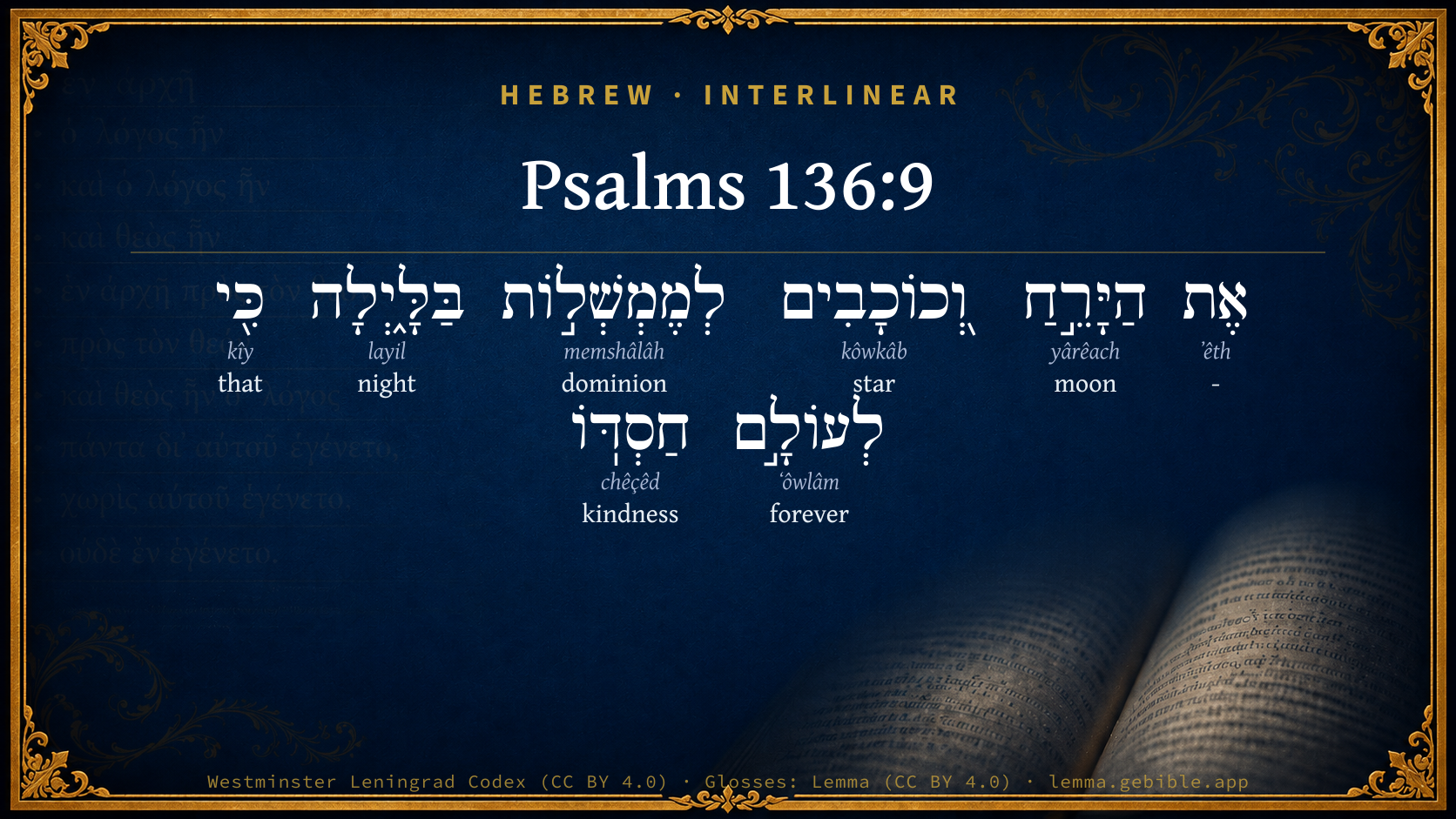
Psalms 136:9

Hebrew (Westminster Leningrad Codex) Psalms 136:9 appears in the Hebrew Old Testament. The text above is from the Westminster Leningrad Codex. Each word links to its Strong’s number, a concise gloss, and parsing drawn from the Open Scriptures Hebrew Bible morphology. Click any word for its full Brown-Driver-Briggs (BDB) entry.
Download image
Cite this verse

Psalms 136:9 (World English Bible). Public Domain. Lemma interlinear Bible study tool, https://lemma.gebible.app/v/psalms/136/9.

Show BibTeX & RIS
BibTeX
RIS
English Translation
The moon and stars to rule by night; For his loving kindness endures forever:
World English Bible · Public Domain
Download a study sheet

One document with this verse’s original text, its word-by-word gloss line, the meaning frame, cross-references with their text, attributed commentary, and full source and license credits — printable, and it pastes into notes with its structure intact.

This verse Autodidact and up

Study sheet (.html) Plain text (.txt)

A passage Seminary Student

Up to 50 verses in one chapter. A passage sheet keeps up to 6 commentary sources and 12 cross-references per verse, in the order this page ranks them, and says so on the sheet whenever that leaves anything out. Ask for a single verse and you get the Autodidact verse sheet above.

Everything on this page stays free to read, with no account — the sheet is a download of what is already on screen, not access to it.

Want to remove ads? Support Godless Engineer
Compare translations 3

The same verse in 3 English versions, stacked beneath the original-language interlinear above. Click any original word for its lexicon entry.

Each is an independent rendering of the whole verse — the interlinear is not word-aligned to these translations.

Highlighted words mark where these versions differ — a whole-verse word diff, not a word-by-word alignment.

  • World English Bible Public Domain
    The moon and stars to rule by night; For his loving kindness endures forever:
  • King James Version Public Domain
    The moon and stars to rule by night: for his mercy endureth for ever.
  • unfoldingWord Literal Text CC BY-SA 4.0
    the moon and stars for dominion in the night, for his covenant faithfulness to forever.

unfoldingWord Literal Text — © unfoldingWord, licensed CC BY-SA 4.0. Word-aligned USFM3 via Door43 (git.door43.org/unfoldingWord/en_ult).

Versions to compare (up to 4)

3 of 4 selected

Show all 18 translations

Every available English version of this verse, each an independent rendering of the whole verse.

  • World English Bible Public Domain
    The moon and stars to rule by night; For his loving kindness endures forever:
  • Berean Standard Bible Public Domain
    the moon and stars to govern the night. His loving devotion endures forever.
  • Majority Standard Bible Public Domain
    the moon and stars to govern the night. His loving devotion endures forever.
  • King James Version Public Domain
    The moon and stars to rule by night: for his mercy endureth for ever.
  • American Standard Version (1901) Public Domain
    The moon and stars to rule by night; For his lovingkindness `endureth' for ever:
  • Revised Version (1885) Public Domain
    The moon and stars to rule by night: for his mercy endureth for ever.
  • Geneva Bible (1599) Public Domain
    The moone and the starres to gouerne the night: for his mercie endureth for euer:
  • Douay-Rheims (1899) Public Domain
    He sent forth signs and wonders in the midst of thee, O Egypt: upon Pharao, and upon all his servants.
  • Young's Literal Translation Public Domain
    The moon and stars to rule by night, For to the age `is' His kindness.
  • Literal Standard Version CC BY-SA 4.0
    The moon and stars to rule by night, || For His kindness [is] for all time.
  • Unlocked Literal Bible CC BY-SA 4.0
    the moon and stars to rule by night, for his covenant faithfulness endures forever.
  • unfoldingWord Literal Text CC BY-SA 4.0
    the moon and stars for dominion in the night, for his covenant faithfulness to forever.
  • Darby Bible Public Domain
    The moon and stars for rule over the night, for his loving-kindness [endureth] for ever:
  • World Messianic Bible Public Domain
    the moon and stars to rule by night, for his loving kindness endures forever;
  • Webster's Bible Public Domain
    The moon and stars to rule by night: for his mercy endureth for ever.
  • Free Bible Version CC BY-SA 4.0
    The moon and stars to rule the night. For his trustworthy love lasts forever.
  • Bible in Basic English Public Domain
    The moon and the stars to have rule by night: for his mercy is unchanging for ever.
  • JPS Tanakh (1917) Public Domain
    The moon and stars to rule by night, for His mercy endureth for ever.

Literal Standard Version (2020), Covenant Press — licensed CC BY-SA 4.0. Text via the HelloAO Bible API (eBible.org). Unlocked Literal Bible (unfoldingWord) — licensed CC BY-SA 4.0. Text via the HelloAO Bible API (eBible.org). unfoldingWord Literal Text — © unfoldingWord, licensed CC BY-SA 4.0. Word-aligned USFM3 via Door43 (git.door43.org/unfoldingWord/en_ult). Free Bible Version, Dr. Jonathan Gallagher — licensed CC BY-SA 4.0. Text via the HelloAO Bible API (eBible.org).

Word by word

More ways to search: Search by grammar → Find every occurrence → Compare this word →

Practice this passage: Drill this verse → Learn its vocabulary →

About this verse

These counts appear in no published source. They are computed here, from the morphology-tagged text and Lemma’s own curated glosses. What Lemma adds →

8
words
8
distinct lemmas
Wisdom
section

Notable vocabulary

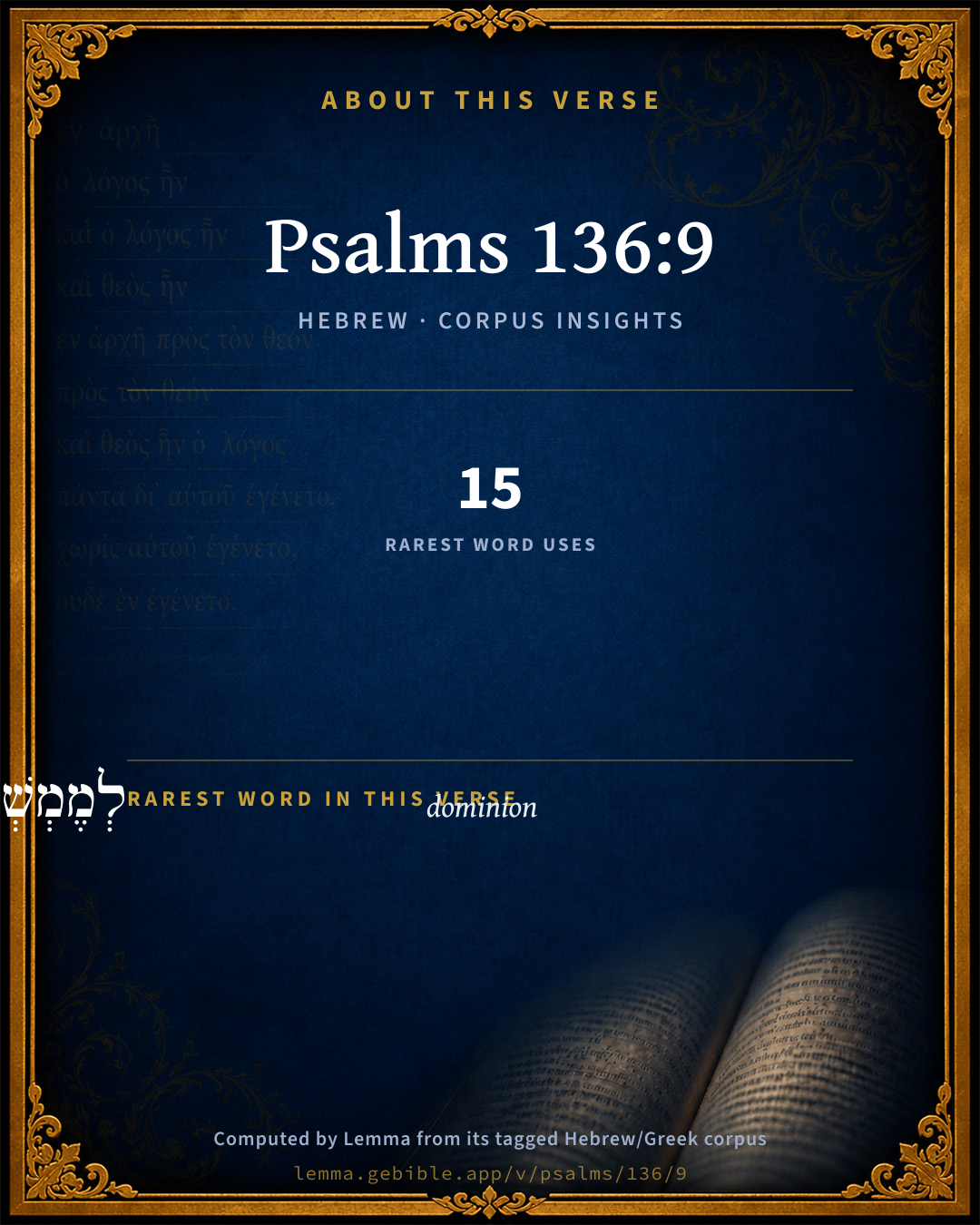
The rarest word here is לְמֶמְשְׁל֣וֹת dominion H4475 — appearing just 15 times in the whole Hebrew Bible.

Shared distinctive vocabulary

לְמֶמְשְׁל֣וֹת dominion H4475 occurs in 14 verses of the Hebrew Bible. Also found in:

Grammatical profile

  • 6 nouns
  • 1 conjunction
  • 1 particle

Hebrew & Septuagint length

In English translation the verse runs 14 words from the Hebrew and 15 from the Septuagint (LXX English) — closely comparable.

A rough comparison of the two English renderings, which tokenize alike — not a word-level alignment.

Word counts can differ between the Hebrew and the Greek without any difference in meaning — e.g. the Hebrew direct-object marker אֵת has no separate Greek word, and Greek often adds the article ὁ.

Cross-references

3

Topical passages linked to Psalms 136:9 in the Treasury of Scripture Knowledge — connected by theme and wording, ordered by reader-vote popularity; previews shown in the World English Bible.

  • Job 31:26 If I have seen the sun when it shined, Or the moon moving in splendor,
  • Psalms 8:3 When I consider your heavens, the work of your fingers, The moon and the stars, which you have ordained;
  • Psalms 89:36–37 His seed will endure forever, His throne like the sun before me.

Cross-references courtesy of OpenBible.info (CC BY 4.0).

Hebrew and Greek witnesses Masoretic Hebrew ↔ Greek Septuagint

The same verse in the two great witnesses to the Old Testament, shown verse-for-verse.

You’re reading Greek Psalm 135 (Hebrew Psalm 136). The Septuagint counts the superscription, so verse numbers can differ from the Hebrew — chapter-level alignment, not verse-by-verse. Numbering follows Rahlfs.

These are two independent witnesses, not word-aligned to each other, and the Septuagint is shown in lemma (dictionary) form.

Hebrew Psalms 136:9 Masoretic · Westminster Leningrad Codex

אֶת הַיָּרֵ֣חַ וְ֭כוֹכָבִים לְמֶמְשְׁל֣וֹת בַּלָּ֑יְלָה כִּ֖י לְעוֹלָ֣ם חַסְדּֽוֹ

The moon and stars to rule by night; For his loving kindness endures forever:

World English Bible · Public Domain

Greek LXX Greek Psalm 135:9 Septuagint · lemma form

ὁ σελήνη καί ὁ ἄστρον εἰς ἐξουσία ὁ νύξ ὅτι εἰς ὁ αἰών ὁ ἔλεος αὐτός

The moon and the stars to rule the night; for his mercy endures for ever.

LXX2012 (modern English Septuagint) · Public Domain

Hebrew: Westminster Leningrad Codex (CC BY 4.0). Greek: Septuagint (public domain); English from LXX2012 (modern English Septuagint) (Public Domain). How the Septuagint differs from the Hebrew →

Commentary

Notes on Psalms 136:9 from classic Christian and Jewish commentators (each source and its license shown beneath its notes). The classic Christian expositions comment on the surrounding passage and are grouped to its opening verse, so a note may address several verses; the Jewish commentaries on the Tanakh (Rashi and others) are per-verse, so they appear only where the commentator wrote on this verse.

Lemma curates 59 commentaries, every one of them public domain or Creative Commons licensed, each selected and text-cleaned for this edition rather than reprinted as found. About our sources →

Trapp's Complete Commentary

John Trapp

Psa 136:9 The moon and stars to rule by night: for his mercy [endureth] for ever.

Ver. 9. The moon and stars to rule by night] For by day they all veil to the sun; from whom also they borrow much of their light. The moon hath her name in Hebrew from moisture, as refreshing the earth with her cool influences; and thrusting forth precious things therein, Deu 33:14.

John Trapp, A Commentary or Exposition upon All the Books of the Old and New Testament (1647–1656) — public domain. Text from a community e-Sword module.

J. A. Alexander on Psalms

Joseph Addison Alexander

9. (Psa 136:9) The moon and stars to rule by night--for unto eternity (is) his mercy. To rule, literally for rules or dominions, perhaps because the stars are here made sharers with the moon in the dominion of the night.

Joseph Addison Alexander, The Psalms Translated and Explained (1850) — public domain. Text from a community e-Sword module.

The Cambridge Bible for Schools and Colleges

gen. ed. J. J. S. Perowne

9. O give thanks unto him that chooseth the sons of Zadok to be priests (cp. Eze_40:46), for &c.

The Cambridge Bible for Schools and Colleges (gen. ed. J. J. S. Perowne; Cambridge University Press, 1878–1918) — public domain. Text from a community e-Sword module.

John Gill's Exposition

The moon and stars to rule by night,.... The lesser lights, and which indeed receive all their light Front the sun, Gen 1:16;

for his mercy endureth for ever; in continuing these lights, so useful to men, as well as in making of them: the moon and stars have their benign influences upon the earth, to produce things out of it useful to men; see Deu 33:14; and are of singular service to benighted travellers, and to those that go down to the sea in ships; see Act 27:20. The moon is an emblem of the church, that receives her light from Christ, the sun, and which will continue for ever; and, stars are emblems of Gospel ministers, who are the means of enlightening dark souls, and of refreshing disconsolate saints; and are a continued mercy to an ignorant world, as well as to the church, and will be continued as long as it stands; see Sol 6:10, Mat 5:14.

John Gill's Exposition of the Whole Bible (1746–1763) — public domain (CC PDM 1.0). Text via the HelloAO Bible API.

Albert Barnes' Notes on the Bible

The moon and stars to rule by night - Gen 1:16.

For his mercy ... - As a proof also of his benignity and mercy. By all the beauty of the moon and stars in their course through the heavens - by all that there is in the harmony and order of their movements - by all that there is to make night less hideous and fearful - by all that there is to reveal a countless number of worlds whose existence could not have been discovered but for the night - by all that there is to guide the mariner on the ocean, enabling him to determine his position and to mark his course when on the deep - and therefore by all the blessings of navigation and commerce, binding the different parts of the world together, by all that there is in the “North-star,” fixed and true in guiding those who flee from bondage - by all these and kindred things without number, do we see the benignity, the goodness, the mercy of God, in forming the moon and stars “to rule by night.”

Albert Barnes' Notes on the Bible (1834–1885) — public domain. Text from a community e-Sword/MySword module.

The Treasury of David

Charles H. Spurgeon

Ver. 9. The moon and stars to rule by night. No hour is left without rule. Blessed be God, he leaves us never to the doom of anarchy. The rule is one of light and benediction. The moon with her charming changes, and the stars in their fixed spheres gladden the night. When the season would be dark and dreary because of the absence of the sun, forth come the many minor comforters. The sun is enough alone; but when he is gone a numerous band cannot suffice to give more than a humble imitation of his radiance. Jesus, the Sun of Righteousness, alone, can do more for us than all his servants put together. He makes our day. When he is hidden, it is night, and remains night, let our human comforters shine at their full. What mercy is seen in the lamps of heaven gladdening our landscape at night! What equal mercy in all the influences of the moon upon the tides, those life floods of the earth! The Lord is the Maker of every star, be the stars what they may; he calleth them all by their names, and at his bidding each messenger with his torch enlightens our darkness.

For his mercy endureth for ever. Let our thanks be as many as the stars, and let our lives reflect the goodness of the Lord, even as the moon reflects the light of the sun. The nightly guides and illuminators of men on land and sea are not for now and then, but for all time.

They shone on Adam, and they shine on us. Thus they are tokens and pledges of undying grace to men; and we may sing with our Scotch friends

"For certainly

His mercies dure

Most firm and sure

Eternally."

Ver. 9. The moon and stars to rule by night. While the apparent revolution of the sun marks out the year and the course of the seasons, the revolution of the moon round the heavens marks out our months; and by regularly changing its figure at the four quarters of its course, subdivides the months into two periods of weeks, and thus exhibits to all the nations of the earth a "watch light", or signal, which every seven days presents a form entirely new, for marking out the shorter periods of duration. By its nearness to the earth, and the consequent increase of its gravitating power, it produces currents in the atmosphere, which direct the course of the winds, and purify the aerial fluid from noxious exhalations; it raises the waters of the ocean, and perpetuates the regular returns of ebb and flow, by which the liquid element is preserved from filth and putrefaction. It extends its sway even over the human frame, and our health and disorders are sometimes partially dependent on its influence. Even its eclipses, and those it produces of the sun, are not without their use. They tend to arouse mankind to the study of astronomy, and the wonders of the firmament; they serve to confirm the deductions of chronology, to direct the navigator, and to settle the geographical position of towns and countries; they assist the astronomer in his celestial investigations, and exhibit an agreeable variety of phenomena in the scenery of the heavens. In short, there are terrestrial scenes presented in moonlight, which, in point of solemnity, grandeur, and picturesque beauty, far surpass in interest, to a poetic imagination, all the brilliancy and splendours of noonday. Hence, in all ages, a moonlight scene has been regarded, by all ranks of men, with feelings of joy and sentiments of admiration. The following description of Homer, translated into English verse by Pope, has been esteemed one of the finest night pieces in poetry:

"Behold the moon, refulgent lamp of night,

O'er Heaven's clear azure spreads her sacred light,

When not a breath disturbs the deep serene,

And not a cloud o'ercasts the solemn scene;

Around her throne the vivid planets roll,

And stars unnumbered gild the glowing pole;

O'er the dark trees a yellower verdure shed,

And tip with silver every mountain's head;

Then shine the vales; the rocks in prospect rise;

A flood of glory bursts from all the skies;

The conscious swains, rejoicing in the sight,

Eye the blue vault, and bless the useful light."

Without the light of the moon, the inhabitants of the polar regions would be for weeks and months immersed in darkness. But the moon, like a kindly visitant, returns at short intervals, in the absence of the sun, and cheers them with her beams for days and weeks together. So that, in this nocturnal luminary, as in all the other arrangements of nature, we behold a display of the paternal care and beneficence of that Almighty Being who ordained "the moon and the stars to rule by night", as an evidence of his superabundant goodness, and of "his mercy which endureth for ever." Thomas Dick (1774-1857), in "Celestial Scenery."

Ver. 9. Stars to rule by night. The purpose of the sacred narrative being to describe the adaption of the earth to the use of man, no account is taken of the nature of the stars, as suns or planets, but merely as signs in the heavens. "Speaker's Commentary."

Ver. 9. Stars. The stars not only adorn the roof of our sublunary mansion, they are also in many respects useful to man. Their influences are placid and gentle. Their rays, being dispersed through spaces so vast and immense, are entirely destitute of heat by the time they arrive at our abode; so that we enjoy the view of a numerous assemblage of luminous globes without any danger of their destroying the coolness of the night or the quiet of our repose. They serve to guide the traveller both by sea and land; they direct the navigator in tracing his course from one continent to another through the pathless ocean. They serve "for signs and for seasons, and for days and years." They direct the labours of the husbandman, and determine the return and conclusion of the seasons. They serve as a magnificent "time piece", to determine the true length of the day and of the year, and to mark with accuracy all their subordinate divisions. They assist us in our commerce, and in endeavouring to propagate religion among the nations, by showing us our path to every region of the earth. They have enabled us to measure the circumference of the globe, to ascertain the density of the materials of which it is composed, and to determine the exact position of all places upon its surface. They cheer the long nights of several months in the polar regions, which would otherwise be overspread with impenetrable darkness. Above all, they open a prospect into the regions of other worlds, and tend to amplify our views of the Almighty Being who brought them into existence by his power, and "whose kingdom ruleth over all." In these arrangements of the stars in reference to our globe, the Divine wisdom and goodness may be clearly perceived. We enjoy all the advantages to which we have alluded as much as if the stars had been created solely for the use of our world, while, at the same time, they serve to diversify the nocturnal sky of other planets, and to diffuse their light and influence over ten thousands of other worlds with which they are more immediately connected, so that, in this respect, as well as in every other, the Almighty produces the most sublime and diversified effects by means the most simple and economical, and renders every part of the universe subservient to another, and to the good of the whole. Thomas Dick.

Ver. 9. Stars. When the First Consul crossed the Mediterranean on his Egyptian expedition, he carried with him a cohort of savans, who ultimately did good service in many ways. Among them, however, as might be expected at that era, were not a few philosophers of the Voltaire Diderot school. Napoleon, for his own instruction and amusement on shipboard, encouraged disputation among these gentlemen; and on one occasion they undertook to show, and, according to their own account, did demonstrate, by infallible logic and metaphysic, that there is no God. Bonaparte, who hated all idealogists, abstract reasoners, and logical demonstrators, no matter what they were demonstrating, would not fence with these subtle dialecticians, but had them immediately on deck, and, pointing to the stars in the clear sky, replied, by way of counter argument, "Very good, messieurs! But who made all these?" George Wilson, in "Religio Chemici", 1862.

Psalms 136:10*

Charles H. Spurgeon's The Treasury of David (1869–1885) — public domain. Psalms only. Text from a community e-Sword/MySword module.

The Pulpit Commentary

The moon and stare to rule by night. (Gen_1:16, Gen_1:18) For his mercy, etc.

The Pulpit Commentary (1880–1919), ed. H.D.M. Spence-Jones & Joseph S. Exell — public domain. Text from a community e-Sword module.

Lesson kit

Teaching starters — assembled from the data on this page, not authored interpretation. Every prompt links to the verse data it draws on. Edit before teaching.

Psalms, in the Wisdom, opens this verse with 8 words (8 distinct Hebrew lemmas). Its most distinctive word is memshâlâh (“dominion”). A historical commentator’s framing appears above. Read the whole chapter for the surrounding context.

Discussion questions

  1. The word memshâlâh carries the sense “dominion.” How does it shape the verse?
  2. How does Genesis 1:16, which shares the word «dominion», read alongside this verse?
  3. These translations render this verse differently. What is at stake in choosing one wording over another?
  4. Compare how Trapp's Complete Commentary and J. A. Alexander on Psalms read this verse. Where do they agree or differ?

Things to notice

Reading settings

Reading text

Shown beneath each verse's original-language words.

Old Testament
Old Testament edition

Read the OT as the Masoretic Hebrew (MT) or the Greek Septuagint (LXX).

English shown for the Greek Septuagint (in the Hebrew ↔ Greek comparison).

Comparing translations? Open the Compare panel on any verse page to stack up to four side by side.