
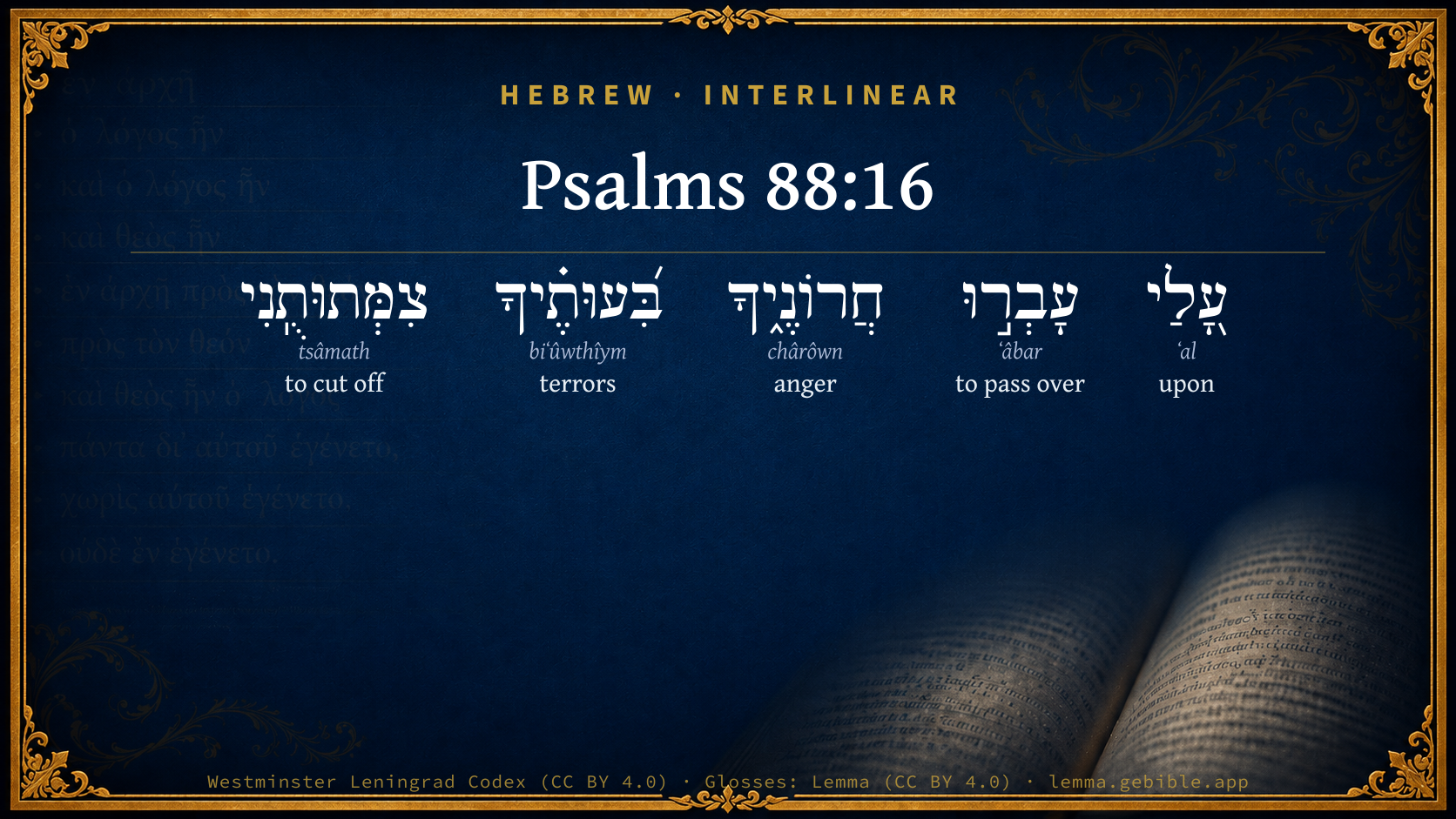
Psalms 88:16

Hebrew (Westminster Leningrad Codex) Psalms 88:16 appears in the Hebrew Old Testament. The text above is from the Westminster Leningrad Codex. Each word links to its Strong’s number, a concise gloss, and parsing drawn from the Open Scriptures Hebrew Bible morphology. Click any word for its full Brown-Driver-Briggs (BDB) entry.
Download image
Cite this verse

Psalms 88:16 (World English Bible). Public Domain. Lemma interlinear Bible study tool, https://lemma.gebible.app/v/psalms/88/16.

Show BibTeX & RIS
BibTeX
RIS
English Translation
Your fierce wrath has gone over me. Your terrors have cut me off.
World English Bible · Public Domain
Download a study sheet

One document with this verse’s original text, its word-by-word gloss line, the meaning frame, cross-references with their text, attributed commentary, and full source and license credits — printable, and it pastes into notes with its structure intact.

This verse Autodidact and up

Study sheet (.html) Plain text (.txt)

A passage Seminary Student

Up to 50 verses in one chapter. A passage sheet keeps up to 6 commentary sources and 12 cross-references per verse, in the order this page ranks them, and says so on the sheet whenever that leaves anything out. Ask for a single verse and you get the Autodidact verse sheet above.

Everything on this page stays free to read, with no account — the sheet is a download of what is already on screen, not access to it.

Want to remove ads? Support Godless Engineer
Compare translations 3

The same verse in 3 English versions, stacked beneath the original-language interlinear above. Click any original word for its lexicon entry.

Each is an independent rendering of the whole verse — the interlinear is not word-aligned to these translations.

Highlighted words mark where these versions differ — a whole-verse word diff, not a word-by-word alignment.

  • World English Bible Public Domain
    Your fierce wrath has gone over me. Your terrors have cut me off.
  • King James Version Public Domain
    Thy fierce wrath goeth over me; thy terrors have cut me off.
  • unfoldingWord Literal Text CC BY-SA 4.0
    Your indignations pass over me; your terrors destroy me.

unfoldingWord Literal Text — © unfoldingWord, licensed CC BY-SA 4.0. Word-aligned USFM3 via Door43 (git.door43.org/unfoldingWord/en_ult).

Versions to compare (up to 4)

3 of 4 selected

Show all 18 translations

Every available English version of this verse, each an independent rendering of the whole verse.

  • World English Bible Public Domain
    Your fierce wrath has gone over me. Your terrors have cut me off.
  • Berean Standard Bible Public Domain
    Your wrath has swept over me; Your terrors have destroyed me.
  • Majority Standard Bible Public Domain
    Your wrath has swept over me; Your terrors have destroyed me.
  • King James Version Public Domain
    Thy fierce wrath goeth over me; thy terrors have cut me off.
  • American Standard Version (1901) Public Domain
    Thy fierce wrath is gone over me; Thy terrors have cut me off.
  • Revised Version (1885) Public Domain
    Thy fierce wrath is gone over me; thy terrors have cut me off.
  • Geneva Bible (1599) Public Domain
    Thine indignations goe ouer me, and thy feare hath cut me off.
  • Douay-Rheims (1899) Public Domain
    I am poor, and in labours from my youth: and being exalted have been humbled and troubled.
  • Young's Literal Translation Public Domain
    Over me hath Thy wrath passed, Thy terrors have cut me off,
  • Literal Standard Version CC BY-SA 4.0
    Your wrath has passed over me, || Your terrors have cut me off,
  • Unlocked Literal Bible CC BY-SA 4.0
    Your angry actions have passed over me, and your terrifying deeds have annihilated me.
  • unfoldingWord Literal Text CC BY-SA 4.0
    Your indignations pass over me; your terrors destroy me.
  • Darby Bible Public Domain
    Thy fierce anger hath gone over me; thy terrors have brought me to nought:
  • World Messianic Bible Public Domain
    Your fierce wrath has gone over me. Your terrors have cut me off.
  • Webster's Bible Public Domain
    \\88:15\\I am afflicted and ready to die from my youth up: while I suffer thy terrors I am distracted.
  • Free Bible Version CC BY-SA 4.0
    Your anger has overcome me; the terrible things you do have destroyed me.
  • Bible in Basic English Public Domain
    The heat of your wrath has gone over me; I am broken by your cruel punishments.
  • JPS Tanakh (1917) Public Domain
    (88-17) Thy fierce wrath is gone over me; Thy terrors have cut me off.

Literal Standard Version (2020), Covenant Press — licensed CC BY-SA 4.0. Text via the HelloAO Bible API (eBible.org). Unlocked Literal Bible (unfoldingWord) — licensed CC BY-SA 4.0. Text via the HelloAO Bible API (eBible.org). unfoldingWord Literal Text — © unfoldingWord, licensed CC BY-SA 4.0. Word-aligned USFM3 via Door43 (git.door43.org/unfoldingWord/en_ult). Free Bible Version, Dr. Jonathan Gallagher — licensed CC BY-SA 4.0. Text via the HelloAO Bible API (eBible.org).

Word by word

More ways to search: Search by grammar → Find every occurrence → Compare this word →

Practice this passage: Drill this verse → Learn its vocabulary →

About this verse

These counts appear in no published source. They are computed here, from the morphology-tagged text and Lemma’s own curated glosses. What Lemma adds →

5
words
5
distinct lemmas
Wisdom
section

Notable vocabulary

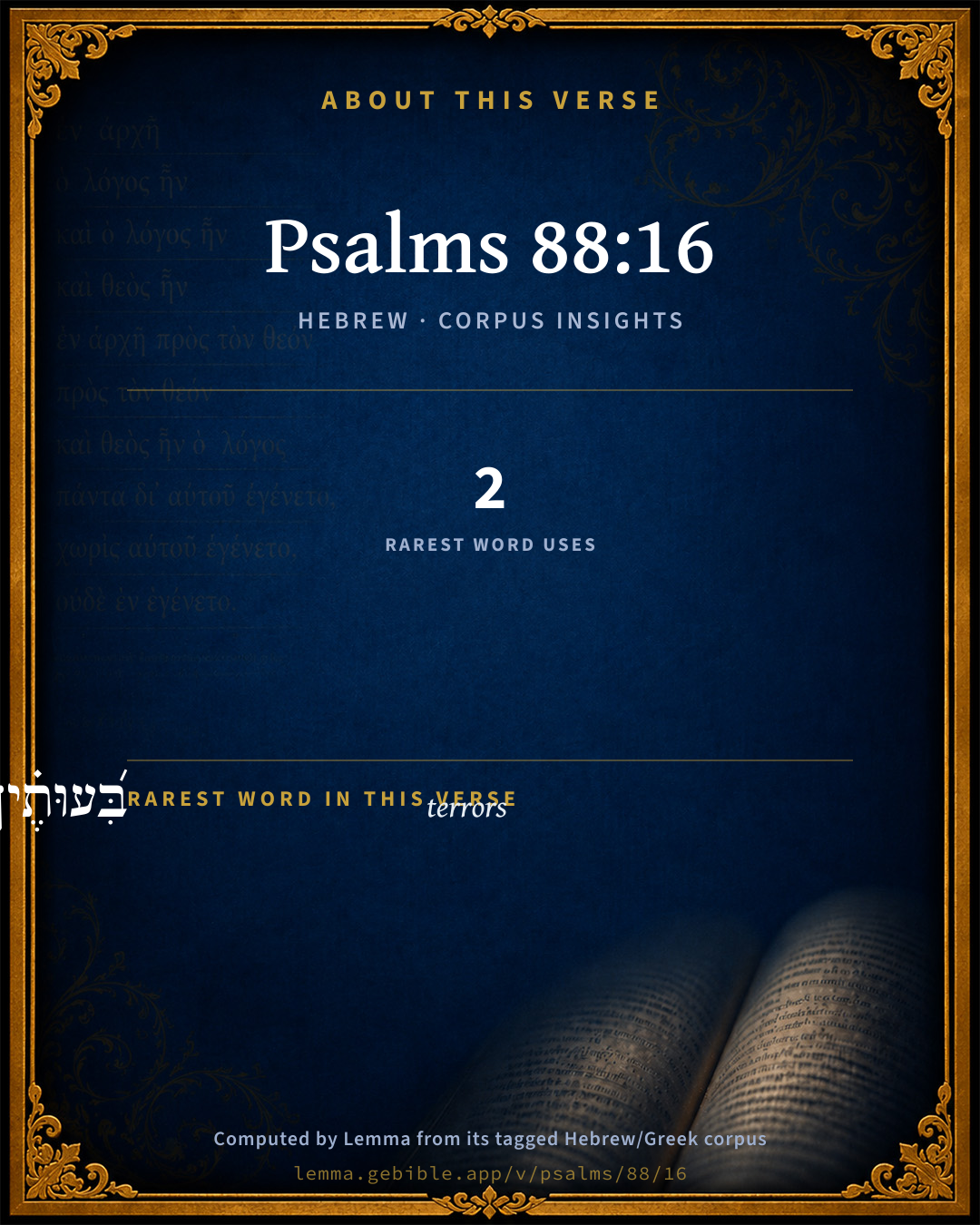
The rarest word here is בִּ֝עוּתֶ֗יךָ terrors H1161 — appearing just 2 times in the whole Hebrew Bible.

Shared distinctive vocabulary

בִּ֝עוּתֶ֗יךָ terrors H1161 occurs in 2 verses of the Hebrew Bible. Also found in:

Grammatical profile

  • 2 verbs
  • 2 nouns
  • 1 preposition

Verb forms

  • עָבְר֣וּ Qal · Perfect
  • צִמְּתוּתֻֽנִי Pilpel · Perfect

Hebrew & Septuagint length

In English translation the verse runs 13 words from the Hebrew and 13 from the Septuagint (LXX English) — the same length.

A rough comparison of the two English renderings, which tokenize alike — not a word-level alignment.

Word counts can differ between the Hebrew and the Greek without any difference in meaning — e.g. the Hebrew direct-object marker אֵת has no separate Greek word, and Greek often adds the article ὁ.

Cross-references

11

Topical passages linked to Psalms 88:16 in the Treasury of Scripture Knowledge — connected by theme and wording, ordered by reader-vote popularity; previews shown in the World English Bible.

  • Revelation 6:17 for the great day of his wrath has come; and who is able to stand?"
  • Psalms 38:1–2 Yahweh, don't rebuke me in your wrath, Neither chasten me in your hot displeasure.
  • Psalms 89:46 How long, Yahweh? Will you hide yourself forever? Will your wrath burn like fire?
  • Psalms 90:7 For we are consumed in your anger. We are troubled in your wrath.
  • Psalms 90:11 Who knows the power of your anger, Your wrath according to the fear that is due to you?
  • Psalms 102:10 Because of your indignation and your wrath, For you have taken me up, and thrown me away.
  • Isaiah 53:4–6 Surely he has borne our sickness, and carried our suffering; yet we considered him plagued, struck by God, and afflicted.
  • Isaiah 53:8 By oppression and judgment he was taken away; and as for his generation, who [among them] considered that he was cut off out of the land of the living for the disobedience of my people to whom the stroke [was due]?
  • Daniel 9:26 After the sixty-two weeks the Anointed One shall be cut off, and shall have nothing: and the people of the prince who shall come shall destroy the city and the sanctuary; and the end of it shall be with a flood, and even to the end shall be war; desolations are determined.
  • Romans 8:32 He who didn't spare his own Son, but delivered him up for us all, how would he not also with him freely give us all things?
  • Galatians 3:13 Christ redeemed us from the curse of the law, having become a curse for us. For it is written, "Cursed is everyone who hangs on a tree,"

Cross-references courtesy of OpenBible.info (CC BY 4.0).

Hebrew and Greek witnesses Masoretic Hebrew ↔ Greek Septuagint

The same verse in the two great witnesses to the Old Testament, shown verse-for-verse.

You’re reading Greek Psalm 87 (Hebrew Psalm 88). The Septuagint counts the superscription, so verse numbers can differ from the Hebrew — chapter-level alignment, not verse-by-verse. Numbering follows Rahlfs.

These are two independent witnesses, not word-aligned to each other, and the Septuagint is shown in lemma (dictionary) form.

Hebrew Psalms 88:16 Masoretic · Westminster Leningrad Codex

עָ֭לַי עָבְר֣וּ חֲרוֹנֶ֑יךָ בִּ֝עוּתֶ֗יךָ צִמְּתוּתֻֽנִי

Your fierce wrath has gone over me. Your terrors have cut me off.

World English Bible · Public Domain

Greek LXX Greek Psalm 87:16 Septuagint · lemma form

πτωχός εἰμί ἐγώ καί ἐν κόπος ἐκ νεότης ἐγώ ὑψόω δέ ταπεινόω καί ἐκἀπορέω

Your wrath has passed over me; and your terrors have greatly disquieted me.

LXX2012 (modern English Septuagint) · Public Domain

On this verse, Ellicott's Commentary for English Readers discusses the Septuagint’s reading. Read the note in Commentary ↓

Hebrew: Westminster Leningrad Codex (CC BY 4.0). Greek: Septuagint (public domain); English from LXX2012 (modern English Septuagint) (Public Domain). How the Septuagint differs from the Hebrew →

Commentary

Notes on Psalms 88:16 from classic Christian and Jewish commentators (each source and its license shown beneath its notes). The classic Christian expositions comment on the surrounding passage and are grouped to its opening verse, so a note may address several verses; the Jewish commentaries on the Tanakh (Rashi and others) are per-verse, so they appear only where the commentator wrote on this verse.

Lemma curates 59 commentaries, every one of them public domain or Creative Commons licensed, each selected and text-cleaned for this edition rather than reprinted as found. About our sources →

Trapp's Complete Commentary

John Trapp

Psa 88:16 Thy fierce wrath goeth over me; thy terrors have cut me off.

Ver. 16. Thy fierce wrath, &c.] As rivers of brimstone.

Have cut me off] Multis excisionibus ideoque duplicatur Tau.

John Trapp, A Commentary or Exposition upon All the Books of the Old and New Testament (1647–1656) — public domain. Text from a community e-Sword module.

J. A. Alexander on Psalms

Joseph Addison Alexander

17. (Psa 88:16) Over me hare passed thine indignation; thy terrors have destroyed me. The image in the first clause is the same as in Psa 42:7. Indignations, literally heats or inflamations, but always applied to anger. The plural occurs only here. The unusual form of the last verb is supposed by some to have been coined by the writer, for the sake of an allusion to Lev 25:23.

Joseph Addison Alexander, The Psalms Translated and Explained (1850) — public domain. Text from a community e-Sword module.

Adam Clarke's Commentary

Verse 16. Thy fierce wrath goeth over me.] It is a mighty flood by which I am overwhelmed.

Adam Clarke's Commentary on the Bible (1810–1826) — public domain. Text from a community e-Sword/MySword module.

Ellicott's Commentary for English Readers

(16) Have cut me off.—Or, extinguished me. The form of the verb is very peculiar, and is variously explained. All that is certain is that it is intensive, expressing the hopeless and continued state of prostration of the sufferer. The LXX., “have frightened.”

A Bible Commentary for English Readers, edited by Charles John Ellicott (1878–1897) — public domain. Text from a community e-Sword module.

The Cambridge Bible for Schools and Colleges

gen. ed. J. J. S. Perowne

16. The fiery streams of thy wrath have gone over me.

Cp. Psa_42:7; but for waves he substitutes fiery wraths.

Thine alarms, a word found only in Job_6:4, have made an end of me (Lam_3:53).

The Cambridge Bible for Schools and Colleges (gen. ed. J. J. S. Perowne; Cambridge University Press, 1878–1918) — public domain. Text from a community e-Sword module.

John Gill's Exposition

Thy fierce wrath goeth over me,.... Or "wraths" (h), burning wrath; the whole of divine wrath, in all its fierceness, due to the sins of his people: these, like the mighty waves of the sea, passed over him, threatening to overwhelm him, Psa 89:38,

thy terrors have cut me off; from the presence of God, and out of his sight; as sometimes the Lord's people are ready to imagine, when forsaken by him, Psa 31:22 or from the land of the living, as the Messiah was, and in a judicial way, though not for any sin of his own, Isa 53:8.

(h) "irae tuae", Pagninus, Montanus; "furores tui", Musculus, Tigurine version.

John Gill's Exposition of the Whole Bible (1746–1763) — public domain (CC PDM 1.0). Text via the HelloAO Bible API.

Albert Barnes' Notes on the Bible

Thy fierce wrath goeth over me - Like waters. See Psa 88:7.

Thy terrors have cut me off - That is, I am as one already dead; I am so near to death that I may be spoken of as dead.

Albert Barnes' Notes on the Bible (1834–1885) — public domain. Text from a community e-Sword/MySword module.

The Treasury of David

Charles H. Spurgeon

Ver. 16. Thy fierce wrath goeth over me. What an expression, "fierce wrath", and it is a man of God who feels it! Do we seek an explanation? It seemed so to him, but "tidings are not what they seem." No punitive anger ever falls upon the saved one, for Jesus shields him from it all; but a father's anger may fall upon his dearest child, none the less but all the more, because he loves it. Since Jesus bore my guilt as my substitute, my Judge cannot punish me, but my Father can and will correct me. In this sense the Father may even manifest "fierce wrath" to his erring child, and under a sense of it that dear broken down one may be laid in the dust and covered with wretchedness, and yet for all that he may be accepted and beloved of the Lord all the while. Heman represents God's wrath as breaking over him as waves over a wreck.

Thy terrors have cut me off. They have made me a marked man, they have made me feel like a leper separated from the congregation of thy people, and they have caused others to look upon me as no better than dead. Blessed be God this is the sufferer's idea and not the very truth, for the Lord will neither cast off nor cut off his people, but will visit his mourners with choice refreshments.

Ver. 16. Thy fierce wrath goeth over me. Like a sea of liquid fire; (Ps 42:7) Heb. "Thy hot wraths." LXX (Septuagint) ai orgai sou William Kay

Ver. 16. Thy terrors have cut me off. In the Hebrew verb the last syllable is repeated for the purpose of putting vehemence into the expression. The word tme signifies, to shut up and press into some narrow place, in order that; one may not breathe or escape...In this sense Gregory Nazianzen in his

first oration concerning peace, calls grief (the prison of the heart). Mollerus.

Ver. 16.

1. Good men are often tried men.

2. Tried men frequently misjudge the Lord's dealings.

3. The Lord does not take them at their word, he is better than their fears. G.R.

Psalms 88:17*

Charles H. Spurgeon's The Treasury of David (1869–1885) — public domain. Psalms only. Text from a community e-Sword/MySword module.

Whedon's Commentary on the Bible

Daniel D. Whedon

16. Cut me off—Thy terrible judgments have severed me from the living.

Daniel D. Whedon (gen. ed.), Commentary on the Old and New Testaments (1874–1909) — public domain. Text from a community e-Sword module.

The Pulpit Commentary

Thy fierce wrath goeth over me. "Overwhelms me;" i.e. "like a fiery flood" (see above, ver. 7). Thy terrors have cut me off. A different word is used for "terrors" from that which occurs in ver. 15, and one elsewhere occurring only in Job_6:4. The verb also is one characteristic of Job, (Job_6:17 Job_23:17) and means "extinguish," or "exterminate."

The Pulpit Commentary (1880–1919), ed. H.D.M. Spence-Jones & Joseph S. Exell — public domain. Text from a community e-Sword module.

Rashi

Rabbi Shlomo Yitzchaki (Rashi)

and close to sudden death Heb. וגוע מנער, dying from the strangulation of sudden death, as (Exod. 14:27): “and the Lord strangled (וינער).” Menachem (p. 123) defines וינער as an expression of beating, as (Isa. 33:15): “who shakes (נוער) his hands from taking hold of bribe”; (Isa. 52:2), “Shake yourself (התנערי) from the dust, arise”; (Isa. 1:31), “And the[ir] strength will become as tow (לנערת)”; (Job 38: 13), “so that the wicked will be shaken (וינערו) from it”; (Neh. 5:13), “even thus may he be shaken out (נעור) and emptied.”

it is well-founded Heb. אפונה. Your fear is settled and based in my heart. אפוּנה is an expression of (Prov. 25:11): “a word spoken with proper basis (אפניו)”; on its basis.

Rashi on the Tanakh — English translations: “The Judaica Press complete Tanach with Rashi, translated by A. J. Rosenberg” (CC BY 4.0); “Pentateuch with Rashi's commentary by M. Rosenbaum and A.M. Silbermann, 1929-1934” (public domain); “The Metsudah Tanach series, Lakewood, N.J” (CC BY 4.0); and “The Book of Joshua, Metsudah Publications, 1997” (CC BY 4.0). Text via Sefaria.

Lesson kit

Teaching starters — assembled from the data on this page, not authored interpretation. Every prompt links to the verse data it draws on. Edit before teaching.

Psalms, in the Wisdom, opens this verse with 5 words (5 distinct Hebrew lemmas). Its most distinctive word is biʻûwthîym (“terrors”). A historical commentator’s framing appears above. Read the whole chapter for the surrounding context.

Discussion questions

  1. How does “terrors” (biʻûwthîym) shape what this verse is saying?
  2. How does Job 6:4, which shares the word «terrors», read alongside this verse?
  3. These translations render this verse differently; the difference is in the English rendering, not the original. What questions does that raise?
  4. «עָבְר֣וּ» is a Qal Perfect verb. How does that grammatical form shape the action described?
  5. Compare how Trapp's Complete Commentary and J. A. Alexander on Psalms read this verse. Where do they agree or differ?

Things to notice

Reading settings

Reading text

Shown beneath each verse's original-language words.

Old Testament
Old Testament edition

Read the OT as the Masoretic Hebrew (MT) or the Greek Septuagint (LXX).

English shown for the Greek Septuagint (in the Hebrew ↔ Greek comparison).

Comparing translations? Open the Compare panel on any verse page to stack up to four side by side.