
Proverbs 20:7

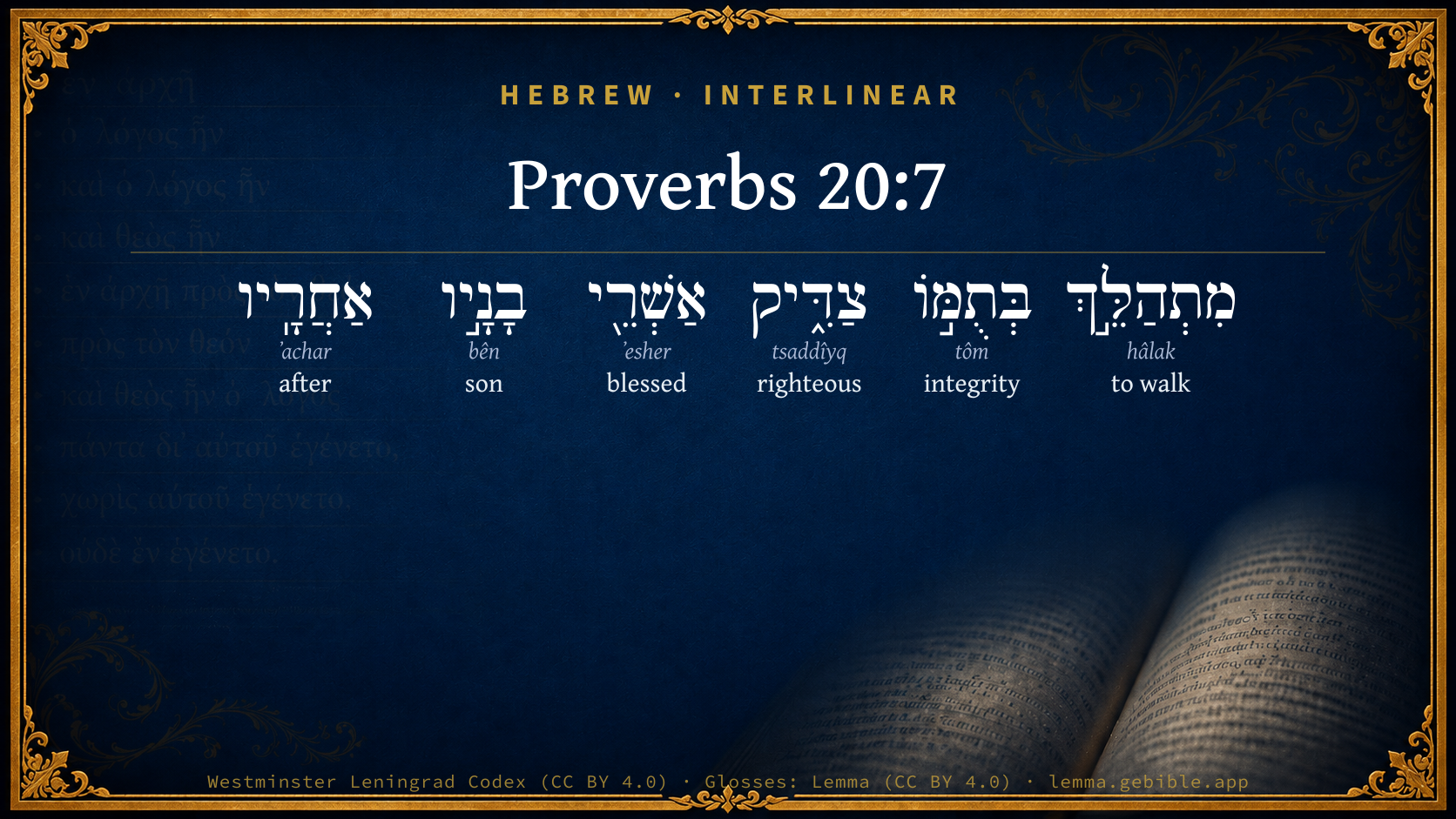
Hebrew (Westminster Leningrad Codex) Proverbs 20:7 appears in the Hebrew Old Testament. The text above is from the Westminster Leningrad Codex. Each word links to its Strong’s number, a concise gloss, and parsing drawn from the Open Scriptures Hebrew Bible morphology. Click any word for its full Brown-Driver-Briggs (BDB) entry.
Download image
Cite this verse

Proverbs 20:7 (World English Bible). Public Domain. Lemma interlinear Bible study tool, https://lemma.gebible.app/v/proverbs/20/7.

Show BibTeX & RIS
BibTeX
RIS
English Translation
A righteous man walks in integrity. Blessed are his children after him.
World English Bible · Public Domain
Download a study sheet

One document with this verse’s original text, its word-by-word gloss line, the meaning frame, cross-references with their text, attributed commentary, and full source and license credits — printable, and it pastes into notes with its structure intact.

This verse Autodidact and up

Study sheet (.html) Plain text (.txt)

A passage Seminary Student

Up to 50 verses in one chapter. A passage sheet keeps up to 6 commentary sources and 12 cross-references per verse, in the order this page ranks them, and says so on the sheet whenever that leaves anything out. Ask for a single verse and you get the Autodidact verse sheet above.

Everything on this page stays free to read, with no account — the sheet is a download of what is already on screen, not access to it.

Want to remove ads? Support Godless Engineer
Compare translations 3

The same verse in 3 English versions, stacked beneath the original-language interlinear above. Click any original word for its lexicon entry.

Each is an independent rendering of the whole verse — the interlinear is not word-aligned to these translations.

Highlighted words mark where these versions differ — a whole-verse word diff, not a word-by-word alignment.

  • World English Bible Public Domain
    A righteous man walks in integrity. Blessed are his children after him.
  • King James Version Public Domain
    The just man walketh in his integrity: his children are blessed after him.
  • unfoldingWord Literal Text CC BY-SA 4.0
    A righteous walks about in his integrity; happy his sons after him.

unfoldingWord Literal Text — © unfoldingWord, licensed CC BY-SA 4.0. Word-aligned USFM3 via Door43 (git.door43.org/unfoldingWord/en_ult).

Versions to compare (up to 4)

3 of 4 selected

Show all 18 translations

Every available English version of this verse, each an independent rendering of the whole verse.

  • World English Bible Public Domain
    A righteous man walks in integrity. Blessed are his children after him.
  • Berean Standard Bible Public Domain
    The righteous man walks with integrity; blessed are his children after him.
  • Majority Standard Bible Public Domain
    The righteous man walks with integrity; blessed are his children after him.
  • King James Version Public Domain
    The just man walketh in his integrity: his children are blessed after him.
  • American Standard Version (1901) Public Domain
    A righteous man that walketh in his integrity, Blessed are his children after him.
  • Revised Version (1885) Public Domain
    A just man that walketh in his integrity, blessed are his children after him.
  • Geneva Bible (1599) Public Domain
    He that walketh in his integritie, is iust: and blessed shall his children be after him.
  • Douay-Rheims (1899) Public Domain
    The just that walketh in his simplicity, shall leave behind him blessed children.
  • Young's Literal Translation Public Domain
    The righteous is walking habitually in his integrity, O the happiness of his sons after him!
  • Literal Standard Version CC BY-SA 4.0
    The righteous is habitually walking in his integrity, || O the blessedness of his sons after him!
  • Unlocked Literal Bible CC BY-SA 4.0
    The righteous person walks in his integrity, and his sons who follow after him will be blessed.
  • unfoldingWord Literal Text CC BY-SA 4.0
    A righteous walks about in his integrity; happy his sons after him.
  • Darby Bible Public Domain
    The righteous walketh in his integrity: blessed are his children after him!
  • World Messianic Bible Public Domain
    A righteous man walks in integrity. Blessed are his children after him.
  • Webster's Bible Public Domain
    The just man walketh in his integrity: his children are blessed after him.
  • Free Bible Version CC BY-SA 4.0
    Good people live honestly; how happy are their children if they follow them.
  • Bible in Basic English Public Domain
    An upright man goes on in his righteousness: happy are his children after him!
  • JPS Tanakh (1917) Public Domain
    He that walketh in his integrity as a just man, happy are his children after him.

Literal Standard Version (2020), Covenant Press — licensed CC BY-SA 4.0. Text via the HelloAO Bible API (eBible.org). Unlocked Literal Bible (unfoldingWord) — licensed CC BY-SA 4.0. Text via the HelloAO Bible API (eBible.org). unfoldingWord Literal Text — © unfoldingWord, licensed CC BY-SA 4.0. Word-aligned USFM3 via Door43 (git.door43.org/unfoldingWord/en_ult). Free Bible Version, Dr. Jonathan Gallagher — licensed CC BY-SA 4.0. Text via the HelloAO Bible API (eBible.org).

Word by word

More ways to search: Search by grammar → Find every occurrence → Compare this word →

Practice this passage: Drill this verse → Learn its vocabulary →

About this verse

These counts appear in no published source. They are computed here, from the morphology-tagged text and Lemma’s own curated glosses. What Lemma adds →

6
words
6
distinct lemmas
Wisdom
section

Notable vocabulary

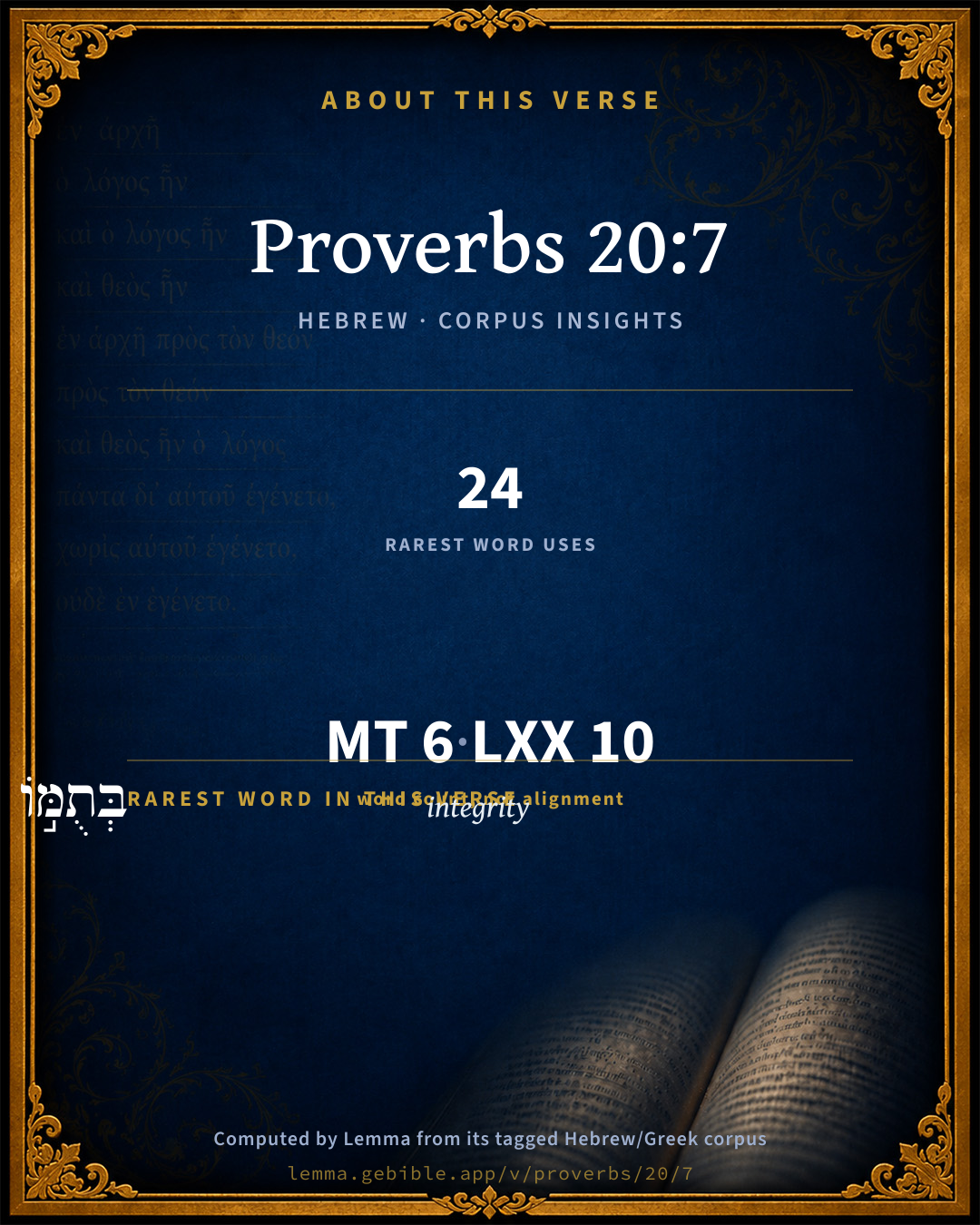
The rarest word here is בְּתֻמּ֣וֹ integrity H8537 — appearing just 24 times in the whole Hebrew Bible.

Shared distinctive vocabulary

בְּתֻמּ֣וֹ integrity H8537 occurs in 24 verses of the Hebrew Bible. Also found in:

Grammatical profile

  • 1 verb
  • 3 nouns
  • 1 adjective
  • 1 preposition

Verb forms

  • מִתְהַלֵּ֣ךְ Hithpael · Participle Active

Hebrew & Septuagint length

In English translation the verse runs 12 words from the Hebrew and 11 from the Septuagint (LXX English) — closely comparable.

A rough comparison of the two English renderings, which tokenize alike — not a word-level alignment.

Word counts can differ between the Hebrew and the Greek without any difference in meaning — e.g. the Hebrew direct-object marker אֵת has no separate Greek word, and Greek often adds the article ὁ.

In the original languages it is 6 Hebrew tokens and 10 Greek tokens — but the two are counted differently (Hebrew bundles its prefixes and suffixes into one token; the Greek is in lemma form), so that isn’t a like-for-like length.

Cross-references

16

Topical passages linked to Proverbs 20:7 in the Treasury of Scripture Knowledge — connected by theme and wording, ordered by reader-vote popularity; previews shown in the World English Bible.

  • Psalms 112:2 His seed will be mighty in the land. The generation of the upright will be blessed.
  • Psalms 37:26 All day long he deals graciously, and lends. His seed is blessed.
  • Jeremiah 32:39 and I will give them one heart and one way, that they may fear me forever, for the good of them, and of their children after them:
  • 2 Corinthians 1:12 For our boasting is this: the testimony of our conscience, that in holiness and sincerity of God, not in fleshly wisdom but in the grace of God we behaved ourselves in the world, and more abundantly toward you.
  • Acts 2:39 For to you is the promise, and to your children, and to all who are far off, even as many as the Lord our God will call to himself."
  • 3 John 1:3–4 For I rejoiced greatly, when brothers came and testified about your truth, even as you walk in truth.
  • Proverbs 13:22 A good man leaves an inheritance to his children's children, But the wealth of the sinner is stored for the righteous.
  • Proverbs 19:1 Better is the poor who walks in his integrity Than he who is perverse in his lips and is a fool.
  • Genesis 17:7 I will establish my covenant between me and you and your seed after you throughout their generations for an everlasting covenant, to be a God to you and to your seed after you.
  • Psalms 15:2 He who walks blamelessly does what is right, And speaks truth in his heart;
  • Psalms 26:1 Judge me, Yahweh, for I have walked in my integrity. I have trusted also in Yahweh without wavering.
  • Proverbs 14:2 He who walks in his uprightness fears Yahweh, But he who is perverse in his ways despises him.
  • Luke 1:6 They were both righteous before God, walking blamelessly in all the commandments and ordinances of the Lord.
  • Titus 2:11–12 For the grace of God has appeared, bringing salvation to all men,
  • Isaiah 33:15 He who walks righteously, and speaks blamelessly; he who despises the gain of oppressions, who shakes his hands from taking a bribe, who stops his ears from hearing of blood, and shuts his eyes from looking on evil:
  • Psalms 26:11 But as for me, I will walk in my integrity. Redeem me, and be merciful to me.

Cross-references courtesy of OpenBible.info (CC BY 4.0).

Hebrew and Greek witnesses Masoretic Hebrew ↔ Greek Septuagint

The same verse in the two great witnesses to the Old Testament, shown verse-for-verse.

These are two independent witnesses, not word-aligned to each other, and the Septuagint is shown in lemma (dictionary) form.

Hebrew Proverbs 20:7 Masoretic · Westminster Leningrad Codex

מִתְהַלֵּ֣ךְ בְּתֻמּ֣וֹ צַדִּ֑יק אַשְׁרֵ֖י בָנָ֣יו אַחֲרָֽיו

A righteous man walks in integrity. Blessed are his children after him.

World English Bible · Public Domain

Greek LXX Proverbs 20:7 Septuagint · lemma form

ὅς ἀναστρέφω ἄμωμος ἐν δικαιοσύνη μακάριος ὁ παῖς αὐτός καταλείπω

He that walks blameless in justice, shall leave his children blessed.

LXX2012 (modern English Septuagint) · Public Domain

On this verse, The Cambridge Bible for Schools and Colleges discusses the Septuagint’s reading. Read the note in Commentary ↓

Hebrew: Westminster Leningrad Codex (CC BY 4.0). Greek: Septuagint (public domain); English from LXX2012 (modern English Septuagint) (Public Domain). How the Septuagint differs from the Hebrew →

Commentary

Notes on Proverbs 20:7 from classic Christian and Jewish commentators (each source and its license shown beneath its notes). The classic Christian expositions comment on the surrounding passage and are grouped to its opening verse, so a note may address several verses; the Jewish commentaries on the Tanakh (Rashi and others) are per-verse, so they appear only where the commentator wrote on this verse.

Lemma curates 59 commentaries, every one of them public domain or Creative Commons licensed, each selected and text-cleaned for this edition rather than reprinted as found. About our sources →

Trapp's Complete Commentary

John Trapp

Pro 20:7 The just [man] walketh in his integrity: his children [are] blessed after him.

Ver. 7. The just man walketh in his integrity.] Walketh constantly; {a} not for a step or two only, when the good fit is upon him. {See Trapp on "Gen 17:1"}

His children are blessed after him.] Personal goodness is profitable to posterity; yet not of merit, but of free grace, and for the promise’ sake; which Jehu’s children found and felt to the fourth generation, though himself were a wicked idolater.

{a} Continenter ambulat.

John Trapp, A Commentary or Exposition upon All the Books of the Old and New Testament (1647–1656) — public domain. Text from a community e-Sword module.

The Biblical Illustrator

Joseph S. Exell

Pro_20:7

His children are blessed after him.

The just mans legacy

1. Anxiety about our family is natural, but we shall be wise if we turn it into care about our own character. If we walk before the Lord in integrity, we shall do more to bless our descendants than if we bequeathed them large estates. A fathers holy life is a rich legacy for his sons.

(1). The upright man leaves his heirs his example, and this in itself will be a mine of true wealth. How many men may trace their success in life to the example of their parents!

(2) He leaves them also his repute. Men think all the better of us as the sons of a man who could be trusted, the successors of a tradesman of excellent repute. Oh, that all young men were anxious to keep up the family name!

(3) Above all, he leaves his children his prayers and the blessing of a prayer-hearing God, and these make an offspring to be favoured among the sons of men. God will save them even after we are dead. Oh, that they might be saved at once!

2. Our integrity may be Gods means of saving our sons and daughters. If they see the truth of our religion proved by our lives, it may be that they will believe in Jesus for themselves. Lord, fulfil this word to my household! (C. H. Spurgeon.)

The Biblical Illustrator, edited by Joseph S. Exell (c. 1880s–1900s) — public domain. Text from a community e-Sword module.

Matthew Henry's Commentary

It is here observed to the honour of a good man, 1. That he does well for himself. He has a certain rule, which with an even steady hand he governs himself by: He walks in his integrity; he keeps good conscience, and he has the comfort of it, for it is his rejoicing. He is not liable to those uneasinesses, either in contriving what he shall do or reflecting on what he has done, which those are liable to that walk in deceit. 2. That he does well for his family: His children are blessed after him, and fare the better for his sake. God has mercy in store for the seed of the faithful.

Matthew Henry's Commentary on the Whole Bible (1708–1710) — public domain (CC PDM 1.0). Text via the HelloAO Bible API.

Jamieson, Fausset & Brown

Robert Jamieson, A. R. Fausset & David Brown

The conduct of good men proclaims their sound principles. God's covenant and their good example secure blessing to their children (Pro 4:26; Psa 112:1-2).

Jamieson, Fausset & Brown — Commentary Critical and Explanatory on the Whole Bible (1871) — public domain (CC PDM 1.0). Text via the HelloAO Bible API.

Ellicott's Commentary for English Readers

(7) The just man.—Comp. Pro_10:2.

His children are blessed after him.—Comp. 1Ki_15:4, Jer_33:20-21.

A Bible Commentary for English Readers, edited by Charles John Ellicott (1878–1897) — public domain. Text from a community e-Sword module.

The Cambridge Bible for Schools and Colleges

gen. ed. J. J. S. Perowne

7. walketh] Rather, that walketh, R.V.

ὄς ἀναστρέφεται ἄμωμος ἐν δικαιοσύνῃ, μακαρίους τοὺς παῖδας αὐτοῦ καταλείψει, LXX.

The Cambridge Bible for Schools and Colleges (gen. ed. J. J. S. Perowne; Cambridge University Press, 1878–1918) — public domain. Text from a community e-Sword module.

John Gill's Exposition

The just man walketh in his integrity,.... This is the faithful and upright man, who is made righteous by the obedience of Christ; and walks by faith in him, and according to the truth of the Gospel;

his children are blessed after him; with temporal blessings; and, walking in the same integrity as he does, they are blessed with spiritual blessings here, and eternal blessedness hereafter; see Psa 37:26. It is an observation of an Heathen poet (c), that good things befall the children of the godly, but not the children of the ungodly.

(c) Theoerit. Idyll. 27. v. 32.

John Gill's Exposition of the Whole Bible (1746–1763) — public domain (CC PDM 1.0). Text via the HelloAO Bible API.

Matthew Poole's English Annotations

The just man walketh in his integrity; he proveth himself to be so not only by his profession, of which he spoke in the former verse, but by his sincere and unblamable conversation. His children are blessed after him, by virtue of that covenant which God hath made with such men, which is not confined to their persons, but entaileth blessings upon their posterity.

Matthew Poole's English Annotations on the Holy Bible (1683–1685) — public domain. Text from a community e-Sword/MySword module.

Whedon's Commentary on the Bible

Daniel D. Whedon

7. The just man — An upright man. The critics transpose: He that walks in his integrity, a righteous man, (or is a righteous man,) happy are his children after him. Comp. Pro_14:26; Gen_24:67; Job_21:21.

Daniel D. Whedon (gen. ed.), Commentary on the Old and New Testaments (1874–1909) — public domain. Text from a community e-Sword module.

The Pulpit Commentary

The just man walketh in his integrity. It is better to connect the two clauses together, and not to take the first as a separate sentence, thus: "He who as a just man walketh in his integrity Blessed are his children after him. (comp. Pro_14:26) So the Septuagint and Vulgate. The man of pure life, who religiously performs his duty towards God and man, shall bring a blessing on his children who follow his good example, both during his life and after his death. The temporal promise is seen in Exo_20:6 Deu_4:40 Psa_112:2, etc. Some see here an instance of utilitarianism; but it cannot be supposed that the writer inculcates virtue for the sake of the worldly advantages connected with it; rather he speaks from experience, and from a faithful dependence on Providence, of the happy results of a holy life.

The Pulpit Commentary (1880–1919), ed. H.D.M. Spence-Jones & Joseph S. Exell — public domain. Text from a community e-Sword module.

Keil & Delitzsch

C. F. Keil & F. Delitzsch

7 He who in his innocence walketh as one upright,

Blessed are his children after him!

We may not take the first line as a separate clause with צדּיק, as subject (Van Dyk, Elster) or predicate (Targ.); for, thus rendered, it does not appropriately fall in as parallel to the second line, because containing nothing of promise, and the second line would then strike in at least not so unconnectedly (cf. on the contrary, Pro 10:9; Pro 14:25). We have before us a substantival clause, of which the first line is the complex subject. But Jerome, the Venet., and Luther erroneously: the just man walking in his innocence; this placing first of the adj. is in opposition to the Hebr. syntax. We must, if the whole is to be interpreted as nom., regard צדיק as permutative: one walking in his innocence, a righteous one. But, without doubt, tsedek is the accus. of the manner; in the manner of one righteous, or in apposition: as one righteous; cf. Job 31:26 with Mic 2:7. Thus Hitzig rightly also refers to these two passages, and Ewald also refers to Pro 22:11; Pro 24:15. To walk in his innocence as a righteous man, is equivalent to always to do that which is right, without laying claim to any distinction or making any boast on that account; for thereby one only follows the impulse and the direction of his heart, which shows itself and can show itself not otherwise than in unreserved devotion to God and to that which is good. The children after him are not the children after his death (Gen 24:67); but, according to Deu 4:40, cf. Job 21:21, those who follow his example, and thus those who come after him; for already in the lifetime of such an one, the benediction begins to have its fulfilment in his children.

Keil & Delitzsch — Biblical Commentary on the Old Testament (1861–1891) — public domain (CC PDM 1.0). Text via the HelloAO Bible API. (Old Testament only.)

Bridges on Proverbs

Charles Bridges

The faithful man is here fully drawn, rich in the blessing of his God. Take the history of the father of the faithful. Abraham was the just man, accepted with God, and "walking before him" in his integrity. And did not the covenant of his God engage an everlasting blessing for his children after him? (Gen 17:1-2, Gen 17:7 .) And thus does every child of Abraham, walking in the same integrity, secure "an inheritance for his children’s children."†1 It is ’not however for the merits of the parent, that they deserve it: but such is the mercy of God to the root and the branches; that, because the fathers are loved, their children also are embraced.’†2 But we must shew our integrity, as did our father Abraham, in the practical habit of faith; not only "taking hold of the covenant" on our children’s behalf, but bringing them under the yoke of the covenant.†3

Christian parents! — let integrity, as before God, be the broad stamp of our family religion. Walk not according to the maxims of the world yourselves, nor allow them in your children. Let us make God’s word — his whole word — our universal rule; his ways, however despised, our daily portion. "Let us seek first," for our children as for ourselves, "the kingdom of God and his righteousness."†4 Thus walking in our integrity, we may look for the honored blessing of being the parents of a godly race. Our children are blessed after us; perhaps "after we, having served our own generation by the will of God, shall have fallen asleep." (Act 13:36 .) But well may we be content to wait the coming of that great disclosing day, when "the thoughts of many hearts shall be revealed." For then surely will the children’s blessing be found in the secret records of Heaven, linked with the prayerful, practical exercises of the parents’ faith and love.

Footnotes:

†1 Pro 13:22. Compare Exo 20:5-6 . Psa 25:12-13 ; Psa 37:26 ; Psa 112:2 .

†2 Muffet in loco. ’The branches fare better for the sap of grace in the root.’ — Swinnock’s Christian Man’s Calling, p. 383. ’When God saith — He will be a God to the godly man and to his children, I believe he intended more in that promise for the comfort of godly parents than most of them think of. Act 2:39 . Gen 17:7 . The children of believers are heirs apparent to the covenant of grace in their parents’ right.’ — Ib. The True Christian, p. 193.

†3 Pro 22:6, with Gen 18:19 .

†4 Mat 6:33. This was Mr. Scott’s grand rule of education; and the manifest honor, which his Master vouchsafed to his singleness and integrity in acting it out, is well known. 1Sa 2:30 . See Life, pp. 611-614.

Charles Bridges, An Exposition of the Book of Proverbs (1846) — public domain. Text from a community e-Sword module.

Kretzmann's Popular Commentary

Paul E. Kretzmann

v. 7. The just man walketh in his integrity, he who in his innocence conducts himself uprightly, righteously, his children are blessed after him, if they follow him in his righteousness, the Lord’s blessing rests upon them to a thousand generations, Exo 20:6; Deu 7:9.

Paul E. Kretzmann, Popular Commentary of the Bible (1921–1924) — public domain. Text from a community e-Sword module.

unfoldingWord translationNotes

Door43 World Missions Community

walks in his integrity

Here walking refers to living. See how you translated this phrase in Proverbs 19:1. AT: "lives by his integrity" or "lives an honest life" (See: Idiom)

his sons who follow after him

This simply means that they "follow after him" since they are younger than he and his children. If this phrase is awkward in your language it may be left to be implied. AT: "his sons after him" or "his sons" (See: Assumed Knowledge and Implicit Information)

is winnowing with his eyes all the evil that is before him

This speaks of the king judging between various types of evil as if he were separating them as a person winnows grain. AT: "sees and sorts the different kinds of evils that are brought before him" (See: Metaphor)

translationWords

walk

integrity

king

throne

judge, judges

winnow

evil

unfoldingWord translationNotes — © Distant Shores Media and the Door43 World Missions Community, licensed CC BY-SA 4.0. Source: git.door43.org/Door43/en_tn.

Lesson kit

Teaching starters — assembled from the data on this page, not authored interpretation. Every prompt links to the verse data it draws on. Edit before teaching.

Proverbs, in the Wisdom, opens this verse with 6 words (6 distinct Hebrew lemmas). Its most distinctive word is tôm (“integrity”). A historical commentator’s framing appears above. Read the whole chapter for the surrounding context.

Discussion questions

  1. The word tôm carries the sense “integrity.” How does it shape the verse?
  2. Genesis 20:5 shares the word «integrity» with this verse. How do the two illuminate each other?
  3. These translations render this verse differently; the difference is in the English rendering, not the original. What questions does that raise?
  4. The verb «מִתְהַלֵּ֣ךְ» is Hithpael Participle Active. How does its form color the action?
  5. Reading how Trapp's Complete Commentary and The Biblical Illustrator read this verse, where do the two commentators agree and where do they part?

Things to notice

Reading settings

Reading text

Shown beneath each verse's original-language words.

Old Testament
Old Testament edition

Read the OT as the Masoretic Hebrew (MT) or the Greek Septuagint (LXX).

English shown for the Greek Septuagint (in the Hebrew ↔ Greek comparison).

Comparing translations? Open the Compare panel on any verse page to stack up to four side by side.