
Luke 7:23

Greek (Tischendorf 8th ed.) Luke 7:23 appears in the Greek New Testament. The text above is from the Tischendorf 8th edition. Each word links to its Strong’s number and a concise gloss. Click any word for its full Thayer’s Greek Lexicon entry.
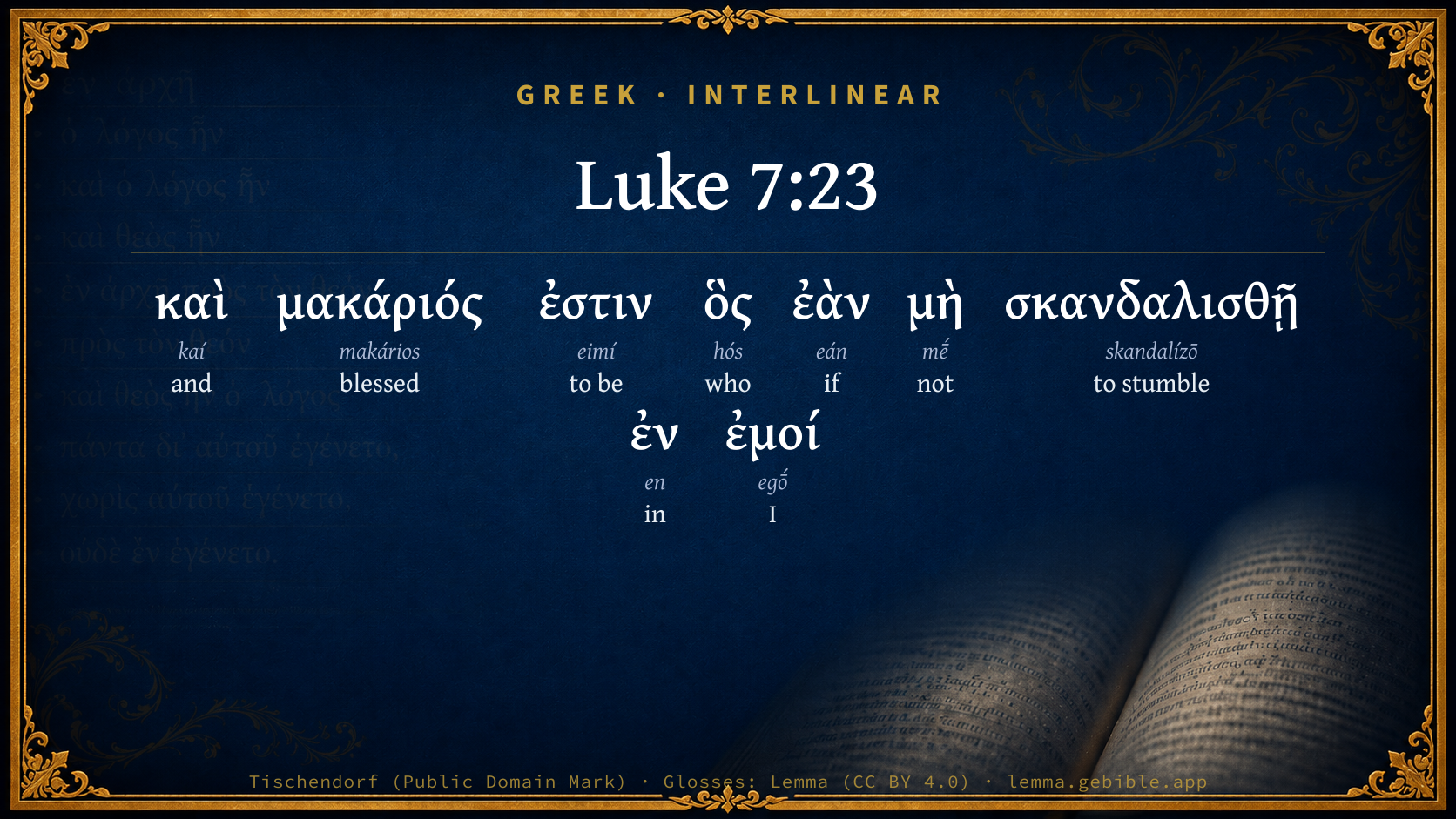
Download image
Cite this verse

Luke 7:23 (World English Bible). Public Domain. Lemma interlinear Bible study tool, https://lemma.gebible.app/v/luke/7/23.

Show BibTeX & RIS
BibTeX
RIS
English Translation
Blessed is he who is not offended by me."
World English Bible · Public Domain
Download a study sheet

One document with this verse’s original text, its word-by-word gloss line, the meaning frame, cross-references with their text, attributed commentary, and full source and license credits — printable, and it pastes into notes with its structure intact.

This verse Autodidact and up

Study sheet (.html) Plain text (.txt)

A passage Seminary Student

Up to 50 verses in one chapter. A passage sheet keeps up to 6 commentary sources and 12 cross-references per verse, in the order this page ranks them, and says so on the sheet whenever that leaves anything out. Ask for a single verse and you get the Autodidact verse sheet above.

Everything on this page stays free to read, with no account — the sheet is a download of what is already on screen, not access to it.

Want to remove ads? Support Godless Engineer
Compare translations 3

The same verse in 3 English versions, stacked beneath the original-language interlinear above. Click any original word for its lexicon entry.

Each is an independent rendering of the whole verse — the interlinear is not word-aligned to these translations.

Highlighted words mark where these versions differ — a whole-verse word diff, not a word-by-word alignment.

  • World English Bible Public Domain
    Blessed is he who is not offended by me."
  • King James Version Public Domain
    And blessed is he, whosoever shall not be offended in me.
  • unfoldingWord Literal Text CC BY-SA 4.0
    And blessed is whoever is not caused to stumble on me.”

unfoldingWord Literal Text — © unfoldingWord, licensed CC BY-SA 4.0. Word-aligned USFM3 via Door43 (git.door43.org/unfoldingWord/en_ult).

Versions to compare (up to 4)

3 of 4 selected

Show all 19 translations

Every available English version of this verse, each an independent rendering of the whole verse.

  • World English Bible Public Domain
    Blessed is he who is not offended by me."
  • Berean Standard Bible Public Domain
    Blessed is the one who does not fall away on account of Me.”
  • Majority Standard Bible Public Domain
    Blessed is the one who does not fall away on account of Me.”
  • King James Version Public Domain
    And blessed is he, whosoever shall not be offended in me.
  • American Standard Version (1901) Public Domain
    And blessed is he, whosoever shall find no occasion of stumbling in me.
  • Revised Version (1885) Public Domain
    And blessed is he, whosoever shall find none occasion of stumbling in me.
  • Geneva Bible (1599) Public Domain
    And blessed is hee, that shall not be offended in me.
  • Douay-Rheims (1899) Public Domain
    And blessed is he whosoever shall not be scandalized in me.
  • Young's Literal Translation Public Domain
    and happy is he whoever may not be stumbled in me.'
  • Literal Standard Version CC BY-SA 4.0
    and blessed is he whoever may not be stumbled in Me.”
  • Unlocked Literal Bible CC BY-SA 4.0
    The person who does not stop believing in me because of my actions is blessed.”
  • unfoldingWord Literal Text CC BY-SA 4.0
    And blessed is whoever is not caused to stumble on me.”
  • Darby Bible Public Domain
    and blessed is whosoever shall not be offended in me.
  • World Messianic Bible Public Domain
    Blessed is he who finds no occasion for stumbling in me.”
  • Webster's Bible Public Domain
    And blessed is he, to whom I shall not be a stumbling block.
  • Free Bible Version CC BY-SA 4.0
    How good it is for those who are not offended because of me!”
  • Bible in Basic English Public Domain
    And a blessing will be on him who has no doubts about me.
  • Text-Critical English NT CC BY 4.0
    And blessed is anyone who does not take offense at me.”
  • Tyndale New Testament (1534) Public Domain
    and happy is he that is not offended by me.

Literal Standard Version (2020), Covenant Press — licensed CC BY-SA 4.0. Text via the HelloAO Bible API (eBible.org). Unlocked Literal Bible (unfoldingWord) — licensed CC BY-SA 4.0. Text via the HelloAO Bible API (eBible.org). unfoldingWord Literal Text — © unfoldingWord, licensed CC BY-SA 4.0. Word-aligned USFM3 via Door43 (git.door43.org/unfoldingWord/en_ult). Free Bible Version, Dr. Jonathan Gallagher — licensed CC BY-SA 4.0. Text via the HelloAO Bible API (eBible.org).

Word by word

More ways to search: Search by grammar → Find every occurrence → Compare this word →

Practice this passage: Drill this verse → Learn its vocabulary →

σκανδαλισθῇ
skandalízō
G4624
“to stumble”
Verb, Aorist, Passive, Subjunctive, 3rd person, Singular
Part of Speech
Verb
Tense
Aorist
Voice
Passive
Mood
Subjunctive
Person
3rd person
Number
Singular
Full Thayer's Definition

Origin: from G4625

TDNT: 12:39,1

1. to put a stumbling block or impediment in the way, upon which another may trip and fall, metaph. to offend a. to entice to sin b. to cause a person to begin to distrust and desert one whom he ought to trust and obey 1. to cause to fall away 2. to be offended in one, i.e. to see in another what I disapprove of and what hinders me from acknowledging his authority 3. to cause one to judge unfavourably or unjustly of another c. since one who stumbles or whose foot gets entangled feels annoyed 1. to cause one displeasure at a thing 2. to make indignant 3. to be displeased, indignant
  1. καὶ kaí G2532 “and” Conjunction
  2. μακάριός makários G3107 “blessed” Adjective, Nominative, Singular, Masculine
  3. ἐστιν eimí G1510 “to be” Verb, Present, Active, Indicative, 3rd person, Singular
  4. ὃς hós G3739 “who” Relative pronoun, Nominative, Singular, Masculine
  5. ἐὰν eán G1437 “if” Conditional
  6. μὴ mḗ G3361 “not” Particle, Negative
  7. ἐν en G1722 “in” Preposition
  8. ἐμοί egṓ G1473 “I” Personal pronoun, 1st person, Dative, Singular

About this verse

These counts appear in no published source. They are computed here, from the morphology-tagged text and Lemma’s own curated glosses. What Lemma adds →

9
words
9
distinct lemmas
Gospels
section

Shared distinctive vocabulary

σκανδαλισθῇ to stumble G4624 occurs in 27 verses of the Greek New Testament. Also found in:
Cross-references

9

Topical passages linked to Luke 7:23 in the Treasury of Scripture Knowledge — connected by theme and wording, ordered by reader-vote popularity; previews shown in the World English Bible.

  • 1 Peter 2:7–8 For you therefore who believe is the honor, but for such as are disobedient, "The stone which the builders rejected, Has become the chief cornerstone,"
  • Isaiah 8:14–15 He shall be for a sanctuary; but for a stone of stumbling and for a rock of offense to both the houses of Israel, for a gin and for a snare to the inhabitants of Jerusalem.
  • Matthew 11:6 Blessed is he who finds no occasion for stumbling in me."
  • Romans 9:32–33 Why? Because they didn't seek it by faith, but as it were by works of the law. They stumbled over the stumbling stone;
  • Matthew 13:57–58 They were offended by him. But Jesus said to them, "A prophet is not without honor, except in his own country, and in his own house."
  • Luke 2:34 and Simeon blessed them, and said to Mary, his mother, "Behold, this child is set for the falling and the rising of many in Israel, and for a sign which is spoken against.
  • John 6:60–66 Therefore many of his disciples, when they heard this, said, "This is a hard saying! Who can listen to it?"
  • 1 Corinthians 1:21–28 For seeing that in the wisdom of God, the world through its wisdom didn't know God, it was God's good pleasure through the foolishness of the preaching to save those who believe.
  • 1 Corinthians 2:14 Now the natural man doesn't receive the things of God's Spirit, for they are foolishness to him, and he can't know them, because they are spiritually discerned.

Cross-references courtesy of OpenBible.info (CC BY 4.0).

Commentary

Notes on Luke 7:23 from classic Christian and Jewish commentators (each source and its license shown beneath its notes). The classic Christian expositions comment on the surrounding passage and are grouped to its opening verse, so a note may address several verses; the Jewish commentaries on the Tanakh (Rashi and others) are per-verse, so they appear only where the commentator wrote on this verse.

Lemma curates 59 commentaries, every one of them public domain or Creative Commons licensed, each selected and text-cleaned for this edition rather than reprinted as found. About our sources →

The Biblical Illustrator

Joseph S. Exell

Luk_7:23

And blessed is he, whosoever shall not be offended in Me

Taking offence at Christ

1.

Some are offended and stumble at Christ, on the pretence that there is not sufficient evidence of His Divine mission.

2. Some are offended in Christ because of circumstances connected with the Person and history of Christ Himself.

(1) His dignity and Godhead.

(2) His humiliation.

3. Some are offended in Christ because of His peculiar doctrines. They dislike mysteries, they say. But what is there which is not mysterious, when searched into very closely?

4. Some are offended at Christ because of His precepts, or the holy life which He requires them to lead.

5. Some are offended in Christ on account of the conduct of those who profess to be His followers. But, however lamentable such misconduct may be, it is unjust to impute it to Christ, or His gospel. We ought always to distinguish between the system and the inconsistencies of those who profess to hold it.

6. Many are offended in Christ because of the trials to which fidelity to Him would expose them. (James Foote, M. A.)

The blessedness of not being offended in Christ

1. A fatal stumble in the way to happiness, which many of the hearers of the gospel make. They are offended in Christ. They stumble at Him. Observe here, the object of their offence, Jesus Christ. It is at Him the world is offended. The God that made and guides the world, the Saviour that redeemed them, does not please the world. What wonder then that others cannot do it. There is something in the mystery of Christ, with which the unbeliever will always be finding fault. The world is unholy, and takes offence at Him. He is the brightness of His Fathers glory: and they, like owls and bats, are blinded at the shining Sun, and therefore carefully keep at a distance from Him. They are offended. In the Greek, scandalized. Now the blind world, by reason of their own corruption, are thus offended or scandalized in Christ. And He shall be for a sanctuary; but for a stone of stumbling, and a rock of offence, to both the houses of Israel: for a gin and for a snare to the inhabitants of Jerusalem. And many among them shall stumble, and fall, and be broken, and be snared, and be taken.

2. In the text there is the happiness of those who escape this fatal stumble. I shall show--

I. What it is to stumble at Christ and be offended in Him.

II. That stumbling at Christ abounds very much in the world.

III. That they are happy indeed who are kept from being offended in Him. And then add some improvement.

I. To SHOW WHAT IT IS TO STUMBLE AT CHRIST, AND BE OFFENDED IN HIM. This is a very awful matter. For a man to die of his disease, when he might have been cured, is sad; but it is a double death for one to destroy himself by the abuse of a remedy prescribed that would have cured him infallibly. It has reference to four things in the general.

1. To the grand device of salvation through Jesus Christ, laid in the infinite wisdom of God, and fixed by the Divine counsel. And at this the unbelieving world ever stumbles, and their hearts can never fall in with it.

2. To the offer of Christ made in the gospel. To be the sinners Head, Lord, and Husband. To be their Prophet, Priest, and King, their all and instead of all. But sinners love not the offer, they stumble at His offices.

3. To the making use of Christ for all the purposes for which the Father has given Him.

4. To the practical understanding of sinners. They ever form a wrong judgment of Christ, and nothing less than overpowering grace will rectify their apprehensions of Him. This stumbling at Christ lies in these four things.

(1) The blind soul ever finds some fault in the mystery of Christ. There is always something in or about Christ that disgusts the sinner, is quite disagreeable and shocking to him. The Son of God is not a match suitable to those whose minds are not savingly enlightened.

(2) That which disgusts them, is what they cannot get over. There is something not to be found in Him, which they cannot want, and something in Him which they cannot endure. And by no art can they reconcile their hearts to it.

(3) Because they cannot get over that one thing, it keeps Christ and the soul asunder effectually. Could the Jews have got over the offence of the mean appearance of Christ, and reconciled it to their own notion of the Messiah, they would have been fond of Him, as they were while He was not come.

(4) This keeping Christ and the soul asunder, the soul is at length thereby ruined, and brought into a worse case than if Christ had never come in the way. If I had not come, says He, and spoken unto them, they had not had sin; but now they have no cloak for their sin.

II. TO SHOW THAT STUMBLING AT CHRIST ABOUNDS VERY MUCH IN THE WORLD. Let us view the heaps upon heaps that are lying broken, snared, and taken.

1. Let us take a view of those that are lying rotting above the ground in open profanity; they are kept away from Christ, even by the very far-off sight of Him and His way. There are many at this day who cry, Let us break their bands asunder, and cast their cords from us. We will not have this Man to reign over us.

2. Let us take a view of those who are lying dead upon their murdered convictions.

3. Those that are lying broken and pining away, having stumbled aver the Cross of Christ.

4. Those that are fallen away from the lusts of Christs consolation, to the fulsome breasts of the world and their own lusts. In every age there are many like the mixed multitude that came out of Egypt, who for a time kept up in the ,wilderness, but afterwards lost hopes of Canaan, and fell a lusting, and even the children of Israel also wept again, and said, Who shall give us flesh to eat? Finally, Look at those whose soul exercises have issued in putting their case in the hands of a physician of no value.

III. TO SHOW THAT THEY ARE HAPPY INDEED WHO ARE KEPT FROM BEING OFFENDED IN HIM.

1. Their eyes are opened to see that superlative glory in Christ that all the unbelieving world cannot discover.

2. Their hearts are new formed, cast into a new mould, otherwise they could never be pleased with Him. But as many as received Him, to them gave He power to become the sons of God, even to them who believe on His name.

3. That soul cannot fail to embrace Christ, to receive Him by faith and unite with Him. For to be well pleased with Christ, is in effect to say amen to the great bargain. Uses for improvement:

1. Be convinced then of this bias of the heart, this disposition of the soul to stumble at Jesus Christ.

2. I exhort one and all of you, that have a mind for any share of eternal happiness, and particularly communicants, that you would try yourselves this night, whether you be well pleased with Christ or not. (T. Boston.)

The Biblical Illustrator, edited by Joseph S. Exell (c. 1880s–1900s) — public domain. Text from a community e-Sword module.

Tyndale Open Study Notes

Tyndale Open Resources

7:23 God blesses those who do not fall away because of me: The blessing is for those who are able to put aside their personal agendas and preconceived ideas about the Messiah and accept Jesus’ path of suffering.

Tyndale Open Study Notes — © Tyndale Open Resources, licensed CC BY-SA 4.0. Text via the HelloAO Bible API.

The Cambridge Bible for Schools and Colleges

gen. ed. J. J. S. Perowne

23. shall not be offended] i.e. caused to stumble. For instances of the stumbling-block which some made for themselves of incidents in our Lord’s career, see Mat_13:55-57; Mat_22:42; Joh_6:60; Joh_6:66; and compare Isa_8:14-15; 1Co_1:23; 1Co_2:14; 1Pe_2:7-8. The word skandalon (Latin offendiculum, Hebr. mokesh ‘snare,’ and mikshol ‘stumbling-block’) means anything over which a person falls (e.g. a stone in the road) or on which he treads and is thrown.

The Cambridge Bible for Schools and Colleges (gen. ed. J. J. S. Perowne; Cambridge University Press, 1878–1918) — public domain. Text from a community e-Sword module.

John Gill's Exposition

But what went you out for to see?.... If not his air and action, what was it? was it his apparel and dress? was it to see

a man clothed in soft raiment? If this was the case, their labour was in vain, and they had their walk for nothing; for John was clothed with camels' hair, rough and undressed, and was girt with a leathern girdle; there was nothing in his person, mien, and garb, that was attractive:

they which are gorgeously, apparelled; or richly clothed, as John was not:

and live delicately; in the most elegant manner, and on the richest dainties, as John did not, his food being locusts and wild honey:

are in kings' courts; and not in a wilderness, where John; came preaching.

John Gill's Exposition of the Whole Bible (1746–1763) — public domain (CC PDM 1.0). Text via the HelloAO Bible API.

Trapp's Complete Commentary

John Trapp

23 And blessed is he, whosoever shall not be offended in me.

Ver. 23. And blessed is he] This is check to them for their preposterous zeal for John, their master. Therefore, also, our Saviour commends not John till they were departed.

John Trapp, A Commentary or Exposition upon All the Books of the Old and New Testament (1647–1656) — public domain. Text from a community e-Sword module.

The Pulpit Commentary

And blessed is he, whosoever shall not be offended in me. Our Lord here shows that he understood that this question came from the Baptist himself. Dean Plumptre calls attention to the tender way in which our Lord dealt with the impatience which John"s question implied. "A warning was needed, but it was given in the form of a beatitude, which it was still open to him to claim and make his own. Not to find a stumbling-block in the manner in which Christ had actually come, there was this condition of entering fully into the blessedness of his kingdom.

Christ as an offence.

"Blessed is he, whosoever shall not be offended in me." It was simply inevitable that our Lord, if he laid himself out to do the very best and greatest that could be done, should be an offence to many. "Not to send peace, but a sword," was a purely incidental, but it was a necessary result of such faithfulness as he showed.

I THE OFFENCE TO BE FOUND IN CHRIST.

1. The offence of the Messiahship. Our Lord offended John the Baptist (see preceding homily) by the quietness of his method and the slowness of his results. He offended Peter by foretelling the sorrows and the shame to which he was moving on. (Mat_16:22) He offended Nicodemus by the profundity of his teaching (John 3). He offended the leaders of religion of his time by denouncing their formality and insincerity. He offended the people by preaching a doctrine too broad for their narrow-mindedness, (Luk_4:28) too deep for their shallow-mindedness, (Joh_6:52-66) too elevated for their earthly mindedness.

2. The offence of the cross.

(1) The memory of a crucified Nazarene was a stumbling-block to the Jew, who expected something very different from this dishonour. (1Co_1:23)

(2) The story of a crucified Jew was foolishness to the Greek. With his venerable mythology, his honoured philosophy, his pride of patriotism, he was not prepared to put his trust in a malefactor executed in Judaea.

3. The offence of the kingdom. In one sense, "the offence of the cross" has ceased. It has become the symbol of all that is beautiful in art, refined in culture, strong in civilization. Yet is there everywhere, yet will there always be, something in Christ that will offend the human soul. For he requires of us that

(1) we empty our minds of preconceived ideas, and approach him with the docility of children; (Mat_18:3)

(2) we surrender every evil habit, however dear or valuable it may seem to us; (Mat_5:29)

(3) we give the first place in our thought and our affections to himself, making even our nearest and dearest human kindred occupy the second place; (Luk_14:26)

(4) we find our recompense for faithful service in the spiritual and the eternal, rather than in the material and the temporal;

(5) we accept his Divine favour and enter his service as those who claim nothing and accept everything at his hand. Many are they who live in our land, who read our Christian literature, who sit in our sanctuaries, and who, for one of these reasons, are offended in Christ.

II THE BLESSEDNESS or THOSE WHO DO NOT FIND IT; who come to learn of him in all docility of spirit; who cheerfully part with all that he condemns that they may follow him; who offer to him their undivided heart; who accept his service that they may receive a spiritual and a heavenly recompense. Blessed, indeed, are they; for:

1. Their hearts will be the home of a heavenly peace, and a joy which no man taketh from them.

2. Their life will rise to a noble height of sanctity, of beauty, of usefulness.

3. On their checkered course will fall the sunshine of their Master"s blessing his consecration of their joy, his overruling of their sorrow.

4. Their life will end in a calm and peaceful hope, which will pass into glorious fruition. Blessed, indeed, is he whosoever is not offended in Christ, but cordially accepts him as the Saviour of his spirit and the rightful Lord of his life. C.

The Pulpit Commentary (1880–1919), ed. H.D.M. Spence-Jones & Joseph S. Exell — public domain. Text from a community e-Sword module.

Burkitt's Expository Notes on the New Testament

William Burkitt

No doubt our Saviour uttered these words with particular respect and reference to John’s disciples, who, out of an extraordinary zeal for the honor of their master, were prejudiced against our Saviour; but the general import of the words does show that there are many to whom Christ is a Rock of offence; the Jews were offended at the meanness of his extraction, at the poverty of his parents, at the lowness of his breeding, at his suffering condition; from their traditions they expected the Messiah should be a temporal prince, whereas the prophets declared he should be a man of sorrows, and acquainted with grief: be despised, and put to death.

Thus at this day many are offended at Christ; some are offended at the asserted divinity of his person, and the meritoriousness of his satisfaction. Some are offended at the sublimity of his doctrine, others at the sanctity and strictness of his laws; some are offended at the free dispensations of his grace; others that the terms of Christianity are very hard, and lay too great a restraint upon human nature: but, Blessed is he, says Christ, that shall not be offended at me: intimating, that such as, instead of being offended at Christ, do believe in him, and ground their expectations of heaven and salvation wholly upon him, are in a happy and blessed condition: Blessed is he that shall not be offended in me.

William Burkitt's Expository Notes on the New Testament (1700–1703) — public domain. Text from a community e-Sword module.

Bengel's Gnomon

Johann Albrecht Bengel

[23. Μὴ σκανδαλισθῇ, shall not have taken offence at) Whatsoever is in Jesus Christ is good and profitable; even that very exterior (of lowliness, which Jesus had for a time, and) which gave offence to men of a perverse mind, is worthy of its own peculiar praise (has its peculiar meritoriousness).—V. g.]

Bengel's Gnomon of the New Testament — English translation (T&T Clark, Edinburgh, 1860) — public domain. Text from a community e-Sword module.

Cambridge Greek Testament for Schools and Colleges

23. σκανδαλισθῇ. ‘Caused to stumble.’ For instances of the stumbling-block which some made for themselves of incidents in our Lord’s career, see Mat 13:55-57; Mat 22:42; Joh 6:60; Joh 6:66; and compare Isa 8:14-15; 1Co 1:23; 1Co 2:14; 1Pe 2:7-8. The word σκάνδαλον (Latin, offendiculum, Hebr. mokesh, ‘snare,’ and mikshol, ‘stumbling-block’) means anything over which a person falls (e.g. a stone in the road) or on which he treads and is thrown.

Cambridge Greek Testament for Schools and Colleges (Cambridge University Press, 1896; 21 vols, various authors incl. Carr, Maclear, Plummer, Farrar, Lumby, Moule, M. R. James, Simcox) — public domain. Text from a community e-Sword module.

International Critical Commentary

23. μακάριος. Not μακάριοι, as it would have been if the direct reference were to the disciples of John. It implies that Baptist had in some way found an occasion of stumbling in Jesus (i.e. he had been wanting in faith, or in trust, or in patience); and it also encourages him to overcome this temptation.

σκανδαλισθῇ. Only here and 17:2 in Lk., but frequent in Mt. and Mk. The verb combines the notions of “trip up” and “entrap,” and in N. T. is always used in the figurative sense of “causing to sin.” See on 17:1. This record of a rebuke to the Baptist is one of many instances of the candour of the Evangelists. For ὃς ἐάν see Greg. Proleg. p. 96, and Win. lxi. 6, p. 390; this use of ἐάν for ἄν is common in LXX and N.T. (17:33?; Mat 5:19, Mat 5:32, Mat 5:12:32, Mat 5:18:5; Jas 4:4).

International Critical Commentary — older volumes (1896–1929), various authors — public domain. Text from a community e-Sword module.

Vincent's Word Studies in the New Testament

Marvin R. Vincent

Shall not be offended [μη σκανδαλισθη] . Rev., shall find none occasion of stumbling. See on Mt 5:29. Note also the conditional not [μη] : "shall not find, whatever may occur."

Marvin R. Vincent, Word Studies in the New Testament (1887–1900) — public domain. Text from a community e-Sword/MySword module.

Lesson kit

Teaching starters — assembled from the data on this page, not authored interpretation. Every prompt links to the verse data it draws on. Edit before teaching.

Luke, in the Gospels, opens this verse with 9 words (9 distinct Greek lemmas). Its most distinctive word is skandalízō (“to stumble”). A historical commentator’s framing appears above. Read the whole chapter for the surrounding context.

Discussion questions

  1. The word skandalízō carries the sense “to stumble.” How does it shape the verse?
  2. How does Matthew 5:29, which shares the word «to stumble», read alongside this verse?
  3. These translations render this verse differently. What is at stake in choosing one wording over another?
  4. Compare how The Biblical Illustrator and Tyndale Open Study Notes read this verse. Where do they agree or differ?

Things to notice

Reading settings

Reading text

Shown beneath each verse's original-language words.

Old Testament
Old Testament edition

Read the OT as the Masoretic Hebrew (MT) or the Greek Septuagint (LXX).

English shown for the Greek Septuagint (in the Hebrew ↔ Greek comparison).

Comparing translations? Open the Compare panel on any verse page to stack up to four side by side.