
Luke 6:20

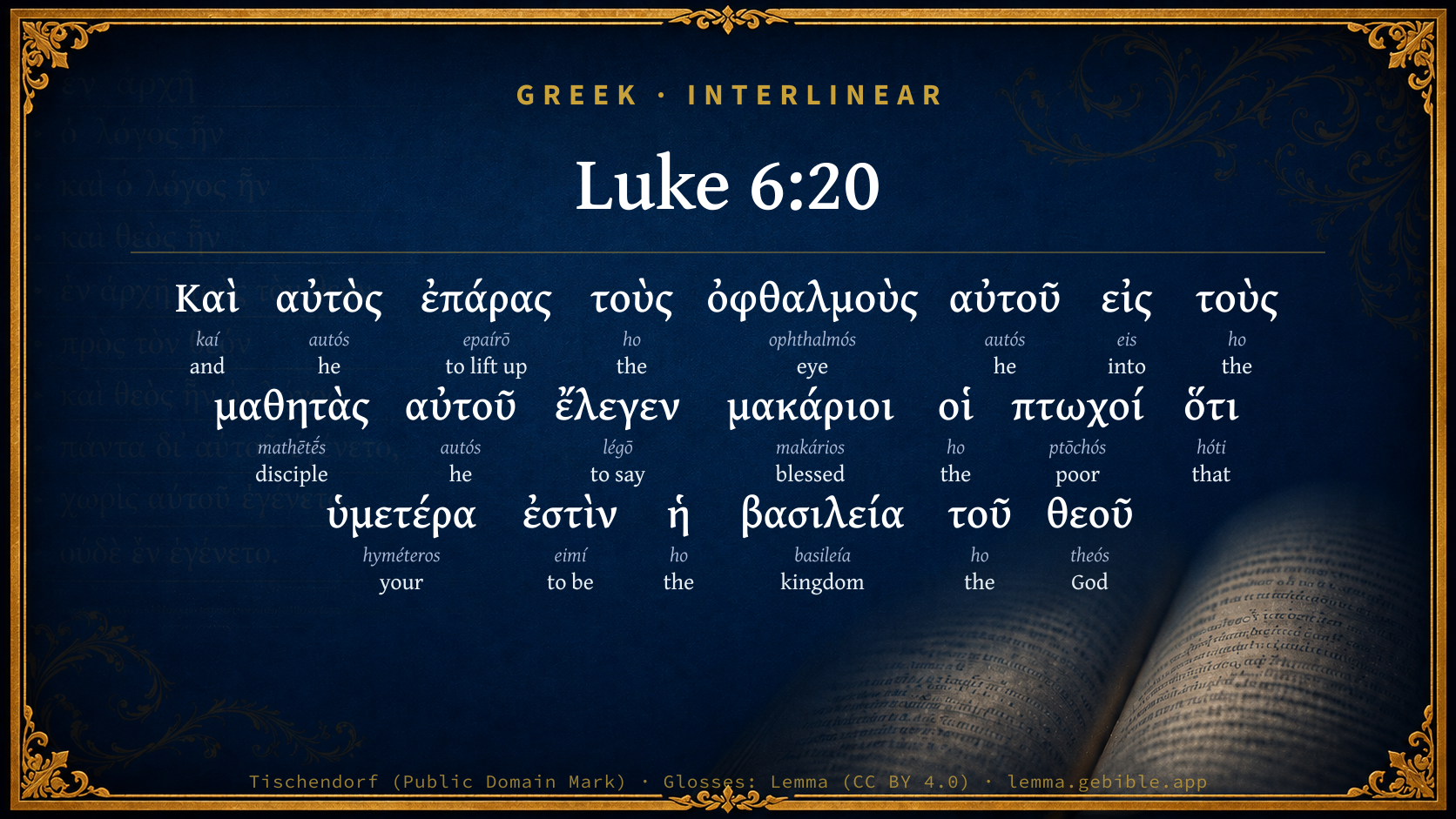
Greek (Tischendorf 8th ed.) Luke 6:20 appears in the Greek New Testament. The text above is from the Tischendorf 8th edition. Each word links to its Strong’s number and a concise gloss. Click any word for its full Thayer’s Greek Lexicon entry.
Download image
Cite this verse

Luke 6:20 (World English Bible). Public Domain. Lemma interlinear Bible study tool, https://lemma.gebible.app/v/luke/6/20.

Show BibTeX & RIS
BibTeX
RIS
English Translation
He lifted up his eyes to his disciples, and said, "Blessed are you who are poor, For yours is the Kingdom of God.
World English Bible · Public Domain
Highlights
  • 1 first appearance in the Greek New Testament
Full analysis ↓
Download a study sheet

One document with this verse’s original text, its word-by-word gloss line, the meaning frame, cross-references with their text, attributed commentary, and full source and license credits — printable, and it pastes into notes with its structure intact.

This verse Autodidact and up

Study sheet (.html) Plain text (.txt)

A passage Seminary Student

Up to 50 verses in one chapter. A passage sheet keeps up to 6 commentary sources and 12 cross-references per verse, in the order this page ranks them, and says so on the sheet whenever that leaves anything out. Ask for a single verse and you get the Autodidact verse sheet above.

Everything on this page stays free to read, with no account — the sheet is a download of what is already on screen, not access to it.

Want to remove ads? Support Godless Engineer
Compare translations 3

The same verse in 3 English versions, stacked beneath the original-language interlinear above. Click any original word for its lexicon entry.

Each is an independent rendering of the whole verse — the interlinear is not word-aligned to these translations.

Highlighted words mark where these versions differ — a whole-verse word diff, not a word-by-word alignment.

  • World English Bible Public Domain
    He lifted up his eyes to his disciples, and said, "Blessed are you who are poor, For yours is the Kingdom of God.
  • King James Version Public Domain
    And he lifted up his eyes on his disciples, and said, Blessed be ye poor: for yours is the kingdom of God.
  • unfoldingWord Literal Text CC BY-SA 4.0
    And he, having lifted up his eyes upon his disciples, said, “Blessed the poor, for yours is the kingdom of God.

unfoldingWord Literal Text — © unfoldingWord, licensed CC BY-SA 4.0. Word-aligned USFM3 via Door43 (git.door43.org/unfoldingWord/en_ult).

Versions to compare (up to 4)

3 of 4 selected

Show all 19 translations

Every available English version of this verse, each an independent rendering of the whole verse.

  • World English Bible Public Domain
    He lifted up his eyes to his disciples, and said, "Blessed are you who are poor, For yours is the Kingdom of God.
  • Berean Standard Bible Public Domain
    Looking up at His disciples, Jesus said: “Blessed are you who are poor, for yours is the kingdom of God.
  • Majority Standard Bible Public Domain
    Looking up at His disciples, Jesus said: “Blessed are you who are poor, for yours is the kingdom of God.
  • King James Version Public Domain
    And he lifted up his eyes on his disciples, and said, Blessed be ye poor: for yours is the kingdom of God.
  • American Standard Version (1901) Public Domain
    And he lifted up his eyes on his disciples, and said, Blessed `are' ye poor: for yours is the kingdom of God.
  • Revised Version (1885) Public Domain
    And he lifted up his eyes on his disciples, and said, Blessed are ye poor: for yours is the kingdom of God.
  • Geneva Bible (1599) Public Domain
    And hee lifted vp his eyes vpon his disciples, and sayd, Blessed be ye poore: for yours is the kingdome of God.
  • Douay-Rheims (1899) Public Domain
    And he, lifting up his eyes on his disciples, said: Blessed are ye poor, for yours is the kingdom of God.
  • Young's Literal Translation Public Domain
    And he, having lifted up his eyes to his disciples, said: `Happy the poor -- because yours is the reign of God.
  • Literal Standard Version CC BY-SA 4.0
    And He, having lifted up His eyes to His disciples, said: “Blessed the poor—because yours is the Kingdom of God.
  • Unlocked Literal Bible CC BY-SA 4.0
    Then he looked at his disciples, and said, “Blessed are you who are poor, for yours is the kingdom of God.
  • unfoldingWord Literal Text CC BY-SA 4.0
    And he, having lifted up his eyes upon his disciples, said, “Blessed the poor, for yours is the kingdom of God.
  • Darby Bible Public Domain
    And *he*, lifting up his eyes upon his disciples, said, Blessed [are] ye poor, for yours is the kingdom of God.
  • World Messianic Bible Public Domain
    He lifted up his eyes to his disciples, and said: “Blessed are you who are poor, for God’s Kingdom is yours.
  • Webster's Bible Public Domain
    And he lifted up his eyes on his disciples, and said, Blessed are ye poor: for yours is the kingdom of God.
  • Free Bible Version CC BY-SA 4.0
    Looking at his disciples, Jesus told them,
  • Bible in Basic English Public Domain
    And turning his eyes to his disciples he said, Happy are you who are poor: for the kingdom of God is yours.
  • Text-Critical English NT CC BY 4.0
    Then he looked up at his disciples and said, “Blessed are you who are poor, for yours is the kingdom of God.
  • Tyndale New Testament (1534) Public Domain
    And he lifted vp his eyes apon the disciples and sayde: Blessed be the poore: for yours is the kyngdome of God.

Literal Standard Version (2020), Covenant Press — licensed CC BY-SA 4.0. Text via the HelloAO Bible API (eBible.org). Unlocked Literal Bible (unfoldingWord) — licensed CC BY-SA 4.0. Text via the HelloAO Bible API (eBible.org). unfoldingWord Literal Text — © unfoldingWord, licensed CC BY-SA 4.0. Word-aligned USFM3 via Door43 (git.door43.org/unfoldingWord/en_ult). Free Bible Version, Dr. Jonathan Gallagher — licensed CC BY-SA 4.0. Text via the HelloAO Bible API (eBible.org).

Word by word

More ways to search: Search by grammar → Find every occurrence → Compare this word →

Practice this passage: Drill this verse → Learn its vocabulary →

ὑμετέρα
hyméteros
G5212
“your”
Possessive pronoun, 2nd person, Nominative, Plural, Feminine
Part of Speech
Possessive pronoun
Person
2nd person
Case
Nominative
Number
Plural
Gender
Feminine
Full Thayer's Definition

Origin: from G5210

TDNT: None

1. you, yours a. to be possessed by you b. to be allocated by you c. proceeding from you
  1. Καὶ kaí G2532 “and” Conjunction
  2. αὐτὸς autós G846 “he” Personal pronoun, Nominative, Singular, Masculine
  3. ἐπάρας epaírō G1869 “to lift up” Verb, Aorist, Active, Participle, Nominative, Singular, Masculine
  4. τοὺς ho G3588 “the” Article, Accusative, Plural, Masculine
  5. ὀφθαλμοὺς ophthalmós G3788 “eye” Noun, Accusative, Plural, Masculine
  6. αὐτοῦ autós G846 “he” Personal pronoun, Genitive, Singular, Masculine
  7. εἰς eis G1519 “into” Preposition
  8. τοὺς ho G3588 “the” Article, Accusative, Plural, Masculine
  9. μαθητὰς mathētḗs G3101 “disciple” Noun, Accusative, Plural, Masculine
  10. αὐτοῦ autós G846 “he” Personal pronoun, Genitive, Singular, Masculine
  11. ἔλεγεν légō G3004 “to say” Verb, Imperfect, Active, Indicative, 3rd person, Singular
  12. μακάριοι makários G3107 “blessed” Adjective, Nominative, Plural, Masculine
  13. οἱ ho G3588 “the” Article, Nominative, Plural, Masculine
  14. πτωχοί ptōchós G4434 “poor” Adjective, Nominative, Plural, Masculine
  15. ὅτι hóti G3754 “that” Conjunction
  16. ἐστὶν eimí G1510 “to be” Verb, Present, Active, Indicative, 3rd person, Singular
  17. ἡ ho G3588 “the” Article, Nominative, Singular, Feminine
  18. βασιλεία basileía G932 “kingdom” Noun, Nominative, Singular, Feminine
  19. τοῦ ho G3588 “the” Article, Genitive, Singular, Masculine
  20. θεοῦ theós G2316 “God” Noun, Genitive, Singular, Masculine

About this verse

These counts appear in no published source. They are computed here, from the morphology-tagged text and Lemma’s own curated glosses. What Lemma adds →

21
words
15
distinct lemmas
Gospels
section

Notable vocabulary

The rarest word here is ὑμετέρα your G5212 — appearing just 11 times in the whole Greek New Testament.

First appearance in Scripture

This word makes its first canonical appearance in the Greek New Testament here:

  • ὑμετέρα your G5212

Shared distinctive vocabulary

ὑμετέρα your G5212 occurs in 11 verses of the Greek New Testament. Also found in:
Repetition

Words recur within this verse:

  • τοὺς the G3588 ×5
  • αὐτὸς he G846 ×3

Cross-references

33

Topical passages linked to Luke 6:20 in the Treasury of Scripture Knowledge — connected by theme and wording, ordered by reader-vote popularity; previews shown in the World English Bible.

  • Luke 6:20–24 He lifted up his eyes to his disciples, and said, "Blessed are you who are poor, For yours is the Kingdom of God.
  • James 2:5 Listen, my beloved brothers. Didn't God choose those who are poor in this world to be rich in faith, and heirs of the Kingdom which he promised to those who love him?
  • 2 Corinthians 8:9 For you know the grace of our Lord Jesus Christ, that, though he was rich, yet for your sakes he became poor, that you through his poverty might become rich.
  • Luke 12:32 Don't be afraid, little flock, for it is your Father's good pleasure to give you the Kingdom.
  • Matthew 25:34 Then the King will tell those on his right hand, 'Come, blessed of my Father, inherit the Kingdom prepared for you from the foundation of the world;
  • Matthew 5:2–12 He opened his mouth and taught them, saying,
  • Revelation 2:9 "I know your works, oppression, and your poverty (but you are rich), and the blasphemy of those who say they are Jews, and they are not, but are a synagogue of Satan.
  • 2 Corinthians 6:10 as sorrowful, yet always rejoicing; as poor, yet making many rich; as having nothing, and yet possessing all things.
  • James 1:9–10 But let the brother in humble circumstances glory in his high position;
  • Isaiah 29:19 The humble also shall increase their joy in Yahweh, and the poor among men shall rejoice in the Holy One of Israel.
  • Zephaniah 3:12 But I will leave in the midst of you an afflicted and poor people, and they will take refuge in the name of Yahweh.
  • Luke 4:18 "The Spirit of the Lord is on me, Because he has anointed me to preach good news to the poor. He has sent me to heal the brokenhearted, To proclaim release to the captives, Recovering of sight to the blind, To deliver those who are crushed,
  • 1 Corinthians 3:21–23 Therefore let no one boast in men. For all things are yours,
  • 2 Thessalonians 1:5 This is an obvious sign of the righteous judgment of God, to the end that you may be counted worthy of the Kingdom of God, for which you also suffer.
  • James 1:12 Blessed is the man who endures temptation, for when he has been approved, he will receive the crown of life, which the Lord promised to those who love him.
  • 1 Samuel 2:8 He raises up the poor out of the dust, He lifts up the needy from the dunghill, To make them sit with princes, Inherit the throne of glory: For the pillars of the earth are Yahweh's, He has set the world on them.
  • Psalms 113:7–8 He raises up the poor out of the dust. Lifts up the needy from the ash heap;
  • Proverbs 16:19 It is better to be of a lowly spirit with the poor, Than to divide the plunder with the proud.
  • Isaiah 57:15–16 For thus says the high and lofty One who inhabits eternity, whose name is Holy: I dwell in the high and holy place, with him also who is of a contrite and humble spirit, to revive the spirit of the humble, and to revive the heart of the contrite.
  • Isaiah 66:2 For all these things has my hand made, and [so] all these things came to be, says Yahweh: but to this man will I look, even to him who is poor and of a contrite spirit, and who trembles at my word.
  • Zechariah 11:11 It was broken in that day; and thus the poor of the flock that listened to me knew that it was the word of Yahweh.
  • Matthew 11:5 the blind receive their sight, the lame walk, the lepers are cleansed, the deaf hear, the dead are raised up, and the poor have good news preached to them.
  • Matthew 12:49–50 He stretched out his hand towards his disciples, and said, "Behold, my mother and my brothers!
  • Luke 13:28 There will be weeping and gnashing of teeth, when you see Abraham, Isaac, Jacob, and all the prophets, in the Kingdom of God, and yourselves being thrown outside.
  • John 7:48–49 Have any of the rulers believed in him, or of the Pharisees?
  • 1 Corinthians 1:26–29 For you see your calling, brothers, that not many are wise according to the flesh, not many mighty, and not many noble;
  • 1 Thessalonians 1:6 You became imitators of us, and of the Lord, having received the word in much affliction, with joy of the Holy Spirit,
  • Psalms 37:16 Better is a little that the righteous has, Than the abundance of many wicked.
  • Proverbs 19:1 Better is the poor who walks in his integrity Than he who is perverse in his lips and is a fool.
  • Luke 14:15 When one of those who sat at the table with him heard these things, he said to him, "Blessed is he who will feast in the Kingdom of God!"
  • Luke 16:25 "But Abraham said, 'Son, remember that you, in your lifetime, received your good things, and Lazarus, in like manner, bad things. But now here he is comforted and you are in anguish.
  • Acts 14:22 confirming the souls of the disciples, exhorting them to continue in the faith, and that through many afflictions we must enter into the Kingdom of God.
  • 2 Corinthians 8:2 how that in much proof of affliction the abundance of their joy and their deep poverty abounded to the riches of their liberality.

Cross-references courtesy of OpenBible.info (CC BY 4.0).

Commentary

Notes on Luke 6:20 from classic Christian and Jewish commentators (each source and its license shown beneath its notes). The classic Christian expositions comment on the surrounding passage and are grouped to its opening verse, so a note may address several verses; the Jewish commentaries on the Tanakh (Rashi and others) are per-verse, so they appear only where the commentator wrote on this verse.

Lemma curates 59 commentaries, every one of them public domain or Creative Commons licensed, each selected and text-cleaned for this edition rather than reprinted as found. About our sources →

Matthew Henry's Commentary

Here begins a practical discourse of Christ, which is continued to the end of the chapter, most of which is found in the sermon upon the mount, Mt. 5 and 7. Some think that this was preached at some other time and place, and there are other instances of Christ's preaching the same things, or to the same purport, at different times; but it is probable that this is only the evangelist's abridgment of that sermon, and perhaps that in Matthew too is but an abridgment; the beginning and the conclusion are much the same; and the story of the cure of the centurion's servant follows presently upon it, both there and here, but it is not material. In these verses, we have,

I. Blessings pronounced upon suffering saints, as happy people, though the world pities them (Luk 6:20): He lifted up his eyes upon his disciples, not only the twelve, but the whole company of them (Luk 6:17), and directed his discourse to them; for, when he had healed the sick in the plain, he went up again to the mountain, to preach. There he sat, as one having authority; thither they come to him (Mat 5:1), and to them he directed his discourse, to them he applied it, and taught them to apply it to themselves. When he had laid it down for a truth, Blessed are the poor in spirit, he added, Blessed are ye poor. All believers, that take the precepts of the gospel to themselves, and live by them may take the promises of the gospel to themselves and live upon them. And the application, as it is here, seems especially designed to encourage the disciples, with reference to the hardships and difficulties they were likely to meet with, in following Christ.

1. "You are poor, you have left all to follow me, are content to live upon alms with me, are never to expect any worldly preferment in my service. You must work hard, and fare hard, as poor people do; but you are blessed in your poverty, it shall be no prejudice at all to your happiness; nay, you are blessed for it, all your losses shall be abundantly made up to you, for yours is the kingdom of God, all the comforts and graces of his kingdom here and all the glories and joys of his kingdom hereafter; yours it shall be, nay, yours it is." Christ's poor are rich in faith, Jam 2:5.

2. "You hunger now (Luk 6:21), you are not fed to the full as others are, you often rise hungry, your commons are so short; or you are so intent upon your work that you have not time to eat bread, you are glad of a few ears of corn for a meal's meat; thus you hunger now in this world, but in the other world you shall be filled, shall hunger no more, nor thirst any more."

3. "You weep now, are often in tears, tears of repentance, tears of sympathy; you are of them that mourn in Zion. But blessed are you; your present sorrows are no prejudices to your future joy, but preparatories for it: You shall laugh. You have triumphs in reserve; you are but sowing in tears, and shall shortly reap in joy," Psa 126:5, Psa 126:6. They that now sorrow after a godly sort are treasuring up comforts for themselves, or, rather, God is treasuring up comforts for them; and the day is coming when their mouth shall be filled with laughing and their lips with rejoicing, Job 8:21.

4. "You now undergo the world's ill will. You must expect all the base treatment that a spiteful world can give you for Christ's sake, because you serve him and his interests; you must expect that wicked men will hate you, because your doctrine and life convict and condemn them; and those that have church-power in their hands will separate you, will force you to separate yourselves, and then excommunicate you for so doing, and lay you under the most ignominious censures. They will pronounce anathemas against you, as scandalous and incorrigible offenders. They will do this with all possible gravity and solemnity, and pomp and pageantry of appeals to Heaven, to make the world believe, and almost you yourselves too, that it is ratified in heaven. Thus will they endeavour to make you odious to others and a terror to yourselves." This is supposed to be the proper notion of aphorisōsin humas - they shall cast you out of their synagogues. "And they that have not this power will not fail to show their malice, to the utmost of their power; for they will reproach you, will charge you with the blackest crimes, which you are perfectly innocent of, will fasten upon you the blackest characters, which you do not deserve; they will cast out your name as evil, your name as Christians, as apostles; they will do all they can to render these names odious." This is the application of the eighth beatitude, Mat 5:10-12.

"Such usage as this seems hard; but blessed are you when you are so used. It is so far from depriving you of your happiness that it will greatly add to it. It is an honour to you, as it is to a brave hero to be employed in the wars, in the service of his prince; and therefore rejoice you in that day, and leap for joy, Luk 6:23. Do not only bear it, but triumph in it. For," (1.) "You are hereby highly dignified in the kingdom of grace, for you are treated as the prophets were before you, and therefore not only need not be ashamed of it, but may justly rejoice in it, for it will be an evidence for you that you walk in the same spirit, and in the same steps, are engaged in the same cause, and employed in the same service, with them." (2.) "You will for this be abundantly recompensed in the kingdom of glory; not only your services for Christ, but your sufferings will come into the account: Your reward is great in heaven. Venture upon your sufferings, in a full belief that the glory of heaven will abundantly countervail all these hardships; so that, though you may be losers for Christ, you shall not be losers by him in the end."

II. Woes denounced against prospering sinners as miserable people, though the world envies them. These we had not in Matthew. It should seem, the best exposition of these woes, compared with the foregoing blessings, is the parable of the rich man and Lazarus. Lazarus had the blessedness of those that are poor, and hunger, and weep, now, for in Abraham's bosom all the promises made to them who did so were made good to him; but the rich man had the woes that follow here, as he had the character of those on whom these woes are entailed.

1. Here is a woe to them that are rich, that is, that trust in riches, that have abundance of this world's wealth, and, instead of serving God with it, serve their lusts with it; woe to them, for they have received their consolation, that which they placed their happiness in, and were willing to take up with for a portion, Luk 6:24. They in their life-time received their good things, which, in their account, were the best things, and all the good things they are ever likely to receive from God. "You that are rich are in temptation to set your hearts upon a smiling world, and to say, Soul, take thine ease in the embraces of it, This is my rest for ever, here will I dwell; and then woe unto you." (1.) It is the folly of carnal worldlings that they make the things of this world their consolation, which were intended only for their convenience. They please themselves with them, pride themselves in them, and make them their heaven upon earth; and to them the consolations of God are small, and of no account. (2.) It is their misery that they are put off with them as their consolation. Let them know it, to their terror, when they are parted from these things, there is an end of all their comfort, a final end of it, and nothing remains to them but everlasting misery and torment.

2. Here is a woe to them that are full (Luk 6:25), that are fed to the full, and have more than heart could wish (Psa 73:7), that have their bellies filled with the hid treasures of this world (Psa 17:14), that, when they have abundance of these, are full, and think they have enough, they need no more, they desire no more, Rev 3:17. Now ye are full, now ye are rich, Co1 4:8. They are full of themselves, without God and Christ. Woe to such, for they shall hunger, they shall shortly be stripped and emptied of all the things they are so proud of; and, when they shall have left behind them in the world all those things which are their fulness, they shall carry away with them such appetites and desires as the world they remove to will afford them no gratifications of; for all the delights of sense, which they are now so full of, will in hell be denied, and in heaven superseded.

3. Here is a woe to them that laugh now, that have always a disposition to be merry, and always something to make merry with; that know no other joy than that which is carnal and sensual, and know no other use of this world's good than purely to indulge that carnal sensual joy that banishes sorrow, even godly sorrow, from their minds, and are always entertaining themselves with the laughter of the fool. Woe unto such, for it is but now, for a little time, that they laugh; they shall mourn and weep shortly, shall mourn and weep eternally, in a world where there is nothing but weeping and wailing, endless, easeless, and remediless sorrow.

4. Here is a woe to them whom all men speak well of, that is, who make it their great and only care to gain the praise and applause of men, who value themselves upon that more than upon the favour of God and his acceptance (Luk 6:26): "Woe unto you; that is, it would be a bad sign that you were not faithful to your trust, and to the souls of men, if you preached so as that nobody would be disgusted; for your business is to tell people of their faults, and, if you do that as you ought, you will get that ill will which never speaks well. The false prophets indeed, that flattered your father in their wicked ways, that prophesied smooth things to them, were caressed and spoken well of; and, if you be in like manner cried up, you will be justly suspected to deal deceitfully as they did." We should desire to have the approbation of those that are wise and good, and not be indifferent to what people say of us; but, as we should despise the reproaches, so we should also despise the praises, of the fools in Israel.

Matthew Henry's Commentary on the Whole Bible (1708–1710) — public domain (CC PDM 1.0). Text via the HelloAO Bible API.

The Cambridge Bible for Schools and Colleges

gen. ed. J. J. S. Perowne

20. Blessed be ye poor] Rather, Blessed are the poor. The makarioi is a Hebrew expression (ashri), Psa_1:1. St Matthew adds “in spirit” (comp. Isa_66:2, “To this man will I look, even to him that is poor and of a contrite spirit, and trembleth at my word”). But

(1) St Luke gives the address of Christ to the poor whose very presence shewed that they were His poor and had come to seek Him; and

(2) the Evangelist seems to have been impressed with the blessings of a faithful and humble poverty in itself (comp. Jas_2:5; 1Co_1:26-29), and loves to record those parts of our Lord’s teaching which were especially ‘the Gospel to the poor’ (see Luk_1:53, Luk_2:7, Luk_6:20, Luk_12:15-34, Luk_16:9-25). See Introd. p. 27.

“Come ye who find contentment’s very core

In the light store

And daisied path Of poverty,

And know how more

A small thing that the righteous hath

Availeth, than the ungodly’s riches great.”

Cov. Patmore.

“This is indeed an admirably sweet friendly beginning...for He does not begin like Moses...with command and threatening, but in the friendliest possible way with free, enticing, alluring and amiable promises.” Luther.

for yours is the kingdom of God] St Matthew uses the expression “the kingdom of the heavens.” The main differences between St Matthew’s and St Luke’s record of the Sermon on the Mount are explained by the different objects and readers of these Gospels; but in both it is the Inaugural Discourse of the Kingdom of Heaven.

(i) St Matthew writes for the Jews, and much that he records has special bearing on the Levitic Law (Luk_5:17-38), which St Luke naturally omits as less intelligible to Gentiles. Other parts here omitted are recorded by St Luke later on (Luk_11:9-13; Mat_7:7-11).

(ii) St Matthew, presenting Christ as Lawgiver and King, gives the Sermon more in the form of a Code. Kurn Hattin is for him the new and more blessed Sinai; St Luke gives it more in the form of a direct homily (‘yours,’ &c., not ‘theirs,’ Luk_6:20; Mat_5:3; and compare Luk_6:46-47 with Mat_7:21; Mat_7:24).

(iii) Much of the Sermon in St Matthew is occupied with the contrast between the false righteousness—the pretentious orthodoxy and self-satisfied ceremonialism—of the Pharisees, and the true righteousness of the Kingdom which is mercy and love. Hence much of his report is occupied with Spirituality as the stamp of true religion, in opposition to formalism, while St Luke deals with Love in the abstract.

(iv) Thus in St Matthew we see mainly the Law of Love as the contrast between the new and the old; in St Luke the Law of Love as the central and fundamental idea of the new.

For a sketch of the Sermon on the Mount, mainly in St Matthew, I may refer to my Life of Christ, i. 259-264. The arrangement of the section in St Luke is not obvious. Some see in it the doctrine of happiness; the doctrine of justice; the doctrine of wisdom; or (1) the salutation of love (Luk_6:20-26); the precepts of love (Luk_6:27-38); the impulsion of love (Luk_6:39-49). These divisions are arbitrary. Godet more successfully arranges it thus: (1) The members of the new society (Luk_6:20-26; Mat_5:1-12); (2) The fundamental principle of the new society (Luk_6:27-45; Mat_5:13 to Mat_7:12); (3) The judgment of God on which it rests (Luk_6:46-49; Mat_7:13-27):—in other words (1) the appeal; (2) the principles; (3) the sanction.

20-26. Beatitudes and Woes.

This section of St Luke, from Luk_6:20 to Luk_9:6, resembles in style the great Journey Section, Luk_9:51—18:34.

The Cambridge Bible for Schools and Colleges (gen. ed. J. J. S. Perowne; Cambridge University Press, 1878–1918) — public domain. Text from a community e-Sword module.

The Biblical Illustrator

Joseph S. Exell

Luk_6:20

Blessed be ye poor: for yours Is the kingdom of God

Blessedness, rather than happiness, the want of man

It is not merely happiness, whatever our shallow moralists may say, that is the aim and end of our being.

Happiness implies merely the undisturbed enjoyment of the man. It may belong to the child, or to the selfish votary of the world. It may be spoken of the misers gold, or of the successful prizes of ambition, or o! the gilded baubles of social folly. There is no moral meaning in it. But it is blessedness that alone can satisfy the mind and heart, which are living for another end than self; blessedness, which has no hap in it, no chance, no merely outward success. (E. A. Washburn, D. D.)

The spirit of gospel morality

The whole spirit of the gospel of Christ is in these beatitudes. It is at once a religion and a morality. It teaches us the essence of all Christian truth, which is in that real love of God, that is manifest in love of men, and holiness. Yet it is a Divine, a perfect morality. No other faith ever revealed itself in such personal teaching, in such living beauty, not of word, but of character. The Divine humanity of Christ and His religion stands forth here in this code, human yet more than man. If I were to put into language the morality of mankind, I should write the very opposite catalogue of beatitudes: Blessed are the rich. Blessed they who do not mourn. Blessed are the high-minded. Blessed they who hunger and thirst after the selfish gain. Blessed they who need no mercy. Blessed the cunning and cold of heart. Blessed they who win the battle of life. Blessed they who are prudent enough to escape persecution. It is this very excellence which always makes it appear to the mass of selfish men an unreal thing. Take any of those rules, and try for an hour to follow them out in practice, and the end would be that the Christian would be the laughing-stock of the crowd. And what is the inference? Why, the Author and Founder of this kingdom was probably one of the pure-hearted ideal enthusiasts of His time: His religion succeeded doubtless awhile, while it was the faith of a few poor devotees. But in proportion as it entered into the world, it lost of necessity this moral severity; and the Christianity of the Church and the world is little more than a civilized heathenism. We may admire much in the New Testament that is pure and beautiful. But we cannot call its morality a basis in any sense of human conduct, a Divine or authoritative standard for mankind. Such is the argument. And there is much that is plausible in it. It falls in with doubts that sometimes naturally rise in us as we read the gospel. It needs careful thought. For, if it be really so, it is plain that the gospel is no longer a standard of action, and cannot be Divine. Now, I would endeavour so to meet it as to set at rest such doubts, and to convince you that your religion is no gospel of dreamers, but a real, a practical morality for the man and the State.

1. I shall begin by granting freely everything that is fairly said of the Divine, absolute, ideal purity of Christs morality. Nay, I shall claim it as its noblest character. He sets before us the highest ideal of personal conduct. And I maintain that there is no domain, where the mind and will of man are employed, which does not recognize and demand such an ideal. It is so in science. It is only as the man, who holds up before him always the noblest standard of knowledge, a perfection beyond what any has reached, who never acknowledges a limit to his growth--it is he who reaches a stature above the crowd. It is so in art. A Thorwaldsen works in the clay model, conscious that in his mind there is an ideal which guides his fingers as he slowly sees the clay take shape. It is so in social order. And is it not true, is it not far truer, of the moral law of life? There must be, not for the monk in his cell, not for the dreamy recluse, but for the man in his daily sphere, an ideal above the common standard of the world in which he lives. If I shoot my arrow at the mark, I aim above it; and why? Because the necessary power of gravitation will carry it to a degree below the straight line; only the higher aim can guide it aright. If I will reach the bank, I steer above it, because the tide draws the boat downward, and my course is made of the two forces. But this law of physics is as much verified in morals. There are in the atmosphere of the world, in our own weakness, and the weight of selfish passion around us, forces that always drag down the will, the affections, below even the mark of attainable goodness. If there be no nobler aim than the common law of society, the outward fear of justice, the rule of a selfish prudence, it will make us but an inferior character. And thus the religion of Christ gives us the ideal and perfect standard. It plants it in the motive. It claims the pure desire of an unselfish heart. It proves that its truth is Divine, because it does not compromise with our false passions, with our earthly appetites, with our worldly dissimulations.

2. This ideal morality is not unreal, but more real, from this very character. It has entered into every human calling. It has inspired every class of mankind. It has taught the lowliest labourer honest thrift. It has taught, too, the highest humility. It has purified the vices of trade. It has nourished domestic love. It has no less presided over the councils of State than over the private heart. It alone has inspired the enthusiasm of humanity. Even in its extravagances, the gospel of Jesus Christ has been the source of all that is heroic, beautiful, pure, Divine, in mankind. Yet it is no less real. If its tides thus reach by such high water-marks the superhuman power it may at times attain, it is no less in its ordinary flow we are to reckon the breadth of its channel.

3. And thus I reach its noblest witness, in the life of society. Am I told by the sceptic that it is this powerless ideal, this gospel of the anchorite, this lofty yet fruitless morality of a faded age? Bear witness for me, this miracle, grander than all of the New Testament, of Christendom itself. (E. A.Washburn, D. D. )

The upward tendency of gospel morality

We are often told that the tendency of religious teaching is to make men indifferent to social improvement; to urge the poor to submit to false distinctions; to flatter the rich into the idea that they can keep their wealth, if they are charitable in alms. This is not the gospel. There is not a sentiment more contradictory to it. Not a cause of justice, of wise reform, not a true channel of social good it does not enforce; not a false barrier of caste it does not frown upon. It tells the wealthy that he is Gods steward; it tells the poor he is to labour in every honest calling, yet to remember that his aim is the wealth of a pure conscience and a holy life. It makes all men one in the spirit of unselfish equality. It is our disposition, not our position, which makes the real difference between man and man in the standard of the gospel morality. It is the Christian principle of social union. Who has the Christian intellect? It is he who pursues knowledge in the desire, not of personal reputation, but of a truth that shall make the world wiser and happier for his toil; and in that poverty of spirit, whether it be a Kepler studying the stars, or a Raphael painting his Madonna, or a Hooker expounding the laws of his Church, it is a sacred calling. Who is the great man in Christs definition? He who, if God hath made him a ruler in the State, rules in His fear, and loves justice and mercy more than his ambition. It is so in every calling. We may pursue our trade or profession for the noble end of a Christian life, or for money-getting and its rivalries. It is here we want our religion. (E. A.Washburn, D. D. )

Relation of this discourse to the Sermon on the Mount

Men have doubted whether the discourse in Mat_5:1-48; Mat_6:1-34; Mat_7:1-29, is to be regarded as an ampler account of that which begins with this verse. Many passages occur in both. The general scope and purport is the same. Yet, as St. Matthew says expressly that Jesus spake sitting, on the mountain, and St. Luke that He spake standing, and in the plain, it seems not very unnatural to suppose that the one (that given by St. Matthew) was a discourse delivered, as it were, to the inner circle of His disciples, apart from the crowd of outside hearers; the other (that preserved by St. Luke), a briefer and more popular rehearsal of the chief topics of the former, addressed, immediately afterwards, on descending from the hill-top, to the promiscuous multitude. And the formation of the hill which tradition has marked as the Mount of the Beatitudes lends itself naturally to this supposition. For modern travellers have marked, upon its eastern summit, a little circular plain exactly suited for the gathering of a smaller and more select audience; and again, on the lower ridge, between that eastern and another western horn of the same mountain, a larger space, flattened also to a plain, corresponding, it would seem, with singular exactness to the scene described by St. Luke, and to the presence of that larger concourse to which the second and briefer discourse is thus conceived to have been addressed. (Dean Vaughan.)

A description of a poor-spirited man

But now, I say, suppose God hath given grace, yet still there is a great deal of poverty.

1. As, in the first place, That grace thou hast, it hath need of continual supply. There is no Christian can live upon the grace he hath without new supply. God will not trust thee with the stock of grace; it is not in thy hand, but in the hand of Christ: and this is the condition of the strongest godly man in the world; he must go daily and continually to Christ to fetch new supply, or he cannot subsist. And this is the poor condition that we are in-this spiritual poverty even of the saints.

2. The poverty of the saints consists in this: the graces that they have are but small. Thy grace is like a little spark wrapped up in a heap of embers, so that the maid is raking a good while before she can see it. Surely thou art but poor, then.

3. Even those that are godly, they are very poor, for they are always needy. We use to say of a man or woman that is always in want, and always complaining, Surely they are poor people.

4. Their services are very poor services that they do perform.

5. Again, poor are the very saints, the godly, for little temptations doth overcome them; at least, unsettle them and put them out of frame.

6. Poor they are, further, for they have but little ability to help others. (J. Burroughs.)

Poverty of spirit helpful to prayer

Men that are men of estates, and rich men, when they come to a door for business, if so be that they cannot have presently what they desire, away they will go; they will not stand waiting. Why? Because they are rich, and so proud in a suitable way to their riches. But now, one that is poor, and come for an alms, is content to wait, especially if he knows that there is no other door for him to go to at that time; if, indeed, he thinks he may have it at some other door, he will not wait, but if he comes for an alms, and he must have it here or nowhere, he is content then to wait. So those that are truly poor in spirit, they arc content to wait at Gods gates, knowing that there is no other door that they can have their alms only at the gates of God. (J. Burroughs.)

The reason why God regards poverty of spirit

1. The great reason why the Lord hath such regard unto such, it is because this disposition doth best serve the great design that God hath of glorifying Himself in the world, namely, the lifting up of His free grace. God would have His glory from the children of men. But what glory? The lifting up of free grace, that is the glory that God would have above all other. God would have the glory of His power, the glory of His wisdom, the glory of His bounty, of His patience; aye, but that is not the glory that God doth look at most; but that He might magnify His free grace in His Son, that is the glory that God doth most delight in. Now, of all dispositions in the world, this disposition of poverty of spirit is that that serves Gods end and Gods design best; and therefore no marvel though God cloth so much accept of it.

2. Such a disposition makes the soul to be conformable even unto Jesus Christ. Now, when Christ shall see a spirit that hath a conformity to His, Christ looks upon it and saith, Here is one that is conformable to My Spirit. I was willing to be poor; and so is such a one. I was willing to empty Myself, and to be anything for the furtherance of the glory of My Father; and so do I see here such a poor creature that is willing to empty itself of anything that it hath, and is willing to give up itself for the glory of My Father and Me. Oh, blessed are these poor! (J. Burroughs.)

Promises to the poor in spirit

1. The first is this, that God loves to honour those that are willing to debase themselves.

2. That blessedness doth not consist in any worldly thing-- Blessed are the poor. There in nothing in this world can make them blessed; it is the kingdom of heaven that must make them blessed. If you would be happy, you must look beyond the world.

3. In that it is said in the present tense, theirs is the kingdom of heaven. From whence the note is this, that the saints of God live not only upon comforts that they shall have hereafter, upon the assurance of what they shall have, but upon present comforts. They have enough for the present to uphold their hearts, in all their poor and mean condition in which they are in respect of the world.

4. That heaven is now to the saints. There is comfort indeed! There is certainly no man or woman upon the earth shall ever go to heaven but such as hath heaven come down to them. First: To open to you what is the meaning of this; what doth Christ mean by the kingdom of heaven? And then, secondly, to apply the kingdom of heaven to such as are poor in spirit.

I. THE KINGDOM OF HEAVEN. There is the kingdom of Gods power whereby He rules over the world; and then there is the kingdom that He hath given to His Son the Mediator. It is the second kingdom that is here meant. When God had made this world, He Himself reigned over it, and was the King of it. But the world that He made was spoiled with sin, and so God could not have that glory from the world that He made it for. Therefore, the Lord He was pleased to erect a new world, another spiritual, heavenly world, to glorify Himself in in another manner, more spiritual and heavenly than in the former world; and He makes His Son to be the King of that spiritual world--that new world which the Scripture speaks of when it saith, All old things are done away, and all things are become new--which new world is begun in the work of grace in the hearts of the saints, and so carried on till it comes to eternal glory. Jesus Christ, He is the King of that world. Why is it called the kingdom of heaven?

1. It is called the kingdom of heaven because Christ is from heaven, who is the King thereof.

2. In distinction and opposition from or unto the kingdoms of the world.

3. Because that Christ His seat is now at the present in heaven.

4. Because that the way of His government it is spiritual and heavenly, not in an outward way.

5. Because it will certainly bring both soul and body to heaven at last.

There is infinite blessedness in this kingdom of heaven.

1. For it is Christ the Mediator that gives the laws. But in this kingdom of heaven, that is a blessedness that thou hast a law from Him that loves thee more than His life; He was willing to lay down His life for thee that gives thee thy law.

2. The second thing in the blessedness of this kingdom of heaven is this, that Jesus Christ He now rules in the hearts of His saints, by His word and Spirit, a great deal more fully than He did in the times of the law, or in any way can be conceived.

3. All transactions between God and them are in this kingdom, and not to go out of this kingdom. So now, wert thou in the kingdom of Gods power, as He is Creator of heaven and earth, and so rules the world, certainly any offence of thine would be eternal death to thee; and it is so with all those men and women that are, I say, only under the kingdom of Gods power--that is, they are Gods creatures, and God is their Creator, and so they have to deal with God as under the kingdom of His power; if they offend as creatures, God in that kingdom deals in a way of exact justice, so as to punish with death upon every offence. But now a believer brought into another kingdom, the kingdom of the Messiah, there he comes to have other privileges; so that when a believer offends he doth not go to answer in that court of His--to wit, the kingdom of His power--but he is to answer before the court of Jesus Christ, and Christ is to be the judge, and Christ He is to deal with them in that administration of His that He hath received from the loather, and so comes a believer to stand with comfort before God, notwithstanding all his offences and weaknesses, for the transaction is between God and Him within this kingdom, and not without it.

4. And then, further, from hence thou hast protection. Though thou beest poor and mean in thyself, thou hast Jesus Christ the Son of God that undertakes to protect thee, to deliver thee from evil, and to supply thee in all thy wants; that is the work of a king.

5. In this kingdom Christ undertakes to subdue all the enemies that are against thy spiritual and eternal good.

6. He, as a king, gives ordinances and gifts and administrations. All the ordinances, gifts, and administrations of the Church, they are given by Jesus Christ as the King of it, and thou that art poor in spirit, thou has right to them.

7. All the world is brought into subjection to this kingdom.

8. For this will bring thee at length to reign with Christ. (J. Burroughs.)

Comfort to the poor in spirit

1. Consider He that is the King of this kingdom of heaven, He was poor Himself; your King was poor.

2. Consider this, Christs poverty it was to sanctify your poverty.

3. This kingdom of heaven, it is so ordered out for the most part, that the poor in the world are the subjects of this kingdom.

4. The Lord hath so ordered things that the great transactions of this kingdom of heaven--that hath been opened unto you--hath been carried on by those that are mean and poor, not by the great ones of the world.

5. Hence follows, therefore, in the fifth place, that poverty it is no hindrance to the highest degree in this kingdom of heaven. Indeed, poverty it is a hindrance to degrees in the honours of a worldly kingdom.

6. Even those that are outwardly poor, if godly, they have right to all things in this world so far as may be good for them. It is said of Abraham Rom_4:13) that he was the heir of the world.

7. In this kingdom are spiritual riches that may countervail to the full, and are infinitely good beyond all outward riches.

8. And then from all these follows, that hence the great temptations that those that are poor people are troubled withal may from the consideration of the blessing of the kingdom be taken away.

What are they?

1. As, first, I am afraid that God goes out against me, and doth not bless me in anything that I go about; and so they are afraid, and under great bondage.

2. The second is, I am in a poor condition, and therefore despised.

3. And then a third temptation is, they are useless in the world. Nay, this text will answer this temptation, Thine is the kingdom. (J. Burroughs.)

Our Lords first text

A fitting text for Christs first sermon, for He came to this earth to bless. His life was a life of blessing; His one thought how He might bless others, make others happy. He died to bless, and His arms outstretched on the cross, His hands wide open, told how He yearned to bless to the last. He rose to bless, and with words of blessing He greeted those who mourned Him as dead. And when He ascended, He was still true to the work of His life, for the last His disciples saw of Him as He disappeared, were His hands outstretched in blessing. And still He lives to bless; on high He ever liveth to make intercession for souls; here on earth He draws nigh to bless in every Sacrament, in every act of worship, in each meditation, in each sermon, in each hour of prayer, always present by His Spirit to bless.

I. HAPPINESS WAS THE END FOR WHICH MAN WAS CREATED. Gods intention for man was a life of beatitude. From God there came to him nothing but blessing. That the curse took the place of the blessing, misery of happiness, was not Gods work, but mans, in abusing the power of freewill. But God would not leave man in his self-wrought misery. And so Jesus came to take away the curse of sin, and to bless mankind.

II. THIS BLESSEDNESS CAN ONLY BE OURS ON CERTAIN CONDITIONS,

1. It is a blessedness to be found in God alone. To reach it, we must climb. Above the city of Edinburgh there is a great rock, overhanging it like a crouching lion. It is a dim, misty, foggy day, such as sometimes envelopes even the modern Athens of the North. We leave the busy streets, go out of the town, and find ourselves on the path which leads up the side of Arthurs seat. We have hardly taken a few steps ere we feel the mist is thinner, and we breathe more easily. Still we climb on, for the top is far above us; we can see it through the fog above us standing out sharp and clear against the sky. Still we climb, and the air becomes at every step more keen and bracing, and our lungs drink it in more freely, until at last we stand on the summit in the brightness of Gods sunshine, while at our feet lies the city buried in the mist. Cannot you read the parable? We are always seeking for happiness; we cannot help it. It is a craving of our being as irresistible as that of hunger or thirst. It will not be crushed out or destroyed. And there are times when we think we have attained to it, and we laugh and sing as we stand in the sunshine. But it is short-lived. The mist creeps over us again, we shiver as we feel its cold dampness, and we murmur and complain in our disappointment. What is wrong? Ah! we have forgotten to climb. We have thought to find what we want on earth, apart from God, and we have failed, as thousands of souls have failed before us.

2. Jesus tells us this blessedness may be ours now. He speaks of the beatitudes in the present tense. Some people will tell us that the innocent joys of earth, the pure affections of home, the pleasures of the intellect, the beauties of nature or art, are only as the fading tints of the sunset, or the falling golden autumn leaves. Ah! but they forget that there is a Power which will fix these fleeting colours, permanize these passing joys. Use them as God intends, as guide-posts to Himself.

3. But Jesus tells us this blessedness is hereafter too. If He speaks in the present tense, He speaks still more in the future. Yes, it must be so, for true blessedness is in God, in God known and realized; and here we see through a glass darkly, here we know only in part; it is yonder that in a fuller knowledge of God we shall find a fuller blessedness.

4. Blessedness can never be selfish. No one can be happy save as he seeks to share his happiness with others.

5. There are degrees of blessedness. It is a mountain which we have to climb. (C. J. Ridgeway, M. A.)

True happiness

Beatitude is the perfect being of every creature. It is that condition in which there remains nothing to be desired, nothing to be obtained.

I. MAN WAS MADE EXPRESSLY FOR THIS PERFECT BEATITUDE. It is because he was created for it, that his whole life is spent in the pursuit of it. The human soul must strain after happiness, it cannot help doing so, for happiness is its necessary object. It seeks it with the energy with which the stone detached from the mountain rolls to its foot, drawn by gravitation. Not only so, but the sinner himself, in all his errors, seeks happiness. He is mistaken in the place where he seeks, but it is happiness which he seeks; and when he find out that he has not obtained that which he desired, he falls back into disgust, and gropes for it elsewhere. The traveller in the desert rushes forward when he sees the mirage, thinking it water, and plunges among sand-hills; he is mistaken in looking for water there, but it is a true thirst which has impelled him towards the spot.

II. EVERYTHING THAT IS GOOD AND BEAUTIFUL, IN THIS WORLD IS GOOD AND BEAUTIFUL BECAUSE IT DERIVES ITS GOOD AND BEAUTY FROM GOD. Riches, pleasure, gaiety, &c., arc not evil in themselves, but only when sought as final ends, without thought of God. When they are sought as sources of happiness, and not as reflections of the perfections which are in God, then they are evil. The creatures which God made arc good, but if we content ourselves with loving and devoting ourselves to the creatures, we are falling away from the Creator. A great bishop and doctor of the Church (Bellarmine) wrote a very lovely book, called The Ascent of the Mind by the Ladder of the Creature to God. The creatures of God are guide-posts to God, not goals to which we are to run, and at which we are to lie down to rest.

III. PERFECT HAPPINESS OR BEATITUDE IS ONLY TO BE FOUND IN GOD. All secondary good things are imperfect because they are created, and for the same reason they are not imperishable. The soul must have that which is perfect and enduring. What is perfect and enduring is in God alone. (S. Baring-Gould, M. A.)

Christs standard and the worlds

How thoroughly Christs conception of blessedness contradicts the popular estimate of happiness. This Preacher seems studiously to reverse the worlds judgment. He frames His words so as to fly in the face of public opinion and the consent of men. This startling contradiction between Christ and the world rests on a radical difference in their way of looking at human life. They do not mean quite the same thing with their beatitudes. It is of condition the world is thinking; Christ of character. When society claps hands to the cry, Oh, Felix! Oh, lucky fellow! Oh, rare success! it is the fortunate circumstances of a mans lot of which society is thinking. It is the blessedness of having a great deal of money, of being always comfortable, of being environed with what may minister to pleasure, and able always to command what one desires--it is this blessedness of condition which society crowns with its beatitudes, and to which men pay the tribute of enjoying it. Alas for this blessedness, which is outside the man; the blessedness of circumstance, and accident, and transient condition; the blessedness which Times scythe mows down like grass to be cast into the oven! Not condition does Jesus bless, but character. The happy man is the good man. Not what a man has, but what he is, is the ground of his blessedness. (J. Oswald Dykes, D. D.)

Gods grace is the source of blessedness

The ground of blessedness is not made by our Lord to rest in the possession of character itself, but in that promised grace of God of which character is the condition. Some of the qualities here (Mat_5:1-48.) called blessed might seem even to us to be their own reward. We can understand how it should be a blessed thing to be merciful, or pure, or pacific, though no promise were attached to these states of heart at all. With others it is not so. It is not in itself a good thing to be poor, or to mourn, or to hunger; but for us it becomes good, because otherwise we cannot be enriched, or comforted, or filled. Here the blessing is plainly not in the state of heart, but in that appropriate Divine gift which meets and answers such a state of heart. In every ease, therefore, there is a deeper Divine reason for the blessedness, which Christs eye sees, where mans sees none. The sum of all the blessings which are here dropped along the course of a Christians life, or rather, that comprehensive blessing which opens out as a man needs it into many forms: which becomes to the mourner comfort, to the meek inheritance, food to the hungry, and mercy to the merciful; which gives to the pure-hearted the vision of God, and adoption to the peace-makers: this inclusive formula of beatitude is the kingdom of heaven. (J. Oswald Dykes, D. D. )

The distinctively Christian character of the beatitudes

The beatitudes may be truly regarded as an exposition of morality purely Christian; and in attempting to make some examination of them, we are to consider ourselves as being under the full light of Christian truth and grace, not dealing with abstract or general morality, but with that which belongs to Gods saints in the Church of Christ, and is only possible to them--and to them possible only by the help of that Holy Spirit of whose blessed influence the saints arc permitted to drink in the Church. (Bishop Moberly.)

Passive virtues first

Mark how Jesus puts passive virtues in the foremost place. We can easily understand why He does this.

1. They are the foundations on which alone the superstructure of the active virtues can be built.

2. They are out of sight, and therefore are easily overlooked, their importance forgotten.

3. They were little thought of in the days when Jesus lived on this earth. (C. J.Ridgeway, M. A.)

St. Lukes version of the Beatitudes

In Lukes version of the Beatitudes they seem to refer to literal poverty, hunger, and sorrow. If the question be asked which of the two forms is the most original, our judgment inclines to that of Luke. Speaking generally, the more pregnant, kernel-like form of any saying of Jesus is always the more likely to have been that actually used by Him. Then the very breadth of the announcements in Luke is in favour of their being the authentic utterances of Jesus. It is intrinsically credible that He had something in His doctrine of happiness for the many, for the million; some such words as Luke puts into His mouth. The poor in spirit, the mourners for sin, the hungerers for righteousness, are a very select band; only a few of them were likely to be found in any crowd that heard Jesus preach. But the poor, the hungry, the sad, are always a large company; probably they embraced nine-tenths of the audience to which the Sermon on the Mount was spoken. Had He nothing to say to them; to catch their ears, and to awaken hopes in their heavy-laden hearts? Who can believe it that remembers that in His message to John Jesus Himself described His gospel as one specially addressed to the poor? We may, therefore, confidently assume that the Preacher on the Mount began His discourse by uttering words of good cheer to those present, to whom the epithets poor, hungry, sad, were applicable, saying, in effect, to such, Blessed are ye whom the world counts wretched. It was a strange, startling laying, which might need much exposition to evince its truth and reasonableness, but it was good to begin with; good to fix attention, provoke thought, and awaken hope. Proceeding now to consider the import of these surprising declarations, we understand--

1. That our Lord did not mean to pronounce the poor, hungry, and weeping blessed, simply in virtue of their poverty, hunger, and tears.

2. The connection between these classes and the kingdom of heaven and its blessings is not quite so immediate. Yet Christ was not mocking His hearers with idle words. He spoke gravely, sincerely, having weighty truths in His mind, every one of which much concerned the children of want and sorrow to know. One of these, the most immediately obvious, was that the classes addressed were in His heart, that He cared for them, sympathized with them, desired their well-being; in a word, that He was the poor mans Friend. This at least is implied in the opening sentence of the sermon, Blessed are ye poor. The mere fact that this was the opening sentence was most significant.

3. But Jesus meant to say more than this to the poor and sorrowful; more than, I feel for you; or, The bliss of the kingdom is possible for you. He meant to say this further; Just because ye are poor, and hungry, and sad, the kingdom of heaven is nearer to you than to others. (A. B. Bruce, D. D.)

Christs paradoxical teaching

He who taught in parables taught also in paradoxes. His thoughts are not our thoughts. It is as though He had said, Happy are the unhappy, honourable the dishonoured, great the little, and rich the poor. Well, we must follow Him. We must learn His language, we must judge His judgment, if we would ever rejoice in His salvation. (Dean Vaughan.)

The title to the kingdom

Surely this first opening of His mouth in systematic teaching was at once a gospel. The more we are poor, the more we are rich! O blessed and life-giving announcement to the sorrowful and self-despairing! Your sense of poverty is the very title-deed of your kingdom. (Dean Vaughan.)

The possession of the kingdom

The kingdom is theirs. Theirs already, by a right all their own. In this life they possess it. For they, alone of all men, live their citizenship. They know that without their King they are beggars; without their franchise they are outlaws; without their home above, they are houseless and shelterless and comfortless exiles. Whatever others can do, they cannot do without their kingdom. They declare plainly, at each step of lifes journey, that they are seeking a country. And therefore God is not ashamed to be called their God; for He hath prepared for them a city. And as they get nearer to its golden gates, and have nothing between it and them but that narrow stream of death which a Saviour once crossed for them, it may well be that the ownership of which the text speaks becomes at last scarcely more a faith than a sight; they can catch the very sounds of the heavenly song, and discern the bright forms of those who were once faithful unto death, and now follow the Lamb whithersoever He goeth. (Dean Vaughan.)

The kingdom for the poor

The kingdom of God comes down to meet the sinner as low as is at all possible; asks the very least; takes us up just where sin and the law left us, stripped and wounded; and at the outset, when a man is at his poorest, it enriches him with its royal riches. Are you only poor? There is no question yet about what some human teachers are ready enough to put foremost, express or vehement mourning for sin. The seed of that, indeed, is in poverty of spirit. But anxious souls often impede their own coming to Christ, by exacting of themselves a certain keenness of feeling, so much heaviness of heart, or so many tears. Be content. Mourning will come soon enough in the order of Jesus. It is not our poverty by itself, but Gods grace to us in our poverty, which makes sorrow flow. Jesus asks not for tears before He will bless; He asks only poverty. If you are so poor in grace that you cannot mourn, cannot hope or hunger as you would, can hardly pray, can only stand in dumb, desolate spiritual want before God, then you are poor enough. Poor enough to bring nothing but empty hands to God, and an empty heart; poor enough to take the heavenly kingdom as a gift from the most rich and bountiful Lord of it; poor enough to have a simple accepting faith when He says, It is yours! (J. O.Dykes, D. D.)

Poverty runs through every act of spiritual citizenship

Poverty of spirit runs through every act of citizenship; it is the secret of its beginning, continuance, and final fruition. It is the secret of entrance into the kingdom, for it is the very essence of baptism. We bring the infant to be baptized because it is nothing, has nothing, can do nothing, and therefore we ask God, of His great mercy, to make the child an inheritor of the kingdom of heaven. It is the secret of perseverance, for poverty of spirit is the only fitness for the right use of every means of grace. In confirmation, he who comes urges this as his plea, I am weak, strengthen me by Thy Spirit, O my Father. In holy communion the communicants pray, We are not worthy so much as to gather up the crumbs under Thy table. In prayer our very posture reminds us that we are suppliants at the throne of grace. In every effort after holiness the Masters words are ever sounding in our ears, Without Me ye can do nothing. In every work of love we can only hope it will be accepted with the words, She hath done what she could. In every almsgiving we must say with David, All things come of Thee, and of Thine own have we given Thee. And in final blessedness the attitude of the redeemed tells us that poverty of spirit belongs to the subjects of the heavenly kingdom, for see, they fall on their faces and cast their crowns at the feet of Him who sitteth upon the throne; and this is the song they sing, Thou art worthy, etc. (Rev_4:11). (C. J. Ridgeway, M. A.)

How poverty of spirit may be attained

We cannot attain humility by directly striving to become so; it must be caught by guile, not taken by storm. It can be ours only by the power of faith. What is faith? It is the eye of spiritual sight by means of which we see God. This is what we need, is it not? We make a false estimate of life; we miscalculate ourselves and what we are; we weigh with false scales what we have; we measure with an imperfect standard what we do; we go on our way deceived as to the true value of all around us by the mists of the valley through which we are journeying; we neglect to climb, to try to get into the clearer atmosphere where God is; nay, we forget God, we leave Him out of our lives, we neglect to give Him His rightful claim; even in our acts of worship He is sometimes absent from our thoughts. And so it must be with us to the end of life, unless by Gods help we attain to the spirit of recollectedness of Gods presence, in the power of which David sang, I have set God always before me; for He is on my right hand, therefore I shall not fall.… Remember, this faith is ours already. It is Gods gift to each one of us in our baptism. But it needs to be exercised, developed, trained by use; left alone it will grow weak until it dies. (C. J. Ridgeway, M. A.)

Poverty favourable to piety in early times

The word poor admits of different degrees of extent. Being here opposed to the word rich in Luk_6:24, it probably includes vaguely all who are not usually called rich. It will naturally be asked, How can such persons be declared blessed, or happy, or fortunate? Can any happiness arise from mere indigence? No, certainly, if we mean by happiness present feelings of pleasure. But might there not be circumstances attending indigence which might lead to beneficial consequences, or future happiness? That this is the meaning of our Saviour is evident from what is added: For the kingdom of God is theirs. What, then, are we to understand by this? All that we can conclude is, merely that there were certain circumstances in the condition of the poor that would dispose them to receive the invitation of Christ more willingly than the rich. A rich man would not be inclined to make those sacrifices, and to expose himself to those sufferings to which all Christians, during the first ages, were liable. On the other hand, it was comparatively easy for a poor man to become a Christian; for he could lose little in this world, and would gain much in the world to come. (J. Thomson, D. D.)

Our Lords love of poverty

Let us see how Jesus by His example and word teaches the love of poverty, and wherein that poverty consists which He loves so tenderly.

I. His EXAMPLE. No one of us has chosen the circumstances of his birth. One is born in a poor hut, another in a magnificent palace. Our Saviour, being God as well as man, could have surrounded His human nature with a splendour surpassing human powers of conception. He who so clothes the lilies of the field that even Solomon, in all his glory, was not arrayed as one of them, could have clad His human body in a beauty far transcending that of all the lilies and flowers upon earth. He who created the precious stones and the glittering gold in the veins of the earth, and who gives the sun and the stars their splendour, could have built for Himself a palace, compared with which all palaces of men were mere hovels. But more than the beauty of flowers, more than the gorgeous glitter of diamonds and gold, more than the magnificence of palaces, more than the splendour of the sun, He loved poverty. He would be born as the bride of poverty, and the brother of the poor in spirit. In poverty came the Expected of nations into the world; in poverty He lived all His lifetime; in poverty He died on the cross. His whole life teaches us His love of poverty.

II. His WORD. As Jesus commenced His earthly life with poverty, so His first doctrine preached in His Sermon on the Mount was, Blessed are the poor in spirit, for theirs is the kingdom of heaven, thus intimating that, unless we be poor m spirit, we are not even able to understand His doctrine. He also pointed out to His disciples in the strongest terms the danger of worldly wealth.

III. THE NATURE OF CHRISTIAN POVERTY. Now the question arises, Wherein does the poverty, without which we cannot be saved, properly consist?

We distinguish four classes of men.

1. The first class comprises those who hart both riches and the love of them. These men are, in most cases, avaricious also. Men of this description are the farthest from Jesus Christ.

2. The second class comprises those who are enamoured with worldly goods, which, nevertheless, they do not possess; those who live in want, but vehemently, and with disquietude, long for the riches of which they are destitute. These men are in a worse condition than those who belong to the former class, for they have only the torment of an ungratified desire.

3. The third class comprises those who, although endowed with worldly wealth, preserve, nevertheless, poverty of spirit; who abound in temporal goods, but make good use of them, and are free from a lasting, vehement, and disquieting attachment to their possessions.

4. The fourth class comprises those who to temporal poverty unite poverty in spirit. Oh! that the poor would recognize how priceless a treasure is hidden in their poverty, if they be content with their condition, and joyfully embrace poverty for the sake of Christ. The world having neither joys nor consolations for those who are poor, doubly unhappy are they who forfeit the blessing belonging to poverty, by discontent and injustice. Christ repudiates them for their wickedness; the world for their poverty. (Bishop Ketteler.)

Music chiefly the inheritance of the poor

It is a curious fact that nearly all the great music of the world has been produced in humble life, and has been developed amid the environments of poverty and in the stern struggle for existence. The aristocracy has contributed very little to music, and that little can be spared without detriment. The enduring music has been the child of poverty, the outcome of sorrow, the apotheosis of suffering. Sebastian Bach was the son of a hireling musician. Beethovens father was a dissipated singer. Cherubini came from the lowest and poorest ranks of life. Gluck was a foresters son. Lulli, in his childhood, was a page, and slept in palace kitchens. Haydns father was a wheelwright, and his mother, previous to marriage, was a cook in the kitchen of Count Harrach. Mozarts father was a musician in humble circumstances, and his grandfather a bookbinder. Handel was the son of a barber and surgeon. Meluel was the son of a cook. Rossinis father was a miserable strolling horn-player. Schubert was the son of a poor schoolmaster. Cimarosas father was a mason, and his mother a washerwoman. Schumann was a booksellers son, and Verdi the son of a Lombardian peasant. Webers father was a strolling actor and musician. Among all the prominent composers, but three were born in affluence--Auber, Meyerbeer, and Mendelssohn.

Joy the inheritance of the poor

The sunniest hearts I have ever found in my pastoral rounds have often been lodged in houses so poverty-stricken and obscure that even the tax-collector never found them. They were people who had very little of this world, but a great deal of the next. They took short views of this life; but long ones of the life to come. Living pretty much from hand to mouth, they learn to trust God a great deal more than their prosperous brethren, who secretly trust--their own bank-accounts and government bonds. The happiest heart I encounter in Brooklyn belongs to an aged cripple, who lives on charity in a fourth storey. She is old and poor, and without relatives, and lost even the power of speech twenty years ago l By dint of hard effort she can make a few words intelligible. But I never saw that withered face distorted by a frown; and a few Sabbaths since, when she was carried in to the communion-table, I looked down from the pulpit into that old saints countenance, and it shone like the face of an angel. She lives every day on the sunny side of Providence, and feeds hungrily on the promises. Jesus knows where she lives. He ofttimes resorts thither. She is one of His hidden ones. That old disciple will not have far to go when the summons comes from her Fathers house. She lives near the gates now, and catches the odours and the music of that marriage supper for which she has her wedding garment on. Would to God that some of the sourspirited, morose, and melancholy Christians of our acquaintance could drop in to that old womans garret occasionally, and borrow a vial of her sunshine! (Dr. Cuyler.)

The Biblical Illustrator, edited by Joseph S. Exell (c. 1880s–1900s) — public domain. Text from a community e-Sword module.

Joseph Benson's Commentary

Luk 6:20. And he lifted up his eyes on his disciples — The multitude that pressed to touch Jesus, in order to be healed, being at length rendered still and quiet, he turned to his disciples, and in their audience, and that of the multitude, repeated, standing on the plain, many remarkable passages of the sermon he had before delivered, sitting on the mount; which for the importance and variety of matter contained in it was, of all his sermons, the most proper to be remembered by the twelve disciples, now that they were constituted apostles, and appointed to preach. “The Evangelist Matthew, having recorded the former sermon in its place, judged it unnecessary to give this repetition of it here. But if the reader is of opinion that the two sermons are the same, because this in Luke comes immediately after the election of the twelve apostles, as that in Matthew comes after the calling of the four disciples, Simon, Andrew, James, and John, let him consider, in the first place, that the calling of the four disciples, which precedes the sermon in Matthew, is without doubt a fact entirely different from the election of the twelve apostles preceding the sermon in Luke, and happened long before it. Besides, the sermon in Luke was preached immediately after the election of the twelve, whereas a large tour through Galilee, which may have taken up some months, intervened between the calling of the four disciples and the sermon in Matthew. And to name no more differences, the sermon recorded by Matthew was delivered on a mountain, in a sitting, posture; whereas, when he pronounced this, which Luke speaks of, he was in a plain, or valley, where he could not sit because of the multitude which surrounded him, but stood with his disciples. But though there was not so much evident disagreement in the facts preceding these two sermons, the reader might easily have allowed that they were pronounced at different times, because he will find other instances of things really different, notwithstanding in their nature they may be alike, and were preceded, and also followed, by like events. For instance, the commission and instructions given to the seventy, were, in substance, the same with the commission and instructions given to the twelve, Matthew 10., and were introduced after the same manner: The harvest is plenteous, &c., Mat 9:37. Yet from Luke himself it appears they were different, that evangelist having related the mission of the twelve as a distinct fact, Luk 9:1. So likewise the two miraculous dinners were not only like each other in their natures, but in their circumstances also, for they were introduced by the same discourses, and followed by like events; particularly at the conclusion of both, Jesus passed over the sea of Galilee. Nevertheless, both being found in the same evangelist, no reader can possibly think them the same.” — Macknight. Dr. Whitby and Dr. Doddridge view this subject in exactly the same light. “Hardly any thing,” says the latter, “that I have observed in the common harmonies surprises me more than that so many of them make this discourse to be the very sermon on the mount, recorded at large by Matthew. That was delivered by Christ sitting on a mountain, this standing in a plain; and, which weighs yet much more with me, there is such a difference in the expression, when the parallel passages come to be compared, that it seems evident the evangelists have not related it exactly, if they meant to give us the same. On the other hand, there appears not the least difficulty in supposing that Christ might here repeat a part of what he had delivered some months before to another auditory, and probably at some greater distance than just in the same neighbourhood. For it is plain from other instances, that this is nothing more than what he often had occasion to do. Compare Mat 9:32-34 with Mat 12:22; Mat 12:24; and Mat 16:21 with Mat 17:23; and Mat 20:17-19.” This, therefore, for the reasons above stated, being evidently a different sermon from that delivered on the mount, and preached to a different auditory, and on a different occasion; and there being here only four of the eight beatitudes mentioned in that sermon, and not one of these being expressed in the same words which are there used; it is not necessary that they should be understood in the same sense. The poor here may either mean the poor in spirit; the hungry, those that hunger after righteousness; and the mourners, those that sorrow after a godly manner to repentance, 2Co 7:9; or the condition added to the last clause, Luk 6:22, for the Son of man’s sake, may be understood as implied in all the clauses, and that those disciples of Christ only are pronounced blessed, who are exposed to, and patiently suffer, poverty, hunger, grief, or persecution for his sake, that they may obtain that kingdom, and that reward in heaven, which he hath promised to his faithful servants. Indeed our Lord’s words are only addressed to his disciples, Luk 6:20, he lifted up his eyes on his disciples, and said, Blessed, (or rather, happy, as μακαριοι means,) are ye poor, &c. — As to those who are not the true disciples of Christ, but are ignorant and wicked, or carnal and worldly, however poor, destitute, afflicted, or reproached they may be in this world, they are not happy, but miserable, and in the way to be miserable for ever. We must therefore say, in explanation of this passage, the poor are happy if they be enriched with divine knowledge and grace; for they are entitled to the kingdom of God in all its transcendent and eternal glories. They that hunger now, and are destitute of all the comfortable accommodations of life, are happy if they feel that nobler appetite, by which the pious soul longs after improvements in holiness: for the time is near when they shall be filled with what they long for, and shall be made partakers of the most substantial and valuable blessings. Happy are they who now weep and mourn under a sense of sin, or under that wholesome discipline of affliction, by which God reduces his wandering children, and trains them up to superior virtue; for all their sorrow shall pass away like a dream, and they shall ere long laugh and rejoice in a complete deliverance from it. They whom men hate, separate from their company, and reproach, &c., for the Son of man’s sake, are happy, for that glorious and powerful and gracious Person, on whose account they are thus treated, is abundantly able, and as willing as able, amply to recompense them for all they suffer for his sake. And therefore far from being dismayed and overwhelmed with trouble and distress, at such abuses and assaults, they ought to rejoice and leap for joy, fully assured that their reward in heaven will be in proportion to their sufferings on earth. Besides, such persecuted followers of Christ may comfort themselves with this consideration, that the servants of God, in all ages, have been treated in a similar manner.

Joseph Benson's Commentary on the Old and New Testaments (1811–1818) — public domain. Text from a community e-Sword module.

Whedon's Commentary on the Bible

Daniel D. Whedon

§ 36. SERMON ON THE MOUNT, Luk_6:20-49.

Mat_5:1—Luk_7:29.

We assume without doubt, what Dr. Nast has at length well proved, that Luke here furnishes the same Sermon on the Mount with Matthew, being a briefer report and less nearly verbatim. The slight difference in arrangement of some of the parts is doubtless owing to the variation in the particular original oral tradition, which Luke may have for the first time reduced to writing, or have received in authentic written form.

In order to harmonize the arrangement of Luke’s report of the Sermon with that of Matthew we must read the verses in the following order: Luk_6:20-26, Luk_6:29-30; Luk_6:27-28; Luk_6:32-42. Luk_6:34-35 in Luke are additional matter.

20. Blessed be ye poor—From the fact that Luke in an abbreviated form furnishes a blessing upon the poor, (omitting the phrase in spirit as given by Matthew,) and a woe in Luk_6:24 upon the rich, it has been maintained by some that Luke, if not our Lord himself, belonged to a sect or class of men who held to the intrinsic sin of riches and merit of poverty. A body of heretics, under the name of Ebionites, arose very early in the Christian Church, formed of primitive Jews, who held our Lord to be a mere man, maintained the Jewish ritual, and asserted the great merit of absolute poverty. This sect developed itself early in the second century. Writers like Renan assert that Luke’s Gospel possesses, in passages like this, a strong Ebionitish tinge. But it is well known that Luke was associated intimately with St. Paul, who was the great champion against this very sort of Jewish ultraism, and whose doctrines were the opposite of Ebionitism. If, as we suppose, Luke received a share of the matter of the Peraean gospel from James the Lord’s brother, (see our notice of Luke, p. 2,) resident pastor or bishop of Jerusalem, it is very likely that the passages that seem to bear hard upon the pride of wealth were furnished by him. For, though no Ebionite, James was strongly Judaic and severely ascetic in his tendencies, as his Epistle shows. In the second place, to say that rich men are wicked, especially in a given age, and to say that wealth in itself is a sin, are very different things. It is the tendency indeed of wealth upon the depraved heart of man to produce an oppressive spirit. And there are times when, as a class, the rich are so utterly oppressors that the very term rich acquires a sameness of meaning with the term oppressive; and in such ages piety and rectitude may be so exclusively with the poor that the virtuous may be naturally designated by the term poor. Yet in the days of an Abraham or a Solomon, piety may dwell in the tents of the rich and in the palaces of the noble, while vice and degradation may prevail among the rustics and the rabble. Thus the rich may be in spirit poor, that is, virtuous; and the poor may be rich in feeling, that is, riotous and oppressive. In the days of Herod and of Jesus, though there were noble exceptions, such as Nicodemus, Joseph of Arimathea, and probably some in Herod’s household, to be rich and to be wicked were about the same thing. That this fact should appear in the very language of the Gospels is no indication of Ebionite tendencies.

Daniel D. Whedon (gen. ed.), Commentary on the Old and New Testaments (1874–1909) — public domain. Text from a community e-Sword module.

The Preacher's Complete Homiletical Commentary

Joseph S. Exell (gen. ed.)

CRITICAL NOTES

Luk_6:20-49.—Though various opinions have been held on the subject, the balance of probabilities seems in favour of the supposition that the discourse commonly known as the Sermon on the Mount, recorded by St. Matthew, is given here in a shorter form. It is probable that St. Luke, in placing it after the choice of the twelve apostles, follows chronological order more exactly than St. Matthew, who places it before that event. A strong argument in favour of the identity of the two discourses is to be found in the fact that both evangelists mention the healing of the centurion’s servant immediately after the delivery of the sermon (Mat_8:5; Luk_7:1). It is true that the scene seems to be differently described in the two narratives: St. Matthew speaks of Christ going up into a mountain (or rather, “the mountain,” i.e. the mountainous region above the Lake of Gennesaret), and St. Luke of His coming down and standing “on a level place” (R.V.). But there is nothing to forbid us to suppose that Jesus came down from one of the higher peaks where He had been engaged in prayer, and took up His stand where He could best be seen and heard—the place He chose being still on the mountain-side.

Luk_6:20. Blessed be ye poor.—In St. Luke the beatitudes and woes are addressed to the persons, and not uttered concerning them. St. Matthew adds “in spirit”: there is every reason to suppose that St. Luke refers to literal poverty, it being among those afflicted with it that Christ found most numerous adherents. Of course spiritual qualities of humility and meekness are presupposed as springing from and promoted by poverty. The “poor” are spoken of frequently in the Psalms in the sense of humble and trustful servants of God. A great deal has been made of the supposed Ebionitism in St. Luke’s Gospel as indicated here and in such passages as Luk_1:53; Luk_12:15-34; Luk_16:9-25. But any such tendency is highly improbable: it is utterly inconsistent with the Pauline spirit which may be recognised in the Gospel, and is by no means necessarily implied in the passages referred to.

Luk_6:22. Separate you.—I.e. excommunication or expulsion from the synagogue. Thus early is the separation between Judaism and Christianity foretold. Your name.—“Either your collective name as Christians (cf. 1Pe_4:14-16), or your individual name” (Alford).

Luk_6:23. In the like manner, etc.—“Elijah and his contemporaries (1Ki_19:10); Hanani imprisoned by Asa (2Ch_16:10); Micaiah imprisoned (1Ki_22:27); Zechariah stoned by Joash (2Ch_24:20-21); Urijah slain by Jehoiakim (Jer_26:23); Jeremiah imprisoned, smitten, and put in the stocks (Jeremiah 37; Jeremiah 38); Isaiah (according to tradition) sawn asunder, etc.” (Farrar).

Luk_6:24-26.—This section is peculiar to St. Luke. Notice that these four woes are in all respects the antitheses of the four preceding beatitudes.

Luk_6:24. Consolation.—Cf. Luk_16:25. This is a warning addressed to the disciples themselves.

Luk_6:27.—Even in the Old Testament checks had been put upon the spirit of enmity. See Exo_23:4; Pro_25:21. We find the teaching of this passage very beautifully reproduced in Rom_12:17; Rom_12:19-21.

Luk_6:28. Pray for them, etc.—St. Luke records two great examples of obedience to this precept—in the case of Christ (Luk_23:34), and of the proto-martyr Stephen (Act_7:60).

Luk_6:29. Him that smiteth thee, etc.—That we are to act according to the spirit and not merely according to the letter of this rule is evident from our Lord’s own procedure in circumstances of the kind (Joh_18:22-23). Cloke … coat.—Cloak is the loose outer dress, the coat the inner and more indispensable article of dress. St. Luke’s order is more logical than St. Matthew’s.

Luk_6:32. What thank have ye?—What claim to recompense from God?

Luk_6:35. Hoping for nothing again.—R. V. “never despairing,” and with the marginal note, “Some ancient authorities read despairing of no man.” The rendering of the A.V. is, however, as good as we can get. Notice that the precepts “love,” “do good,” “lend hoping for nothing again,” correspond to Luk_6:32-34 respectively.

Luk_6:36.—The best MSS. omit “therefore”: it is omitted in R.V.

Luk_6:37. Judge not.—I.e. in a harsh, censorious spirit. Cf. with the teaching of the whole verse, Mat_18:21-35.

Luk_6:38. Good measure.—The figure is evidently taken from measuring corn. Bosom.—The loose folds above the girdle served as a pocket.

Luk_6:39. Ditch.—R.V. “pit.”

Luk_6:40. Every one that is perfect.—Rather, “every one when he is perfected” (R.V.), i.e. no disciple on passing through the full course of training rises above the teacher from whom he has learned. The figure was evidently one frequently used by Jesus, and is employed to illustrate different aspects of truth. Cf. Mat_10:25; Joh_13:16; Joh_15:20. The general idea of Luk_6:39-40, is: “The blind cannot lead the blind better than he can guide himself: the scholar will not be better than his teacher: the judgment which one sinful man passes on another can never raise the standard of moral excellence in the world” (Speaker’s Commentary).

Luk_6:41.—Notice the two different words “behold” and “perceive”—R.V. “behold” and “consider.” As it were, he sees at a glance the defect in another, but the most careful observation does not reveal to him his own defects. Mote.—A dry twig or stalk, as distinguished from a beam of wood.

Luk_6:48. Founded upon a rock.—A better reading is “well builded” (R.V.). The reading followed by the A.V. may have been taken from the parallel passage in Mat_7:25. The point of the figure is often missed: it is not that rock is a good foundation, and earth or sand (Mat_7:26) a bad (for sand may be a good foundation), but that the one man took pains to get a good foundation, while the other did not, or built at haphazard.

MAIN HOMILETICS OF THE PARAGRAPH.—Luk_6:20-49

The Sermon on the Mount as given in St. Matthew’s Gospel may be taken as setting forth

(1) the character of the citizens of the kingdom of heaven (Luk_5:3-16);

(2) the new law that is given to them (Luk_5:17-39), and the new life which they live, with its duties, aims, dangers, and responsibilities (6, 7). A like general scheme underlies the sermon as reported by St. Luke. In the fuller report of Christ’s words as given in the first Gospel, the tone is more polemical than in St. Luke—as Christ contrasts the spirituality of the righteousness which He commends to His disciples with the external and artificial righteousness of scribes and Pharisees. (For a full analysis of the Sermon on the Mount in St. Matthew’s Gospel, see Westcott, Introduction to the Study of the Gospels, p. 386).

I. The dispositions of those who are inclined to enter the kingdom of heaven, and of those who shut themselves out of it.—Four beatitudes are announced to the former, four woes uttered against the latter (Luk_6:20-26).

1. Beatitudes. Those that are in poverty, and live hard, laborious lives, and are crushed down by affliction, if they are under the influence of the spirit of religion, are likely to abound in that humility and meekness which qualify men to be citizens of the kingdom of heaven. The rich and prosperous are apt to be proud and haughty, and harsh in temper. Doubtless the mass of those now listening to Christ belonged to the former class. The beatitudes do not belong to them in virtue of their earthly poverty and misfortunes, but in virtue of their piety. For these were not simply poor men and women, but poor men and women seeking blessings from the Saviour, and thereby confessing their own insufficiency and their reliance upon Him. (So that the gloss in St. Matthew’s report of the first beatitude, “poor in spirit,” is not in conflict with the words here.) The evil circumstances of their lives become naturally under God’s blessing a discipline to prepare them for receiving an infinite reward. Their blessedness is partly in the present (Luk_6:20)—they possess the kingdom of heaven, they are enrolled as citizens of it, and have a right to all its privileges; and partly in the future (Luk_6:21; Luk_6:23)—their present misery will be exchanged for happy outward conditions, their griefs will be exchanged for unending joys, the only misfortunes they will know will be persecution for a time of a kind like that endured by God’s true prophets in all ages, to be followed by “a great reward in heaven.” In view of what is in store for them they may well be pronounced “blessed,” in spite of all in their present lot that seems sordid and unhappy.

2. Woes. These correspond exactly to the foregoing beatitudes: over against the “poor” are set “the rich,” over against “the hungry” are “the full,” over against “those that weep” are “those that laugh,” over against those that are hated by the world are those that are loved by the world. The words “for ye have received your consolation” show us what we are to understand by “the rich”: they are those who find all their satisfaction in the present life. It is not mere riches that are cursed—just as in the preceding section it was not mere poverty that was blessed. Men like Joseph of Arimathæa and Nicodemus, who were rich, were not disqualified for being disciples of Jesus. But as a matter of fact the wealthy and those of high rank, as a class, set themselves against Jesus, and therefore shut themselves out of the kingdom of heaven. The woes now uttered were amply fulfilled in the sufferings that accompanied the overthrow of Jerusalem and the fall of the Jewish state a generation later, and have no doubt reference also to a reversal of lot in a future state (cf. Luk_16:25). A similar passage is found in Jas_5:1 ff.

II. A proclamation of the new law by which the society Christ founds is to be governed, and of the spirit by which it is animated (Luk_6:27-45).—The new law or principle by which Christ would have the society He founds to be directed and animated is that of charity or love, and He sets it forth in concrete form (Luk_6:27-30), and then as an abstract rule.

1. Practical manifestations of charity (Luk_6:27-30). It is to be more than merely not rendering evil for evil: it is to be a rendering good for evil (cf. Rom_12:21), or an overcoming evil by good. To every fresh exhibition of malice, a stronger and more intense exhibition of love is to be opposed. “Do good,” “bless,” “pray for,” are ascending degrees of love in its outward manifestations—just as the words “hate you,” “curse you,” “despitefully use you,” mark increasing degrees of maliciousness. It is to be the source of beneficent actions, and under its influence the Christian ceases, if need be, to insist upon his rights (Luk_6:29-30). Both to do good unceasingly and to bear wrong unmurmuringly are commended to him.

2. The golden rule (Luk_6:31). “As ye would that men,” etc. In its negative form, “Do not to others what you would have others abstain from doing to you,” the rule has been found in more than one system of morality outside the Christian; but in none does it have the prominent place that Christ gives it—in none is it commended to men by an example comparable with His. Further,

3. Christ lays stress upon the disinterestedness of this virtue as compared with ordinary affection (Luk_6:32-35 a). Ordinary love is quenched by want of sympathy, and naturally seeks a return of kindred feeling. But there is no stain of selfishness or alloy of worldly-wise calculation in the love which Christ commanded and exemplified.

4. He describes the great example of this disinterested love in the Divine love which is shown even to the unthankful and the evil (Luk_6:35 b, 36). The reward won by manifesting this love is not some external recompense, but it consists in the love becoming purer and more intense, and in the possessor of it sharing the blessedness of Him who is love itself.

5. The effects of this love as manifested towards men: it leads to the formation of merciful judgments concerning the sinful (Luk_6:37); to generosity and helpfulness towards all, which God will bountifully reward (Luk_6:38); to ability to guide the erring and correct the faulty,—actions which the proud, unloving Pharisees were incapable of performing (Luk_6:39-42). It is only from a nature that is itself good that these good results can proceed. A proud man cannot teach humility, a selfish man cannot teach charity, any more than a thorn can yield figs or a bramble bush grapes (Luk_6:43-44). If we are to teach others holiness, we must be holy ourselves: it was the holiness of Jesus that gave Him pre-eminence as a teacher, and His disciples must be like Him if they would continue His work (Luk_6:45).

III. The necessity for sincerity and thoroughness in discipleship, and the disasters incurred by the opposite faults (Luk_6:46-49).—To hear and not to do the sayings of Christ is to give them intellectual acceptance, but not to allow them to penetrate and govern the whole being—conscience, will, feelings, and conduct—in short, all that constitutes one’s true personality. Our spiritual life is an erection we set up; and if it be not well built, it will fall before the assault of temptation or trial, and will not stand the final test by which the Divine Judge will bring to light the value of our work (cf. 1Co_3:12-15).

SUGGESTIVE COMMENTS ON Luk_6:20-49

Luk_6:20. The Qualifications for the Kingdom of Heaven—poverty, hunger, etc.,—we do not possess of ourselves, but Christ imparts them to us by awakening in our hearts, which have grown weary under the pressure of worldly things, the longing for spiritual food. This longing shall in very truth be satisfied. One of the traditional sayings of Christ preserved by Clement is, “Will, and thou shalt be able.”

Spiritual Poverty.—Spiritual poverty, a heart that feels its need, is the first thing that makes us fit for the kingdom of God. He who does not have this first qualification cannot have those that follow. “There are many,” Augustine says, “who would rather give all their goods to the poor than themselves become poor in the sight of God.” The source of true humility is found only in Him “who, though He was rich, yet for our sakes became poor.”

“Blessed be ye poor.”—This is indeed an admirably sweet, friendly beginning of His doctrine and preaching. For He does not proceed like Moses … with command, threatening and terrifying, but in the friendliest possible way with pure, enticing, alluring, and amiable promises.—Luther.

The Poor inherit the Kingdom.—St. James seems to give a paraphrase of this beatitude when he speaks of “the poor of this world, rich in faith, and heirs of the kingdom which God hath promised to them that love Him” (Luk_2:5). As a simple matter of fact, the poor seem to have been the class that was most forward to receive the Saviour, and in which He found the most devoted of His disciples (cf. also 1Co_1:26-29).

Luk_6:21. “Ye that hunger now.”—An anticipation of this beatitude is to be found in the song of Mary: “He hath filled the hungry with good things” (Luk_1:53). Cf. also Psa_107:9 : “For He satisfieth the longing soul, and filleth the hungry soul with goodness.”

“Ye that weep now.”—In the eye of Heaven blessedness begins at the point which, in human estimation, is reckoned the extreme of misery.

Luk_6:22. “Shall hate you.”—In the manifestation of hatred towards the followers of Jesus a climax is observable.

1. The feeling of dislike.

2. A breaking off of intercourse. 3, Malicious slanders.

4. Excommunication. Cf. Joh_9:22; Joh_9:34; Joh_12:42; Joh_16:2.

“Your name.”—I.e. the name of Christian. St. Peter alludes to these words in 1Pe_4:14; 1Pe_4:16, and St. James in Luk_2:7, as in Luk_6:5 of the same chapter he has alluded to Luk_6:20 of this. “ ‘Malefic’ or ‘execrable superstition’ was the favourite description of Christianity among the Pagans, and Christians were charged with incendiarism, cannibalism, and every infamy” (Farrar).

Luk_6:23. “Rejoice ye in that day.”—A very striking fulfilment of this command, and a statement of the ground on which the joy of the apostles was based, are given in Act_5:41 : “Rejoicing that they were counted worthy to suffer shame for His name.” In several other passages in the New Testament “glorying in tribulation” is commended as a Christian duty, and various beneficial results are described as flowing from patient submission to suffering for the sake of Christ. See Heb_11:26; Rom_5:3; Jas_1:2-3; Col_1:24.

“Reward in heaven.”—An indirect hint that they were not to expect too great a reward for their faithfulness in the present life.

“Did their fathers,” etc.—“If the empress,” said Chrysostom, “causes me to be sawn asunder, then let me be sawn asunder, for that was the fate of the prophet Isaiah; if she casts me into the sea, I will think of Jonah; if she casts me into the furnace of fire, I think of the three holy children; if she throws me to the wild beasts, I will think of Daniel in the lions’ den; if she cuts off my head, I have still St. John as my companion; if she causes me to be stoned, what else happened to Stephen?”

“The prophets.”—It is especially noticeable how the Saviour at once places His newly chosen apostles in the same rank with the prophets of the Old Testament, and in the demand that they should be ready for His name’s sake to suffer shame shows the sublimest self-consciousness. It scarcely needs pointing out how completely the idea that they were to suffer in such society, surrounded by such “a cloud of witnesses,” was adapted to strengthen the courage and the spiritual might of the apostles.—Lange.

Luk_6:24. “Woe unto you.”—In this passage, as in Mat_24:19, the words perhaps imply commiseration rather than anger: “Alas! for you.” In Mat_23:13-16 the same phrase is used in denunciation of evil-doers.

“Rich.”—Not all the rich, but those who “receive their consolation” in the world—that is, who are so completely occupied with their worldly possessions that they forget the life to come. The meaning is—riches are so far from making a man happy that they often become the means of his destruction. In any other point of view the rich are not excluded from the kingdom of heaven, provided they do not become snares for themselves, or fix their hope on the earth, so as to shut against them the kingdom of heaven. This is finely illustrated by Augustine, who, in order to show that riches are not in themselves a hindrance to the children of God, reminds his readers that poor Lazarus was received into the bosom of rich Abraham.—Calvin.

“Received your consolation.”—“For ye, who trust in your riches, and accounting them sufficient for your happiness, neglect the spiritual treasures which I offer you, may be assured that you have received all your enjoyment in this world, and have no ground for expecting any in the world to come.” Cf. chap. Luk_16:25.

Luk_6:25. “Full.”—Those who possess all that the heart can desire, and do not hunger and thirst after righteousness. The danger in which they stand is that of losing all that they possess at present, and thus of being destitute at once of both earthly and heavenly goods. See again an illustration in the fate of the rich man in the parable, who had been accustomed to “fare sumptuously every day,” and who found himself both excluded from the heavenly banquet and stripped of those luxuries in which he had placed all his delight.

“Laugh.”—Senseless, frivolous, ungodly mirth is rebuked here as in Ecc_2:2; Ecc_7:6; Pro_14:13. Yet, on the other hand, the Christian is described as “sorrowful, yet always rejoicing” (2Co_6:10), and receives exhortations to maintain this spirit of holy gladness (cf. Php_4:4).

Luk_6:26. “Speak well of you.”—Cf. Jas_4:4 : “Know ye not that the friendship of the world is enmity with God?” Joh_15:19 : “If ye were of the world, the world would love his own.”

“False prophets.”—“Universal praise from the world is a stigma for the Saviour’s disciples, since it brings them into the suspicion

(1) of unfaithfulness;

(2) of characterlessness;

(3) of the lust of pleasing. False prophets can ever reckon upon loud applause” (Van Oosterzee). Cf. Mic_2:11 : “If a man walking in wind and falsehood do lie, saying, I will prophesy unto thee of wine and of strong drink: he shall even be the prophet of this people” (R.V.).

Luk_6:27. “Love your enemies.”—The word here used generally denotes “complacency in the character” of the one loved, as distinguished from personal affection; but the sense in which it is here employed is that of maintaining kindly feelings and conduct towards another in spite of his enmity. The connection between this precept and the foregoing words is well brought out by Meyer: “Yet although I utter against those these woes, yet I enjoin on you not hatred but love towards your enemies. It is therefore no accidental antithesis.”

“Do good,” etc.—A climax is noticeable in the precepts which describe the manner in which love to enemies is to be displayed.

1. In deeds—“do good.”

2. In words—“bless.”

3. In prayers for their Welfare—“pray for them.”

A New Departure.—Although it cannot be denied that love to enemies is in a certain sense required even by Jewish and heathen moralists, it must yet be remembered that the thought of requiting acts of enmity with devout intercession could only arise in the heart of Him who has Himself prayed for the evil-doers.—Lange.

Luk_6:27-38. Christ’s Law of Love.—A seemingly easy but profoundly difficult section. We must keep in mind—

I. That the address is given to Christ’s own followers.—It can neither be understood nor practised by any others. The contrast is between true disciples and sinners who will do nothing but what will bring an immediate reward from men.

II. It is to be obeyed in the spirit, and not in the letter.—Christ gives us here some examples of how the true spirit of Christianity is seen. Had He intended these examples to be practised by His followers in literal obedience on all occasions, He would not have been content with merely giving instances. He would have gone over the whole range of possible circumstances, and shown us how to act in every case. But this is impossible, and contrary to the very spirit and essence of Christianity.—Hastings.

The Law of Love proclaimed.

I. The extent of love (Luk_6:27-30).

II. The golden rule of love (Luk_6:31).

III. The Christian’s standard of love (Luk_6:32-36).

IV. Love’s reward (Luk_6:37-38).—W. Taylor.

Luk_6:28. “Pray for them.”—Many imagine what is here commanded to be impossible. But Christ never commands impossibilities; but He prescribes such kind of perfection as was attained by David in the case of Saul, and by Abraham and by Stephen the martyr in praying for his murderers, and by St. Paul in wishing to be accursed for his persecutors (Rom_9:3).—Jerome.

Luk_6:29. “Turn to him, the other also.”

I. Do not return blow for blow.

II. Bear the blow in silence.

III. Lovingly lay thyself open to receive another blow.

Public Rights.—This precept does not require or permit any one to surrender public rights, which are not his own “cloke” or “coat,” much less Christian principles and Christian truth, for which we are to contend earnestly (Jud_1:3), and of which we are not to divest ourselves; or to allow any one to strip us, for then we should be naked indeed; nor allow any one, as far as in us lies, to strip others, and to rob Christ.—Wordsworth.

Luk_6:30. “Give to every man”—The promise is made to us by Christ that He will give us whatever we ask for (Joh_14:14). Yet it is not always literally fulfilled. We do not receive what would be hurtful for us, even if we ask for it; and are often constrained to confess thankfully that our disappointment is better than our wish. “So in his humble sphere should the Christian giver act. To give everything to every one—the sword to the madman, the alms to the impostor, the criminal request to the temptress—would be to act as the enemy of others and of ourselves. Ours should be a higher and deeper charity, flowing from those inner springs of love which are the sources of outward actions sometimes widely divergent, whence may arise both the timely concession and the timely refusal” (Alford).

“Ask them not again.”—We must remember that we ought not to quibble about words, as if a good man were not permitted to recover what is his own, when God gives him the lawful means. We are only enjoined to exercise patience, that we may not be unduly distressed by the loss of our property, but calmly wait till the Lord Himself shall call the robbers to account.—Calvin.

“Asketh of thee … ask them not again.”—It is to be noted that in this verse two Greek words are translated “ask”: the first of them means to ask as a favour, the second to demand as a right.

Luk_6:31. The Golden Rule.

I. We must consider how we should like other people to treat us, were they in our circumstances and we in theirs.

II. It is not what others really do to us, but what we wish them to do, that should be our rule.

III. That which we wish others to do to us must be lawful and reasonable.

The excellence of the rule is evident from its reasonableness, and its intelligibility, and from the fact that it is readily applicable to all persons in all circumstances. The Saviour gathers up His detailed instructions into “a little bundle which every man can put into his bosom and easily carry about with him” (Luther). We all love ourselves, and therefore we can all know the love our neighbour requires from us. The natural man loves himself, and that love blinds him to the wants of his neighbours: the Christian loves himself, but that love enlightens him as to what is due to his neighbour.

Luk_6:32-34. “For if ye love them” etc.—Our Lord means to say that in all these things nothing has been done for the love of God, and therefore no thanks are due. The world’s view of returning love for love is well put by Hesiod: “Those who love will be loved in return, and those who visit will be visited in return; he who gives will receive gifts, and he who does not give, will receive nothing. One gives willingly to the giver; but no one to be sure gives to him who refuses to give.” In the same way Socrates teaches that it is allowable to cherish a grudge at the good fortune of your enemy, but that envy only consists in grudging the good fortune of a friend. Plato speaks of it as impossible to love an enemy. Such is the wisdom of the heathen.

Luk_6:35-36. “Children of the Highest.”—Our Father in heaven more than any one else meets with the ingratitude of men, and it should not depress His children on earth to have to experience it also. The great reward which the Lord of love promises to the children of God consists chiefly in this, that they taste the blessedness of being able to love. “To give is more blessed than to receive.” It is sweet to be loved from the heart, but it is much sweeter and inexpressibly blessed to love with the whole heart. One is more blessed in the love which one feels than in the love which one inspires.

Luk_6:36; Luk_6:38. The Christian’s Duty as Man to Man.

I. The pattern of mercy, of justice, of forbearance and forgiveness, of generosity, which we ought to take.—This is the example of Almighty God. “Be ye therefore merciful,” because “the Highest is kind,” etc.

II. The rule of God’s government and judgment in matters between man and man.—“With the same measure,” etc. Words well known and familiar, but some of the most awful words in the Bible. For

(1) we feel they must be true, but

(2) we cannot see or guess how they will be carried out.—Church.

Luk_6:37. “Judge not.”—

1. We can only go by appearances.

2. We can never be sure of the motive which has prompted the action in question.

3. We cannot fully estimate the circumstances in which the man was placed whose conduct we arraign.

4. We are only too liable to be influenced by our prejudices, and by considerations of self-interest, and are to a corresponding extent disqualified to act as judges.

Luk_6:39-40. Blind Leaders of Blind. Note:—

I. The presumption of the leaders.

II. The delusion of those who trust themselves to their guidance.

III. The inevitable fate which be falls both.

Luk_6:40 explains why the fate is inevitable: the disciple, even when perfected, when he has learned his whole lesson, can know no more than his teacher, and the very care with which he follows will ensure his falling into the mistakes his master makes.

Luk_6:41-42. The Literal and the Figurative Beam.—In the physical region a beam in the eye does not sharpen its sight: in morals the case is different. Those who are corrupt in mind are very quick in detecting corruption in others, even in cases where innocence would discover nothing amiss. The man with a beam in his eye has two faults:

1. He does not know the beam to be there.

2. He assumes airs of moral superiority, and carries himself as a judge instead of a brother.

Correcting the Faults of Others.

I. It is a delicate operation to correct the faults of other men.—It may be likened to the feat of taking a chip of wood out of an inflamed eye. A clumsy operator may easily make things worse. The case supposed is one of visible and undeniable fault. Still it is a delicate task to judge of it: it is a difficult operation to correct or remove it.

II. Self-ignorance and self-conceit incapacitate one for performing this operation.—Most accurate and pungent moral strictures often proceed from men who are quite aware that their own lives will not bear close inspection. Christ strongly disapproves of such conduct.

III. An honest Christian reserves his strictest judgment for himself.—Fraser.

Luk_6:42. “Let me pull out the mote.”—A subtle form of harsh judgment of others is that which assumes the appearance of solicitude for their improvement. Our Lord teaches that all honest desire to help in the reformation of our neighbour must be preceded by earnest efforts at amending our own conduct. If we have grave faults of our own undetected and unconquered, we are incapable either of judging or helping our brethren. Such efforts will be hypocritical, for they pretend to come from genuine zeal for righteousness and care for another’s good, whereas their real root is simply censorious exaggeration of a neighbour’s faults; they imply that the person affected with such a tender care for another’s eyes has his own in good condition. A blind guide is bad enough, but a blind oculist is a still more ridiculous anomaly. Note that the result of clearing our own vision is beautifully put, not as being ability to see the faults of our fellows, but ability to cure them. It is only the experience of the pain of casting out a darling evil, and the consciousness of God’s pitying mercy as given to us, that make the eye keen enough, and the hand steady and gentle enough, to pull out the mote.—Maclaren.

Luk_6:43-45. Good and Bad Fruit.—Christ here speaks of the inner nature—the heart—of man and of its outward manifestations, and asserts that in all cases the inner is the maker of the outward. A good heart will infallibly reveal itself in holiness of word and deed: in like manner an evil heart will disclose itself, in spite of all hypocritical attempts to conceal the true state of matters. We have here therefore—

I. A law which is bound up with the nature of things, and which we cannot control; and—

II. A test of character of the most stringent yet most reasonable kind.

Luk_6:46. “Why call ye Me, Lord?” etc.—Acknowledgment of Christ’s authority is to be accompanied by obedience to His commandments.

Four Classes of Men may be described by their Relation to Christ.

I. There are those who neither call Him Lord, nor do the things which He says.

II. There are those who call Him Lord, but do not the things which He says.

III. There are those who do not call Him Lord, but do the things which He says.

IV. There are those who both call Him Lord and do the things which He says.

Luk_6:47-49. The Wise and the Foolish Hearers.—The point of the contrast between the two men in the parable is not, as often supposed, in the selection made of a foundation on which to build. The contrast is that between two men, one of whom makes the foundation a matter of deliberate consideration, while the other never takes a moment’s thought about a foundation, but proceeds to build at haphazard, on the surface, just where he happens to be. St. Luke brings this out clearly by saying that the latter built “without a foundation.” The one builder is characterised by considerateness and thoroughness, the other by inconsiderateness and superficiality. Two points of difference between the two builders are clearly hinted at:—

I. The wise builder has a prudent regard to the future.—He anticipates the coming of storms, and he aims at being well provided against them. The foolish builder, on the contrary, thinks only of the present. If all is well to-day, he recks not of to-morrow, and of the storms it may bring.

II. The wise builder does not look merely to appearances.—The question with him is not, What will look well? but, What will stand, being founded on the rock? The foolish builder; on the other hand, cares for appearances only. His house looks as well as another’s, so far as what is above ground is concerned; and as for what is below ground, that, in his esteem, goes for nothing.

The man who has regard to appearances only never considers the future: he acts from impulse, imitation, and fashion, and the use of religion as a stay in temptation and trouble is not in all his thoughts. With the genuine disciple religion is an affair of reason and conscience—of reason looking well before and after, and of conscience realising seriously moral responsibility. The spurious, too, look only to what is seen, the outward act; the genuine look to what is not seen, the hidden foundation of inward disposition, the heart-motive, out of which flow the issues of life. The outward acts of both may be the same, but the motive of the one is love of goodness, that of the other is vanity. While we can on paper discriminate between these two classes, it is a difficult and delicate task to discern and judge between them in real life. We can only judge by appearances, and are apt to think better of the pretender than of the genuine man, for the former makes appearances his study. False disciples often gain golden opinions, when true disciples, with their faults all on the surface, are of little account.

The elements decide as to the merits of the two builders. By these are meant times of severe trial, the judgment days which overtake men even in this world occasionally, and in which many fair edifices of religious profession go down. The forms in which the trial may come are very diverse. There are trials by outward calamities, by religious doubt, by sinful desires—trials in business, by commercial crises and the like—trials by tribulations, such as overtake professors of religion in evil times. The thing to be laid to heart is that trial, in one form or another, is to be expected. It will come, and may come suddenly.—Bruce.

The Wise Builder and the Foolish.—An admonition for all who read Christ’s words as much as for those who originally heard them. The peroration of His sermon employs a double illustration, which must have told with graphic power on an audience accustomed to the sudden tempests and sweeping floods of the climate of Judæa.

I. The two builders.—To the first is likened the obedient hearer of the words of Christ. Those who follow Him are believers, as He is their Saviour—disciples, as He is their Teacher. To the second is likened the disobedient hearer of the words of Christ. He listens, and seems to honour and approve, yet does not keep or do the word. How frequent are such builders in every Church!

II. The day of trial.—In fair weather the two houses are equally safe. The day of storm reveals the difference. In the Day of Judgment all hollow discipleship will be exposed. How great the fall! How piteous the ruin!—Fraser.

The Two Houses, and their Fates.—These words apply to all the subjects of the kingdom, and not to teachers only. Obedience is the only safety. We are all builders. The houses we build are our characters. The underground work is the main thing in estimating stability. No house is stronger than its foundation. Real building on Christ is practical obedience to His commandments. Only such a life is firm whatever storm comes. There are lives which look like true Christian lives, and are not. One little “not” expresses the awful contrariety in the experience of two builders whose houses it may be stood side by side for years. So the sermon ends, burning these two pictures into our imagination.—Maclaren.

The Preacher's Complete Homiletical Commentary (gen. ed. Joseph S. Exell; Funk & Wagnalls, c. 1892) — public domain (pre-1929). A full-Bible homiletical/sermon-outline anthology covering 65 of 66 books (2 John is absent from the source module). Text from a community e-Sword module.

MacLaren's Expositions of Holy Scripture

Alexander MacLaren

Luke

LAWS OF THE KINGDOM

Luk 6:20 - Luk 6:31.

Luke condenses and Matthew expands the Sermon on the Mount. The general outline is the same in both versions. The main body of both is a laying down the law for Christ’s disciples. Luke, however, characteristically omits what is prominent in Matthew, the polemic against Pharisaic righteousness, and the contrast between the moral teaching of Christ and that of the law. These were appropriate in a Gospel which set forth Jesus as the crown of earlier revelation, while Luke is true to the broad humanities of his Gospel, in setting forth rather the universal aspect of Christian duty, and gathering it all into the one precept of love.

The fragment which forms the present passage falls into two parts-the description of the subjects of the kingdom and their blessedness, contrasted with the character of the rebels; and the summing up of the law of the kingdom in the all-including commandment of love.

I. The subjects and blessedness of the kingdom, and the rebels.

It is to be well kept in view that the discourse is addressed to ‘His disciples.’ That fact remembered would have saved some critics from talking nonsense about the discrepancy between Luke and Matthew, and supposing that the former meant merely literal poverty, hunger, and tears. No doubt he omits the decisive words which appear in Matthew, who appends ‘in spirit’ to ‘poor,’ and ‘after righteousness’ to ‘hunger and thirst,’ but there is no ground for supposing that Luke meant anything else than Matthew.

Notice that in our passage the sayings are directly addressed to the disciples, while in Matthew they are cast into the form of general propositions. In that shape, the additions were needed to prevent misunderstanding of Christ, as if He were talking like a vulgar demagogue, flattering the poor, and inveighing against the rich. Matthew’s view of the force of the expressions is involved in Luke’s making them an address to the disciples., ‘Ye poor’ at once declares that our Lord is not thinking of the whole class of literally needy, but of such of these as He saw willing to learn of Him. No doubt, the bulk of them were poor men as regards the world’s goods, and knew the pinch of actual want, and had often had to weep. But their earthly poverty and misery had opened their hearts to receive Him, and that had transmuted the outward wants and sorrows into spiritual ones, as is evident from their being disciples; and these are the characteristics which He pronounces blessed. In this democratic and socialistic age, it is important to keep clearly in view the fact that Jesus was no flatterer of poor men as such, and did not think that circumstances had such power for good or evil, as that virtue and true blessedness were their prerogatives.

The foundation characteristic is poverty of spirit, the consciousness of one’s own weakness, the opposite of the delusion that we are ‘rich and increased with goods.’ All true subjection to the kingdom begins with that accurate, because lowly, estimate of ourselves. Humility is life, lofty mindedness is death. The heights are barren, rivers and fertility are down in the valleys.

Luke makes hunger the second characteristic, and weeping the third, while Matthew inverts that order. Either arrangement suggests important thoughts. Desire after the true riches naturally follows on consciousness of poverty, while, on the other hand, sorrow for one’s conscious lack of these may be regarded as preceding and producing longing. In fact, the three traits of character are contemporaneous, and imply each other. Outward condition comes into view, only in so far as it tends to the production of these spiritual characteristics, and has, in fact, produced them, as it had done, in some measure, in the disciples. The antithetical characteristics of the adversaries of the kingdom are, in like manner, mainly spiritual; and their riches, fullness, and laughter refer to circumstances only in so far as actual wealth, abundance, and mirth tend to hide from men their inward destitution, starvation, and misery.

But what paradoxes to praise all that flesh abhors, and to declare that it is better to be poor than rich, better to feel gnawing desire than to be satisfied, better to weep than to laugh! How little the so-called Christian world believes it! How dead against most men’s theory and practice Christ goes! These Beatitudes have a solemn warning for all, and if we really believed them, our lives would be revolutionised. The people who say, ‘Give me the Sermon on the Mount: I don’t care for your doctrines, but I can understand it,’ have not felt the grip of these Beatitudes.

Note that the blessings and woes are based on the future issues of the two states of mind. These are not wholly in the future life, for Jesus says, ‘Yours is the kingdom.’ That kingdom is a state of obedience to God, complete in that future world, but begun here. True poverty secures entrance thither, since it leads to submission of will and trust. True hunger is sure of satisfaction, since it leads to waiting on God, who ‘will fulfil the desire of them that fear Him.’ Sorrow which is according to God, cannot but bring us near Him who ‘will wipe away tears from off all faces.’

On the other hand, they who in condition are prosperous and satisfied with earth, and in disposition are devoid of suspicion of their own emptiness, and draw their joys and sorrows from this world alone, cannot but have a grim awaking waiting for them. Here they will often feel that earth’s goods are no solid food, and that nameless yearnings and sadness break in on their mirth; and in the dim world beyond, they will start to find their hands empty and their souls starving.

The fourth of Luke’s Beatitudes contrasts the treatment received from men by the subjects and the enemies of the kingdom. Better to be Christ’s martyr than the world’s favourite! Alas, how few Christians wear the armour of that great saying! They would not set so much store by popularity, nor be so afraid of being on the unpopular side, if they did.

II. The second part of the passage contains the summary of the laws of the kingdom from the lips of the King.

Its keynote is love. The precept follows strikingly on the predictions of excommunication and hatred. The only weapon to fight hate is love. ‘The hate of hate, the scorn of scorn,’ are not Christian dispositions, though Tennyson tells us that they are the poet’s. So much the worse for him if they are! First, the commandment, so impossible to us unless our hearts are made Christlike by much dwelling with Christ, is laid down in the plainest terms. Enmity should only stimulate love, as a gash in some tree bearing precious balsam makes the fragrant treasure flow. Who of us has conformed to that law which in three words sums up perfection? How few of us have even honestly tried to conform to it!

But the command becomes more stringent as it advances. The sentiment is worth much, but it must bear fruit in act. So the practical manifestations of it follow. Deeds of kindness, words of blessing, and highest of all, and the best help to fulfilling the other two, prayer, are to be our meek answers to evil. Why should Christians always let their enemies settle the terms of intercourse? They are not to be mere reverberating surfaces, giving back echoes of angry voices. Let us take the initiative, and if men scowl, let us meet them with open hearts and smiles. ‘A soft answer turneth away wrath.’ ‘It takes two to make a quarrel.’ Frost and snow bind the earth in chains, but the silent sunshine conquers at last, and evil can be overcome with good.

Our Lord goes on to speak of another form of love-namely, patient endurance of wrong and unreasonableness. He puts that in terms so strong that many readers are fain to pare down their significance. Non-resistance is commanded in the most uncompromising fashion, and illustrated in the cases of assault, robbery, and pertinacious mendicancy. The world stands stiffly on its rights; the Christian is not to bristle up in defence of his, but rather to suffer wrong and loss. This is regarded by many as an impossible ideal. But it is to be observed that the principle involved is that love has no limits but itself. There may be resistance to wrong, and refusal of a request, if love prompts to these. If it is better for the other man that a Christian should not let him have his way or his wish, and if the Christian, in resisting or refusing, is honestly actuated by love, then he is fulfilling the precept when he says ‘No’ to some petition, or when he resists robbery. We must live near Jesus Christ to know when such limitations of the precept come in, and to make sure of our motives.

The world and the Church would be revolutionised if even approximate obedience were rendered to this commandment. Let us not forget that it is a commandment, and cannot be put aside without disloyalty.

Christ then crystallises His whole teaching on the subject of our conduct to others into the immortal words which make our wishes for ourselves the standard of our duty to others, and so give every man an infallible guide. We are all disposed to claim more from others than we give to them. What a paradise earth would be if the two measuring-lines which we apply to their conduct and to our own were exactly of the same length!

Alexander MacLaren, Expositions of Holy Scripture (1904–1910) — public domain. Text from a community e-Sword module.

Godbey's Commentary on the New Testament

William B. Godbey

CHAPTER 16

SERMON ON THE MOUNT

Matthew 5-7, and Luk 6:20-49. A few days ago it was my privilege to spend two beautiful bright days at the sea of Galilee, sailing over it, and visiting the places of historic note. Our dragoman escorted us up Mt. Hattin, which hangs over the city of Tiberias on the west coast, and said to us, “This is the Mount of Beatitudes.” I correct this mistake, lest you fall into it. While perhaps all the guides through that country would corroborate our dragoman, the Word of the Lord is the end of all controversy. Mt. Hattin, so celebrated as the battlefield on which the Christian Crusaders suffered their last and final defeat by Saladin, the Mohammedan general, A.D. 1189, after which the Cross retreated from the Holy Land, the Crescent superseding even till this day, is twenty miles from Capernaum overland, and ten by sea. Hence this can not be the Mount of Beatitudes, as we see (Matthew 8 and Luke 7) that when our Lord concluded this sermon, and they descended from the mount, they were at the city of Capernaum, which is on the north coast. From these Scriptures, we see very clearly that the great mountain, rising in his majesty, immediately back of Capernaum, is really and unmistakably the Mount of Beatitudes. This conclusion satisfies the Scripture at all points — i.e., the location of the mountain; the plateau, about midway from the summit down to the sea, where Jesus descended with his apostles; and the city of Capernaum, down on the plain, hard by the sea.

“Seeing the multitudes, He went up into the mountain, and having sat down, His disciples came to Him.” Our Lord, having already this morning done a mighty work of bodily healing and soul saving, retires from the multitude, leaving them on that “level place” — i.e., plateau, on the southern slope of the Mount of Beatitudes, Capernaum and the sea of Galilee being down at the base — retires back into the mountain, where He had spent the preceding night in prayer, organizing the Apostolate about sunrise. Though at the beginning only His disciples came to Him, the multitudes doubtless follow on.

“Opening His mouth, He continued to teach them, saying, Blessed are the poor in spirit, because theirs is the kingdom of the heavens.” Luke: “Lifting up His eyes toward His disciples, He said, Blessed are ye poor, because yours is the kingdom of God.” Here, as uniformly in the Scriptures, “heaven” (E.V.) is “heavens” in the Greek, corroborating the astronomical revelation of many worlds constituting the celestial universe. “Kingdom of heaven” and “kingdom of God” are everywhere precisely synonymous — here, Matthew giving the former, and Luke the latter; simply meaning the Divine government, including all the saints and angels in glory, and the holy people under the reign of grace on the earth. Spiritual poverty stands at the head of these seven wonderful, spiritual Beatitudes, corroborating the uniform teaching of God’s Word, setting forth humility as the fundamental and primary grace of the Holy Spirit, without which every other is defective and evanescent. Conviction, superinduced by the straight preaching of the awful Sinai gospel is prerequisite in every substantial work of grace. John Fletcher was once interrogated, “What is the most important Christian grace?” He answered, “Humility.” “What is the next?” His response was, “Humility.” To the third inquiry he gave the same answer. When John Wesley preached the funeral sermon of that good man, he said: “The most saintly man I ever saw lies in that coffin, and I never expect to see another such till I go to glory.” Perfect humility is the corner-stone of all Christian perfection.

“Blessed are they that mourn, because they shall be comforted.” When the Holy Spirit transmits His wonderful light into the deep interior of the sinner’s heart, revealing to him his absolute destitution and hopeless bankruptcy, he is inundated with a Bochim of weeping, refusing to eat or sleep; but crying to God out of a broken heart, mourning night and day, despite all efforts to comfort him, till Jesus sends into his troubled breast the infallible Comforter. Hence, you see the logical connection of these two Beatitudes — “poverty of the spirit” preparing the way for the comfort of the Holy Ghost.

“Blessed are the meek, because they shall inherit the earth.” Meekness is a strong, clear case of humility, bringing us down low at the feet of Jesus, there to abide in the bottom of the valley of humiliation, from which we can never fall, as we are already on the bottom, and no place into which to fall. The meek here signifies the genuine humble saints of God in all ages and nations, in whom the Holy Ghost has wrought the glorious work of pride’s extermination. Here our Savior flashes out a glorious anticipation of the Millennial Theocracy, when the humble saints of God, who have lived and died in poverty, many of them sealing their faith with their blood, shall be promoted to the thrones and principalities, and, as the subordinates of the glorified Christ, rule the world. We are very sure that the Lord’s meek and holy people have not yet inherited this earth. With very little exception, it is in the hands of Satan’s people. The Word of the Lord can not fail. I am living in constant anticipation of the trumpet call, responsive to which the saints, living and dead, will fly up to meet the Lord in the air. (1Th 4:13-18.)

“Blessed are they who do hunger and thirst after righteousness, because they shall be filled.” Here we have another beautiful couplet of these Beatitudes; meekness, which is perfect humility, puts us in position to be filled with the Holy Ghost. Are you hungry? Do you not hear the invitation ringing? Your chair is vacant at the table of the Lord, which is groaning beneath the very bounty of heaven, the blessed Master sitting at the head, and saying to all, “Help yourselves,” while the angels are all around you, with smiling solicitations to partake of this and that, and everything sweet, delicious, and nutritious; the fatted calf floating in his gravy, bread enough and to spare, milk and honey flowing, delicious grapes of Eshcol, strawberries, cream, and every edible desirable or conceivable, without money and without price. Are you thirsty? The crystal river of life is flowing at your feet, and Jesus is ready to turn the water into wine.

It is your privilege to eat to gluttony and drink to intoxication. I fear the trouble is, that you do not hunger and thirst. Thirty thousand promises in God’s Infallible Word assure you, that heaven is full of salvation, and you have nothing to do but tap the ocean by faith and you will get full. Even now is the auspicious moment for you to eat and drink and be filled.

“Blessed are the merciful, for they shall obtain mercy.” The merciful man is merciful to everything that has feeling. His heart leaps over the ocean, and breaks with sympathy for the heathen millions, “sitting in the valley and the shadow of death.” He cries to God to make him a blessing to all his neighbors and friends. O how gushingly and genuinely he loves his enemies! He is full of kindness to the horse, cow, hog, sheep, dog, cat, chicken, and every living creature. He longs to do good to everybody and everything. O how he loves the antiholiness people, who fight him so pugnaciously! He does not feel like leaving his Church, where God needs him to show mercy to the unsaved. If they turn him out, he is still the more flooded with loving sympathy and tender mercy, crying out, “Father, forgive them; they know not what they do.” This blessing takes away all your horns, hoofs, claws, sharp teeth, and leaves you harmless as a wasp whose sting has been extracted. These Beatitudes run in couplets: Spiritual poverty puts you down where you can mourn and be comforted.

Meekness is still a deeper humiliation, preparatory for the filling of the Holy Ghost. From the bottom of a deep well, you can look up and see stars at noonday. If you want to see the deep things of God, close your eyes. The blessing of mercy is still progressive in the sphere of humiliation, and a glorious preparatory school for the happy graduation, which follows in the next Beatitude; i.e., a clean heart.

“Blessed are the pure in heart, because they shall see God.” Our Savior has decreed that none shall see the kingdom unless they are “born from above;” and now we hear the irrevocable decree ringing out, “None but the pure in heart shall see God.” The heart is never pure, so long as it contains any malevolent affection; — i.e., pride, vanity, folly, envy, jealousy, revenge, selfishness, bigotry, sectarianism, anger, malice, ambition, avarice, lust, or any other incentive out of harmony with pure love, the character of Jesus, the inspiration of the Holy Ghost, and the will of God. The precious blood of Jesus, applied by the Holy Spirit, through humble faith, preceded and accompanied by complete consecration and obedience to God, is the heavenly elixir for the purification of the heart.

“Blessed are the peacemakers, because they shall be called the children of God.” Things are very apt to be called what they are. The Bible was first written in Hebrew, which is a rigidly significant language, every name having a meaning. Consequently, when Adam, before the black darkness of sin fell on his intellect, looked on the animals which God had created and brought to him, he had no trouble to name them all, not haphazardously, but significantly of their character, by the wonderful intuition of his unfallen intellect looking into the very nature of every animal, diagnosing its constitution, recognizing its character, and calling it just what it was. That mutation is still in the world in a modified state, as a rule calling everything by its right name; i.e., what it is. When you receive a clean heart, you, ex-officio, become a peacemaker; i.e., like a ministering angel, you make peace among all the inmates of your house, not only with one another, but with God, thus rendering your home a little heaven. You become a peacemaker in your community, reconciling alienated friends; rising above partisan strife, whether political or ecclesiastical; shedding a benignant, heavenly influence all around. Is there any serious trouble between neighbors or Church members? You run, lest some one may anticipate you, and take the blessing which God has for the peacemaker, and you may miss it. Religious professions which do not illustrate and verify these Beatitudes are all counterfeit and spurious.

“Blessed are they who are persecuted for righteousness’ sake, because theirs is the kingdom of the heavens.” Such is the importance of the blessing of persecution that our Lord here repeats it in a more elaborate form: “Blessed are ye when they may revile you, and persecute you, and say every evil word against you falsely, for My sake. Rejoice, and be exceedingly glad, because great is your reward in the heavens; for thus they persecuted the prophets who were before you.” Luke gives this blessing so grand and beautiful, we give you the full benefit of his testimony: “Blessed are ye when the people may hate you, and when they may turn you out of the Church, despise and cast out your name as evil, for the sake of the Son of man. Rejoice in that day, and leap for joy; for, behold, your reward is great in heaven, for according to these things their fathers were accustomed to do unto the prophets.” The old prophets, like the apostles, suffered a terrible persecution all their lives, many of them sealing their faith with their blood. You wonder why I give you this Scripture from Luke, “Turn you out of the Church.” The word which our Savior used is aphorisosin, and means separate — i.e., separate you from their fellowship; i.e., turn you out of the Church, which was currently customary during all the persecutionary ages, when they burned the heretics, invariably excommunicating them from the Church antecedently to their martyrdom. When they burned Bishops Latimer and Ridley at Smithfield, during the reign of Bloody Mary, the Roman Catholic bishop turned them out of the Church before they took their lives. Much of this excommunication is now going on — a matter of great encouragement to God’s true people, because it is a literal fulfillment of our Savior’s prophecy. What shall we do amid all these persecutions, excommunications, and everything they dare to undertake? as they certainly would expose God’s people to martyrdom now, as in bygone ages, if the civil arm would only enforce ecclesiastical law. Our Savior tells us what we are to do amid all these persecutions, (Luk 6:23), “Rejoice in that day, and leap for joy; for, behold, your reward in heaven is great; for according to these things their fathers were accustomed to do unto the prophets.” Hence, you see, it is no time to put on a long face, turn blue, and complain, “O they have done me so much evil, and even turned me out of the Church.” Do you not know that all your murmuring and complaining grieves the Holy Spirit and pleases the devil, and at the same time shows to the world that your place is down low at the altar, where you are to stay until you get a clean heart? Do you not see here that persecution is a blessing, and actually climaxes the preceding six? If you were sanctified wholly, then persecution would be a blessing to you, and you would rejoice in it. The joy of perfect love can not be quenched out by the devil’s cold water. When you get this catalogue of blessings, as you see, culminating in a clean heart, then you will be in fix to obey the Savior, who commands you to rejoice in your persecutions, and leap for joy, even in case that they turn you out of the Church, ignoring you as a heathen or a publican. Rely upon it, this is all true.

These Beatitudes are a glorious and ineffable reality. If you are not sanctified wholly, having a genuine case, in harmony with the Scriptures, wrought by the Holy Ghost, persecution will not be a blessing to you; as it is very likely to upset you, provoke you to commit sin, and bring you under condemnation. While, if you really have a clean heart, filled with the Holy Ghost, you will stand on an eminence, not only above, but out of reach of persecution, so that you will actually get happy, rejoice and leap for joy, amid the persecutions; not that you rejoice over the persecution, but your eye is on that great reward in heaven, the persecution serving as an exceedingly valuable test, throwing wide open the door through which God pours a flood of blessed assurance, which lifts you above all the raging storms and black tornadoes which earth and hell combined can raise against you. Remember, the blackest clouds are white as snow on the upper side, where the sun is shining in his beauty. These seven Beatitudes are the sapphire steps of Jacob’s ladder, by which you climb above every storm, tread the bright plateaus of the Delectable Mountains, where the Sun of righteousness eternally shines in His undimmed glory, and the fadeless flowers of Paradise emit their heavenly fragrance on celestial airs, their fadeless tints and hues flashing in the gorgeous glory of the Sun that never sets.

“Moreover, woe unto you rich people, because you exhaust your consolation;” not, as E.V., “have your consolation,” as in that case it would read echete, whereas we have apechete, which means exhaust. How is this? Why the rich, worldly people have only the consolation of this world, which is fleeting and transitory. Therefore they exhaust their happiness in this life — i.e., use it all up and have none left for eternity.

“Woe unto you who have been filled, because you shall hunger.” Still speaking of these rich, worldly, unsaved people, who have been filled — i.e., satisfied with the bounty of this world, which they must quickly leave, and go away to hunger through all eternity. “Woe unto you who laugh now, because you shall weep and mourn.” It is impossible to live for this world and for heaven at the same time, as they are utterly out of harmony, either with other. Here is the turning-point in human destiny.

We are all brought face to face with the issue: Take this world or heaven.

“Woe unto you when all the people may speak well of you; according to these things their fathers were accustomed to do unto the false prophets.” During an Annual Conference, a petition was brought before the Cabinet, requesting them to send a preacher who would please, not only the Methodists, but other denominations and the outsiders, specifying, “We want a well-rounded man.” The presiding bishop observed, “There is but one round figure, and that is zero, all the rest having sharp corners; so go and tell them I haven’t got the man. But be of good comfort; for they can pick him up anywhere, as there are plenty of them.” It is a significant fact that the climacteric effort is made in pulpit and pew to please everybody, which is inevitably selfcondemnatory, at the same time illustrating their unhappy identity with the false prophets, and confirming the sad conclusion that we live in an age of fallen Churches and false prophets; also warranting the conclusion that the false prophets of the old dispensation were the popular preachers, beloved and applauded by the people, who believed them to be orthodox, genuine, and true, while they persecuted Elijah, Elisha, John the Baptist, and all the glorious prophetical procession from righteous Abel down to the present day.

William B. Godbey, Commentary on the New Testament (1896–1900) — public domain. Text from a community e-Sword module.

Tyndale Open Study Notes

Tyndale Open Resources

6:20-23 God blesses those who acknowledge their inadequacy and weakness and turn to God for strength. The value system of God’s Kingdom is radically different from the world’s value system, in which power and strength represent success.

6:20-21 poor . . . hungry: Cp. Matt 5:3, 6. This statement likely included physical and spiritual poverty. Poverty and suffering tend to make us more dependent on God. The Old Testament includes many promises that God will feed and comfort his people (Pss 22:26; 107:36-41; 126:1-6; Isa 49:10-13; 51:3; 65:13).

Tyndale Open Study Notes — © Tyndale Open Resources, licensed CC BY-SA 4.0. Text via the HelloAO Bible API.

Bengel's Gnomon

Johann Albrecht Bengel

Luk 6:20. Αὐτὸς, Himself) In antithesis to the people, whose attention was directed to His miracles rather than to His word (or to Himself, the Word).—εἰς, on) among.—οἱ πτωχοὶ, the poor) These briefly-enunciated sentiments constitute משלים parables: the meaning of which is presented to us more fully in [Mat 5:3, etc. Internal and external things often go together: for which reason the one is denominated of the other; for instance, poverty or riches [i.e. “the poor in spirit” are simply called here the poor, by a denomination taken from external poverty. So of “the rich”]: Luk 6:24.—ὑμετέρα, yours peculiarly) Herein is His application of consolation individually. The expression ἐπάρας (τοὺς ὀφθαλμοὺς), having lifted up (His eyes), corresponds: for the glances of His eyes point out individuals [have a demonstrative power.

Bengel's Gnomon of the New Testament — English translation (T&T Clark, Edinburgh, 1860) — public domain. Text from a community e-Sword module.

Meyer's Critical & Exegetical Commentary

Heinrich August Wilhelm Meyer

Luk_6:20-21. Καὶ αὐτός] And He, on His part, as contrasted with this multitude of people seeking His word and His healing power. Comp. Luk_5:1; Luk_5:16.

εἰς τοὺς μαθητ. αὐτοῦ] in the wider sense, quite as in Mat_5:2; for see Luk_6:13; Luk_6:17. As in Matthew, so here also the discourse is delivered first of all for the circle of the disciples, but in presence of the people, and, moreover, for the people (Luk_7:1). The lifting up of His eyes on the disciples is the solemn opening movement, to which in Matthew corresponds the opening of His mouth.

μακάριοι κ.τ.λ.] Luke has only four beatitudes, and omits (just as Matthew does in the case of πενθοῦντες) all indication, not merely that κλαίοντες, but also that πτωχοί and πεινῶντες should be taken ethically, so that according to Luke Jesus has in view the poor and suffering earthly position of His disciples and followers, and promises to them compensation for it in the Messiahs kingdom. The fourfold woe, then, in Luk_6:24 ff. has to do with those who are rich and prosperous on earth (analogous to the teaching in the narrative of the rich man and Lazarus); comp. Luk_1:53. Certainly Luke has the later form of the tradition, which of necessity took its rise in consequence of the affliction of the persecuted Christians as contrasted with the rich, satisfied, laughing, belauded υἱοῖς τοῦ αἰῶνος τούτου; comp. the analogous passages in the Epistle of Jam_2:5; Jam_5:1 ff; Jam_4:9. This also is especially true of the denunciations of woe, which were still unknown to the first evangelist. Comp. Weiss in the Jahrb. f. d. Theol. 1864, p. 58 f. (in opposition to Holtzmann). That they were omitted in Matthew from motives of forbearance (Schenkel) is an arbitrary assumption, quite opposed to the spirit of the apostolic church; just as much as the notion that the poverty, etc., pronounced blessed in Matthew, should be interpreted spiritually. The late date of Lukes composition, and the greater originality in general which is to be attributed to the discourse in Matthew, taken as it is from the Logia,[104] which formed the basis in an especial manner of this latter Gospel, make the reverse view less probable, that (so also Ewald, p. 211; comp. Wittichen in the Jahrb. f. d. Theol. 1862, p. 323) the general expressions, as Luke has them, became more specific at a later date, as may be seen in Matthew, by reason of possible and partly of actually occurring misunderstanding. Moreover, the difference in itself is not to be got rid of (Tholuck says that the outer misery awakens the inner; Olshausen, that τ. πνεύματι, must in Luke be supplied!); probably, however, it is to be conceded that Jesus assumes as existing the ethical condition of the promise in the case of His afflicted people (according to Lukes representation) as in His believing and future members of the kingdom; hence the variation is no contradiction. The Ebionitic spirit is foreign to the Pauline Luke (in opposition to Strauss, I. p. 603 f.; Schwegler, and others).

ὑμετέρα] Applicatio solatii individualis; congruit attollens, nam radii oculorum indigitant, Bengel.

χορτασθ. and ΓΕΛΆΣ.] corresponding representations of the Messianic blessedness.

[104] For the Logia, not a primitive Mark (Holtzmann), was the original source of the discourse. The form of it given by Luke is derived by Weizsäcker, p. 148, from the collection of discourses of the great intercalation (see on Luk_9:51), from which the evangelist transplanted it into the earlier period of the foundation of the church. But for the hypothesis of such a disruption of the great whole of the source of this intercalation, Luk_9:51 ff., there is no trace of proof elsewhere. Moreover, Weizsäcker aptly shows the secondary character of this discourse in Luke, both in itself and in comparison with Matthew.

Meyer — Critical and Exegetical Commentary on the New Testament — English translation by Peter Christie, edited by Frederick Crombie (T&T Clark, 1880) — public domain. Text from a community e-Sword module.

Expositor's Greek Testament

ed. W. Robertson Nicoll

Luk 6:20-49 . The Sermon (Matthew 5-7). That it is the same sermon as Mt. reports in chapters 5 7 may be regarded as beyond discussion. How, while the same, they came to be so different, is a question not quite easy to answer. There probably was addition to the original utterance in the case of Mt., and there was almost certainly selection involving omission in the case of Lk.’s version, either on his part or on the part of those who prepared the text he used. Retouching of expression in the parts common to both reports is, of course, also very conceivable. As it stands in Lk. the great utterance has much more the character of a popular discourse than the more lengthy, elaborate version of Mt. In Mt. it is didache , in Lk. kerygma a discourse delivered to a great congregation gathered for the purpose, with the Apostles and disciples in the front benches so to speak, a discourse exemplifying the “words of grace” (Luk 4:22 ) Jesus was wont to speak, the controversial antithesis (Mat 5:17-48 ) eliminated, and only the evangelic passages retained; a sermon serving at once as a model for “Apostles” and as a gospel for the million.

Luk 6:20-26 . First part of the discourse: Beatitudes and Woes (Mat 5:1-12 ).

Luk 6:20 . ἐπάρας τ . ὀφ .: in Lk. the Preacher lifts up His eyes upon His audience ( τ . μαθητὰς , who are themselves a crowd), in Mt. He opens His mouth; both expressions introducing a solemn set discourse. Lk.’s phrase suggests a benignant look, answering to the nature of the utterance. μακάριοι : Lk. has only four Beatitudes , of which the poor , the hungry , the weeping , the Persecuted are the objects; the sorrows not the activities of the children of the kingdom the theme. πτωχοί , πεινῶντες , κλαἰοντες are to be taken literally as describing the social condition of those addressed. They are characteristics of those who are supposed to be children of the kingdom, not (as in Mt.) conditions of entrance. The description corresponds to the state of the early Church. It is as if Jesus were addressing a church meeting and saying: Blessed are ye, my brethren, though poor, etc., for in the Kingdom of God, and its blessings, present and prospective, ye have ample compensation. Note the use of the second person. In Mt. Jesus speaks didactically in the third person. Christ’s words are adapted to present circumstances, but it is not necessary to suppose that the adaptation proceeds from an ebionitic circle, ascetic in spirit and believing poverty to be in itself a passport to the kingdom, and riches the way to perdition.

The Expositor's Greek Testament, edited by W. Robertson Nicoll (1897–1910) — public domain. Text from a community e-Sword module.

Cambridge Greek Testament for Schools and Colleges

20–26. BEATITUDES AND WOES

This section of St Luke, from Luk 6:20 to Luk 9:6, resembles in style the great Journey Section, Luk 9:51 to Luk 18:34.

20. μακάριοι οἱ πτωχοί. ‘Blessed are the poor.’ The μακάριοι is a Hebrew expression (ashrê), (Psa 1:1). St Matthew adds “in spirit” (comp. Isa 66:2, “To this man will I look, even to him that is poor and of a contrite spirit, and trembleth at my word”). But (1) St Luke gives the address of Christ to the poor, whose very presence shewed that they were His poor and had come to seek Him; and (2) the Evangelist seems to have been impressed with the blessings of a faithful and humble poverty in itself (comp. Jas 2:5; 1Co 1:26-29), and loves to record those parts of our Lord’s teaching which were especially ‘the Gospel to the poor’ (see Luk 1:53, Luk 2:7, Luk 6:20, Luk 12:15-34, Luk 16:9-25). See Introd. p. xxxv.

“Come ye who find contentment’s very core

In the light store

And daisied path

Of poverty,

And know how more

A small thing that the righteous hath

Availeth, than the ungodly’s riches great.”

COV. PATMORE.

“This is indeed an admirably sweet friendly beginning … for He does not begin like Moses … with command and threatening, but in the friendliest possible way with free, enticing, alluring and amiable promises.” Luther.

ὑμετέρα ἐστὶν ἡ βασιλεία τοῦ θεοῦ. It must be obvious to common sense that ‘the poor,’ ‘the hungry,’ ‘the weeping,’ must be understood ethically. St Matthew uses the expression ‘the kingdom of the heavens.’ The main differences between St Matthew’s and St Luke’s record of the Sermon on the Mount are explained by the different objects and readers of these Gospels; but in both it is the Inaugural Discourse of the Kingdom of Heaven:—

(i) St Matthew writes for the Jews, and much that he records has special bearing on the Levitic Law (Luk 5:17-38), which St Luke naturally omits as less intelligible to Gentiles. Other parts here omitted are recorded by St Luke later on (Luk 11:9-13; Mat 7:7-11).

(ii) St Matthew, presenting Christ as Lawgiver and King, gives the Sermon more in the form of a Code. Kurn Hattin is for him the new and more blessed Sinai; St Luke gives it more in the form of a direct homily (“yours,” &c., not “theirs,” Luk 6:20; Mat 5:3; and compare Luk 6:46-47 with Mat 7:21; Mat 7:24).

(iii) Much of the Sermon in St Matthew is occupied with the contrast between the false righteousness—the pretentious orthodoxy and self-satisfied ceremonialism—of the Pharisees, and the true righteousness of the Kingdom which is mercy and love. Hence much of his report is occupied with Spirituality as the stamp of true religion, in opposition to formalism, while St Luke deals with Love in the abstract.

(iv) Thus in St Matthew we see mainly the Law of Love as the contrast between the new and the old; in St Luke the Law of Love as the central and fundamental idea of the new.

For a sketch of the Sermon on the Mount, mainly in St Matthew, I may refer to my Life of Christ, I. 259–264. The arrangement of the section in St Luke is not obvious. Some see in it the doctrine of happiness; the doctrine of justice; the doctrine of wisdom; or (1) the salutation of love (Luk 6:20-26); the precepts of love (27–38); the impulsion of love (39–49). These divisions are arbitrary. Godet more successfully arranges it thus: (1) The members of the new society (20–26; Mat 5:1-12); (2) The fundamental principle of the new society (27–45; Mat 5:13 to Mat 7:12); (3) The judgment of God on which it rests (46–49; Mat 7:13-27):—in other words (1) the appeal; (2) the principles; (3) the sanction.

Cambridge Greek Testament for Schools and Colleges (Cambridge University Press, 1896; 21 vols, various authors incl. Carr, Maclear, Plummer, Farrar, Lumby, Moule, M. R. James, Simcox) — public domain. Text from a community e-Sword module.

International Critical Commentary

20-49. The Sermon ἐπὶ τόπου πεδινοῦ. D.B. v. art. “Sermon.”

To call it “the Sermon on the Plain,” following the AV. in ver. 17, is convenient, but scarcely justifiable. “The plain” has not been mentioned, and τὸ πεδίον does not occur in N.T. Moreover, it is by no means certain that this τόπος πεδινός was at the foot of the mount. And to talk of “the Sermon on the Plain” assumes, what cannot be proved, that the discourse here recorded is entirely distinct from “the Sermon on the Mount” (Mat 5:1-7, Mat 5:29). The relations between the two discourses will never cease to be discussed, because the materials are insufficient for a final decision. The following are the chief hypotheses which have been suggested in order to explain the marked similarities and differences. 1. They are reports, at first or second hand, of two similar but different discourses, distinct in time, place, and circumstance (Auger, Greswell, Osiander, Patritius, Plumptre, Sadler; so also in the main Barradius, Basil, Doddridge, Toletus, Tostatus). 2. They are reports of two different discourses delivered on the same day, Mt. giving the esoteric address to the disciples on the mountain, Lk. the exoteric address to the mixed multitude below (Augustine, Lange), 3. The are recensions, with interpolations and omissions, of two independent reports of one and the same sermon (Schleiermacher). 4. They are recessions of the same report, to which Mt. adds material from other sources, and from which Lk. perhaps omits portions (B. Weiss). 5. Mt. gives a conflate arrangement of sayings which were uttered on various occasions, and some of these occasions are given by Lk. (Bleek, Calvin, Godet, Holtzmann, Keim, Kuinoel, Neander, Pott, Semler, Weizsäcker, Wieseler). 6. Both sermons are a conglomeration of detached sayings collected into an anthology of aphorisms (Strauss, and to some extent Baur). Besides the writers mentioned above under the last four heads, a multitude of commentators adopt the view that the main portions of the reports given by Mt. and Lk. represent one and the same discourse (Bengal, Bucer, Calovius, Caspari, Chemnitz, Chrysostom, De Wette, Ebrard, Edersheim, Ellicott, Ewald, Farrar, Fritzsche, Grotius, Hilgenfeld, Keim, Lewin, Luther, McClellan, Meyer, Milman, Olshausen, Oosterzee, Origen, Robinson, Schanz, Schneckenburger, Sieffert, Stroud, Tholuck, Tischendorf, Wordsworth).

Bad or inadequate arguments are used on both sides. It is a great deal too much to say with Schleiermacher that the fact that the portions common to both appear in the same order, with the same beginning and end, “Proves incontrovertibly the identity of the discourse.” Any preacher repeating a carefully prepared sermon would begin and end in the same way, and would put his points in the same order. And it is mere dogmatism without argument when Sadler asserts that “the Lord must have pronounced each [beatitude] which St. Matthew records, and yet it is equally plain that He could hardly have pronounced them according to St. Luke’s form. He would not have said, Blessed are ye meek ones, Blessed are ye merciful ones, Blessed are ye peacemakers. The four given by St. Luke are the only ones which could well have been pronounced personally on the disciples; so that the beatitudes as given by St. Matthew and St. Luke respectively, could not have been altered forms of the same discourse.” Much more reasonable is the position of Grotius, who beleives that both record the same sermon: sicut facti narrationes circumstantiis congruents non temere ad res diversas referendæ sunt, ita sermones nihil vetat sæpius habitos eosdem aut similes, præsertim continents vitæ totius præcepta, quæ non potuerunt nimium sæ repeti (on Luk 6:17). We know beyond all question that some of our Lord’s words were uttered several times, and there is nothing antecedently improbable in the hypothesis that the words of this discourse, quæ non potuerunt nimium sæpe repeti, were delivered one or other of these forms more than once. Nor does it follow that those portions which Lk. gives as having been uttered on other occasions were not also uttered as parts of a continuous discourse. A preacher naturally repeats fragments of his own sermons in giving catechetical instruction, and also gathers up detached items of instruction when composing a sermon. The fact that Lk. meant to record these other occasions may have been part of his reason for omitting the similar words in this discourse. Another consideration which may have determined his selection is the thought of what would best suit Gentile readers. But in any case the dictum of Grotius must be remembered, that the hypothesis of a repetition of verbally similar sayings may be used with much more freedom than hypothesis of a repetition of circumstantially similar acts.

The conclusion arrived at by Sanday and P. Ewald is of this kind. The beatitudes originally stood in the Logia in a form similar to that in Mat 5:3-12. Lk. used the Logia, but had also a rocument entirely independent of the Logia; and this contained a discourse, spoken originally on some other occasion, but yet so like the Sermon on the Mount as to be identified with it by Lk. The sermon in Luke is, therefore, a compound of the reports of two similar but different discourses; and in this compound the elements derived from the Logia are dominated by those derived from the independent document (Expositor for April 1891, p. 315). It seems, however, simpler to suppose that Lk. took the whole of his report from the document which contained this very similar, but different sermon. See Paul Feine, Ueber das gegenseit. Verhältniss d. Texte der Bergpredigt bei Matthä und Lukas in the jahrb. für Protest. Theologie, ix. 1.

The following tables will show the parallels between the two Evangelists:—

Between the Two Sermons.

Luk 6:20, Luk 6:21.Mat 5:3, Mat 5:4, Mat 5:6. Luk 6:37, Luk 6:38. Mat 7:1, Mat 7:2.

20-26. The Qualifications necessary for Admission to the Kingdom: the Happiness of those who possess them (20-23), and the Misery of those who possess them not (24-26). This contrast of Blessings and Woes at the beginning of the sermon corresponds with the contrast in the parable with which it ends.

The Beatitudes common to Mt. and Lk. with the corresponding Woes in Lk.

Μακάριοι Μακάριοι Οὐαί

20. Καὶ αὐτὸς ἐπάρας τοὺς ὀφθαλμοὺς αὐτοῦ εἰς τοὺς μαθητάς. Lk.’s favourite mode of connexion in narrative: see on 5:14 and comp. 8:1, 22, 9:51, etc. With ἐπάρας τ. ὀφθ. comp. 18:13 and Joh 17:1. We must not take εἰς with ἔλεγεν; Lk. would have Written πρός, and after ἔλεγεν: contrast 22:65 and Mar 3:29. Mt. has προσῆλθαν αὐτῷ οἱ μαθηταὶ αὐτοῦ. καὶ … ἐδίδασκεν αὐτούς. The discourse in both cases is addressed to the disciples; there is nothing to indicate that the discourse in Lk. is address mixed multitudes, including unbelieving Jews and heathen. These Beatitudes would not be true, if addressed to them. It is to the faithful Christian that poverty, hunger, sorrow, and unpopularity are real blessings; to others they may be mere sterile suffering. Whereas, even for the heathen, to be poor in spirit and to hunger and thirst after righteousness are blessed things. In Mt. the Beatitudes are in the third person and have a wider sweep.

μακάριοι οἱ, This is the common constr, both in LXX and N.T., the reason for the blessedness being expressed by a noun or participle which is the subject of the sentence (Psa 2:12, 40:5, 41:2, 84:5, Psa 2:6, 13, 89:16, etc.); but the reason is sometimes expressed by the relative with a finite verb (Psa 1:1, 32:1, Psa 1:2; Luk 14:15; Jas 1:12), or by ὅτι (14:14; 1Pe 4:14), or by ἐάν (Joh 13:17; 1Co 7:40).

οἱ πτωχοί. See on 4:18. We have no right to supply τῷ πνεύματι from Mt. It is actual poverty that is here meant. Nor is it the meaning that actual poverty makes men “poor in spirit.” Still less does it mean that in itself poverty is to all men a blessing. There is no Ebionite doctrine here. But “to you, My disciples, poverty is a blessing, because it preserves you in your dependence on God, and helps you to be truly His subjects”: τὸ γὰρ ὑμετέρα δεικτικῶς πρὸς πάροντας ἐλέγετο (Eus.) Some of these disciples had made themselves poor by surrendering all in order to follow Christ. Comp. Psa 72:12, Psa 72:13.

ὑμετέρα ἐστὶν ἡ βασιλεία. “Yours is the kingdom,” not “Will be.” It is not a promise, as in the next Beatitudes, but the statement of a fact. But the Kingdom is not yet theirs in its fulness; and those elements which are not yet possessed are promised in the Beatitudes which follow.

International Critical Commentary — older volumes (1896–1929), various authors — public domain. Text from a community e-Sword module.

Vincent's Word Studies in the New Testament

Marvin R. Vincent

Lifted up his eyes. Peculiar to Luke. Compare he opened his mouth (Mt 5:1). Both indicate a solemn and impressive opening of a discourse.

Blessed. See on Mt 5:3.

Ye poor. See on Mt 5:3. Luke adopts the style of direct address; Matthew of abstract statement.

Kingdom of God [η βασιλεια του θεου] . Matthew has kingdom of heaven, or of the heavens [των ουρανων] , a phrase used by him only, and most frequently employed by Christ himself to describe the kingdom; though Matthew also uses, less frequently, kingdom of God. The two are substantially equivalent terms, though the pre - eminent title was kingdom of God, since it was expected to be fully realized in the Messianic era, when God should take upon himself the kingdom by a visible representative. Compare Isa 40:9, "Behold your God." The phrase kingdom of Heaven was common in the Rabbinical writings, and had a double signification : the historical kingdom and the spiritual and moral kingdom. They very often understood by it divine worship; adoration of God; the sum of religious duties; but also the Messianic kingdom.

The kingdom of God is, essentially, the absolute dominion of God in the universe, both in a physical and a spiritual sense. It is "an organic commonwealth which has the principle of its existence in the will of God" (Tholuck). It was foreshadowed in the Jewish theocracy. The idea of the kingdom advanced toward clearer defination from Jacob 's prophecy of the Prince out of Judah (Gen 49:10), though David 's prophecy of the everlasting kingdom and the king of righteousness and peace (Psalms 22,

Luk 6:72through Isaiah, until, in Daniel, its eternity and superiority over the kingdoms of the world are brought strongly out. For this kingdom Israel looked with longing, expecting its realization in the Messiah; and while the common idea of the people was narrow, sectarian, Jewish, and political, yet "there was among the people a certain consciousness that the principle itself was of universal application" (Tholuck). In Daniel this conception is distinctly expressed (vii. 14 - 27; Luk 4:25; Luk 2:44). In this sense it was apprehended by John the Baptist.

The ideal kingdom is to be realized in the absolute rule of the eternal Son, Jesus Christ, by whom all things are made and consist (Joh 1:3; Col 1:16 - 20), whose life of perfect obedience to God and whose sacrificial offering of love upon the cross reveal to men their true relation to God, and whose spirit works to bring them into this relation. The ultimate idea of the kingdom is that of "a redeemed humanity, with its divinely revealed destiny manifesting itself in a religious communion, or the Church; a social communion, or the state; and an aesthetic communion, expressing itself in forms of knowledge and art."

This kingdom is both present (Mt 11:12; Mt 12:28; Mt 16:19; Luk 11:20; Luk 16:16; Luk 17:21; see, also, the parables of the Sower, the Tares, the Leaven, and the Drag - net; and compare the expression "theirs, or yours, is the kingdom," Mt 5:3; Luk 6:20) and future (Dan 7:27; Mt 13:43; Mt 19:28; Mt 25:34; Mt 26:29; Mr 9:47; 2Pe 1:11; 1Co 6:9; Revelation 20 sq.). As a present kingdom it is incomplete and in process of development. It is expanding in society like the grain of mustard seed (Mt 13:31, 32); working toward the pervaion of society like the leaven in the lump (Mt 13:33). God is in Christ reconciling the world unto himself, and the Gospel of Christ is the great instrument in that process (2Co 5:19, 20). The kingdom develops from within outward under the power of its essential divine energy and law of growth, which insures its progress and final triumph against all obstacles.

Similarly, its work in reconciling and subjection the world to God begins at the fountain head of man's life, by implanting in his heart its own divine potency, and thus giving a divine impulse and direction to the whole man, rather than by moulding him from without by a moral code. The law is written in his heart. In like manner the State and the Church are shaped, not by external pressure, like the Roman empire and the Romish hierarchy, but by the evolution of holy character in men. The kingdom of God in its present development is not identical with the Church. The Church is identified with the kingdom to the dgree in which it is under the power of the spirit of Christ. "As the Old Testament kingdom of God was perfected and competed when it ceased to be external, and became internal by being enthroned in the heart, so, on the other hand, the perfection of the New Testament kingdom will consist in its complete incarnation and externalization; that is, when it shall attain an outward manifestation, adequately expressing, exactly corresponding to its internal principle" (Tholuck). The consummation is described in Revelation 21, 22.

Marvin R. Vincent, Word Studies in the New Testament (1887–1900) — public domain. Text from a community e-Sword/MySword module.

Godet's Commentaries

Frédéric Louis Godet

2 d. Luk 6:20-49. The Sermon.

The aim, prevailing thought, and plan of this discourse have been understood in many different ways. The solution of these questions is rendered more difficult by the difference between the two accounts given by Matthew and Luke. As to its aim, Weizsäcker regards the Sermon on the Mount as a grand proclamation of the kingdom of God, addressed to the whole people; and it is in Matthew’s version that he finds the best support for this view of it. He acknowledges, nevertheless, that the fact stated in the preface (Luk 6:1-2: “He taught them [His disciples], saying...”) is not in harmony with this design. Luke, according to him, has deviated further even than Matthew from its original aim, by modifying the entire discourse, to make it an address to the disciples alone. Ritschl and Holtzmann, on the contrary, think that the discourse was addressed originally to the disciples alone, and that Luke’s version of it has preserved with greater accuracy its real tenor; only the situation described Luk 6:17-19 would not, according to Holtzmann, accord with its being addressed to them. Keim reconciles all these different views by distinguishing two principal discourses, one addressed to all the people, about the time of the Passover feast, of which we have fragments in Mat 6:19-34; Mat 7:7-11; Mat 7:1-5; Mat 7:24-27. This inaugural discourse would be on the chief care of human life. The second is supposed to have been addressed somewhat later to the disciples only, about the time of Pentecost. Matthew 5 is a summary of it. This would be a word of welcome addressed by Jesus to His disciples, and an exposition of the new law as the fulfilment of the old. As to the criticism on the Pharisaical virtues, Mat 6:1-18, it is doubtless closely related, both in substance and time, to the preceding discourse; but it did not form part of it.

The prevailing idea, in Matthew, is certainly an exposition of the new law in its relations with the old. In Luke, the subject is simply the law of charity, as the foundation of the new order of things. Many critics deny that any agreement can be found between these two subjects. According to Holtzmann, the 5th chapter of Matthew should be regarded as a separate dissertation which the author of the first Gospel introduced into the Sermon; Keim thinks that Luke, as a disciple of Paul, wanted to detach the new morality completely from the old. The anonymous Saxon even sets himself to prove that the Sermon on the Mount was transformed by Luke into a cutting satire against

Saint Peter!

As to the plan of the discourse, many attempts have been made to systematize it. Beck: (1) the doctrine of happiness (beatitudes); (2) that of righteousness (the central part in Matthew and Luke); (3) that of wisdom (conclusion). Oosterzee: (1) the salutation of love (Luke, Luk 6:20-26); (2) the commandment of love (Luk 6:27-38); (3) the impulse of love (Luk 6:39-49). The best division, regarding it in this abstract way, and taking Matthew as a basis, is certainly that of Gess: (1) the happiness of those who are fit to enter into the kingdom (Mat 5:3-12); (2) the lofty vocation of the disciples (Mat 5:13-16); (3) the righteousness, superior to that of the Pharisees, after which they must strive who would enter into the kingdom (v. Luk 6:17-34); the rocks on which they run a risk of striking (the disposition to judge, intemperate proselytizing, being led away by false prophets); next, the help against these dangers, with the conclusion. (Luk 7:1-27).

The solution of these different questions, as it seems to us, must be sought first of all in the position of affairs which gave rise to the Sermon on the Mount. In order to see it reproduced, as it were, before our eyes, we have only to institute a comparison. Picture a leader of one of those great social revolutions, for which preparations seem making in our day. At an appointed hour he presents himself, surrounded by his principal adherents, at some public place; the crowd gathers; he communicates his plans to them. He begins by indicating the class of persons to which he specially addresses himself: you, poor working people, loaded with suffering and toil! and he displays to their view the hopes of the era which is about to dawn. Next, he proclaims the new principle which is to govern humanity in the future: “The mutual service of mankind; justice, universal charity!” Lastly, he points out the sanction of the law which he proclaims, the penalties that await those who violate it, and the rewards of those who faithfully keep it. This is the caricature; and by the aid of its exaggerations, we are able to give some account of the features of the original model. What, in fact, does the Sermon on the Mount contain? Three things: 1 st. An indication of the persons to whom Jesus chiefly addresses Himself, in order to form the new people (Luke, Luk 6:20-26; Mat 5:1-12); 2 d. The proclamation of the fundamental principle of the new society (Luke, Luk 6:27-45; Mat 5:13 to Mat 7:12); 3 d. An announcement of the judgment to which the members of the new kingdom of God will have to submit (Luke, Luk 6:46-49; Mat 7:13-27). In other words: the call, the declaration of principles, and their sanction. This is the order of the discourse. There is nothing artificial about this plan. It is not a logical outline forcibly fitted to the discourse; it is the result of the actual position of the work of Jesus, just as we have stated it. The discourse itself explains for whom it is intended. Jesus addresses the mass of the people present, as forming the circle within which the new order of things is to be realized, and at the same time the disciples and apostles, by means of whom this revolution is to be brought about. Luke and Matthew, therefore, are not at variance in this matter, either with each other or with themselves. As to the fundamental idea of this discourse, see Luk 6:27.

First part: Luk 6:20-26. The Call.

This solemn invitation describes: (1 st.) Those who are qualified to become members of the order of things inaugurated by Jesus (Luk 6:20-23); (2 d.) Their adversaries (Luk 6:24-26).

Matthew begins in the same way; but there are two important differences between him and Luke: 1 st. The latter has only four beatitudes; Matthew has eight (not seven or nine, as is often said). 2 d. To the four beatitudes of Luke are joined four woes, which are wanting in Matthew. In Luke’s form, Keim sees nothing but an artificial construction. That would not in any case be the work of Luke, but of his document. For if there is any one portion which from its contents should be assigned to the primitive document (of an Ebionitish colour), evidently it is this. But the context appears to us decisive in favour of Luke’s version. This call deals with the conditions which qualify for entering into the kingdom. These are clearly indicated in the first four beatitudes of Matthew; but the next four (mercy, purity of heart, a peaceable spirit, and joy under persecution) indicate the dispositions by means of which men will remain in the kingdom, and consequently their natural place is not in this call. It is only the eighth (Luke’s fourth) which can belong here, as a transition from the persecuted disciples to the persecutors, who are the objects of the following woes. Two of the last four beatitudes of Matthew find their place very naturally in the body of the discourse. As to the woes, they perfectly agree with the context. After having proclaimed the blessedness of those who are qualified to enter, Jesus announces the unhappiness of those who are animated by contrary dispositions. Schleiermacher says: a harmless addition of Luke’s. But, as we have just seen, Luke is here certainly only a copyist. A Gentile Christian would not have dreamed of identifying, as Judaism did, the two ideas of piety and poverty; nor, on the other hand, riches and violence. De Wette says: the first manifestation of the fixed (Ebionitish) idea of Luke. But see Luk 12:32, Luk 16:27, and Luk 18:18-30.

Vers. 20 and 21.—“And He lifted up His eyes on His disciples, and said, Blessed be ye poor: for yours is the kingdom of God. 21. Blessed are ye that hunger now: for ye shall be filled. Blessed are ye that weep now: for ye shall laugh.”

The disciples are the constant hearers of Jesus, amongst whom He has just assigned a distinct place to His apostles. Luke does not say that Jesus spoke to them alone. He spoke to all the people, but regarding them as the representatives of the new order of things which He was about to institute. In Matthew, αὐτούς, Luk 6:2 (He taught them), comprises both the people and the disciples, Luk 6:1.

This commencement of the Sermon on the Mount breathes a sentiment of the deepest joy. In these disciples immediately about Him, and in this multitude surrounding Him in orderly ranks, all eager to hear the word of God, Jesus beholds the first appearance of the true Israel, the true people of the kingdom. He surveys with deep joy this congregation which His Father has brought together for Him, and begins to speak. It must have been a peculiarly solemn moment; comp. the similar picture, Mat 5:1-2.

This assembly was chiefly composed of persons belonging to the poor and suffering classes. Jesus knew it; He recognises in this a higher will, and in His first words He does homage to this divine dispensation. Πτωχός, which we translate poor, comes from πτώσσω, to make oneself little, to crouch, and conveys the idea of humiliation rather than of poverty (πένης). Πεινῶντες, the hungry (a word connected with πένης), denotes rather those whom poverty condemns to a life of toil and privation. This second term marks the transition to the third, those who weep, amongst whom must be numbered all classes of persons who are weighed down by the trials of life. All those persons who, in ordinary language, are called unhappy, Jesus salutes with the epithet μακάριοι, blessed. This word answers to the שׁרֵיאִַ, felicitates, of the O. T. (Psa 1:1 and elsewhere). The idea is the same as in numerous passages in which the poor and despised are spoken of as God’s chosen ones, not because poverty and suffering are in themselves a title to His blessing; but they dispose the soul to those meek and lowly dispositions which qualify them to receive it, just as, on the other hand, prosperity and riches dispose the heart to be proud and hard. In the very composition of this congregation, Jesus sees a proof of this fact of experience so often expressed in the O. T. The joy which He feels at this sight arises from the magnificent promises which He can offer to such hearers.

The kingdom of God is a state of things in which the will of God reigns supreme. This state is realized first of all in the hearts of men, in the heart it may be of a single man, but speedily in the hearts of a great number; and eventually there will come a day when, all rebellious elements having been vanquished or taken away, it will be found in the hearts of all. It is an order of things, therefore, which, from being inward and individual, tends to become outward and social, until at length it shall take possession of the entire domain of human life, and appear as a distinct epoch in history. Since this glorious state as yet exists in a perfect manner only in a higher sphere, it is also called the kingdom of heaven (the ordinary term in Matthew).

Luke says: is—not shall be—yours; which denotes partial present possession, and a right to perfect future possession.

But are men members of this kingdom simply through being poor and suffering? The answer to this question is to be found in what precedes, and in such passages as Isa 66:2: “To whom will I look? saith the Lord. To him who is poor (עָנִי, H6714) and of a broken spirit, and who trembles at my word.” It is to hearts which suffering has broken that Jesus brings the blessings of the kingdom.

These blessings are primarily spiritual—pardon and holiness. But outward blessings cannot fail to follow them; and this notion is also contained in the idea of a kingdom of God, for glory is the crown of grace. The words of Jesus contain, therefore, the following succession of ideas: temporal abasement, from which come humiliation and sighing after God; then spiritual graces, crowned with outward blessings. The same connection of ideas explains the beatitudes that follow. Luk 6:21 a: temporal poverty (being hungry) leads the soul to the need of God and of His grace (Psa 42:1); then out of the satisfaction of this spiritual hunger and thirst arises full outward satisfaction (being filled). Luk 6:21 b: with tears shed over temporal misfortunes, is easily connected the mourning of the soul for its sins; the latter draws down the unspeakable consolations of divine love, which eventually raise the soul to the triumph of perfect joy. The terms κλαίειν, to sob, γελᾷν, to laugh, cannot well be literally rendered here. They denote a grief and joy which find outward demonstration; comp. Psa 126:2, “Our mouth was filled with laughter,” and Paul’s καυχᾶσθαι ἐν Θεῷ, to joy in God (Rom 5:11). The text of Matthew presents here two important differences: 1 st. He employs the third person instead of the second: “Blessed are the poor, for theirs is the kingdom of heaven; they that mourn, for they shall be comforted,” etc. The beatitudes, which in Luke are addressed directly to the hearers, are presented here under the form of general maxims and moral sentences. 2 d. In Matthew, these maxims have an exclusively spiritual meaning: “the poor in spirit, they who hunger after righteousness.” Here interpreters are divided, some maintaining that Matthew has spiritualized the words of Jesus; others (as Keim), that Luke, under the influence of a prejudice against riches, has given to these blessings a grossly temporal meaning. Two things appear evident to us: (1) That the direct form of address in Luke, “Ye,” can alone be historically accurate: Jesus was speaking to His hearers, not discoursing before them. (2) That this first difference has led to the second; having adopted the third person, and given the beatitudes that Maschal form so often found in the didactic parts of the O. T. (Psalms, Proverbs), Matthew was obliged to bring out expressly in the text of the discourse those moral aims which are inherent in the very persons of the poor whom Jesus addresses directly in Luke, and without which these words, in this abstract form, would have been somewhat too unqualified. How could one say, without qualification, Blessed are the poor, the hungry? Temporal sufferings of themselves could not be a pledge of salvation. On the other hand, the form, Blessed are ye poor, ye hungry, in Luke, renders all such explanation superfluous. For Jesus, when He spoke thus, was addressing particular concrete poor and afflicted, whom He already recognised as His disciples, as believers, and whom He regarded as the representatives of that new people which He was come to install in the earth. That they were such attentive hearers sufficiently proved that they were of the number of those in whom temporal sufferings had awakened the need of divine consolation, that they belonged to those labouring and heavyladen souls whom He was sent to lead to rest (Mat 11:29), and that they hungered, not for material bread only, but for the bread of life, for the word of God, for God Himself. The qualification which Matthew was necessarily obliged to add, in order to limit the application of the beatitudes, in the general form which he gives to them, is in Luke then implied in this ye, which was only addressed to poor believers. These two differences between Matthew and Luke are very significant. They seem to me to prove: (1) that the text of Luke is a more exact report of the discourse than Matthew’s; (2) that Matthew’s version was originally made with a didactic rather than a historical design, and consequently that it formed part of a collection of discourses in which the teaching of Jesus was set forth without regard to the particular circumstances under which He gave it, before it entered into the historical framework in which we find it contained at the present day.

Frédéric Louis Godet — Commentaries on Luke, John, Romans, and 1 Corinthians — English translation (T&T Clark, Edinburgh, 1870s–1890s) — public domain. Text from a community e-Sword module.

Geneva Bible (1599)

Geneva Bible translators

Christ teacheth against all Philosophers, and especially the Epicureans, that the chiefest felicity of man is laid up in no place here on earth, but in heaven: and that persecution for righteousness’ sake, is the right way unto it.

Geneva Bible (1599) marginal notes — public domain. Text via Bolls.life.

Jamieson, Fausset & Brown

Robert Jamieson, A. R. Fausset & David Brown

In the Sermon on the Mount the benediction is pronounced upon the "poor in spirit" and those who "hunger and thirst after righteousness" (Mat 5:3, Mat 5:6). Here it is simply on the "poor" and the "hungry now." In this form of the discourse, then, our Lord seems to have had in view "the poor of this world, rich in faith, and heirs of the kingdom which God hath promised to them that love Him," as these very beatitudes are paraphrased by James (Jam 2:5).

Jamieson, Fausset & Brown — Commentary Critical and Explanatory on the Whole Bible (1871) — public domain (CC PDM 1.0). Text via the HelloAO Bible API.

Adam Clarke's Commentary

Verse 20. Blessed be ye poor] See the sermon on the mount paraphrased and explained, Matt. 5, 11, 7. Mt 5:1,ffMt 11:1ff, Mt 7:1ff.

Adam Clarke's Commentary on the Bible (1810–1826) — public domain. Text from a community e-Sword/MySword module.

Ellicott's Commentary for English Readers

(20) Blessed be ye poor . . .—See Notes on Mat_5:1. The conclusion there arrived at—that the two discourses differ so widely, both in their substance and in their position in the Gospel narrative, that it is a less violent hypothesis to infer that they were spoken at different times than to assume that the two Evangelists inserted or omitted, as they thought fit, in reporting the same discourse—will be taken here as the basis of interpretation. It was quite after our Lord’s method of teaching that He should thus reproduce, with more or less variation, what He had taught before. The English, “Blessed be ye poor,” is ambiguous, as leaving it uncertain whether the words are the declaration of a fact or the utterance of a prayer. Better, Blessed are ye poor. We note at once the absence of the qualifying words of St. Matthew’s “poor in spirit.” Assume the identity of the two discourses, and then we have to think of St. Luke or his informant as omitting words, and those singularly important words, which our Lord had spoken; and this, it is obvious, presents a far greater difficulty than the thought that our Lord varied the aspects of the truths which He presented, now affirming the blessedness of the “poor in spirit,” now that of those who were literally “poor,” as having less to hinder them from the attainment of the higher poverty. See Notes on Mat_5:3. It seems to have been St. Luke’s special aim to collect as much as he could of our Lord’s teaching as to the danger of riches. (See Introduction.)

Note the substitution of the “kingdom of God” for the “kingdom of heaven” in St. Matthew.

A Bible Commentary for English Readers, edited by Charles John Ellicott (1878–1897) — public domain. Text from a community e-Sword module.

John Gill's Exposition

Blessed are ye that hunger now,.... Not only suffer hunger and thirst in a literal sense, in this present life, but who have hunger and thirst in a spiritual sense, after righteousness and eternal life, as in Mat 5:6 where it is also said as here:

for ye shall be filled: with righteousness and life; See Gill on Mat 5:6.

blessed are ye that weep now; under afflictions and pressures of life, and mourn for sin, their own, and others:

for ye shall laugh; be filled with spiritual joy and pleasure, and be comforted with the consolations of the Spirit; See Gill on Mat 5:4.

John Gill's Exposition of the Whole Bible (1746–1763) — public domain (CC PDM 1.0). Text via the HelloAO Bible API.

Trapp's Complete Commentary

John Trapp

19 And the whole multitude sought to touch him: for there went virtue out of him, and healed them all.

20 And he lifted up his eyes on his disciples, and said, Blessed be ye poor: for yours is the kingdom of God.

Ver. 20. Blessed be ye poor] Here we have a repetition of that famous sermon on the mount, Mat 5:6-7. {See Trapp on "Mat 5:6"} {See Trapp on "Mat 5:7"}

John Trapp, A Commentary or Exposition upon All the Books of the Old and New Testament (1647–1656) — public domain. Text from a community e-Sword module.

Albert Barnes' Notes on the Bible

See this passage fully illustrated in the sermon on the mount, in Matt. 5–7.

Luk 6:21

That hunger now - Matthew has it, “that hunger and thirst after righteousness.” Matthew has expressed more fully what Luke has briefly, but there is no contradiction.

Luk 6:24-26

These verses have been omitted by Matthew. They seem to have been spoken to the Pharisees.

Who are rich - In this world’s goods. They loved them; they had sought for them; they found their consolation in them. It implies, farther, that they would not seek or receive consolation from the gospel. They were proud, and would not seek it; satisfied, and did not desire it; filled with cares, and had no time or disposition to attend to it. All the consolation which they had reason to expect they had received. Alas! how poor and worthless is such consolation, compared with that which the gospel would give!

Woe unto you that are full! - Not hungry. Satisfied with their wealth, and not feeling their need of anything better than earthly wealth can give. Many, alas! are thus “full.” They profess to be satisfied. They desire nothing but wealth, and a sufficiency to satisfy the wants of the body. They have no anxiety for the riches that shall endure forever.

Ye shall hunger - Your property shall be taken away, or you shall see that it is of little value; and then you shall see the need of something better. You shall feel your want and wretchedness, and shall “hunger” for something to satisfy the desires of a dying, sinful soul.

That laugh now - Are happy, or thoughtless, or joyful, or filled with levity.

Shall mourn and weep - The time is coming when you shall sorrow deeply. In sickness, in calamity, in the prospect of death, in the fear of eternity, your laughter shall be turned into sorrow. “There is” a place where you cannot laugh, and there you will see the folly of having passed the “proper time” of preparing for such scenes in levity and folly. Alas! how many thus spend their youth! and how many weep when it is too late! God gives them over, and “laughs” at their “calamity,” and mocks when their fear comes, Pro 1:26. To be happy in “such scenes,” it is necessary to be sober, humble, pious in early life. “Then” we need not weep in the day of calamity; then there will be no terror in death; then there will be nothing to fear in the grave.

Luk 6:26

When all men shall speak well of you - When they shall praise or applaud you. The people of the world will not praise or applaud “my” doctrine; they are “opposed” to it, and therefore, if they speak well of “you” and of “your teachings,” it is proof that you do not teach the true doctrine. If you do “not” do this, then there will be woe upon you. If men teach false doctrines for true; if they declare that God has spoken that which he has not spoken, and if they oppose what he “has” delivered, then heavy punishments will await them.

For so did their fathers - The fathers or ancestors of this people; the ancient Jews.

To the false prophets - Men who pretended to be of God - who delivered their “own” doctrines as the truth of God, and who accommodated themselves to the desires of the people. Of this number were the prophets of Baal, the false prophets who appeared in the time of Jeremiah, etc.

Luk 6:27, Luk 6:28

See Mat 5:44-45.

Luk 6:29

See Mat 5:39-40.

Luk 6:30

See Mat 5:42.

Luk 6:31

See Mat 7:12.

Luk 6:32-36

See Mat 5:46-48.

Luk 6:37-42

See Mat 7:1-9.

Luk 6:38

Good measure - They shall give you good measure, or “full” measure.

Pressed down - As figs or grapes might be, and thus many more might be put into the measure.

Shaken together - To make it more compact, and thus to give more.

Running over - So full that the measure would overflow.

Shall men give - This is said to be the reward of “giving” to the poor and needy; and the meaning is that the man who is liberal will find others liberal to him in dealing with them, and when he is also in circumstances of want. A man who is himself kind to the poor - who has that “character” established - will find many who are ready to help “him” abundantly when he is in want. He that is parsimonious, close, niggardly, will find few or none who will aid him.

Into your bosom - That is, to you. The word “bosom” here has reference to a custom among Oriental nations of making the bosom or front part of their garments large, so that articles could be carried in them, answering the purpose of our pockets. Compare Exo 4:6-7; Pro 6:27; Rth 3:15.

Luk 6:39

A parable - A proverb or similitude.

Can the blind lead the blind? - See the notes at Mat 15:14.

Luk 6:40

The disciple is not ... - The learner is not above his teacher, does not know more, and must expect to fare no better. This seems to have been spoken to show them that they were not to expect that their disciples would go “beyond them” in attainments; that if they were blind, their followers would be also; and that therefore it was important for them to understand fully the doctrines of the gospel, and not to be blind leaders of the blind.

Every one that is perfect - The word rendered “is perfect” means sometimes to repair or mend, and is thus applied to mending nets, Mat 4:21; Mar 1:19. Hence, it means to repair or amend in a moral sense, or to make whole or complete. Here it means, evidently, “thoroughly instructed” or “informed.” The Christian should be like his Master - holy, harmless, and undefiled, and separate from sinners. He should copy his example, and grow into the likeness of his Redeemer. Nor can any other be a Christian.

Luk 6:41, Luk 6:42

See the notes at Mat 7:3-5.

Luk 6:43, Luk 6:44

See the notes at Mat 7:16-18.

Luk 6:45

This verse is not found in the sermon on the mount as recorded by Matthew, but is recorded by him in Mat 12:35. See the notes at that passage.

Luk 6:46-49

See the notes at Mat 7:21-27.

Albert Barnes' Notes on the Bible (1834–1885) — public domain. Text from a community e-Sword/MySword module.

Haydock's Catholic Bible Commentary

St. Matthew (v. 3. 10.) mentions eight beatitudes, St. Luke only four; but St. Luke only gives an abridgment in this place of the discourse, which St. Matthew gives more at length. We are also to remark, that in these four the whole eight are comprised, and that both evangelists place poverty in the first place, because it is the first in rank, and, as it were, the parent of the other virtues; for he who hath forsaken earthly possessions, deserves heavenly ones. Neither can any man reasonably expect eternal life, who is not willing to forsake all in affection, and in effect also, if called upon for the love of Jesus Christ. (St. Ambrose) --- Not that every one under great poverty is happy, but that the man who prefers the poverty of Christ to the riches of the world, ought certainly to be esteemed such. Many indeed are poor in worldly substance, but are avaricious in affection; to such as these poverty is no advantage. Nothing that is against the will, merits reward; therefore all virtue is known by the will. Blessed, therefore, are the poor, who bear poverty for the sake of Christ: he himself hath already trodden the path before us, and taught us by his example that it leads to honour and enjoyment. (St. Cyril in St. Thomas Aquinas)

George Leo Haydock (1774–1849), Haydock's Catholic Family Bible and Commentary, 1859 edition — public domain. Excludes Psalms (Douay-Rheims chapter numbering differs from Protestant) and Deuterocanonical books (Catholic canon only).

Matthew Poole's English Annotations

There are many that think that what Luke hath in these verses, and so to the end of this chapter, is but a shorter epitome of what Matthew hath in his 5th, 6th, and 7th chapters, and that both Matthew and Luke mean the same sermon preached at the same time. The things which favour this opinion are,

1. That sermon is said to be preached upon a mountain; this, when he came down and stood upon the plain, by which some understand only a plainer and more level part of the mountain.

2. That very many passages in the remaining part of this chapter are plainly the same with those we find in one of these three chapters in Matthew.

I can hardly be of that mind:

1. Because of the phrase here used,

he came down, and stood in the plain: it seemeth to me hard to interpret that either of the top of the mountain, (which might be a plain), for how then could he be said to come down, or of a plainer place of the mountain.

2. The multitude described there are said to have come

from Galilee, Decapolis, Jerusalem, Judea, and beyond Jordan. These are said to have come from Judea, Jerusalem, and the seacoasts of Tyre and Sidon. But:

3. Principally from the great difference in the relations of Matthew and Luke.

a) Many large discourses are not touched by Luke, viz. Christ’s whole discourse in giving a true interpretation of the law, and his discourses, Mat 6:1-34, about alms, prayer, fasting.

b) Secondly, Luke here putteth in three verses together wherein there are woes denounced, of which Matthew saith nothing.

Now though it be usual with the evangelists to relate the same discourses and miracles with some different circumstances, yet not with such considerable differences and variations. Matthew records nine blessednesses pronounced by Christ; Luke but four, and those with considerable variation from Matthew. As for those things which incline some to think it the same sermon, they do not seem to me conclusive. For what they say as to the place, it rather proves the contrary. Matthew saith it was when he had gone up into a mountain, and sat down; Luke saith, he was come down, and stood in the plain. Nor is it more considerable, that most of the passages in this chapter are to be found in the 5th, 6th, or 7th chapter of Matthew; for as they are not here exactly repeated according as Matthew recites them, so what should hinder but that our Saviour at another time, and to another auditory, might preach the same things which concern all men? Leaving therefore all to their own judgments, I see no reason to think that this discourse was but a shorter copy of the same discourse, referring to the same time and company. This being premised, let us now come to consider the words themselves, comparing them with the words recited by Matthew.

Blessed be ye poor: for yours is the kingdom of God. Matthew saith, Blessed are the poor in spirit: for theirs is the kingdom of heaven. It is true, neither riches nor poverty bless or curse any man, and none that are poor are blessed if they be proud and high minded, nor any rich man cursed but he that places his portion or consolation in riches; yet Christ here, by the antithesis, seems more particularly to direct his discourse to relieve his disciples discouraged by their poor and low estate in the world, by telling them that, whatever the world thought, they, being his disciples, believing in him, and following him, were in a better condition than those that were rich, and had their consolation in this life.

Blessed are ye that weep now: for ye shall laugh. Matthew saith, Blessed are they that mourn: for they shall be comforted. The sense is much the same: You that are in a sad, afflicted state (being my disciples) are blessed; for there will come a time when God shall wipe tears from your eyes.

Blessed are ye that hunger now: for ye shall be filled. Matthew saith, Blessed are they which do hunger and thirst after righteousness. It is true, hungering and thirsting are no blessings, but neither are they curses to a truly righteous soul, or a soul that truly seeketh after and studieth righteousness.

Blessed are ye, when men shall hate you, and when they shall separate you from their company, and shall reproach you, and cast out your name as evil, for the Son of man’s sake. Matthew saith,

Blessed are they which are persecuted for righteousness’ sake: for theirs is the kingdom of heaven. Blessed are ye, when men shall revile you, and persecute you, and shall say all manner of evil against you falsely, for my sake. It is true the general sense is the same, sufferers for the name of Christ are pronounced blessed; but the words are very different, and here are some species of persecution mentioned that Matthew mentions not particularly.

1. Separating the disciples.

2. Casting out their names as evil.

The separating here mentioned may indeed be understood of imprisonment, or banishment, for persons under those circumstances are separated from the company of their relations and countrymen; but it may also be understood of ecclesiastical censures; and thus it agreeth both with our Saviour’s prophecy, Joh 16:2, They shall put you out of the synagogues, and with Joh 9:22, where we read of a decree they made, that if any man did confess that Jesus was the Christ, he should be put out of the synagogue. There are some who think that the Jews exercised no such power till the time of Ezra, when their governor was but a substitute under a pagan prince, who did not give their conquered subjects a power to put any to death, but left them to exercise any lighter punishments. I cannot subscribe to the judgment of those learned men that think so. For as it is not reasonable, that God left the church of the Jews without that power that nature clothes every society with, to purge out of itself such as are not fit members for it; so it will not enter into my thoughts, that all were to be put to death, of whom God said so often, he, or they, shall be cut off from his, or their, people, as in case of uncircumcision, and not receiving the passover in its time. So as I do not think that the latter Jews derived this practice from a human constitution, but from a Divine law. Now we are told that the Jews had three degrees of this separation: some they merely separated from their communion; others they anathematized, that is, cursed; others they so separated, that they prayed against them, that God would make them examples of his vengeance; and some think (but I judge it but a guess) that these were those sinners unto death, for whom John would not have Christians pray, 1Jo 5:16. Now it is certain that the Jews exercised not the lowest degree only, but the highest, against Christians, and also made it their business by letters, and word of mouth, to reproach them all over the world, Act 28:22. Now Christ pronounces them, under these circumstances, blessed, if they suffered these things for his name’s sake. This casting out of their names as evil, doth not only signify the blotting out their names out of the rolls of the church, but the defaming of them in the manner before mentioned, which was like to be a sore temptation to the disciples; against which he further arms them, saying,

Rejoice ye in that day, and leap for joy: for, behold, your reward is great in heaven: for in the like manner did their fathers unto the prophets. See Poole on "Mat 5:12".

Matthew Poole's English Annotations on the Holy Bible (1683–1685) — public domain. Text from a community e-Sword/MySword module.

The Pulpit Commentary

Vers. 20-49. St. Lukes report of the discourse of our Lord commonly termed the sermon on the mount. We consider that the discourse contained in the following thirty verses (20-49) is identical with that longer "sermon on the mount" reported by St. Matthew (Mt 5). Certain differences are alleged to exist in the framework of the two discourses.

In St. Matthew the Lord is stated to have spoken it on the mountain; in St. Luke, in the plain. This apparent discrepancy has been already discussed (see above, on ver. 17). The "plain" of St. Luke was, no doubt, simply a level spot on the hillside, on the fiat space between the two peaks of the hill.

The more important differences in the Master"s utterances of which, perhaps, one of the weightiest is the addition of St. Matthew to that first beatitude which explains what poor were blessed the" poor in spirit probably arose from some questions put to the Master as he was teaching. In his reply he probably amplified or paraphrased the first utterance, which gave rise to the question; hence the occasional discrepancies in the two accounts. It is, too, most likely that many of the weightier utterances of the great sermon were several times reproduced in a longer or shorter form in the course of his teaching. Such repetitions would be likely to produce the differences we find in the two reports of the great sermon.

The plan or scheme of the two Gospels was not the same. St. Luke, doubtless, had before him, when he compiled his work, copious notes or memoranda of the famous discourse. He evidently selected such small portions of it as fell in with his design. The two discourses reported by SS. Matthew and Luke have besides many striking resemblances both beginning with the beatitudes, both concluding with the same simile or parable of the two buildings, both immediately succeeded by the same miracle, the healing of the centurion"s servant. It is scarcely possible when these points are taken into consideration to suppose that the reports are of two distinct discourses. The theory held by some scholars, that the great sermon was delivered twice on the same day, on the hillside to a smaller and more selected auditory, then on the plain below to the multitude in a shorter form, is in the highest degree improbable.

No portion of the public teaching of the Lord seems to have made so deep an impression as the mount-sermon. St. James, the so-called brother of Jesus, the first president of the Jerusalem Church, repeatedly quotes it in his Epistle. It was evidently the groundwork of his teaching in the first days. Barnabas, Clement of Rome, Ignatius, and Polycarp, the nameless author of the recently found "Teaching of the Apostles," whose writings represent to us most of the Christian literature which we possess of the first century after the death of St. Paul, quote it often. It may be taken, indeed, as the pattern discourse which mirrors better and mere fully than any other portion of the Gospels the Lord"s teaching concerning the life he would have his followers lead.

It is not easy to give a precis of such a report as that of St. Luke, necessarily brief, and yet containing, we feel, many of the words, and even sentences, in the very form in which the Lord spoke them. What we possess here is, perhaps, little more itself than a summary of the great original discourse to which the disciples and the people listened. Godet has attempted, and not unsuccessfully, to give a resume of the contents of St.

Luke"s memoir here. Still, it must be felt that any such work must necessarily be unsatisfactory.

There appear to be three main divisions in the sermon:

(1) A description of the persons to Whom Jesus chiefly addressed himself (vers. 20-26).

(2) The proclamation of the fundamental principles of the new society (vers. 27-45).

(3) An announcement of the judgment to which the members of the new kingdom of God will have to submit (vers. 46-49).

Blessed be ye poor: for yours is the kingdom of God; better rendered, blessed are ye poor, etc. It is the exact equivalent of the well-known Hebrew expression with which the Psalms begin: vyaih yreva, which should be rendered, "Oh the blessedness of the man," etc.! This was probably the exact form in which Jesus began the sermon: "Blessed are the poor." He was gazing on a vast congregation mostly made of the literally poor. Those Standing nearest to him belonged to the masses the fishermen, the carpenters, and the like. The crowd was mainly composed of the trading and artisan class, and they, at least then, were friendly to him, heard him gladly, came out to him from their villages, their poor industries, their little farms, their boats. The comparatively few rich and powerful who were present that day in the listening multitude were for the most part enemies, jealous, angry men, spying emissaries of the Jerusalem Sanhedrin, men who hated rather than loved the words and works of the Galilaean Teacher. The literally poor, then, represented the friends of Jesus; the rich, his enemies. But we may conceive of some like Nicodemus, Joseph of Arimathaea, Gamaliel, or the wealthy patrician centurion, in that listening crowd, gently asking the Teacher as he taught, "Are only the poor, then, to be reckoned among thy blessed ones?" Some such question, we think, elicited the qualifying words of Matthew, "Blessed are the poor in spirit," with some such underlying thought as, "Alas! this is not very often the character of the rich." It certainly was not while the Lord worked among men. While, then, the blessedness he spoke of belonged not to the poor because they were poor, yet it seemed to belong to them especially as a class, because they welcomed the Master and tried to share his life, while the rich and powerful as a class did not. It runs indisputably all through the teaching of Paul and Luke, this tender love for the poor and despised of this world; full of warnings are their writings against the perils and dangers of riches. The awful parable of the rich man and Lazarus gathers up, in the story form best understood by Oriental peoples, that truth of which these great servants of the Redeemer were so intensely conscious, that the poor stand better than the rich for the kingdom of God. The kingdom of God.

Not here, not now. Just a few drops from the river of joy which flows through that kingdom will sprinkle the life of his blessed ones while they live and struggle to do his will on earth; but the kingdom of God, in its full glorious signification, will be only enjoyed hereafter. It is an expression which includes citizenship in his city, a home among the mansions of the blessed, a place in the society of heaven, the enjoyment of the sight of God the beatific vision.

The blessedness of humility.

Acting on the established and valid principle that we must interpret the less by the more complete, we determine the meaning of this passage by the words as recorded in Matthew"s Gospel, "Blessed are the poor in spirit," etc.; and thus taking it, we conclude

I THAT NARROWNESS OF MEANS IS NOT A DESIRABLE THING. Our Lord could not have intended to teach that the poor (in outward circumstances) were necessarily blessed, for poverty itself means privation, inability to command the various bounties and treasures our Creator has provided for our enjoyment and enrichment. Moreover, it by no means constantly or certainly leads to anything which can be called "the kingdom of God;" on the contrary, it frequently conducts to dishonesty, servility, demoralization. (see Pro_30:8, Pro_30:9) Neither, therefore, in the present nor in the future can such poverty be pronounced blessed (see, however, homily on Luk_4:18, "to preach the gospel to the poor").

II THAT POOR-SPIRITEDNESS IS A DECIDEDLY UNWORTHY THING. A "poor-spirited" man, according to the common usage of the term, is a man no one can esteem, and he is a man who cannot respect himself. Christ could not have intended to commend him as the heir of the kingdom of God. He did indeed say much in praise of the meek, the enduring, the merciful, the forgiving; he did say much in deprecation of violence and retaliation. But meekness is a vastly different thing from meanness or cowardice; and a man may be nobly superior to mere violence who fights bravest battles for truth and righteousness. All struggle is not soldiership; and he who has most of what Christ meant when he blessed the poor in spirit may be very valiant and very aggressive at his post as the champion of all that is true and pure.

III THAT HUMILITY OF HEART IS THE DESIRABLE THING FOR SINFUL MEN. Blessed are the men who have in their hearts a deep sense of their own unworthiness. And they are so because this is:

1. The true and therefore the right thing. Truth is always and under all circumstances to be preferred to error. It would make a man much more comfortable in his mind to persuade him that he is everything that is good, and that he had done everything that was required of him. But what a hollow and rotten thing such a satisfaction would be, if the man were wrong and guilty! How much better for him to know that he was guilty, in need of cleansing and of mercy! How pitiable (not enviable) the Church or the nation that supposes itself to be rich and strong when it is utterly poor and weak! How enviable (not pitiable) the man who has come to understand that he is in urgent need of those resources which he may have if he will seek them, and which now that he knows his necessity he will not fail to seek! To have a deep sense of our unworthiness before God is to know ourselves as we are; it is to recognize our lives as they have been. It is to perceive how far we have failed to be that which we should have been to our Divine Father; it is to realize how much there has been in our lives which God"s Law condemns, how much there has been absent from them which his Word demands. It is to hold the truth in our hearts; it is, so far, to be in the right. It is a blessed estate as compared with its opposite that of error and delusion. But it is also:

2. The receptive and therefore the hopeful thing. When a man imagines himself to be safe he admits no Saviour to his heart; when he knows and feels himself to be in danger and in difficulty he opens his door wide to one that will befriend him. The man in whose heart is a true humility, who finds himself to be wrong with God, who sees how far he is from perfect rectitude, is the very man who will welcome Jesus Christ in all his gracious offices.

(1) Conscious ignorance will welcome the Divine Teacher.

(2) Conscious guilt will rejoice in an all-sufficient Saviour.

(3) Conscious weakness will lean on Almighty Power, and be ever seeking the upholding grace of a mighty Spirit.

(4) Conscious error and insufficiency will yield itself to the guidance and direction of a Divine Lord and Leader. And surrendering ourselves to Christ, we enter the kingdom of God. C.

Vers. 20-49. The Legislator on the mount.

We have seen how, after a whole night spent in prayer, our Lord proceeded to the important work of selecting his apostles. In this way he organized his kingdom. And now, having healed all who needed healing, and had been brought or had come to him, he has the ground cleared for legislative work. From this mountain-top in Galilee he publishes the laws of the kingdom, and thus gives to the world such a high-toned morality as has not been surpassed or superseded by any ethical speculations since. It may be safely said that all the Christless ethics which have been offered to the world in lieu of the Christian, contain nothing valuable which Christ"s system has not in better form, and that they err by defect in many places. Christ is still, in the department of ethics, "the Light of the world." The audience to whom the sermon on the mount was delivered was almost entirely Jewish, and they doubtless entertained the usual ideas about the kingdom of Messiah. This kingdom was, they hoped, to be one where they would enjoy immunity from trouble, and be in flourishing worldly circumstances. Theirs was a worldly dream. They wanted a golden age of wealth and worldly power. It was needful for our Lord, consequently, to correct these superficial notions, and to create a kingdom which could flourish in spite of the world"s opposition and of all possible disadvantages. Accordingly, we find the Divine Legislator first quietly describing the members of his kingdom and distinguishing them from the worldly minded outside; secondly, laying down the policy his people should pursue; thirdly, pointing out the secret of true leadership among men; and lastly, the stability of the obedient. To these points let us devote ourselves for a little in their order.

I CHRIST DIFFERENTIATES HIS SUBJECTS FROM THE WORLDLY MINDED OUTSIDE. (Vers. 20-26) For the simple statement of the Beatitudes, and of the woes that constitute their contrast, really draws the line between his kingdom and the world. Matthew, in his fuller version of this sermon on the mount, gives eight Beatitudes and no woes; Luke balances the four Beatitudes by four contrasted woes. The teaching in both versions is, however, practically identical. And when we look into our Lord"s declarations, we find, in the first place, that, in his kingdom, the poor, the hungry, the tearful, and the persecuted are enabled to realize blessedness. This is the paradox of Christian experience, that, in spite of poverty, and of hunger, and of sorrow, and of opposition, Christ enables his people to maintain a blessed spirit. The poor are "rich in faith;" the hungry, especially those whose appetite is keen for righteousness, (cf. Mat_5:6) are certain to be filled; the tearful have the assurance that God will wipe away all tears from their eyes, if not on earth, at all events in heaven; (cf. Rev_7:17) and the persecuted for Christ"s sake are enabled to rejoice in view of that great reward in heaven which awaits all Christ"s faithful martyrs. This blessedness is maintained in all these cases in spite of everything which militates against it. On the other hand, our Lord shows the rich, and the satiated, and the laughter-indulging, and the popularity-hunting people that, having received their consolation in this life, there is nothing in the next life for them but disappointment, lamentation, and woe. This may easily be verified. Those who "trust in uncertain riches and it is to these our Lord refers, as parallel passages show must be woefully disappointed when they have to cross the Stygian river without their gold. All that they trusted in shall then have failed them for evermore. Those, again, who are satiated with this world"s pleasures, and who have contracted no higher appetite, will be terribly empty when this world and all its pleasures shall have passed away like a dream. Those, again, who lived for laughter the sportsmen of the world shall find no provision made in another life for such profitless people,and shall mourn and weep over the lost opportunities of life. And, lastly, the popularity-hunters, who made the good opinion of the populace their great ambition, and were satisfied when all men spoke well of them, will find, like the popular false prophets of the past, that the other life is constructed upon such lines as will assign to each his due, and to popularity-hunting the doom of those who love applause rather than principle. Upon the worldly minded and successful, so far as this life is concerned, there is cast, by the great Lawgiver, the shadow of doom. For such people there is no reserve fund in a future life; they have eaten up both capital and interest.

II CHRIST LAYS DOWN THE POLICY HIS PEOPLE SHOULD PURSUE, (Vers. 27-38) Now, one of the cardinal principles of worldly policy is to "give nothing for nothing." The world insists on a quid pro quo. Hence the worldly minded will always ask the question about the course a person pursues, "What does he expect to gain by it?" To act without hope of recompense is what the world cannot understand. And in strict conformity with this, the world is prompted to "give as much as it gets" in the way of injury. Curse for curse, hatred for hatred, a blow for a blow, a counterplot for a plot. This is the gamut of the world"s revenge. The great Legislator, on the other hand, sets his face against all this worldly policy. He ridicules doing good for the sake of getting good. Such speculative philanthropy is pure worldliness. He must have a better system within his kingdom. He can dispense with revenge and the quid. pro quo, and work his kingdom upon purely philanthropic lines. God the Father is the great Philanthropist, and men, by entertaining love for its own sake, may become "children of the Highest" and the elements of a new kingdom. Hence our Lord directs his people to love their enemies, to do good to those that hate them, to bless those that curse them, to pray for their persecutors, to give a kiss for a blow, to suffer violence a second time rather than practise it revengefully; to give to the utmost of their power to all who ask. In short, they are to love and do good and lend, hoping for nothing again; they are to be merciful, like their Father in heaven; they are to be free from censoriousness, and forgiving; and they may rest assured that in another life they shall get a great reward. What Christ proposes, therefore, is a policy of patient phitanthropy a policy of consideration, doing always to others what we would like to receive were we in their circumstances. And it is this new policy of love which is sure to overcome the world.

III CHRIST SHOWS THE SECRET OF TRUE LEADERSHIP AMONG MEN. (Vers. 39-45) But if love is to regulate all our conduct, may not others suffer through the proverbial "blindness" of love? There is little danger from the blindness of real love, only from the blindness induced by selfishness. Our danger, as the Lord here shows, is always from exaggerated self-love; we are blind to our own faults; we see motes in a brother"s eye, and forget the beam in our own. Hence he recommends here severe self-criticism, such self-criticism as will prevent all hypocrisy, and secure that our eyes be truly purged. When this is the ease, then we can see the little faults in others, and deal with them after we have dealt honestly with the great ones of our own. And so heart-purity is the great secret of successful leadership among men. If our hearts are set right with God, if we are washed and cleansed from secret faults, if we are purged from an evil conscience and dead works, then are we in a fit state to deal tenderly with erring brothers and lead them to a better way. And so our Saviour shows, by this part of his legislation, that only the purified in heart can become successful leaders of their fellows. It is he who knows his own heart"s plagues that can tenderly and skilfully deal with the plagues of others, and put them, by God"s blessing, on a better way.

IV CHRIST FINALLY BRINGS OUT THE STABILITY OF THE OBEDIENT. (Vers. 46-49) Now, it is important to recognize the position taken up here by the great Lawgiver. He claims absolute sovereignty. His word is to be law. Once we know his will, we have only got to do it. But the claim is not unreasonable, nor is it excessive. He understands the strain and stress of human temptations thoroughly. He not only understand these speculatively, but experimentally; for he "was in all points tempted like as we are, yet without sin". (Heb_4:15) He can consequently give to us the best advice, advice infallible. If we would stand like a rock amid the temptations of life, then we have got simply and cordially to obey Christ. He is the Rock of ages; nothing can shake him; and nothing can disturb those who have learned to trust him. But those who hear his advice and do it not, shall be swept away by the torrent of temptation and involved in a ruin that is great. Obedience is the secret, therefore, of stability. May it be our experience continually! R.M.E.

The Pulpit Commentary (1880–1919), ed. H.D.M. Spence-Jones & Joseph S. Exell — public domain. Text from a community e-Sword module.

John Wesley's Explanatory Notes

In the following verses our Lord, in the audience of his newly- chosen disciples, and of the multitude, repeats, standing on the plain, many remarkable passages of the sermon he had before delivered, sitting on the mount. He here again pronounces the poor and the hungry, the mourners, and the persecuted, happy; and represents as miserable those who are rich, and full, and joyous, and applauded: because generally prosperity is a sweet poison, and affliction a healing, though bitter medicine. Let the thought reconcile us to adversity, and awaken our caution when the world smiles upon us; when a plentiful table is spread before us, and our cup is running over; when our spirits are gay; and we hear (what nature loves) our own praise from men. Happy are ye poor - The word seems here to be taken literally: ye who have left all for me. Matt. v, 3.

John Wesley, Explanatory Notes Upon the Whole Bible (1754–1765) — public domain. Text via the GEBible commentary corpus.

Kretzmann's Popular Commentary

Paul E. Kretzmann

The beginning of the sermon:

v. 20. And He lifted up His eyes on His disciples and said, Blessed be ye poor; for yours is the kingdom of God.

v. 21. Blessed are ye that hunger now; for ye shall be filled. Blessed are ye that weep now; for ye shall laugh.

v. 22. Blessed are ye when men shall hate you, and when they shall separate you from their company, and shall reproach you, and cast out your name as evil, for the Son of Man’s sake.

v. 23. Rejoice ye in that day, and leap for joy; for, behold, your reward is great in heaven; for in the like manner did their fathers unto the prophets.

This discourse is commonly considered as an extract of the Sermon on the Mount, but it is not essential to regard it as such. The Lord may well have spoken on the same subject and in much the same words upon different occasions. The words were addressed chiefly to His disciples, but the other people were also within reach of His voice and had an opportunity to take with them the golden truths which the Lord here uttered. Blessed the poor: Not so much those that are poor in the goods of this world, although the truly poor are usually found among these, but those that are poor in spirit, that in themselves and in the whole world neither have nor find what can truly delight their souls. This poverty has a glorious promise: For yours is the kingdom of God. They will receive the true riches of the grace of God in Christ Jesus. Blessed that now hunger: Not spoken of physical hunger, but of that greater desire for the food from on high, the hungering and thirsting after righteousness. They will be filled: The bounteous riches of the beauty of God’s table are theirs. Blessed those that weep now: Such as feel deeply the distress of sins and their consequences and live in constant sorrow because of them. For they shall laugh: The joy of the Redeemer will be theirs, filling them with a happiness beyond all human comprehension. Blessed are ye if the people hate you; if they show this hatred by withdrawing from you, by ostracizing you as people afflicted with a malignant disease; if they vituperate you and cast your name out from them and their society on account of the Savior. Note: So thoroughly has the amalgamation of the world with the Church been done, so far has it progressed, that such isolation is rare in our days, more’s the shame! People that call themselves Christians will rather confine their Christianity and its profession and practice to a few hours on Sunday than to bear the reproach of the Lord, for the sake of the Savior. The spirit of martyrdom seems to have left the Church entirely. Denials of Christ are practiced daily, confessions for the sake of the Christian principle are rare. Rejoice in that day and leap: That is a reason for being happy, that the world refuses to recognize the Christians as belonging to them, that they accuse them of narrowness and bigotry, that it withdraws from them; that is an evidence of Christian profession. For, behold, your reward will be great in heaven. Just because it is a reward of mercy, it will be all the more acceptable. When Christians suffer such persecutions, they are but following in the footsteps of the early martyrs, those that preferred death to the denial of the Lord and the Christian doctrines and practices.

Paul E. Kretzmann, Popular Commentary of the Bible (1921–1924) — public domain. Text from a community e-Sword module.

Burkitt's Expository Notes on the New Testament

William Burkitt

As our Saviour’s condition in this world was very poor, so was his disciples’ condition also; therefore to relieve them against their poverty and low estate in the world, he thus bespeaks them, Blessed be ye poor; you that believe in me, and follow me, are in a happier condition than those that are rich, and have received their consolation; for yours is the kingdom of heaven.

Christ was the poor man’s preacher, and the poor man’s comforter; yet a bare outward poverty, or an avowed voluntary poverty, will entitle none to the blessing. It is not a poverty of possession, but a poverty of spirit, that makes us members of the kingdom of grace, and heirs of the kingdom of glory.

William Burkitt's Expository Notes on the New Testament (1700–1703) — public domain. Text from a community e-Sword module.

McGarvey & Pendleton's Commentaries

J. W. McGarvey

J. W. McGarvey's The Fourfold Gospel [XLII. B. Beatitudes].

XLII. THE SERMON ON THE MOUNT. (A Mountain Plateau not far from Capernaum.) Subdivision B. BEATITUDES: PROMISES TO MESSIAH'S SUBJECTS. aMATT. V. 3-12; cLUKE VI. 20-26.

a3 Blessed are the poor in spirit: for theirs is the kingdom of heaven. [The sayings in this subdivision are called beatitudes from the word "beati (meaning blessed), with which they begin in the Vulgate, or Latin Bible. According to Matthew, these beatitudes are nine in number and seven in character, for the last two, which concern persecution, do not relate to traits of character, but to certain external circumstances which lead to blessings. Luke gives us [228] beatitudes not recorded in Matthew. Most of the beatitudes are paradoxical, being the very reverse of the world's view, but Christians who have put them to the test have learned to realize their unquestionable truth. The poor in spirit are those who feel a deep sense of spiritual destitution and comprehend their nothingness before God. The kingdom of heaven is theirs, because they seek it, and therefore find and abide in it. To this virtue is opposed the pride of the Pharisee, which caused him to thank God that he was not as other men, and to despise and reject the kingdom of heaven. There must be emptiness before there can be fullness, and so poverty of spirit precedes riches and grace in the kingdom of God.] 4 Blessed are they that mourn: for they shall be comforted. [ Isa_42:2, Isa_42:3, Luk_2:25, Rom_8:18, Joh_16:20, Joh_16:21. The blessing is not upon all that mourn ( 2Co_7:10); but upon those who mourn in reference to sin. They shall be comforted by the discovery and appropriation of God's pardon. But all mourning is traced directly or indirectly to sin. We may take it, therefore, that in its widest sense the beatitude covers all those who are led by mourning to a discerning of sin, and who so deplore its effects and consequences in the world as to yearn for and seek the deliverance which is in Christ. Those to whom Christ spoke the beatitude bore a double sorrow. Not only did their own sins afflict their consciences, but the hatred and opposition of other sinners added many additional sighs and tears. Joy springs from such sorrow so naturally that it is likened to harvest gathered from the seed ( Psa_126:6). But sorrows, even apart from a sense of sin, often prove blessings to us by drawing us near unto God.] 5 Blessed are the meek: for they shall inherit the earth. [His hearers were full of hopes that, as Messiah, he would glut their martial spirit, and lead them to world-wide conquest. But the earth was not to be subjugated to him by force. Those who were meek and forbearing should receive what the arrogant and selfish grasp after and can not get. "Man the animal has hitherto possessed the globe. Man the divine is yet to take it. The [229] struggle is going on. But in every cycle more and more does the world feel the superior authority of truth, purity, justice, kindness, love, and faith. They shall yet possess the earth" (Beecher). The meek shall inherit it in two ways: 1. They shall enjoy it more fully while in it. 2. They shall finally, as part of the triumphant church, possess and enjoy it. Doubtless there is also here a reference to complete possession to be fulfilled in the new earth-- Dan_7:27, Rev_3:21, Rev_5:10.] 6 Blessed are they who hunger and thirst after righteousness: for they shall be filled. [Our Lord here declares that those who feel a most intense desire for righteousness shall obtain it. Under no other religion had such a promise ever been given. Under Christianity the promise is clear and definite. Compare Rom_8:3, Rom_8:4, Heb_7:11, Heb_7:19, Heb_7:25. This promise is realized in part by the attainment of a higher degree of righteous living, and in part by the perfect forgiveness of our sins. But the joy of this individual righteousness, blessed as it is, shall be surpassed by that of the universal righteousness of the new creation-- 2Pe_3:13.] 7 Blessed are the merciful: for they shall obtain mercy. [As meekness is rather a passive virtue, so mercy is an active one. The meek bear, and the merciful forbear, and for so doing they shall obtain mercy both from God and man. This beatitude, like the rest, has a subordinate, temporal application; for God rules the world in spite of its sin. This beatitude has primary reference to the forgiveness of offences. The forgiving are forgiven-- Mat_6:14, Mat_6:15.] 8 Blessed are the pure in heart: for they shall see God. [The pure in heart are those who are free from evil desires and purposes. They have that similarity of life to the divine life which excludes all uncleanness, and which enables them to comprehend, after a sympathetic fashion, the motives and actions of God. Such see God by faith now, that is, by the spiritual vision of a regenerate heart ( Eph_1:17, Eph_1:18), and shall see him face to face hereafter ( 1Co_13:12, 1Jo_3:2, 1Jo_3:3). The Jews to whom Christ spoke, having their hearts defiled with carnal hopes and self-righteous pride, failed to see God, [230] as he was then revealing himself in the person of his Son, thus forming a sad contrast to the gracious promise of the beatitude. "They only can understand God who have in themselves some moral resemblance to him; and they will enter most largely into the knowledge of him who are most in sympathy with the divine life"--Beecher.] 9 Blessed are the peacemakers: for they shall be called sons of God. [The term includes all who make peace between men, whether as individuals or as communities. It includes even those who worthily endeavor to make peace, though they fail of success. They shall be called God's children, because he is the God of peace ( Rom_15:33, Rom_16:20, 2Co_13:11); whose supreme purpose is to secure peace ( Luk_2:14); and who gave his Son to be born into this world as the Prince of Peace ( Isa_9:6). Here again Jesus varies from human ideas. In worldly kingdoms the makers of war stand highest, but in his kingdom peacemakers outrank them, for the King himself is a great Peacemaker-- Col_1:20, Eph_2:14.] 10 Blessed are they that have been persecuted for righteousness' sake: for theirs is the kingdom of heaven. [Those who suffer because of their loyalty to the kingdom of heaven are blessed by being bound more closely to that kingdom for which they suffer.] cBlessed are ye poor: for yours is the kingdom of God. 21 Blessed are ye that hunger now: for ye shall be filled. Blessed are ye that weep now: for ye shall laugh. [These three beatitudes given by Luke, like the two closing beatitudes of Matthew are pronounced not upon character, but upon those in certain trying conditions. They are addressed to the disciples ( Luk_6:17), and are meant to strengthen and encourage them to continue in the life of sacrifice when discipleship demanded. For light upon the meaning of these beatitudes, see such passages as these: Mat_10:37-39, Mat_16:24-26, Mar_10:28-30, Mat_10:22-25. The service to which Jesus called meant poverty, hunger, and tears, but it led to rich reward-- 1Co_11:23-33, 1Co_12:1-5.] 22 Blessed are ye, when men shall hate you, and when [231] they shall separate you i from their company, and reproach you, and cast out your name as evil, aand persecute you, and say all manner of evil against you falsely, for my cthe Son of man's sake. [The Master here presents the various forms of suffering which would come upon the disciples by reason of their loyalty to him. We shall find several like statements as we proceed with the gospel story. They would first be conscious of the coldness of their brethren before the secret hate became outspoken and active. Later they should find themselves excommunicated from the synagogue ( Joh_16:2). This act in turn would be followed by bitter reproaches and blasphemy of the sacred name by which they were called--the name Christian ( Jam_2:7, 1Pe_4:4). "'Malefic' or 'execrable superstition' was the favorite description of Christianity among Pagans (Tac., Ann. xv. 44; Suet. Nero, xvi.), and Christians were charged with incendiarism, cannibalism and every infamy" (Farrar). All this would finally culminate in bloody-handed persecution, and procure the death of Christ's followers by forms of law; all manner of false and evil accusations would be brought against them.] 23 Rejoice ye in that day, band be exceeding glad: cand leap for joy: for behold, your reward is great in heaven; for in the same manner did their fathers unto the prophets. afor so persecuted they the prophets that were before you. [In commanding rejoicing under such circumstances Jesus seemed to make a heavy demand upon his disciples, but it is a demand which very many have responded to ( Act_5:41, Act_16:25). Anticipations of the glorious future are a great tonic. For instances of persecution of the prophets, see 1Ki_19:10, 2Ch_16:10, 1Ki_22:27, 2Ch_24:20, 2Ch_24:21; Jer_26:23, Jer_32:2, Jer_37:15, Jer_38:4-6, Jer_38:28, Heb_11:36-38.] c24 But woe unto you that are rich! for ye have received your consolation. [ Luk_16:25.] 25 Woe unto you that are full now! for ye shall hunger. Woe i unto you, ye that laugh now! for ye shall mourn and weep. [These three woes are respectively the converse of the three beatitudes recorded by [232] Luke. This converse is to be expected, for as long as sin lasts woes stand over against beatitudes as Ebal against Gerizim. But the woe here expressed by the Saviour is more of a cry of compassion than a denunciation, and may be translated, "Alas for you!" The first woe applies to those who love and trust in riches ( Mar_10:24). Jesus does not clearly define the line beyond which the possession of riches becomes a danger, lest any, fancying himself to be on the safe side of the line, should lull himself to repose and be taken off his guard. Riches are always dangerous, and we must be ever watchful against their seduction. The second woe is kindred to the first. Righteousness is the soul's true food. Those who feast upon it shall be satisfied, but those who satiate themselves with this world shall waken some day to a sense of emptiness, since they have filled themselves with vanity ( Ecc_2:1-11, Jam_5:1-6). The third woe is not pronounced upon those who make merriment an occasional relief ( Pro_17:22, Pro_15:13, Pro_15:15); but upon those who, through lack of earnestness, make it a constant aim. Half the world has no higher object in life than to be amused ( Pro_13:14, Ecc_7:6). Those who sow folly shall reap a harvest of tears. The truth of this saying was abundantly fulfilled in the Jewish wars, which culminated in the destruction of Jerusalem about forty years later.] 26 Woe i unto you, when all men shall speak well of you! for in the same manner did their fathers to the false prophets. [This is the converse to the beatitudes pronounced upon those who are reviled, etc. A righteous life rebukes an evil one, and the general tendency of evil is to deride that which rebukes it. This tendency caused the wicked of Christ's times to say that he had a demon, and that he cast out demons by the power of Beelzebub. If our lives draw to themselves no reproach, they can not be right in the sight of God. A good name is more to be desired than great riches; but we must not sacrifice our fidelity to Christ in order to attain it. If we adhere strictly to the virtues which Christ enjoined, we shall find that the world has an evil name for every one of them. Earnest contention for his [233] truth is called bigotry; loyalty to his ordinances is dubbed narrowness; strict conformity to the laws of purity is named puritanism; liberality is looked upon as an effort to court praise; piety is scorned as hypocrisy, and faith is regarded as fanaticism.]

[FFG 228-234]

J. W. McGarvey (with Philip Y. Pendleton), Commentaries on the New Testament (The Fourfold Gospel, 1914; Acts; and the epistles) — public domain. Text from a community e-Sword/MySword module.

The People's New Testament

B. W. Johnson

20–23. Blessed. These beatitudes are given more fully in Matt. 5:3–12, where see notes. Luke says kingdom of God; Matthew, of heaven, showing that the two are the same.

B. W. Johnson's The People's New Testament with Notes (1889–1891) — public domain. Electronic text from the Christian Classics Ethereal Library (CCEL) ThML edition.

unfoldingWord translationNotes

Door43 World Missions Community

Blessed are you

This phrase is repeated three times. Each time, it indicates that God gives favor to certain people or that their situation is positive or good.

Blessed are you who are poor

"You who are poor receive God's favor" or "You who are poor benefit"

for yours is the kingdom of God

Languages that do not have a word for kingdom might say, "for God is your king" or "because God is your ruler."

yours is the kingdom of God

"the kingdom of God belongs to you." This could mean 1) "you belong to God's kingdom" or 2) "you will have authority in God's kingdom."

you will laugh

"you will laugh with joy" or "you will be joyful"

translationWords

bless

kingdom of God

unfoldingWord translationNotes — © Distant Shores Media and the Door43 World Missions Community, licensed CC BY-SA 4.0. Source: git.door43.org/Door43/en_tn.

Alford’s Greek Testament

Henry Alford

20-49.] Sermon on the Mount (?). Peculiar (in this form) to Luke, answering to Matt. 5-7. On the whole question of the identity or diversity of the two discourses, see on Mat 5:1. In Matthew I cannot doubt that we have the whole discourse much as it was spoken; the connexion is intimate throughout; the arrangement wonderfully consistent and admirable. Here, on the other hand, the discourse is only reported in fragments—there is a wide gap between vv. 26 and 27, and many omissions in other parts; besides which, sayings of our Lord, belonging apparently to other occasions, are inserted: see vv. 39, 40, 45. At the same time we must remember, that such gnomic sayings would probably be frequently uttered by Him, and might very likely form part of this discourse originally. His teaching was not studious of novelty like that of men, but speaking with authority, as He did, He would doubtless utter again and again the same weighty sentences when occasion occurred. Hence may have arisen much of the difference of arrangement observable in the reports—because sayings known to have been uttered together at one time, might be thrown together with sayings spoken at another, with some one common link perhaps connecting the two groups.

20. εἰς τοὺς μ.] The discourse was spoken to the disciples generally,—to the Twelve particularly,—to the people prospectively; and its subject, both here and in Matt., is, the state and duties of a disciple of Christ.

πτωχοί] To suppose that Luke’s report of this discourse refers only to this world’s poverty, &c.—and the blessings to anticipated outward prosperity in the Messiah’s Kingdom (De Wette, Meyer), is surely quite a misapprehension. Comparing these expressions with other passages in Luke himself, we must have concluded, even without Matthew’s report, that they bore a spiritual sense: see ch. 16:11, where he speaks of ‘the true riches,’ and ch. 12:21, where we have εἰς θεὸν πλουτῶν. And who would apply such an interpretation to our ver. 21?

See on each of these beatitudes the corresponding notes in Matt.

ἡ βασ. τ. θ. = ἡ βασ. τ. οὐρανῶν Matt., but it does not thence follow that αὐρανοί = θεός, but the two are different ways of designating the same kingdom—the one by its situation—in heaven, where its πολιτεία is (ἡ ἄνω Ἰερουσαλήμ, Gal 4:26), the other by Him, whose it is.

Henry Alford, The Greek Testament (1849–1861) — public domain. Text from a community e-Sword module.

Lesson kit

Teaching starters — assembled from the data on this page, not authored interpretation. Every prompt links to the verse data it draws on. Edit before teaching.

Luke, in the Gospels, opens this verse with 21 words (15 distinct Greek lemmas). Its most distinctive word is hyméteros (“your”). A historical commentator’s framing appears above. Read the whole chapter for the surrounding context.

Discussion questions

  1. What does “your” (hyméteros) contribute to the verse as a whole?
  2. This is the first place “your” appears in Scripture (first appears here). What does its debut here establish?
  3. How does Luke 16:12, which shares the word «your», read alongside this verse?
  4. What does the repetition of “the” (5× in this one verse) do in this verse?
  5. These translations render this verse differently; the difference is in the English rendering, not the original. What questions does that raise?
  6. Compare how Matthew Henry's Commentary and The Cambridge Bible for Schools and Colleges read this verse. Where do they agree or differ?

Things to notice

  • 1 word makes its first canonical appearance in Scripture here.
  • These translations choose different wording for 4 words in this verse.
  • “the” occurs 5× in this single verse.
  • 15 distinct Greek lemmas span 21 words in this verse.

Reading settings

Reading text

Shown beneath each verse's original-language words.

Old Testament
Old Testament edition

Read the OT as the Masoretic Hebrew (MT) or the Greek Septuagint (LXX).

English shown for the Greek Septuagint (in the Hebrew ↔ Greek comparison).

Comparing translations? Open the Compare panel on any verse page to stack up to four side by side.