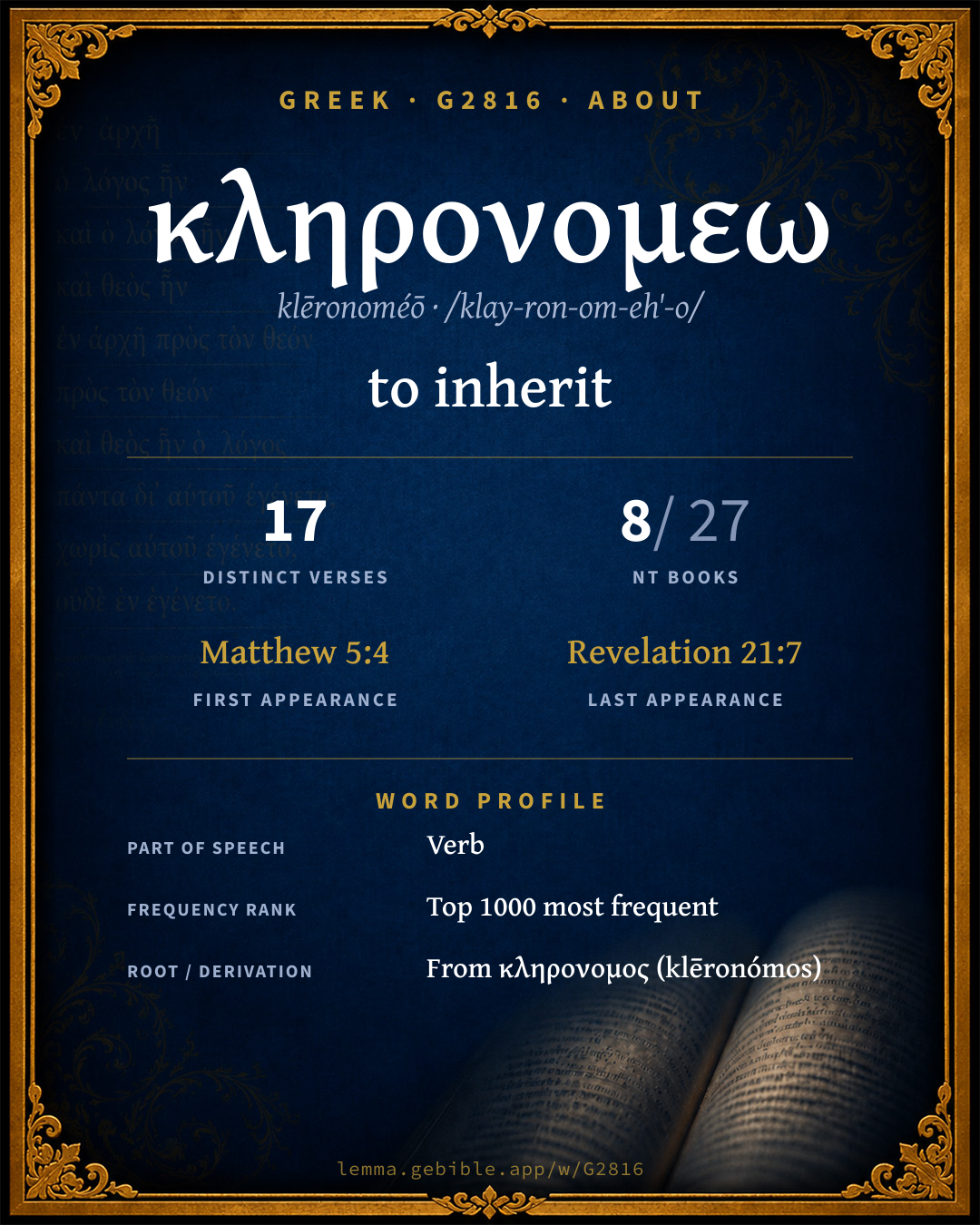
κληρονομέω
to inherit
‘to inherit’ is one of 3 main senses fuller range ↓
Full lexicon entry — Thayer's Greek Lexicon
From Thayer's Greek Lexicon
Where this word appears
See every Future-tense verb in the Greek New Testament →
Grammar key — what these labels mean
Part of speech
- Verb
- An action or state-of-being word.
Tense
- Future
- Action expected in future time.
- Aorist
- Action viewed as a simple whole, without regard to duration — often past (perfective aspect).
- Present
- Ongoing or general action in present time (imperfective aspect).
- Perfect
- A completed past action with continuing present results.
Voice
- Active
- The subject performs the action.
Mood
- Indicative
- States a fact or asks a factual question (the mood of reality).
- Infinitive
- A verbal noun (“to write”), unmarked for person or number.
- Imperative
- Expresses a command or request.
- Subjunctive
- Expresses probability, purpose, or possibility (the mood of contingency).
- Participle
- A verbal adjective (“writing,” “having written”).
Case
- Genitive
- The case of source, possession, or “of” — answers “whose / from what.”
Person
- 3rd person
- The one spoken about (“he / she / it / they”).
- 1st person
- The speaker (“I / we”).
- 2nd person
- The one addressed (“you”).
Gender
- Masculine
- Grammatically masculine.
Number
- Plural
- More than one.
- Singular
- One.
Grammatical forms 11 distinct
- Verb, Future, Active, Indicative, 3rd person, Plural 4 times (22%)
- Verb, Future, Active, Indicative, 3rd person, Singular 3 times (17%)
- Verb, Aorist, Active, Infinitive 2 times (11%)
- Verb, Future, Active, Indicative, 1st person, Singular 2 times (11%)
- Verb, Aorist, Active, Imperative, 2nd person, Plural 1 time (6%)
- Verb, Aorist, Active, Subjunctive, 1st person, Singular 1 time (6%)
- Verb, Aorist, Active, Subjunctive, 2nd person, Plural 1 time (6%)
- Verb, Present, Active, Indicative, 3rd person, Singular 1 time (6%)
+3 more forms (3 occurrences)
Parsed forms decoded from the imported morphology (Robinson–Tischendorf, public domain), counted across 18 parsed occurrences — not distinct verses.
Every verse where G2816 appears — 17 distinct verses across 8 books. Click any verse to open its interlinear word-by-word view. Verse text shown in the World English Bible for context — . Each verse’s Greek form is shown with its reference; the English is not keyword-highlighted, since the data carries no word-level English alignment. Use “Compare translations” on any verse to read it across multiple English versions. This concordance covers the Greek New Testament; Septuagint (Greek Old Testament) occurrences of this word are not indexed here.
Matthew 3 verses
- Matthew 5:4 κληρονομήσουσιν fut act ind 3pl Blessed are those who mourn, For they shall be comforted.
- Matthew 19:29 κληρονομήσει fut act ind 3sg Everyone who has left houses, or brothers, or sisters, or father, or mother, or wife, or children, or lands, for my name's sake, will receive one hundred times, and will inherit eternal life.
- Matthew 25:34 κληρονομήσατε aor act impv 2pl Then the King will tell those on his right hand, 'Come, blessed of my Father, inherit the Kingdom prepared for you from the foundation of the world;
Mark 1 verse
Luke 2 verses
1 Corinthians 3 verses
- 1 Corinthians 6:9 κληρονομήσουσιν fut act ind 3pl Or don't you know that the unrighteous will not inherit the Kingdom of God? Don't be deceived. Neither the sexually immoral, nor idolaters, nor adulterers, nor male prostitutes, nor homosexuals,
- 1 Corinthians 6:10 κληρονομήσουσιν fut act ind 3pl nor thieves, nor covetous, nor drunkards, nor slanderers, nor extortioners, will inherit the Kingdom of God.
- 1 Corinthians 15:50 κληρονομῆσαι κληρονομεῖ aor act inf pres act ind 3sg Now I say this, brothers, that flesh and blood can't inherit the Kingdom of God; neither does corruption inherit incorruption.
Galatians 2 verses
- Galatians 4:30 κληρονομήσει fut act ind 3sg However what does the Scripture say? "Throw out the handmaid and her son, for the son of the handmaid will not inherit with the son of the free woman."
- Galatians 5:21 κληρονομήσουσιν fut act ind 3pl envyings, murders, drunkenness, orgies, and things like these; of which I forewarn you, even as I also forewarned you, that those who practice such things will not inherit the Kingdom of God.
Hebrews 4 verses
- Hebrews 1:4 κεκληρονόμηκεν perf act ind 3sg having become so much better than the angels, as he has inherited a more excellent name than they have.
- Hebrews 1:14 κληρονομεῖν pres act inf Aren't they all ministering spirits, sent out to do service for the sake of those who will inherit salvation?
- Hebrews 6:12 κληρονομούντων pres act ptcp gen pl masc that you won't be sluggish, but imitators of those who through faith and patience inherited the promises.
- Hebrews 12:17 κληρονομῆσαι aor act inf For you know that even when he afterward desired to inherit the blessing, he was rejected, for he found no place for a change of mind though he sought it diligently with tears.
1 Peter 1 verse
Revelation 1 verse
About this entry
At a glance — auto-summarized from this page’s data, not written by a person. Every figure links to its source below. This summary describes the numbers; it doesn’t interpret them.
“to inherit” is the headline sense of the Greek verb κληρονομεω (klēronoméō). First canonically at Matthew 5:4, it enters the text early. It appears 17 verses across 8 books of the Greek New Testament, among its uncommon vocabulary. Lexicons map it across 3 senses. Related forms include κληρονομος and κληρονομια. The sections below give every sense, occurrence, and version rendering.
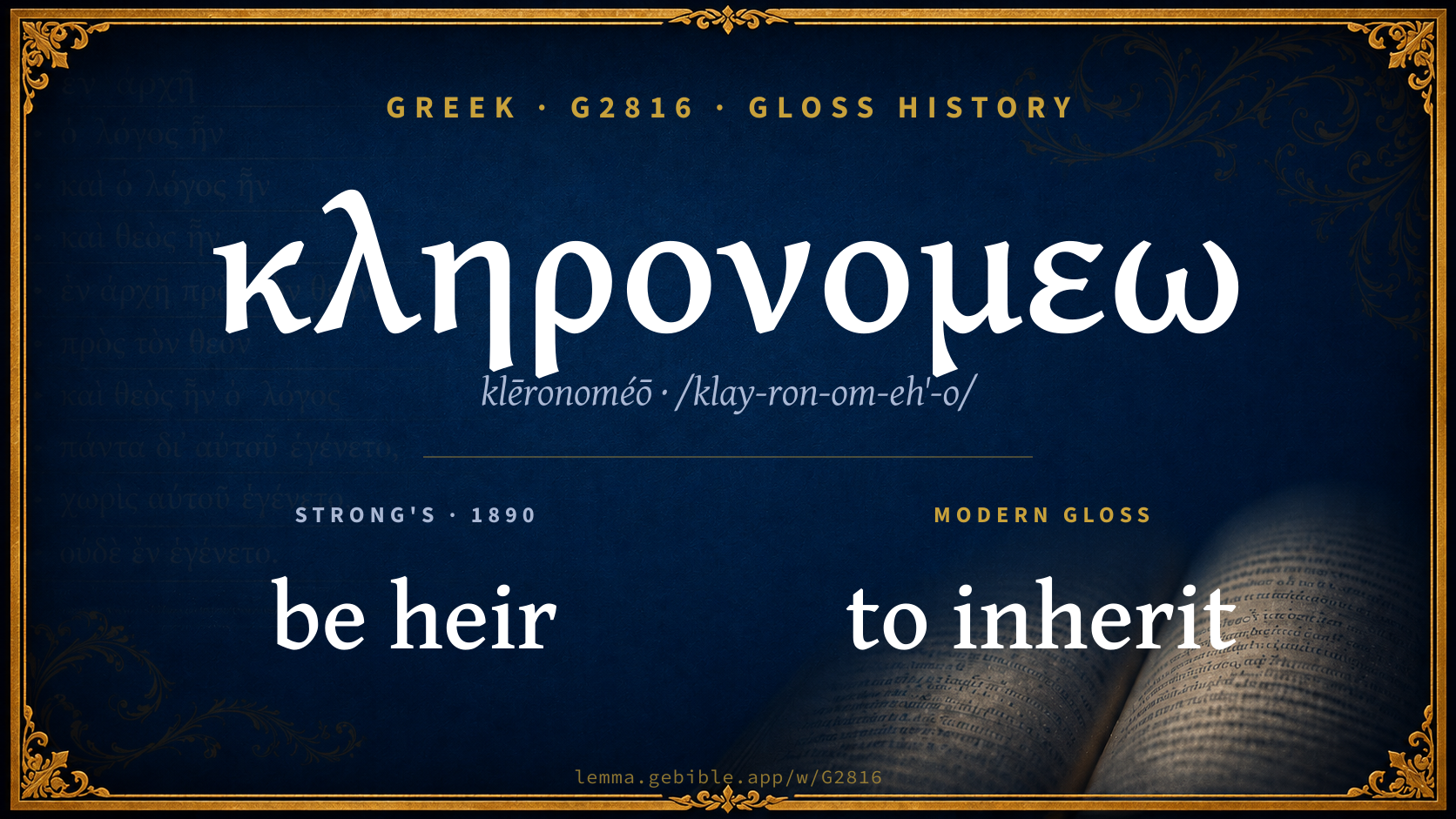
Gloss history
Strong's 1890 vs modern scholarship
About this word
Strong's G2816 catalogs a Greek word from the Greek New Testament.
These counts are not copied from any lexicon or concordance. They are computed here, from the morphology-tagged Greek New Testament. What Lemma adds →
- 17
- distinct verses
- The word appears in 17 distinct verses.
- 8 / 27
- NT books
- The word appears in 8 of 27 New Testament books.
- #664
- by frequency
- Top 1000 most frequent Greek words (rank 664 of 5,347 Greek words by occurrence).
View all 17 occurrences in the concordance →
Most concentrated in
- Hebrews 4 verses 24%
- Matthew 3 verses 18%
- 1 Corinthians 3 verses 18%
By section of the New Testament
By traditional corpus
Conventional, traditional groupings — biblical authorship is debated, so this is a traditional corpus grouping, not an authorship claim. Some books belong to more than one corpus (Luke is in both the Gospels and the Lukan corpus, and so on), so these shares overlap and need not total 100%. Each figure is a share of the word’s 17 distinct verses.
- Gospels 6 verses · 35%
- Pauline corpus 5 verses · 29%
- Hebrews 4 verses · 24%
- Lukan (Luke–Acts) 2 verses · 12%
- Johannine 1 verse · 6%
- General (Catholic) Epistles 1 verse · 6%
- Revelation 1 verse · 6%
How translations render this word
Counts come from each version’s own published word-to-Strong’s tagging or interlinear alignment — an approximate guide to how each version renders this word, not a word-level alignment the data otherwise carries. Because each total is that version’s own tagged count, the per-version totals vary from one another and need not match the appearance or distinct-verse counts above. These counts may also differ from a printed concordance because Lemma counts each distinctly tagged rendering and does not collapse phrase taggings into a single head-word total. This is a fixed set of word-tagged versions (KJV, ASV, BSB, ULT) and does not change with the reading translation you choose elsewhere. Each version’s license is shown beside its name below (and on Sources).
- King James Version: Inherit 8×, Shall 3×, Shall inherit 3×
- American Standard Version: Inherit 12×, Shall 3×, Shall inherit 3×
- Berean Standard Bible: Inherit 9×, Will inherit 4×, Will not inherit 2×
- unfoldingWord Literal Text: Inherit 8×, Will inherit 4×, Will 3×
King James Version Public Domain
Renders G2816 across 21 tagged occurrences — most commonly:
Plus 7 renderings that appear only once — usually multi-word phrases or single function words the recovered tagging swept in, not distinct renderings. Not rendered by a distinct English word in 1 further occurrence.
American Standard Version Public Domain
Renders G2816 across 24 tagged occurrences — most commonly:
Plus 6 renderings that appear only once — usually multi-word phrases or single function words the recovered tagging swept in, not distinct renderings.
Berean Standard Bible Public Domain
Renders G2816 across 18 tagged occurrences — most commonly:
Plus 3 renderings that appear only once — usually multi-word phrases or single function words the recovered tagging swept in, not distinct renderings.
unfoldingWord Literal Text CC BY-SA 4.0
Renders G2816 across 22 tagged occurrences — most commonly:
Plus 5 renderings that appear only once — usually multi-word phrases or single function words the recovered tagging swept in, not distinct renderings.
Senses in Thayer's
The 3 senses Thayer's distinguishes for this word, in lexicon order (not ranked by frequency or importance). The full entry — with sub-senses — is in the Lexicon Entry tab.
- to receive a lot, receive by lot
- to receive the portion assigned to one, receive an allotted portion, receive as one's own or as a possession
- to become partaker of, to obtain
Word origin
Derived from κληρονομος (klēronómos) (G2818) — heir.
From G2818 ; to be an heir to (literally or figuratively): - be heir (obtain by) inherit (-ance).
— Strong’s Exhaustive Concordance (1890), public domain.
Forms in the corpus
The 10 distinct written forms G2816 takes in the Greek New Testament, most frequent first — each parse links to that tense’s occurrences in the concordance.
| Form | Parsing | Example | Uses |
|---|---|---|---|
| κληρονομήσουσιν klēronomḗsousin | Verb, Future, Active, Indicative, 3rd person, Plural | Matthew 5:4 | 4 |
| κληρονομήσω klēronomḗsō | Verb, Future, Active, Indicative, 1st person, Singular | Luke 10:25 | 3 |
| κληρονομήσει klēronomḗsei | Verb, Future, Active, Indicative, 3rd person, Singular | Matthew 19:29 | 3 |
| κληρονομῆσαι klēronomē̂sai | Verb, Aorist, Active, Infinitive | 1 Corinthians 15:50 | 2 |
| κεκληρονόμηκεν keklēronómēken | Verb, Perfect, Active, Indicative, 3rd person, Singular | Hebrews 1:4 | 1 |
| κληρονομήσατε klēronomḗsate | Verb, Aorist, Active, Imperative, 2nd person, Plural | Matthew 25:34 | 1 |
| κληρονομήσητε klēronomḗsēte | Verb, Aorist, Active, Subjunctive, 2nd person, Plural | 1 Peter 3:9 | 1 |
| κληρονομεῖ klēronomeî | Verb, Present, Active, Indicative, 3rd person, Singular | 1 Corinthians 15:50 | 1 |
| κληρονομεῖν klēronomeîn | Verb, Present, Active, Infinitive | Hebrews 1:14 | 1 |
| κληρονομούντων klēronomoúntōn | Verb, Present, Active, Participle, Genitive, Plural, Masculine | Hebrews 6:12 | 1 |
Same root — word family
Other Thayer's entries built from the same root as G2816, grouped by Strong’s listed origin. These share a root / origin per the lexicon — not necessarily a shared meaning. Each links to that word’s own entry.
Derives from
Shares the same root
Compare all same-root words → They share a root, not necessarily a meaning.
Septuagint usage
The same Greek word κληρονομεω appears 141 times in the Greek Old Testament (Septuagint), across 134 verses in 19 books.
- 141
- LXX occurrences
- Tagged occurrences of this Greek word in the Septuagint.
- 134
- verses
- Distinct Septuagint verses containing this word.
- 19 / 39
- OT books
- The word appears in 19 of the 39 Old Testament books.
Sample Septuagint occurrences
- Genesis 15:3 κληρονομέω
- Exodus 23:30 κληρονομέω
- Leviticus 20:24 κληρονομέω
- Numbers 14:24 κληρονομέω
- Deuteronomy 1:8 κληρονομέω
- Joshua 1:15 κληρονομέω
- Judges 1:18 κληρονομέω
- 1 Kings 20:15 κληρονομέω
- 2 Kings 17:24 κληρονομέω
- 1 Chronicles 28:8 κληρονομέω
- Ezra 9:11 κληρονομέω
- Psalms 5:1 κληρονομέω
Septuagint occurrences (same lexeme)
Every verse where the same Strong’s number (G2816) appears in the Greek Septuagint — showing the first 50 of 134. Verse text shown in the World English Bible for context; the Greek form is the matched word — the English is not keyword-highlighted.
- Genesis 15:3 κληρονομέω Abram said, "Behold, to me you have given no seed: and, behold, one born in my house is my heir."
- Genesis 15:4 κληρονομέω Behold, the word of Yahweh came to him, saying, "This man will not be your heir, but he who will come forth out of your own body will be your heir."
- Genesis 15:7 κληρονομέω He said to him, "I am Yahweh who brought you out of Ur of the Chaldees, to give you this land to inherit it."
- Genesis 15:8 κληρονομέω He said, "Lord Yahweh, how will I know that I will inherit it?"
- Genesis 21:10 κληρονομέω Therefore she said to Abraham, "Cast out this handmaid and her son! For the son of this handmaid will not be heir with my son, even with Isaac."
- Genesis 22:17 κληρονομέω that in blessing I will bless you, and in multiplying I will multiply your seed as the stars of the heavens, and as the sand which is on the seashore. Your seed will possess the gate of his enemies.
- Genesis 24:60 κληρονομέω They blessed Rebekah, and said to her, "Our sister, may you be the mother of thousands of ten thousands, and let your seed possess the gate of those who hate them."
- Genesis 28:4 κληρονομέω and give you the blessing of Abraham, to you, and to your seed with you, that you may inherit the land where you travel, which God gave to Abraham."
- Genesis 47:27 κληρονομέω Israel lived in the land of Egypt, in the land of Goshen; and they got themselves possessions therein, and were fruitful, and multiplied exceedingly.
- Exodus 23:30 κληρονομέω Little by little I will drive them out from before you, until you have increased and inherit the land.
- Leviticus 20:24 κληρονομέω But I have said to you, "You shall inherit their land, and I will give it to you to possess it, a land flowing with milk and honey." I am Yahweh your God, who has separated you from the peoples.
- Numbers 14:24 κληρονομέω but my servant Caleb, because he had another spirit with him, and has followed me fully, him will I bring into the land into which he went; and his seed shall possess it.
- Numbers 14:31 κληρονομέω But your little ones, that you said should be a prey, them will I bring in, and they shall know the land which you have rejected.
- Numbers 18:20 κληρονομέω Yahweh said to Aaron, You shall have no inheritance in their land, neither shall you have any portion among them: I am your portion and your inheritance among the children of Israel.
- Numbers 18:23 κληρονομέω But the Levites shall do the service of the tent of meeting, and they shall bear their iniquity: it shall be a statute forever throughout your generations; and among the children of Israel they shall have no inheritance.
- Numbers 18:24 κληρονομέω For the tithe of the children of Israel, which they offer as a heave-offering to Yahweh, I have given to the Levites for an inheritance: therefore I have said to them, Among the children of Israel they shall have no inheritance.
- Numbers 21:35 κληρονομέω So they struck him, and his sons and all his people, until there was none left him remaining: and they possessed his land.
- Numbers 26:53 κληρονομέω To these the land shall be divided for an inheritance according to the number of names.
- Numbers 26:55 κληρονομέω Notwithstanding, the land shall be divided by lot: according to the names of the tribes of their fathers they shall inherit.
- Numbers 27:11 κληρονομέω If his father have no brothers, then you shall give his inheritance to his kinsman who is next to him of his family, and he shall possess it: and it shall be to the children of Israel a statute [and] ordinance, as Yahweh commanded Moses.
- Numbers 32:19 κληρονομέω For we will not inherit with them on the other side of the Jordan, and forward; because our inheritance is fallen to us on this side of the Jordan eastward.
- Numbers 33:54 κληρονομέω You shall inherit the land by lot according to your families; to the more you shall give the more inheritance, and to the fewer you shall give the less inheritance: wherever the lot falls to any man, that shall be his; according to the tribes of your fathers shall you inherit.
- Numbers 34:17 κληρονομέω These are the names of the men who shall divide the land to you for inheritance: Eleazar the priest, and Joshua the son of Nun.
- Numbers 35:8 κληρονομέω Concerning the cities which you shall give of the possession of the children of Israel, from the many you shall take many; and from the few you shall take few: everyone according to his inheritance which he inherits shall give of his cities to the Levites.
- Deuteronomy 1:8 κληρονομέω Behold, I have set the land before you: go in and possess the land which Yahweh swore to your fathers, to Abraham, to Isaac, and to Jacob, to give to them and to their seed after them.
- Deuteronomy 1:21 κληρονομέω Behold, Yahweh your God has set the land before you: go up, take possession, as Yahweh, the God of your fathers, has spoken to you; don't be afraid, neither be dismayed.
- Deuteronomy 1:39 κληρονομέω Moreover your little ones, whom you said should be a prey, and your children, who this day have no knowledge of good or evil, they shall go in there, and to them will I give it, and they shall possess it.
- Deuteronomy 2:9 κληρονομέω Yahweh said to me, Don't bother Moab, neither contend with them in battle; for I will not give you of his land for a possession; because I have given Ar to the children of Lot for a possession.
- Deuteronomy 2:24 κληρονομέω Rise up, take your journey, and pass over the valley of the Arnon: behold, I have given into your hand Sihon the Amorite, king of Heshbon, and his land; begin to possess it, and contend with him in battle.
- Deuteronomy 2:31 κληρονομέω Yahweh said to me, Behold, I have begun to deliver up Sihon and his land before you: begin to possess, that you may inherit his land.
- Deuteronomy 3:12 κληρονομέω This land we took in possession at that time: from Aroer, which is by the valley of the Arnon, and half the hill-country of Gilead, and the cities of it, gave I to the Reubenites and to the Gadites:
- Deuteronomy 4:1 κληρονομέω Now, Israel, listen to the statutes and to the ordinances, which I teach you, to do them; that you may live, and go in and possess the land which Yahweh, the God of your fathers, gives you.
- Deuteronomy 4:5 κληρονομέω Behold, I have taught you statutes and ordinances, even as Yahweh my God commanded me, that you should do so in the midst of the land where you go in to possess it.
- Deuteronomy 4:14 κληρονομέω Yahweh commanded me at that time to teach you statutes and ordinances, that you might do them in the land where you go over to possess it.
- Deuteronomy 4:22 κληρονομέω but I must die in this land, I must not go over the Jordan; but you shall go over, and possess that good land.
- Deuteronomy 4:26 κληρονομέω I call heaven and earth to witness against you this day, that you shall soon utterly perish from off the land whereunto you go over the Jordan to possess it; you shall not prolong your days on it, but shall utterly be destroyed.
- Deuteronomy 4:38 κληρονομέω to drive out nations from before you greater and mightier than you, to bring you in, to give you their land for an inheritance, as at this day.
- Deuteronomy 4:47 κληρονομέω They took his land in possession, and the land of Og king of Bashan, the two kings of the Amorites, who were beyond the Jordan toward the sunrise;
- Deuteronomy 5:33 κληρονομέω You shall walk in all the way which Yahweh your God has commanded you, that you may live, and that it may be well with you, and that you may prolong your days in the land which you shall possess.
- Deuteronomy 6:1 κληρονομέω Now this is the commandment, the statutes, and the ordinances, which Yahweh your God commanded to teach you, that you might do them in the land where you go over to possess it;
- Deuteronomy 6:18 κληρονομέω You shall do that which is right and good in the sight of Yahweh; that it may be well with you, and that you may go in and possess the good land which Yahweh swore to your fathers,
- Deuteronomy 7:1 κληρονομέω When Yahweh your God shall bring you into the land where you go to possess it, and shall cast out many nations before you, the Hittite, and the Girgashite, and the Amorite, and the Canaanite, and the Perizzite, and the Hivite, and the Jebusite, seven nations greater and mightier than you;
- Deuteronomy 8:1 κληρονομέω All the commandment which I command you this day shall you observe to do, that you may live, and multiply, and go in and possess the land which Yahweh swore to your fathers.
- Deuteronomy 9:1 κληρονομέω Hear, Israel: you are to pass over the Jordan this day, to go in to dispossess nations greater and mightier than yourself, cities great and fortified up to the sky,
- Deuteronomy 9:4 κληρονομέω Don't speak in your heart, after that Yahweh your God has thrust them out from before you, saying, For my righteousness Yahweh has brought me in to possess this land; whereas for the wickedness of these nations Yahweh does drive them out from before you.
- Deuteronomy 9:5 κληρονομέω Not for your righteousness, or for the uprightness of your heart, do you go in to possess their land; but for the wickedness of these nations Yahweh your God does drive them out from before you, and that he may establish the word which Yahweh swore to your fathers, to Abraham, to Isaac, and to Jacob.
- Deuteronomy 9:6 κληρονομέω Know therefore, that Yahweh your God doesn't give you this good land to possess it for your righteousness; for you are a stiff-necked people.
- Deuteronomy 9:23 κληρονομέω When Yahweh sent you from Kadesh-barnea, saying, Go up and possess the land which I have given you; then you rebelled against the commandment of Yahweh your God, and you didn't believe him, nor listen to his voice.
- Deuteronomy 10:11 κληρονομέω Yahweh said to me, Arise, take your journey before the people; and they shall go in and possess the land, which I swore to their fathers to give to them.
- Deuteronomy 11:8 κληρονομέω Therefore shall you keep all the commandment which I command you this day, that you may be strong, and go in and possess the land, where you go over to possess it;
These are occurrences of the same Greek lexeme (G2816) in the Septuagint — not a translation of any one Hebrew word. The store carries no word-level Hebrew↔Greek alignment, so no Hebrew original is asserted here. Counts come from the recovered LXX Strong's tagging — high-frequency vocabulary is well covered, while rare or late forms may be untagged — so they reflect tagged occurrences and may slightly undercount.