Numbers 26:55

Hebrew (Westminster Leningrad Codex) Numbers 26:55 appears in the Hebrew Old Testament. The text above is from the Westminster Leningrad Codex. Each word links to its Strong’s number, a concise gloss, and parsing drawn from the Open Scriptures Hebrew Bible morphology. Click any word for its full Brown-Driver-Briggs (BDB) entry.
Download image
Cite this verse

Numbers 26:55 (World English Bible). Public Domain. Lemma interlinear Bible study tool, https://lemma.gebible.app/v/numbers/26/55.

Show BibTeX & RIS
BibTeX
RIS
English Translation
Notwithstanding, the land shall be divided by lot: according to the names of the tribes of their fathers they shall inherit.
World English Bible · Public Domain
Download a study sheet

One document with this verse’s original text, its word-by-word gloss line, the meaning frame, cross-references with their text, attributed commentary, and full source and license credits — printable, and it pastes into notes with its structure intact.

This verse Autodidact and up

Study sheet (.html) Plain text (.txt)

A passage Seminary Student

Up to 50 verses in one chapter. A passage sheet keeps up to 6 commentary sources and 12 cross-references per verse, in the order this page ranks them, and says so on the sheet whenever that leaves anything out. Ask for a single verse and you get the Autodidact verse sheet above.

Everything on this page stays free to read, with no account — the sheet is a download of what is already on screen, not access to it.

Want to remove ads? Support Godless Engineer
Compare translations 3

The same verse in 3 English versions, stacked beneath the original-language interlinear above. Click any original word for its lexicon entry.

Each is an independent rendering of the whole verse — the interlinear is not word-aligned to these translations.

Highlighted words mark where these versions differ — a whole-verse word diff, not a word-by-word alignment.

  • World English Bible Public Domain
    Notwithstanding, the land shall be divided by lot: according to the names of the tribes of their fathers they shall inherit.
  • King James Version Public Domain
    Notwithstanding the land shall be divided by lot: according to the names of the tribes of their fathers they shall inherit.
  • unfoldingWord Literal Text CC BY-SA 4.0
    Surely the land shall be apportioned by lots. They shall inherit according to the names of the tribes of their fathers.

unfoldingWord Literal Text — © unfoldingWord, licensed CC BY-SA 4.0. Word-aligned USFM3 via Door43 (git.door43.org/unfoldingWord/en_ult).

Versions to compare (up to 4)

3 of 4 selected

Show all 18 translations

Every available English version of this verse, each an independent rendering of the whole verse.

  • World English Bible Public Domain
    Notwithstanding, the land shall be divided by lot: according to the names of the tribes of their fathers they shall inherit.
  • Berean Standard Bible Public Domain
    Indeed, the land must be divided by lot; they shall receive their inheritance according to the names of the tribes of their fathers.
  • Majority Standard Bible Public Domain
    Indeed, the land must be divided by lot; they shall receive their inheritance according to the names of the tribes of their fathers.
  • King James Version Public Domain
    Notwithstanding the land shall be divided by lot: according to the names of the tribes of their fathers they shall inherit.
  • American Standard Version (1901) Public Domain
    Notwithstanding, the land shall be divided by lot: according to the names of the tribes of their fathers they shall inherit.
  • Revised Version (1885) Public Domain
    Notwithstanding the land shall be divided by lot: according to the names of the tribes of their fathers they shall inherit.
  • Geneva Bible (1599) Public Domain
    Notwithstanding, the land shalbe deuided by lot: according to the names of the tribes of their fathers they shall inherite:
  • Douay-Rheims (1899) Public Domain
    Yet so that by lot the land be divided to the tribe and families.
  • Young's Literal Translation Public Domain
    `Only by lot is the land apportioned, by the names of the tribes of their fathers they inherit;
  • Literal Standard Version CC BY-SA 4.0
    Surely the land is apportioned by lot; they inherit by the names of the tribes of their fathers;
  • Unlocked Literal Bible CC BY-SA 4.0
    However, the land must be divided by random lots. They must inherit the land as it will be divided among their ancestors' tribes.
  • unfoldingWord Literal Text CC BY-SA 4.0
    Surely the land shall be apportioned by lots. They shall inherit according to the names of the tribes of their fathers.
  • Darby Bible Public Domain
    Notwithstanding the land shall be divided by lot; according to the names of the tribes of their fathers shall they inherit;
  • World Messianic Bible Public Domain
    Notwithstanding, the land shall be divided by lot. According to the names of the tribes of their fathers they shall inherit.
  • Webster's Bible Public Domain
    Notwithstanding, the land shall be divided by lot: according to the names of the tribes of their fathers they shall inherit.
  • Free Bible Version CC BY-SA 4.0
    The land has to be divided up by casting lots. Everyone shall receive their allotted land based on the name of their ancestor's tribe.
  • Bible in Basic English Public Domain
    But let the distribution of the land be made by the decision of the Lord: by the names of the tribes of their fathers let their heritage be given them.
  • JPS Tanakh (1917) Public Domain
    Notwithstanding the land shall be divided by lot; according to the names of the tribes of their fathers they shall inherit.

Literal Standard Version (2020), Covenant Press — licensed CC BY-SA 4.0. Text via the HelloAO Bible API (eBible.org). Unlocked Literal Bible (unfoldingWord) — licensed CC BY-SA 4.0. Text via the HelloAO Bible API (eBible.org). unfoldingWord Literal Text — © unfoldingWord, licensed CC BY-SA 4.0. Word-aligned USFM3 via Door43 (git.door43.org/unfoldingWord/en_ult). Free Bible Version, Dr. Jonathan Gallagher — licensed CC BY-SA 4.0. Text via the HelloAO Bible API (eBible.org).

Word by word

More ways to search: Search by grammar → Find every occurrence → Compare this word →

Practice this passage: Drill this verse → Learn its vocabulary →

יִנְחָֽלוּ
nâchal
H5157
“to inherit”
Verb, Qal, Imperfect, 3rd Person, Masculine, Plural
Part of Speech
Verb
Stem
Qal
Form
Imperfect
Person
3rd Person
Gender
Masculine
Number
Plural
Full BDB Definition

Origin: a primitive root

TWOT: 1342

to get as a possession, acquire, inherit, possess - (Qal) - to take possession, inherit - to have or get as a possession or property (figuratively) - to divide the land for a possession - to acquire (testimonies) (figuratively) - (Piel) to divide for a possession - (Hithpael) to possess oneself of - (Hiphil) - to give as a possession - to cause to inherit, give as an inheritance - (Hophal) to be allotted, be made to possess
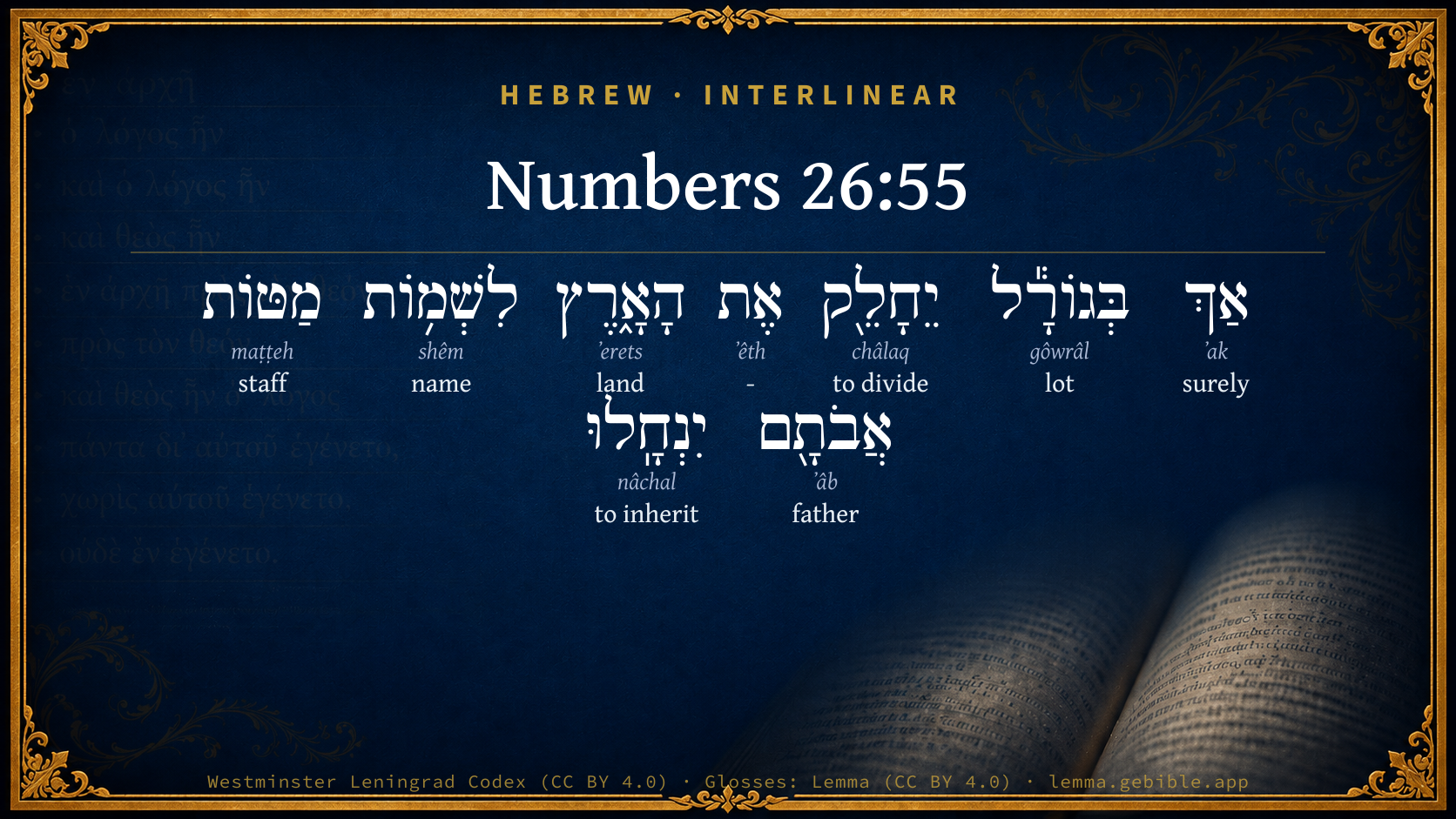
  1. אַךְ ʼak H389 “surely” Particle, Accusative
  2. בְּגוֹרָ֕ל gôwrâl H1486 “in/at · lot” Preposition + Noun, Common, Masculine, Singular, Absolute
  3. יֵחָלֵ֖ק châlaq H2505 “to divide” Verb, Niphal, Imperfect, 3rd Person, Masculine, Singular
  4. אֶת ʼêth H853 “-” Particle, Direct Object
  5. הָאָ֑רֶץ ʼerets H776 “the · land” Particle, Definite Article + Noun, Common, Both, Singular, Absolute
  6. לִשְׁמ֥וֹת shêm H8034 “to/for · names of” Preposition + Noun, Common, Masculine, Plural, Construct
  7. מַטּוֹת maṭṭeh H4294 “staffs of” Noun, Common, Masculine, Plural, Construct
  8. אֲבֹתָ֖ם ʼâb H1 “fathers · their” Noun, Common, Masculine, Plural, Construct + Suffix, Personal, 3rd Person, Masculine, Plural

About this verse

These counts appear in no published source. They are computed here, from the morphology-tagged text and Lemma’s own curated glosses. What Lemma adds →

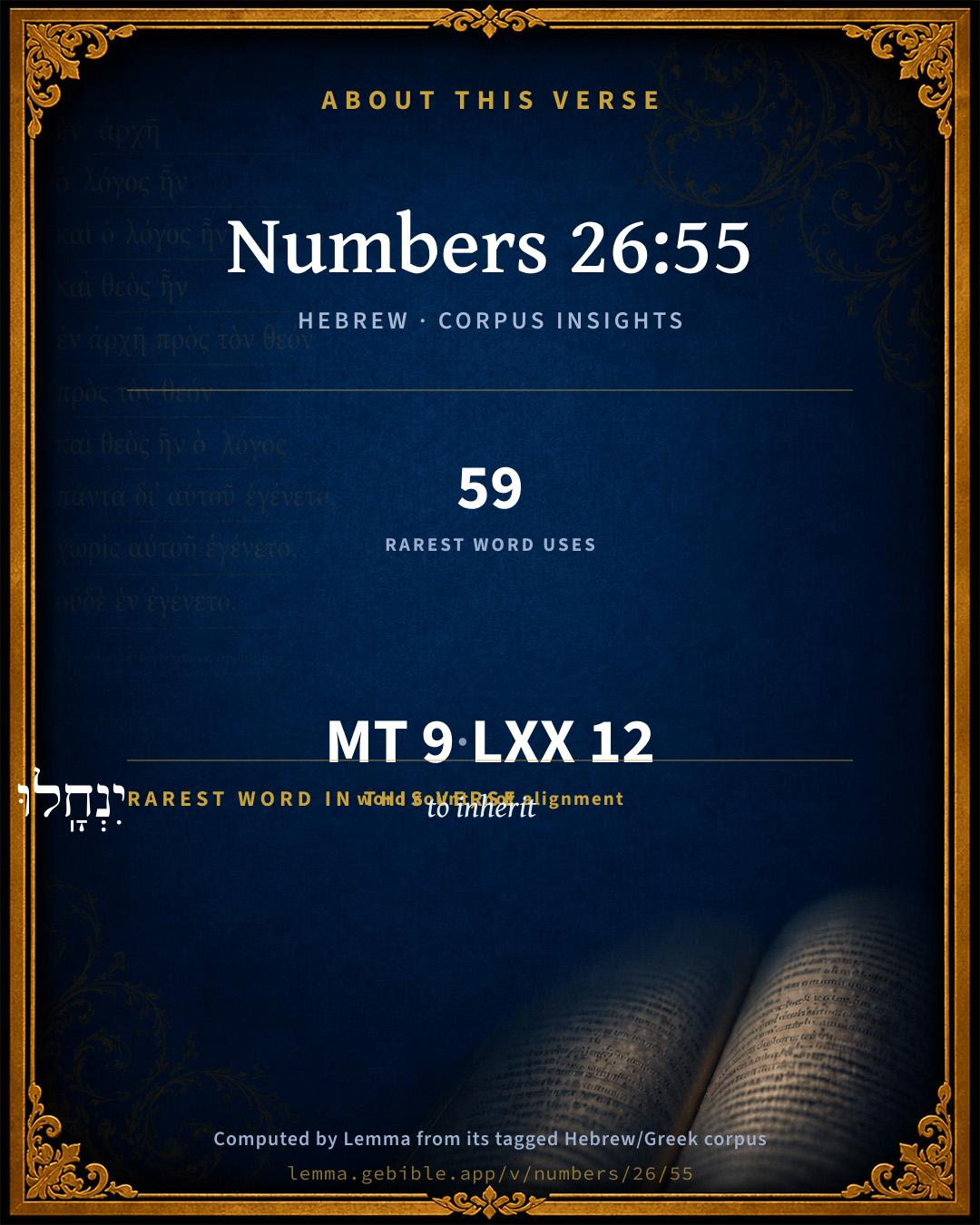
9
words
9
distinct lemmas
Pentateuch
section

Shared distinctive vocabulary

יִנְחָֽלוּ to inherit H5157 occurs in 57 verses of the Hebrew Bible. Also found in:

Grammatical profile

  • 2 verbs
  • 5 nouns
  • 2 particles

Verb forms

  • יֵחָלֵ֖ק Niphal · Imperfect
  • יִנְחָֽלוּ Qal · Imperfect

Hebrew & Septuagint length

In English translation the verse runs 21 words from the Hebrew and 20 from the Septuagint (LXX English) — closely comparable.

A rough comparison of the two English renderings, which tokenize alike — not a word-level alignment.

Word counts can differ between the Hebrew and the Greek without any difference in meaning — e.g. the Hebrew direct-object marker אֵת has no separate Greek word, and Greek often adds the article ὁ.

In the original languages it is 9 Hebrew tokens and 12 Greek tokens — but the two are counted differently (Hebrew bundles its prefixes and suffixes into one token; the Greek is in lemma form), so that isn’t a like-for-like length.

Cross-references

19

Topical passages linked to Numbers 26:55 in the Treasury of Scripture Knowledge — connected by theme and wording, ordered by reader-vote popularity; previews shown in the World English Bible.

  • Numbers 33:54 You shall inherit the land by lot according to your families; to the more you shall give the more inheritance, and to the fewer you shall give the less inheritance: wherever the lot falls to any man, that shall be his; according to the tribes of your fathers shall you inherit.
  • Numbers 34:13 Moses commanded the children of Israel, saying, This is the land which you shall inherit by lot, which Yahweh has commanded to give to the nine tribes, and to the half-tribe;
  • Joshua 14:2 by the lot of their inheritance, as Yahweh commanded by Moses, for the nine tribes, and for the half-tribe.
  • Joshua 11:23 So Joshua took the whole land, according to all that Yahweh spoke to Moses; and Joshua gave it for an inheritance to Israel according to their divisions by their tribes. The land had rest from war.
  • Numbers 26:56 According to the lot shall their inheritance be divided between the more and the fewer.
  • Joshua 17:14 The children of Joseph spoke to Joshua, saying, Why have you given me but one lot and one part for an inheritance, seeing I am a great people, because hitherto Yahweh has blessed me?
  • Joshua 18:6 You shall describe the land into seven portions, and bring [the description] here to me; and I will cast lots for you here before Yahweh our God.
  • Joshua 18:10–11 Joshua cast lots for them in Shiloh before Yahweh: and there Joshua divided the land to the children of Israel according to their divisions.
  • Joshua 19:1 The second lot came out for Simeon, even for the tribe of the children of Simeon according to their families: and their inheritance was in the midst of the inheritance of the children of Judah.
  • Joshua 19:10 The third lot came up for the children of Zebulun according to their families; and the border of their inheritance was to Sarid;
  • Joshua 19:17 The fourth lot came out for Issachar, even for the children of Issachar according to their families.
  • Joshua 19:24 The fifth lot came out for the tribe of the children of Asher according to their families.
  • Joshua 19:32 The sixth lot came out for the children of Naphtali, even for the children of Naphtali according to their families.
  • Joshua 19:40 The seventh lot came out for the tribe of the children of Dan according to their families.
  • Proverbs 16:33 The lot is cast into the lap, But its every decision is from Yahweh.
  • Proverbs 18:18 The lot settles disputes, And keeps strong ones apart.
  • Acts 1:26 They drew lots for them, and the lot fell on Matthias, and he was numbered with the eleven apostles.
  • Colossians 1:12 giving thanks to the Father, who made us fit to be partakers of the inheritance of the saints in light;
  • Revelation 7:4–8 I heard the number of those who were sealed, one hundred forty-four thousand, sealed out of every tribe of the children of Israel:

Cross-references courtesy of OpenBible.info (CC BY 4.0).

Hebrew and Greek witnesses Masoretic Hebrew ↔ Greek Septuagint

The same verse in the two great witnesses to the Old Testament, shown verse-for-verse.

These are two independent witnesses, not word-aligned to each other, and the Septuagint is shown in lemma (dictionary) form.

Hebrew Numbers 26:55 Masoretic · Westminster Leningrad Codex

אַךְ בְּגוֹרָ֕ל יֵחָלֵ֖ק אֶת הָאָ֑רֶץ לִשְׁמ֥וֹת מַטּוֹת אֲבֹתָ֖ם יִנְחָֽלוּ

Notwithstanding, the land shall be divided by lot: according to the names of the tribes of their fathers they shall inherit.

World English Bible · Public Domain

Greek LXX Numbers 26:55 Septuagint · lemma form

διά κλῆρος μερίζω ὁ γῆ ὁ ὄνομα κατά φυλή πατριά αὐτός κληρονομέω

The land shall be divided to the names by lot, they shall inherit according to the tribes of their families.

LXX2012 (modern English Septuagint) · Public Domain

Hebrew: Westminster Leningrad Codex (CC BY 4.0). Greek: Septuagint (public domain); English from LXX2012 (modern English Septuagint) (Public Domain). How the Septuagint differs from the Hebrew →

Targum (Aramaic paraphrase)

2

The Targum is the ancient Jewish Aramaic paraphrase of the Hebrew Scriptures — an interpretive translation, not the Hebrew text itself. Onkelos (literal) and Pseudo-Jonathan (expansive) render the Torah, and Jonathan the Prophets. Coverage is partial: where no permissively-licensed English translation exists for a verse, only the Aramaic is shown. This is verse-level text, not a word-by-word alignment to the Hebrew.

  1. Targum Onkelos Torah (Genesis–Deuteronomy)
    בְּרַם בְּעַדְבָא תִּתְפְּלֵיג יַת אַרְעָא לִשְׁמָהָן שִׁבְטֵי אֲבָהָתְהוֹן יַחְסְנוּן

    (no public-domain English translation for this verse)

    Targum Onkelos — Aramaic: “Onkelos Genesis” (public domain); “Onkelos Exodus” (public domain); “Onkelos Leviticus” (public domain); “Onkelos Numbers” (public domain); “Onkelos Deuteronomy” (public domain). English: “Sefaria Community Translation” (CC0 1.0 (public-domain dedication)); “J.W. Etheridge. The Targums of Onkelos and Jonathan Ben Uzziel on the Pentateuch. London: Longmans, Green, 1862” (public domain). Text via Sefaria.

  2. Targum Pseudo-Jonathan Torah (Genesis–Deuteronomy)
    בְּרַם בְּעַדְבִין תִּתְפְּלֵג אַרְעָא לִשְׁמָהָן שִׁבְטַיָא דְאַבְהַתְהוֹן יַחְסִינוּן

    Yet the land shall be divided by lots; according to the names of their fathers tribes they shall inherit.

    Targum Pseudo-Jonathan — Aramaic: “Targum Jonathan on Genesis” (public domain); “Targum Jonathan on Exodus” (public domain); “Targum Jonathan on Leviticus” (public domain); “Targum Jonathan on Numbers” (public domain); “Targum Jonathan on Deuteronomy” (public domain). English: “The Targum of Jonathan ben Uzziel, trans. J. W. Etheridge, London, 1862” (public domain). Text via Sefaria.

Commentary

Notes on Numbers 26:55 from classic Christian and Jewish commentators (each source and its license shown beneath its notes). The classic Christian expositions comment on the surrounding passage and are grouped to its opening verse, so a note may address several verses; the Jewish commentaries on the Tanakh (Rashi and others) are per-verse, so they appear only where the commentator wrote on this verse.

Lemma curates 59 commentaries, every one of them public domain or Creative Commons licensed, each selected and text-cleaned for this edition rather than reprinted as found. About our sources →

Joseph Benson's Commentary

Num 26:55. By lot — The quantity of land, it seems, was to be assigned according to the number in each tribe, but the situation was to be determined by lot, both as to the tribes and as to individuals. For instance, it was determined by lot which of the tribes were to inherit in the south, which in the north, &c. But in that quarter where their lot fell a larger or smaller portion of land was appointed them, according to the goodness of the soil, and in proportion as they were more or less numerous. By these means all ground of quarrel among the several tribes was removed, and each acquiesced in his portion, as assigned by God himself, to whom the appeal was made by lot.

Joseph Benson's Commentary on the Old and New Testaments (1811–1818) — public domain. Text from a community e-Sword module.

Jamieson, Fausset & Brown

Robert Jamieson, A. R. Fausset & David Brown

the land shall be divided by lot--The appeal to the lot did not place the matter beyond the control of God; for it is at His disposal (Pro 16:33), and He has fixed to all the bounds of their habitation. The manner in which the lot was taken has not been recorded. But it is evident that the lot was cast for determining the section of the country in which each tribe should be located--not the quantity of their possessions. In other words, when the lot had decided that a particular tribe was to be settled in the north or the south, the east or the west, the extent of territory was allocated according to the rule (Num 26:54).

Jamieson, Fausset & Brown — Commentary Critical and Explanatory on the Whole Bible (1871) — public domain (CC PDM 1.0). Text via the HelloAO Bible API.

Adam Clarke's Commentary

Verse 55. The land shall be divided by lot] The word גורל goral, translated lot, is supposed by some to signify the stone or pebble formerly used for the purpose of what we term casting lots. The word [Anglo-Saxon] hlot is Anglo-Saxon, from [Anglo-Saxon] to divide, or portion out, i. e., fortuitously: it answers to the Greek κληρος, which some think comes from κλαω to break; because the lot, being a sort of appeal to God, ("The lot is cast into the lap, but the whole disposing thereof is of the Lord," Pr 16:33,) broke off all contentions and litigations relative to the matter in dispute. From this original division of the promised land by lot to the children of Israel, all portions, appointments, offices, shares, or divisions in spiritual and ecclesiastical matters, were termed lots. So in the New Testament, the word κληρος, lot, is used to signify a portion of spiritual blessedness, and κληρονομια, a division by lot, an inheritance; and κληροι the lotted or appointed persons to different works, shares, c. hence our word clergy, κληροι, persons appointed by lot to a lot, portion, or inheritance; see the case of Matthias, Ac 1:26. Persons thus appointed were by accommodation termed inheritors, because originally, when there could be no claims of exclusive right, all lands where a wandering tribe chose to take up its residence were divided by lot, as the promised land in the case before us. So Judah says to Simeon his brother, Jdg 1:3: "Come up with me into my lot." And as God was ever supposed to be the whole disposer in such matters, whatever fell out in the course of God's providence was called a lot. "This is the lot of them that rob us;" Isa 17:14. "Thou hast neither part nor lot in this matter;" Ac 8:21. A lot in the promised land was evidently typical of a place in eternal glory. "That they may receive forgiveness of sins, and an inheritance (κληρον, a lot) among them that are sanctified;" Ac 26:18. "Who hath made us meet to be partakers of the inheritance, κληρου, of the lot) of the saints in light;" Col 1:12. "Which is the earnest of our inheritance, (κληρονομιας, of our allotted portion;") Eph 1:4. "What is the riches of the glory of his inheritance," (κληρονομιας, allotted portion;) Eph 1:18. As therefore the promised land was divided by lot to the believing Israelites, God determining the lot as he saw good, none of the people having any claim on or right to it; so the kingdom of heaven is a lot given by the mere good will of God to them that believe and obey him; for as unbelief and disobedience threw 600,000 people out of the inheritance of the promised land; so none who disbelieve God's word, and rebel against his authority, shall ever enter into the kingdom of heaven. - See Ainsworth. These things happened unto them for examples: see then, reader, that thou fall not after the same example of unbelief.

Adam Clarke's Commentary on the Bible (1810–1826) — public domain. Text from a community e-Sword/MySword module.

The Cambridge Bible for Schools and Colleges

gen. ed. J. J. S. Perowne

55. the land shall be divided by lot] Since the distribution was to be proportionate the purpose of the lot must only have been to decide roughly in what part of the country each tribe was to settle.

according to the names of the tribes of their fathers they shall inherit] The meaning is doubtful. ‘The names of the tribes of their fathers’ appears to be a periphrasis for ‘their tribes.’ If so, the meaning is either that individuals shall in every case possess land within the region assigned to their tribe, or (perhaps better) that no smaller division than a whole tribe is to be taken account of in the general distribution, and the property of clans and families must be settled privately within each tribe.

The Cambridge Bible for Schools and Colleges (gen. ed. J. J. S. Perowne; Cambridge University Press, 1878–1918) — public domain. Text from a community e-Sword module.

Haydock's Catholic Bible Commentary

Lot. Josue appointed commissioners, who measured the land, and divided it according to its fertility; and the portions assigned to each of the tribes by lot, corresponded with the predications of Jacob and of Moses; God so regulating the lots by his allwise Providence, in order that the people might be more convinced of the truth of the prophecies, and that no undue favour was shewn to any one by Josue, Eleazar, or by the other men in authority. He took the whole upon himself, that none might complain of their rulers. (Calmet) --- Masius supposes that the different divisions of the land were written down, and placed in an urn, and that the heads of the tribes drew according to their birth, Josue xv. 1. --- The heads of families, such as Henoch, &c., (ver. 5.) probably also drew lots, to know what part of territory allotted to the tribe, should fall to their share; (Haydock) and they parcelled out their land among their children. (Menochius)

George Leo Haydock (1774–1849), Haydock's Catholic Family Bible and Commentary, 1859 edition — public domain. Excludes Psalms (Douay-Rheims chapter numbering differs from Protestant) and Deuterocanonical books (Catholic canon only).

Matthew Poole's English Annotations

By lot; which lots seem to have been cast only for the tribes, not, as some would have it, for the several families, for the distribution of it to them was left to the ruler’s wisdom, according to the rule now given, Num 26:54. Yet if any lot was too large for the tribe, they might give up part of their right to others, with the ruler’s consent, as Judah gave a share to Simeon and to Dan within his lot.

According to the names of the tribes, i.e. the lots shall go under the names of each tribe or each patriarch.

Matthew Poole's English Annotations on the Holy Bible (1683–1685) — public domain. Text from a community e-Sword/MySword module.

Whedon's Commentary on the Bible

Daniel D. Whedon

55, 56. The land shall be divided by lot — The principle laid down by Jehovah is, that the location of each tribe must be determined by lot. Since there was a difference in the quality of the land, some being richer and some poorer, to avoid all occasion for complaint in this matter the lot was resorted to as the fairest method of procedure. For the manner of the lot, see Jos_13:6, note. The result of the lot was regarded, not only by the Hebrews, (Pro_16:33; Pro_18:18,) but also by nearly all other nations, as an indication of the divine will. The Greeks and Romans resorted to the lot in the division of conquered lands. Lands are still occasionally divided in this manner.

Daniel D. Whedon (gen. ed.), Commentary on the Old and New Testaments (1874–1909) — public domain. Text from a community e-Sword module.

The Pulpit Commentary

Notwithstanding the land shall be divided by lot. This can only be reconciled with the preceding order by assuming that the lot was to determine the situation of the territory, the actual boundaries being left to the discretion of the rulers. Recourse was had as far as possible to the lot in order to refer the matter directly to God, of whose will and gift they held the land. (cf. Pro_16:33 Act_1:26) The lot would also remove any suspicion that the more numerous tribes, such as Judah or Dan, were unfairly favoured (verse 56).

The Pulpit Commentary (1880–1919), ed. H.D.M. Spence-Jones & Joseph S. Exell — public domain. Text from a community e-Sword module.

John Wesley's Explanatory Notes

By lot - For the tribes, not for the several families; for the distribution of it to them was left to the rulers wisdom according to the rule now given.

John Wesley, Explanatory Notes Upon the Whole Bible (1754–1765) — public domain. Text via the GEBible commentary corpus.

Rashi

Rabbi Shlomo Yitzchaki (Rashi)

לשמות מטה אבתם ACCORDING TO THE NAMES OF THE TRIBES OF THEIR FATHERS [THEY SHALL INHERIT] — These (the fathers referred to) were they who came out of Egypt. — Scripture treated this inheritance differently to all other inheritances mentioned in the Torah, for in the case of all other inheritances the living become heirs to the dead, whilst here the dead become heirs to the living. How is this so? Two brothers who were of those who came out of Egypt who had sons at least twenty years old amongst those who came into the Land, one son to this and three to that, the one son took one portion, and the three took three portions, for it is said, (v. 53) “To these (enumerated in the census taken immediately before they entered Palestine) shall the land be divided”. Their inheritance (that of these four) returns to (is regarded as having belonged to) their fathers’ father, and they (the two brothers who have four sons between them), divide equally. This is what is stated, “according to the names of the tribes of their fathers they shall inherit” — that after the sons have received they divide it according to the fathers who came out of Egypt. If, however, they had straightway divided it according to the number of those who came out of Egypt these four would have taken only two portions, whilst now they take four portions (Bava Batra 117a; Sifrei Bamidbar 132:1).

אך בגורל — Joshua and Caleb are excepted from this method of division (since אך is a limiting term) and so indeed it states, (Judges 1:20) “And they gave Hebron to Caleb as Moses had said” (cf. Rashi on Numbers XlV. 24), and it further states, (Joshua 19:50) “According to the command of the Lord they gave him (Joshua) the city which he had asked” (Sifrei Bamidbar 132:3).

מטות אבתם THE TRIBES OF THEIR FATHERS — Consequently proselytes and slaves were excepted (Sifrei Bamidbar 132:4).

Rashi on the Tanakh — English translations: “The Judaica Press complete Tanach with Rashi, translated by A. J. Rosenberg” (CC BY 4.0); “Pentateuch with Rashi's commentary by M. Rosenbaum and A.M. Silbermann, 1929-1934” (public domain); “The Metsudah Tanach series, Lakewood, N.J” (CC BY 4.0); and “The Book of Joshua, Metsudah Publications, 1997” (CC BY 4.0). Text via Sefaria.

Ramban (Nachmanides)

Rabbi Moshe ben Nachman (Ramban / Nachmanides)

HOWEVER, THE LAND SHALL BE DIVIDED BY LOT amongst the tribes of Israel, and ACCORDING TO THE NAMES OF THE TRIBES OF THEIR FATHERS who constituted twelve tribes THEY SHALL INHERIT them [i.e., the twelve equal portions of the Land]. And then He repeated: 56. ACCORDING TO THE LOT SHALL THE INHERITANCE of the tribe BE DIVIDED BETWEEN THE MORE AND THE FEWER, meaning that they should also cast lots amongst the [individual] families, so that [for instance] the portion of the Hanochites should be in the direction and place which the lot chooses for him, and the portion of the Palluites should be in the place which the lot chooses for him, but we are to allot more [of the land] to the larger [families], and give less to the smaller families. This is the meaning of that which it says in the section. of Eileh Mas’ei: And ye shall inherit the land by lot according to your families — to the more ye shall give the more inheritance, and to the fewer thou shalt give the less inheritance; wheresoever the lot falleth to any man, that shall be his; according to the tribes of your fathers shall ye inherit. Thus He explained that the inheritance should be allotted to families by the lot, and in whichever direction the lot chooses for him [any individual family], there we shall give a larger [portion] to the larger of the families and a smaller [portion] to the smaller [families]. He [furthermore] said that it [the division of the Land] should be according to the tribes of your fathers, meaning to say twelve tribes. Now that which Rashi said — “According to the names of ‘matoth’ of their fathers, this means those who came out of Egypt” — is not correct, for the term matoth always means “the tribes” of Israel, just as it is written, So shall no inheritance remove ‘mimateh’ (from one tribe) ‘l’mateih acheir’ (to another tribe); for ‘matoth’ (the tribes of) the children of Israel shall cleave each one to its own inheritance. Similarly [it is written], a thousand ‘l’mateh’ (of every tribe) throughout all ‘matoth’ (tribes of) Israel, 31:4. and so also in the case of the spies, (of every tribe) of their fathers. and likewise in all other places — for the terms sheivet and mateh are identical. And when the Rabbis said in the Gemara: “Rabbi Yashiyah says: The Land was divided amongst those that came out of Egypt, for it is said, according to the names of ‘matoth’ of their fathers they shall inherit” — this interpretation [is not based, as Rashi understood, on the meaning of the word matoth itself, but] is deduced because of the [seeming] redundancy of the verse, for it would have been enough for Scripture to say: However, the Land shall be divided by lot according to the names of the tribes [and to omit the concluding phrase … of their fathers they shall inherit]. But since He did mention … of their fathers they shall inherit, the Rabbis interpreted that it is ‘the fathers’ — namely those who are mentioned [as having left] Egypt, [as it says]: These are the heads of their fathers’ houses. It is they who are to inherit the Land, and it is through them that the Land is to come to those who [actually] divided it.

Ramban (Nachmanides) on the Tanakh — English translation: “Commentary on the Torah by Ramban (Nachmanides). Translated and annotated by Charles B. Chavel. New York, Shilo Pub. House, 1971-1976” (CC BY 4.0). Text via Sefaria.

Lesson kit

Teaching starters — assembled from the data on this page, not authored interpretation. Every prompt links to the verse data it draws on. Edit before teaching.

Numbers, in the Pentateuch, opens this verse with 9 words (9 distinct Hebrew lemmas). Its most distinctive word is nâchal (“to inherit”). A historical commentator’s framing appears above. Read the whole chapter for the surrounding context.

Discussion questions

  1. How does “to inherit” (nâchal) shape what this verse is saying?
  2. Exodus 23:30 shares the word «to inherit» with this verse. How do the two illuminate each other?
  3. These translations render this verse differently; the difference is in the English rendering, not the original. What questions does that raise?
  4. The verb «יֵחָלֵ֖ק» is Niphal Imperfect. How does its form color the action?
  5. Reading how Joseph Benson's Commentary and Jamieson, Fausset & Brown read this verse, where do the two commentators agree and where do they part?

Things to notice

Reading settings

Reading text

Shown beneath each verse's original-language words.

Old Testament
Old Testament edition

Read the OT as the Masoretic Hebrew (MT) or the Greek Septuagint (LXX).

English shown for the Greek Septuagint (in the Hebrew ↔ Greek comparison).

Comparing translations? Open the Compare panel on any verse page to stack up to four side by side.