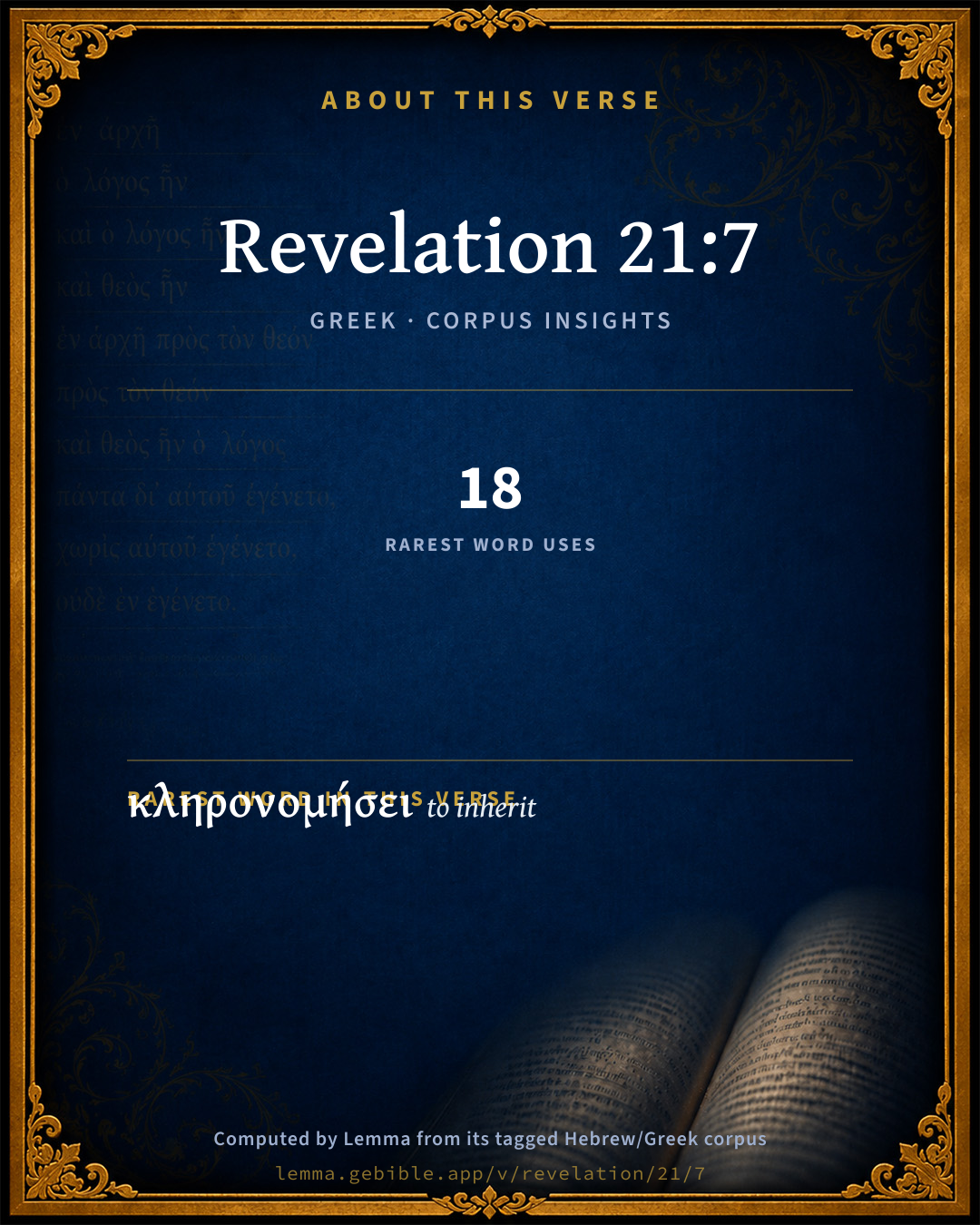
Revelation 21:7

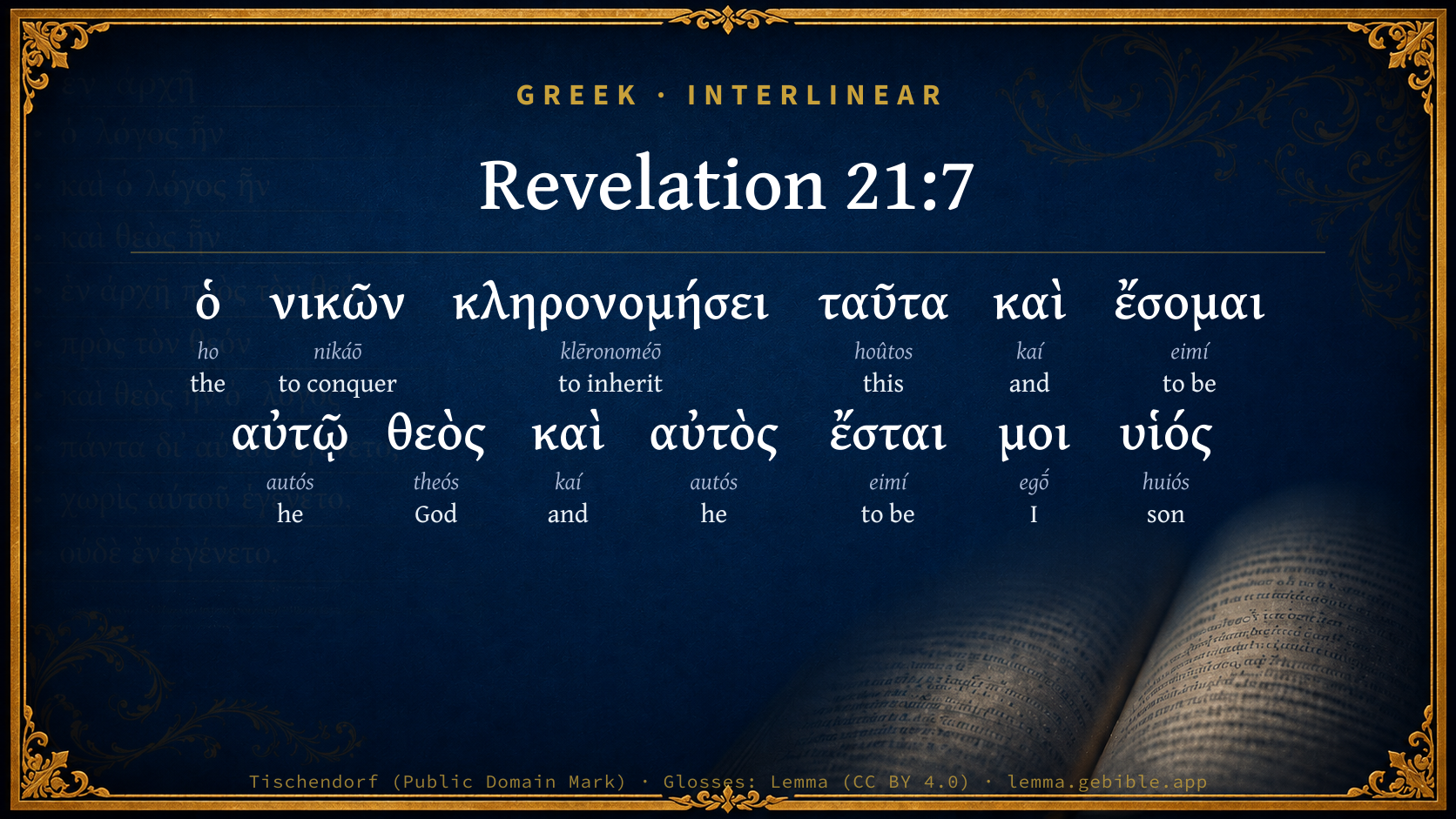
Greek (Tischendorf 8th ed.) Revelation 21:7 appears in the Greek New Testament. The text above is from the Tischendorf 8th edition. Each word links to its Strong’s number and a concise gloss. Click any word for its full Thayer’s Greek Lexicon entry.
Download image
Cite this verse

Revelation 21:7 (World English Bible). Public Domain. Lemma interlinear Bible study tool, https://lemma.gebible.app/v/revelation/21/7.

Show BibTeX & RIS
BibTeX
RIS
English Translation
He who overcomes, I will give him these things. I will be his God, and he will be my son.
World English Bible · Public Domain
Download a study sheet

One document with this verse’s original text, its word-by-word gloss line, the meaning frame, cross-references with their text, attributed commentary, and full source and license credits — printable, and it pastes into notes with its structure intact.

This verse Autodidact and up

Study sheet (.html) Plain text (.txt)

A passage Seminary Student

Up to 50 verses in one chapter. A passage sheet keeps up to 6 commentary sources and 12 cross-references per verse, in the order this page ranks them, and says so on the sheet whenever that leaves anything out. Ask for a single verse and you get the Autodidact verse sheet above.

Everything on this page stays free to read, with no account — the sheet is a download of what is already on screen, not access to it.

Want to remove ads? Support Godless Engineer
Compare translations 3

The same verse in 3 English versions, stacked beneath the original-language interlinear above. Click any original word for its lexicon entry.

Each is an independent rendering of the whole verse — the interlinear is not word-aligned to these translations.

Highlighted words mark where these versions differ — a whole-verse word diff, not a word-by-word alignment.

  • World English Bible Public Domain
    He who overcomes, I will give him these things. I will be his God, and he will be my son.
  • King James Version Public Domain
    He that overcometh shall inherit all things; and I will be his God, and he shall be my son.
  • unfoldingWord Literal Text CC BY-SA 4.0
    The one conquering will inherit these, and I will be his God, and he will be my son.

unfoldingWord Literal Text — © unfoldingWord, licensed CC BY-SA 4.0. Word-aligned USFM3 via Door43 (git.door43.org/unfoldingWord/en_ult).

Versions to compare (up to 4)

3 of 4 selected

Show all 19 translations

Every available English version of this verse, each an independent rendering of the whole verse.

  • World English Bible Public Domain
    He who overcomes, I will give him these things. I will be his God, and he will be my son.
  • Berean Standard Bible Public Domain
    The one who overcomes will inherit all things, and I will be his God, and he will be My son.
  • Majority Standard Bible Public Domain
    The one who overcomes will inherit all things, and I will be his God, and he will be My son.
  • King James Version Public Domain
    He that overcometh shall inherit all things; and I will be his God, and he shall be my son.
  • American Standard Version (1901) Public Domain
    He that overcometh shall inherit these things; and I will be his God, and he shall be my son.
  • Revised Version (1885) Public Domain
    He that overcometh shall inherit these things; and I will be his God, and he shall be my son.
  • Geneva Bible (1599) Public Domain
    He that ouercommeth, shall inherit all things, and I will be his God, and he shall be my sonne.
  • Douay-Rheims (1899) Public Domain
    He that shall overcome shall possess these things, and I will be his God; and he shall be my son.
  • Young's Literal Translation Public Domain
    he who is overcoming shall inherit all things, and I will be to him -- a God, and he shall be to me -- the son,
  • Literal Standard Version CC BY-SA 4.0
    The [one] who is overcoming will inherit all things, and I will be his God, and he will be My son.
  • Unlocked Literal Bible CC BY-SA 4.0
    The one who conquers will inherit these things, and I will be his God, and he will be my son.
  • unfoldingWord Literal Text CC BY-SA 4.0
    The one conquering will inherit these, and I will be his God, and he will be my son.
  • Darby Bible Public Domain
    He that overcomes shall inherit these things, and I will be to him God, and he shall be to me son.
  • World Messianic Bible Public Domain
    He who overcomes, I will give him these things. I will be his God, and he will be my son.
  • Webster's Bible Public Domain
    He that overcometh shall inherit all things; and I will be his God, and he shall be my son.
  • Free Bible Version CC BY-SA 4.0
    Those who are victorious will inherit all these things, and I will be their God and they shall be my children.
  • Bible in Basic English Public Domain
    He who overcomes will have these things for his heritage; and I will be his God, and he will be my son.
  • Text-Critical English NT CC BY 4.0
    I will give these things to him who overcomes; I will be his God, and he will be my son.
  • Tyndale New Testament (1534) Public Domain
    He that overcometh shall inheret all thynges and I will be his God and he shalbe my sonne.

Literal Standard Version (2020), Covenant Press — licensed CC BY-SA 4.0. Text via the HelloAO Bible API (eBible.org). Unlocked Literal Bible (unfoldingWord) — licensed CC BY-SA 4.0. Text via the HelloAO Bible API (eBible.org). unfoldingWord Literal Text — © unfoldingWord, licensed CC BY-SA 4.0. Word-aligned USFM3 via Door43 (git.door43.org/unfoldingWord/en_ult). Free Bible Version, Dr. Jonathan Gallagher — licensed CC BY-SA 4.0. Text via the HelloAO Bible API (eBible.org).

Word by word

More ways to search: Search by grammar → Find every occurrence → Compare this word →

Practice this passage: Drill this verse → Learn its vocabulary →

κληρονομήσει
klēronoméō
G2816
“to inherit”
Verb, Future, Active, Indicative, 3rd person, Singular
Part of Speech
Verb
Tense
Future
Voice
Active
Mood
Indicative
Person
3rd person
Number
Singular
Full Thayer's Definition

Origin: from G2818

TDNT: 15:47,4

1. to receive a lot, receive by lot a. esp. to receive a part of an inheritance, receive as an inheritance, obtain by right of inheritance b. to be an heir, to inherit 2. to receive the portion assigned to one, receive an allotted portion, receive as one's own or as a possession 3. to become partaker of, to obtain
  1. ὁ ho G3588 “the” Article, Nominative, Singular, Masculine
  2. νικῶν nikáō G3528 “to conquer” Verb, Present, Active, Participle, Nominative, Singular, Masculine
  3. ταῦτα hoûtos G3778 “this” Demonstrative pronoun, Accusative, Plural, Neuter
  4. καὶ kaí G2532 “and” Conjunction
  5. ἔσομαι eimí G1510 “to be” Verb, Future, Middle deponent, Indicative, 1st person, Singular
  6. αὐτῷ autós G846 “he” Personal pronoun, Dative, Singular, Masculine
  7. θεὸς theós G2316 “God” Noun, Nominative, Singular, Masculine
  8. καὶ kaí G2532 “and” Conjunction
  9. αὐτὸς autós G846 “he” Personal pronoun, Nominative, Singular, Masculine
  10. ἔσται eimí G1510 “to be” Verb, Future, Middle deponent, Indicative, 3rd person, Singular
  11. μοι egṓ G1473 “I” Personal pronoun, 1st person, Dative, Singular
  12. υἱός huiós G5207 “son” Noun, Nominative, Singular, Masculine

About this verse

These counts appear in no published source. They are computed here, from the morphology-tagged text and Lemma’s own curated glosses. What Lemma adds →

13
words
10
distinct lemmas
Revelation
section

Notable vocabulary

The rarest word here is κληρονομήσει to inherit G2816 — appearing just 18 times in the whole Greek New Testament.

Shared distinctive vocabulary

κληρονομήσει to inherit G2816 occurs in 17 verses of the Greek New Testament. Also found in:

Repetition

Words recur within this verse:

  • ἔσομαι to be G1510 ×2
  • καὶ and G2532 ×2
  • αὐτῷ he G846 ×2

Cross-references

19

Topical passages linked to Revelation 21:7 in the Treasury of Scripture Knowledge — connected by theme and wording, ordered by reader-vote popularity; previews shown in the World English Bible.

  • 2 Corinthians 6:18 I will be to you a Father. You will be to me sons and daughters,' says the Lord Almighty."
  • Hebrews 8:10 "For this is the covenant that I will make with the house of Israel. After those days," says the Lord; "I will put my laws into their mind, I will also write them on their heart. I will be to them a God, And they will be to me a people.
  • Revelation 2:11 He who has an ear, let him hear what the Spirit says to the assemblies. He who overcomes won't be harmed by the second death.
  • Revelation 21:3 I heard a loud voice out of heaven saying, "Behold, God's dwelling is with people, and he will dwell with them, and they will be his people, and God himself will be with them as their God.
  • 1 John 3:1–3 Behold, how great a love the Father has bestowed on us, that we should be called children of God! For this cause the world doesn't know us, because it didn't know him.
  • Matthew 25:34 Then the King will tell those on his right hand, 'Come, blessed of my Father, inherit the Kingdom prepared for you from the foundation of the world;
  • Romans 8:15–17 For you didn't receive the spirit of bondage again to fear, but you received the Spirit of adoption, by whom we cry, "Abba! Father!"
  • 1 Peter 1:3–4 Blessed be the God and Father of our Lord Jesus Christ, who according to his great mercy became our father again to a living hope through the resurrection of Jesus Christ from the dead,
  • Matthew 19:29 Everyone who has left houses, or brothers, or sisters, or father, or mother, or wife, or children, or lands, for my name's sake, will receive one hundred times, and will inherit eternal life.
  • Revelation 2:17 He who has an ear, let him hear what the Spirit says to the assemblies. To him who overcomes, to him I will give of the hidden manna, and I will give him a white stone, and on the stone a new name written, which no one knows but he who receives it.
  • Revelation 2:7 He who has an ear, let him hear what the Spirit says to the assemblies. To him who overcomes I will give to eat of the tree of life, which is in the Paradise of my God.
  • Zechariah 8:8 and I will bring them, and they will dwell in the midst of Jerusalem; and they will be my people, and I will be their God, in truth and in righteousness."
  • Proverbs 3:35 The wise will inherit glory, But shame will be the promotion of fools.
  • 1 Samuel 2:8 He raises up the poor out of the dust, He lifts up the needy from the dunghill, To make them sit with princes, Inherit the throne of glory: For the pillars of the earth are Yahweh's, He has set the world on them.
  • 1 Peter 3:9 not rendering evil for evil, or reviling for reviling; but instead blessing; knowing that to this were you called, that you may inherit a blessing.
  • Revelation 2:25 Nevertheless, hold firmly that which you have, until I come.
  • Isaiah 65:9 I will bring forth a seed out of Jacob, and out of Judah an inheritor of my mountains; and my chosen shall inherit it, and my servants shall dwell there.
  • Mark 10:17 As he was going out into the way, one ran to him, knelt before him, and asked him, "Good Teacher, what shall I do that I may inherit eternal life?"
  • 1 Corinthians 3:21–23 Therefore let no one boast in men. For all things are yours,

Cross-references courtesy of OpenBible.info (CC BY 4.0).

Commentary

Notes on Revelation 21:7 from classic Christian and Jewish commentators (each source and its license shown beneath its notes). The classic Christian expositions comment on the surrounding passage and are grouped to its opening verse, so a note may address several verses; the Jewish commentaries on the Tanakh (Rashi and others) are per-verse, so they appear only where the commentator wrote on this verse.

Lemma curates 59 commentaries, every one of them public domain or Creative Commons licensed, each selected and text-cleaned for this edition rather than reprinted as found. About our sources →

Tyndale Open Study Notes

Tyndale Open Resources

21:7 All who are victorious: God’s children who persevere in life will inherit his blessings. Adoption is a covenant relationship; the language of adoption certifies their privileges and responsibilities (cp. Gen 17:8; 2 Sam 7:14-16; Jer 31:33; Ezek 34:24).

Tyndale Open Study Notes — © Tyndale Open Resources, licensed CC BY-SA 4.0. Text via the HelloAO Bible API.

Jamieson, Fausset & Brown

Robert Jamieson, A. R. Fausset & David Brown

He that overcometh--another aspect of the believer's life: a conflict with sin, Satan, and the world is needed. Thirsting for salvation is the first beginning of, and continues for ever (in the sense of an appetite and relish for divine joys) a characteristic of the believer. In a different sense, the believer "shall never thirst."

inherit all things--A, B, Vulgate, and CYPRIAN read, "these things," namely, the blessings described in this whole passage. With "all things," compare Co1 3:21-23.

I will be his God--Greek, "I will be to him a God," that is, all that is implied of blessing in the name "God."

he shall be my son--"He" is emphatic: He in particular and in a peculiar sense, above others: Greek, "shall be to me a son," in fullest realization of the promise made in type to Solomon, son of David, and antitypically to the divine Son of David.

Jamieson, Fausset & Brown — Commentary Critical and Explanatory on the Whole Bible (1871) — public domain (CC PDM 1.0). Text via the HelloAO Bible API.

Adam Clarke's Commentary

Verse 7. Inherit all things] Here he had no inheritance; there he shall inherit the kingdom of heaven, and be with God and Christ, and have every possible degree of blessedness.

Adam Clarke's Commentary on the Bible (1810–1826) — public domain. Text from a community e-Sword/MySword module.

Ellicott's Commentary for English Readers

(7) He that overcometh shall inherit all things . . .—Rather, He that conquereth shall inherit these things; and I will be to him God, and he shall be to me a son. The general promise of Rev_21:3 is in part repeated, and this time more individually. Again we catch, as it were, the echo of the promises to the Seven Churches, the blessing is for him that conquereth. The idea of the war and the conquest is a favourite one with St. John. (Joh_16:33, and 1Jn_2:13-14; 1Jn_5:4-5; see also Note on Rev_2:7.) The source and weapon of victory have been before stated: the blood of the Lamb, the word of their testimony (Rev_12:11), and the victory of faith (1Jn_5:4).

A Bible Commentary for English Readers, edited by Charles John Ellicott (1878–1897) — public domain. Text from a community e-Sword module.

The Cambridge Bible for Schools and Colleges

gen. ed. J. J. S. Perowne

7. He that overcometh] Carries back our thoughts to the promises at the beginning of the book, Rev_2:7, &c. There is perhaps some significance in the Father thus taking up and repeating the language of the Son. all things] Read, these things; viz. the new heavens and earth, and the things in them which, like them, have just “come into being.”

I will be … my son] Lit. I will be to him a God, and he shall be to Me a son. The form of the promise therefore resembles 2Sa_7:14, at least as closely as Jer_24:7, &c.: and the sense combines that of both. The finally victorious share in the privileges, not only of God’s people, but of the Only-begotten: see Rev_3:21.

The Cambridge Bible for Schools and Colleges (gen. ed. J. J. S. Perowne; Cambridge University Press, 1878–1918) — public domain. Text from a community e-Sword module.

John Gill's Exposition

He that overcometh,.... All spiritual enemies, sin, Satan, and the world, the antichristian beast, his image, mark, and number of his name; who is more than a conqueror through Christ; one that perseveres to the end, notwithstanding all temptations, trials, and difficulties; See Gill on Rev 2:7,

shall inherit all things; the kingdom of Christ in the new Jerusalem state, and all things in it; heaven, eternal glory and happiness, and everlasting salvation; yea, God himself, who is the portion, and exceeding great reward of his people, and will be all in all. The Alexandrian copy, and the Vulgate Latin, Syriac, and Arabic versions, read, "these things": the new heaven, and new earth, the presence of God with men, freedom from all evils, and divine refreshments from the fountain of living water before mentioned:

and I will be his God, and he shall be my Son; Christ is not only concerned in predestination to the adoption of children, in making way by redemption for the enjoyment of this blessing, and in the actual donation of it; but he himself, who is the mighty God, is the everlasting Father, and his people are his spiritual seed and offspring, and in his kingdom he will see his seed, and prolong his days; he will long enjoy them, and present them to himself, and afterwards to his Father, saying as in Heb 2:13 and though they are now, in the present state of things, the sons of God, yet it does not appear so manifest that they are, or at least what they shall be; but in this new and glorious state of things, it will be abundantly manifest that they are the sons of God and seed of Christ; and it will be known how glorious they are, and shall be, when they shall see Christ in his glory, and be like him; who will now be , "the Father of the world to come", as the Septuagint render the phrase in Isa 9:6.

John Gill's Exposition of the Whole Bible (1746–1763) — public domain (CC PDM 1.0). Text via the HelloAO Bible API.

Trapp's Complete Commentary

John Trapp

7 He that overcometh shall inherit all things; and I will be his God, and he shall be my son.

Ver. 7. He that overcometh] Gr. "He that is overcoming," or not yielding, though he hath not yet overcome; if he be but doing at it, and do not yield up the bucklers, ο νικων, quasi μη εικων.

Shall inherit all things] Tanquam haeres ex asse. All God’s servants are sons, and every son an heir.

John Trapp, A Commentary or Exposition upon All the Books of the Old and New Testament (1647–1656) — public domain. Text from a community e-Sword module.

Albert Barnes' Notes on the Bible

He that overcometh - See the notes on Rev 2:7.

Shall inherit all things - Be an heir of God in all things. See the notes on Rom 8:17. Compare Rev 2:7, Rev 2:11, Rev 2:17, Rev 2:26; Rev 3:5, Rev 3:12, Rev 3:21.

And I will be his God - That is, forever. He would be to them all that is properly implied in the name of God; he would bestow upon them all the blessings which it was appropriate for God to bestow. See the 2Co 6:18 note; Heb 8:10 note.

And he shall be my son - He shall sustain to me the relation of a son, and shall be treated as such. He would ever onward sustain this relation, and be honored as a child of God.

Albert Barnes' Notes on the Bible (1834–1885) — public domain. Text from a community e-Sword/MySword module.

Matthew Poole's English Annotations

He that overcometh, shall inherit all things: God revealed this to John almost sixteen hundred years since; and how long it shall be before this glorious time shall come, God alone knows: the most of this time hath been, and will be, a time of fighting with the world, the flesh, and the devil; but whoever he be that shall fight this good fight, and come out of it a conqueror, shall inherit all the joys and happiness of heaven.

I will be his God, and he shall be my son: I will be to him all in all; I will be his God to love and glorify him, and he shall be with me as my son, to live with me for ever and ever.

Matthew Poole's English Annotations on the Holy Bible (1683–1685) — public domain. Text from a community e-Sword/MySword module.

Whedon's Commentary on the Bible

Daniel D. Whedon

7. Overcometh—Against antichrist and the world.

All things—Better reading, these things.

Daniel D. Whedon (gen. ed.), Commentary on the Old and New Testaments (1874–1909) — public domain. Text from a community e-Sword module.

The Pulpit Commentary

He that overcometh shall inherit all things. The correct reading makes the sense plain: He that overcometh shall inherit these things, i.e. the promises just enumerated. These words show the reason for the words of ver. 6; and may be called the text on which the Apocalypse is based; (cf. Re 2) for, though the words themselves do not often recur, yet the spirit of them is constantly appearing. (cf. Rev_12:11; see also Joh_16:33) And I will be his God, and he shall be my son. (cf. Lev_26:12, "And I will walk among you, and will be your God, and ye shall be my people Some have thought that these words prove the Speaker to be God the Father; but it is impossible to separate the Persons of the Blessed Trinity in these chapters. This promise, first made to David concerning Solomon, (2Sa_7:14) received its mystical fulfilment in Christ, (Heb_1:5) and is now fulfilled in the members of Christ (Alford).

The predominant practical purpose of the Apocalypse.

"He that over-cometh," etc. At the beginning of this book in the epistles to the seven Churches we had this repeated promise, "to him that overcometh." And its reiteration there as well as here alike proves that the purpose of this book was an intently practical one. It was not given to furnish food for mere mental or sentimental musings, or to be only a treasure house of poetical imagery. Far other and higher than these were the ends contemplated. Think of some of them.

I THAT ONE HERE NAMED to encourage the persecuted, much tried Church, into whose hands the book first came, to continue patient, to increase courage, to endure still the trials of their lot. For this were all its awful warnings, its vivid pictures of judgment, its entrancingly beautiful promises so exceedingly great and precious. They all aimed to deepen in the mind of each member of the Church the conviction of Rom_8:18, "I reckon that the sufferings of this present time are not worthy," etc.; and to convince of the truth of the Lord"s words, (Mat_19:29) "Every one that hath forsaken," etc. Such was the primary purpose of the book. But there are others.

II TO VINDICATE THE CHARACTER OF GOD. It has ever been the trial of the thoughtful in all ages how the present condition of the world could be consistent with the conviction of the character of God as holy, just, and good. This Apocalypse of the end and issue of all things does not a little to reassure and re-establish the tottering faith. When we know we are being conducted to a glorious and beautiful city where we would fain be, we do not heed overmuch the discomforts of the way.

III TO ENNOBLE LIFE. It does this:

1. By revealing a noble destiny. The elevating power of such a revelation cannot but be, for it always is, great.

2. By inspiring scorn for what is inconsistent therewith.

3. By uplifting our desires and aims.

IV TO IMPART PATIENCE IN SUFFERING. If I believe in the issue of suffering, and know the good it is to "work out," must not this minister patience?

V TO MAKE US "ALWAYS ABOUNDING IN THE WORK OF THE LORD," because here we have shown to us "that our labour is not in vain in the Lord." No faithful effort is thrown away, or can be.

VI TO FURNISH US WITH A GOSPEL FOR THE POOR. Because, when here we have done what we can for those who need our help, ministering to them to the best of our power, if we have nothing else to say to them, our all is but little. But this Apocalypse gives us much else much indeed.

VII TO MEET AND MINISTER TO THE NATURAL DESIRE FOR BLESSEDNESS. Man is made to be blessed. His constitution demonstrates that, and his incessant desire for happiness is that which lends greatest force to the lies of the world, the flesh, and the devil. Now, in such revelation of the future of God"s redeemed as these chapters give, there is the response to that hunger of the soul which others falsely promise, but which this alone can give.

VIII TO MAKE THE LORD JESUS CHRIST PRECIOUS TO US. For he it is who, having "overcome the sharpness of death," has opened "the kingdom of heaven to all believers." We owe it all to him, and by him alone can we keep in that "patient continuance in well doing," which by his grace lands us at last on that blessed shore. Such are some of the ends contemplated by this book. Are they being fulfilled in us? S.C.

The Pulpit Commentary (1880–1919), ed. H.D.M. Spence-Jones & Joseph S. Exell — public domain. Text from a community e-Sword module.

John Wesley's Explanatory Notes

He that overcometh - Which is more than, "he that thirsteth." Shall inherit these things - Which I have made new. I will be his God, and he shall be my son - Both in the Hebrew and Greek language, in which the scriptures were written, what we translate shall and will are one and the same word. The only difference consists in an English translation, or in the want of knowledge in him that interprets what he does not understand.

John Wesley, Explanatory Notes Upon the Whole Bible (1754–1765) — public domain. Text via the GEBible commentary corpus.

Burkitt's Expository Notes on the New Testament

William Burkitt

Observe here, 1. That our design of happiness must be accompanied with endeavours after it, or they will be ineffectual; to thirsting in the former verse, he joins overcoming in this verse: we must not barely wish, but work; not only talk, but fight; and not only fight but overcome our spiritual enemies in fighting, or we are miserable; how strong soever our desires after happiness may be supposed to be, without proportionable endeavours we can have no good ground of hope.

Observe, 2. He that overcometh, that is, he that is overcoming, he that daily maintains the combat, though he has not yet obtained a perfect conquest over his spiritual enemies, yet he keeps the field with sword in hand, resolving never to throw down his weapon, but to die as a conqueror, rather than be taken a prisoner.

Observe, 3. The encouraging promise given to the conqueror, He shall inherit all things.

Where note, The extent and latitude of the promise, the enjoying all things, that is, all blessings and benefits, all joys and comforts, that are requisite to make him perfectly and perpetually happy.

Note also, God’s way and manner of dispensing the mercy promised, and that is, by free gift, he shall inherit all things, not merit any thing; an inheritance is gratuitum paterni amoris pignus, an estate freely given by the father to his children.

Observe, 4. A superadded promise, I will be his God, and he shall be my son; that is, I will give him the manifestation of his adoption before angels and men: I am now his God, and he is now my son, but the world knoweth it not; they brand my people for a generation of hypocrites, and sometimes they call in question their own sincerity, and their title to the privilege of adoption; but at the great day I will publicly own them before angels and men, and make it appear that I love them as a father, and they shall live with me as sons for ever and ever: He that overcometh, &c.

William Burkitt's Expository Notes on the New Testament (1700–1703) — public domain. Text from a community e-Sword module.

The People's New Testament

B. W. Johnson

7. He that overcometh. Here for the first time, after the close of the seven epistles of chapters 2 and 3, do we have the promise to him who overcomes.

B. W. Johnson's The People's New Testament with Notes (1889–1891) — public domain. Electronic text from the Christian Classics Ethereal Library (CCEL) ThML edition.

unfoldingWord translationNotes

Door43 World Missions Community

Connecting Statement:

The one seated on the throne continues to speak to John.

the cowards

"those who are too afraid to do what is right"

the detestable

"those who do terrible things"

the fiery lake of burning sulfur

"the lake of fire that burns with sulfur" or "place full of fire that burns with sulfur." See how you translated this in Revelation 19:20.

the second death

"dying a second time." This is described as eternal punishment in the lake of fire in Revelation 20:14 and Revelation 21:08. See how you translated this in Revelation 2:11. AT: "the final death in the lake of fire" (See: Symbolic Language)

translationWords

inherit

son

faithless

sexual immorality

sorcerer

false god

hell

sulfur

die

unfoldingWord translationNotes — © Distant Shores Media and the Door43 World Missions Community, licensed CC BY-SA 4.0. Source: git.door43.org/Door43/en_tn.

Expositor's Greek Testament

ed. W. Robertson Nicoll

These boons (Rev 21:3-7 ), however, are reserved for the loyal; the third (son of God) was a title applied to Augustus and the emperors generally throughout the Greek and Roman world. κληρονομήσει (here only in Apoc.) in general sense = “enter into possession of,” “partake of”. (“This place” of bliss “is prepared for the righteous who endure every kind of attack in their lives from those who afflict their souls … for them this place is prepared as an eternal inheritance,” Slav. En. ix.). This is the sole allusion, and a purely incidental one, to that central conception of the messianic bliss as a κληρονομία , which bulks so prominently in apocalypses like Fourth Esdras and is employed in a cosmic sense by Paul as lordship over the whole creation (see Bacon, Biblical and Semitic Studies , Yale Univ. 1902, pp. 240 f.). The solitary allusion to sonship expresses the close relation to God for which this writer elsewhere prefers to use the metaphor of priesthood. Partly owing to the bent of his mind, partly owing to the stern circumstances of his age, he (like Clem. Rom.) allows the majesty and mystery of God to overshadow that simple and close confidence which Jesus inculcated towards the Father (Titius, 13, 14), as also the direct love of God for his people (only in Rev 3:9 ; Rev 3:19 , Rev 20:9 ).

The Expositor's Greek Testament, edited by W. Robertson Nicoll (1897–1910) — public domain. Text from a community e-Sword module.

Cambridge Greek Testament for Schools and Colleges

7. ὁ νικῶν. Tert[815] has qui vicerint.

[815] Tertullian as quoted by Haussleiter.

κληρονομήσει. B2 has δώσω αὐτῷ.

ταῦτα. Primas[816] has ea. Cyp[817] has ea hereditate, or eorum hereditatem, i.q. αὐτά.

[816] Primasius, edited by Haussleiter.

[817] St Cyprian as quoted by Haussleiter.

αὐτῷ. A 1 have αὐτῶν. Tert[818] illis.

[818] Tertullian as quoted by Haussleiter.

7. ὁ νικῶν. Carries back our thoughts to the promises at the beginning of the book, Rev 2:7, &c. There is perhaps some significance in the Father thus taking up and repeating the language of the Son.

ταῦτα. The new heavens and earth and the things in them, which, like them, have just “come into being.”

καὶ ἔσομαι … υἱός The form of the promise resembles 2Sa 7:14, at least as closely as Jer 24:7, &c.: and the sense combines that of both. The finally victorious share in the privileges, not only of God’s people, but of the Only-begotten: see Rev 3:21.

Cambridge Greek Testament for Schools and Colleges (Cambridge University Press, 1896; 21 vols, various authors incl. Carr, Maclear, Plummer, Farrar, Lumby, Moule, M. R. James, Simcox) — public domain. Text from a community e-Sword module.

Vincent's Word Studies in the New Testament

Marvin R. Vincent

All things [παντα] . The correct reading is tauta these things. So Rev. His God [αυτω θεος] . Lit., God unto him.

My Son [μοι ο υιος] . Lit., the Son to me. See on Joh 1:12. This is the only place in John's writings where uiJov son is used of the relation of man to God.

Marvin R. Vincent, Word Studies in the New Testament (1887–1900) — public domain. Text from a community e-Sword/MySword module.

Lesson kit

Teaching starters — assembled from the data on this page, not authored interpretation. Every prompt links to the verse data it draws on. Edit before teaching.

Revelation, in the Revelation, opens this verse with 13 words (10 distinct Greek lemmas). Its most distinctive word is klēronoméō (“to inherit”). A historical commentator’s framing appears above. Read the whole chapter for the surrounding context.

Discussion questions

  1. How does “to inherit” (klēronoméō) shape what this verse is saying?
  2. How does Matthew 5:4, which shares the word «to inherit», read alongside this verse?
  3. What does the repetition of “to be” (2× in this one verse) do in this verse?
  4. The translations on this page render this verse differently — a whole-verse word diff, not a word-by-word alignment. What might account for the different wordings?
  5. Compare how Tyndale Open Study Notes and Jamieson, Fausset & Brown read this verse. Where do they agree or differ?

Things to notice

Reading settings

Reading text

Shown beneath each verse's original-language words.

Old Testament
Old Testament edition

Read the OT as the Masoretic Hebrew (MT) or the Greek Septuagint (LXX).

English shown for the Greek Septuagint (in the Hebrew ↔ Greek comparison).

Comparing translations? Open the Compare panel on any verse page to stack up to four side by side.