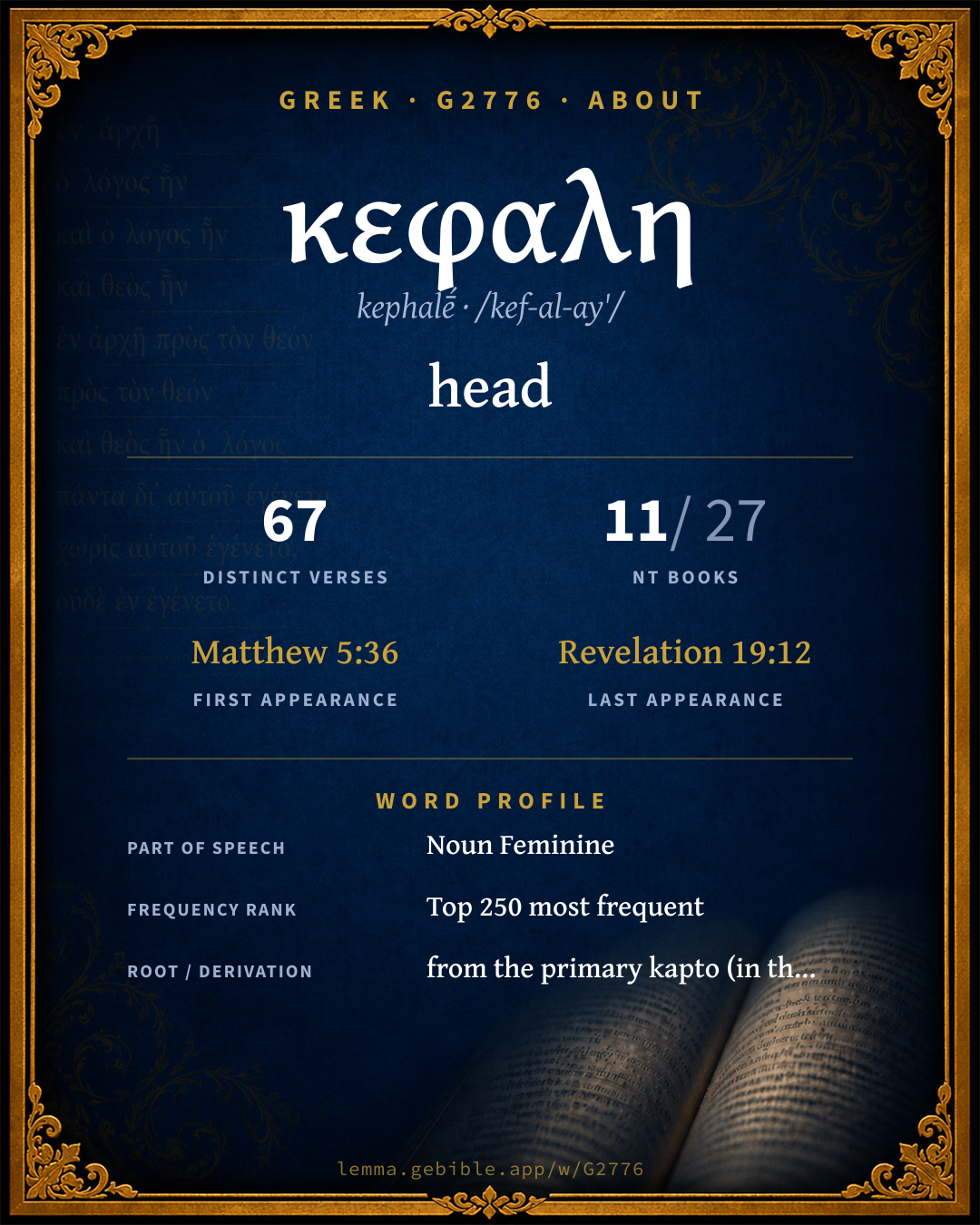
κεφαλή
head
‘head’ is one of 2 main senses fuller range ↓
Full lexicon entry — Thayer's Greek Lexicon
From Thayer's Greek Lexicon
Where this word appears
See every Accusative-case word in the Greek New Testament →
Grammar key — what these labels mean
Part of speech
- Noun
- A naming word — a person, place, thing, or idea.
Case
- Accusative
- The case of the direct object and of extent.
- Genitive
- The case of source, possession, or “of” — answers “whose / from what.”
- Nominative
- The case of the subject (and the predicate nominative).
- Dative
- The case of the indirect object, means, or location — “to / for / with / in.”
Gender
- Feminine
- Grammatically feminine.
Number
- Singular
- One.
- Plural
- More than one.
2 verses where G2776 appears in the Nominative case in the Book of 1 Corinthians. Filtered view — show all forms. Click any verse to open its interlinear word-by-word view. Verse text shown in the World English Bible for context — . Each verse’s Greek form is shown with its reference; the English is not keyword-highlighted, since the data carries no word-level English alignment. Use “Compare translations” on any verse to read it across multiple English versions. This concordance covers the Greek New Testament; Septuagint (Greek Old Testament) occurrences of this word are not indexed here.
1 Corinthians
- 1 Corinthians 11:3 κεφαλὴ κεφαλὴ κεφαλὴ n nom sg fem n nom sg fem n nom sg fem But I would have you know that the head of every man is Christ, and the head of the woman is the man, and the head of Christ is God.
- 1 Corinthians 12:21 κεφαλὴ n nom sg fem The eye can't tell the hand, "I have no need for you," or again the head to the feet, "I have no need for you."
About this entry
At a glance — auto-summarized from this page’s data, not written by a person. Every figure links to its source below. This summary describes the numbers; it doesn’t interpret them.
κεφαλη — transliterated kephalḗ — is a Greek noun carrying the sense “head.” It first appears in Matthew 5:36. With 67 verses in 11 books, it is a moderately common word in the Greek New Testament. Its lexical range runs to 2 senses. From the same root come κεφαλαιον and κεφαλις. Each statement above links to its evidence; the full detail follows below.
Gloss history
Strong's 1890 vs modern scholarship
About this word
Strong's G2776 catalogs a Greek word from the Greek New Testament.
These counts are not copied from any lexicon or concordance. They are computed here, from the morphology-tagged Greek New Testament. What Lemma adds →
- 67
- distinct verses
- The word appears in 67 distinct verses.
- 11 / 27
- NT books
- The word appears in 11 of 27 New Testament books.
- #228
- by frequency
- Top 250 most frequent Greek words (rank 228 of 5,347 Greek words by occurrence).
View all 67 occurrences in the concordance →
Most concentrated in
- Revelation 16 verses 24%
- Matthew 12 verses 18%
- Mark 8 verses 12%
By section of the New Testament
By traditional corpus
Conventional, traditional groupings — biblical authorship is debated, so this is a traditional corpus grouping, not an authorship claim. Some books belong to more than one corpus (Luke is in both the Gospels and the Lukan corpus, and so on), so these shares overlap and need not total 100%. Each figure is a share of the word’s 67 distinct verses.
- Gospels 32 verses · 48%
- Johannine 21 verses · 31%
- Revelation 16 verses · 24%
- Pauline corpus 13 verses · 19%
- Lukan (Luke–Acts) 12 verses · 18%
- General (Catholic) Epistles 1 verse · 1%
How translations render this word
Counts come from each version’s own published word-to-Strong’s tagging or interlinear alignment — an approximate guide to how each version renders this word, not a word-level alignment the data otherwise carries. Because each total is that version’s own tagged count, the per-version totals vary from one another and need not match the appearance or distinct-verse counts above. These counts may also differ from a printed concordance because Lemma counts each distinctly tagged rendering and does not collapse phrase taggings into a single head-word total. This is a fixed set of word-tagged versions (KJV, ASV, BSB, ULT) and does not change with the reading translation you choose elsewhere. Each version’s license is shown beside its name below (and on Sources).
- King James Version: Head 55×, Heads 18×
- American Standard Version: Head 52×, Heads 18×, Of 2×
- Berean Standard Bible: Head 49×, Heads 19×, Cornerstone 2×
- unfoldingWord Literal Text: Head 56×, Heads 18×, Of 3×
King James Version Public Domain
Renders G2776 across 76 tagged occurrences — most commonly:
Plus 3 renderings that appear only once — usually multi-word phrases or single function words the recovered tagging swept in, not distinct renderings.
American Standard Version Public Domain
Renders G2776 across 76 tagged occurrences — most commonly:
Plus 4 renderings that appear only once — usually multi-word phrases or single function words the recovered tagging swept in, not distinct renderings.
Berean Standard Bible Public Domain
Renders G2776 across 71 tagged occurrences — most commonly:
Plus 1 rendering that appears only once — usually multi-word phrases or single function words the recovered tagging swept in, not distinct renderings. Not rendered by a distinct English word in 1 further occurrence.
unfoldingWord Literal Text CC BY-SA 4.0
Renders G2776 across 80 tagged occurrences — most commonly:
Plus 3 renderings that appear only once — usually multi-word phrases or single function words the recovered tagging swept in, not distinct renderings.
Senses in Thayer's
The 2 senses Thayer's distinguishes for this word, in lexicon order (not ranked by frequency or importance). The full entry — with sub-senses — is in the Lexicon Entry tab.
- the head, both of men and often of animals. Since the loss of the head destroys life, this word is used in the phrases…
- metaph. anything supreme, chief, prominent
Word origin
Origin: from the primary kapto (in the sense of seizing)
Probably from the primary word κάπτω kaptō (in the sense of seizing ); the head (as the part most readily taken hold of) literally or figuratively : - head.
— Strong’s Exhaustive Concordance (1890), public domain.
Forms in the corpus
The 10 distinct written forms G2776 takes in the Greek New Testament, most frequent first — each parse links to that case’s occurrences in the concordance.
| Form | Parsing | Example | Uses |
|---|---|---|---|
| κεφαλὴν kephalḕn | Noun, Accusative, Singular, Feminine | Matthew 6:17 | 24 |
| κεφαλῆς kephalē̂s | Noun, Genitive, Singular, Feminine | Matthew 10:30 | 13 |
| κεφαλὰς kephalàs | Noun, Accusative, Plural, Feminine | Matthew 27:39 | 12 |
| κεφαλὴ kephalḕ | Noun, Nominative, Singular, Feminine | Matthew 14:11 | 10 |
| κεφαλήν kephalḗn | Noun, Accusative, Singular, Feminine | Luke 7:46 | 6 |
| κεφαλῇ kephalē̂ | Noun, Dative, Singular, Feminine | Matthew 5:36 | 4 |
| κεφαλαὶ kephalaì | Noun, Nominative, Plural, Feminine | Revelation 9:17 | 3 |
| κεφαλάς kephalás | Noun, Accusative, Plural, Feminine | Revelation 9:19 | 1 |
| κεφαλή kephalḗ | Noun, Nominative, Singular, Feminine | Ephesians 4:15 | 1 |
| κεφαλῶν kephalō̂n | Noun, Genitive, Plural, Feminine | Revelation 13:3 | 1 |
Same root — word family
Other Thayer's entries built from the same root as G2776, grouped by Strong’s listed origin. These share a root / origin per the lexicon — not necessarily a shared meaning. Each links to that word’s own entry.
Derived from this word
Compare all same-root words → They share a root, not necessarily a meaning.
Septuagint usage
The same Greek word κεφαλη appears 334 times in the Greek Old Testament (Septuagint), across 309 verses in 31 books.
- 334
- LXX occurrences
- Tagged occurrences of this Greek word in the Septuagint.
- 309
- verses
- Distinct Septuagint verses containing this word.
- 31 / 39
- OT books
- The word appears in 31 of the 39 Old Testament books.
Sample Septuagint occurrences
- Genesis 3:15 κεφαλή
- Exodus 12:9 κεφαλή
- Leviticus 1:4 κεφαλή
- Numbers 1:2 κεφαλή
- Deuteronomy 21:6 κεφαλή
- Joshua 7:6 κεφαλή
- Judges 5:26 κεφαλή
- 1 Samuel 1:11 κεφαλή
- 2 Samuel 1:2 κεφαλή
- 1 Kings 2:32 κεφαλή
- 2 Kings 2:3 κεφαλή
- 1 Chronicles 10:9 κεφαλή
Septuagint occurrences (same lexeme)
Every verse where the same Strong’s number (G2776) appears in the Greek Septuagint — showing the first 50 of 309. Verse text shown in the World English Bible for context; the Greek form is the matched word — the English is not keyword-highlighted.
- Genesis 3:15 κεφαλή I will put enmity between you and the woman, and between your offspring and her offspring. He will bruise your head, and you will bruise his heel."
- Genesis 8:5 κεφαλή The waters receded continually until the tenth month. In the tenth month, on the first day of the month, the tops of the mountains were seen.
- Genesis 11:4 κεφαλή They said, "Come, let's build us a city, and a tower, whose top reaches to the sky, and let's make us a name; lest we be scattered abroad on the surface of the whole earth."
- Genesis 28:11 κεφαλή He came to a certain place, and stayed there all night, because the sun had set. He took one of the stones of the place, and put it under his head, and lay down in that place to sleep.
- Genesis 28:12 κεφαλή He dreamed. Behold, a stairway set up on the earth, and the top of it reached to heaven. Behold, the angels of God ascending and descending on it.
- Genesis 28:18 κεφαλή Jacob rose up early in the morning, and took the stone that he had put under his head, and set it up for a pillar, and poured oil on the top of it.
- Genesis 40:16 κεφαλή When the chief baker saw that the interpretation was good, he said to Joseph, "I also was in my dream, and, behold, three baskets of white bread were on my head.
- Genesis 40:17 κεφαλή In the uppermost basket there was all kinds of baked food for Pharaoh, and the birds ate them out of the basket on my head."
- Genesis 40:19 κεφαλή Within three more days, Pharaoh will lift up your head from off you, and will hang you on a tree; and the birds will eat your flesh from off you."
- Genesis 48:14 κεφαλή Israel stretched out his right hand, and laid it on Ephraim's head, who was the younger, and his left hand on Manasseh's head, guiding his hands knowingly, for Manasseh was the firstborn.
- Genesis 48:17 κεφαλή When Joseph saw that his father laid his right hand on the head of Ephraim, it displeased him. He held up his father's hand, to remove it from Ephraim's head to Manasseh's head.
- Genesis 48:18 κεφαλή Joseph said to his father, "Not so, my father; for this is the firstborn; put your right hand on his head."
- Genesis 49:26 κεφαλή The blessings of your father Have prevailed above the blessings of the ancient mountains, Above the bounty of the age-old hills. They will be on the head of Joseph, On the crown of the head of him who is separated from his brothers.
- Exodus 12:9 κεφαλή Don't eat it raw, nor boiled at all with water, but roasted with fire; with its head, its legs and its inner parts.
- Exodus 16:16 κεφαλή This is the thing which Yahweh has commanded: "Gather of it everyone according to his eating; an omer a head, according to the number of your persons, shall you take it, every man for those who are in his tent."
- Exodus 29:6 κεφαλή and you shall set the turban on his head, and put the holy crown on the turban.
- Exodus 29:7 κεφαλή Then you shall take the anointing oil, and pour it on his head, and anoint him.
- Exodus 29:10 κεφαλή "You shall bring the bull before the tent of meeting: and Aaron and his sons shall lay their hands on the head of the bull.
- Exodus 29:15 κεφαλή "You shall also take the one ram; and Aaron and his sons shall lay their hands on the head of the ram.
- Exodus 29:17 κεφαλή You shall cut the ram into its pieces, and wash its innards, and its legs, and put them with its pieces, and with its head.
- Exodus 29:19 κεφαλή "You shall take the other ram; and Aaron and his sons shall lay their hands on the head of the ram.
- Exodus 39:3 κεφαλή They beat the gold into thin plates, and cut it into wires, to work it in the blue, in the purple, in the scarlet, and in the fine linen, the work of the skillful workman.
- Leviticus 1:4 κεφαλή He shall lay his hand on the head of the burnt offering, and it shall be accepted for him to make atonement for him.
- Leviticus 1:8 κεφαλή and Aaron's sons, the priests, shall lay the pieces, the head, and the fat in order on the wood that is on the fire which is on the altar;
- Leviticus 1:10 κεφαλή "'If his offering is from the flock, from the sheep, or from the goats, for a burnt offering, he shall offer a male without blemish.
- Leviticus 1:12 κεφαλή He shall cut it into its pieces, with its head and its fat. The priest shall lay them in order on the wood that is on the fire which is on the altar,
- Leviticus 1:15 κεφαλή The priest shall bring it to the altar, and wring off its head, and burn it on the altar; and its blood shall be drained out on the side of the altar;
- Leviticus 3:2 κεφαλή He shall lay his hand on the head of his offering, and kill it at the door of the tent of meeting: and Aaron's sons the priests shall sprinkle the blood on the altar round about.
- Leviticus 3:8 κεφαλή and he shall lay his hand on the head of his offering, and kill it before the tent of meeting: and Aaron's sons shall sprinkle its blood on the altar round about.
- Leviticus 3:13 κεφαλή and he shall lay his hand on its head, and kill it before the tent of meeting; and the sons of Aaron shall sprinkle its blood on the altar round about.
- Leviticus 4:4 κεφαλή He shall bring the bull to the door of the Tent of Meeting before Yahweh; and he shall lay his hand on the head of the bull, and kill the bull before Yahweh.
- Leviticus 4:11 κεφαλή The bull's skin, all its flesh, with its head, and with its legs, its innards, and its dung,
- Leviticus 4:15 κεφαλή The elders of the congregation shall lay their hands on the head of the bull before Yahweh; and the bull shall be killed before Yahweh.
- Leviticus 4:24 κεφαλή He shall lay his hand on the head of the goat, and kill it in the place where they kill the burnt offering before Yahweh. It is a sin offering.
- Leviticus 4:29 κεφαλή He shall lay his hand on the head of the sin offering, and kill the sin offering in the place of burnt offering.
- Leviticus 4:33 κεφαλή He shall lay his hand on the head of the sin offering, and kill it for a sin offering in the place where they kill the burnt offering.
- Leviticus 5:8 κεφαλή He shall bring them to the priest, who shall first offer the one which is for the sin offering, and wring off its head from its neck, but shall not sever it completely.
- Leviticus 8:9 κεφαλή He set the turban on his head; and on the turban, in front, he set the golden plate, the holy crown; as Yahweh commanded Moses.
- Leviticus 8:12 κεφαλή He poured some of the anointing oil on Aaron's head, and anointed him, to sanctify him.
- Leviticus 8:14 κεφαλή He brought the bull of the sin offering, and Aaron and his sons laid their hands on the head of the bull of the sin offering.
- Leviticus 8:18 κεφαλή He presented the ram of the burnt offering: and Aaron and his sons laid their hands on the head of the ram.
- Leviticus 8:20 κεφαλή He cut the ram into its pieces; and Moses burned the head, and the pieces, and the fat.
- Leviticus 8:22 κεφαλή He presented the other ram, the ram of consecration: and Aaron and his sons laid their hands on the head of the ram.
- Leviticus 9:13 κεφαλή They delivered the burnt offering to him, piece by piece, and the head: and he burned them upon the altar.
- Leviticus 10:6 κεφαλή Moses said to Aaron, and to Eleazar and to Ithamar, his sons, "Don't let the hair of your heads go loose, neither tear your clothes; that you don't die, and that he not be angry with all the congregation: but let your brothers, the whole house of Israel, bewail the burning which Yahweh has kindled.
- Leviticus 13:12 κεφαλή "If the leprosy breaks out all over the skin, and the leprosy covers all the skin of the infected person from his head even to his feet, as far as it appears to the priest;
- Leviticus 13:29 κεφαλή "When a man or woman has a plague on the head or on the beard,
- Leviticus 13:30 κεφαλή then the priest shall examine the plague; and, behold, if the appearance of it is deeper than the skin, and the hair in it is yellow and thin, then the priest shall pronounce him unclean: it is an itch, it is leprosy of the head or of the beard.
- Leviticus 13:40 κεφαλή "If a man's hair has fallen from his head, he is bald. He is clean.
- Leviticus 13:41 κεφαλή If his hair has fallen off from the front part of his head, he is forehead bald. He is clean.
These are occurrences of the same Greek lexeme (G2776) in the Septuagint — not a translation of any one Hebrew word. The store carries no word-level Hebrew↔Greek alignment, so no Hebrew original is asserted here. Counts come from the recovered LXX Strong's tagging — high-frequency vocabulary is well covered, while rare or late forms may be untagged — so they reflect tagged occurrences and may slightly undercount.