
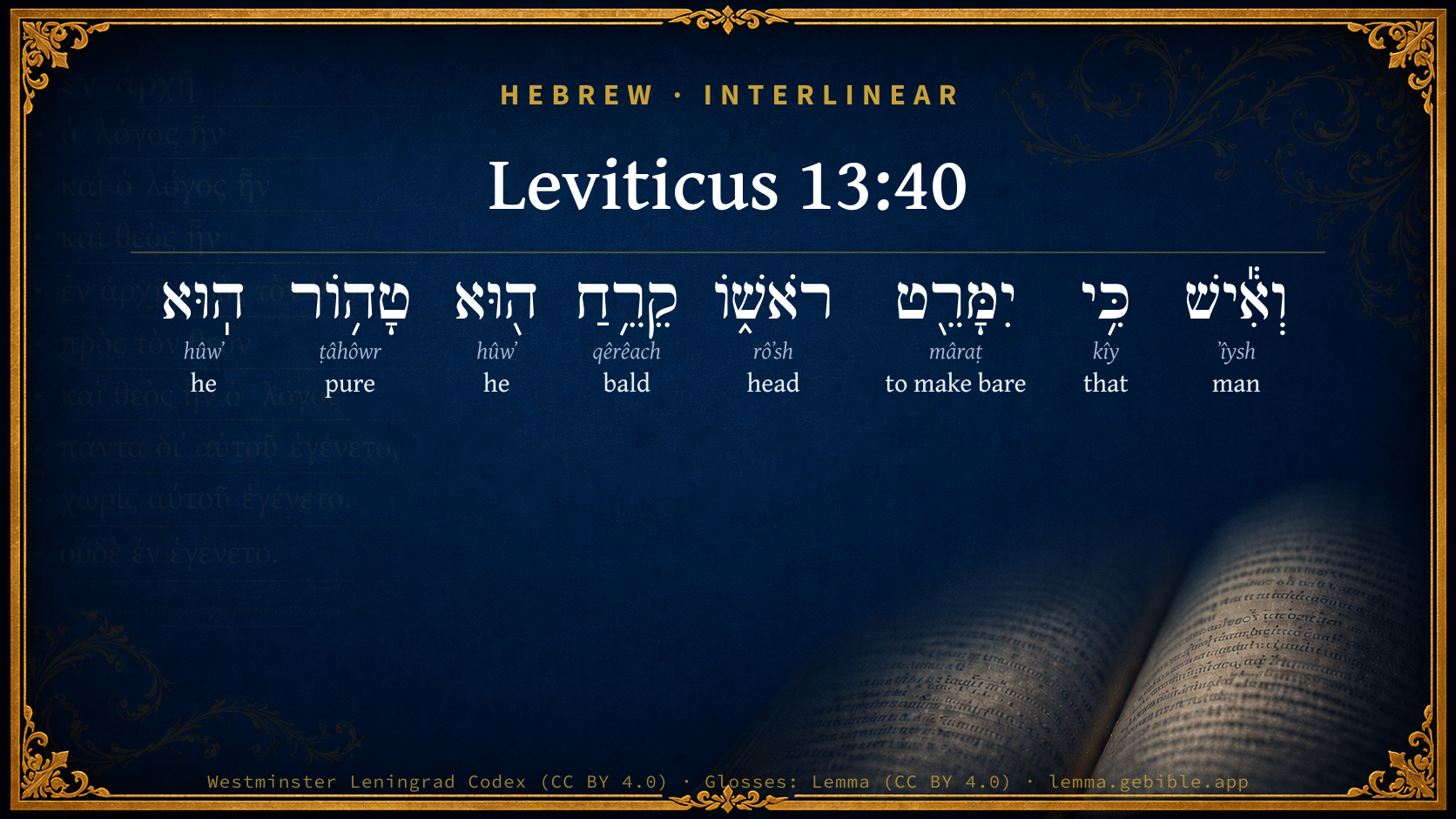
Leviticus 13:40

Hebrew (Westminster Leningrad Codex) Leviticus 13:40 appears in the Hebrew Old Testament. The text above is from the Westminster Leningrad Codex. Each word links to its Strong’s number, a concise gloss, and parsing drawn from the Open Scriptures Hebrew Bible morphology. Click any word for its full Brown-Driver-Briggs (BDB) entry.
Download image
Cite this verse

Leviticus 13:40 (World English Bible). Public Domain. Lemma interlinear Bible study tool, https://lemma.gebible.app/v/leviticus/13/40.

Show BibTeX & RIS
BibTeX
RIS
English Translation
"If a man's hair has fallen from his head, he is bald. He is clean.
World English Bible · Public Domain
Highlights
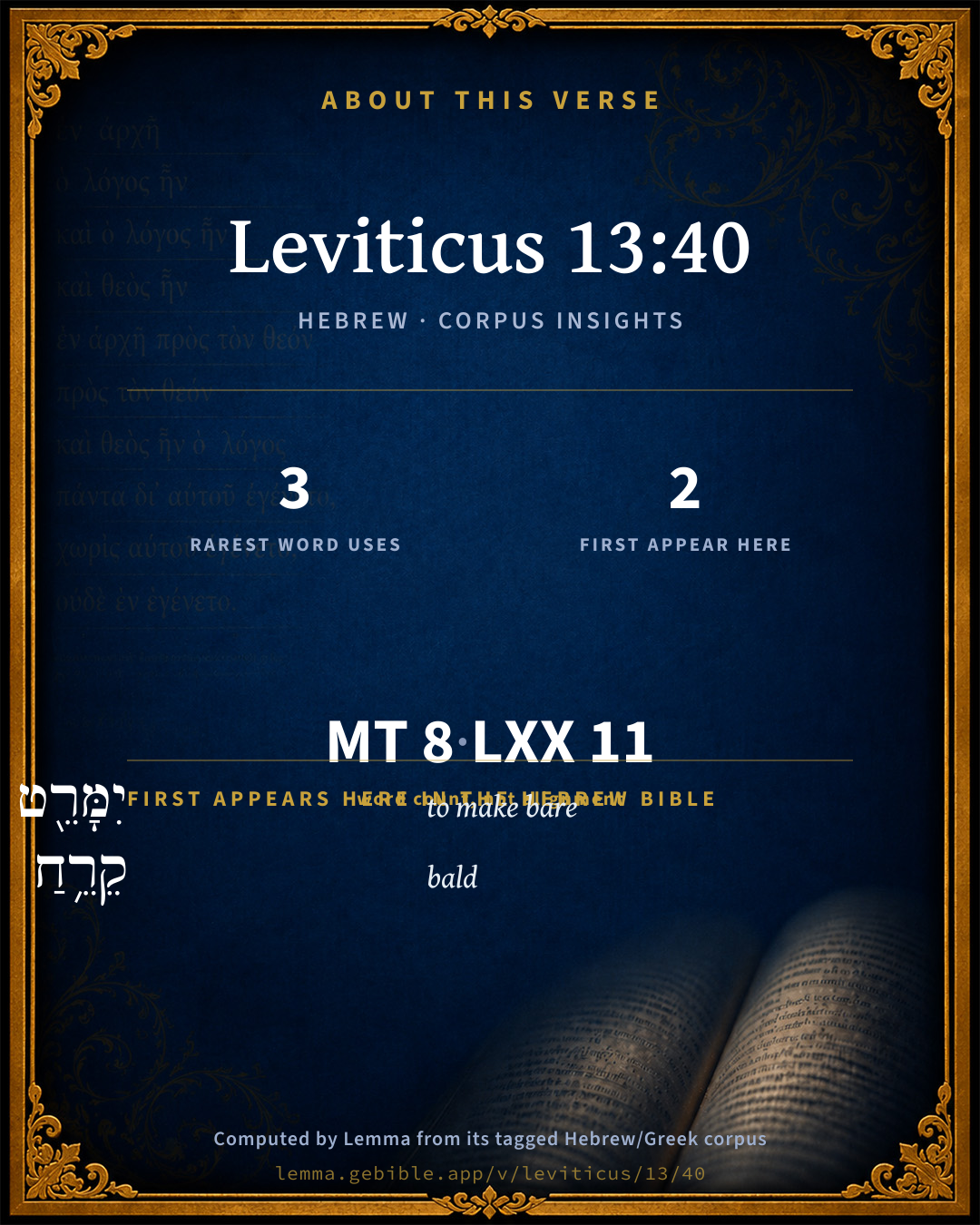
  • 2 first appearances in the Hebrew Bible
Full analysis ↓
Download a study sheet

One document with this verse’s original text, its word-by-word gloss line, the meaning frame, cross-references with their text, attributed commentary, and full source and license credits — printable, and it pastes into notes with its structure intact.

This verse Autodidact and up

Study sheet (.html) Plain text (.txt)

A passage Seminary Student

Up to 50 verses in one chapter. A passage sheet keeps up to 6 commentary sources and 12 cross-references per verse, in the order this page ranks them, and says so on the sheet whenever that leaves anything out. Ask for a single verse and you get the Autodidact verse sheet above.

Everything on this page stays free to read, with no account — the sheet is a download of what is already on screen, not access to it.

Want to remove ads? Support Godless Engineer
Compare translations 3

The same verse in 3 English versions, stacked beneath the original-language interlinear above. Click any original word for its lexicon entry.

Each is an independent rendering of the whole verse — the interlinear is not word-aligned to these translations.

Highlighted words mark where these versions differ — a whole-verse word diff, not a word-by-word alignment.

  • World English Bible Public Domain
    "If a man's hair has fallen from his head, he is bald. He is clean.
  • King James Version Public Domain
    And the man whose hair is fallen off his head, he is bald; yet is he clean.
  • unfoldingWord Literal Text CC BY-SA 4.0
    And a man, when his head is made bare, he bald. He clean.

unfoldingWord Literal Text — © unfoldingWord, licensed CC BY-SA 4.0. Word-aligned USFM3 via Door43 (git.door43.org/unfoldingWord/en_ult).

Versions to compare (up to 4)

3 of 4 selected

Show all 18 translations

Every available English version of this verse, each an independent rendering of the whole verse.

  • World English Bible Public Domain
    "If a man's hair has fallen from his head, he is bald. He is clean.
  • Berean Standard Bible Public Domain
    Now if a man loses his hair and is bald, he is still clean.
  • Majority Standard Bible Public Domain
    Now if a man loses his hair and is bald, he is still clean.
  • King James Version Public Domain
    And the man whose hair is fallen off his head, he is bald; yet is he clean.
  • American Standard Version (1901) Public Domain
    And if a man's hair be fallen off his head, he is bald; `yet' is he clean.
  • Revised Version (1885) Public Domain
    And if a man’s hair be fallen off his head, he is bald; yet is he clean.
  • Geneva Bible (1599) Public Domain
    And the man whose heare is fallen off his head, and is balde, is cleane.
  • Douay-Rheims (1899) Public Domain
    The man whose hair falleth off from his head, he is bald and clean:
  • Young's Literal Translation Public Domain
    `And when a man's head `is' polished, he `is' bald, he `is' clean;
  • Literal Standard Version CC BY-SA 4.0
    And when a man’s head [is] polished, he [is] bald; he [is] clean;
  • Unlocked Literal Bible CC BY-SA 4.0
    If a man's hair has fallen out of his head, he is bald, but he is clean.
  • unfoldingWord Literal Text CC BY-SA 4.0
    And a man, when his head is made bare, he bald. He clean.
  • Darby Bible Public Domain
    And if a man's hair have fallen off his head, he is bald: he is clean;
  • World Messianic Bible Public Domain
    “If a man’s hair has fallen from his head, he is bald. He is clean.
  • Webster's Bible Public Domain
    And the man whose hair hath fallen off his head, he is bald; yet is he clean.
  • Free Bible Version CC BY-SA 4.0
    If a man loses his hair and goes bald, he is still clean.
  • Bible in Basic English Public Domain
    And if a man's hair has come out and he has no hair, still he is clean.
  • JPS Tanakh (1917) Public Domain
    And if a man's hair be fallen off his head, he is bald; yet is he clean.

Literal Standard Version (2020), Covenant Press — licensed CC BY-SA 4.0. Text via the HelloAO Bible API (eBible.org). Unlocked Literal Bible (unfoldingWord) — licensed CC BY-SA 4.0. Text via the HelloAO Bible API (eBible.org). unfoldingWord Literal Text — © unfoldingWord, licensed CC BY-SA 4.0. Word-aligned USFM3 via Door43 (git.door43.org/unfoldingWord/en_ult). Free Bible Version, Dr. Jonathan Gallagher — licensed CC BY-SA 4.0. Text via the HelloAO Bible API (eBible.org).

Word by word

More ways to search: Search by grammar → Find every occurrence → Compare this word →

Practice this passage: Drill this verse → Learn its vocabulary →

About this verse

These counts appear in no published source. They are computed here, from the morphology-tagged text and Lemma’s own curated glosses. What Lemma adds →

8
words
7
distinct lemmas
Pentateuch
section

Notable vocabulary

The rarest word here is קֵרֵ֥חַ bald H7142 — appearing just 3 times in the whole Hebrew Bible.

First appearance in Scripture

These words make their first canonical appearance in the Hebrew Bible here:

  • יִמָּרֵ֖ט to make bare H4803
  • קֵרֵ֥חַ bald H7142

Shared distinctive vocabulary

קֵרֵ֥חַ bald H7142 occurs in 2 verses of the Hebrew Bible. Also found in:

Grammatical profile

  • 1 verb
  • 2 nouns
  • 2 adjectives
  • 2 pronouns
  • 1 conjunction

Verb forms

  • יִמָּרֵ֖ט Niphal · Imperfect

Repetition

A word recurs within this verse — often emphatic in Hebrew:

  • ה֖וּא he H1931 ×2

Hebrew & Septuagint length

In English translation the verse runs 15 words from the Hebrew and 16 from the Septuagint (LXX English) — closely comparable.

A rough comparison of the two English renderings, which tokenize alike — not a word-level alignment.

Word counts can differ between the Hebrew and the Greek without any difference in meaning — e.g. the Hebrew direct-object marker אֵת has no separate Greek word, and Greek often adds the article ὁ.

In the original languages it is 8 Hebrew tokens and 11 Greek tokens — but the two are counted differently (Hebrew bundles its prefixes and suffixes into one token; the Greek is in lemma form), so that isn’t a like-for-like length.

Cross-references

9

Topical passages linked to Leviticus 13:40 in the Treasury of Scripture Knowledge — connected by theme and wording, ordered by reader-vote popularity; previews shown in the World English Bible.

  • Galatians 4:13 but you know that because of weakness of the flesh I preached the Gospel to you the first time.
  • Leviticus 13:41 If his hair has fallen off from the front part of his head, he is forehead bald. He is clean.
  • 2 Kings 2:23 He went up from there to Bethel; and as he was going up by the way, there came forth young lads out of the city, and mocked him, and said to him, Go up, you baldy; go up, you baldhead.
  • Song of Solomon 5:11 His head is like the purest gold. His hair is bushy, black as a raven.
  • Isaiah 15:2 They are gone up to Bayith, and to Dibon, to the high places, to weep: Moab wails over Nebo, and over Medeba; on all their heads is baldness, every beard is cut off.
  • Amos 8:10 I will turn your feasts into mourning, And all your songs into lamentation; And I will make you wear sackcloth on all your bodies, And baldness on every head. I will make it like the mourning for an only son, And the end of it like a bitter day.
  • Romans 6:12 Therefore don't let sin reign in your mortal body, that you should obey it in its lusts.
  • Romans 6:19 I speak in human terms because of the weakness of your flesh, for as you presented your members as servants to uncleanness and to wickedness upon wickedness, even so now present your members as servants to righteousness for sanctification.
  • Romans 8:10 If Christ is in you, the body is dead because of sin, but the spirit is alive because of righteousness.

Cross-references courtesy of OpenBible.info (CC BY 4.0).

Hebrew and Greek witnesses Masoretic Hebrew ↔ Greek Septuagint

The same verse in the two great witnesses to the Old Testament, shown verse-for-verse.

These are two independent witnesses, not word-aligned to each other, and the Septuagint is shown in lemma (dictionary) form.

Hebrew Leviticus 13:40 Masoretic · Westminster Leningrad Codex

וְאִ֕ישׁ כִּ֥י יִמָּרֵ֖ט רֹאשׁ֑וֹ קֵרֵ֥חַ ה֖וּא טָה֥וֹר הֽוּא

"If a man's hair has fallen from his head, he is bald. He is clean.

World English Bible · Public Domain

Greek LXX Leviticus 13:40 Septuagint · lemma form

ἐάν δέ τις μαδάω ὁ κεφαλή αὐτός φαλακρός εἰμί καθαρός εἰμί

And if any one's head should lose the hair, he is only bald, he is clean.

LXX2012 (modern English Septuagint) · Public Domain

Hebrew: Westminster Leningrad Codex (CC BY 4.0). Greek: Septuagint (public domain); English from LXX2012 (modern English Septuagint) (Public Domain). How the Septuagint differs from the Hebrew →

Targum (Aramaic paraphrase)

2

The Targum is the ancient Jewish Aramaic paraphrase of the Hebrew Scriptures — an interpretive translation, not the Hebrew text itself. Onkelos (literal) and Pseudo-Jonathan (expansive) render the Torah, and Jonathan the Prophets. Coverage is partial: where no permissively-licensed English translation exists for a verse, only the Aramaic is shown. This is verse-level text, not a word-by-word alignment to the Hebrew.

  1. Targum Onkelos Torah (Genesis–Deuteronomy)
    וּגְבַר אֲרֵי יַתַּר שְׂעַר רֵישֵׁהּ קְרַח הוּא דְכֵי הוּא

    (no public-domain English translation for this verse)

    Targum Onkelos — Aramaic: “Onkelos Genesis” (public domain); “Onkelos Exodus” (public domain); “Onkelos Leviticus” (public domain); “Onkelos Numbers” (public domain); “Onkelos Deuteronomy” (public domain). English: “Sefaria Community Translation” (CC0 1.0 (public-domain dedication)); “J.W. Etheridge. The Targums of Onkelos and Jonathan Ben Uzziel on the Pentateuch. London: Longmans, Green, 1862” (public domain). Text via Sefaria.

  2. Targum Pseudo-Jonathan Torah (Genesis–Deuteronomy)
    וּגְבַר אֲרוּם יִתַּר שְעַר רֵישֵׁיהּ קְרוּחַ הוּא דְכֵי הוּא

    And if a man's hair fall off from his head, he is bald, but he is clean.

    Targum Pseudo-Jonathan — Aramaic: “Targum Jonathan on Genesis” (public domain); “Targum Jonathan on Exodus” (public domain); “Targum Jonathan on Leviticus” (public domain); “Targum Jonathan on Numbers” (public domain); “Targum Jonathan on Deuteronomy” (public domain). English: “The Targum of Jonathan ben Uzziel, trans. J. W. Etheridge, London, 1862” (public domain). Text via Sefaria.

Commentary

Notes on Leviticus 13:40 from classic Christian and Jewish commentators (each source and its license shown beneath its notes). The classic Christian expositions comment on the surrounding passage and are grouped to its opening verse, so a note may address several verses; the Jewish commentaries on the Tanakh (Rashi and others) are per-verse, so they appear only where the commentator wrote on this verse.

Lemma curates 59 commentaries, every one of them public domain or Creative Commons licensed, each selected and text-cleaned for this edition rather than reprinted as found. About our sources →

Ellicott's Commentary for English Readers

(40) And the man whose hair is fallen off—Better, And if a man loseth the hair of his head. The sixth and last case, discussed in Lev_13:40-44, is leprosy either at the back or in the front of the head. Though baldness in itself was regarded as a disgrace, and often looked upon as a Divine punishment (2Ki_2:23; Isa_3:17; Jer_48:37), yet the simple fact of the mere falling of the hair is not to be taken as a sign of leprosy.

He is bald; yet is he clean.—Better, if he is backhead bald, he is clean. The baldness mentioned in the first part of the verse in general terms is now more minutely specified as consisting of two kinds of baldness.

Lev_13:41-42 distinctly show that the word (kçrçach), here translated simply “bald” in the Authorised Version, denotes a person who has lost hair from the crown of his head downwards towards the channel of his neck, as the administrators of the law during the second Temple rightly define it, in contradistinction to the fore baldness which immediately follows.

A Bible Commentary for English Readers, edited by Charles John Ellicott (1878–1897) — public domain. Text from a community e-Sword module.

The Cambridge Bible for Schools and Colleges

gen. ed. J. J. S. Perowne

Baldness in the back or front part of the head (40–44)

This is not in itself a sign of uncleanness, but if in either part a reddish white plague (white reddish sore A. V.) appears, he must be seen by the priest. The word ‘bald’ in Lev_13:40 means bald at the back of the head, as distinguished from forehead bald in Lev_13:41.

The Cambridge Bible for Schools and Colleges (gen. ed. J. J. S. Perowne; Cambridge University Press, 1878–1918) — public domain. Text from a community e-Sword module.

Jamieson, Fausset & Brown

Robert Jamieson, A. R. Fausset & David Brown

bald . . . forehead bald--The falling off of the hair, when the baldness commences in the back part of the head, is another symptom which creates a suspicion of leprosy. But it was not of itself a decisive sign unless taken in connection with other tokens, such as a "sore of a reddish white color" [Lev 13:43]. The Hebrews as well as other Orientals were accustomed to distinguish between the forehead baldness, which might be natural, and that baldness which might be the consequence of disease.

Jamieson, Fausset & Brown — Commentary Critical and Explanatory on the Whole Bible (1871) — public domain (CC PDM 1.0). Text via the HelloAO Bible API.

John Gill's Exposition

And if there be,.... Or, "but if there be", or, "when there shall be" (y), or shall appear to be:

in the bald head, or in the bald forehead, a white reddish sore; white and red mixed, as the Targum of Jonathan, having something of both colours, neither a clear white nor thorough red; though, according to Bochart, it should be rendered "a white sore exceeding bright"; See Gill on Lev 13:19,

it is a leprosy sprung up in his bald head, or in his bald forehead; the signs of which were raw flesh and spreading; so it is said in the Misnah (z),"those two sorts of baldness defile in two weeks, by two signs, by quick raw flesh and by spreading;''if there was the bright spot and no quick flesh, then he was to be shut up seven days, and looked upon at the end of them; and if there was either quick flesh or a spreading, he was pronounced unclean, but if neither, he was shut up seven days more; and if either of the above signs appeared he was pronounced unclean, if not he was set free.

(y) "sin autem", V. L. "quum autem", Junius & Tremellius, Piscator Drusius. (z) Ut supra. (Misn. Negaim, c. 10. sect. 10.)

John Gill's Exposition of the Whole Bible (1746–1763) — public domain (CC PDM 1.0). Text via the HelloAO Bible API.

Whedon's Commentary on the Bible

Daniel D. Whedon

40. Bald… yet… clean — Literally, hind bald. Natural baldness was so uncommon among the Israelites that it subjected men to an unpleasant suspicion and public derision. It is perpetually alluded to as a mark of squalor and misery. 2Ki_2:23; Isa_3:24. Herodotus says that “one would see the fewest bald Egyptians of all men.” He attributes this immunity to their construct shaving. It is here carefully distinguished from the methek, or scall, of Lev_13:29-39.

Daniel D. Whedon (gen. ed.), Commentary on the Old and New Testaments (1874–1909) — public domain. Text from a community e-Sword module.

The Pulpit Commentary

Vers. 40-44. Leprosy appearing on the bald head. Though leprosy makes the hair drop off around the leprous spot, baldness is in itself no sign of leprosy, whether at the back or front of the head (verses 40, 41); but as the bald head is a not unusual place for the leprous spot to appear, any eruption upon it is therefore to be watched and tested as before.

Vers. 40-44. Affections of the mind.

We learn lessons concerning

I THE BLEMISH OF MENTAL PECULIARITY. (Verse 40.) Evidently baldness was an unusual and an unsightly thing among the Israelites. Otherwise it would not have excited notice and could not have created derision. (2Ki_2:23 Isa_3:24 Eze_7:18) It was regarded as an unbecoming peculiarity. Affecting the head, we may regard it as a type of mental peculiarity which does not amount to a serious sin, but is yet unusual and unbecoming. Many men who are substantially sound in heart and life, loving that which is highest and doing that which is just and right, are yet affected and afflicted by mental peculiarities oddities, crotchets, fancies, awkwardness or crookedness of mental habit; things which are not formidably had, but which, because they are superficial, strike the eye, provoke general remark, and stand in the way of effective service.

1. It is right that those who observe them in others should remember that they are only blemishes, and nothing more; detracting in some degree from "the beauty of holiness," but not inconsistent with real and even admirable excellence. "He is bald, yet he is clean" (verse 40).

2. It is right that those who possess them should reflect, and act on the reflection, that these things, though only blemishes, may importantly diminish the power of the possessor to influence, guide, and win other people. The candle (character) is of much more importance than the candlestick (mental habit), but if character be obscured by some darkening "bushel," and not put on the candlestick of pleasant and agreeable habits, it will not "give light to all that are in the house". (Mat_5:15)

II THE EVIL OF ERROR. There might come on the bald head a spot, a sore; this might be a "white reddish sore leprous (verses 42, 43). But it might not; it might be nothing but a boil or some coetaneous disorder, which was not leprosy. In that case the patient Would be treated as described in verses 2-6. There would be something wrong, but it was not the unclean thing, leprosy. There is a mental disease which is something more serious than peculiarity and something less serious than guilty perversity. It is error; the arrival at wrong conclusions. There may be but small faultiness in coming to convictions which are not correct, but there may be positive disaster resulting therefrom. A man may innocently take the wrong road, but his innocency will not save him from walking into the bog or over the precipice to which it leads. Error is not the worst thing in the world, but it is a seriously bad and dangerous thing. When we are earnestly warned, by obviously thoughtful and godly men, that we are wrong in our judgments, it becomes us to listen patiently and consider well whether we are in the right track, or whether we have mistaken a false path for the "path of life.

III THE SIN OF MENTAL PERVERSITY. (Verses 43, 44) There is great significance in the sentence "the priest shall pronounce him utterly unclean." The man who had leprosy in the head was accounted unclean in an especial degree: he was utterly unclean. Sin, of which this malady was so striking a type, never assumes so dangerous a phase as when it appears in the form of a perverted judgment or a darkened conscience. When, by sinning, a man has blunted his spiritual perceptions so that he "calls evil good, and good evil," he is in the last stage of moral decline; death is near at hand. If" our eye be evil" (if our judgment be perverted, our faculty of spiritual perception be diseased), our "whole body is full of darkness;" if "the light that is in, us" (our own mental and spiritual faculty) be darkness, how great is that darkness! (Mat_5:23) Witness the Pharisees in their treatment of our Lord. We may well be actively on our guard against, and may well be earnest in prayer that God will deliver us from, that of which leprosy in the head is the painful picture, a guilty, blinding, ruinous perversity of mind. C.

The Pulpit Commentary (1880–1919), ed. H.D.M. Spence-Jones & Joseph S. Exell — public domain. Text from a community e-Sword module.

Keil & Delitzsch

C. F. Keil & F. Delitzsch

The leprosy of bald heads. - קרח is a head bald behind; גּבּח, in front, "bald from the side, or edge of his face, i.e., from the forehead and temples." Bald heads of both kinds were naturally clean.

Keil & Delitzsch — Biblical Commentary on the Old Testament (1861–1891) — public domain (CC PDM 1.0). Text via the HelloAO Bible API. (Old Testament only.)

unfoldingWord translationNotes

Door43 World Missions Community

General Information:

Yahweh continues telling Moses and Aaron what the people must do when someone has a skin disease.

he is clean

The person whom other people may touch is spoken of as if he were physically clean. (See: Metaphor)

translationWords

clean

unfoldingWord translationNotes — © Distant Shores Media and the Door43 World Missions Community, licensed CC BY-SA 4.0. Source: git.door43.org/Door43/en_tn.

Rashi

Rabbi Shlomo Yitzchaki (Rashi)

קרח הוא טהור הוא HE IS BALD, HE IS CLEAN — clean from the uncleanness of נתק (a scall in a hairy spot) (Sifra, Braita d'Rabbi Yishmael 15), for he is not subject to the law about the symptoms of the head or the beard, which are places where hair grows, but to that about the symptoms of a plague on the skin of the flesh — [white hair], healthy flesh or the spreading of the plague.

Rashi on the Tanakh — English translations: “The Judaica Press complete Tanach with Rashi, translated by A. J. Rosenberg” (CC BY 4.0); “Pentateuch with Rashi's commentary by M. Rosenbaum and A.M. Silbermann, 1929-1934” (public domain); “The Metsudah Tanach series, Lakewood, N.J” (CC BY 4.0); and “The Book of Joshua, Metsudah Publications, 1997” (CC BY 4.0). Text via Sefaria.

Lesson kit

Teaching starters — assembled from the data on this page, not authored interpretation. Every prompt links to the verse data it draws on. Edit before teaching.

Leviticus, in the Pentateuch, opens this verse with 8 words (7 distinct Hebrew lemmas). Its most distinctive word is qêrêach (“bald”). A historical commentator’s framing appears above. Read the whole chapter for the surrounding context.

Discussion questions

  1. The word qêrêach carries the sense “bald.” How does it shape the verse?
  2. 2 words here appear for the first time in Scripture. What is being introduced at this debut?
  3. 2 Kings 2:23 shares the word «bald» with this verse. How do the two illuminate each other?
  4. “he” occurs 2× in this one verse. What is the effect of the repetition?
  5. These translations render this verse differently; the difference is in the English rendering, not the original. What questions does that raise?
  6. The verb «יִמָּרֵ֖ט» is Niphal Imperfect. How does its form color the action?
  7. Reading how Ellicott's Commentary for English Readers and The Cambridge Bible for Schools and Colleges read this verse, where do the two commentators agree and where do they part?

Things to notice

Reading settings

Reading text

Shown beneath each verse's original-language words.

Old Testament
Old Testament edition

Read the OT as the Masoretic Hebrew (MT) or the Greek Septuagint (LXX).

English shown for the Greek Septuagint (in the Hebrew ↔ Greek comparison).

Comparing translations? Open the Compare panel on any verse page to stack up to four side by side.