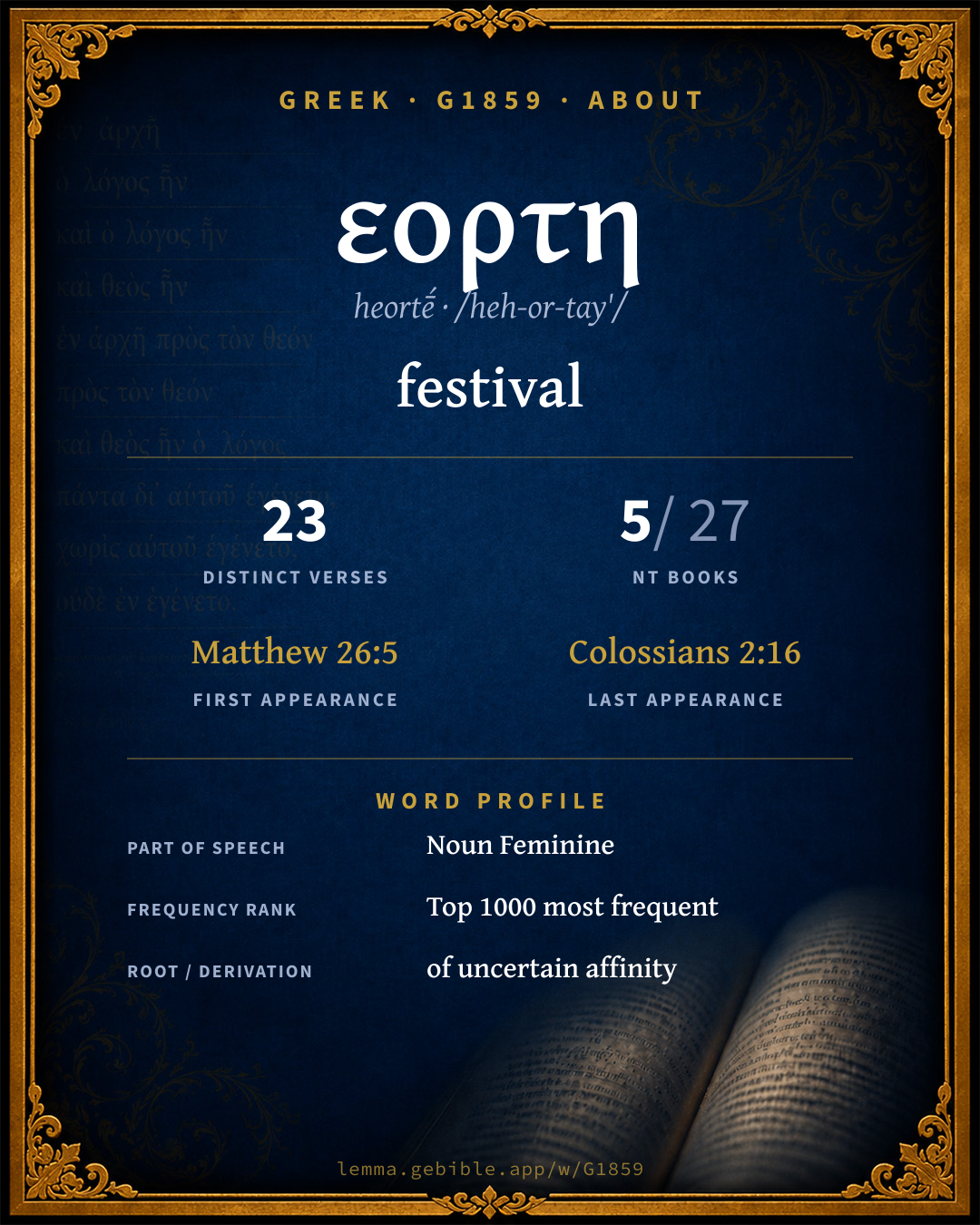
ἑορτή
festival
Full lexicon entry — Thayer's Greek Lexicon
From Thayer's Greek Lexicon
Where this word appears
See every Accusative-case word in the Greek New Testament →
Grammar key — what these labels mean
Part of speech
- Noun
- A naming word — a person, place, thing, or idea.
Case
- Accusative
- The case of the direct object and of extent.
- Dative
- The case of the indirect object, means, or location — “to / for / with / in.”
- Genitive
- The case of source, possession, or “of” — answers “whose / from what.”
- Nominative
- The case of the subject (and the predicate nominative).
Gender
- Feminine
- Grammatically feminine.
Number
- Singular
- One.
Every verse where G1859 appears in the Book of Matthew — 2 distinct verses. Click any verse to open its interlinear word-by-word view. Verse text shown in the World English Bible for context — . Each verse’s Greek form is shown with its reference; the English is not keyword-highlighted, since the data carries no word-level English alignment. Use “Compare translations” on any verse to read it across multiple English versions. This concordance covers the Greek New Testament; Septuagint (Greek Old Testament) occurrences of this word are not indexed here.
Matthew
About this entry
At a glance — auto-summarized from this page’s data, not written by a person. Every figure links to its source below. This summary describes the numbers; it doesn’t interpret them.
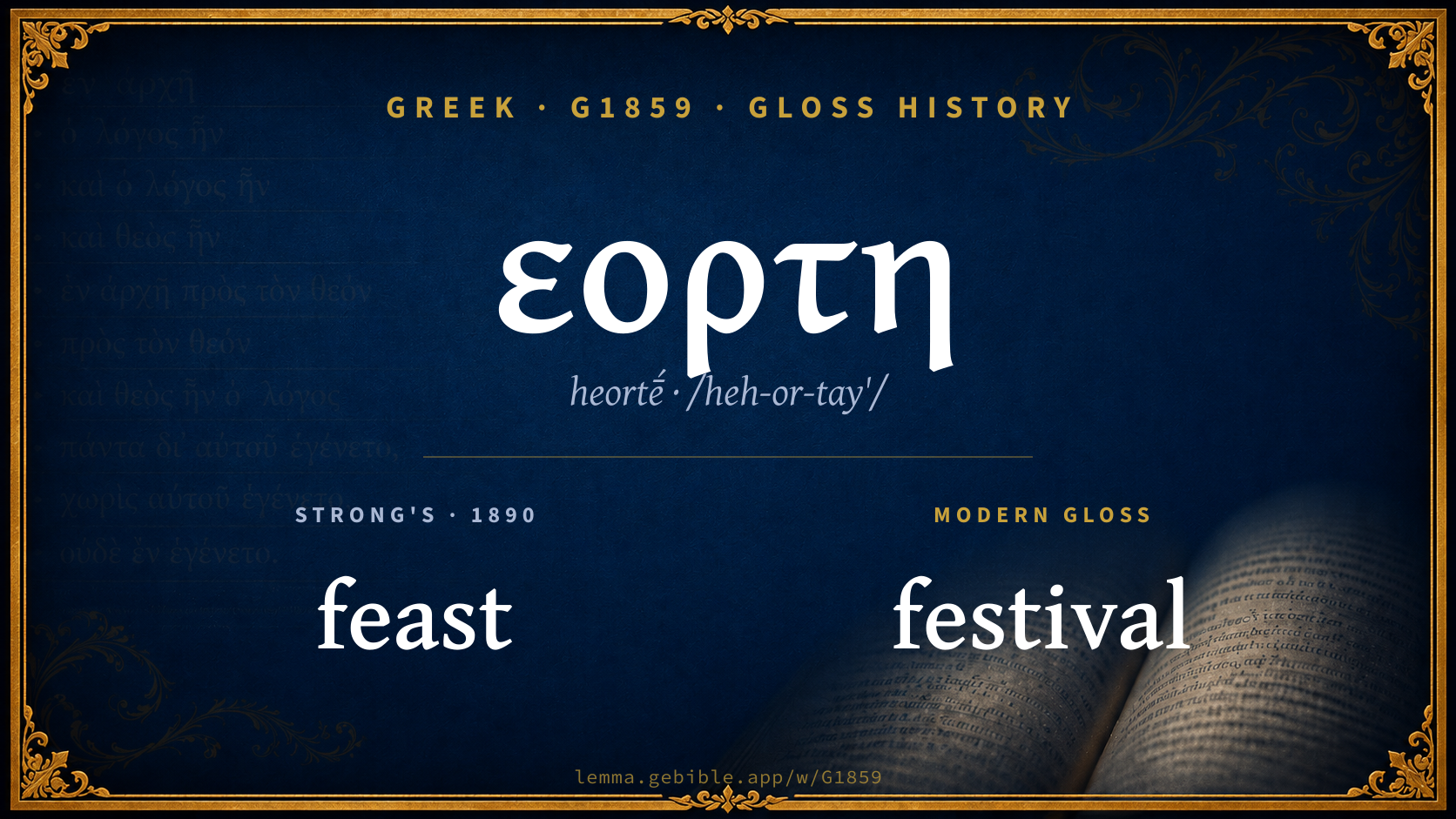
“festival” is the headline sense of the Greek noun εορτη (heortḗ). It clusters heavily in John, which alone accounts for 65% of its uses. With 23 verses in 5 books, it is an uncommon word in the Greek New Testament. Scripture first uses it in Matthew 26:5. The King James Version usually renders it “feast,” while modern versions prefer “festival” (unfoldingWord Literal Text) — see the renderings breakdown. See the sense tree, 23-verse concordance, and the renderings breakdown below.
Gloss history
Strong's 1890 vs modern scholarship
About this word
Strong's G1859 catalogs a Greek word from the Greek New Testament.
These counts are not copied from any lexicon or concordance. They are computed here, from the morphology-tagged Greek New Testament. What Lemma adds →
- 23
- distinct verses
- The word appears in 23 distinct verses.
- 5 / 27
- NT books
- The word appears in 5 of 27 New Testament books.
- #530
- by frequency
- Top 1000 most frequent Greek words (rank 530 of 5,347 Greek words by occurrence).
View all 23 occurrences in the concordance →
By section of the New Testament
By traditional corpus
Conventional, traditional groupings — biblical authorship is debated, so this is a traditional corpus grouping, not an authorship claim. Some books belong to more than one corpus (Luke is in both the Gospels and the Lukan corpus, and so on), so these shares overlap and need not total 100%. Each figure is a share of the word’s 23 distinct verses.
- Gospels 22 verses · 96%
- Johannine 15 verses · 65%
- Lukan (Luke–Acts) 3 verses · 13%
- Pauline corpus 1 verse · 4%
How translations render this word
Counts come from each version’s own published word-to-Strong’s tagging or interlinear alignment — an approximate guide to how each version renders this word, not a word-level alignment the data otherwise carries. Because each total is that version’s own tagged count, the per-version totals vary from one another and need not match the appearance or distinct-verse counts above. These counts may also differ from a printed concordance because Lemma counts each distinctly tagged rendering and does not collapse phrase taggings into a single head-word total. This is a fixed set of word-tagged versions (KJV, ASV, BSB, ULT) and does not change with the reading translation you choose elsewhere. Each version’s license is shown beside its name below (and on Sources).
- King James Version: Feast 25×
- American Standard Version: Feast 21×
- Berean Standard Bible: Feast 24×
- unfoldingWord Literal Text: Festival 23×, Feast 3×
King James Version Public Domain
Renders G1859 across 27 tagged occurrences — most commonly:
Plus 2 renderings that appear only once — usually multi-word phrases or single function words the recovered tagging swept in, not distinct renderings.
American Standard Version Public Domain
Renders G1859 across 23 tagged occurrences — most commonly:
Plus 2 renderings that appear only once — usually multi-word phrases or single function words the recovered tagging swept in, not distinct renderings.
Berean Standard Bible Public Domain
Renders G1859 across 24 tagged occurrences — most commonly:
Not rendered by a distinct English word in 1 further occurrence.
unfoldingWord Literal Text CC BY-SA 4.0
Renders G1859 across 26 tagged occurrences — most commonly:
Senses in Thayer's
The 1 sense Thayer's distinguishes for this word, in lexicon order (not ranked by frequency or importance). The full entry — with sub-senses — is in the Lexicon Entry tab.
- a feast day, festival
Word origin
Origin: of uncertain affinity
Of uncertain affinity; a festival : - feast holyday.
— Strong’s Exhaustive Concordance (1890), public domain.
Forms in the corpus
The 5 distinct written forms G1859 takes in the Greek New Testament, most frequent first — each parse links to that case’s occurrences in the concordance.
| Form | Parsing | Example | Uses |
|---|---|---|---|
| ἑορτῇ heortē̂ | Noun, Dative, Singular, Feminine | Matthew 26:5 | 7 |
| ἑορτήν heortḗn | Noun, Accusative, Singular, Feminine | John 4:45 | 6 |
| ἑορτῆς heortē̂s | Noun, Genitive, Singular, Feminine | Luke 2:42 | 5 |
| ἑορτὴ heortḕ | Noun, Nominative, Singular, Feminine | Luke 22:1 | 4 |
| ἑορτὴν heortḕn | Noun, Accusative, Singular, Feminine | Matthew 27:15 | 3 |
Same root — word family
Other Thayer's entries built from the same root as G1859, grouped by Strong’s listed origin. These share a root / origin per the lexicon — not necessarily a shared meaning. Each links to that word’s own entry.
Derived from this word
Compare all same-root words → They share a root, not necessarily a meaning.
Septuagint usage
The same Greek word εορτη appears 95 times in the Greek Old Testament (Septuagint), across 83 verses in 21 books.
- 95
- LXX occurrences
- Tagged occurrences of this Greek word in the Septuagint.
- 83
- verses
- Distinct Septuagint verses containing this word.
- 21 / 39
- OT books
- The word appears in 21 of the 39 Old Testament books.
Sample Septuagint occurrences
- Exodus 10:9 ἑορτή
- Leviticus 22:21 ἑορτή
- Numbers 10:10 ἑορτή
- Deuteronomy 16:8 ἑορτή
- Judges 21:19 ἑορτή
- 1 Kings 8:65 ἑορτή
- 2 Kings 23:16 ἑορτή
- 1 Chronicles 23:31 ἑορτή
- 2 Chronicles 2:3 ἑορτή
- Ezra 3:4 ἑορτή
- Psalms 73:4 ἑορτή
- Isaiah 1:14 ἑορτή
Septuagint occurrences (same lexeme)
Every verse where the same Strong’s number (G1859) appears in the Greek Septuagint — showing the first 50 of 83. Verse text shown in the World English Bible for context; the Greek form is the matched word — the English is not keyword-highlighted.
- Exodus 10:9 ἑορτή Moses said, "We will go with our young and with our old; with our sons and with our daughters, with our flocks and with our herds will we go; for we must hold a feast to Yahweh."
- Exodus 12:14 ἑορτή This day shall be to you for a memorial, and you shall keep it a feast to Yahweh: throughout your generations you shall keep it a feast by an ordinance forever.
- Exodus 13:6 ἑορτή Seven days you shall eat unleavened bread, and in the seventh day shall be a feast to Yahweh.
- Exodus 23:15 ἑορτή You shall observe the feast of unleavened bread. Seven days you shall eat unleavened bread, as I commanded you, at the time appointed in the month Abib (for in it you came out from Egypt), and no one shall appear before me empty.
- Exodus 23:16 ἑορτή And the feast of harvest, the first fruits of your labors, which you sow in the field: and the feast of harvest, at the end of the year, when you gather in your labors out of the field.
- Exodus 23:18 ἑορτή "You shall not offer the blood of my sacrifice with leavened bread, neither shall the fat of my feast remain all night until the morning.
- Exodus 32:5 ἑορτή When Aaron saw this, he built an altar before it; and Aaron made a proclamation, and said, "Tomorrow shall be a feast to Yahweh."
- Exodus 34:18 ἑορτή "You shall keep the feast of unleavened bread. Seven days you shall eat unleavened bread, as I commanded you, at the time appointed in the month Abib; for in the month Abib you came out from Egypt.
- Exodus 34:22 ἑορτή You shall observe the feast of weeks with the first fruits of wheat harvest, and the feast of harvest at the year's end.
- Exodus 34:25 ἑορτή "You shall not offer the blood of my sacrifice with leavened bread; neither shall the sacrifice of the feast of the Passover be left to the morning.
- Leviticus 22:21 ἑορτή Whoever offers a sacrifice of peace offerings to Yahweh to accomplish a vow, or for a freewill offering, of the herd or of the flock, it shall be perfect to be accepted; there shall be no blemish therein.
- Leviticus 23:2 ἑορτή "Speak to the children of Israel, and tell them, 'The set feasts of Yahweh, which you shall proclaim to be holy convocations, even these are my set feasts.
- Leviticus 23:4 ἑορτή "'These are the set feasts of Yahweh, even holy convocations, which you shall proclaim in their appointed season.
- Leviticus 23:6 ἑορτή On the fifteenth day of the same month is the feast of unleavened bread to Yahweh. Seven days you shall eat unleavened bread.
- Leviticus 23:34 ἑορτή "Speak to the children of Israel, and say, 'On the fifteenth day of this seventh month is the feast of tents for seven days to Yahweh.
- Leviticus 23:37 ἑορτή "'These are the appointed feasts of Yahweh, which you shall proclaim to be holy convocations, to offer an offering made by fire to Yahweh, a burnt offering, and a meal offering, a sacrifice, and drink offerings, each on its own day;
- Leviticus 23:44 ἑορτή Moses declared to the children of Israel the appointed feasts of Yahweh.
- Numbers 10:10 ἑορτή Also in the day of your gladness, and in your set feasts, and in the beginnings of your months, you shall blow the trumpets over your burnt offerings, and over the sacrifices of your peace-offerings; and they shall be to you for a memorial before your God: I am Yahweh your God.
- Numbers 15:3 ἑορτή and will make an offering by fire to Yahweh, a burnt offering, or a sacrifice, to accomplish a vow, or as a freewill-offering, or in your set feasts, to make a sweet savor to Yahweh, of the herd, or of the flock;
- Numbers 28:2 ἑορτή Command the children of Israel, and tell them, My offering, my food for my offerings made by fire, of a sweet savor to me, shall you observe to offer to me in their due season.
- Numbers 28:17 ἑορτή On the fifteenth day of this month shall be a feast: seven days shall unleavened bread be eaten.
- Numbers 29:12 ἑορτή On the fifteenth day of the seventh month you shall have a holy convocation; you shall do no servile work, and you shall keep a feast to Yahweh seven days:
- Numbers 29:39 ἑορτή These you shall offer to Yahweh in your set feasts, besides your vows, and your freewill-offerings, for your burnt offerings, and for your meal-offerings, and for your drink-offerings, and for your peace-offerings.
- Deuteronomy 16:8 ἑορτή Six days you shall eat unleavened bread; and on the seventh day shall be a solemn assembly to Yahweh your God; you shall do no work [therein].
- Deuteronomy 16:10 ἑορτή You shall keep the feast of weeks to Yahweh your God with a tribute of a freewill-offering of your hand, which you shall give, according as Yahweh your God blesses you:
- Deuteronomy 16:13 ἑορτή You shall keep the feast of tents seven days, after that you have gathered in from your threshing floor and from your winepress:
- Deuteronomy 16:14 ἑορτή and you shall rejoice in your feast, you, and your son, and your daughter, and your man-servant, and your maid-servant, and the Levite, and the foreigner, and the fatherless, and the widow, who are within your gates.
- Deuteronomy 16:16 ἑορτή Three times in a year shall all your males appear before Yahweh your God in the place which he shall choose: in the feast of unleavened bread, and in the feast of weeks, and in the feast of tents; and they shall not appear before Yahweh empty:
- Deuteronomy 31:10 ἑορτή Moses commanded them, saying, At the end of [every] seven years, in the set time of the year of release, in the feast of tents,
- Judges 21:19 ἑορτή They said, Behold, there is a feast of Yahweh from year to year in Shiloh, which is on the north of Bethel, on the east side of the highway that goes up from Bethel to Shechem, and on the south of Lebonah.
- 1 Kings 8:65 ἑορτή So Solomon held the feast at that time, and all Israel with him, a great assembly, from the entrance of Hamath to the brook of Egypt, before Yahweh our God, seven days and seven days, even fourteen days.
- 1 Kings 12:32 ἑορτή Jeroboam ordained a feast in the eighth month, on the fifteenth day of the month, like the feast that is in Judah, and he went up to the altar; so did he in Bethel, sacrificing to the calves that he had made: and he placed in Bethel the priests of the high places that he had made.
- 1 Kings 12:33 ἑορτή He went up to the altar which he had made in Bethel on the fifteenth day in the eighth month, even in the month which he had devised of his own heart: and he ordained a feast for the children of Israel, and went up to the altar, to burn incense.
- 2 Kings 23:16 ἑορτή As Josiah turned himself, he spied the tombs that were there in the mountain; and he sent, and took the bones out of the tombs, and burned them on the altar, and defiled it, according to the word of Yahweh which the man of God proclaimed, who proclaimed these things.
- 1 Chronicles 23:31 ἑορτή and to offer all burnt offerings to Yahweh, on the Sabbaths, on the new moons, and on the set feasts, in number according to the ordinance concerning them, continually before Yahweh;
- 2 Chronicles 2:3 ἑορτή Solomon sent to Huram the king of Tyre, saying, As you dealt with David my father, and sent him cedars to build him a house in which to dwell, [even so deal with me].
- 2 Chronicles 5:3 ἑορτή And all the men of Israel assembled themselves to the king at the feast, which was [in] the seventh month.
- 2 Chronicles 7:8 ἑορτή So Solomon held the feast at that time seven days, and all Israel with him, a very great assembly, from the entrance of Hamath to the brook of Egypt.
- 2 Chronicles 7:9 ἑορτή On the eighth day they held a solemn assembly: for they kept the dedication of the altar seven days, and the feast seven days.
- 2 Chronicles 8:13 ἑορτή even as the duty of every day required, offering according to the commandment of Moses, on the Sabbaths, and on the new moons, and on the set feasts, three times in the year, [even] in the feast of unleavened bread, and in the feast of weeks, and in the feast of tents.
- 2 Chronicles 30:13 ἑορτή There assembled at Jerusalem much people to keep the feast of unleavened bread in the second month, a very great assembly.
- 2 Chronicles 30:21 ἑορτή The children of Israel who were present at Jerusalem kept the feast of unleavened bread seven days with great gladness; and the Levites and the priests praised Yahweh day by day, [singing] with loud instruments to Yahweh.
- 2 Chronicles 30:22 ἑορτή Hezekiah spoke comfortably to all the Levites who had good understanding [in the service] of Yahweh. So they ate throughout the feast for the seven days, offering sacrifices of peace-offerings, and making confession to Yahweh, the God of their fathers.
- 2 Chronicles 30:26 ἑορτή So there was great joy in Jerusalem; for since the time of Solomon the son of David king of Israel there was not the like in Jerusalem.
- 2 Chronicles 31:3 ἑορτή [He appointed] also the king's portion of his substance for the burnt-offerings, [to wit], for the morning and evening burnt offerings, and the burnt offerings for the Sabbaths, and for the new moons, and for the set feasts, as it is written in the law of Yahweh.
- 2 Chronicles 35:17 ἑορτή The children of Israel who were present kept the Passover at that time, and the feast of unleavened bread seven days.
- Ezra 3:4 ἑορτή They kept the feast of tents, as it is written, and [offered] the daily burnt offerings by number, according to the ordinance, as the duty of every day required;
- Ezra 3:5 ἑορτή and afterward the continual burnt-offering, and [the offerings] of the new moons, and of all the set feasts of Yahweh that were consecrated, and of everyone who willingly offered a freewill-offering to Yahweh.
- Ezra 6:22 ἑορτή and kept the feast of unleavened bread seven days with joy: for Yahweh had made them joyful, and had turned the heart of the king of Assyria to them, to strengthen their hands in the work of the house of God, the God of Israel.
- Ezra 18:14 ἑορτή
These are occurrences of the same Greek lexeme (G1859) in the Septuagint — not a translation of any one Hebrew word. The store carries no word-level Hebrew↔Greek alignment, so no Hebrew original is asserted here. Counts come from the recovered LXX Strong's tagging — high-frequency vocabulary is well covered, while rare or late forms may be untagged — so they reflect tagged occurrences and may slightly undercount.