Exodus 34:22

Hebrew (Westminster Leningrad Codex) Exodus 34:22 appears in the Hebrew Old Testament. The text above is from the Westminster Leningrad Codex. Each word links to its Strong’s number, a concise gloss, and parsing drawn from the Open Scriptures Hebrew Bible morphology. Click any word for its full Brown-Driver-Briggs (BDB) entry.
Download image
Cite this verse

Exodus 34:22 (World English Bible). Public Domain. Lemma interlinear Bible study tool, https://lemma.gebible.app/v/exodus/34/22.

Show BibTeX & RIS
BibTeX
RIS
English Translation
You shall observe the feast of weeks with the first fruits of wheat harvest, and the feast of harvest at the year's end.
World English Bible · Public Domain
Highlights
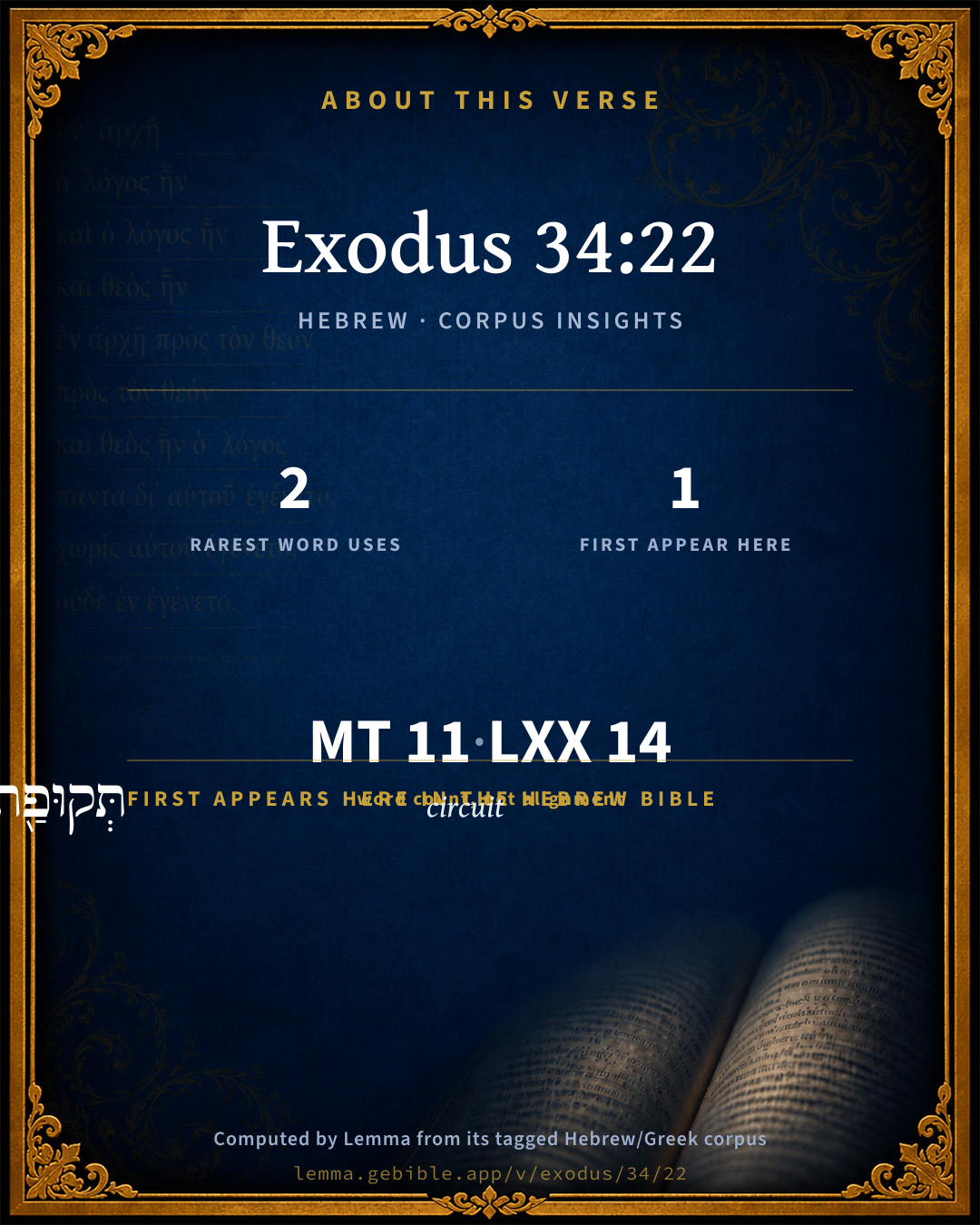
  • 1 first appearance in the Hebrew Bible
Full analysis ↓
Download a study sheet

One document with this verse’s original text, its word-by-word gloss line, the meaning frame, cross-references with their text, attributed commentary, and full source and license credits — printable, and it pastes into notes with its structure intact.

This verse Autodidact and up

Study sheet (.html) Plain text (.txt)

A passage Seminary Student

Up to 50 verses in one chapter. A passage sheet keeps up to 6 commentary sources and 12 cross-references per verse, in the order this page ranks them, and says so on the sheet whenever that leaves anything out. Ask for a single verse and you get the Autodidact verse sheet above.

Everything on this page stays free to read, with no account — the sheet is a download of what is already on screen, not access to it.

Want to remove ads? Support Godless Engineer
Compare translations 3

The same verse in 3 English versions, stacked beneath the original-language interlinear above. Click any original word for its lexicon entry.

Each is an independent rendering of the whole verse — the interlinear is not word-aligned to these translations.

Highlighted words mark where these versions differ — a whole-verse word diff, not a word-by-word alignment.

  • World English Bible Public Domain
    You shall observe the feast of weeks with the first fruits of wheat harvest, and the feast of harvest at the year's end.
  • King James Version Public Domain
    And thou shalt observe the feast of weeks, of the firstfruits of wheat harvest, and the feast of ingathering at the year's end.
  • unfoldingWord Literal Text CC BY-SA 4.0
    And you shall keep for yourself the Festival of Weeks the first-fruits of the harvest of the wheat, and the Festival of the Gathering at the turning of the year.

unfoldingWord Literal Text — © unfoldingWord, licensed CC BY-SA 4.0. Word-aligned USFM3 via Door43 (git.door43.org/unfoldingWord/en_ult).

Versions to compare (up to 4)

3 of 4 selected

Show all 18 translations

Every available English version of this verse, each an independent rendering of the whole verse.

  • World English Bible Public Domain
    You shall observe the feast of weeks with the first fruits of wheat harvest, and the feast of harvest at the year's end.
  • Berean Standard Bible Public Domain
    And you are to celebrate the Feast of Weeks with the firstfruits of the wheat harvest, and the Feast of Ingathering at the turn of the year.
  • Majority Standard Bible Public Domain
    And you are to celebrate the Feast of Weeks with the firstfruits of the wheat harvest, and the Feast of Ingathering at the turn of the year.
  • King James Version Public Domain
    And thou shalt observe the feast of weeks, of the firstfruits of wheat harvest, and the feast of ingathering at the year's end.
  • American Standard Version (1901) Public Domain
    And thou shalt observe the feast of weeks, `even' of the first-fruits of wheat harvest, and the feast of ingathering at the year's end.
  • Revised Version (1885) Public Domain
    And thou shalt observe the feast of weeks, even of the firstfruits of wheat harvest, and the feast of ingathering at the year’s end.
  • Geneva Bible (1599) Public Domain
    Thou shalt also obserue the feast of weekes in the time of ye first fruits of wheate haruest, and the feast of gathering fruites in the ende of the yere.
  • Douay-Rheims (1899) Public Domain
    Thou shalt keep the feast of weeks with the firstfruits of the corn of thy wheat harvest, and the feast when the time of the year returneth that all things are laid in.
  • Young's Literal Translation Public Domain
    `And a feast of weeks thou dost observe for thyself; first-fruits of wheat-harvest; and the feast of in-gathering, at the revolution of the year.
  • Literal Standard Version CC BY-SA 4.0
    And you observe [the] Celebration of Weeks for yourself, of [the] first-fruits of wheat-harvest; and the Celebration of Ingathering at the revolution of the year.
  • Unlocked Literal Bible CC BY-SA 4.0
    You must observe the Festival of Weeks with the first yield of the wheat harvest, and you must observe the Festival of Ingathering at the year's end.
  • unfoldingWord Literal Text CC BY-SA 4.0
    And you shall keep for yourself the Festival of Weeks the first-fruits of the harvest of the wheat, and the Festival of the Gathering at the turning of the year.
  • Darby Bible Public Domain
    -- And thou shalt observe the feast of weeks, of the first-fruits of wheat-harvest, and the feast of ingathering at the turn of the year.
  • World Messianic Bible Public Domain
    “You shall observe the feast of weeks with the first fruits of wheat harvest, and the feast of harvest at the year’s end.
  • Webster's Bible Public Domain
    And thou shalt observe the feast of weeks, of the first-fruits of wheat-harvest, and the feast of in-gathering at the year's end.
  • Free Bible Version CC BY-SA 4.0
    Observe the Festival of Weeks when you offer the firstfruits of wheat harvest, and the Harvest Festival at the end of the agricultural year.
  • Bible in Basic English Public Domain
    And you are to keep the feast of weeks when you get in the first-fruits of the grain, and the feast at the turn of the year when you take in the produce of your fields.
  • JPS Tanakh (1917) Public Domain
    And thou shalt observe the feast of weeks, even of the first-fruits of wheat harvest, and the feast of ingathering at the turn of the year.

Literal Standard Version (2020), Covenant Press — licensed CC BY-SA 4.0. Text via the HelloAO Bible API (eBible.org). Unlocked Literal Bible (unfoldingWord) — licensed CC BY-SA 4.0. Text via the HelloAO Bible API (eBible.org). unfoldingWord Literal Text — © unfoldingWord, licensed CC BY-SA 4.0. Word-aligned USFM3 via Door43 (git.door43.org/unfoldingWord/en_ult). Free Bible Version, Dr. Jonathan Gallagher — licensed CC BY-SA 4.0. Text via the HelloAO Bible API (eBible.org).

Word by word

More ways to search: Search by grammar → Find every occurrence → Compare this word →

Practice this passage: Drill this verse → Learn its vocabulary →

הָֽאָסִ֔יף
ʼâçîyph
H614
“the · harvest”
Particle, Definite Article + Noun, Common, Masculine, Singular, Absolute
Part of Speech
Particle + Noun
Type
Common
Gender
Masculine
Number
Singular
State
Absolute
Full BDB Definition

Origin: from H622

TWOT: 140b

ingathering, harvest
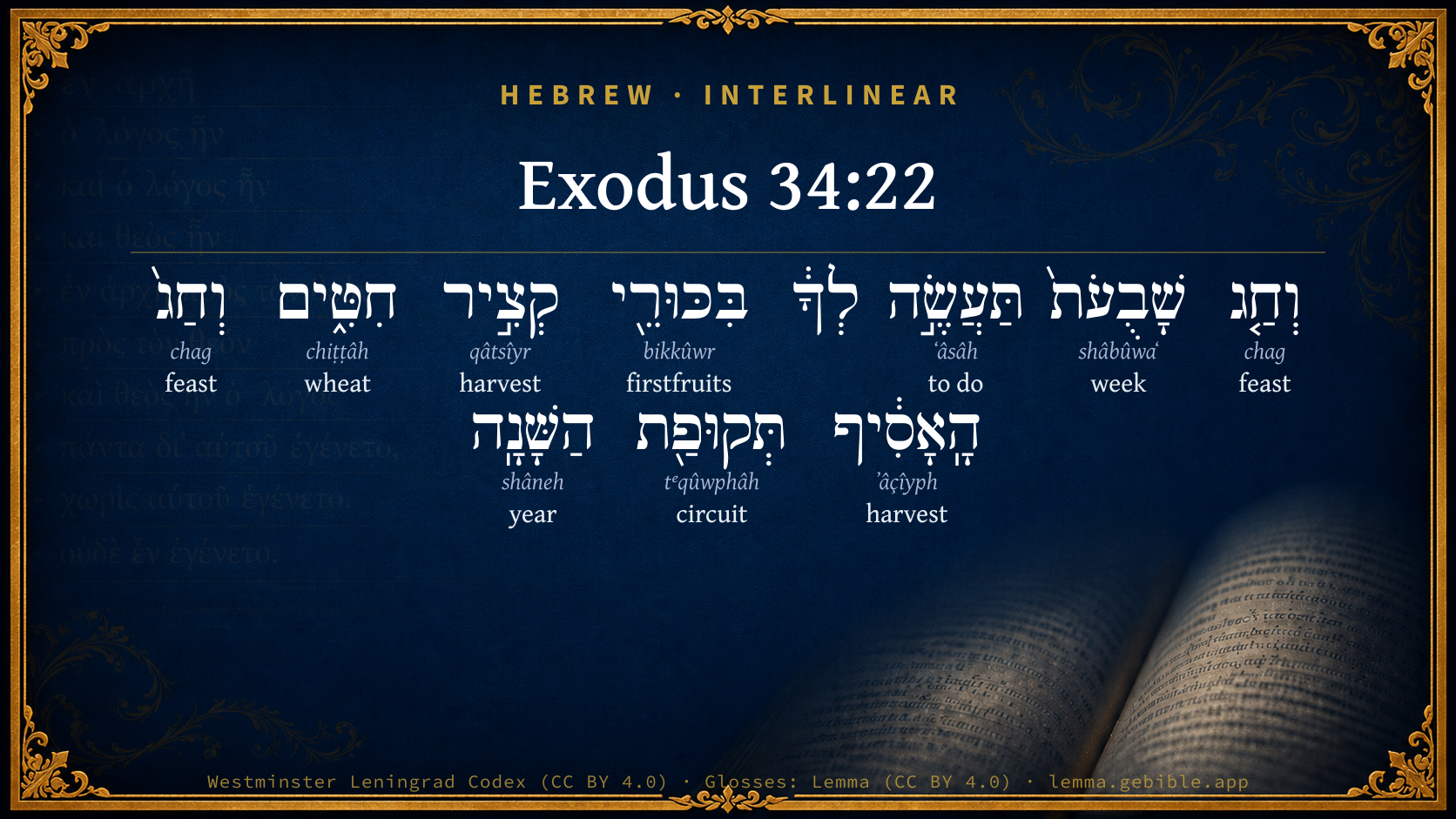
  1. וְחַ֤ג chag H2282 “and · feast of” Conjunction + Noun, Common, Masculine, Singular, Construct
  2. שָׁבֻעֹת֙ shâbûwaʻ H7620 “weeks” Noun, Common, Masculine, Plural, Absolute
  3. תַּעֲשֶׂ֣ה ʻâsâh H6213 “to do” Verb, Qal, Imperfect, 2nd Person, Masculine, Singular
  4. בִּכּוּרֵ֖י bikkûwr H1061 “firstfruits of” Noun, Common, Both, Plural, Construct
  5. קְצִ֣יר qâtsîyr H7105 “harvest of” Noun, Common, Masculine, Singular, Construct
  6. חִטִּ֑ים chiṭṭâh H2406 “wheat” Noun, Common, Feminine, Plural, Absolute
  7. וְחַג֙ chag H2282 “and · feast of” Conjunction + Noun, Common, Masculine, Singular, Construct
  8. תְּקוּפַ֖ת tᵉqûwphâh H8622 “circuit of” Noun, Common, Feminine, Singular, Construct
  9. הַשָּׁנָֽה shâneh H8141 “the · year” Particle, Definite Article + Noun, Common, Feminine, Singular, Absolute

About this verse

These counts appear in no published source. They are computed here, from the morphology-tagged text and Lemma’s own curated glosses. What Lemma adds →

11
words
9
distinct lemmas
Pentateuch
section

Notable vocabulary

The rarest word here is הָֽאָסִ֔יף harvest H614 — appearing just 2 times in the whole Hebrew Bible.

First appearance in Scripture

This word makes its first canonical appearance in the Hebrew Bible here:

  • תְּקוּפַ֖ת circuit H8622

Shared distinctive vocabulary

הָֽאָסִ֔יף harvest H614 occurs in 2 verses of the Hebrew Bible. Also found in:

Grammatical profile

  • 1 verb
  • 9 nouns
  • 1 preposition

Verb forms

  • תַּעֲשֶׂ֣ה Qal · Imperfect

Repetition

A word recurs within this verse — often emphatic in Hebrew:

  • וְחַ֤ג feast H2282 ×2

Hebrew & Septuagint length

In English translation the verse runs 23 words from the Hebrew and 26 from the Septuagint (LXX English) — closely comparable.

A rough comparison of the two English renderings, which tokenize alike — not a word-level alignment.

Word counts can differ between the Hebrew and the Greek without any difference in meaning — e.g. the Hebrew direct-object marker אֵת has no separate Greek word, and Greek often adds the article ὁ.

In the original languages it is 11 Hebrew tokens and 14 Greek tokens — but the two are counted differently (Hebrew bundles its prefixes and suffixes into one token; the Greek is in lemma form), so that isn’t a like-for-like length.

Cross-references

6

Topical passages linked to Exodus 34:22 in the Treasury of Scripture Knowledge — connected by theme and wording, ordered by reader-vote popularity; previews shown in the World English Bible.

  • Exodus 23:16 And the feast of harvest, the first fruits of your labors, which you sow in the field: and the feast of harvest, at the end of the year, when you gather in your labors out of the field.
  • Deuteronomy 16:10–15 You shall keep the feast of weeks to Yahweh your God with a tribute of a freewill-offering of your hand, which you shall give, according as Yahweh your God blesses you:
  • Numbers 28:16–31 In the first month, on the fourteenth day of the month, is Yahweh's Passover.
  • John 7:2 Now the feast of the Jews, the Feast of Booths, was at hand.
  • Numbers 29:12–39 On the fifteenth day of the seventh month you shall have a holy convocation; you shall do no servile work, and you shall keep a feast to Yahweh seven days:
  • Acts 2:1 Now when the day of Pentecost had come, they were all with one accord in one place.

Cross-references courtesy of OpenBible.info (CC BY 4.0).

Hebrew and Greek witnesses Masoretic Hebrew ↔ Greek Septuagint

The same verse in the two great witnesses to the Old Testament, shown verse-for-verse.

These are two independent witnesses, not word-aligned to each other, and the Septuagint is shown in lemma (dictionary) form.

Hebrew Exodus 34:22 Masoretic · Westminster Leningrad Codex

וְחַ֤ג שָׁבֻעֹת֙ תַּעֲשֶׂ֣ה לְךָ֔ בִּכּוּרֵ֖י קְצִ֣יר חִטִּ֑ים וְחַג֙ הָֽאָסִ֔יף תְּקוּפַ֖ת הַשָּׁנָֽה

You shall observe the feast of weeks with the first fruits of wheat harvest, and the feast of harvest at the year's end.

World English Bible · Public Domain

Greek LXX Exodus 34:22 Septuagint · lemma form

καί ἑορτή ἑβδομάς ποιέω ἐγώ ἀρχή θερισμός πυρός καί ἑορτή συναγωγή μεσόω ὁ ἐνιαυτός

And you shall keep to me the feast of weeks, the beginning of wheat harvest; and the feast of ingathering in the middle of the year.

LXX2012 (modern English Septuagint) · Public Domain

On this verse, Haydock's Catholic Bible Commentary discusses the Septuagint’s reading. Read the note in Commentary ↓

Hebrew: Westminster Leningrad Codex (CC BY 4.0). Greek: Septuagint (public domain); English from LXX2012 (modern English Septuagint) (Public Domain). How the Septuagint differs from the Hebrew →

Targum (Aramaic paraphrase)

2

The Targum is the ancient Jewish Aramaic paraphrase of the Hebrew Scriptures — an interpretive translation, not the Hebrew text itself. Onkelos (literal) and Pseudo-Jonathan (expansive) render the Torah, and Jonathan the Prophets. Coverage is partial: where no permissively-licensed English translation exists for a verse, only the Aramaic is shown. This is verse-level text, not a word-by-word alignment to the Hebrew.

  1. Targum Onkelos Torah (Genesis–Deuteronomy)
    וְחַגָא דְשָׁבוּעַיָא תַּעְבֵּד לָךְ בִּכּוּרֵי חֲצַד חִטִין וְחַגָא דִכְנָשָׁא בְּמִפְקָא דְשַׁתָּא:

    (no public-domain English translation for this verse)

    Targum Onkelos — Aramaic: “Onkelos Genesis” (public domain); “Onkelos Exodus” (public domain); “Onkelos Leviticus” (public domain); “Onkelos Numbers” (public domain); “Onkelos Deuteronomy” (public domain). English: “Sefaria Community Translation” (CC0 1.0 (public-domain dedication)); “J.W. Etheridge. The Targums of Onkelos and Jonathan Ben Uzziel on the Pentateuch. London: Longmans, Green, 1862” (public domain). Text via Sefaria.

  2. Targum Pseudo-Jonathan Torah (Genesis–Deuteronomy)
    וְחַגָא דִּשְׁבוּעַיָא תַּעֲבֵיד לָךְ בִּזְמַן בִּכּוּרֵי חֲצַד חִינְטִין וְחַגָא דִכְנָשָׁא בְּמִיפְקָא דְשַׁתָּא

    The feast of weeks also shalt thou make to thee in the time of the firsts of the wheat harvest; and the feast of ingathering at the conclusion of the ear.

    Targum Pseudo-Jonathan — Aramaic: “Targum Jonathan on Genesis” (public domain); “Targum Jonathan on Exodus” (public domain); “Targum Jonathan on Leviticus” (public domain); “Targum Jonathan on Numbers” (public domain); “Targum Jonathan on Deuteronomy” (public domain). English: “The Targum of Jonathan ben Uzziel, trans. J. W. Etheridge, London, 1862” (public domain). Text via Sefaria.

Commentary

Notes on Exodus 34:22 from classic Christian and Jewish commentators (each source and its license shown beneath its notes). The classic Christian expositions comment on the surrounding passage and are grouped to its opening verse, so a note may address several verses; the Jewish commentaries on the Tanakh (Rashi and others) are per-verse, so they appear only where the commentator wrote on this verse.

Lemma curates 59 commentaries, every one of them public domain or Creative Commons licensed, each selected and text-cleaned for this edition rather than reprinted as found. About our sources →

Trapp's Complete Commentary

John Trapp

Exo 34:22 And thou shalt observe the feast of weeks, of the firstfruits of wheat harvest, and the feast of ingathering at the year’s end.

Ver. 22. And thou shalt observe.] See Exo 23:16.

John Trapp, A Commentary or Exposition upon All the Books of the Old and New Testament (1647–1656) — public domain. Text from a community e-Sword module.

Tyndale Open Study Notes

Tyndale Open Resources

34:22 Festival of the Final Harvest: See study notes on 23:16; Lev 23:15-21, 34-43.

Tyndale Open Study Notes — © Tyndale Open Resources, licensed CC BY-SA 4.0. Text via the HelloAO Bible API.

Geneva Bible (1599)

Geneva Bible translators

Which was in September, when the sun declined which in the count of political things they called the end of the year.

Geneva Bible (1599) marginal notes — public domain. Text via Bolls.life.

Ellicott's Commentary for English Readers

(22) The feast of weeks.—Called in Exo_23:16, “the feast of harvest,” and in the New Testament “the day of Pentecost”—seven weeks after the first day of unleavened bread. (See Note 1 on Exo_23:16.) The special offering to be made at the feast consisted of “two wave loaves of fine flour, baken with leaven” (Lev_23:17), which were “the first-fruits of the wheat harvest.”

And the feast of ingathering.—Called also “the feast of tabernacles” (Lev_23:34; Deu_16:13; Deu_16:16; Deu_31:10, &c.), on account of the command to “dwell in booths seven days” during its continuance (Lev_23:42). On the character of the festival see Note 2 on Exo_23:16.

A Bible Commentary for English Readers, edited by Charles John Ellicott (1878–1897) — public domain. Text from a community e-Sword module.

The Cambridge Bible for Schools and Colleges

gen. ed. J. J. S. Perowne

22. See on Exo_23:16. Feast of weeks is a name derived (see Deu_16:9) from the ‘seven weeks’—the average duration of harvest-time—by which this feast followed the commencement of harvest. The same expression is used in Deu_16:10; Deu_16:16, 2Ch_8:13†.

hold thee] See on Exo_12:47. So Deu_16:13.

close] lit. circuit, i.e. completed circuit; Ges. (Thes.) ‘ad (post) decursum anni.’ So Exo 1Sa_1:20 (lit. at the (completed) circuit of days),—also, in all probability, of the feast of weeks at the close of the year (notice in v. 21 ‘the yearly sacrifice,’ lit. the sacrifice of days, of the same feast1[222]): the word occurs also in Psa_19:6 [Hebrews 7], 2Ch_24:23 †; cf. the cognate verb in Isa_29:1 ‘let the feasts go round,’ i.e. complete their circuit.

[222] The words ‘that [Heb. and] Hannah conceived’ in v. 20 are almost certainly misplaced, and should stand at the beginning of the verse: ‘And Hannah conceived; and it came to pass, at the close of the days (i.e. of the year), that she bare a son.’

The Cambridge Bible for Schools and Colleges (gen. ed. J. J. S. Perowne; Cambridge University Press, 1878–1918) — public domain. Text from a community e-Sword module.

John Gill's Exposition

For I will cast out the nations before thee,.... Who are particularly mentioned, Exo 34:11 and therefore they need not be in any fear of them, when they should go up to the appointed place, and appear before the Lord; for to this they were not obliged, until they were come into the land of Canaan, and the inhabitants driven out before them:

and enlarge thy borders; so that as they should have no enemies within them, to hinder and molest them, or discourage and deter them from attendance on the Lord at such set times, so they would be set at a great distance from them, that they should have nothing to fear from them; and should it be objected that at such times, when only women and children were left at home, and their borders were defenceless, it would be a proper opportunity for their enemies to invade them, it is further promised:

neither, shall any man desire thy land; though it is a desirable land; and their neighbours, and especially the old inhabitants of it, envied the happiness of the Israelites, and could not but wish it was in their possession; yet God, who has the hearts of all men in his hands, and can direct their thoughts, and turn the inclinations of their minds, and influence their affections, and engage them with other objects, promises that they should not think of an invasion of them, or have their minds, and the desires and affections of their hearts, in the least turned that way at these seasons, whatever they might have at other times; even

when thou shall go up to appear before the Lord thy God thrice in a year; at the feasts before mentioned, which was a most wonderful display of the power and providence of God.

John Gill's Exposition of the Whole Bible (1746–1763) — public domain (CC PDM 1.0). Text via the HelloAO Bible API.

Haydock's Catholic Bible Commentary

Harvest. Pentecost. --- Laid in, at the feast of tabernacles, in September. (Menochius) --- The Septuagint have, "the feast of gathering, in the middle of the (sacred) year." The greatest solemnity of the Passover is mentioned, ver. 18. (Haydock)

George Leo Haydock (1774–1849), Haydock's Catholic Family Bible and Commentary, 1859 edition — public domain. Excludes Psalms (Douay-Rheims chapter numbering differs from Protestant) and Deuterocanonical books (Catholic canon only).

Matthew Poole's English Annotations

The feast of weeks, i.e. which is numbered by weeks being just seven weeks after the passover, whence it is called pentecost, i.e. the fiftieth day, to wit, after the passover. See Lev 23:15; 25:8.

The first-fruits of wheat harvest; so this is a designation of the time and business of the feast of weeks.

The feast of ingathering, to wit, of the fruits of the earth.

The year’s end; so it was in regard of the jubilee and civil contracts.

Matthew Poole's English Annotations on the Holy Bible (1683–1685) — public domain. Text from a community e-Sword/MySword module.

The Pulpit Commentary

Of the first-fruits. There is here an unfortunate ambiguity. The English reader naturally supposes that three festivals are mentioned

1. That of weeks;

2. That of the first-fruits of wheat harvest; and

3. That of in-gathering.

But in reality the feast of weeks is that of the first-fruits of wheat harvest. Lev_23:17; Num_28:26. The observance of this feast, as well as that of the feast of in-gathering, was commanded in the "Book of the Covenant". (Exo_23:16)

The Pulpit Commentary (1880–1919), ed. H.D.M. Spence-Jones & Joseph S. Exell — public domain. Text from a community e-Sword module.

Rashi

Rabbi Shlomo Yitzchaki (Rashi)

בכורי קציר חטים [THE FESTIVAL] OF THE FIRST OF THE WHEAT HARVEST — It is so called because on it you offer the two loaves of wheat (Leviticus 23:17).

בכורי OF THE FIRST [OF THE WHEAT HARVEST] — It is so called because it (the offering of the two loaves) is the first meal offering which is brought in the Temple of the new wheat crop; for the meal offering of the Omer which had already been brought on Passover was of barley (Menachot 84a).

וחג האסיף AND THE FESTIVAL OF INGATHERING — the festival that falls at the time of the year when you gather in thy produce from the field into the barns. The word אסף here means bringing in (and not, collecting), as (Deuteronomy 22:2) “thou shalt gather it (ואספתו) into thine house” (cf. Rashi on Exodus 23:16 and on Genesis 49:29).

תקופת השנה lit., [THE FESTIVAL …] THE YEARS CIRCUIT — i. e. the festival at the coming round of the year — at the beginning of the coming (the new) year.

תקופת is a term denoting going round.

Rashi on the Tanakh — English translations: “The Judaica Press complete Tanach with Rashi, translated by A. J. Rosenberg” (CC BY 4.0); “Pentateuch with Rashi's commentary by M. Rosenbaum and A.M. Silbermann, 1929-1934” (public domain); “The Metsudah Tanach series, Lakewood, N.J” (CC BY 4.0); and “The Book of Joshua, Metsudah Publications, 1997” (CC BY 4.0). Text via Sefaria.

Lesson kit

Teaching starters — assembled from the data on this page, not authored interpretation. Every prompt links to the verse data it draws on. Edit before teaching.

Exodus, in the Pentateuch, opens this verse with 11 words (9 distinct Hebrew lemmas). Its most distinctive word is ʼâçîyph (“harvest”). A historical commentator’s framing appears above. Read the whole chapter for the surrounding context.

Discussion questions

  1. The word ʼâçîyph carries the sense “harvest.” How does it shape the verse?
  2. This is the first place “circuit” appears in Scripture (first appears here). What does its debut here establish?
  3. How does Exodus 23:16, which shares the word «harvest», read alongside this verse?
  4. What does the repetition of “feast” (2× in this one verse) do in this verse?
  5. These translations render this verse differently; the difference is in the English rendering, not the original. What questions does that raise?
  6. «תַּעֲשֶׂ֣ה» is a Qal Imperfect verb. How does that grammatical form shape the action described?
  7. Compare how Trapp's Complete Commentary and Tyndale Open Study Notes read this verse. Where do they agree or differ?

Things to notice

Reading settings

Reading text

Shown beneath each verse's original-language words.

Old Testament
Old Testament edition

Read the OT as the Masoretic Hebrew (MT) or the Greek Septuagint (LXX).

English shown for the Greek Septuagint (in the Hebrew ↔ Greek comparison).

Comparing translations? Open the Compare panel on any verse page to stack up to four side by side.