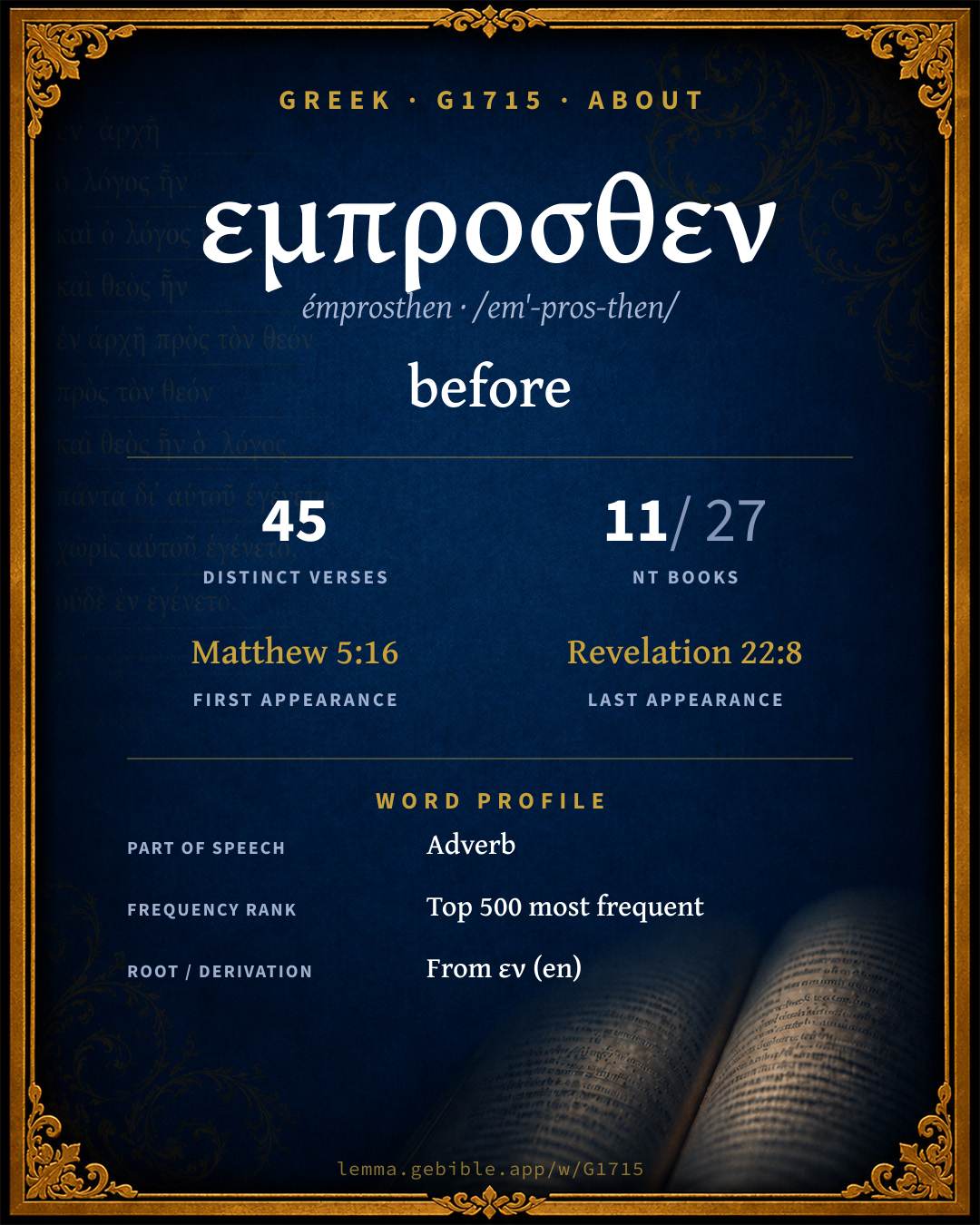
ἔμπροσθεν
before
‘before’ is one of 4 main senses fuller range ↓
Full lexicon entry — Thayer's Greek Lexicon
From Thayer's Greek Lexicon
Where this word appears
Grammar key — what these labels mean
Part of speech
- Preposition
- A relational word governing a noun in a particular case.
- Adverb
- A word that modifies a verb, adjective, or other adverb.
Every verse where G1715 appears in the Book of John — 5 distinct verses. Click any verse to open its interlinear word-by-word view. Verse text shown in the World English Bible for context — . Each verse’s Greek form is shown with its reference; the English is not keyword-highlighted, since the data carries no word-level English alignment. Use “Compare translations” on any verse to read it across multiple English versions. This concordance covers the Greek New Testament; Septuagint (Greek Old Testament) occurrences of this word are not indexed here.
John
- John 1:15 ἔμπροσθέν prep John testified about him. He cried out, saying, "This was he of whom I said, 'He who comes after me has surpassed me, for he was before me.'"
- John 1:30 ἔμπροσθέν prep This is he of whom I said, 'After me comes a man who is preferred before me, for he was before me.'
- John 3:28 ἔμπροσθεν prep You yourselves testify that I said, 'I am not the Christ,' but, 'I have been sent before him.'
- John 10:4 ἔμπροσθεν prep Whenever he brings out his own sheep, he goes before them, and the sheep follow him, for they know his voice.
- John 12:37 ἔμπροσθεν prep But though he had done so many signs before them, yet they didn't believe in him,
About this entry
At a glance — auto-summarized from this page’s data, not written by a person. Every figure links to its source below. This summary describes the numbers; it doesn’t interpret them.
εμπροσθεν (émprosthen) is a Greek verb most often rendered “before.” Its lexical range runs to 4 senses. It turns up in 45 verses across 11 books, a moderately common footprint. It concentrates in Matthew, which alone accounts for 36% of its uses. It first appears in Matthew 5:16. For the data behind this summary, explore the sense tree and the renderings breakdown below.
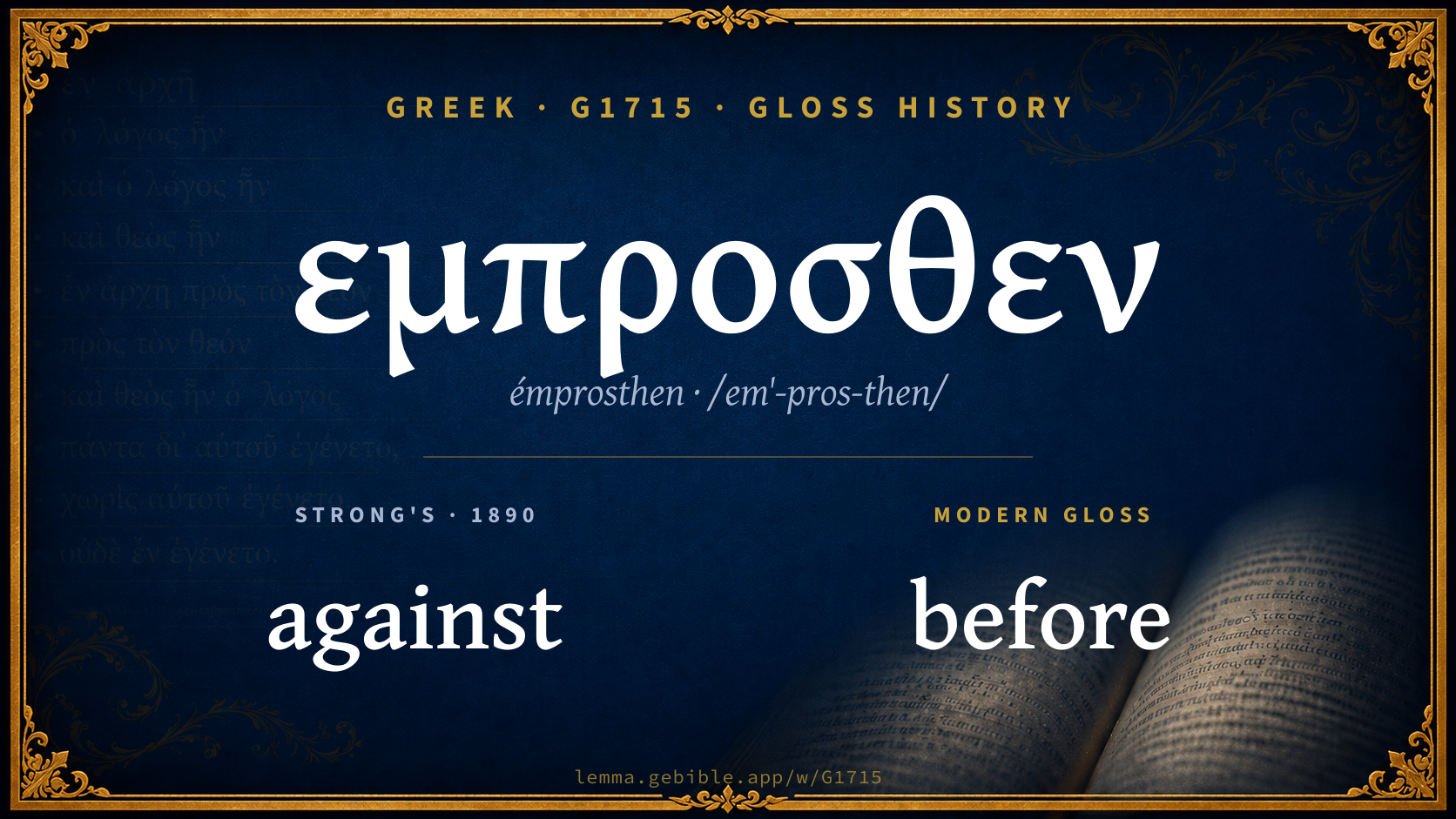
Gloss history
Strong's 1890 vs modern scholarship
About this word
Strong's G1715 catalogs a Greek word from the Greek New Testament.
These counts are not copied from any lexicon or concordance. They are computed here, from the morphology-tagged Greek New Testament. What Lemma adds →
- 45
- distinct verses
- The word appears in 45 distinct verses.
- 11 / 27
- NT books
- The word appears in 11 of 27 New Testament books.
- #322
- by frequency
- Top 500 most frequent Greek words (rank 322 of 5,347 Greek words by occurrence).
View all 45 occurrences in the concordance →
By section of the New Testament
By traditional corpus
Conventional, traditional groupings — biblical authorship is debated, so this is a traditional corpus grouping, not an authorship claim. Some books belong to more than one corpus (Luke is in both the Gospels and the Lukan corpus, and so on), so these shares overlap and need not total 100%. Each figure is a share of the word’s 45 distinct verses.
- Gospels 32 verses · 71%
- Lukan (Luke–Acts) 11 verses · 24%
- Johannine 9 verses · 20%
- Pauline corpus 7 verses · 16%
- Revelation 3 verses · 7%
- General (Catholic) Epistles 1 verse · 2%
How translations render this word
Counts come from each version’s own published word-to-Strong’s tagging or interlinear alignment — an approximate guide to how each version renders this word, not a word-level alignment the data otherwise carries. Because each total is that version’s own tagged count, the per-version totals vary from one another and need not match the appearance or distinct-verse counts above. These counts may also differ from a printed concordance because Lemma counts each distinctly tagged rendering and does not collapse phrase taggings into a single head-word total. This is a fixed set of word-tagged versions (KJV, ASV, BSB, ULT) and does not change with the reading translation you choose elsewhere. Each version’s license is shown beside its name below (and on Sources).
- King James Version: Before 40×, Sight 3×
- American Standard Version: Before 39×, Down before 2×, In 2×
- Berean Standard Bible: Before 25×, Ahead 3×, Front of 3×
- unfoldingWord Literal Text: Before 36×, Ahead 4×, Front of 4×
King James Version Public Domain
Renders G1715 across 49 tagged occurrences — most commonly:
Plus 6 renderings that appear only once — usually multi-word phrases or single function words the recovered tagging swept in, not distinct renderings.
American Standard Version Public Domain
Renders G1715 across 47 tagged occurrences — most commonly:
Plus 4 renderings that appear only once — usually multi-word phrases or single function words the recovered tagging swept in, not distinct renderings.
Berean Standard Bible Public Domain
Renders G1715 across 46 tagged occurrences — most commonly:
Plus 4 renderings that appear only once — usually multi-word phrases or single function words the recovered tagging swept in, not distinct renderings. Not rendered by a distinct English word in 1 further occurrence.
unfoldingWord Literal Text CC BY-SA 4.0
Renders G1715 across 48 tagged occurrences — most commonly:
Plus 2 renderings that appear only once — usually multi-word phrases or single function words the recovered tagging swept in, not distinct renderings.
Senses in Thayer's
The 4 senses Thayer's distinguishes for this word, in lexicon order (not ranked by frequency or importance). The full entry — with sub-senses — is in the Lexicon Entry tab.
- before, i.e. in that local region which is in front of a person or thing
- before, in the presence of, i.e. opposite to, over against one
- before, in the sight of
- before, denoting rank
Word origin
Derived from εν (en) (G1722).
Forms in the corpus
The 3 distinct written forms G1715 takes in the Greek New Testament, most frequent first — each parse links to that case’s occurrences in the concordance.
| Form | Parsing | Example | Uses |
|---|---|---|---|
| ἔμπροσθεν émprosthen | Preposition | Matthew 5:16 | 39 |
| ἔμπροσθέν émprosthén | Preposition | Matthew 6:2 | 8 |
| ἔνπροσθεν énprosthen | Adverb | Revelation 4:6 | 1 |
Same root — word family
Other Thayer's entries built from the same root as G1715, grouped by Strong’s listed origin. These share a root / origin per the lexicon — not necessarily a shared meaning. Each links to that word’s own entry.
Derives from
Shares the same root
- εγγραφω engráphō G1449 to inscribe
- εγγυος éngyos G1450 surety
- εγκαθετος enkáthetos G1455 to spy
- εγκαινια enkaínia G1456 dedication
- εγκαλεω enkaléō G1458 to accuse
- εγκαταλειπω enkataleípō G1459 to abandon
- εγκατοικεω enkatoikéō G1460 to dwell
- εγκεντριζω enkentrízō G1461 to graft
- εγκομβοομαι enkombóomai G1463 band
- εγκοπτω enkóptō G1465 to hinder
- εγκρατης enkratḗs G1468 strong
- εγκρινω enkrínō G1469 to judge worthy
- εγκρυπτω enkrýptō G1470 to conceal
- εγκυος énkyos G1471 pregnant
- εγχριω enchríō G1472 to anoint
- ελλογεω ellogéō G1677 impute
- εμβαινω embaínō G1684 to enter
- εμβαλλω embállō G1685 to cast in
- εμβαπτω embáptō G1686 to dip in
- εμβατευω embateúō G1687 to enter
- εμβιβαζω embibázō G1688 to lead in
- εμβλεπω emblépō G1689 to look at
- εμβριμαομαι embrimáomai G1690 to warn sternly
- εμμαινομαι emmaínomai G1693 to rage against
+58 more words share this root (not shown).
Compare all same-root words → Showing 4 of 84 — not the complete family. They share a root, not necessarily a meaning.
Septuagint usage
The same Greek word εμπροσθεν appears 124 times in the Greek Old Testament (Septuagint), across 121 verses in 26 books.
- 124
- LXX occurrences
- Tagged occurrences of this Greek word in the Septuagint.
- 121
- verses
- Distinct Septuagint verses containing this word.
- 26 / 39
- OT books
- The word appears in 26 of the 39 Old Testament books.
Sample Septuagint occurrences
- Genesis 24:7 ἔμπροσθεν
- Numbers 14:43 ἔμπροσθεν
- Joshua 3:6 ἔμπροσθεν
- Judges 1:11 ἔμπροσθεν
- Ruth 4:7 ἔμπροσθεν
- 1 Samuel 2:29 ἔμπροσθεν
- 2 Samuel 3:31 ἔμπροσθεν
- 1 Kings 1:5 ἔμπροσθεν
- 2 Kings 4:31 ἔμπροσθεν
- 1 Chronicles 4:40 ἔμπροσθεν
- 2 Chronicles 1:12 ἔμπροσθεν
- Ezra 4:18 ἔμπροσθεν
Septuagint occurrences (same lexeme)
Every verse where the same Strong’s number (G1715) appears in the Greek Septuagint — showing the first 50 of 121. Verse text shown in the World English Bible for context; the Greek form is the matched word — the English is not keyword-highlighted.
- Genesis 24:7 ἔμπροσθεν Yahweh, the God of heaven, who took me from my father's house, and from the land of my birth, who spoke to me, and who swore to me, saying, 'I will give this land to your seed.' He will send his angel before you, and you shall take a wife for my son from there.
- Genesis 32:4 ἔμπροσθεν He commanded them, saying, "This is what you shall tell my lord, Esau: 'This is what your servant, Jacob, says. I have lived as a foreigner with Laban, and stayed until now.
- Genesis 32:17 ἔμπροσθεν He commanded the foremost, saying, "When Esau, my brother, meets you, and asks you, saying, 'Whose are you? Where are you going? Whose are these before you?'
- Genesis 33:3 ἔμπροσθεν He himself passed over in front of them, and bowed himself to the ground seven times, until he came near to his brother.
- Genesis 33:14 ἔμπροσθεν Please let my lord pass over before his servant: and I will lead on gently, according to the pace of the cattle that are before me and according to the pace of the children, until I come to my lord to Seir."
- Genesis 41:43 ἔμπροσθεν and he made him to ride in the second chariot which he had. They cried before him, "Bow the knee!" He set him over all the land of Egypt.
- Genesis 45:5 ἔμπροσθεν Now don't be grieved, nor angry with yourselves, that you sold me here, for God sent me before you to preserve life.
- Genesis 45:7 ἔμπροσθεν God sent me before you to preserve you a remnant in the earth, and to save you alive by a great deliverance.
- Genesis 46:28 ἔμπροσθεν He sent Judah before him to Joseph, to show the way before him to Goshen, and they came into the land of Goshen.
- Genesis 48:20 ἔμπροσθεν He blessed them that day, saying, "In you will Israel bless, saying, 'God make you as Ephraim and as Manasseh'" He set Ephraim before Manasseh.
- Numbers 14:43 ἔμπροσθεν For there the Amalekite and the Canaanite are before you, and you shall fall by the sword: because you are turned back from following Yahweh, therefore Yahweh will not be with you.
- Joshua 3:6 ἔμπροσθεν Joshua spoke to the priests, saying, Take up the ark of the covenant, and pass over before the people. They took up the ark of the covenant, and went before the people.
- Joshua 4:5 ἔμπροσθεν and Joshua said to them, Pass over before the ark of Yahweh your God into the midst of the Jordan, and take up every man of you a stone on his shoulder, according to the number of the tribes of the children of Israel;
- Joshua 4:11 ἔμπροσθεν It happened, when all the people had completely passed over, that the ark of Yahweh passed over, with the priests, in the presence of the people.
- Joshua 4:12 ἔμπροσθεν The children of Reuben, and the children of Gad, and the half-tribe of Manasseh, passed over armed before the children of Israel, as Moses spoke to them:
- Joshua 4:23 ἔμπροσθεν For Yahweh your God dried up the waters of the Jordan from before you, until you were passed over, as Yahweh your God did to the Red Sea, which he dried up from before us, until we were passed over;
- Joshua 5:1 ἔμπροσθεν It happened, when all the kings of the Amorites, who were beyond the Jordan westward, and all the kings of the Canaanites, who were by the sea, heard how that Yahweh had dried up the waters of the Jordan from before the children of Israel, until we were passed over, that their heart melted, neither was there spirit in them any more, because of the children of Israel.
- Joshua 6:9 ἔμπροσθεν The armed men went before the priests who blew the trumpets, and the rearward went after the ark, [the priests] blowing the trumpets as they went.
- Joshua 8:6 ἔμπροσθεν and they will come out after us, until we have drawn them away from the city; for they will say, They flee before us, as at the first: so we will flee before them;
- Judges 1:11 ἔμπροσθεν From there he went against the inhabitants of Debir. (Now the name of Debir before was Kiriath Sepher.)
- Judges 1:23 ἔμπροσθεν The house of Joseph sent to spy out Bethel. (Now the name of the city before was Luz.)
- Judges 3:2 ἔμπροσθεν only that the generations of the children of Israel might know, to teach them war, at the least such as before knew nothing of it:
- Judges 3:27 ἔμπροσθεν It happened, when he had come, that he blew a trumpet in the hill-country of Ephraim; and the children of Israel went down with him from the hill-country, and he before them.
- Judges 4:14 ἔμπροσθεν Deborah said to Barak, Up; for this is the day in which Yahweh has delivered Sisera into your hand; hasn't Yahweh gone out before you? So Barak went down from Mount Tabor, and ten thousand men after him.
- Judges 4:23 ἔμπροσθεν So God subdued on that day Jabin the king of Canaan before the children of Israel.
- Judges 18:21 ἔμπροσθεν So they turned and departed, and put the little ones and the cattle and the goods before them.
- Ruth 4:7 ἔμπροσθεν Now this was [the custom] in former time in Israel concerning redeeming and concerning exchanging, to confirm all things: a man drew off his shoe, and gave it to his neighbor; and this was the [manner of] attestation in Israel.
- 1 Samuel 2:29 ἔμπροσθεν Why kick you at my sacrifice and at my offering, which I have commanded in [my] habitation, and honor your sons above me, to make yourselves fat with the best of all the offerings of Israel my people?
- 1 Samuel 8:20 ἔμπροσθεν that we also may be like all the nations, and that our king may judge us, and go out before us, and fight our battles.
- 1 Samuel 9:9 ἔμπροσθεν (In earlier times in Israel, when a man went to inquire of God, thus he said, Come, and let us go to the seer; for he who is now called a Prophet was before called a Seer.)
- 1 Samuel 9:15 ἔμπροσθεν Now Yahweh had revealed to Samuel a day before Saul came, saying,
- 1 Samuel 9:19 ἔμπροσθεν Samuel answered Saul, and said, I am the seer; go up before me to the high place, for you shall eat with me today: and in the morning I will let you go, and will tell you all that is in your heart.
- 1 Samuel 9:27 ἔμπροσθεν As they were going down at the end of the city, Samuel said to Saul, Bid the servant pass on before us (and he passed on), but stand you still first, that I may cause you to hear the word of God.
- 1 Samuel 10:5 ἔμπροσθεν After that you shall come to the hill of God, where is the garrison of the Philistines: and it shall happen, when you are come there to the city, that you shall meet a band of prophets coming down from the high place with a psaltery, and a tambourine, and a pipe, and a harp, before them; and they will be prophesying:
- 1 Samuel 10:8 ἔμπροσθεν You shall go down before me to Gilgal; and, behold, I will come down to you, to offer burnt offerings, and to sacrifice sacrifices of peace-offerings: seven days shall you wait, until I come to you, and show you what you shall do.
- 1 Samuel 18:6 ἔμπροσθεν It happened as they came, when David returned from the slaughter of the Philistine, that the women came out of all the cities of Israel, singing and dancing, to meet king Saul, with tambourines, with joy, and with instruments of music.
- 1 Samuel 23:24 ἔμπροσθεν They arose, and went to Ziph before Saul: but David and his men were in the wilderness of Maon, in the Arabah on the south of the desert.
- 1 Samuel 25:19 ἔμπροσθεν She said to her young men, Go on before me; behold, I come after you. But she didn't tell her husband, Nabal.
- 1 Samuel 30:20 ἔμπροσθεν David took all the flocks and the herds, [which] they drove before those [other] cattle, and said, This is David's spoil.
- 2 Samuel 3:31 ἔμπροσθεν David said to Joab, and to all the people who were with him, Tear your clothes, and gird you with sackcloth, and mourn before Abner. King David followed the bier.
- 2 Samuel 5:24 ἔμπροσθεν It shall be, when you hear the sound of marching in the tops of the mulberry trees, that then you shall bestir yourself; for then is Yahweh gone out before you to strike the host of the Philistines.
- 2 Samuel 6:4 ἔμπροσθεν They brought it out of the house of Abinadab, which was in the hill, with the ark of God: and Ahio went before the ark.
- 2 Samuel 10:15 ἔμπροσθεν When the Syrians saw that they were put to the worse before Israel, they gathered themselves together.
- 2 Samuel 10:16 ἔμπροσθεν Hadarezer sent, and brought out the Syrians who were beyond the River: and they came to Helam, with Shobach the captain of the host of Hadarezer at their head.
- 2 Samuel 10:19 ἔμπροσθεν When all the kings who were servants to Hadarezer saw that they were put to the worse before Israel, they made peace with Israel, and served them. So the Syrians feared to help the children of Ammon any more.
- 2 Samuel 15:1 ἔμπροσθεν It happened after this, that Absalom prepared him a chariot and horses, and fifty men to run before him.
- 2 Samuel 19:18 ἔμπροσθεν There went over a ferry-boat to bring over the king's household, and to do what he thought good. Shimei the son of Gera fell down before the king, when he was come over the Jordan.
- 2 Samuel 20:8 ἔμπροσθεν When they were at the great stone which is in Gibeon, Amasa came to meet them. Joab was girded with his apparel of war that he had put on, and thereon was a sash with a sword fastened on his loins in the sheath of it; and as he went forth it fell out.
- 2 Samuel 24:13 ἔμπροσθεν So Gad came to David, and told him, and said to him, Shall seven years of famine come to you in your land? or will you flee three months before your foes while they pursue you? or shall there be three days' pestilence in your land? now advise you, and consider what answer I shall return to him who sent me.
- 1 Kings 1:5 ἔμπροσθεν Then Adonijah the son of Haggith exalted himself, saying, I will be king: and he prepared him chariots and horsemen, and fifty men to run before him.
These are occurrences of the same Greek lexeme (G1715) in the Septuagint — not a translation of any one Hebrew word. The store carries no word-level Hebrew↔Greek alignment, so no Hebrew original is asserted here. Counts come from the recovered LXX Strong's tagging — high-frequency vocabulary is well covered, while rare or late forms may be untagged — so they reflect tagged occurrences and may slightly undercount.