
Judges 4:23

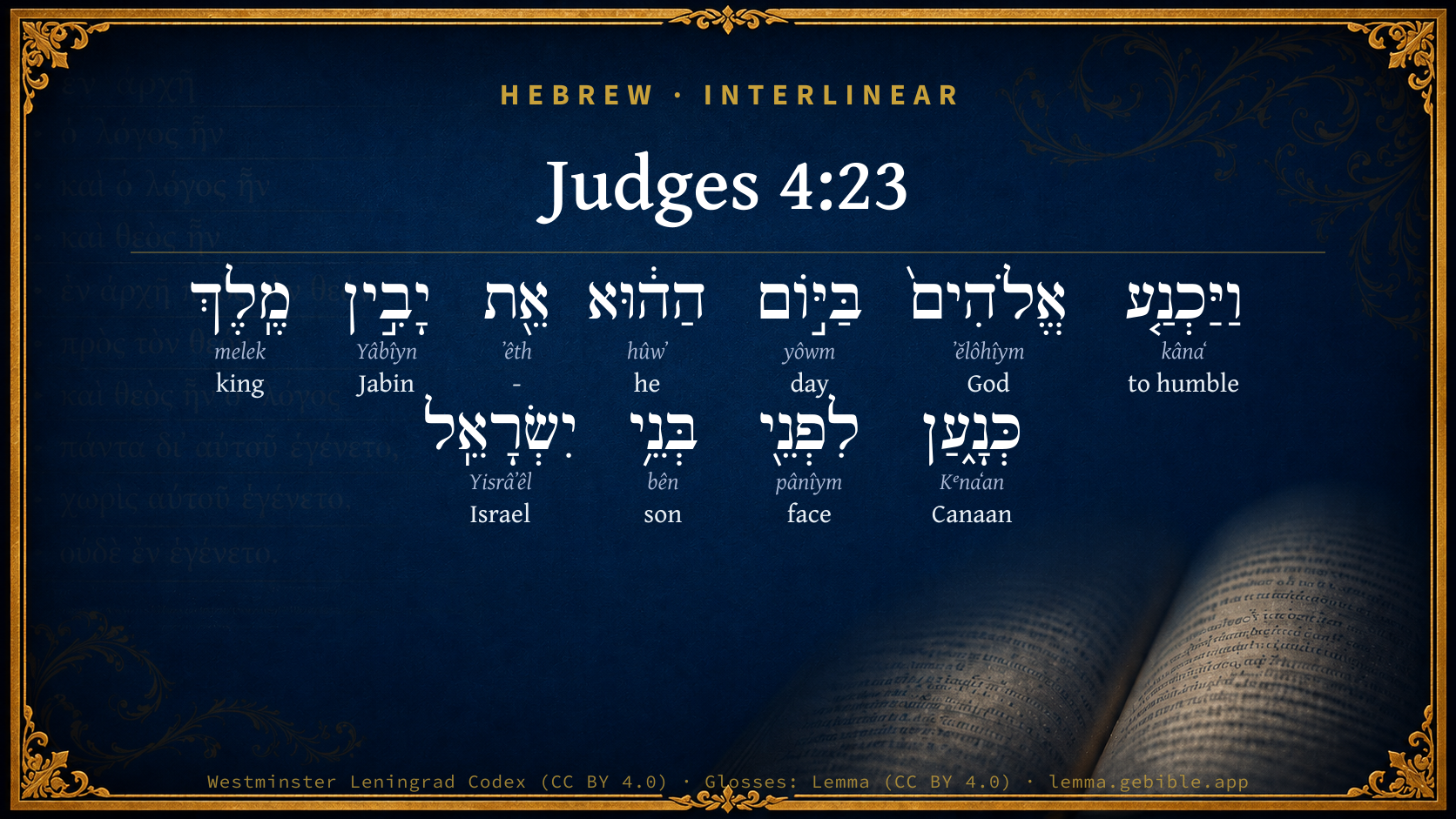
Hebrew (Westminster Leningrad Codex) Judges 4:23 appears in the Hebrew Old Testament. The text above is from the Westminster Leningrad Codex. Each word links to its Strong’s number, a concise gloss, and parsing drawn from the Open Scriptures Hebrew Bible morphology. Click any word for its full Brown-Driver-Briggs (BDB) entry.
Download image
Cite this verse

Judges 4:23 (World English Bible). Public Domain. Lemma interlinear Bible study tool, https://lemma.gebible.app/v/judges/4/23.

Show BibTeX & RIS
BibTeX
RIS
English Translation
So God subdued on that day Jabin the king of Canaan before the children of Israel.
World English Bible · Public Domain
Download a study sheet

One document with this verse’s original text, its word-by-word gloss line, the meaning frame, cross-references with their text, attributed commentary, and full source and license credits — printable, and it pastes into notes with its structure intact.

This verse Autodidact and up

Study sheet (.html) Plain text (.txt)

A passage Seminary Student

Up to 50 verses in one chapter. A passage sheet keeps up to 6 commentary sources and 12 cross-references per verse, in the order this page ranks them, and says so on the sheet whenever that leaves anything out. Ask for a single verse and you get the Autodidact verse sheet above.

Everything on this page stays free to read, with no account — the sheet is a download of what is already on screen, not access to it.

Want to remove ads? Support Godless Engineer
Compare translations 3

The same verse in 3 English versions, stacked beneath the original-language interlinear above. Click any original word for its lexicon entry.

Each is an independent rendering of the whole verse — the interlinear is not word-aligned to these translations.

Highlighted words mark where these versions differ — a whole-verse word diff, not a word-by-word alignment.

  • World English Bible Public Domain
    So God subdued on that day Jabin the king of Canaan before the children of Israel.
  • King James Version Public Domain
    So God subdued on that day Jabin the king of Canaan before the children of Israel.
  • unfoldingWord Literal Text CC BY-SA 4.0
    So on that day God subdued Jabin, the king of Canaan, to the face of the sons of Israel.

unfoldingWord Literal Text — © unfoldingWord, licensed CC BY-SA 4.0. Word-aligned USFM3 via Door43 (git.door43.org/unfoldingWord/en_ult).

Versions to compare (up to 4)

3 of 4 selected

Show all 18 translations

Every available English version of this verse, each an independent rendering of the whole verse.

  • World English Bible Public Domain
    So God subdued on that day Jabin the king of Canaan before the children of Israel.
  • Berean Standard Bible Public Domain
    On that day God subdued Jabin king of Canaan before the Israelites.
  • Majority Standard Bible Public Domain
    On that day God subdued Jabin king of Canaan before the Israelites.
  • King James Version Public Domain
    So God subdued on that day Jabin the king of Canaan before the children of Israel.
  • American Standard Version (1901) Public Domain
    So God subdued on that day Jabin the king of Canaan before the children of Israel.
  • Revised Version (1885) Public Domain
    So God subdued on that day Jabin the king of Canaan before the children of Israel.
  • Geneva Bible (1599) Public Domain
    So God brought downe Iabin the King of Canaan that day before the children of Israel.
  • Douay-Rheims (1899) Public Domain
    So God that day humbled Jabin the king of Chanaan before the children of Israel:
  • Young's Literal Translation Public Domain
    And God humbleth on that day Jabin king of Canaan before the sons of Israel,
  • Literal Standard Version CC BY-SA 4.0
    And God humbles Jabin king of Canaan before the sons of Israel on that day,
  • Unlocked Literal Bible CC BY-SA 4.0
    So on that day God defeated Jabin, the king of Canaan, before the people of Israel.
  • unfoldingWord Literal Text CC BY-SA 4.0
    So on that day God subdued Jabin, the king of Canaan, to the face of the sons of Israel.
  • Darby Bible Public Domain
    So on that day God subdued Jabin the king of Canaan before the people of Israel.
  • World Messianic Bible Public Domain
    So God subdued Jabin the king of Canaan before the children of Israel on that day.
  • Webster's Bible Public Domain
    So God subdued on that day Jabin the king of Canaan before the children of Israel.
  • Free Bible Version CC BY-SA 4.0
    That day God defeated Jabin, king of Canaan, in the presence of the Israelites.
  • Bible in Basic English Public Domain
    So that day God overcame Jabin, king of Canaan, before the children of Israel.
  • JPS Tanakh (1917) Public Domain
    So God subdued on that day Jabin the king of Canaan before the children of Israel.

Literal Standard Version (2020), Covenant Press — licensed CC BY-SA 4.0. Text via the HelloAO Bible API (eBible.org). Unlocked Literal Bible (unfoldingWord) — licensed CC BY-SA 4.0. Text via the HelloAO Bible API (eBible.org). unfoldingWord Literal Text — © unfoldingWord, licensed CC BY-SA 4.0. Word-aligned USFM3 via Door43 (git.door43.org/unfoldingWord/en_ult). Free Bible Version, Dr. Jonathan Gallagher — licensed CC BY-SA 4.0. Text via the HelloAO Bible API (eBible.org).

Word by word

More ways to search: Search by grammar → Find every occurrence → Compare this word →

Practice this passage: Drill this verse → Learn its vocabulary →

יָבִ֣ין
Yâbîyn
H2985
“Jabin”
Noun, Proper
Part of Speech
Noun
Type
Proper
Full BDB Definition

Origin: from H995

TWOT: None

Jabin = "whom God observes" - a king of Hazor who organised a confederacy of the northern princes against Joshua; confederacy routed by the waters of Merom - another king of Hazor whose general, Sisera, was defeated by Barak
  1. וַיַּכְנַ֤ע kânaʻ H3665 “and · to humble” Conjunction + Verb, Hiphil, Sequential Imperfect, 3rd Person, Masculine, Singular
  2. אֱלֹהִים֙ ʼĕlôhîym H430 “God(s)” Noun, Common, Masculine, Plural, Absolute
  3. בַּיּ֣וֹם yôwm H3117 “in/at the · day” Preposition, Determined + Noun, Common, Masculine, Singular, Absolute
  4. הַה֔וּא hûwʼ H1931 “the · he” Particle, Definite Article + Pronoun, Personal, 3rd Person, Masculine, Singular
  5. אֵ֖ת ʼêth H853 “-” Particle, Direct Object
  6. מֶֽלֶךְ melek H4428 “king of” Noun, Common, Masculine, Singular, Construct
  7. כְּנָ֑עַן Kᵉnaʻan H3667 “Canaan” Noun, Proper
  8. לִפְנֵ֖י pânîym H6440 “to/for · face(s) of” Preposition + Noun, Common, Both, Plural, Construct
  9. בְּנֵ֥י bên H1121 “sons of” Noun, Common, Masculine, Plural, Construct
  10. יִשְׂרָאֵֽל Yisrâʼêl H3478 “Israel” Noun, Proper

About this verse

These counts appear in no published source. They are computed here, from the morphology-tagged text and Lemma’s own curated glosses. What Lemma adds →

11
words
11
distinct lemmas
Historical
section

Notable vocabulary

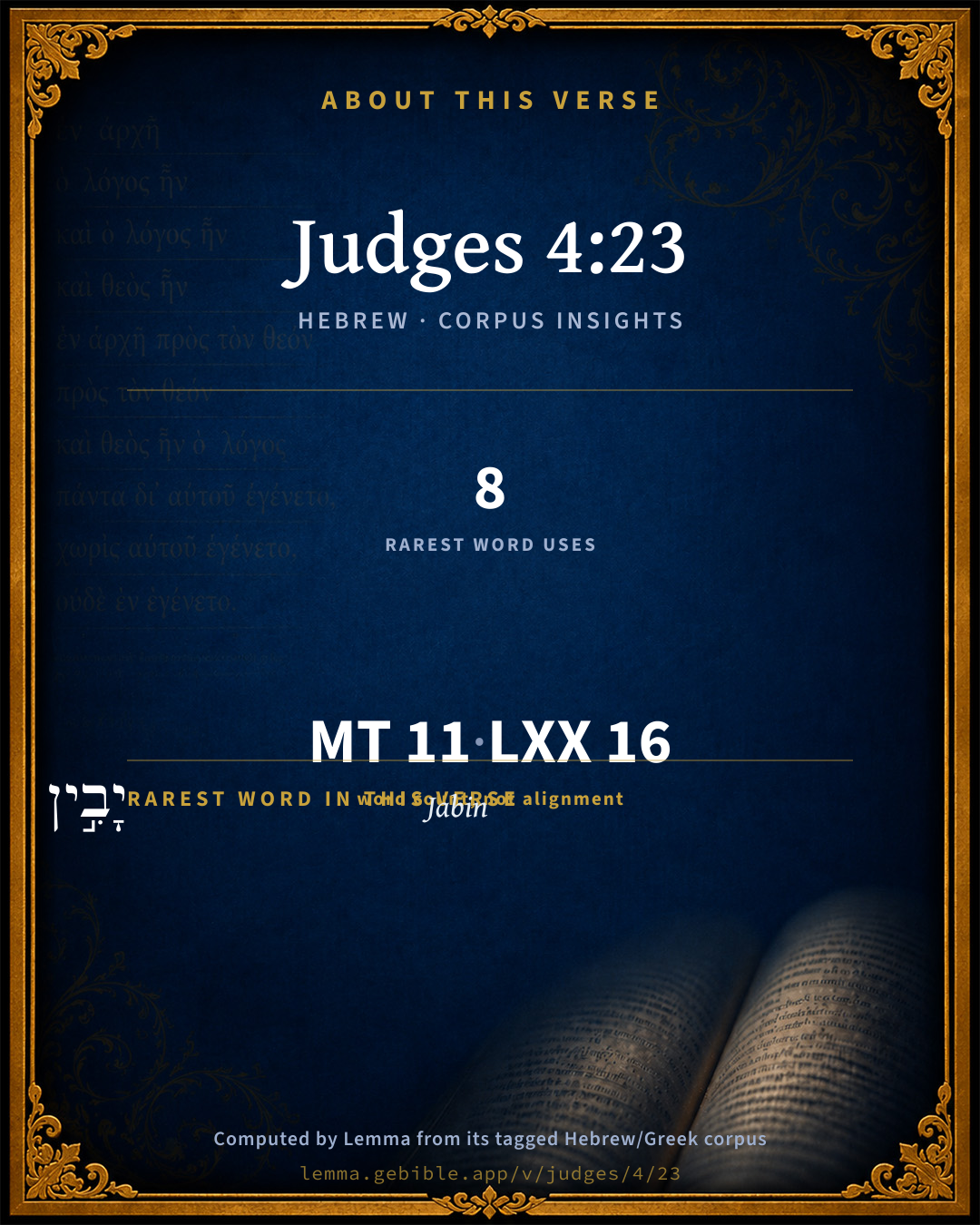
The rarest word here is יָבִ֣ין Jabin H2985 — appearing just 8 times in the whole Hebrew Bible.

Shared distinctive vocabulary

יָבִ֣ין Jabin H2985 occurs in 7 verses of the Hebrew Bible. Also found in:

Grammatical profile

  • 1 verb
  • 8 nouns
  • 1 pronoun
  • 1 particle

Verb forms

  • וַיַּכְנַ֤ע Hiphil · Sequential Imperfect

Hebrew & Septuagint length

In English translation the verse runs 16 words from the Hebrew and 15 from the Septuagint (LXX English) — closely comparable.

A rough comparison of the two English renderings, which tokenize alike — not a word-level alignment.

Word counts can differ between the Hebrew and the Greek without any difference in meaning — e.g. the Hebrew direct-object marker אֵת has no separate Greek word, and Greek often adds the article ὁ.

In the original languages it is 11 Hebrew tokens and 16 Greek tokens — but the two are counted differently (Hebrew bundles its prefixes and suffixes into one token; the Greek is in lemma form), so that isn’t a like-for-like length.

Cross-references

8

Topical passages linked to Judges 4:23 in the Treasury of Scripture Knowledge — connected by theme and wording, ordered by reader-vote popularity; previews shown in the World English Bible.

  • Nehemiah 9:24 So the children went in and possessed the land, and you subdued before them the inhabitants of the land, the Canaanites, and gave them into their hands, with their kings, and the peoples of the land, that they might do with them as they would.
  • Psalms 18:47 Even the God who executes vengeance for me, And subdues peoples under me.
  • Psalms 18:39 For you have girded me with strength to the battle. You have subdued under me those who rose up against me.
  • 1 Chronicles 22:18 Isn't Yahweh your God with you? Hasn't he given you rest on every side? for he has delivered the inhabitants of the land into my hand; and the land is subdued before Yahweh, and before his people.
  • Psalms 47:3 He subdues nations under us, And peoples under our feet.
  • Psalms 81:14 I would soon subdue their enemies, And turn my hand against their adversaries.
  • 1 Corinthians 15:28 When all things have been subjected to him, then the Son will also himself be subjected to him who subjected all things to him, that God may be all in all.
  • Hebrews 11:33 who, through faith subdued kingdoms, worked out righteousness, obtained promises, stopped the mouths of lions,

Cross-references courtesy of OpenBible.info (CC BY 4.0).

Hebrew and Greek witnesses Masoretic Hebrew ↔ Greek Septuagint

The same verse in the two great witnesses to the Old Testament, shown verse-for-verse.

These are two independent witnesses, not word-aligned to each other, and the Septuagint is shown in lemma (dictionary) form.

Hebrew Judges 4:23 Masoretic · Westminster Leningrad Codex

וַיַּכְנַ֤ע אֱלֹהִים֙ בַּיּ֣וֹם הַה֔וּא אֵ֖ת יָבִ֣ין מֶֽלֶךְ כְּנָ֑עַן לִפְנֵ֖י בְּנֵ֥י יִשְׂרָאֵֽל

So God subdued on that day Jabin the king of Canaan before the children of Israel.

World English Bible · Public Domain

Greek LXX Judges 4:23 Septuagint · lemma form

καί τροπόω ὁ θεός ἐν ὁ ἡμέρα ἐκεῖνος ὁ ιαβιν βασιλεύς χανααν ἔμπροσθεν ὁ υἱός ἰσραήλ

So God routed Jabin king of Chanaan in that day before the children of Israel.

LXX2012 (modern English Septuagint) · Public Domain

Hebrew: Westminster Leningrad Codex (CC BY 4.0). Greek: Septuagint (public domain); English from LXX2012 (modern English Septuagint) (Public Domain). How the Septuagint differs from the Hebrew →

Targum (Aramaic paraphrase)

1

The Targum is the ancient Jewish Aramaic paraphrase of the Hebrew Scriptures — an interpretive translation, not the Hebrew text itself. Onkelos (literal) and Pseudo-Jonathan (expansive) render the Torah, and Jonathan the Prophets. Coverage is partial: where no permissively-licensed English translation exists for a verse, only the Aramaic is shown. This is verse-level text, not a word-by-word alignment to the Hebrew.

  1. Targum Jonathan Prophets (Joshua–Malachi)
    וּתְבַר יְיָ בְּיוֹמָא הַהוּא יַת יָבִין מַלְכָּא דִכְנָעַן קֳדָם בְּנֵי יִשְׂרָאֵל:

    (no public-domain English translation for this verse)

    Targum Jonathan — Aramaic: “Mikraot Gedolot” (public domain). English: “Sefaria Community Translation” (CC0 1.0 (public-domain dedication)); “London "Chaldee Paraphrase," 1871” (public domain). Text via Sefaria.

Commentary

Notes on Judges 4:23 from classic Christian and Jewish commentators (each source and its license shown beneath its notes). The classic Christian expositions comment on the surrounding passage and are grouped to its opening verse, so a note may address several verses; the Jewish commentaries on the Tanakh (Rashi and others) are per-verse, so they appear only where the commentator wrote on this verse.

Lemma curates 59 commentaries, every one of them public domain or Creative Commons licensed, each selected and text-cleaned for this edition rather than reprinted as found. About our sources →

Trapp's Complete Commentary

John Trapp

Jdg 4:23 So God subdued on that day Jabin the king of Canaan before the children of Israel.

Ver. 23. So God subdued on that day Jabin.] By the death of his general and destruction of his forces. See Jdg 4:16.

John Trapp, A Commentary or Exposition upon All the Books of the Old and New Testament (1647–1656) — public domain. Text from a community e-Sword module.

The Biblical Illustrator

Joseph S. Exell

Jdg_4:23

So God subdued on that day Jabin.

A great victory--but Gods

I. What he did: God subdued . . . Jabin the king.

1. This is the normal issue of Gods activity. For God to act is for Him to conquer. Where the victory tarries, it is only God waiting.

2. He subdued Jabin the king of Canaan. Who is able to stand against Him?

3. Every oppressor of Gods people becomes His foe. He who molests them virtually challenges God.

II. How he did it: So.

1. By inspiring Deborah with a holy courage.

2. By arrangement. The plan of salvation is only one grand instance of the Divine order,

III. When he did it: On that day. God never miscalculates. The Eternal is never late.

1. It was as soon as they wanted it.

2. It was when they were most ready to receive it.

IV. Where he did it: Before the children of Israel.

1. There are many things which God must do out of our sight.

2. There are instances when He works by signs which are visible--Red Sea; Carmel. This victory was not only decided, but manifest. (E. M. Mouchin.)

.

The Biblical Illustrator, edited by Joseph S. Exell (c. 1880s–1900s) — public domain. Text from a community e-Sword module.

Ellicott's Commentary for English Readers

(23) So God subdued.—The word used for God is here Elohim, while Jehovah occurs through the rest of the narrative. We are not yet in a position to formulate the law which regulates the interchange of these names. It need hardly be added that this attribution of the deliverance of Israel to God’s providence and aid does not necessarily involve the least approval of the false and cruel elements which stained the courage and faith of Jael. Though God overrules even criminal acts to the fulfilment of His own purposes, the crimes themselves meet with their own just condemnation and retribution. This may be seen decisively in the case of Jehu. His conduct, like that of Jael, was of a mixed character. He was an instrument in the hands of God to punish and overthrow the guilty house of Ahab, and in carrying out this Divine commission, he, too, showed dauntlessness and faith, yet his atrocious cruelty is justly condemned by the voice of the prophet (Hos_1:4), just as that of Baasha had been (1Ki_16:7), though he, too, was an instrument of Divine retribution. To explain this clause, and the triumphal cry of Deborah—“So let all thine enemies perish, O Lord”—as Bishop Wordsworth does, to mean that “the work of Jael is represented by the sacred writer as the work of God,” is to claim Divine sanction for a wish that wicked or hostile powers should always “so” perish by cruel and treacherous assassination. At the same time, Jael must not be classed with women actuated only by a demoniacal thirst for vengeance, like Criemhild, in the Niebelungen; or even with Aretophila, of Cyrene, whom Plutarch so emphatically praises (On the Virtues of Women, p. 19, quoted by Cassel); but rather with women like Judith in ancient, or Charlotte Corday in modern times, who regarded themselves as the champions of a great and good cause.

A Bible Commentary for English Readers, edited by Charles John Ellicott (1878–1897) — public domain. Text from a community e-Sword module.

John Gill's Exposition

So God subdued on that day Jabin king of Canaan before the children, of Israel. Freed Israel from subjection to him and delivered him into the hands of the Israelites; for Josephus (o) says, that as Barak went towards Hazor, he met Jabin, and slew him; who perhaps having heard of the defeat of his army under Sisera, came forth with another against Israel, which being overcome by them, he was slain, and the city utterly destroyed, as the same writer says; but by what follows it seems rather that the total conquest of him was afterwards and gradually accomplished.

(o) Antiqu. l. 5. c. 5. sect. 4.

John Gill's Exposition of the Whole Bible (1746–1763) — public domain (CC PDM 1.0). Text via the HelloAO Bible API.

Haydock's Catholic Bible Commentary

Humbled Jabin, though he was not present in this battle. The Israelites followed up the victory, and presently brought their late oppressor to ruin, that all might confess, none could resist their power, when God was propitious to them; as, on the other hand, the most feeble state was able to reduce them to servitude, when they proved rebellious. (Haydock)

George Leo Haydock (1774–1849), Haydock's Catholic Family Bible and Commentary, 1859 edition — public domain. Excludes Psalms (Douay-Rheims chapter numbering differs from Protestant) and Deuterocanonical books (Catholic canon only).

Keil & Delitzsch

C. F. Keil & F. Delitzsch

"So God subdued at that time Jabin the king of Canaan before the children of Israel; and the hand of the Israelites became heavier and heavier in its pressure upon him, until they had destroyed him." וקשׁה הלוך ... יד ותּלך, "the hand ... increased more and more, becoming heavy." הלך, used to denote the progress or continual increase of an affair, as in Gen 8:3, etc., is connected with the infinitive absolute, and with the participle of the action concerned. קשׁה is the feminine participle of קשׁה, like גּדל in Gen 26:13 (see Ges. 131, 3, Anm. 3). The overthrow of Jabin and his rule did not involve the extermination of the Canaanites generally.

Keil & Delitzsch — Biblical Commentary on the Old Testament (1861–1891) — public domain (CC PDM 1.0). Text via the HelloAO Bible API. (Old Testament only.)

unfoldingWord translationNotes

Door43 World Missions Community

God defeated Jabin, the king of Canaan, before the people of Israel

God causing the Israelites to defeat Jabin and his army is spoken of as is God himself defeated Jabin as the people of Israel watched. (See: Metaphor)

The might

"The military power"

they destroyed him

Here "him" refers to Jabin who represents himself and his army. AT: "they destroyed Jabin and his army" (See: Synecdoche)

translationWords

God

king

Canaan

Israel

might

unfoldingWord translationNotes — © Distant Shores Media and the Door43 World Missions Community, licensed CC BY-SA 4.0. Source: git.door43.org/Door43/en_tn.

Lesson kit

Teaching starters — assembled from the data on this page, not authored interpretation. Every prompt links to the verse data it draws on. Edit before teaching.

Judges, in the Historical, opens this verse with 11 words (11 distinct Hebrew lemmas). Its most distinctive word is Yâbîyn (“Jabin”). A historical commentator’s framing appears above. Read the whole chapter for the surrounding context.

Discussion questions

  1. What does “Jabin” (Yâbîyn) contribute to the verse as a whole?
  2. How does Joshua 11:1, which shares the word «Jabin», read alongside this verse?
  3. These translations render this verse differently; the difference is in the English rendering, not the original. What questions does that raise?
  4. «וַיַּכְנַ֤ע» is a Hiphil Sequential Imperfect verb. How does that grammatical form shape the action described?
  5. Compare how Trapp's Complete Commentary and The Biblical Illustrator read this verse. Where do they agree or differ?

Things to notice

Reading settings

Reading text

Shown beneath each verse's original-language words.

Old Testament
Old Testament edition

Read the OT as the Masoretic Hebrew (MT) or the Greek Septuagint (LXX).

English shown for the Greek Septuagint (in the Hebrew ↔ Greek comparison).

Comparing translations? Open the Compare panel on any verse page to stack up to four side by side.