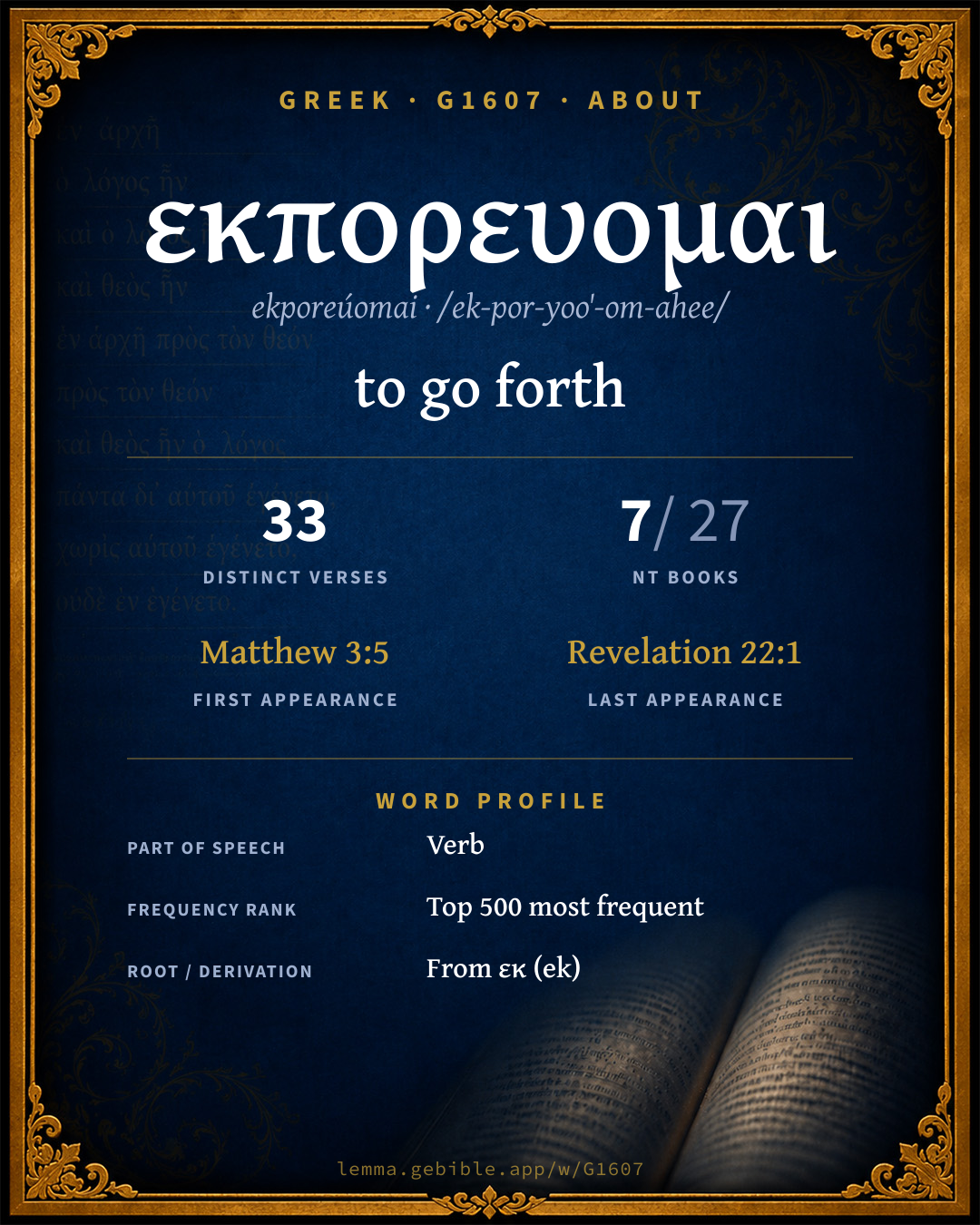
ἐκπορεύομαι
to go forth
also: go out, depart fuller range ↓
Full lexicon entry — Thayer's Greek Lexicon
From Thayer's Greek Lexicon
Where this word appears
See every Present-tense verb in the Greek New Testament →
Grammar key — what these labels mean
Part of speech
- Verb
- An action or state-of-being word.
Tense
- Present
- Ongoing or general action in present time (imperfective aspect).
- Imperfect
- Continuous or repeated action in past time (“was writing”).
- Future
- Action expected in future time.
Voice
- Middle or Passive deponent
- Middle/passive in form but active in meaning.
- Middle deponent
- Middle in form but active in meaning.
Mood
- Indicative
- States a fact or asks a factual question (the mood of reality).
- Participle
- A verbal adjective (“writing,” “having written”).
- Infinitive
- A verbal noun (“to write”), unmarked for person or number.
- Imperative
- Expresses a command or request.
Case
- Genitive
- The case of source, possession, or “of” — answers “whose / from what.”
- Dative
- The case of the indirect object, means, or location — “to / for / with / in.”
- Nominative
- The case of the subject (and the predicate nominative).
- Accusative
- The case of the direct object and of extent.
Person
- 3rd person
- The one spoken about (“he / she / it / they”).
Gender
- Masculine
- Grammatically masculine.
- Neuter
- Grammatically neuter.
- Feminine
- Grammatically feminine.
Number
- Singular
- One.
- Plural
- More than one.
1 distinct verse where G1607 appears in the Future tense, across 1 book. Filtered view — show all forms. Click any verse to open its interlinear word-by-word view. Verse text shown in the World English Bible for context — . Each verse’s Greek form is shown with its reference; the English is not keyword-highlighted, since the data carries no word-level English alignment. Use “Compare translations” on any verse to read it across multiple English versions. This concordance covers the Greek New Testament; Septuagint (Greek Old Testament) occurrences of this word are not indexed here.
John 1 verse
About this entry
At a glance — auto-summarized from this page’s data, not written by a person. Every figure links to its source below. This summary describes the numbers; it doesn’t interpret them.
The Greek verb εκπορευομαι centers on the idea of “to go forth.” Debuting at Matthew 3:5, it then recurs through the corpus. Spanning 33 verses in 7 books, it ranks among the moderately common words of the Greek New Testament. Mark dominates its distribution — 11 of 33 verses. Thayer's distinguishes 2 senses; alongside “to go forth” it spans “go out” and “depart”. Dig into 33-verse concordance and the renderings breakdown below.
Gloss history
Strong's 1890 vs modern scholarship

About this word
Strong's G1607 catalogs a Greek word from the Greek New Testament.
These counts are not copied from any lexicon or concordance. They are computed here, from the morphology-tagged Greek New Testament. What Lemma adds →
- 33
- distinct verses
- The word appears in 33 distinct verses.
- 7 / 27
- NT books
- The word appears in 7 of 27 New Testament books.
- #433
- by frequency
- Top 500 most frequent Greek words (rank 433 of 5,347 Greek words by occurrence).
View all 33 occurrences in the concordance →
Most concentrated in
- Mark 11 verses 33%
- Revelation 8 verses 24%
- Matthew 5 verses 15%
By section of the New Testament
By traditional corpus
Conventional, traditional groupings — biblical authorship is debated, so this is a traditional corpus grouping, not an authorship claim. Some books belong to more than one corpus (Luke is in both the Gospels and the Lukan corpus, and so on), so these shares overlap and need not total 100%. Each figure is a share of the word’s 33 distinct verses.
- Gospels 21 verses · 64%
- Johannine 10 verses · 30%
- Revelation 8 verses · 24%
- Lukan (Luke–Acts) 6 verses · 18%
- Pauline corpus 1 verse · 3%
How translations render this word
Counts come from each version’s own published word-to-Strong’s tagging or interlinear alignment — an approximate guide to how each version renders this word, not a word-level alignment the data otherwise carries. Because each total is that version’s own tagged count, the per-version totals vary from one another and need not match the appearance or distinct-verse counts above. These counts may also differ from a printed concordance because Lemma counts each distinctly tagged rendering and does not collapse phrase taggings into a single head-word total. This is a fixed set of word-tagged versions (KJV, ASV, BSB, ULT) and does not change with the reading translation you choose elsewhere. Each version’s license is shown beside its name below (and on Sources).
- King James Version: Proceed 3×, Proceedeth 3×, Went 3×
- American Standard Version: Proceedeth 5×, Proceed 4×, Went out 4×
- Berean Standard Bible: Come 5×, Came 3×, Comes 3×
- unfoldingWord Literal Text: Come out 5×, Going out 5×, Coming out 3×
King James Version Public Domain
Renders G1607 across 35 tagged occurrences — most commonly:
Plus 15 renderings that appear only once — usually multi-word phrases or single function words the recovered tagging swept in, not distinct renderings. Not rendered by a distinct English word in 1 further occurrence.
American Standard Version Public Domain
Renders G1607 across 32 tagged occurrences — most commonly:
Plus 12 renderings that appear only once — usually multi-word phrases or single function words the recovered tagging swept in, not distinct renderings.
Berean Standard Bible Public Domain
Renders G1607 across 32 tagged occurrences — most commonly:
Plus 12 renderings that appear only once — usually multi-word phrases or single function words the recovered tagging swept in, not distinct renderings. Not rendered by a distinct English word in 1 further occurrence.
unfoldingWord Literal Text CC BY-SA 4.0
Renders G1607 across 38 tagged occurrences — most commonly:
Plus 14 renderings that appear only once — usually multi-word phrases or single function words the recovered tagging swept in, not distinct renderings.
Senses in Thayer's
The 2 senses Thayer's distinguishes for this word, in lexicon order (not ranked by frequency or importance). The full entry — with sub-senses — is in the Lexicon Entry tab.
- to go forth, go out, depart
- metaph.
Word origin
Derived from εκ (ek) (G1537) — from.
Forms in the corpus
The 17 distinct written forms G1607 takes in the Greek New Testament, most frequent first — each parse links to that tense’s occurrences in the concordance.
Same root — word family
Other Thayer's entries built from the same root as G1607, grouped by Strong’s listed origin. These share a root / origin per the lexicon — not necessarily a shared meaning. Each links to that word’s own entry.
Derives from
Shares the same root
- εκβαλλω ekbállō G1544 to cast out
- εκβασις ékbasis G1545 exit
- εκγαμιζω ekgamízō G1547 to give in marriage
- εκγαμισκω ekgamískō G1548 to give in marriage
- εκγονον ékgonon G1549 offspring
- εκδαπαναω ekdapanáō G1550 to spend
- εκδεχομαι ekdéchomai G1551 to receive
- εκδηλος ékdēlos G1552 evident
- εκδημεω ekdēméō G1553 to depart
- εκδιδωμι ekdídōmi G1554 to give out
- εκδιηγεομαι ekdiēgéomai G1555 to relate
- εκδικος ékdikos G1558 without justice
- εκδιωκω ekdiṓkō G1559 to banish
- εκδοτος ékdotos G1560 delivered up
- εκδυω ekdýō G1562 to put off
- εκζητεω ekzētéō G1567 to seek out
- εκθαμβος ékthambos G1569 astonished
- εκθετος ékthetos G1570 exposed
- εκκαθαιρω ekkathaírō G1571 to cleanse
- εκκαιω ekkaíō G1572 to burn
- εκκακεω ekkakéō G1573 to be exhausted
- εκκεντεω ekkentéō G1574 to pierce
- εκκλαω ekkláō G1575 to cut off
- εκκλειω ekkleíō G1576 to shut out
+88 more words share this root (not shown).
Compare all same-root words → Showing 4 of 114 — not the complete family. They share a root, not necessarily a meaning.
Septuagint usage
The same Greek word εκπορευομαι appears 148 times in the Greek Old Testament (Septuagint), across 144 verses in 22 books.
- 148
- LXX occurrences
- Tagged occurrences of this Greek word in the Septuagint.
- 144
- verses
- Distinct Septuagint verses containing this word.
- 22 / 39
- OT books
- The word appears in 22 of the 39 Old Testament books.
Sample Septuagint occurrences
- Genesis 2:10 ἐκπορεύομαι
- Exodus 5:20 ἐκπορεύομαι
- Numbers 1:3 ἐκπορεύομαι
- Deuteronomy 8:3 ἐκπορεύομαι
- Joshua 2:10 ἐκπορεύομαι
- Judges 1:24 ἐκπορεύομαι
- 1 Samuel 11:7 ἐκπορεύομαι
- 2 Samuel 16:5 ἐκπορεύομαι
- 1 Kings 2:30 ἐκπορεύομαι
- 2 Kings 11:7 ἐκπορεύομαι
- 1 Chronicles 5:18 ἐκπορεύομαι
- 2 Chronicles 15:5 ἐκπορεύομαι
Septuagint occurrences (same lexeme)
Every verse where the same Strong’s number (G1607) appears in the Greek Septuagint — showing the first 50 of 144. Verse text shown in the World English Bible for context; the Greek form is the matched word — the English is not keyword-highlighted.
- Genesis 2:10 ἐκπορεύομαι A river went out of Eden to water the garden; and from there it was parted, and became four heads.
- Genesis 24:11 ἐκπορεύομαι He made the camels kneel down outside the city by the well of water at the time of evening, the time that women go out to draw water.
- Genesis 24:13 ἐκπορεύομαι Behold, I am standing by the spring of water. The daughters of the men of the city are coming out to draw water.
- Genesis 24:15 ἐκπορεύομαι It happened, before he had done speaking, that behold, Rebekah came out, who was born to Bethuel the son of Milcah, the wife of Nahor, Abraham's brother, with her pitcher on her shoulder.
- Genesis 24:45 ἐκπορεύομαι Before I had done speaking in my heart, behold, Rebekah came forth with her pitcher on her shoulder. She went down to the spring, and drew. I said to her, 'Please let me drink.'
- Genesis 34:24 ἐκπορεύομαι All who went out of the gate of his city listened to Hamor, and to Shechem his son; and every male was circumcised, all who went out of the gate of his city.
- Exodus 5:20 ἐκπορεύομαι They met Moses and Aaron, who stood in the way, as they came forth from Pharaoh:
- Exodus 7:15 ἐκπορεύομαι Go to Pharaoh in the morning. Behold, he goes out to the water; and you shall stand by the river's bank to meet him; and the rod which was turned to a serpent you shall take in your hand.
- Exodus 13:4 ἐκπορεύομαι This day you go forth in the month Abib.
- Exodus 13:8 ἐκπορεύομαι You shall tell your son in that day, saying, 'It is because of that which Yahweh did for me when I came forth out of Egypt.'
- Exodus 14:8 ἐκπορεύομαι Yahweh hardened the heart of Pharaoh king of Egypt, and he pursued after the children of Israel; for the children of Israel went out with a high hand.
- Exodus 16:29 ἐκπορεύομαι Behold, because Yahweh has given you the Sabbath, therefore he gives you on the sixth day the bread of two days. Everyone stay in his place. Let no one go out of his place on the seventh day."
- Exodus 25:32 ἐκπορεύομαι There shall be six branches going out of its sides: three branches of the lampstand out of its one side, and three branches of the lampstand out of its other side;
- Exodus 25:33 ἐκπορεύομαι three cups made like almond blossoms in one branch, a bud and a flower; and three cups made like almond blossoms in the other branch, a bud and a flower, so for the six branches going out of the lampstand;
- Exodus 25:35 ἐκπορεύομαι and a bud under two branches of one piece with it, and a bud under two branches of one piece with it, and a bud under two branches of one piece with it, for the six branches going out of the lampstand.
- Exodus 33:7 ἐκπορεύομαι Now Moses used to take the tent and to pitch it outside the camp, far away from the camp, and he called it "The tent of meeting." It happened that everyone who sought Yahweh went out to the tent of meeting, which was outside the camp.
- Exodus 33:11 ἐκπορεύομαι Yahweh spoke to Moses face to face, as a man speaks to his friend. He turned again into the camp, but his servant Joshua, the son of Nun, a young man, didn't depart out of the Tent.
- Exodus 34:34 ἐκπορεύομαι But when Moses went in before Yahweh to speak with him, he took the veil off, until he came out; and he came out, and spoke to the children of Israel that which he was commanded.
- Exodus 40:17 ἐκπορεύομαι It happened in the first month in the second year, on the first day of the month, that the tent was raised up.
- Numbers 1:3 ἐκπορεύομαι from twenty years old and upward, all who are able to go out to war in Israel. You and Aaron shall number them by their divisions.
- Numbers 1:20 ἐκπορεύομαι The children of Reuben, Israel's firstborn, their generations, by their families, by their fathers' houses, according to the number of the names, one by one, every male from twenty years old and upward, all who were able to go out to war;
- Numbers 1:22 ἐκπορεύομαι Of the children of Simeon, their generations, by their families, by their fathers' houses, those who were numbered of it, according to the number of the names, one by one, every male from twenty years old and upward, all who were able to go out to war;
- Numbers 1:24 ἐκπορεύομαι Of the children of Gad, their generations, by their families, by their fathers' houses, according to the number of the names, from twenty years old and upward, all who were able to go out to war;
- Numbers 1:26 ἐκπορεύομαι Of the children of Judah, their generations, by their families, by their fathers' houses, according to the number of the names, from twenty years old and upward, all who were able to go out to war;
- Numbers 1:28 ἐκπορεύομαι Of the children of Issachar, their generations, by their families, by their fathers' houses, according to the number of the names, from twenty years old and upward, all who were able to go out to war;
- Numbers 1:30 ἐκπορεύομαι Of the children of Zebulun, their generations, by their families, by their fathers' houses, according to the number of the names, from twenty years old and upward, all who were able to go out to war;
- Numbers 1:32 ἐκπορεύομαι Of the children of Joseph, of the children of Ephraim, their generations, by thir families, by their fathers' houses, according to the number of the names, from twenty years old and upward, all who were able to go out to war;
- Numbers 1:34 ἐκπορεύομαι Of the children of Manasseh, their generations, by their families, by their fathers' houses, according to the number of the names, from twenty years old and upward, all who were able to go out to war;
- Numbers 1:36 ἐκπορεύομαι Of the children of Benjamin, their generations, by their families, by their fathers' houses, according to the number of the names, from twenty years old and upward, all who were able to go out to war;
- Numbers 1:38 ἐκπορεύομαι Of the children of Dan, their generations, by their families, by their fathers' houses, according to the number of the names, from twenty years old and upward, all who were able to go forth to war;
- Numbers 1:40 ἐκπορεύομαι Of the children of Asher, their generations, by their families, by their fathers' houses, according to the number of the names, from twenty years old and upward, all who were able to go forth to war;
- Numbers 1:42 ἐκπορεύομαι Of the children of Naphtali, their generations, by their families, by their fathers' houses, according to the number of the names, from twenty years old and upward, all who were able to go forth to war;
- Numbers 1:45 ἐκπορεύομαι So all those who were numbered of the children of Israel by their fathers' houses, from twenty years old and upward, all who were able to go out to war in Israel;
- Numbers 12:12 ἐκπορεύομαι Let her not, I pray, be as one dead, of whom the flesh is half consumed when he comes out of his mother's womb.
- Numbers 26:2 ἐκπορεύομαι Take the sum of all the congregation of the children of Israel, from twenty years old and upward, by their fathers' houses, all who are able to go forth to war in Israel.
- Numbers 31:27 ἐκπορεύομαι and divide the prey into two parts: between the men skilled in war, who went out to battle, and all the congregation.
- Numbers 31:28 ἐκπορεύομαι Levy a tribute to Yahweh of the men of war who went out to battle: one soul of five hundred, [both] of the persons, and of the oxen, and of the donkeys, and of the flocks:
- Numbers 31:36 ἐκπορεύομαι The half, which was the portion of those who went out to war, was in number three hundred thirty-seven thousand five hundred sheep:
- Numbers 32:24 ἐκπορεύομαι Build you cities for your little ones, and folds for your sheep; and do that which has proceeded out of your mouth.
- Deuteronomy 8:3 ἐκπορεύομαι He humbled you, and allowed you to hunger, and fed you with manna, which you didn't know, neither did your fathers know; that he might make you know that man does not live by bread only, but by everything that proceeds out of the mouth of Yahweh does man live.
- Deuteronomy 8:7 ἐκπορεύομαι For Yahweh your God brings you into a good land, a land of brooks of water, of springs and springs, flowing forth in valleys and hills;
- Deuteronomy 11:10 ἐκπορεύομαι For the land, where you go in to possess it, isn't as the land of Egypt, from whence you came out, where you sowed your seed, and watered it with your foot, as a garden of herbs;
- Deuteronomy 23:5 ἐκπορεύομαι Nevertheless Yahweh your God wouldn't listen to Balaam; but Yahweh your God turned the curse into a blessing to you, because Yahweh your God loved you.
- Deuteronomy 23:24 ἐκπορεύομαι When you come into your neighbor's vineyard, then you may eat of grapes your fill at your own pleasure; but you shall not put any in your vessel.
- Deuteronomy 24:9 ἐκπορεύομαι Remember what Yahweh your God did to Miriam, by the way as you came forth out of Egypt.
- Deuteronomy 25:17 ἐκπορεύομαι Remember what Amalek did to you by the way as you came forth out of Egypt;
- Deuteronomy 28:6 ἐκπορεύομαι Blessed shall you be when you come in, and blessed shall you be when you go out.
- Deuteronomy 28:19 ἐκπορεύομαι Cursed shall you be when you come in, and cursed shall you be when you go out.
- Deuteronomy 31:2 ἐκπορεύομαι He said to them, I am one hundred twenty years old this day; I can no more go out and come in: and Yahweh has said to me, You shall not go over this Jordan.
- Joshua 2:10 ἐκπορεύομαι For we have heard how Yahweh dried up the water of the Red Sea before you, when you came out of Egypt; and what you did to the two kings of the Amorites, who were beyond the Jordan, to Sihon and to Og, whom you utterly destroyed.
These are occurrences of the same Greek lexeme (G1607) in the Septuagint — not a translation of any one Hebrew word. The store carries no word-level Hebrew↔Greek alignment, so no Hebrew original is asserted here. Counts come from the recovered LXX Strong's tagging — high-frequency vocabulary is well covered, while rare or late forms may be untagged — so they reflect tagged occurrences and may slightly undercount.