
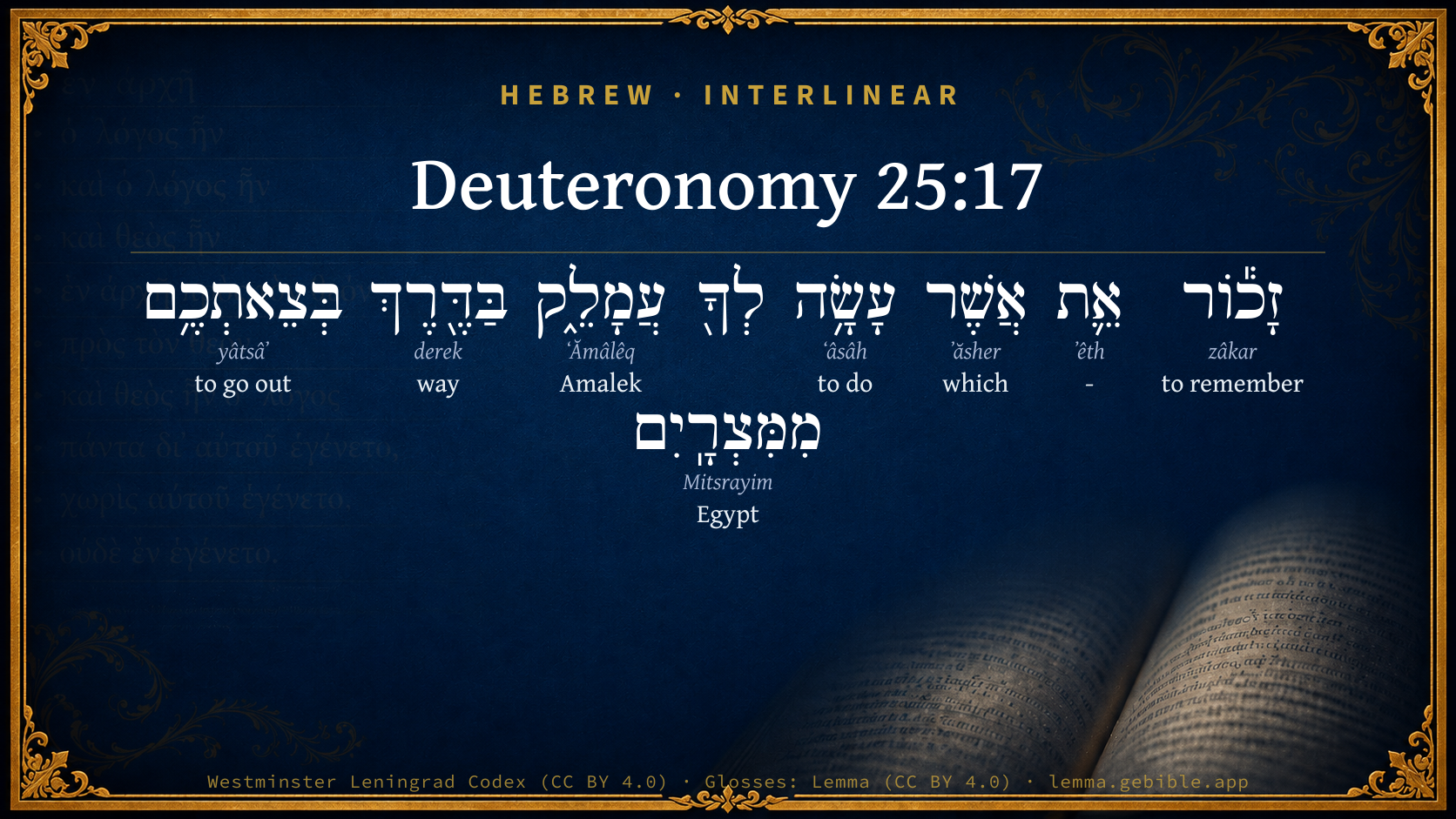
Deuteronomy 25:17

Hebrew (Westminster Leningrad Codex) Deuteronomy 25:17 appears in the Hebrew Old Testament. The text above is from the Westminster Leningrad Codex. Each word links to its Strong’s number, a concise gloss, and parsing drawn from the Open Scriptures Hebrew Bible morphology. Click any word for its full Brown-Driver-Briggs (BDB) entry.
Download image
Cite this verse

Deuteronomy 25:17 (World English Bible). Public Domain. Lemma interlinear Bible study tool, https://lemma.gebible.app/v/deuteronomy/25/17.

Show BibTeX & RIS
BibTeX
RIS
English Translation
Remember what Amalek did to you by the way as you came forth out of Egypt;
World English Bible · Public Domain
Download a study sheet

One document with this verse’s original text, its word-by-word gloss line, the meaning frame, cross-references with their text, attributed commentary, and full source and license credits — printable, and it pastes into notes with its structure intact.

This verse Autodidact and up

Study sheet (.html) Plain text (.txt)

A passage Seminary Student

Up to 50 verses in one chapter. A passage sheet keeps up to 6 commentary sources and 12 cross-references per verse, in the order this page ranks them, and says so on the sheet whenever that leaves anything out. Ask for a single verse and you get the Autodidact verse sheet above.

Everything on this page stays free to read, with no account — the sheet is a download of what is already on screen, not access to it.

Want to remove ads? Support Godless Engineer
Compare translations 3

The same verse in 3 English versions, stacked beneath the original-language interlinear above. Click any original word for its lexicon entry.

Each is an independent rendering of the whole verse — the interlinear is not word-aligned to these translations.

Highlighted words mark where these versions differ — a whole-verse word diff, not a word-by-word alignment.

  • World English Bible Public Domain
    Remember what Amalek did to you by the way as you came forth out of Egypt;
  • King James Version Public Domain
    Remember what Amalek did unto thee by the way, when ye were come forth out of Egypt;
  • unfoldingWord Literal Text CC BY-SA 4.0
    Remember what Amalek did to you on the road as you came out from Egypt,

unfoldingWord Literal Text — © unfoldingWord, licensed CC BY-SA 4.0. Word-aligned USFM3 via Door43 (git.door43.org/unfoldingWord/en_ult).

Versions to compare (up to 4)

3 of 4 selected

Show all 18 translations

Every available English version of this verse, each an independent rendering of the whole verse.

  • World English Bible Public Domain
    Remember what Amalek did to you by the way as you came forth out of Egypt;
  • Berean Standard Bible Public Domain
    Remember what the Amalekites did to you along your way from Egypt,
  • Majority Standard Bible Public Domain
    Remember what the Amalekites did to you along your way from Egypt,
  • King James Version Public Domain
    Remember what Amalek did unto thee by the way, when ye were come forth out of Egypt;
  • American Standard Version (1901) Public Domain
    Remember what Amalek did unto thee by the way as ye came forth out of Egypt;
  • Revised Version (1885) Public Domain
    Remember what Amalek did unto thee by the way as ye came forth out of Egypt;
  • Geneva Bible (1599) Public Domain
    Remember what Amalek did vnto thee by the way, when ye were come out of Egypt:
  • Douay-Rheims (1899) Public Domain
    Remember what Amalec did to thee in the way when thou camest out of Egypt:
  • Young's Literal Translation Public Domain
    `Remember that which Amalek hath done to thee in the way, in your going out from Egypt,
  • Literal Standard Version CC BY-SA 4.0
    Remember that which Amalek has done to you in the way in your going out from Egypt,
  • Unlocked Literal Bible CC BY-SA 4.0
    Call to mind what Amalek did to you on the road as you came out of Egypt,
  • unfoldingWord Literal Text CC BY-SA 4.0
    Remember what Amalek did to you on the road as you came out from Egypt,
  • Darby Bible Public Domain
    Remember what Amalek did unto thee on the way, when ye came forth out of Egypt;
  • World Messianic Bible Public Domain
    Remember what Amalek did to you by the way as you came out of Egypt,
  • Webster's Bible Public Domain
    Remember what Amalek did to thee by the way, when ye had come forth from Egypt;
  • Free Bible Version CC BY-SA 4.0
    Remember what the Amalekites did to you on your way out of Egypt.
  • Bible in Basic English Public Domain
    Keep in mind what Amalek did to you on your way from Egypt;
  • JPS Tanakh (1917) Public Domain
    Remember what Amalek did unto thee by the way as ye came forth out of Egypt;

Literal Standard Version (2020), Covenant Press — licensed CC BY-SA 4.0. Text via the HelloAO Bible API (eBible.org). Unlocked Literal Bible (unfoldingWord) — licensed CC BY-SA 4.0. Text via the HelloAO Bible API (eBible.org). unfoldingWord Literal Text — © unfoldingWord, licensed CC BY-SA 4.0. Word-aligned USFM3 via Door43 (git.door43.org/unfoldingWord/en_ult). Free Bible Version, Dr. Jonathan Gallagher — licensed CC BY-SA 4.0. Text via the HelloAO Bible API (eBible.org).

Word by word

More ways to search: Search by grammar → Find every occurrence → Compare this word →

Practice this passage: Drill this verse → Learn its vocabulary →

About this verse

These counts appear in no published source. They are computed here, from the morphology-tagged text and Lemma’s own curated glosses. What Lemma adds →

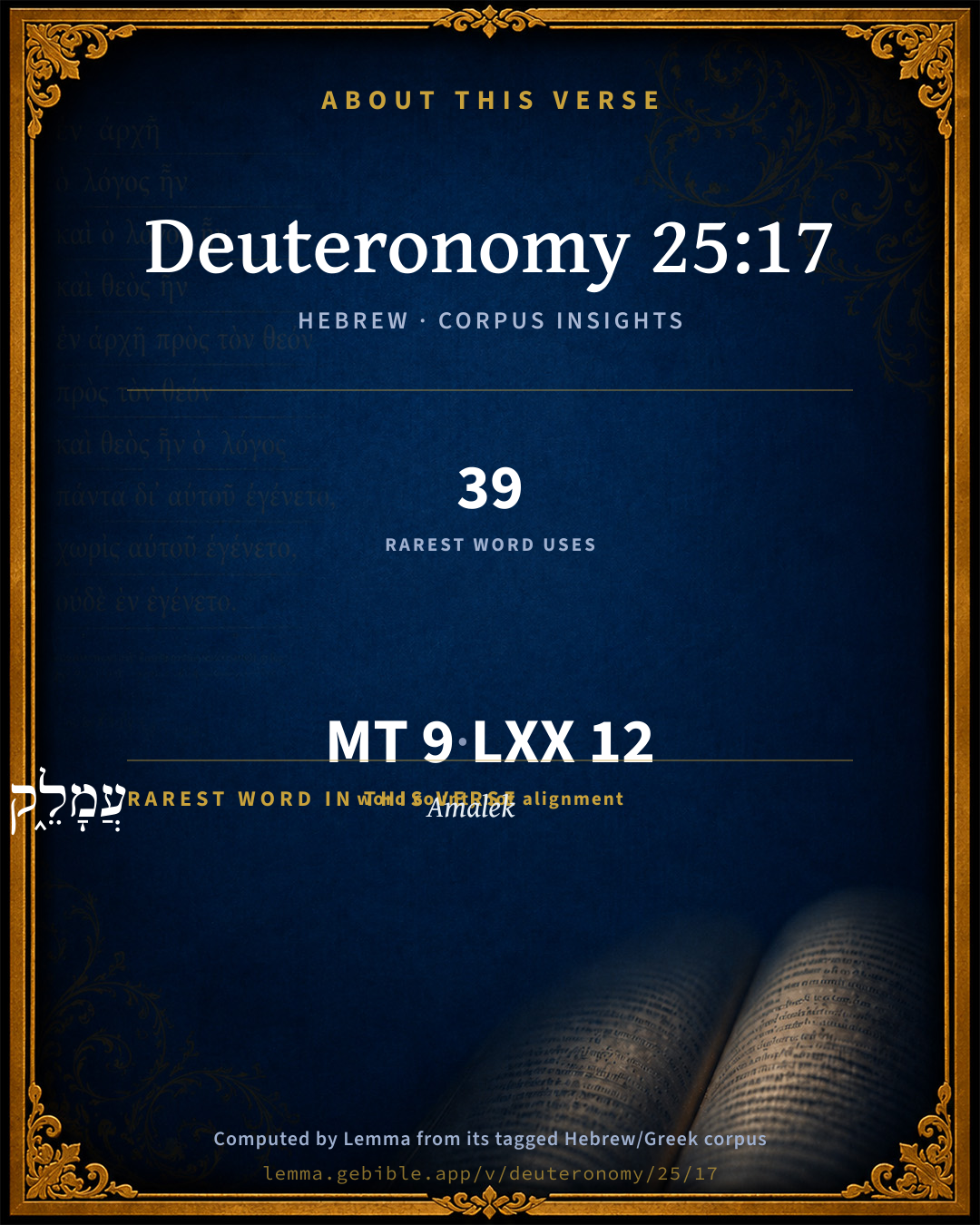
9
words
8
distinct lemmas
Pentateuch
section

Shared distinctive vocabulary

עֲמָלֵ֑ק Amalek H6002 occurs in 37 verses of the Hebrew Bible. Also found in:

Grammatical profile

  • 3 verbs
  • 3 nouns
  • 1 preposition
  • 2 particles

Verb forms

  • זָכ֕וֹר Qal · Infinitive Absolute
  • עָשָׂ֥ה Qal · Perfect
  • בְּצֵאתְכֶ֥ם Qal · Infinitive Construct

Hebrew & Septuagint length

In English translation the verse runs 16 words from the Hebrew and 20 from the Septuagint (LXX English) — closely comparable.

A rough comparison of the two English renderings, which tokenize alike — not a word-level alignment.

Word counts can differ between the Hebrew and the Greek without any difference in meaning — e.g. the Hebrew direct-object marker אֵת has no separate Greek word, and Greek often adds the article ὁ.

In the original languages it is 9 Hebrew tokens and 12 Greek tokens — but the two are counted differently (Hebrew bundles its prefixes and suffixes into one token; the Greek is in lemma form), so that isn’t a like-for-like length.

Cross-references

3

Topical passages linked to Deuteronomy 25:17 in the Treasury of Scripture Knowledge — connected by theme and wording, ordered by reader-vote popularity; previews shown in the World English Bible.

  • Exodus 17:8–16 Then Amalek came and fought with Israel in Rephidim.
  • Numbers 24:20 He looked at Amalek, and took up his parable, and said, Amalek was the first of the nations; But his latter end shall come to destruction.
  • Numbers 25:17–18 Vex the Midianites, and strike them;

Cross-references courtesy of OpenBible.info (CC BY 4.0).

Hebrew and Greek witnesses Masoretic Hebrew ↔ Greek Septuagint

The same verse in the two great witnesses to the Old Testament, shown verse-for-verse.

These are two independent witnesses, not word-aligned to each other, and the Septuagint is shown in lemma (dictionary) form.

Hebrew Deuteronomy 25:17 Masoretic · Westminster Leningrad Codex

זָכ֕וֹר אֵ֛ת אֲשֶׁר עָשָׂ֥ה לְךָ֖ עֲמָלֵ֑ק בַּדֶּ֖רֶךְ בְּצֵאתְכֶ֥ם מִמִּצְרָֽיִם

Remember what Amalek did to you by the way as you came forth out of Egypt;

World English Bible · Public Domain

Greek LXX Deuteronomy 25:17 Septuagint · lemma form

μιμνήσκω ὅσος ποιέω σύ αμαληκ ἐν ὁ ὁδός ἐκπορεύομαι σύ ἐκ αἴγυπτος

Remember what things Amalec did to you by the way, when you went forth out of the land of Egypt:

LXX2012 (modern English Septuagint) · Public Domain

On this verse, The Cambridge Bible for Schools and Colleges discusses the Septuagint’s reading. Read the note in Commentary ↓

Hebrew: Westminster Leningrad Codex (CC BY 4.0). Greek: Septuagint (public domain); English from LXX2012 (modern English Septuagint) (Public Domain). How the Septuagint differs from the Hebrew →

Targum (Aramaic paraphrase)

2

The Targum is the ancient Jewish Aramaic paraphrase of the Hebrew Scriptures — an interpretive translation, not the Hebrew text itself. Onkelos (literal) and Pseudo-Jonathan (expansive) render the Torah, and Jonathan the Prophets. Coverage is partial: where no permissively-licensed English translation exists for a verse, only the Aramaic is shown. This is verse-level text, not a word-by-word alignment to the Hebrew.

  1. Targum Onkelos Torah (Genesis–Deuteronomy)
    הֲוֵי דְכִיר יָת דִי עֲבַד לָךְ עֲמָלֵק בְּאָרְחָא בְּמִפָּקְכוֹן מִמִצְרָיִם

    (no public-domain English translation for this verse)

    Targum Onkelos — Aramaic: “Onkelos Genesis” (public domain); “Onkelos Exodus” (public domain); “Onkelos Leviticus” (public domain); “Onkelos Numbers” (public domain); “Onkelos Deuteronomy” (public domain). English: “Sefaria Community Translation” (CC0 1.0 (public-domain dedication)); “J.W. Etheridge. The Targums of Onkelos and Jonathan Ben Uzziel on the Pentateuch. London: Longmans, Green, 1862” (public domain). Text via Sefaria.

  2. Targum Pseudo-Jonathan Torah (Genesis–Deuteronomy)
    הֲווֹ דְּכִירִין יַת דְּעָבָדוּ לְכוֹן דְּבֵית עֲמָלֵק בְּאָרְחָא בְּמִפַּקְכוֹן מִמִּצְרָיִם

    Keep in mind what the house of Amalek did unto you in the way, on your coming up out of Mizraim;

    Targum Pseudo-Jonathan — Aramaic: “Targum Jonathan on Genesis” (public domain); “Targum Jonathan on Exodus” (public domain); “Targum Jonathan on Leviticus” (public domain); “Targum Jonathan on Numbers” (public domain); “Targum Jonathan on Deuteronomy” (public domain). English: “The Targum of Jonathan ben Uzziel, trans. J. W. Etheridge, London, 1862” (public domain). Text via Sefaria.

Commentary

Notes on Deuteronomy 25:17 from classic Christian and Jewish commentators (each source and its license shown beneath its notes). The classic Christian expositions comment on the surrounding passage and are grouped to its opening verse, so a note may address several verses; the Jewish commentaries on the Tanakh (Rashi and others) are per-verse, so they appear only where the commentator wrote on this verse.

Lemma curates 59 commentaries, every one of them public domain or Creative Commons licensed, each selected and text-cleaned for this edition rather than reprinted as found. About our sources →

Ellicott's Commentary for English Readers

Deu_25:17-19. AMALEK TO BE EXTERMINATED.

At the end of all the precepts of humanity, the extermination of that people which is presented to us as the incarnation of inhumanity is decreed.

(18) He . . . smote the hindmost . . .—These details are not given in Exodus 17. Amalek’s attack follows the appearance of the stream of water from Horeb. There was nothing more natural than that the faint and weary should stay behind at the water side. There the Amalekites appear to have found them and cruelly massacred them.

(19) Thou shalt blot out the remembrance of Amalek.—This decree was entrusted to Joshua in the first instance, as the “servant of the Book” (Exo_17:14); here it is enjoined upon the nation of Israel. It was carried out in several stages: by Barak and Gideon (Jdg_5:14; Jdg_6:3; Jdg_7:12, &c.), by Saul and Samuel (1 Samuel 15), by David (1Sa_27:8-9; 1Sa_30:17), by the Simeonites (1Ch_4:42-43), and lastly by Esther, who exterminated the Agagites in Haman’s house. No doubt any remnant of Amalek in the Persian empire under Mordecai would have shared Haman’s fate.

A Bible Commentary for English Readers, edited by Charles John Ellicott (1878–1897) — public domain. Text from a community e-Sword module.

The Cambridge Bible for Schools and Colleges

gen. ed. J. J. S. Perowne

17. Remember, etc.] The construction, even to the change from Sg. to Pl., is the same as in Deu_24:9, q.v. For other historical statements introd. by remember, see Deu_5:15, Deu_7:18, Deu_9:7, Deu_15:15, Deu_16:12.

as ye came forth] LXX, Vulg. thou earnest. But the Pl. is probably original here, and may be regarded as an echo of Deu_23:4 (5), Deu_24:9.

17–19. On ‘Amaleḳ

Israel, remembering ‘Amaleḳ’s impious treatment of their derelicts on the way from Egypt, must, when they rest from their enemies in the land, exterminate ‘Amaleḳ.—In the Sg. address (except for an accidental Pl. in Deu_25:17) and partly in D’s phrasing; but also with phrases from E (Deu_25:18 f.), and therefore, like so much else in D, based upon E. This is confirmed by another reference to the same behaviour of ‘Amaleḳ in a passage which otherwise shows affinity to E (1Sa_15:2). Further, Israel’s attitude to ‘Amaleḳ under Saul and David, was one of implacable hostility. There is therefore no ground for supposing that this law is a late addition to D (Steuern., Berth., the latter of whom takes it for a piece of haggadah); and it falls in with D’s other laws on foreign nations, Deu_23:3-8.

The reference cannot be to E’s description of the pitched battle in Rephidim, in which Joshua discomfited ‘Amaleḳ (Exo_17:8-13), nor indeed to any other single contest with that tribe; but is rather to the harassment which Israel suffered throughout the wilderness. Such cruel treatment of the stragglers and derelicts of the host by the wild Arabs of the desert is extremely probable (cp. Doughty, Ar. Des. ii. 153, etc.); and the memory of it would be bitter enough to account for such an early oracle against ‘Amaleḳ as is quoted by E, Exo_17:14, and for this law, as well as for the lasting hatred of ‘Amaleḳ by Israel (enforced as this was by ‘Amaleḳite raids on Israel after their settlement) and their desire for his extermination. See 1Sa_14:48; 1Sa_15:2 f, Deu_27:8 f., Deu_28:18 (which regards Saul’s fall as due to his not having fully executed God’s wrath on ‘Amaleḳ), Deu_30:1 f., 2Sa_8:12. Such feelings may well have continued after ‘Amaleḳ’s disappearance from the history of Israel; D’s restatement of them is on a level with the command to exterminate the Canaanites and other peoples of the land.

The Cambridge Bible for Schools and Colleges (gen. ed. J. J. S. Perowne; Cambridge University Press, 1878–1918) — public domain. Text from a community e-Sword module.

Joseph Benson's Commentary

Deu 25:17-18. Out of Egypt — Which circumstance greatly aggravated their sin, that they should do thus to a people who had been long exercised with sore afflictions, to whom pity was due by the laws of nature and humanity, and for whose rescue God had in so glorious a manner appeared, which they could not be ignorant of. And he feared not God — Though they feared Israel, whom they durst not look in the face, but cut them off behind, yet they feared not God, but acted a base and inhuman part, in contempt of the divine authority, and of all the miraculous interpositions of the divine providence in behalf of that chosen nation. So that while their conduct was barbarous to Israel, they set the great Jehovah at defiance.

Joseph Benson's Commentary on the Old and New Testaments (1811–1818) — public domain. Text from a community e-Sword module.

Keil & Delitzsch

C. F. Keil & F. Delitzsch

But whilst the Israelites were to make love the guiding principle of their conduct in their dealings with a neighbour, and even with strangers and foes, this love was not to degenerate into weakness or indifference towards open ungodliness. To impress this truth upon the people, Moses concludes the discourse on the law by reminding them of the crafty enmity manifested towards them by Amalek on their march out of Egypt, and with the command to root out the Amalekites (cf. Exo 17:9-16). This heathen nation had come against Israel on its journey, viz., at Rephidim in Horeb, and had attacked its rear: "All the enfeebled behind thee, whilst thou wast faint and weary, without fearing God." זנּב, lit., to tail, hence to attack or destroy the rear of an army or of a travelling people (cf. Jos 10:19). For this reason, when the Lord should have given Israel rest in the land of its inheritance, it was to root out the remembrance of Amalek under heaven. (On the execution of this command, see 1 Sam 15.) "Thou shalt not forget it:" an emphatic enforcement of the "remember" in Deu 25:17.

Keil & Delitzsch — Biblical Commentary on the Old Testament (1861–1891) — public domain (CC PDM 1.0). Text via the HelloAO Bible API. (Old Testament only.)

Tyndale Open Study Notes

Tyndale Open Resources

25:17 The Amalekites were tribal peoples who attacked Israel’s rear flanks during the Sinai wilderness wandering (Exod 17:8-16). They were apparently related to the Edomites (Gen 36:12).

Tyndale Open Study Notes — © Tyndale Open Resources, licensed CC BY-SA 4.0. Text via the HelloAO Bible API.

Jamieson, Fausset & Brown

Robert Jamieson, A. R. Fausset & David Brown

Remember what Amalek did--This cold-blooded and dastardly atrocity is not narrated in the previous history (Exo 17:14). It was an unprovoked outrage on the laws of nature and humanity, as well as a daring defiance of that God who had so signally shown His favor towards Israel (see on 1 Samuel 15; 27. 8; 30).

Next: Deuteronomy Chapter 26

Jamieson, Fausset & Brown — Commentary Critical and Explanatory on the Whole Bible (1871) — public domain (CC PDM 1.0). Text via the HelloAO Bible API.

John Gill's Exposition

Remember what Amalek did unto thee,.... The Amalekites, how they came out against them, and fought with them at Rephidim, Exo 17:8,

by the way, when ye were come forth out of Egypt; which was an aggravation of their cruel and inhuman action, that they not only came out against them unprovoked, were the aggressors, and fell upon them as they were travelling on the road, but when they were just come out of Egypt, where they had been in hard bondage, and their spirits broken, and they not used to war; and so took them at all these disadvantages, a people that had not in the least injured them.

John Gill's Exposition of the Whole Bible (1746–1763) — public domain (CC PDM 1.0). Text via the HelloAO Bible API.

Haydock's Catholic Bible Commentary

Amalec. This order for destroying the Amalecites, in the mystical sense, sheweth how hateful they are to God, and what punishments they are to look for from his justice, who attack and discourage his servants when they are but just come out, as it were, of the Egypt of this wicked world, and being yet weak and faint-hearted, are but beginning their journey to the land of promise.

George Leo Haydock (1774–1849), Haydock's Catholic Family Bible and Commentary, 1859 edition — public domain. Excludes Psalms (Douay-Rheims chapter numbering differs from Protestant) and Deuterocanonical books (Catholic canon only).

Matthew Poole's English Annotations

Which circumstance greatly aggravates their sin, that they should do thus to a people, who had been long exercised with sore afflictions, to whom pity and help was due by the laws of nature and humanity, and for whose rescue God had in so glorious a manner appeared, which they could not be ignorant of. So this was barbarousness to Israel, and setting the great Jehovah at defiance.

Matthew Poole's English Annotations on the Holy Bible (1683–1685) — public domain. Text from a community e-Sword/MySword module.

Whedon's Commentary on the Bible

Daniel D. Whedon

17-19. Remember what Amalek did — Moses concludes this part of his discourse by reminding the people of the crafty enmity of the Amalekites. Comp. Exo_17:8-16.

Thou shalt blot out the remembrance of Amalek — This was partially done under Saul, (1 Samuel 15,) and more fully in Hezekiah’s reign. See 1Ch_4:42-43.

Daniel D. Whedon (gen. ed.), Commentary on the Old and New Testaments (1874–1909) — public domain. Text from a community e-Sword module.

The Pulpit Commentary

Vers. 17-19. Whilst in their intercourse with each other the law of love and brotherly kindness was to predominate, it was to be otherwise in regard to the enemies of God and his people. Them they were to overcome by force; wickedness was to be removed by the extinction of the wicked. Moses has already repeatedly reminded the Israelites that they had utterly to destroy the wicked nations of Canaan; and he here closes this discourse by reminding them that there was a nation outside of Canaan which was also doomed, and which they were to root out. This was Amalek, which had attacked the Israelites in their journey at Rephidim, and had taken advantage of their exhausted condition to harass their rear and destroy those who, faint and weary, had lagged behind. For this they had been already punished by the Israelites, who, led on by Joshua, had turned upon them and discomfited them with the edge of the sword. This, however, was not enough; Amalek was to be utterly destroyed, and this the Israelites were to effect as soon as the Lord had given them rest in the Promised Land. It was not, however, till the time of David that this was done.

Vers. 17-19. Kindness to enemies is not to degenerate into sympathy with or indifference to ungodliness.

God is kind. God is terrible. When he riseth up against sin to punish it openly, who who can stand? The repeated injunctions in this book, of kindness to enemies, the prohibitions against private revenge, etc., should effectually guard any against attributing to Moses any incitement of the people to revengeful retaliation. He utters a prophecy, as a prophet. in Exo_17:16, the LXX read, ejn ceiria, k.t.l. "by an unseen hand the Lord will war against Amalek." in Num_24:20, Balaam foretells Amalek"s doom. In 1Sa 15., the execution of judgment on Amalek is recorded; and thus is the meaning of our present paragraph explained.

Note:

1. It is a very dangerous thing for a nation to harass or injure the people of God.

2. Such a nation may seem to prosper a while, but judgment is "laid up in store.

3. The retribution will come sooner or later in God"s wonder-working providence. "Their fees shall slide in due time.

4. Whatever sympathy we may rightly feel for individual sufferers, the fact that God will ultimately avenge his people"s wrongs may fill us with grateful joy.

Vers. 17-19. Amalek.

Moses, in calling the sin of Amalek to remembrance, and enjoining destruction of that people, was not speaking "of himself." He but declared the will of God, long before announced, and solemnly recorded in a book. (Exo_17:14) It was not "after the spirit or mission of the Law," as has been well remarked, "to and at overcoming inveterate opposition by love and by attempts at conversion. The Law taught God"s hatred of sin and of rebellion against him by enjoining the extinction of the obstinate sinner" ("Speaker"s Commentary"). The lessons from the command are these

I GOD KEEPS IN REMEMBRANCE INJURIES DONE TO HIS CHURCH AND PEOPLE. (Ver. 17.)

II GOD SPECIALLY REMEMBERS INJURIES TO THE FEEBLE AND AFFLICTED. (Ver. 18.) The "fear of God," if nothing else, ought to restrain inhumanities. "Saul, Saul, why persecutest thou me?". (Act_9:4)

III WRONGS TO THE CHURCH OF GOD WILL NOT PASS UNAVENGED. (Ver. 19.) Repentance, as in Paul"s case, may reverse the sentence. If the sinner is obstinate, the doom will fall as certainly as in the case of Amalek. J.O. (2Th_1:9)

Vers. 17-19. Cowardice and cruelty avenged.

The feeling of resentment must be classed "low" among the moral sentiments. But this command to remember and to avenge the conduct of Amalek is not resentment. Abundant time was allowed the Amalekites to abandon evil ways and to cultivate friendly relations with Israel. But they continued, century after century, godless and hostile: hence their extinction.

I ATHEISM BREEDS IS MEN BOTH CRUELTY AND COWARDICE. Against Amalek the gravest charge is, "he feared not God." This is the root of all his wickedness the source of his base hostility to Israel. Practical atheism is the prolific parent of hateful vices. There was not a trait of nobleness in Amalek"s conduct. It was cowardly and cruel. He attacked Israel in the rear the hindmost" stragglers fell upon those already half-dead from fatigue. For a moment he gloriedin the inglorious massacre, but only for a moment. The prayer of one man was more than a match for Amalek. In every age it is found that he "who fears not God" has no "regard for man." The influence of a bad man is perilously contagious. The whole tribe is embraced under the character of one man.

II CRUEL TREATMENT LEAVES AN INDELIBLE IMPRESSION UPON THE MIND. Human nature is so constituted that a wrong done to us or to our fathers is held tenaciously in the memory, and provokes all the feelings to avenge the deed. Herein the Word of God is in accord with our mental nature. Human nature says, "Remember!" The Scripture says, "Remember!" "Thou shalt not forget it." Incidentally, we have here a proof that the Creator of the human mind is also the Author of Scripture. Injustice rouses up all the moral forces in the universe to inflict a fitting retribution; and very often God employs as his ministers of vengeance the victims of former oppression. The increase, the strength, the organization of Israel were to be employed early upon this end, viz. to extinguish Amalek.

III INHERITANCE FROM GOD CARRIES WITH IT AN OBLIGATION TO DO HIS WILL. Rest is given to prepare for more difficult service. "When the Lord thy God hath given thee rest... thou shalt blot out Amalek." God never gives to men any inheritance for exclusive selfish enjoyment. If we are not disposed for service, and even for warfare, the only consistent course is to decline God"s gifts. He has plainly made known to men the conditions of his bequests. Before Israel possessed the Promised Land it was clearly revealed what was expected from the occupants of that inheritance. Nor is the inheritance of heaven a state of indolent repose. The voice that says, "Enter into joy," says also, "Be thou ruler." We read of disputes between Michael and the adversary. Who shall say that God will not employ his ransomed ones to put down rebellion in some outlying province? D.

Vers. 17-19. The extermination of the merciless.

The crime of the Amalekites was falling upon the hindmost, who were faint and weary. It was an act of judgment untempered by any mercy; and the decree of God is their extermination because they were merciless. Just as we see in another place that God won"t forgive the unforgiving, so here we see that he will blot out the merciless from under his merciful heaven. "For he shall have judgment without mercy, that hath showed no mercy". (Jam_2:13)

I THE MERCILESS DESERVE NO MERCY. In the case before us there was everything calculated to stir up mercy. The rearguard was feeble and faint and weary. Surely these Amalekites will pity the poor pilgrims, and show them some mercy. But no, they think they are all the better prey, and so they smite the people of God most mercilessly. In their heartless act they put themselves beyond the pale of God"s compassion, lie consigns them to extermination under the swords of Israel. Our conscience says, "Amen" to this decree. The Amalekites deserve destruction for their heartlessness.

What a word of warning to heartless people still! Let it be carried to a certain point, and God will hand them over to deserved destruction.

II THE REARGUARD IS ALWAYS AVENGED. The tribe of Dan was directed to go "hindmost with their standards". (Num_2:31) And it must have seemed a trial to be always in the rear and never in the van. But they were here taught that they had in God a special Avenger. He espouses their cause, and will bring forth their righteousness as the light, and their judgment as the noonday. (Psa_37:6)

III LET US CONTENTEDLY TAKE THE HINDMOST PLACE IF GOD GIVES IT TO US. All cannot be in the van, and the faithfulness of the rearguard is as much a matter of Divine observation as is the dash and courage which characterize the van. R.M.E.

The Pulpit Commentary (1880–1919), ed. H.D.M. Spence-Jones & Joseph S. Exell — public domain. Text from a community e-Sword module.

John Wesley's Explanatory Notes

Out of Egypt - Which circumstance greatly aggravates their sin, that they should do thus to a people, who had been long exercised with sore afflictions, to whom pity was due by the laws of nature and humanity, and for whose rescue God had in so glorious a manner appeared, which they could not be ignorant of. So this was barbarousness to Israel, and setting the great Jehovah at defiance.

John Wesley, Explanatory Notes Upon the Whole Bible (1754–1765) — public domain. Text via the GEBible commentary corpus.

unfoldingWord translationNotes

Door43 World Missions Community

General Information:

Moses speaks to the Israelites as if they were one man, so except where noted the words "you" and "your" here are singular. (See: Forms of You)

Call to mind what Amalek did to you

This is an idiom, and "Amalek" is a metonym for the Amelikite people. AT: "Remember what the Amalekites did to you" (See: Idiom and How to Translate Names and Metonymy)

as you came out

The word "you" here is plural. (See: Forms of You)

how he met you on the road

"how they met you along the way"

attacked those of you at the rear

"attacked those of your people who were in the back of the line"

all who were feeble in your rear

"all the people who were weak in the back of the line"

faint and weary

These words have similar meanings and emphasize how tired the people were. AT: "tired and exhausted" (See: Doublet)

he did not honor God

The full meaning of this statement can be made explicit. AT: "he was not afraid of God's punishment" or "he did not respect God" (See: Assumed Knowledge and Implicit Information)

you must blot out the remembrance of Amalek from under heaven

"you must kill all of the Amalekites so that nobody will remember them anymore"

translationWords

Amalek

Egypt

honor

rest

Promised Land

possess

inherit

blot out

heaven

unfoldingWord translationNotes — © Distant Shores Media and the Door43 World Missions Community, licensed CC BY-SA 4.0. Source: git.door43.org/Door43/en_tn.

Rashi

Rabbi Shlomo Yitzchaki (Rashi)

זכור את אשר עשה לך REMEMBER WHAT [AMALEK] DID UNTO THEE — If you use false weights and measures then you must apprehend the provocation of the enemy, as it states (Proverbs 11:1): “A false balance is an abomination to the Lord, etc.”, and there is written immediately after this (v. 2): “If intentional sin comes, shame comes”(Midrash Tanchuma, Ki Teitzei 8).

Rashi on the Tanakh — English translations: “The Judaica Press complete Tanach with Rashi, translated by A. J. Rosenberg” (CC BY 4.0); “Pentateuch with Rashi's commentary by M. Rosenbaum and A.M. Silbermann, 1929-1934” (public domain); “The Metsudah Tanach series, Lakewood, N.J” (CC BY 4.0); and “The Book of Joshua, Metsudah Publications, 1997” (CC BY 4.0). Text via Sefaria.

Ramban (Nachmanides)

Rabbi Moshe ben Nachman (Ramban / Nachmanides)

REMEMBER WHAT AMALEK DID UNTO THEE. I have already mentioned the Midrash which the Rabbis interpreted in the Sifra:. “I might think that it means, ‘in your heart.’ But when Scripture states, thou shalt not forget, forgetfulness of heart is already stated. How then can I fulfill the injunction Remember? It must mean ‘by verbal utterance.’” It is also stated in the Sifre, 296. “Remember what Amalek did unto thee means verbal [remembrance]. Thou shalt not forget means [remembrance] in the heart.”But I know not what is this remembrance through the spoken word. If it is to say that we are to read the section of Amalek in public, then we might deduce therefrom that the duty of reading on the second [Sabbath in the month of Adar the section] Remember what Amalek did unto thee is by law of the Torah! 685:7, where this opinion is mentioned. So also we shall have in that case a Scriptural support for the reading of the Scroll [of Esther on Purim]! The correct interpretation appears to me that the verse states that you are not to forget what Amalek did to us until we blot out his remembrance from under the heavens, and that we are to relate it to our children and to our generations, saying to them, “Thus did the wicked one do to us and therefore we have been commanded to blot out his name.” Similarly, in the affair of Miriam, we were commanded to make it known to our children and relate it to the generations. And although it would have been appropriate to conceal it in order not to speak of the shortcomings of the righteous, yet Scripture commanded that it be made known and revealed so that the admonition against slander be put in their mouths because it is a great sin and causes many evils, and people are in the habit of stumbling therein, just as the Rabbis have said: “All people are [suspect] of a shade of slander.”Ki Thavo

Ramban (Nachmanides) on the Tanakh — English translation: “Commentary on the Torah by Ramban (Nachmanides). Translated and annotated by Charles B. Chavel. New York, Shilo Pub. House, 1971-1976” (CC BY 4.0). Text via Sefaria.

Lesson kit

Teaching starters — assembled from the data on this page, not authored interpretation. Every prompt links to the verse data it draws on. Edit before teaching.

Deuteronomy, in the Pentateuch, opens this verse with 9 words (8 distinct Hebrew lemmas). Its most distinctive word is ʻĂmâlêq (“Amalek”). A historical commentator’s framing appears above. Read the whole chapter for the surrounding context.

Discussion questions

  1. The word ʻĂmâlêq carries the sense “Amalek.” How does it shape the verse?
  2. Genesis 36:12 shares the word «Amalek» with this verse. How do the two illuminate each other?
  3. The translations on this page render this verse differently — a whole-verse word diff, not a word-by-word alignment. What might account for the different wordings?
  4. The verb «זָכ֕וֹר» is Qal Infinitive Absolute. How does its form color the action?
  5. Reading how Ellicott's Commentary for English Readers and The Cambridge Bible for Schools and Colleges read this verse, where do the two commentators agree and where do they part?

Things to notice

Reading settings

Reading text

Shown beneath each verse's original-language words.

Old Testament
Old Testament edition

Read the OT as the Masoretic Hebrew (MT) or the Greek Septuagint (LXX).

English shown for the Greek Septuagint (in the Hebrew ↔ Greek comparison).

Comparing translations? Open the Compare panel on any verse page to stack up to four side by side.