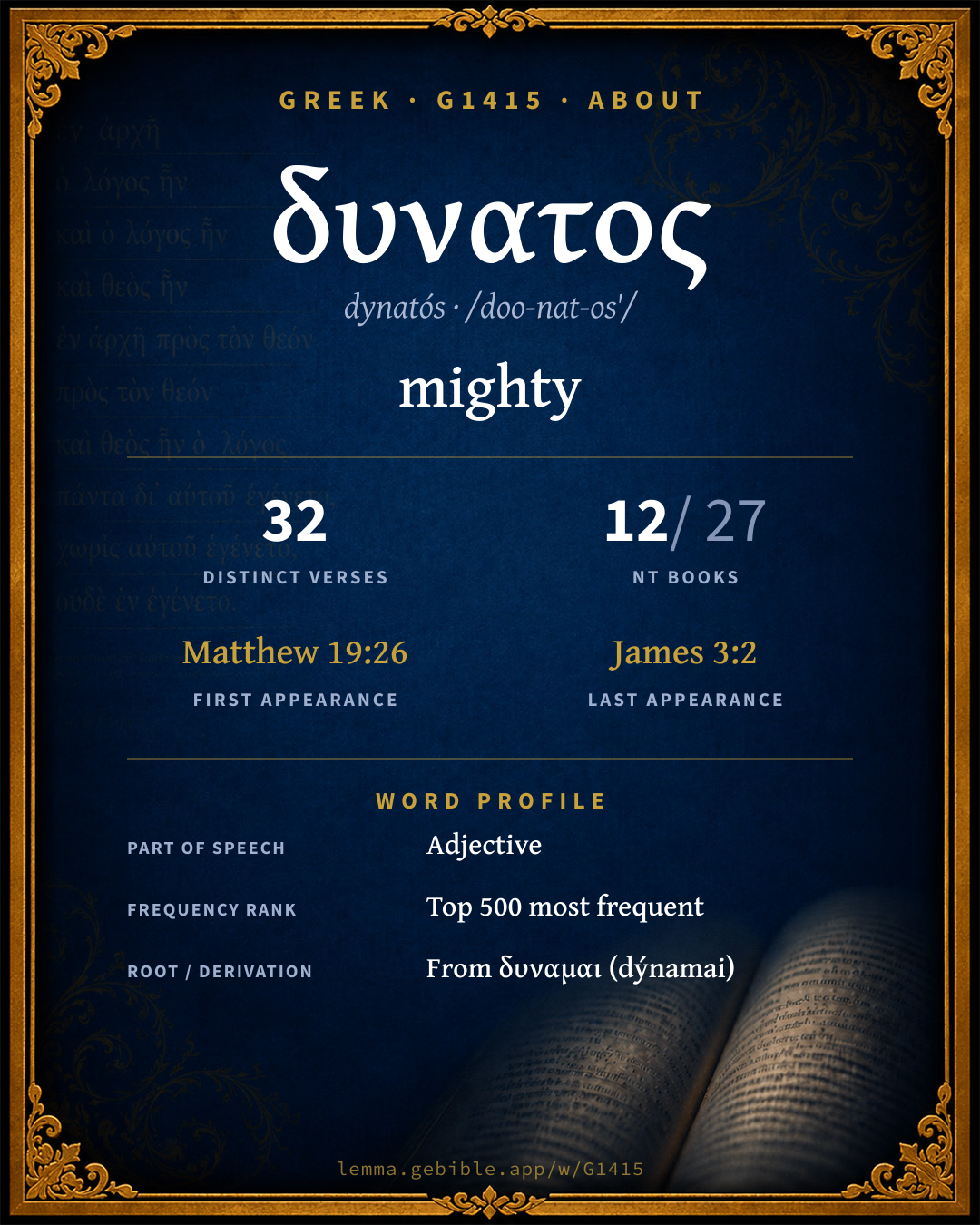
δυνατός
mighty
also: able, powerful, strong fuller range ↓
Full lexicon entry — Thayer's Greek Lexicon
From Thayer's Greek Lexicon
Where this word appears
Grammar key — what these labels mean
Part of speech
- Adjective
- A word that describes or qualifies a noun.
Case
- Nominative
- The case of the subject (and the predicate nominative).
- Accusative
- The case of the direct object and of extent.
Gender
- Masculine
- Grammatically masculine.
- Neuter
- Grammatically neuter.
Number
- Singular
- One.
- Plural
- More than one.
Every verse where G1415 appears in the Book of Luke — 4 distinct verses. Click any verse to open its interlinear word-by-word view. Verse text shown in the World English Bible for context — . Each verse’s Greek form is shown with its reference; the English is not keyword-highlighted, since the data carries no word-level English alignment. Use “Compare translations” on any verse to read it across multiple English versions. This concordance covers the Greek New Testament; Septuagint (Greek Old Testament) occurrences of this word are not indexed here.
Luke
- Luke 1:49 δυνατός adj nom sg masc For he who is mighty has done great things for me. Holy is his name.
- Luke 14:31 δυνατός adj nom sg masc Or what king, as he goes to encounter another king in war, will not sit down first and consider whether he is able with ten thousand to meet him who comes against him with twenty thousand?
- Luke 18:27 δυνατὰ adj nom pl neut But he said, "The things which are impossible with men are possible with God."
- Luke 24:19 δυνατὸς adj nom sg masc He said to them, "What things?" They said to him, "The things concerning Jesus, the Nazarene, who was a prophet mighty in deed and word before God and all the people;
About this entry
At a glance — auto-summarized from this page’s data, not written by a person. Every figure links to its source below. This summary describes the numbers; it doesn’t interpret them.
The Greek adjective δυνατος centers on the idea of “mighty.” Its earliest occurrence is Matthew 19:26. It turns up in 32 verses across 12 books, a moderately common footprint. Thayer's distinguishes 2 senses; alongside “mighty” it spans “able”, “powerful”, and “strong”. It shares a root with δυναμαι, δυναμις and δυναστης. Dig into 32-verse concordance and the renderings breakdown below.
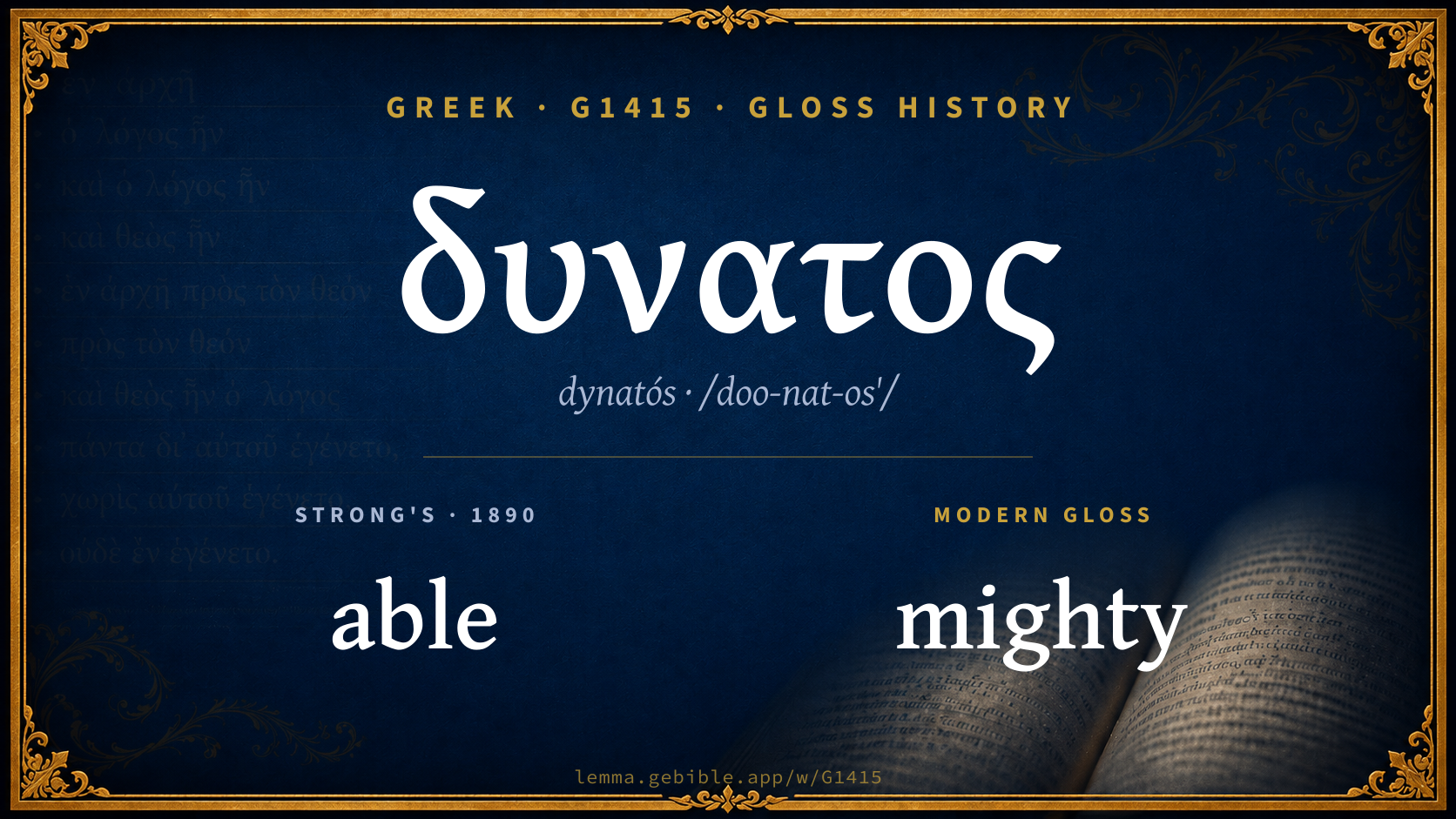
Gloss history
Strong's 1890 vs modern scholarship
About this word
Strong's G1415 catalogs a Greek word from the Greek New Testament.
These counts are not copied from any lexicon or concordance. They are computed here, from the morphology-tagged Greek New Testament. What Lemma adds →
- 32
- distinct verses
- The word appears in 32 distinct verses.
- 12 / 27
- NT books
- The word appears in 12 of 27 New Testament books.
- #438
- by frequency
- Top 500 most frequent Greek words (rank 438 of 5,347 Greek words by occurrence).
View all 32 occurrences in the concordance →
By section of the New Testament
By traditional corpus
Conventional, traditional groupings — biblical authorship is debated, so this is a traditional corpus grouping, not an authorship claim. Some books belong to more than one corpus (Luke is in both the Gospels and the Lukan corpus, and so on), so these shares overlap and need not total 100%. Each figure is a share of the word’s 32 distinct verses.
- Gospels 12 verses · 38%
- Pauline corpus 12 verses · 38%
- Lukan (Luke–Acts) 10 verses · 31%
- Hebrews 1 verse · 3%
- General (Catholic) Epistles 1 verse · 3%
How translations render this word
Counts come from each version’s own published word-to-Strong’s tagging or interlinear alignment — an approximate guide to how each version renders this word, not a word-level alignment the data otherwise carries. Because each total is that version’s own tagged count, the per-version totals vary from one another and need not match the appearance or distinct-verse counts above. These counts may also differ from a printed concordance because Lemma counts each distinctly tagged rendering and does not collapse phrase taggings into a single head-word total. This is a fixed set of word-tagged versions (KJV, ASV, BSB, ULT) and does not change with the reading translation you choose elsewhere. Each version’s license is shown beside its name below (and on Sources).
- King James Version: Able 7×, Possible 7×, Mighty 4×
- American Standard Version: Possible 9×, Able 6×, Mighty 4×
- Berean Standard Bible: Possible 10×, Able 4×, Powerful 3×
- unfoldingWord Literal Text: Possible 9×, Able 6×, Are possible 4×
King James Version Public Domain
Renders G1415 across 34 tagged occurrences — most commonly:
Plus 12 renderings that appear only once — usually multi-word phrases or single function words the recovered tagging swept in, not distinct renderings. Not rendered by a distinct English word in 1 further occurrence.
American Standard Version Public Domain
Renders G1415 across 35 tagged occurrences — most commonly:
Plus 6 renderings that appear only once — usually multi-word phrases or single function words the recovered tagging swept in, not distinct renderings.
Berean Standard Bible Public Domain
Renders G1415 across 31 tagged occurrences — most commonly:
Plus 11 renderings that appear only once — usually multi-word phrases or single function words the recovered tagging swept in, not distinct renderings. Not rendered by a distinct English word in 1 further occurrence.
unfoldingWord Literal Text CC BY-SA 4.0
Renders G1415 across 32 tagged occurrences — most commonly:
Plus 7 renderings that appear only once — usually multi-word phrases or single function words the recovered tagging swept in, not distinct renderings.
Senses in Thayer's
The 2 senses Thayer's distinguishes for this word, in lexicon order (not ranked by frequency or importance). The full entry — with sub-senses — is in the Lexicon Entry tab.
- able, powerful, mighty, strong
- to be able (to do something)
Word origin
Derived from δυναμαι (dýnamai) (G1410) — to be able.
From G1410 ; powerful or capable (literally or figuratively); neuter possible : - able could (that is) mighty (man) possible power strong.
— Strong’s Exhaustive Concordance (1890), public domain.
Forms in the corpus
The 8 distinct written forms G1415 takes in the Greek New Testament, most frequent first — each parse links to that case’s occurrences in the concordance.
| Form | Parsing | Example | Uses |
|---|---|---|---|
| δυνατὸς dynatòs | Adjective, Nominative, Singular, Masculine | Luke 24:19 | 8 |
| δυνατόν dynatón | Adjective, Nominative, Singular, Neuter | Matthew 24:24 | 5 |
| δυνατός dynatós | Adjective, Nominative, Singular, Masculine | Luke 1:49 | 5 |
| δυνατὸν dynatòn | Adjective, Nominative, Singular, Neuter | Acts 2:24 | 4 |
| δυνατὰ dynatà | Adjective, Nominative, Plural, Neuter | Mark 9:23 | 4 |
| δυνατοὶ dynatoì | Adjective, Nominative, Plural, Masculine | Acts 25:5 | 3 |
| δυνατά dynatá | Adjective, Nominative, Plural, Neuter | Matthew 19:26 | 2 |
| δυνατοί dynatoí | Adjective, Nominative, Plural, Masculine | 1 Corinthians 1:26 | 1 |
Same root — word family
Other Thayer's entries built from the same root as G1415, grouped by Strong’s listed origin. These share a root / origin per the lexicon — not necessarily a shared meaning. Each links to that word’s own entry.
Derives from
Shares the same root
Derived from this word
Compare all same-root words → Showing 4 of 5 — not the complete family. They share a root, not necessarily a meaning.
Septuagint usage
The same Greek word δυνατος appears 133 times in the Greek Old Testament (Septuagint), across 130 verses in 26 books.
- 133
- LXX occurrences
- Tagged occurrences of this Greek word in the Septuagint.
- 130
- verses
- Distinct Septuagint verses containing this word.
- 26 / 39
- OT books
- The word appears in 26 of the 39 Old Testament books.
Sample Septuagint occurrences
- Genesis 26:16 δυνατός
- Exodus 8:22 δυνατός
- Numbers 13:30 δυνατός
- Deuteronomy 1:28 δυνατός
- Joshua 6:2 δυνατός
- Judges 5:7 δυνατός
- Ruth 2:1 δυνατός
- 1 Samuel 2:4 δυνατός
- 2 Samuel 1:19 δυνατός
- 1 Kings 1:8 δυνατός
- 2 Kings 5:1 δυνατός
- 1 Chronicles 5:2 δυνατός
Septuagint occurrences (same lexeme)
Every verse where the same Strong’s number (G1415) appears in the Greek Septuagint — showing the first 50 of 130. Verse text shown in the World English Bible for context; the Greek form is the matched word — the English is not keyword-highlighted.
- Genesis 26:16 δυνατός Abimelech said to Isaac, "Go from us, for you are much mightier than we."
- Genesis 32:29 δυνατός Jacob asked him, "Please tell me your name." He said, "Why is it that you ask what my name is?" He blessed him there.
- Genesis 47:5 δυνατός Pharaoh spoke to Joseph, saying, "Your father and your brothers have come to you.
- Exodus 8:22 δυνατός I will set apart in that day the land of Goshen, in which my people dwell, that no swarms of flies shall be there; to the end you may know that I am Yahweh in the midst of the earth.
- Exodus 17:9 δυνατός Moses said to Joshua, "Choose men for us, and go out, fight with Amalek. Tomorrow I will stand on the top of the hill with God's rod in my hand."
- Exodus 18:21 δυνατός Moreover you shall provide out of all the people able men, such as fear God: men of truth, hating unjust gain; and place such over them, to be rulers of thousands, rulers of hundreds, rulers of fifties, and rulers of tens.
- Exodus 18:25 δυνατός Moses chose able men out of all Israel, and made them heads over the people, rulers of thousands, rulers of hundreds, rulers of fifties, and rulers of tens.
- Numbers 13:30 δυνατός Caleb stilled the people before Moses, and said, Let us go up at once, and possess it; for we are well able to overcome it.
- Numbers 22:38 δυνατός Balaam said to Balak, Behold, I have come to you: have I now any power at all to speak anything? the word that God puts in my mouth, that shall I speak.
- Deuteronomy 1:28 δυνατός Where are we going up? our brothers have made our heart to melt, saying, The people are greater and taller than we; the cities are great and fortified up to the sky; and moreover we have seen the sons of the Anakim there.
- Deuteronomy 2:21 δυνατός a people great, and many, and tall, as the Anakim; but Yahweh destroyed them before them; and they succeeded them, and lived in their place;
- Deuteronomy 3:18 δυνατός I commanded you at that time, saying, Yahweh your God has given you this land to possess it: you shall pass over armed before your brothers the children of Israel, all the men of valor.
- Joshua 6:2 δυνατός Yahweh said to Joshua, Behold, I have given into your hand Jericho, and the king of it, and the mighty men of valor.
- Joshua 8:3 δυνατός So Joshua arose, and all the people of war, to go up to Ai: and Joshua chose out thirty thousand men, the mighty men of valor, and sent them forth by night.
- Joshua 10:7 δυνατός So Joshua went up from Gilgal, he, and all the people of war with him, and all the mighty men of valor.
- Judges 5:7 δυνατός The rulers ceased in Israel, they ceased, Until that I Deborah arose, That I arose a mother in Israel.
- Judges 5:21 δυνατός The river Kishon swept them away, That ancient river, the river Kishon. My soul, march on with strength.
- Judges 5:23 δυνατός Curse you Meroz, said the angel of Yahweh. Curse you bitterly the inhabitants of it, Because they didn't come to the help of Yahweh, To the help of Yahweh against the mighty.
- Judges 18:26 δυνατός The children of Dan went their way: and when Micah saw that they were too strong for him, he turned and went back to his house.
- Ruth 2:1 δυνατός Naomi had a kinsman of her husband's, a mighty man of wealth, of the family of Elimelech, and his name was Boaz.
- 1 Samuel 2:4 δυνατός The bows of the mighty men are broken; Those who stumbled are girded with strength.
- 1 Samuel 2:9 δυνατός He will keep the feet of his holy ones; But the wicked shall be put to silence in darkness; For by strength shall no man prevail.
- 1 Samuel 2:10 δυνατός Those who strive with Yahweh shall be broken to pieces; Against them will he thunder in the sky: Yahweh will judge the ends of the earth; He will give strength to his king, Exalt the horn of his anointed.
- 1 Samuel 9:1 δυνατός Now there was a man of Benjamin, whose name was Kish, the son of Abiel, the son of Zeror, the son of Becorath, the son of Aphiah, the son of a Benjamite, a mighty man of valor.
- 1 Samuel 14:52 δυνατός There was sore war against the Philistines all the days of Saul: and when Saul saw any mighty man, or any valiant man, he took him to him.
- 1 Samuel 17:4 δυνατός There went out a champion out of the camp of the Philistines, named Goliath, of Gath, whose height was six cubits and a span.
- 1 Samuel 17:31 δυνατός When the words were heard which David spoke, they rehearsed them before Saul; and he sent for him.
- 2 Samuel 1:19 δυνατός Your glory, Israel, is slain on your high places! How are the mighty fallen!
- 2 Samuel 1:21 δυνατός You mountains of Gilboa, Let there be no dew nor rain on you, neither fields of offerings: For there the shield of the mighty was vilely cast away, The shield of Saul, not anointed with oil.
- 2 Samuel 1:22 δυνατός From the blood of the slain, from the fat of the mighty, The bow of Jonathan didn't turn back, The sword of Saul didn't return empty.
- 2 Samuel 1:25 δυνατός How are the mighty fallen in the midst of the battle! Jonathan is slain on your high places.
- 2 Samuel 1:27 δυνατός How are the mighty fallen, The weapons of war perished!
- 2 Samuel 2:7 δυνατός Now therefore let your hands be strong, and be you valiant; for Saul your lord is dead, and also the house of Judah have anointed me king over them.
- 2 Samuel 10:7 δυνατός When David heard of it, he sent Joab, and all the host of the mighty men.
- 2 Samuel 16:6 δυνατός He cast stones at David, and at all the servants of king David: and all the people and all the mighty men were on his right hand and on his left.
- 2 Samuel 17:8 δυνατός Hushai said moreover, You know your father and his men, that they are mighty men, and they are fierce in their minds, as a bear robbed of her cubs in the field; and your father is a man of war, and will not lodge with the people.
- 2 Samuel 17:10 δυνατός Even he who is valiant, whose heart is as the heart of a lion, will utterly melt; for all Israel knows that your father is a mighty man, and those who are with him are valiant men.
- 2 Samuel 20:7 δυνατός There went out after him Joab's men, and the Cherethites and the Pelethites, and all the mighty men; and they went out of Jerusalem, to pursue after Sheba the son of Bichri.
- 2 Samuel 23:8 δυνατός These are the names of the mighty men whom David had: Josheb Basshebeth a Tahchemonite, chief of the captains; the same was Adino the Eznite, against eight hundred slain at one time.
- 2 Samuel 23:9 δυνατός After him was Eleazar the son of Dodai the son of an Ahohite, one of the three mighty men with David, when they defied the Philistines who were there gathered together to battle, and the men of Israel were gone away.
- 2 Samuel 23:16 δυνατός The three mighty men broke through the host of the Philistines, and drew water out of the well of Bethlehem, that was by the gate, and took it, and brought it to David: but he would not drink of it, but poured it out to Yahweh.
- 2 Samuel 23:17 δυνατός He said, Be it far from me, Yahweh, that I should do this: [shall I drink] the blood of the men who went in jeopardy of their lives? therefore he would not drink it. These things did the three mighty men.
- 2 Samuel 23:22 δυνατός These things did Benaiah the son of Jehoiada, and had a name among the three mighty men.
- 2 Samuel 23:24 δυνατός Asahel the brother of Joab was one of the thirty; Elhanan the son of Dodo of Bethlehem,
- 1 Kings 1:8 δυνατός But Zadok the priest, and Benaiah the son of Jehoiada, and Nathan the prophet, and Shimei, and Rei, and the mighty men who belonged to David, were not with Adonijah.
- 1 Kings 1:10 δυνατός but Nathan the prophet, and Benaiah, and the mighty men, and Solomon his brother, he didn't call.
- 2 Kings 5:1 δυνατός Now Naaman, captain of the host of the king of Syria, was a great man with his master, and honorable, because by him Yahweh had given victory to Syria: he was also a mighty man of valor, [but he was] a leper.
- 2 Kings 9:16 δυνατός So Jehu rode in a chariot, and went to Jezreel; for Joram lay there. Ahaziah king of Judah was come down to see Joram.
- 2 Kings 15:20 δυνατός Menahem exacted the money of Israel, even of all the mighty men of wealth, of each man fifty shekels of silver, to give to the king of Assyria. So the king of Assyria turned back, and didn't stay there in the land.
- 2 Kings 24:14 δυνατός He carried away all Jerusalem, and all the princes, and all the mighty men of valor, even ten thousand captives, and all the craftsmen and the smiths; none remained, save the poorest sort of the people of the land.
These are occurrences of the same Greek lexeme (G1415) in the Septuagint — not a translation of any one Hebrew word. The store carries no word-level Hebrew↔Greek alignment, so no Hebrew original is asserted here. Counts come from the recovered LXX Strong's tagging — high-frequency vocabulary is well covered, while rare or late forms may be untagged — so they reflect tagged occurrences and may slightly undercount.