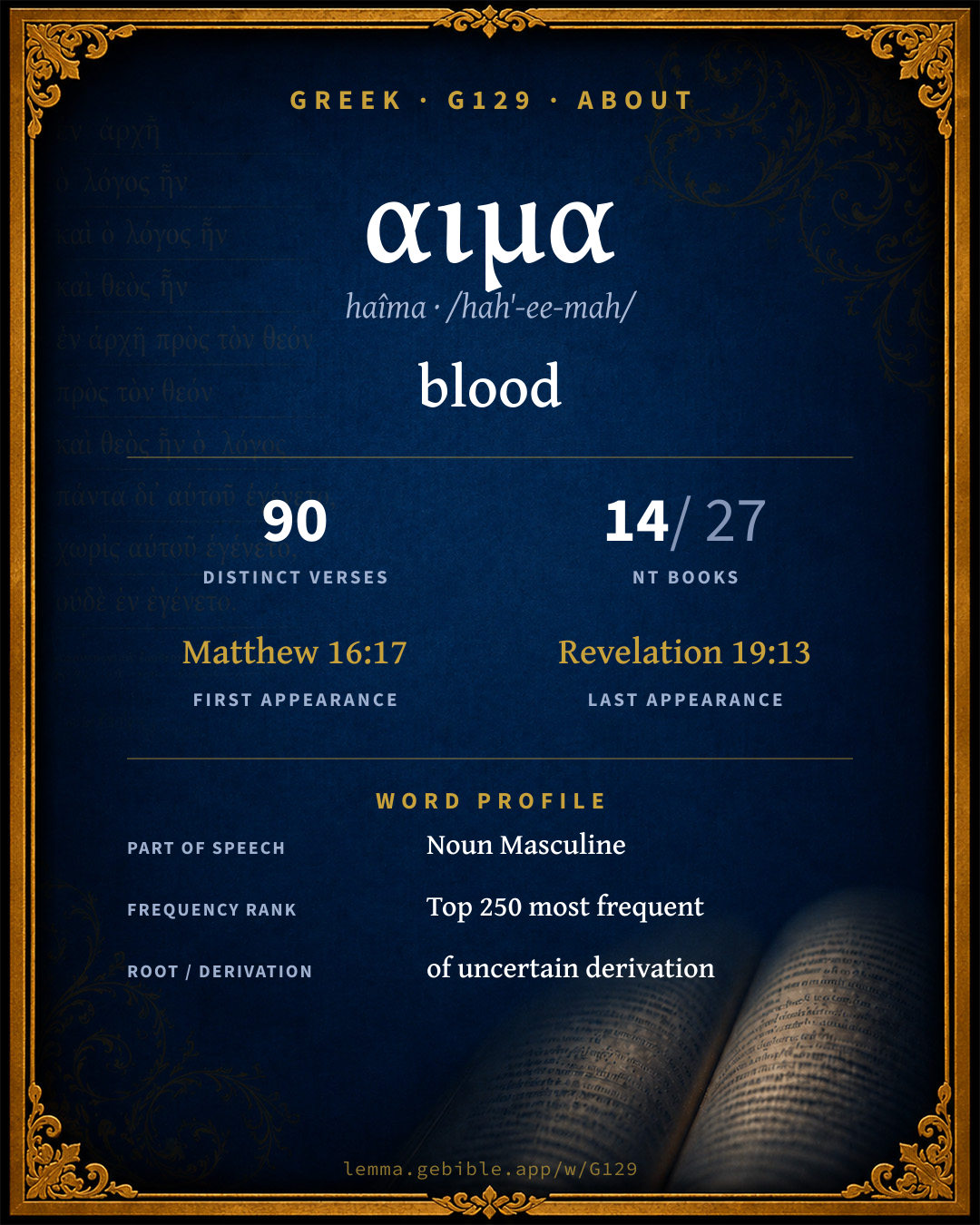
αἷμα
blood
‘blood’ is one of 2 main senses fuller range ↓
Full lexicon entry — Thayer's Greek Lexicon
From Thayer's Greek Lexicon
Where this word appears
See every Genitive-case word in the Greek New Testament →
Grammar key — what these labels mean
Part of speech
- Noun
- A naming word — a person, place, thing, or idea.
Case
- Genitive
- The case of source, possession, or “of” — answers “whose / from what.”
- Nominative
- The case of the subject (and the predicate nominative).
- Dative
- The case of the indirect object, means, or location — “to / for / with / in.”
- Accusative
- The case of the direct object and of extent.
Gender
- Neuter
- Grammatically neuter.
Number
- Singular
- One.
- Plural
- More than one.
1 verse where G129 appears in the Dative case in the Book of 1 Corinthians. Filtered view — show all forms. Click any verse to open its interlinear word-by-word view. Verse text shown in the World English Bible for context — . Each verse’s Greek form is shown with its reference; the English is not keyword-highlighted, since the data carries no word-level English alignment. Use “Compare translations” on any verse to read it across multiple English versions. This concordance covers the Greek New Testament; Septuagint (Greek Old Testament) occurrences of this word are not indexed here.
1 Corinthians
About this entry
At a glance — auto-summarized from this page’s data, not written by a person. Every figure links to its source below. This summary describes the numbers; it doesn’t interpret them.
At its core, αιμα (haîma) means “blood.” First canonically at Matthew 16:17, it enters the text early. It appears 90 verses across 14 books of the Greek New Testament, among its moderately common vocabulary. Catalogued under 2 senses, its meaning is not single-sense. It shares a root with αιματεκχυσια and αιμορρεω. Each statement above links to its evidence; the full detail follows below.
Gloss history
Strong's 1890 vs modern scholarship
About this word
Strong's G129 catalogs a Greek word from the Greek New Testament.
These counts are not copied from any lexicon or concordance. They are computed here, from the morphology-tagged Greek New Testament. What Lemma adds →
- 90
- distinct verses
- The word appears in 90 distinct verses.
- 14 / 27
- NT books
- The word appears in 14 of 27 New Testament books.
- #174
- by frequency
- Top 250 most frequent Greek words (rank 174 of 5,347 Greek words by occurrence).
View all 90 occurrences in the concordance →
Most concentrated in
- Hebrews 20 verses 22%
- Revelation 17 verses 19%
- Acts 11 verses 12%
By section of the New Testament
By traditional corpus
Conventional, traditional groupings — biblical authorship is debated, so this is a traditional corpus grouping, not an authorship claim. Some books belong to more than one corpus (Luke is in both the Gospels and the Lukan corpus, and so on), so these shares overlap and need not total 100%. Each figure is a share of the word’s 90 distinct verses.
- Johannine 26 verses · 29%
- Gospels 25 verses · 28%
- Hebrews 20 verses · 22%
- Lukan (Luke–Acts) 18 verses · 20%
- Revelation 17 verses · 19%
- Pauline corpus 12 verses · 13%
- General (Catholic) Epistles 5 verses · 6%
How translations render this word
Counts come from each version’s own published word-to-Strong’s tagging or interlinear alignment — an approximate guide to how each version renders this word, not a word-level alignment the data otherwise carries. Because each total is that version’s own tagged count, the per-version totals vary from one another and need not match the appearance or distinct-verse counts above. These counts may also differ from a printed concordance because Lemma counts each distinctly tagged rendering and does not collapse phrase taggings into a single head-word total. This is a fixed set of word-tagged versions (KJV, ASV, BSB, ULT) and does not change with the reading translation you choose elsewhere. Each version’s license is shown beside its name below (and on Sources).
- King James Version: Blood 98×
- American Standard Version: Blood 91×
- Berean Standard Bible: Blood 90×, Bleeding 4×
- unfoldingWord Literal Text: Blood 96×, The 3×, Of 2×
King James Version Public Domain
Renders G129 across 99 tagged occurrences — most commonly:
Plus 1 rendering that appears only once — usually multi-word phrases or single function words the recovered tagging swept in, not distinct renderings.
American Standard Version Public Domain
Renders G129 across 95 tagged occurrences — most commonly:
Plus 4 renderings that appear only once — usually multi-word phrases or single function words the recovered tagging swept in, not distinct renderings.
Berean Standard Bible Public Domain
Renders G129 across 96 tagged occurrences — most commonly:
Plus 2 renderings that appear only once — usually multi-word phrases or single function words the recovered tagging swept in, not distinct renderings. Not rendered by a distinct English word in 1 further occurrence.
unfoldingWord Literal Text CC BY-SA 4.0
Renders G129 across 103 tagged occurrences — most commonly:
Plus 2 renderings that appear only once — usually multi-word phrases or single function words the recovered tagging swept in, not distinct renderings.
Senses in Thayer's
The 2 senses Thayer's distinguishes for this word, in lexicon order (not ranked by frequency or importance). The full entry — with sub-senses — is in the Lexicon Entry tab.
- blood
- blood shed, to be shed by violence, slay, murder
Word origin
Origin: of uncertain derivation
Of uncertain derivation; blood literally (of men or animals) figuratively (the juice of grapes) or specifically (the atoning blood of christ); by implication bloodshed also kindred : - blood.
— Strong’s Exhaustive Concordance (1890), public domain.
Forms in the corpus
The 8 distinct written forms G129 takes in the Greek New Testament, most frequent first — each parse links to that case’s occurrences in the concordance.
| Form | Parsing | Example | Uses |
|---|---|---|---|
| αἷμα haîma | Noun, Nominative, Singular, Neuter | Matthew 16:17 | 39 |
| αἵματος haímatos | Noun, Genitive, Singular, Neuter | Matthew 23:35 | 32 |
| αἵματι haímati | Noun, Dative, Singular, Neuter | Matthew 23:30 | 18 |
| αἷμά haîmá | Noun, Nominative, Singular, Neuter | Matthew 26:28 | 3 |
| αἵματί haímatí | Noun, Dative, Singular, Neuter | Luke 22:20 | 2 |
| αἱμάτων haimátōn | Noun, Genitive, Plural, Neuter | John 1:13 | 1 |
| αἵματα haímata | Noun, Accusative, Plural, Neuter | Revelation 16:6 | 1 |
| αἵματός haímatós | Noun, Genitive, Singular, Neuter | Matthew 27:6 | 1 |
Same root — word family
Other Thayer's entries built from the same root as G129, grouped by Strong’s listed origin. These share a root / origin per the lexicon — not necessarily a shared meaning. Each links to that word’s own entry.
Derived from this word
Compare all same-root words → They share a root, not necessarily a meaning.
Septuagint usage
The same Greek word αιμα appears 347 times in the Greek Old Testament (Septuagint), across 284 verses in 28 books.
- 347
- LXX occurrences
- Tagged occurrences of this Greek word in the Septuagint.
- 284
- verses
- Distinct Septuagint verses containing this word.
- 28 / 39
- OT books
- The word appears in 28 of the 39 Old Testament books.
Sample Septuagint occurrences
- Genesis 4:10 αἷμα
- Exodus 4:9 αἷμα
- Leviticus 1:5 αἷμα
- Numbers 18:17 αἷμα
- Deuteronomy 12:16 αἷμα
- Joshua 20:3 αἷμα
- Judges 9:24 αἷμα
- 1 Samuel 14:32 αἷμα
- 2 Samuel 1:16 αἷμα
- 1 Kings 2:5 αἷμα
- 2 Kings 3:22 αἷμα
- 1 Chronicles 11:19 αἷμα
Septuagint occurrences (same lexeme)
Every verse where the same Strong’s number (G129) appears in the Greek Septuagint — showing the first 50 of 284. Verse text shown in the World English Bible for context; the Greek form is the matched word — the English is not keyword-highlighted.
- Genesis 4:10 αἷμα Yahweh said, "What have you done? The voice of your brother's blood cries to me from the ground.
- Genesis 4:11 αἷμα Now you are cursed because of the ground, which has opened its mouth to receive your brother's blood from your hand.
- Genesis 9:4 αἷμα But flesh with the life of it, the blood of it, you shall not eat.
- Genesis 9:5 αἷμα I will surely require your blood of your lives. At the hand of every animal I will require it. At the hand of man, even at the hand of every man's brother, I will require the life of man.
- Genesis 9:6 αἷμα Whoever sheds man's blood, by man will his blood be shed, for in the image of God made he man.
- Genesis 37:22 αἷμα Reuben said to them, "Shed no blood. Throw him into this pit that is in the wilderness, but lay no hand on him"-- that he might deliver him out of their hand, to restore him to his father.
- Genesis 37:26 αἷμα Judah said to his brothers, "What profit is it if we kill our brother and conceal his blood?
- Genesis 37:31 αἷμα They took Joseph's coat, and killed a male goat, and dipped the coat in the blood.
- Genesis 42:22 αἷμα Reuben answered them, saying, "Didn't I tell you, saying, 'Don't sin against the child,' and you wouldn't listen? Therefore also, behold, his blood is required."
- Genesis 49:11 αἷμα Binding his foal to the vine, His donkey's colt to the choice vine; He has washed his garments in wine, His robes in the blood of grapes:
- Exodus 4:9 αἷμα It will happen, if they will not believe even these two signs, neither listen to your voice, that you shall take of the water of the river, and pour it on the dry land. The water which you take out of the river will become blood on the dry land."
- Exodus 4:25 αἷμα Then Zipporah took a flint, and cut off the foreskin of her son, and cast it at his feet; and she said, "Surely you are a bridegroom of blood to me."
- Exodus 4:26 αἷμα So he let him alone. Then she said, "You are a bridegroom of blood," because of the circumcision.
- Exodus 7:17 αἷμα Thus says Yahweh, "In this you shall know that I am Yahweh. Behold, I will strike with the rod that is in my hand on the waters which are in the river, and they shall be turned to blood.
- Exodus 7:19 αἷμα Yahweh said to Moses, "Tell Aaron, 'Take your rod, and stretch out your hand over the waters of Egypt, over their rivers, over their streams, and over their pools, and over all their ponds of water, that they may become blood; and there shall be blood throughout all the land of Egypt, both in vessels of wood and in vessels of stone.'"
- Exodus 7:20 αἷμα Moses and Aaron did so, as Yahweh commanded; and he lifted up the rod, and struck the waters that were in the river, in the sight of Pharaoh, and in the sight of his servants; and all the waters that were in the river were turned to blood.
- Exodus 7:21 αἷμα The fish that were in the river died; and the river became foul, and the Egyptians couldn't drink water from the river; and the blood was throughout all the land of Egypt.
- Exodus 12:7 αἷμα They shall take some of the blood, and put it on the two side-posts and on the lintel, on the houses in which they shall eat it.
- Exodus 12:13 αἷμα The blood shall be to you for a token on the houses where you are: and when I see the blood, I will pass over you, and there shall no plague be on you to destroy you, when I strike the land of Egypt.
- Exodus 12:22 αἷμα You shall take a bunch of hyssop, and dip it in the blood that is in the basin, and strike the lintel and the two side-posts with the blood that is in the basin; and none of you shall go out of the door of his house until the morning.
- Exodus 12:23 αἷμα For Yahweh will pass through to strike the Egyptians; and when he sees the blood on the lintel, and on the two side-posts, Yahweh will pass over the door, and will not allow the destroyer to come in to your houses to strike you.
- Exodus 23:18 αἷμα "You shall not offer the blood of my sacrifice with leavened bread, neither shall the fat of my feast remain all night until the morning.
- Exodus 24:6 αἷμα Moses took half of the blood and put it in basins, and half of the blood he sprinkled on the altar.
- Exodus 24:8 αἷμα Moses took the blood, and sprinkled it on the people, and said, "Look, this is the blood of the covenant, which Yahweh has made with you concerning all these words."
- Exodus 29:12 αἷμα You shall take of the blood of the bull, and put it on the horns of the altar with your finger; and you shall pour out all the blood at the base of the altar.
- Exodus 29:16 αἷμα You shall kill the ram, and you shall take its blood, and sprinkle it around on the altar.
- Exodus 29:20 αἷμα Then you shall kill the ram, and take some of its blood, and put it on the tip of the right ear of Aaron, and on the tip of the right ear of his sons, and on the thumb of their right hand, and on the big toe of their right foot, and sprinkle the blood on the altar round about.
- Exodus 29:21 αἷμα You shall take of the blood that is on the altar, and of the anointing oil, and sprinkle it on Aaron, and on his garments, and on his sons, and on the garments of his sons with him: and he shall be made holy, and his garments, and his sons, and his sons' garments with him.
- Exodus 30:10 αἷμα Aaron shall make atonement on its horns once in the year; with the blood of the sin offering of atonement once in the year he shall make atonement for it throughout your generations. It is most holy to Yahweh."
- Exodus 34:25 αἷμα "You shall not offer the blood of my sacrifice with leavened bread; neither shall the sacrifice of the feast of the Passover be left to the morning.
- Leviticus 1:5 αἷμα He shall kill the bull before Yahweh. Aaron's sons, the priests, shall present the blood and sprinkle the blood around on the altar that is at the door of the Tent of Meeting.
- Leviticus 1:11 αἷμα He shall kill it on the north side of the altar before Yahweh. Aaron's sons, the priests, shall sprinkle its blood around on the altar.
- Leviticus 1:15 αἷμα The priest shall bring it to the altar, and wring off its head, and burn it on the altar; and its blood shall be drained out on the side of the altar;
- Leviticus 3:2 αἷμα He shall lay his hand on the head of his offering, and kill it at the door of the tent of meeting: and Aaron's sons the priests shall sprinkle the blood on the altar round about.
- Leviticus 3:8 αἷμα and he shall lay his hand on the head of his offering, and kill it before the tent of meeting: and Aaron's sons shall sprinkle its blood on the altar round about.
- Leviticus 3:13 αἷμα and he shall lay his hand on its head, and kill it before the tent of meeting; and the sons of Aaron shall sprinkle its blood on the altar round about.
- Leviticus 3:17 αἷμα "'It shall be a perpetual statute throughout your generations in all your dwellings, that you shall eat neither fat nor blood.'"
- Leviticus 4:5 αἷμα The anointed priest shall take some of the blood of the bull, and bring it to the Tent of Meeting.
- Leviticus 4:6 αἷμα The priest shall dip his finger in the blood, and sprinkle some of the blood seven times before Yahweh, before the veil of the sanctuary.
- Leviticus 4:7 αἷμα The priest shall put some of the blood on the horns of the altar of sweet incense before Yahweh, which is in the tent of meeting; and he shall pour out all the blood of the bull out at the base of the altar of burnt offering, which is at the door of the Tent of Meeting.
- Leviticus 4:16 αἷμα The anointed priest shall bring of the blood of the bull to the Tent of Meeting:
- Leviticus 4:17 αἷμα and the priest shall dip his finger in the blood, and sprinkle it seven times before Yahweh, before the veil.
- Leviticus 4:18 αἷμα He shall put some of the blood on the horns of the altar which is before Yahweh, that is in the Tent of Meeting; and the rest of the blood he shall pour out at the base of the altar of burnt offering, which is at the door of the Tent of Meeting.
- Leviticus 4:25 αἷμα The priest shall take some of the blood of the sin offering with his finger, and put it on the horns of the altar of burnt offering. He shall pour out the rest of its blood at the base of the altar of burnt offering.
- Leviticus 4:30 αἷμα The priest shall take some of its blood with his finger, and put it on the horns of the altar of burnt offering; and the rest of its blood he shall pour out at the base of the altar.
- Leviticus 4:34 αἷμα The priest shall take some of the blood of the sin offering with his finger, and put it on the horns of the altar of burnt offering; and all the rest of its blood he shall pour out at the base of the altar.
- Leviticus 5:9 αἷμα He shall sprinkle some of the blood of the sin offering on the side of the altar; and the rest of the blood shall be drained out at the base of the altar. It is a sin offering.
- Leviticus 6:20 αἷμα "This is the offering of Aaron and of his sons, which they shall offer to Yahweh in the day when he is anointed: the tenth part of an ephah of fine flour for a meal offering perpetually, half of it in the morning, and half of it in the evening.
- Leviticus 6:23 αἷμα Every meal offering of a priest shall be wholly burned. It shall not be eaten."
- Leviticus 7:2 αἷμα In the place where they kill the burnt offering, he shall kill the trespass offering; and its blood he shall sprinkle on the altar round about.
These are occurrences of the same Greek lexeme (G129) in the Septuagint — not a translation of any one Hebrew word. The store carries no word-level Hebrew↔Greek alignment, so no Hebrew original is asserted here. Counts come from the recovered LXX Strong's tagging — high-frequency vocabulary is well covered, while rare or late forms may be untagged — so they reflect tagged occurrences and may slightly undercount.