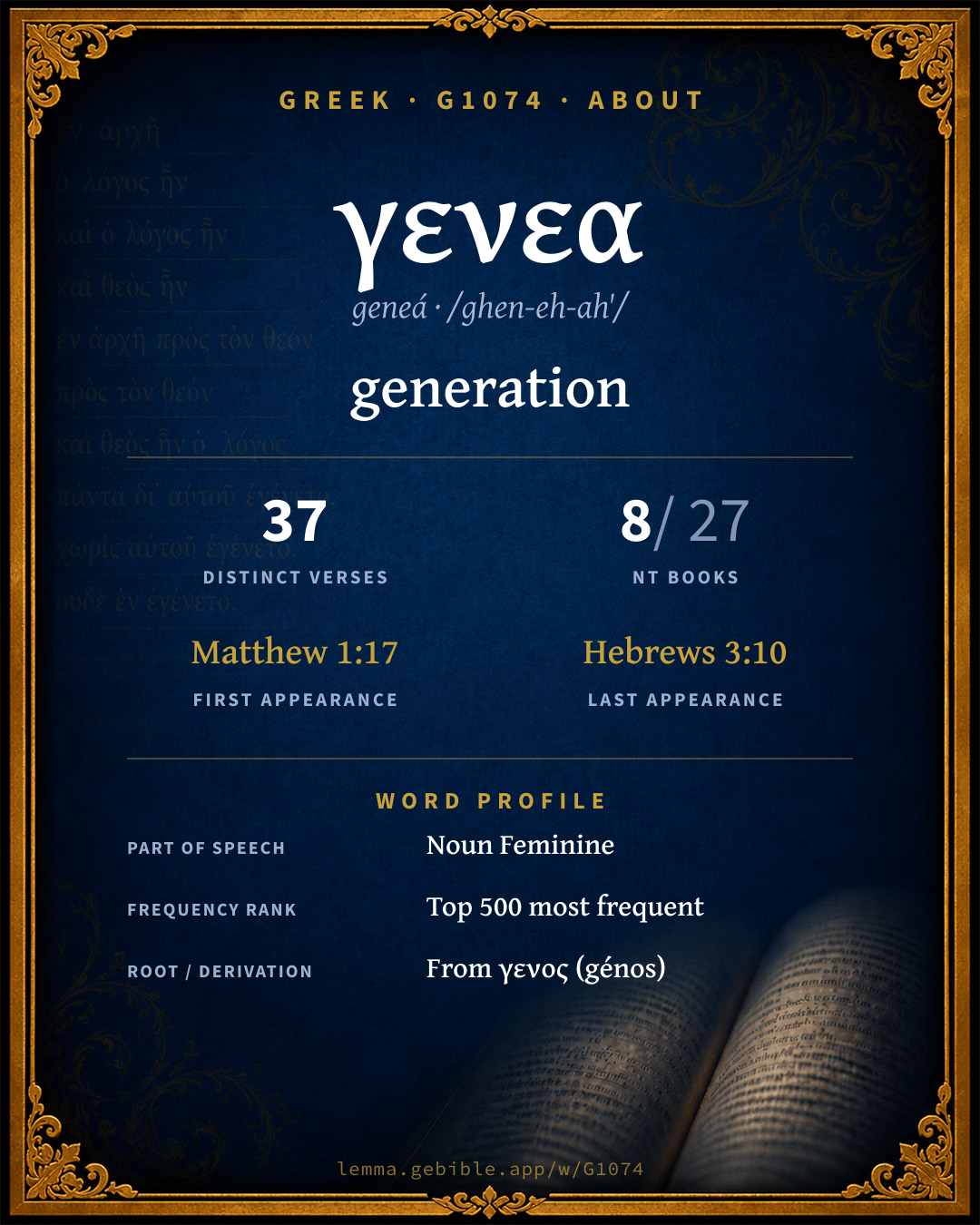
γενεά
generation
‘generation’ is one of 4 main senses fuller range ↓
Full lexicon entry — Thayer's Greek Lexicon
From Thayer's Greek Lexicon
Where this word appears
See every Nominative-case word in the Greek New Testament →
Grammar key — what these labels mean
Part of speech
- Noun
- A naming word — a person, place, thing, or idea.
Case
- Genitive
- The case of source, possession, or “of” — answers “whose / from what.”
- Nominative
- The case of the subject (and the predicate nominative).
- Dative
- The case of the indirect object, means, or location — “to / for / with / in.”
- Accusative
- The case of the direct object and of extent.
- Vocative
- The case of direct address (“O Lord”).
Gender
- Feminine
- Grammatically feminine.
Number
- Singular
- One.
- Plural
- More than one.
4 verses where G1074 appears in the Nominative case in the Book of Matthew. Filtered view — show all forms. Click any verse to open its interlinear word-by-word view. Verse text shown in the World English Bible for context — . Each verse’s Greek form is shown with its reference; the English is not keyword-highlighted, since the data carries no word-level English alignment. Use “Compare translations” on any verse to read it across multiple English versions. This concordance covers the Greek New Testament; Septuagint (Greek Old Testament) occurrences of this word are not indexed here.
Matthew
- Matthew 1:17 γενεαὶ γενεαὶ γενεαὶ γενεαὶ n nom pl fem n nom pl fem n nom pl fem n nom pl fem So all the generations from Abraham to David are fourteen generations; from David to the exile to Babylon fourteen generations; and from the carrying away to Babylon to the Christ, fourteen generations.
- Matthew 12:39 γενεὰ n nom sg fem But he answered them, "An evil and adulterous generation seeks after a sign, but no sign will be given it but the sign of Jonah the prophet.
- Matthew 16:4 γενεὰ n nom sg fem An evil and adulterous generation seeks after a sign, and there will be no sign given to it, except the sign of the prophet Jonah." He left them, and departed.
- Matthew 24:34 γενεὰ n nom sg fem Most assuredly I tell you, this generation will not pass away, until all these things are accomplished.
About this entry
At a glance — auto-summarized from this page’s data, not written by a person. Every figure links to its source below. This summary describes the numbers; it doesn’t interpret them.
γενεα (geneá) is a Greek noun most often rendered “generation.” Ranging over 4 senses, it is not a single-sense word. It turns up in 37 verses across 8 books, a moderately common footprint. It concentrates in Luke, which alone accounts for 35% of its uses. Scripture first uses it in Matthew 1:17. For the data behind this summary, explore the sense tree and the renderings breakdown below.
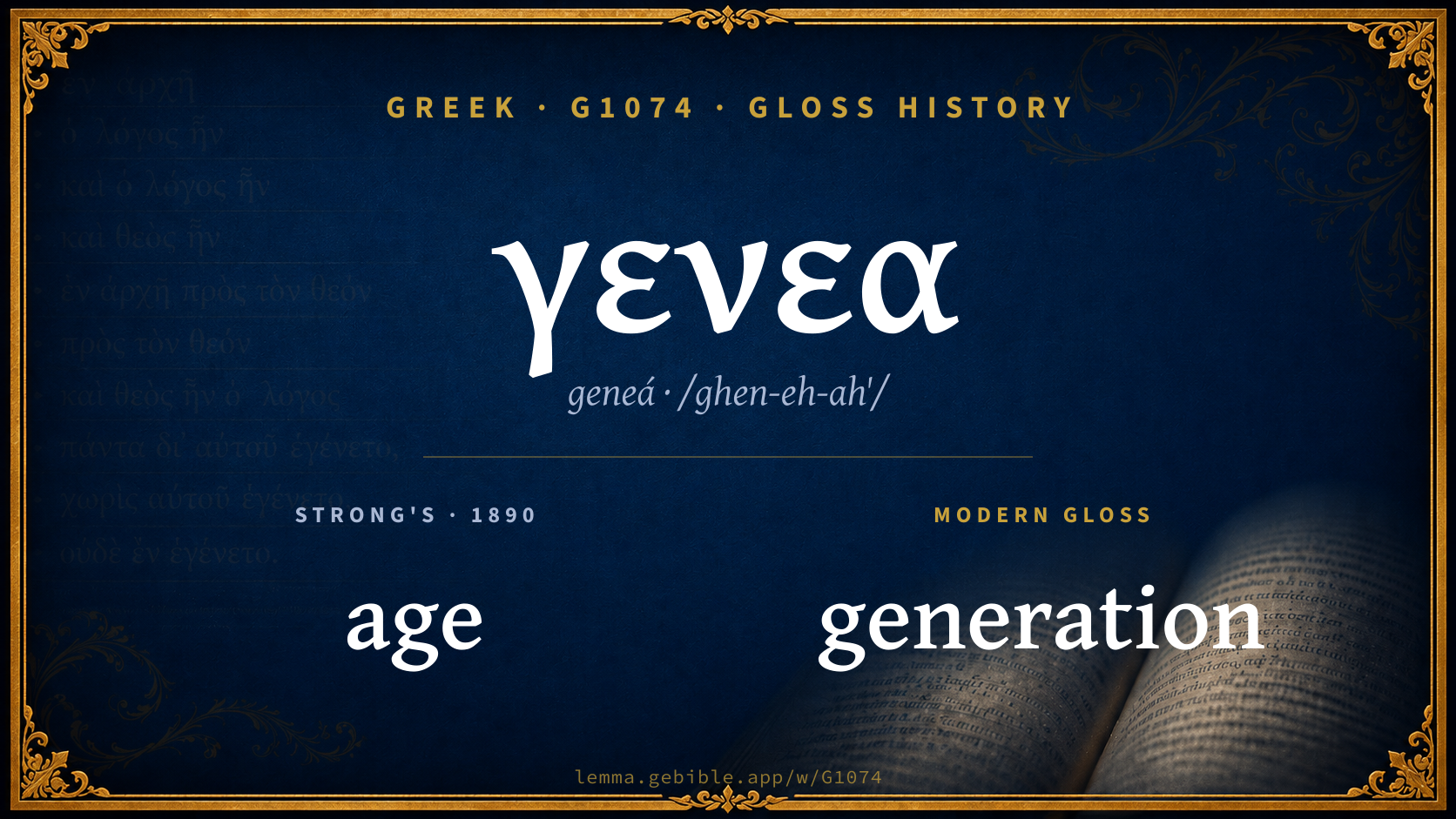
Gloss history
Strong's 1890 vs modern scholarship
About this word
Strong's G1074 catalogs a Greek word from the Greek New Testament.
These counts are not copied from any lexicon or concordance. They are computed here, from the morphology-tagged Greek New Testament. What Lemma adds →
- 37
- distinct verses
- The word appears in 37 distinct verses.
- 8 / 27
- NT books
- The word appears in 8 of 27 New Testament books.
- #347
- by frequency
- Top 500 most frequent Greek words (rank 347 of 5,347 Greek words by occurrence).
View all 37 occurrences in the concordance →
By section of the New Testament
By traditional corpus
Conventional, traditional groupings — biblical authorship is debated, so this is a traditional corpus grouping, not an authorship claim. Some books belong to more than one corpus (Luke is in both the Gospels and the Lukan corpus, and so on), so these shares overlap and need not total 100%. Each figure is a share of the word’s 37 distinct verses.
- Gospels 27 verses · 73%
- Lukan (Luke–Acts) 18 verses · 49%
- Pauline corpus 4 verses · 11%
- Hebrews 1 verse · 3%
How translations render this word
Counts come from each version’s own published word-to-Strong’s tagging or interlinear alignment — an approximate guide to how each version renders this word, not a word-level alignment the data otherwise carries. Because each total is that version’s own tagged count, the per-version totals vary from one another and need not match the appearance or distinct-verse counts above. These counts may also differ from a printed concordance because Lemma counts each distinctly tagged rendering and does not collapse phrase taggings into a single head-word total. This is a fixed set of word-tagged versions (KJV, ASV, BSB, ULT) and does not change with the reading translation you choose elsewhere. Each version’s license is shown beside its name below (and on Sources).
- King James Version: Generation 31×, Generations 6×, Ages 2×
- American Standard Version: Generation 30×, Generations 12×, An 2×
- Berean Standard Bible: Generation 30×, Generations 6×
- unfoldingWord Literal Text: Generation 33×, Generations 9×, An 3×
King James Version Public Domain
Renders G1074 across 42 tagged occurrences — most commonly:
Plus 3 renderings that appear only once — usually multi-word phrases or single function words the recovered tagging swept in, not distinct renderings.
American Standard Version Public Domain
Renders G1074 across 50 tagged occurrences — most commonly:
Plus 4 renderings that appear only once — usually multi-word phrases or single function words the recovered tagging swept in, not distinct renderings.
Berean Standard Bible Public Domain
Renders G1074 across 39 tagged occurrences — most commonly:
Plus 3 renderings that appear only once — usually multi-word phrases or single function words the recovered tagging swept in, not distinct renderings. Not rendered by a distinct English word in 4 further occurrences.
unfoldingWord Literal Text CC BY-SA 4.0
Renders G1074 across 57 tagged occurrences — most commonly:
Plus 1 rendering that appears only once — usually multi-word phrases or single function words the recovered tagging swept in, not distinct renderings.
Senses in Thayer's
The 4 senses Thayer's distinguishes for this word, in lexicon order (not ranked by frequency or importance). The full entry — with sub-senses — is in the Lexicon Entry tab.
- fathered, birth, nativity
- that which has been begotten, men of the same stock, a family
- the whole multitude of men living at the same time
- an age (i.e. the time ordinarily occupied be each successive generation), a space of 30 - 33 years
Word origin
Derived from γενος (génos) (G1085) — nation.
From (a presumed derivative of) G1085 ; a generation ; by implication an age (the period or the persons): - age generation nation time.
— Strong’s Exhaustive Concordance (1890), public domain.
Forms in the corpus
The 9 distinct written forms G1074 takes in the Greek New Testament, most frequent first — each parse links to that case’s occurrences in the concordance.
| Form | Parsing | Example | Uses |
|---|---|---|---|
| γενεὰ geneà | Noun, Nominative, Singular, Feminine | Matthew 12:39 | 11 |
| γενεᾶς geneâs | Noun, Genitive, Singular, Feminine | Matthew 12:41 | 10 |
| γενεᾷ geneâ | Noun, Dative, Singular, Feminine | Matthew 12:45 | 6 |
| γενεαὶ geneaì | Noun, Nominative, Plural, Feminine | Matthew 1:17 | 4 |
| γενεὰν geneàn | Noun, Accusative, Singular, Feminine | Matthew 11:16 | 4 |
| γενεὰς geneàs | Noun, Accusative, Plural, Feminine | Luke 1:50 | 3 |
| γενεαῖς geneaîs | Noun, Dative, Plural, Feminine | Acts 14:16 | 2 |
| γενεῶν geneō̂n | Noun, Genitive, Plural, Feminine | Acts 15:21 | 2 |
| γενεαί geneaí | Noun, Nominative, Plural, Feminine | Luke 1:48 | 1 |
Same root — word family
Other Thayer's entries built from the same root as G1074, grouped by Strong’s listed origin. These share a root / origin per the lexicon — not necessarily a shared meaning. Each links to that word’s own entry.
Derives from
Shares the same root
Derived from this word
Compare all same-root words → Showing 4 of 6 — not the complete family. They share a root, not necessarily a meaning.
Septuagint usage
The same Greek word γενεα appears 183 times in the Greek Old Testament (Septuagint), across 142 verses in 19 books.
- 183
- LXX occurrences
- Tagged occurrences of this Greek word in the Septuagint.
- 142
- verses
- Distinct Septuagint verses containing this word.
- 19 / 39
- OT books
- The word appears in 19 of the 39 Old Testament books.
Sample Septuagint occurrences
- Genesis 6:9 γενεά
- Exodus 1:6 γενεά
- Leviticus 3:17 γενεά
- Numbers 9:10 γενεά
- Deuteronomy 2:14 γενεά
- Joshua 22:27 γενεά
- Judges 2:10 γενεά
- 1 Chronicles 16:15 γενεά
- Esther 9:27 γενεά
- Job 8:8 γενεά
- Psalms 9:27 γενεά
- Proverbs 22:4 γενεά
Septuagint occurrences (same lexeme)
Every verse where the same Strong’s number (G1074) appears in the Greek Septuagint — showing the first 50 of 142. Verse text shown in the World English Bible for context; the Greek form is the matched word — the English is not keyword-highlighted.
- Genesis 6:9 γενεά This is the history of the generations of Noah. Noah was a righteous man, blameless among the people of his time. Noah walked with God.
- Genesis 7:1 γενεά Yahweh said to Noah, "Come with all of your household into the ark, for I have seen your righteousness before me in this generation.
- Genesis 9:12 γενεά God said, "This is the token of the covenant which I make between me and you and every living creature that is with you, for perpetual generations:
- Genesis 15:16 γενεά In the fourth generation they will come here again, for the iniquity of the Amorite is not yet full."
- Genesis 17:7 γενεά I will establish my covenant between me and you and your seed after you throughout their generations for an everlasting covenant, to be a God to you and to your seed after you.
- Genesis 17:9 γενεά God said to Abraham, "As for you, you will keep my covenant, you and your seed after you throughout their generations.
- Genesis 17:10 γενεά This is my covenant, which you shall keep, between me and you and your seed after you. Every male among you shall be circumcised.
- Genesis 17:12 γενεά He who is eight days old will be circumcised among you, every male throughout your generations, he who is born in the house, or bought with money of any foreigner who is not of your seed.
- Genesis 25:13 γενεά These are the names of the sons of Ishmael, by their names, according to the order of their birth: the firstborn of Ishmael, Nebaioth, then Kedar, Adbeel, Mibsam,
- Genesis 31:3 γενεά Yahweh said to Jacob, "Return to the land of your fathers, and to your relatives, and I will be with you."
- Genesis 43:7 γενεά They said, "The man asked directly concerning ourselves, and concerning our relatives, saying, 'Is your father still alive? Have you another brother?' We just answered his questions. Is there any way we could know that he would say, 'Bring your brother down?'"
- Genesis 50:23 γενεά Joseph saw Ephraim's children to the third generation. The children also of Machir, the son of Manasseh, were born on Joseph's knees.
- Exodus 1:6 γενεά Joseph died, as did all his brothers, and all that generation.
- Exodus 3:15 γενεά God said moreover to Moses, "You shall tell the children of Israel this, 'Yahweh, the God of your fathers, the God of Abraham, the God of Isaac, and the God of Jacob, has sent me to you.' This is my name forever, and this is my memorial to all generations.
- Exodus 12:14 γενεά This day shall be to you for a memorial, and you shall keep it a feast to Yahweh: throughout your generations you shall keep it a feast by an ordinance forever.
- Exodus 12:17 γενεά You shall observe the feast of unleavened bread; for in this same day have I brought your hosts out of the land of Egypt: therefore shall you observe this day throughout your generations by an ordinance forever.
- Exodus 12:42 γενεά It is a night to be much observed to Yahweh for bringing them out from the land of Egypt. This is that night of Yahweh, to be much observed of all the children of Israel throughout their generations.
- Exodus 13:18 γενεά but God led the people around by the way of the wilderness by the Red Sea; and the children of Israel went up armed out of the land of Egypt.
- Exodus 16:32 γενεά Moses said, "This is the thing which Yahweh has commanded, 'Let an omer-full of it be kept throughout your generations, that they may see the bread with which I fed you in the wilderness, when I brought you forth from the land of Egypt."
- Exodus 16:33 γενεά Moses said to Aaron, "Take a pot, and put an omer-full of manna in it, and lay it up before Yahweh, to be kept throughout your generations."
- Exodus 17:16 γενεά He said, "Yah has sworn: 'Yahweh will have war with Amalek from generation to generation.'"
- Exodus 20:5 γενεά you shall not bow yourself down to them, nor serve them, for I, Yahweh your God, am a jealous God, visiting the iniquity of the fathers on the children, on the third and on the fourth generation of those who hate me,
- Exodus 27:21 γενεά In the tent of meeting, outside the veil which is before the testimony, Aaron and his sons shall keep it in order from evening to morning before Yahweh: it shall be a statute forever throughout their generations on the behalf of the children of Israel.
- Exodus 29:42 γενεά It shall be a continual burnt offering throughout your generations at the door of the tent of meeting before Yahweh, where I will meet with you, to speak there to you.
- Exodus 30:8 γενεά When Aaron lights the lamps at evening, he shall burn it, a perpetual incense before Yahweh throughout your generations.
- Exodus 30:10 γενεά Aaron shall make atonement on its horns once in the year; with the blood of the sin offering of atonement once in the year he shall make atonement for it throughout your generations. It is most holy to Yahweh."
- Exodus 30:21 γενεά So they shall wash their hands and their feet, that they not die: and it shall be a statute forever to them, even to him and to his descendants throughout their generations."
- Exodus 30:31 γενεά You shall speak to the children of Israel, saying, 'This shall be a holy anointing oil to me throughout your generations.
- Exodus 31:13 γενεά "Speak also to the children of Israel, saying, 'Most assuredly you shall keep my Sabbaths: for it is a sign between me and you throughout your generations; that you may know that I am Yahweh who sanctifies you.
- Exodus 31:16 γενεά Therefore the children of Israel shall keep the Sabbath, to observe the Sabbath throughout their generations, for a perpetual covenant.
- Exodus 34:7 γενεά keeping loving kindness for thousands, forgiving iniquity and disobedience and sin; and that will by no means clear the guilty, visiting the iniquity of the fathers on the children, and on the children's children, on the third and on the fourth generation."
- Exodus 40:15 γενεά You shall anoint them, as you anointed their father, that they may minister to me in the priest's office. Their anointing shall be to them for an everlasting priesthood throughout their generations.
- Leviticus 3:17 γενεά "'It shall be a perpetual statute throughout your generations in all your dwellings, that you shall eat neither fat nor blood.'"
- Leviticus 6:11 γενεά He shall take off his garments, and put on other garments, and carry the ashes outside the camp to a clean place.
- Leviticus 7:36 γενεά which Yahweh commanded to be given them of the children of Israel, in the day that he anointed them. It is their portion forever throughout their generations.
- Leviticus 10:9 γενεά "Drink no wine nor strong drink, you, nor your sons with you, when you go into the Tent of Meeting, that you don't die: it shall be a statute forever throughout your generations:
- Leviticus 17:7 γενεά They shall no more sacrifice their sacrifices to the goat idols, after which they play the prostitute. This shall be a statute forever to them throughout their generations.'
- Leviticus 21:17 γενεά "Say to Aaron, 'None of your seed throughout their generations who has a blemish, may approach to offer the bread of his God.
- Leviticus 22:3 γενεά Tell them, 'If anyone of all your seed throughout your generations approaches the holy things, which the children of Israel make holy to Yahweh, having his uncleanness on him, that soul shall be cut off from before me. I am Yahweh.
- Leviticus 23:14 γενεά You shall eat neither bread, nor roasted grain, nor fresh grain, until this same day, until you have brought the offering of your God. This is a statute forever throughout your generations in all your dwellings.
- Leviticus 23:21 γενεά You shall make proclamation on the same day: there shall be a holy convocation to you; you shall do no regular work. This is a statute forever in all your dwellings throughout your generations.
- Leviticus 23:31 γενεά You shall do no manner of work: it is a statute forever throughout your generations in all your dwellings.
- Leviticus 23:41 γενεά You shall keep it a feast to Yahweh seven days in the year: it is a statute forever throughout your generations; you shall keep it in the seventh month.
- Leviticus 23:43 γενεά that your generations may know that I made the children of Israel to dwell in booths, when I brought them out of the land of Egypt. I am Yahweh your God.'"
- Leviticus 24:3 γενεά Outside of the veil of the Testimony, in the Tent of Meeting, shall Aaron keep it in order from evening to morning before Yahweh continually: it shall be a statute forever throughout your generations.
- Leviticus 25:30 γενεά If it isn't redeemed within the space of a full year, then the house that is in the walled city shall be made sure in perpetuity to him who bought it, throughout his generations. It shall not be released in the Jubilee.
- Leviticus 25:41 γενεά then he shall go out from you, he and his children with him, and shall return to his own family, and to the possession of his fathers.
- Numbers 9:10 γενεά "Say to the children of Israel, 'If any man of you or of your generations is unclean by reason of a dead body, or is on a journey far away, he shall still keep the Passover to Yahweh.
- Numbers 10:8 γενεά The sons of Aaron, the priests, shall blow the trumpets; and they shall be to you for a statute forever throughout your generations.
- Numbers 10:30 γενεά He said to him, I will not go; but I will depart to my own land, and to my relatives.
These are occurrences of the same Greek lexeme (G1074) in the Septuagint — not a translation of any one Hebrew word. The store carries no word-level Hebrew↔Greek alignment, so no Hebrew original is asserted here. Counts come from the recovered LXX Strong's tagging — high-frequency vocabulary is well covered, while rare or late forms may be untagged — so they reflect tagged occurrences and may slightly undercount.