
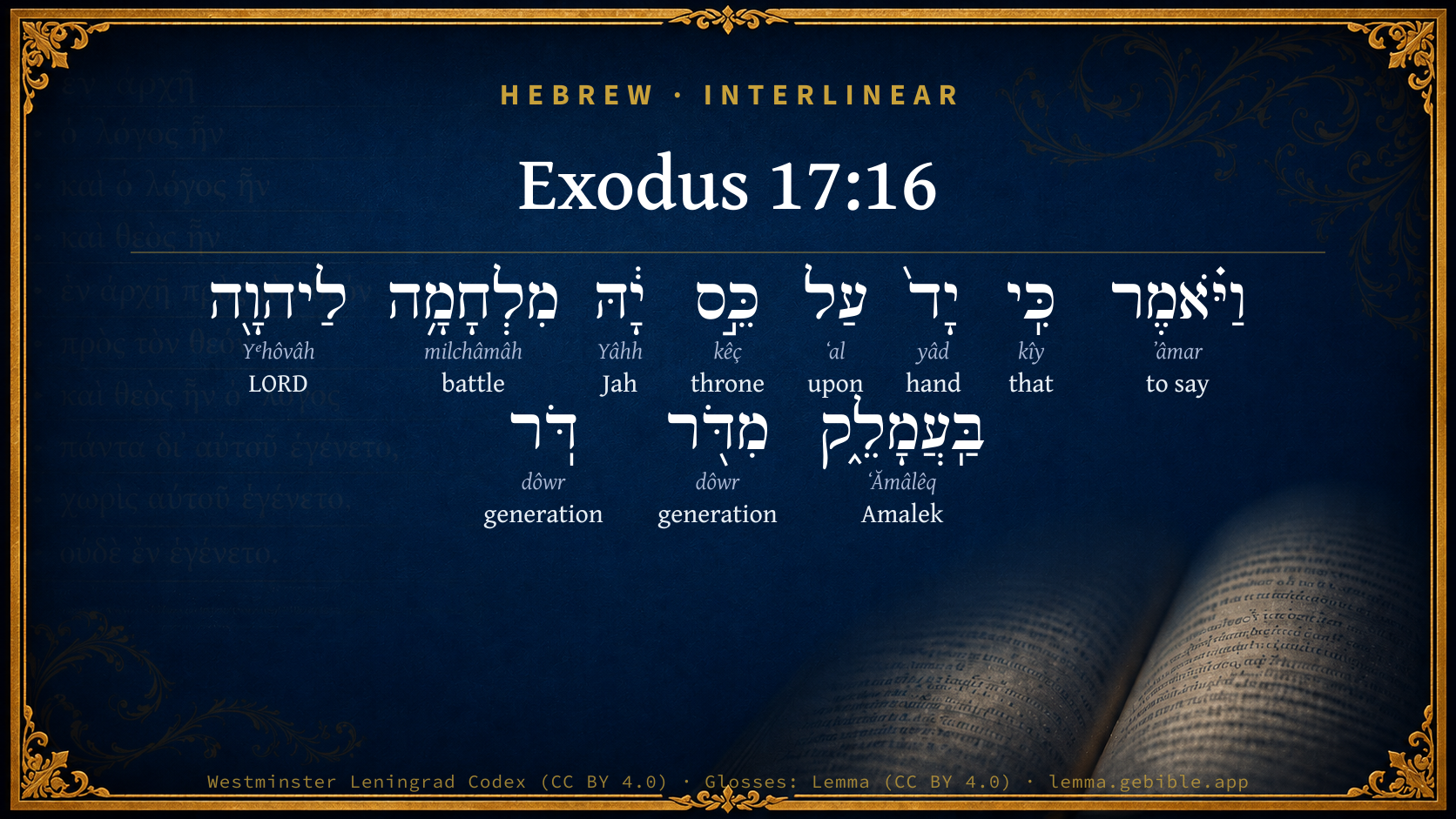
Exodus 17:16

Hebrew (Westminster Leningrad Codex) Exodus 17:16 appears in the Hebrew Old Testament. The text above is from the Westminster Leningrad Codex. Each word links to its Strong’s number, a concise gloss, and parsing drawn from the Open Scriptures Hebrew Bible morphology. Click any word for its full Brown-Driver-Briggs (BDB) entry.
Download image
Cite this verse

Exodus 17:16 (World English Bible). Public Domain. Lemma interlinear Bible study tool, https://lemma.gebible.app/v/exodus/17/16.

Show BibTeX & RIS
BibTeX
RIS
English Translation
He said, "Yah has sworn: 'Yahweh will have war with Amalek from generation to generation.'"
World English Bible · Public Domain
Highlights
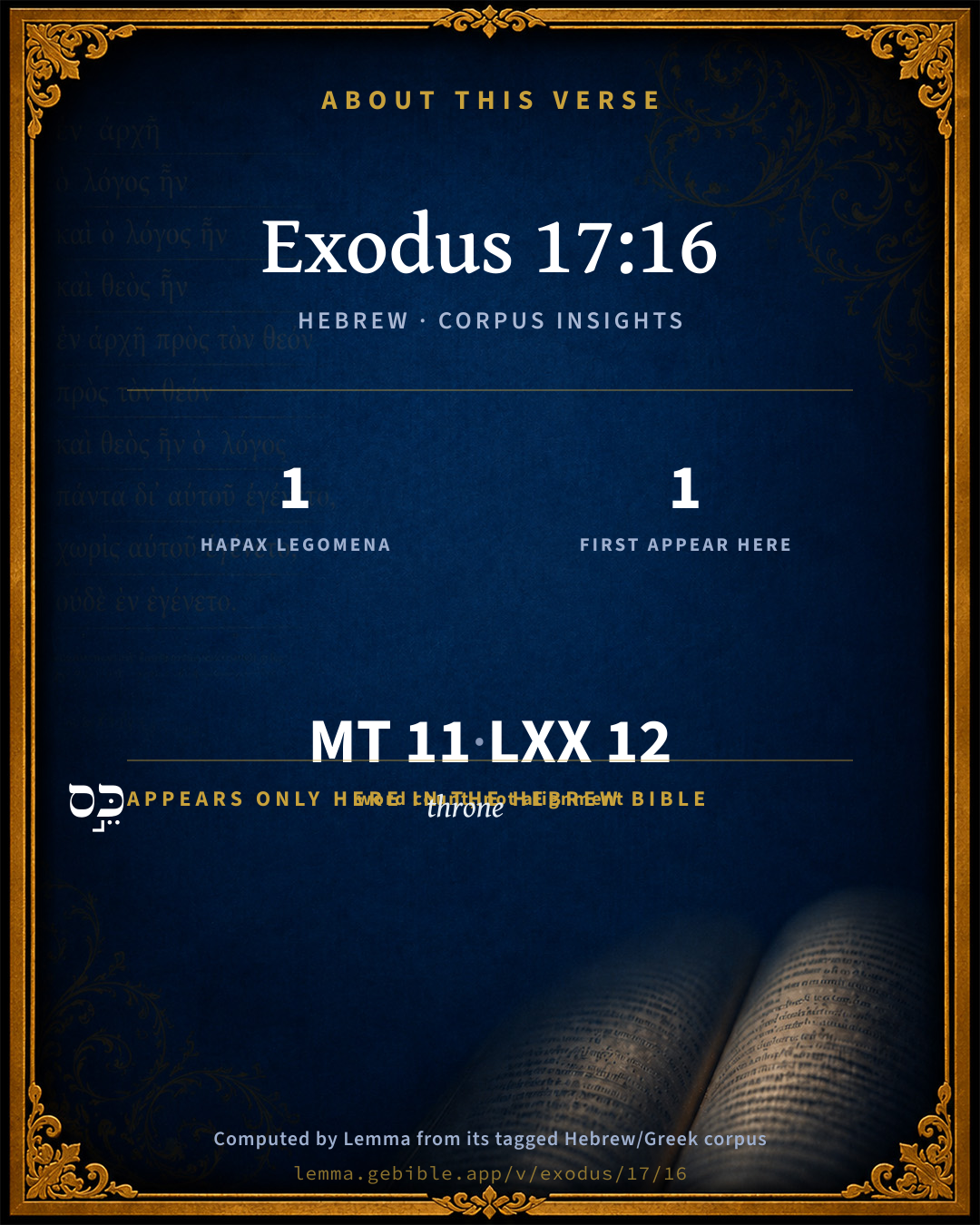
  • 1 hapax legomenon — only here in the Hebrew Bible
  • 1 first appearance in the Hebrew Bible
Full analysis ↓
Download a study sheet

One document with this verse’s original text, its word-by-word gloss line, the meaning frame, cross-references with their text, attributed commentary, and full source and license credits — printable, and it pastes into notes with its structure intact.

This verse Autodidact and up

Study sheet (.html) Plain text (.txt)

A passage Seminary Student

Up to 50 verses in one chapter. A passage sheet keeps up to 6 commentary sources and 12 cross-references per verse, in the order this page ranks them, and says so on the sheet whenever that leaves anything out. Ask for a single verse and you get the Autodidact verse sheet above.

Everything on this page stays free to read, with no account — the sheet is a download of what is already on screen, not access to it.

Want to remove ads? Support Godless Engineer
Compare translations 3

The same verse in 3 English versions, stacked beneath the original-language interlinear above. Click any original word for its lexicon entry.

Each is an independent rendering of the whole verse — the interlinear is not word-aligned to these translations.

Highlighted words mark where these versions differ — a whole-verse word diff, not a word-by-word alignment.

  • World English Bible Public Domain
    He said, "Yah has sworn: 'Yahweh will have war with Amalek from generation to generation.'"
  • King James Version Public Domain
    For he said, Because the LORD hath sworn that the LORD will have war with Amalek from generation to generation.
  • unfoldingWord Literal Text CC BY-SA 4.0
    And he said, “Because a hand was against the throne of Yah, war is to Yahweh against Amalek from generation to generation.”

unfoldingWord Literal Text — © unfoldingWord, licensed CC BY-SA 4.0. Word-aligned USFM3 via Door43 (git.door43.org/unfoldingWord/en_ult).

Versions to compare (up to 4)

3 of 4 selected

Show all 18 translations

Every available English version of this verse, each an independent rendering of the whole verse.

  • World English Bible Public Domain
    He said, "Yah has sworn: 'Yahweh will have war with Amalek from generation to generation.'"
  • Berean Standard Bible Public Domain
    “Indeed,” he said, “a hand was lifted up toward the throne of the LORD. The LORD will war against Amalek from generation to generation.”
  • Majority Standard Bible Public Domain
    “Indeed,” he said, “a hand was lifted up toward the throne of the LORD. The LORD will war against Amalek from generation to generation.”
  • King James Version Public Domain
    For he said, Because the LORD hath sworn that the LORD will have war with Amalek from generation to generation.
  • American Standard Version (1901) Public Domain
    And he said, Jehovah hath sworn: Jehovah will have war with Amalek from generation to generation.
  • Revised Version (1885) Public Domain
    and he said, The LORD hath sworn: the LORD will have war with Amalek from generation to generation.
  • Geneva Bible (1599) Public Domain
    Also he said, The Lord hath sworne, that he will haue warre with Amalek from generation to generation.
  • Douay-Rheims (1899) Public Domain
    Because the hand of the throne of the Lord, and the war of the Lord shall be against Amalec, from generation to generation.
  • Young's Literal Translation Public Domain
    and saith, `Because a hand `is' on the throne of Jah, war `is' to Jehovah with Amalek from generation -- generation.'
  • Literal Standard Version CC BY-SA 4.0
    and says, “Because a hand [is] on the throne of YAH, war [is] to YHWH with Amalek from generation [to] generation.”
  • Unlocked Literal Bible CC BY-SA 4.0
    He said, “For a hand was lifted up to the throne of Yahweh—that Yahweh will wage war with Amalek from generation to generation.”
  • unfoldingWord Literal Text CC BY-SA 4.0
    And he said, “Because a hand was against the throne of Yah, war is to Yahweh against Amalek from generation to generation.”
  • Darby Bible Public Domain
    And he said, For the hand is on the throne of Jah; Jehovah will have war with Amalek from generation to generation!
  • World Messianic Bible Public Domain
    He said, “The LORD has sworn: ‘The LORD will have war with Amalek from generation to generation.’”
  • Webster's Bible Public Domain
    For he said, Because the LORD hath sworn that the LORD will have war with Amalek from generation to generation.
  • Free Bible Version CC BY-SA 4.0
    “Hold up the victory banner of the Lord!” Moses declared. “The Lord will go on fighting the Amalekites for all generations!”
  • Bible in Basic English Public Domain
    For he said, The Lord has taken his oath that there will be war with Amalek from generation to generation.
  • JPS Tanakh (1917) Public Domain
    And he said: 'The hand upon the throne of the LORD: the LORD will have war with Amalek from generation to generation.'

Literal Standard Version (2020), Covenant Press — licensed CC BY-SA 4.0. Text via the HelloAO Bible API (eBible.org). Unlocked Literal Bible (unfoldingWord) — licensed CC BY-SA 4.0. Text via the HelloAO Bible API (eBible.org). unfoldingWord Literal Text — © unfoldingWord, licensed CC BY-SA 4.0. Word-aligned USFM3 via Door43 (git.door43.org/unfoldingWord/en_ult). Free Bible Version, Dr. Jonathan Gallagher — licensed CC BY-SA 4.0. Text via the HelloAO Bible API (eBible.org).

Word by word

More ways to search: Search by grammar → Find every occurrence → Compare this word →

Practice this passage: Drill this verse → Learn its vocabulary →

About this verse

These counts appear in no published source. They are computed here, from the morphology-tagged text and Lemma’s own curated glosses. What Lemma adds →

11
words
10
distinct lemmas
Pentateuch
section

Notable vocabulary

1 hapax legomenon — a word that appears only here in the entire Hebrew Bible:

  • כֵּ֣ס throne H3676

First appearance in Scripture

This word makes its first canonical appearance in the Hebrew Bible here:

  • כֵּ֣ס throne H3676

Shared distinctive vocabulary

בַּֽעֲמָלֵ֑ק Amalek H6002 occurs in 37 verses of the Hebrew Bible. Also found in:

Grammatical profile

  • 1 verb
  • 8 nouns
  • 1 preposition
  • 1 conjunction

Verb forms

  • וַיֹּ֗אמֶר Qal · Sequential Imperfect

Repetition

A word recurs within this verse — often emphatic in Hebrew:

  • מִדֹּ֖ר generation H1755 ×2

Hebrew & Septuagint length

In English translation the verse runs 15 words from the Hebrew and 14 from the Septuagint (LXX English) — closely comparable.

A rough comparison of the two English renderings, which tokenize alike — not a word-level alignment.

Word counts can differ between the Hebrew and the Greek without any difference in meaning — e.g. the Hebrew direct-object marker אֵת has no separate Greek word, and Greek often adds the article ὁ.

In the original languages it is 11 Hebrew tokens and 12 Greek tokens — but the two are counted differently (Hebrew bundles its prefixes and suffixes into one token; the Greek is in lemma form), so that isn’t a like-for-like length.

Cross-references

3

Topical passages linked to Exodus 17:16 in the Treasury of Scripture Knowledge — connected by theme and wording, ordered by reader-vote popularity; previews shown in the World English Bible.

  • Psalms 21:8–11 Your hand will find out all of your enemies. Your right hand will find out those who hate you.
  • Isaiah 66:1 Thus says Yahweh, heaven is my throne, and the earth is my footstool: what manner of house will you build to me? and what place shall be my rest?
  • Acts 7:49 'heaven is my throne, And the earth a footstool for my feet. What kind of house will you build me?' says the Lord; 'Or what is the place of my rest?

Cross-references courtesy of OpenBible.info (CC BY 4.0).

Hebrew and Greek witnesses Masoretic Hebrew ↔ Greek Septuagint

The same verse in the two great witnesses to the Old Testament, shown verse-for-verse.

These are two independent witnesses, not word-aligned to each other, and the Septuagint is shown in lemma (dictionary) form.

Hebrew Exodus 17:16 Masoretic · Westminster Leningrad Codex

וַיֹּ֗אמֶר כִּֽי יָד֙ עַל כֵּ֣ס יָ֔הּ מִלְחָמָ֥ה לַיהוָ֖ה בַּֽעֲמָלֵ֑ק מִדֹּ֖ר דֹּֽר

He said, "Yah has sworn: 'Yahweh will have war with Amalek from generation to generation.'"

World English Bible · Public Domain

Greek LXX Exodus 17:16 Septuagint · lemma form

ὅτι ἐν χείρ κρυφαῖος πολεμέω κύριος ἐπί αμαληκ ἀπό γενεά εἰς γενεά

For with a secret hand the Lord wages war upon Amalec to all generations.

LXX2012 (modern English Septuagint) · Public Domain

On this verse, Albert Barnes' Notes on the Bible discusses the Septuagint’s reading. Read the note in Commentary ↓

Hebrew: Westminster Leningrad Codex (CC BY 4.0). Greek: Septuagint (public domain); English from LXX2012 (modern English Septuagint) (Public Domain). How the Septuagint differs from the Hebrew →

Targum (Aramaic paraphrase)

2

The Targum is the ancient Jewish Aramaic paraphrase of the Hebrew Scriptures — an interpretive translation, not the Hebrew text itself. Onkelos (literal) and Pseudo-Jonathan (expansive) render the Torah, and Jonathan the Prophets. Coverage is partial: where no permissively-licensed English translation exists for a verse, only the Aramaic is shown. This is verse-level text, not a word-by-word alignment to the Hebrew.

  1. Targum Onkelos Torah (Genesis–Deuteronomy)
    וַאֲמַר בִּשְׁבוּעָה אֲמִירָא דָא מִן קֳדָם דְחֵילָא דִשְׁכִנְתֵּהּ עַל כָּרְסֵהּ יְקָרֵהּ דְעָתִיד דְאִתָּגַח קְרָבָא קֳדָם יְיָ בִּדְבֵית עֲמָּ לֵק לְשֵׁצָיוּתְהוֹן מִדָרֵי עָלְמָא:

    (no public-domain English translation for this verse)

    Targum Onkelos — Aramaic: “Onkelos Genesis” (public domain); “Onkelos Exodus” (public domain); “Onkelos Leviticus” (public domain); “Onkelos Numbers” (public domain); “Onkelos Deuteronomy” (public domain). English: “Sefaria Community Translation” (CC0 1.0 (public-domain dedication)); “J.W. Etheridge. The Targums of Onkelos and Jonathan Ben Uzziel on the Pentateuch. London: Longmans, Green, 1862” (public domain). Text via Sefaria.

  2. Targum Pseudo-Jonathan Torah (Genesis–Deuteronomy)
    וַאֲמַר אֲרוּם קַיֵּים מֵימְרָא דַיְיָ בְּכוּרְסֵיהּ יְקָרֵיהּ דְּהוּא בְּמֵימְרֵיהּ יַגִּיחַ קְרָבָא בִּדְבֵית עֲמָלֵק וִישֵׁיצֵי יַתְהוֹן לִתְלָתֵי דָרַיָא מִדָּרָא דְעַלְמָא דֵין וּמִדָּרָא דִמְשִׁיחָא וּמִדָּרָא דְעַלְמָא דְאָתֵי

    And he said, Because the Word of the Lord hath sworn by the throne of His glory, that He by His Word will fight against those of the house of Amalek, and destroy them unto three generations; from the generation of this world, from the generation of the Meshiha, and from the generation of the world to come.

    Targum Pseudo-Jonathan — Aramaic: “Targum Jonathan on Genesis” (public domain); “Targum Jonathan on Exodus” (public domain); “Targum Jonathan on Leviticus” (public domain); “Targum Jonathan on Numbers” (public domain); “Targum Jonathan on Deuteronomy” (public domain). English: “The Targum of Jonathan ben Uzziel, trans. J. W. Etheridge, London, 1862” (public domain). Text via Sefaria.

Commentary

Notes on Exodus 17:16 from classic Christian and Jewish commentators (each source and its license shown beneath its notes). The classic Christian expositions comment on the surrounding passage and are grouped to its opening verse, so a note may address several verses; the Jewish commentaries on the Tanakh (Rashi and others) are per-verse, so they appear only where the commentator wrote on this verse.

Lemma curates 59 commentaries, every one of them public domain or Creative Commons licensed, each selected and text-cleaned for this edition rather than reprinted as found. About our sources →

Trapp's Complete Commentary

John Trapp

Exo 17:16 For he said, Because the LORD hath sworn [that] the LORD [will have] war with Amalek from generation to generation.

Ver. 16. Because the Lord, &c.] Heb., The hand upon the throne of the Lord. God’s hand is laid upon his own throne, as swearing to root out Amalek. Or Amalek’s hand is lifted up against God’s throne - that is, the Church; called God’s throne of glory, {Jer 3:17} and crown of glory; {Isa 62:3} therefore he will have perpetual war with him. Tua causa erit mea causa, said the Emperor Charles V to Julius Pflugius, who, being his agent, had received wrong by the Duke of Saxony. So saith God to all that belong to him.

John Trapp, A Commentary or Exposition upon All the Books of the Old and New Testament (1647–1656) — public domain. Text from a community e-Sword module.

Joseph Benson's Commentary

Exo 17:16. Because the Lord hath sworn, &c. — The original of this passage is variously rendered. There are two senses which appear most plausible. The one of them we have here in our text, the other in the margin. The words כי יד על כס יהchi jad gnall ches Jah, are literally, Because the hand upon the throne of Jah, Or Jehovah. The text considers it as an oath: Because he (Jehovah) hath lifted up his hand upon (that is, hath sworn by) his throne. So the Chaldee paraphrast. Others apply it to Moses: Because I have lifted up my hand, or sworn, by the throne of Jehovah. There is, however, no verb in the original answering to lifted up.

Therefore, some of the interpreters prefer the sense of the margin. Because the hand (the hand of Amalek) was against the throne of Jehovah, (the verb was being often understood,) therefore Jehovah will have war with Amalek, &c. — His hand is said to have been against the throne of Jehovah, because the throne of God was then among the Israelites, whose King he was in a peculiar manner; on which account Jerusalem is called his throne, Jer 3:17.

Joseph Benson's Commentary on the Old and New Testaments (1811–1818) — public domain. Text from a community e-Sword module.

Tyndale Open Study Notes

Tyndale Open Resources

17:16 They have raised their fist against the Lord’s throne, so now: The NLT sees the fist raised against the Lord’s throne as Amalek’s aggression against the Lord and his people. The alternate interpretation sees a reference to Moses’ own hands that were lifted to the Lord in prayer (17:15).

Tyndale Open Study Notes — © Tyndale Open Resources, licensed CC BY-SA 4.0. Text via the HelloAO Bible API.

Geneva Bible (1599)

Geneva Bible translators

Hebrew, the hand of the Lord upon the throne.

Geneva Bible (1599) marginal notes — public domain. Text via Bolls.life.

Adam Clarke's Commentary

Verse 16. The Lord hath sworn that the Lord will have war with Amalek, c.] This is no translation of the words כי יד על כס יה מלחמה ki yad al kes yah milckamah, which have been variously rendered by different translators and critics the most rational version of which is the following: Because the hand of Amalek is against the throne of God, therefore will I have war with Amalek from generation to generation. This gives a tolerably consistent sense, yet still there is considerable obscurity in the passage. Houbigant, a most judicious though bold critic, supposes that, as יהוה נסי Jehovah-nissi, Jehovah my ensign, was spoken of immediately before, כס kes, a throne, in this verse, is an error of some transcriber for נס nes, an ensign, which might be readily occasioned by the great similarity between the כ caph and the נ nun. He thinks farther that the two letters יה yah, which are supposed to be here a contraction of the word יהוה Yehovah, are separated, the י yod from the נס nes, which should be written נשי nissi, and the ה he, from מלחמה milchamah, which should be written המלחמה hammilchamah, and then the whole verse will run thus: For the hand shall be upon the ensigns of war unto the Lord, against Amalek for ever, i.e., God makes now a declaration of war against the Amalekites, which shall continue till their final destruction. The conjecture of Mr. Julius Bate, in his Literal Translation of the Pentateuch, deserves attention. He supposes that, as כס cos signifies a cup, and a cup is emblematically used for wrath, on one of the stones of the altar, mentioned in the preceding verse, a hand holding a cup was sculptured, this being a memorial, according to the custom of hieroglyphical writing, that the Lord would continue the cup of wrath, portending continual war, against Amalek for ever. I prefer Houbigant's exposition.

1. THIS first victory of Israel must have inspired them with a considerable measure of confidence in God, and in his servant Moses. Though God alone could give them the victory, yet it was necessary to show them that it was by the influence of Moses they got it. Moses could not deliver Amalek into their hands; yet if Moses did not continue to hold up his hands, i.e., to pray, Amalek must prevail. God, therefore, wrought this work in such a way as to instruct the people, promote his own glory, and secure the true honour of his servant. The Divine Being always performs the greatest number possible of ends, by the fewest and simplest means. In every work of God there is as much of wisdom and economy, as there is of sovereign uncontrolled power.

2. It is not probable that the people whom Joshua chose out to lead against Amalek were unarmed; and we have already seen that it is not at all likely that they came armed out of Egypt. And as the whole circumstances of this case show that those who fought against the Amalekites were properly equipped for the fight, we may then safely presume that they got their arms from the Egyptians, whose bodies were thrown on the shore after having been overwhelmed in the Red Sea. Thus, what was a judgment in the one case, was a most gracious providence in the other. Judgment on God's foes is mercy to his friends.

3. Of the efficacy of prayer we have already had the most striking examples. He who has the spirit of prayer, has the highest interest in the court of heaven; and the only way to retain it, is to keep it in constant employment. Apostasy begins in the closet: no man ever backslid from the life and power of Christianity who continued constant and fervent, especially in private prayer. He who prays without ceasing is likely to rejoice evermore.

Adam Clarke's Commentary on the Bible (1810–1826) — public domain. Text from a community e-Sword/MySword module.

Ellicott's Commentary for English Readers

(16) Because the Lord hath sworn that the Lord will have war with Amalek.—Heb,, because (his) hand is against the throne of Jehovah, (there shall be) war to Jehovah with Amalek, &c. The Hebrew can scarcely be said to be “obscure.” It gives plainly enough the sense which our translators have placed in the margin. Amalek, by attacking Israel, had lifted up his hand against the throne of God, therefore would God war against him from generation to generation.

A Bible Commentary for English Readers, edited by Charles John Ellicott (1878–1897) — public domain. Text from a community e-Sword module.

The Cambridge Bible for Schools and Colleges

gen. ed. J. J. S. Perowne

16. A solemn poetical utterance of Moses, swearing war for ever on Jehovah’s part against Amalek.

Yah hath sworn] This rendering cannot be right. The Heb. is A hand upon (or to [as Exo_9:22-23 Heb.]) the throne of Yah! i.e. I (Moses) swear, with my hand raised to Jehovah’s throne in heaven (see on Exo_6:8). So Ew. (Hist. i. 251), Di. But many scholars, as Clericus, J. D. Mich., Ges., Kn., Bäntsch, read nçs ‘banner’ for the otherwise unknown kçs (for kissç’, ‘throne’), i.e. A hand on the banner (v. 15) of Yah! let it ever be faithful to this banner, and ready to bear it in the future battles against Amalek. This reading has the advantage of bringing Moses’ words into direct relation with the name of the altar in v. 15.

This unfriendliness of Amalek to Israel was remembered afterwards with some bitterness. In 1Sa_15:2 f. it is assigned as the ground for Saul’s expedition against them; and in Deu_25:17-19 Moses is represented as exhorting Israel to remember it, and, when their possession of Canaan is secured, to be careful to recollect the injunction of Exo_17:14, and ‘blot out the remembrance of Amalek from under heaven.’ Cf. also Num_24:20. Saul’s raid, however, in spite of the terms used in 1Sa_15:8, did not exterminate the entire tribe: see 1Sa_27:7; 1Sa_30:1 ff. (where a band of them make a raid upon Ziklag, and are smitten afterwards by David, though 400 escape, v. 17), 2Sa_8:12, 1Ch_4:43 (the remnant of them smitten by 500 Simeonites, in the time of Hezekiah).

The Cambridge Bible for Schools and Colleges (gen. ed. J. J. S. Perowne; Cambridge University Press, 1878–1918) — public domain. Text from a community e-Sword module.

John Gill's Exposition

For he said, because the Lord hath sworn,.... So some Jewish writers (b) take it for an oath, as we do; or "because the hand is on the throne of the Lord" (c); which the Targum of Jonathan, Jarchi, and Aben Ezra, interpret of the hand of the Lord being lifted up, of his swearing by the throne of his glory; but, as Drusius observes, it is not credible that God should swear by that which is prohibited by Christ, Mat 5:24 rather the words are to be rendered, "because the hand", that is, the hand of Amalek, "is against the throne of the Lord" (d); against his people, among whom his throne was, and over whom he ruled, so against himself, and the glory of his majesty; because he was the first that made war upon Israel, when the Lord brought them out of Egypt, and unprovoked fell upon their rear, and smote the hindmost, faint and weary among them: therefore

the Lord will have war with Amalek from generation to generation; until they are utterly destroyed; and so in fact he had, and thus it was. The Targum of Jonathan is,"he by his word will make war against those that are of the house of Amalek, and destroy them to three generations, from the generation of this world, from the generation of the Messiah, and from the generation of the world to come;''and Baal Hatturim on the place observes, that this phrase, "from generation to generation", by gematry, signifies the days of the Messiah. Amalek may be considered as a type of antichrist, whose hand is against the throne of God, his tabernacle, and his saints; who, with all the antichristian states which make war with the Lamb, will be overcome and destroyed by him.

(b) R. Sol. Urbin. fol. 95. 1. (c) "quia manus super thronum Domini", Pagninus, Montanus; "sublata manu super solium Dei (juro)", Tigurine version. (d) "Quia manus (Hamaleki) fuit contra solium Jah", Junius & Tremellius, Piscator; so Ainsworth.

Next: Exodus Chapter 18

John Gill's Exposition of the Whole Bible (1746–1763) — public domain (CC PDM 1.0). Text via the HelloAO Bible API.

Albert Barnes' Notes on the Bible

Because the Lord hath sworn - This rendering is incorrect. Our translators regard the expression as a solemn asseveration by the throne of God. However, to this the objections are insuperable; it has no parallel in Scriptural usage: God swears by Himself, not by His Throne. As the Hebrew text now stands the meaning is more satisfactorily given in the margin.

An alteration, slight in form, but considerable in meaning, has been proposed with much confidence, namely, נס nês, “standard” for כסא kı̂ssê', “throne”; thus connecting the name of the altar with the sentence. Conjectural emendations are not to be adopted without necessity, and the obvious a priori probability of such a reading makes it improbable that one so far more difficult should have been substituted for it. One of the surest canons of criticism militates against its reception. As it stands, the text was undoubtedly that which was alone known to the Targumists, the Samaritan, the Syriac, the Latin and the Arabic translators. The Septuagint appears to have had a different reading: ἐν χειρὶ κρυφαίᾳ πολεμεῖ en cheiri kruphē polemeō.

Albert Barnes' Notes on the Bible (1834–1885) — public domain. Text from a community e-Sword/MySword module.

Haydock's Catholic Bible Commentary

Hand of the throne. The Lord hath lifted up his hand, and sworn on his throne, that war, &c., (Chaldean) or the hand of Amalec hath attacked the throne (Israel, the inheritance) of the Lord; therefore shall he pursue them for ever. The Septuagint have followed a different reading, "because with a secret hand the Lord will fight; and some suggest, that instead of ces, throne, we should read nos, signal, or standard." Since the hand has attacked the standard of the Lord, the war of the Lord is against Amalec. (Le Clerc.) --- Or "the Lord has taken his standard into his hand to destroy the Amalecites for ever." (Chateillon.) (Calmet)

George Leo Haydock (1774–1849), Haydock's Catholic Family Bible and Commentary, 1859 edition — public domain. Excludes Psalms (Douay-Rheims chapter numbering differs from Protestant) and Deuterocanonical books (Catholic canon only).

Matthew Poole's English Annotations

For, or, and, as the Hebrew particle properly signifies; for these words are not a reason of the passage next preceding, but an additional sentence.

Because, or, surely, (as that particle is oft used, as Job 8:6; 20:20; Psa 10:14; 44:22, &c.) Heb. the hand upon the throne of the Lord, for the hand of the Lord upon his throne, which is perfectly the same thing, only the order of the words is a little varied after the manner of the Hebrew tongue. These words then are a paraphrastical description of a solemn oath, by the usual posture of it, viz. the lifting up the hand, which is usually put for swearing, and in that sense is ascribed both to men, as Gen 14:22, and to God, as Deu 32:40. And this hand of God lifted up upon his throne, where his majesty doth peculiarly and gloriously dwell, signifies that God swears by himself, as is said Heb 6:13. And thus the Chaldee and Arabic interpreters understand it. Others render the place thus, Because the hand (or, his hand, the pronoun being here understood, as it frequently is in the Hebrew language, of which several instances have been given before, i.e. the hand of Amalek, which may easily be understood out of the following clause, in which Amalek is named) was against the throne of the Lord, i.e. was stretched out against God himself; for so God esteems it, because it was done against that people among whom God had placed his throne, or seat, or dwelling, according to his covenant made with them; which also was well known to the Amalekites by the relation of their progenitors, who in all probability had acquainted them with their own rights, and with Jacob’s arts, whereby he robbed Esau, the father of Amalek, Gen 36:15,16, of his birthright and blessing, and consequently of the land of Canaan, to which now God was bringing them, that he might plant them there, and set up his throne among them. And the Amalekites doubtless heard, as the other neighbours also did, in what a miraculous manner God had brought them out of Egypt, and over the Red Sea. And they knew better than others, by tradition from their parents, that God had promised Canaan to them, and now they saw that he was conducting them thither, and therefore to prevent this they now commence a war against them, and against God or his throne, whose presence with and conduct over them was most manifest; which was a great aggravation of their sin. And this latter translation and interpretation seems most probable,

1. Because it exactly agrees with the Hebrew words, and the order in which they are placed.

2. It makes the coherence more clear than our translation doth, the former part of the verse containing a reason of the latter, to wit, of that severe curse and everlasting war denounced against Amalek, because they attempted by force to overthrow God’s throne and people, and that with so many aggravating circumstances; of which see Deu 25:17,18.

Matthew Poole's English Annotations on the Holy Bible (1683–1685) — public domain. Text from a community e-Sword/MySword module.

Whedon's Commentary on the Bible

Daniel D. Whedon

16. Because the Lord (JEHOVAH) hath sworn — An obscure and much disputed verse. It is quite generally conceded that “throne” here should be read “banner,” as in Exo_17:15, כס being some copyist’s error for נס, which could very easily take place, especially as the word is nowhere else found. (Mich., Vater, Houbig., Ges., Knob.) The “because” shows that this verse gives a reason for the name of the altar, and the literal rendering would then run thus: And he said, [the name is Jehovah, my Banner,] Because the hand [of Israel is] on the banner of JAH, [there shall be] war from Jehovah with Amalek from generation to generation; that is, till he is blotted out. That is, Jehovah has reared up a standard against this heathen people, on which standard Israel has laid its hand, as Moses on this eventful day laid his hand upon the rod of God, and that standard shall not fall till Amalek is blotted out. Amalek, called by Balaam the “beginning of peoples,” most ancient among nations, the first foe of the covenant people, is the type of universal heathenism, which shall fall before Jehovah’s banner; and that banner shall not droop in the hands of his true Israel — the rod will not sink on the mount, nor the sword drop on the field — till all his foes are “wiped out” from under heaven. The Jehovah-Saviour “must reign till he hath put all enemies under his feet.”

Daniel D. Whedon (gen. ed.), Commentary on the Old and New Testaments (1874–1909) — public domain. Text from a community e-Sword module.

The Pulpit Commentary

Because the Lord hath sworn. Rather, as in the margin, "Because the hand of Amalek was against the throne of the Lord i.e. , "in attacking Israel, Amalek had as it were lifted up his hand against God on his throne," therefore should there be war against Amalek from generation to generation.

The Pulpit Commentary (1880–1919), ed. H.D.M. Spence-Jones & Joseph S. Exell — public domain. Text from a community e-Sword module.

Rashi

Rabbi Shlomo Yitzchaki (Rashi)

ויאמר AND HE SAID — i. e. Moses said.

כי יד על כס יה BECAUSE THE HAND IS UPON THE THRONE OF JAH — the hand of the Holy One, blessed be He, is raised to swear by His throne that He will have war and enmity against Amalek to all eternity. And what is the force of כס — why does it not say as usual כסא? And the Divine Name, also, is divided into half (יה is only the half of the Tetragrammaton)! The Holy One, blessed be He, swears that His Name will not be perfect nor His throne perfect until the name of Amalek be entirely blotted out. But when his name is blotted out then will His (God’s) Name be perfect and His throne perfect, as it is said, (Psalms 9:7) “The enemy is come to an end, he whose swords were for ever” — and this refers to Amalek of whom it is written, (Amos 1:11; the paragraph is a prophecy against Edom — Esau — the father of Amalek) “he kept his wrath for ever”. The verse in the Psalm continues: “and thou didst uproot enemies, their very memorial is perished”, What does it say immediately after this? (Psalms 9:8) “But the Lord (the Divine Name as given here is the Tetragrammaton) shall now remain for ever” — you see that the Name will be perfect (after Amalek is entirely rooted out as is mentioned in v. 7); “He establishes his throne (כסאו not כס) in righteousness” — so you see that His throne will then be perfect (Midrash Tanchuma, Ki Teitzei 11).

Rashi on the Tanakh — English translations: “The Judaica Press complete Tanach with Rashi, translated by A. J. Rosenberg” (CC BY 4.0); “Pentateuch with Rashi's commentary by M. Rosenbaum and A.M. Silbermann, 1929-1934” (public domain); “The Metsudah Tanach series, Lakewood, N.J” (CC BY 4.0); and “The Book of Joshua, Metsudah Publications, 1997” (CC BY 4.0). Text via Sefaria.

Ramban (Nachmanides)

Rabbi Moshe ben Nachman (Ramban / Nachmanides)

FOR THE HAND UPON ‘KEIS Y-AH’ (THE THRONE OF THE ETERNAL). “The hand of the Holy One, blessed be He, is raised to swear by His throne that He will maintain [a state of] war and enmity against Amalek forever. Now what is the significance of the word keis, and why does it not say kisei [as usual]? Furthermore, even the Divine Name is divided into half! [The answer is that] the Holy One, blessed be He, swore that the throne will not be perfect and the Name will not be full until He will blot out the name of Amalek the son of Esau. And when his name will be blotted out, then will G-d’s Name be full and the throne perfect, as it is said, The foe — they are destroyed; perpetual ruins. [This refers to Esau, of whom it is said, And he kept his wrath for ever.] Their very memorial is perished. What is written after that? And the Eternal is enthroned for ever. Thus you see [that after Amalek’s memory has perished], G-d’s Name is full. He hath established ‘kis’o’ (His throne) for judgment. Thus you see that the throne will be perfect.” Thus far the language of Rashi, and it is a Midrash of the Sages. 11.Some scholars explain the verse as meaning that “when there will be a ‘hand,’ [i.e., king, as explained further], upon the throne of the Eternal, the Eternal will have war with Amalek, and so shall it be from generation to generation.” The purport of this is that when there will be a king in Israel sitting upon the throne of the Eternal, he shall wage war against Amalek, thus alluding to Saul, the first king [of Israel]. And so shall it continue from generation to generation, that every king of Israel shall be duty-bound to fight with them until their name will extinct.The following is also a Midrash of the Gemara, Note 204. as found in [Tractate Sanhedrin] in the chapter of the High Priest: “By saying, The hand upon the throne of the Eternal: the Eternal will have war with Amalek from generation to generation, Scripture intimates that the Israelites must first appoint a king over themselves [before they are to annihilate the offspring of Amalek], for the throne of the Eternal refers only to the king, as it is said, Then Solomon sat on the throne of the Eternal. In line with the plain meaning of Scripture, this is correct.And by way of the Truth, [that is, the mystic lore of the Cabala, the verse is to be understood as meaning] that the Hand, [i.e., the attribute of justice], which is upon the throne of Y-ah, and which is the war from the Eternal, will continue with Amalek from generation to generation, for the high attribute of justice will pursue his extinction forever from generation to generation. The Midrash of the Sages [mentioned above] concerning “the full Divine Name” and “the perfect throne” allude to this [interpretation by way of the Truth].Now the reason for the punishment of Amalek, i.e., why punitive measures were meted out to him more than to all other nations, is that when all the nations heard [of G-d’s visitation upon the Egyptians], they trembled. Philistia, Edom, and Moab and the inhabitants of Canaan melted away from before the terror of the Eternal, and from the Glory of His majesty, whereas Amalek came from afar as if to make himself master over G-d. It is for this reason that it is said concerning him, and he feared not G-d. Besides, he was a descendant of Esau and related to us, a passer-by who meddles with a quarrel not his own. Yithro

Ramban (Nachmanides) on the Tanakh — English translation: “Commentary on the Torah by Ramban (Nachmanides). Translated and annotated by Charles B. Chavel. New York, Shilo Pub. House, 1971-1976” (CC BY 4.0). Text via Sefaria.

Lesson kit

Teaching starters — assembled from the data on this page, not authored interpretation. Every prompt links to the verse data it draws on. Edit before teaching.

Exodus, in the Pentateuch, opens this verse with 11 words (10 distinct Hebrew lemmas). Its most distinctive word is kêç (“throne”). A historical commentator’s framing appears above. Read the whole chapter for the surrounding context.

Discussion questions

  1. The word kêç carries the sense “throne.” How does it shape the verse?
  2. 1 word here appears nowhere else in the Hebrew Bible. Why might the author reach for such rare wording?
  3. This is the first place “throne” appears in Scripture (first appears here). What does its debut here establish?
  4. How does Genesis 36:12, which shares the word «Amalek», read alongside this verse?
  5. What does the repetition of “generation” (2× in this one verse) do in this verse?
  6. These translations render this verse differently. What is at stake in choosing one wording over another?
  7. «וַיֹּ֗אמֶר» is a Qal Sequential Imperfect verb. How does that grammatical form shape the action described?
  8. Compare how Trapp's Complete Commentary and Joseph Benson's Commentary read this verse. Where do they agree or differ?

Things to notice

  • 1 word in this verse appears nowhere else in the Hebrew Bible.
  • 1 word makes its first canonical appearance in Scripture here.
  • This verse counts 11 Hebrew ↔ 12 Greek words.
  • These translations choose different wording for 11 words in this verse.
  • “generation” occurs 2× in this single verse.

Reading settings

Reading text

Shown beneath each verse's original-language words.

Old Testament
Old Testament edition

Read the OT as the Masoretic Hebrew (MT) or the Greek Septuagint (LXX).

English shown for the Greek Septuagint (in the Hebrew ↔ Greek comparison).

Comparing translations? Open the Compare panel on any verse page to stack up to four side by side.