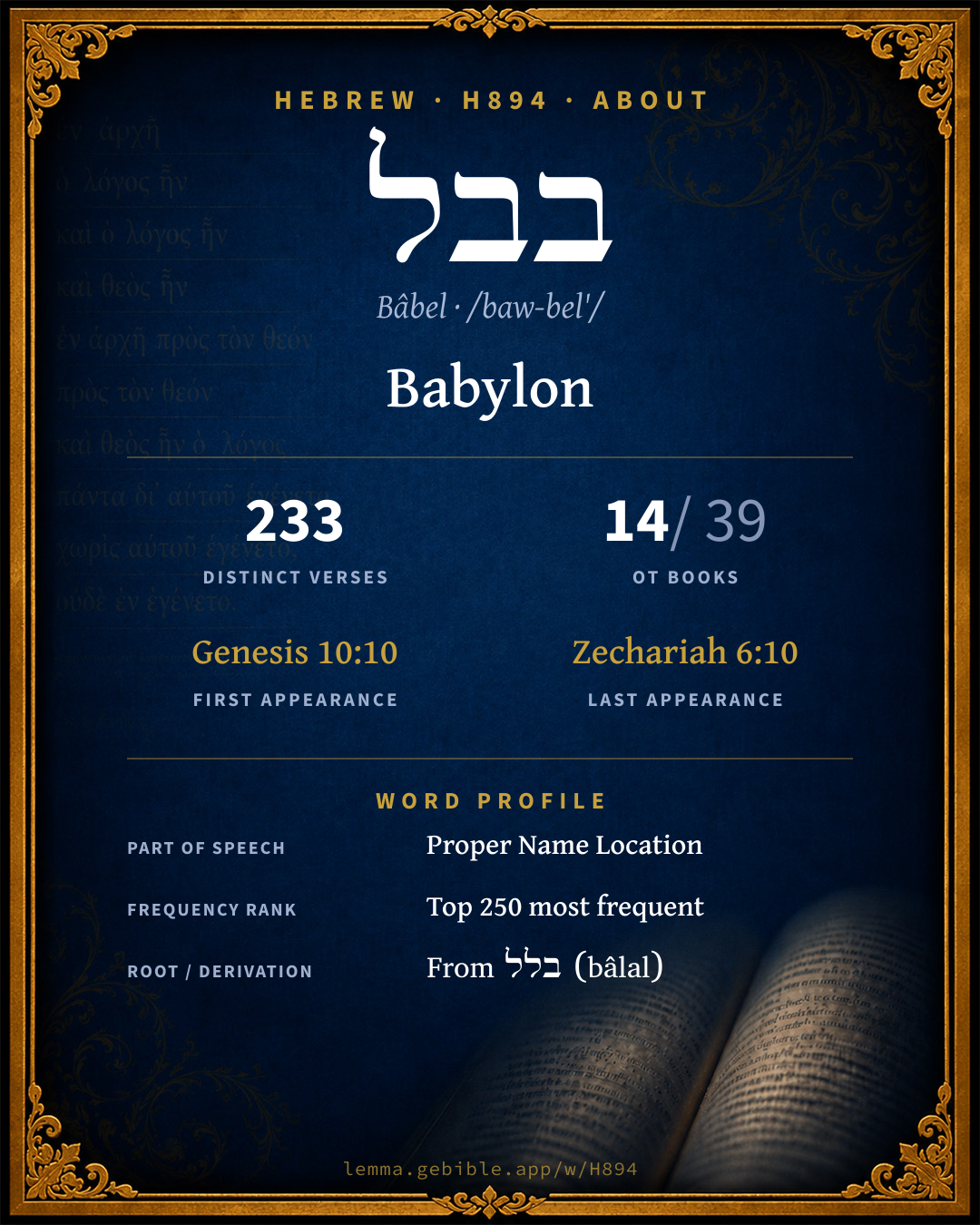
בָּבֶ֫ל
Babylon
BDB lists 2 entries for ‘Babylon’ fuller range ↓
Full lexicon entry — Brown-Driver-Briggs (BDB)
From Brown-Driver-Briggs (BDB)
Where this word appears
Grammar key — what these labels mean
Part of speech
- Noun
- A naming word — a person, place, thing, or idea.
Noun type
- Proper
- A name of a specific person, place, or people (e.g. Abraham, Zion, Israel).
Every verse where H894 appears in the Book of Zechariah — 2 distinct verses. Click any verse to open its interlinear word-by-word view. Verse text shown in the World English Bible for context — . Each verse’s Hebrew form is shown with its reference; the English is not keyword-highlighted, since the data carries no word-level English alignment. Use “Compare translations” on any verse to read it across multiple English versions. This concordance covers the Hebrew Bible; Septuagint (Greek Old Testament) occurrences are not indexed here.
Zechariah
- Zechariah 2:7 בָּבֶֽל n Proper 'Come, Zion! Escape, you who dwell with the daughter of Babylon.'
- Zechariah 6:10 מִ/בָּבֶֽל prep + n Proper "Take of them of the captivity, even of Heldai, of Tobijah, and of Jedaiah; and come the same day, and go into the house of Josiah the son of Zephaniah, where they have come from Babylon.
About this entry
At a glance — auto-summarized from this page’s data, not written by a person. Every figure links to its source below. This summary describes the numbers; it doesn’t interpret them.
“Babylon” is the headline sense of the Hebrew name בבל (Bâbel). More than half of its appearances fall in Jeremiah. The Hebrew Bible uses it across 233 verses — common. First canonically at Genesis 10:10, it enters the text early. See 233-verse concordance and the renderings breakdown below.
Gloss history
Strong's 1890 vs modern scholarship
About this word
Strong's H894 catalogs a Hebrew word from the Hebrew Old Testament.
These counts are not copied from any lexicon or concordance. They are computed here, from the morphology-tagged Hebrew Old Testament. What Lemma adds →
- 233
- distinct verses
- The word appears in 233 distinct verses.
- 14 / 39
- OT books
- The word appears in 14 of 39 Old Testament books.
- #188
- by frequency
- Top 250 most frequent Hebrew words (rank 188 of 8,640 Hebrew words by occurrence).
View all 233 occurrences in the concordance →
By section of the Old Testament
By traditional corpus
Conventional, traditional groupings — biblical authorship is debated, so this is a traditional corpus grouping, not an authorship claim. Each share is this word’s portion of its verses in that division of the Hebrew canon. Each figure is a share of the word’s 233 distinct verses.
- Prophets (Nevi'im) 211 verses · 91%
- Writings (Ketuvim) 20 verses · 9%
- Torah (Pentateuch) 2 verses · 1%
How translations render this word
Counts come from each version’s own published word-to-Strong’s tagging or interlinear alignment — an approximate guide to how each version renders this word, not a word-level alignment the data otherwise carries. Because each total is that version’s own tagged count, the per-version totals vary from one another and need not match the appearance or distinct-verse counts above. These counts may also differ from a printed concordance because Lemma counts each distinctly tagged rendering and does not collapse phrase taggings into a single head-word total. This is a fixed set of word-tagged versions (KJV, ASV, BSB, ULT) and does not change with the reading translation you choose elsewhere. Each version’s license is shown beside its name below (and on Sources).
- King James Version: Babylon 231×, Against babylon 8×, Babylon's 8×
- American Standard Version: Babylon 225×, Against babylon 5×, Concerning babylon 2×
- Berean Standard Bible: Babylon 240×, Babylon’s 6×, Against babylon 2×
- unfoldingWord Literal Text: Babylon 123×, Babel 2×, Babylonians 2×
King James Version Public Domain
Renders H894 across 259 tagged occurrences — most commonly:
Plus 8 renderings that appear only once — usually multi-word phrases or single function words the recovered tagging swept in, not distinct renderings. Not rendered by a distinct English word in 3 further occurrences.
American Standard Version Public Domain
Renders H894 across 259 tagged occurrences — most commonly:
Plus 23 renderings that appear only once — usually multi-word phrases or single function words the recovered tagging swept in, not distinct renderings.
Berean Standard Bible Public Domain
Renders H894 across 254 tagged occurrences — most commonly:
Plus 4 renderings that appear only once — usually multi-word phrases or single function words the recovered tagging swept in, not distinct renderings. Not rendered by a distinct English word in 8 further occurrences.
unfoldingWord Literal Text CC BY-SA 4.0
Renders H894 across 133 tagged occurrences — most commonly:
Plus 6 renderings that appear only once — usually multi-word phrases or single function words the recovered tagging swept in, not distinct renderings.
Senses in BDB
The 2 senses BDB distinguishes for this word, in lexicon order (not ranked by frequency or importance). The full entry — with sub-senses — is in the Lexicon Entry tab.
- Babel or Babylon = "confusion (by mixing)"
- Babel or Babylon, the ancient site and/or capital of Babylonia (modern Hillah) situated on the Euphrates
Word origin
n.pr.loc. Babel, Babylon (in Assyrian written Bâb-ili, gate of god DlPa 212, cf. on other hand JenKosmol. 498)—c. ָהloc. בָּבֶ֫לָה Ez 12:13 +, בָּבֶ֑לָה 2 K 20:17 + once מִכָּבֶ֫לָה Je 27:16;—the ancient capital of Babylonia, mod. Hillah, situated on Euphrates, in long. c. 44° 30’ E., and lat. c. 32° 50’ N.; Gn 10:10; 11:9 (where name connected with בלל confuse, confound), both J, not elsewhere in Hex; 2 K 17:24 + 31 times 2 K; 18 times Chr; Est 2:6; late ψ 87:4; 137:1, 8; Is 2, 3, viz. 13:1, 9; 14:4, 22; 21:9; 39:1, 3, 6, 7; 43:14; 47:1; 48:14, 20; Mi 4:10 (but here prob. not orig., cf. RSProph. vii. n. 5 & reff.) Zc 2:11; 6:10 Dn 1:1 Ez 12:13 + 19 times Ez; Je 20:4(×2) 5, 6 + 165 times Je;—note especially אֶרֶץ בּ׳ Je 50:28; also of land & people = realm, partic. in מֶלֶךְ בּ׳ 2 K 20:12 of Merodach Baladan; v 18; 24:1, 7, 11, 12(×2) + often of Nebuchadrezzar; 2 K 25:27 = Je 52:31 cf. v 34 of Evil-Merodach; Ne 13:6 of Artaxerxes; the city personif. as בַּת בָּבֶל Is 47:1 Je 50:42. (See DlPa 212 COT Gn 11:9; KG 95.)
— Brown-Driver-Briggs (Oxford 1906, public domain), digitized via Sefaria, supplemented by the OpenScriptures HebrewLexicon (CC BY 4.0). See Sources.
Derived from בלל (bâlal) (H1101) — to mix.
Jastrow Dictionary
A second Hebrew/Aramaic lexicon for comparison, covering Aramaic and post-biblical (Talmudic, Targumic, Midrashic) usage that the biblical-Hebrew BDB does not. Matched by lemma rather than by Strong’s number, so a lemma may carry more than one Jastrow headword (shown separately below), and the entries cover usage well beyond the Bible.
בָּבֶל
- (b. h.) pr. n. Babel, the city of Babylon; Babylonia, a country of varying limits, chiefly comprising Mesopotamia, a portion of Great Armenia and some neighbouring countries east of the Tigris (v. Neub. Géogr. p. 320). [Owing to the continued political disturbances in Palestine, Babylonia gradually became the centre of Jewish scholarship; hence both the frequent comparisons and jealousies between the East and the West (Babyl. a. Palest.); cmp. אֶרֶץ, חֲנַנְיָה, תַּלְמוּד. Kidd. 69ᵇ; 71ᵇ. Sot. 49ᵇ. Y. Snh. I, 19ᵃ; Y. Ned. VI, 40ᵃ bot. כי מב׳ תצא וכ׳ (sarcastic imitation of Is. II, 3). Snh. 24ᵃ תלמודה של ב׳ Babylonian method (Talmud). עולי ב׳ those coming from Bab. to visit the Temple, pilgrims. Ned. V, 4 דבר של ע׳ ב׳ that in which pilgrims from Bab. (i.e. Jews living abroad) have a share, as the Temple Mount &c. [Macc. 24ᵃ, a. e. המונה של ב׳, read רומי as Ms. M.; cmp. אֲרָמִי.] e.g. Isaiah 2:3
A Dictionary of the Targumim, the Talmud Babli and Yerushalmi, and the Midrashic Literature (Marcus Jastrow; London, Luzac, 1903) — Public Domain. Digitized via Sefaria. Digitized via Sefaria. Full attribution on Sources.
Forms in the corpus
The 56 distinct written forms H894 takes in the Hebrew Bible, most frequent first — each parse links to that state’s occurrences in the concordance. Hebrew forms include their vowel points and cantillation, so a single lemma takes many written forms.
| Form | Parsing | Example | Uses |
|---|---|---|---|
| בָּבֶ֖ל | Noun, Proper | Ezekiel 17:16 | 39 |
| בָּבֶ֔ל | Noun, Proper | Ezekiel 21:19 | 37 |
| בָּבֶֽל | Noun, Proper | Esther 2:6 | 23 |
| בָּבֶל֙ | Noun, Proper | Ezekiel 24:2 | 19 |
| בָּבֶֽלָ/ה | Noun, Proper | Ezekiel 17:12 | 16 |
| בָּבֶ֛ל | Noun, Proper | Daniel 1:1 | 15 |
| בָּבֶ֑ל | Noun, Proper | Ezekiel 19:9 | 14 |
| בָּבֶ֜ל | Noun, Proper | Ezekiel 21:21 | 10 |
| בָּבֶ֗ל | Noun, Proper | 2 Chronicles 32:31 | 8 |
| בָּבֶ֤ל | Noun, Proper | Ezekiel 17:12 | 5 |
| בָבֶ֔ל | Noun, Proper | Jeremiah 50:35 | 4 |
| בָבֶל֙ | Noun, Proper | Ezekiel 23:15 | 4 |
| מִ/בָּבֶֽל | Noun, Proper | Ezra 8:1 | 4 |
| בָבֶֽל | Noun, Proper | 2 Chronicles 36:18 | 3 |
| בְּ/בָבֶֽל | Noun, Proper | 2 Chronicles 36:7 | 3 |
| בָּבֶ֑לָ/ה | Noun, Proper | 2 Kings 20:17 | 3 |
| בָבֶ֖ל | Noun, Proper | Jeremiah 40:4 | 2 |
| בָבֶ֗ל | Noun, Proper | 2 Kings 17:30 | 2 |
| בָבֶ֗לָ/ה | Noun, Proper | Ezekiel 17:20 | 2 |
| בָבֶ֜ל | Noun, Proper | Jeremiah 50:2 | 2 |
| בָּבֶ֕ל | Noun, Proper | Jeremiah 51:33 | 2 |
| בָּבֶ֣ל | Noun, Proper | Jeremiah 34:1 | 2 |
| בָּבֶ֥ל | Noun, Proper | Jeremiah 29:28 | 2 |
| בָּבֶ֥לָ/ה | Noun, Proper | Jeremiah 27:22 | 2 |
| בָּבֶ֧ל | Noun, Proper | 2 Kings 25:21 | 2 |
| בָּבֶל֮ | Noun, Proper | Jeremiah 25:9 | 2 |
| לְ/בָבֶ֑ל | Noun, Proper | Ezra 2:1 | 2 |
| לְ/בָבֶ֜ל | Noun, Proper | Isaiah 14:22 | 2 |
| מִ/בָּבֶ֑ל | Noun, Proper | Ezra 7:9 | 2 |
| מִ/בָּבֶ֔ל | Noun, Proper | Ezra 7:6 | 2 |
| מִ/בָּבֶ֖ל | Noun, Proper | Ezra 1:11 | 2 |
| בָבֶ֔לָ/ה | Noun, Proper | 2 Chronicles 36:10 | 1 |
| בָבֶ֣ל | Noun, Proper | Ezekiel 23:23 | 1 |
| בָבֶ֨ל | Noun, Proper | Jeremiah 51:37 | 1 |
| בָבֶ֨לָ/ה֙ | Noun, Proper | Ezekiel 12:13 | 1 |
| בְּ/בָבֶ֔ל | Noun, Proper | Isaiah 48:14 | 1 |
| בְּ/בָבֶ֖ל | Noun, Proper | Jeremiah 29:22 | 1 |
| בְּ/בָבֶ֗ל | Noun, Proper | Jeremiah 51:44 | 1 |
| בָּ֠בֶל | Noun, Proper | Ezekiel 29:18 | 1 |
| בָּבֶ֔לָ/ה | Noun, Proper | Jeremiah 52:11 | 1 |
| בָּבֶ֖לָ/ה | Noun, Proper | Jeremiah 20:4 | 1 |
| בָּבֶ֗לָ/ה | Noun, Proper | Jeremiah 28:4 | 1 |
| בָּבֶ֡ל | Noun, Proper | Jeremiah 24:1 | 1 |
| בָּבֶל֒ | Noun, Proper | Jeremiah 51:34 | 1 |
| בָּבֶל֩ | Noun, Proper | Jeremiah 25:12 | 1 |
| וּ/בָבֶ֗ל | Noun, Proper | Psalms 87:4 | 1 |
| וּ/בָבֶ֞ל | Noun, Proper | Jeremiah 32:5 | 1 |
| וּ/בָבֶ֣ל | Noun, Proper | Jeremiah 20:6 | 1 |
| וּ/בָבֶ֥ל | Noun, Proper | Jeremiah 34:3 | 1 |
| לְ/בָבֶ֖ל | Noun, Proper | 1 Chronicles 9:1 | 1 |
| לְ/בָבֶ֛ל | Noun, Proper | Jeremiah 29:10 | 1 |
| לְ/בָבֶ֤ל | Noun, Proper | Jeremiah 51:2 | 1 |
| לְ/בָבֶ֥ל | Noun, Proper | Jeremiah 51:49 | 1 |
| מִ/בָּבֶ֖לָ/ה | Noun, Proper | Jeremiah 27:16 | 1 |
| מִ/בָּבֶ֡ל | Noun, Proper | 2 Kings 17:24 | 1 |
| מִ/בָּבֶל֮ | Noun, Proper | Isaiah 48:20 | 1 |
Same root — word family
Other BDB entries built from the same root as H894, grouped by Strong’s listed origin. These share a root / origin per the lexicon — not necessarily a shared meaning. Each links to that word’s own entry.
Derives from
Shares the same root
Proper names from this root
People and places named from this root — a name, not an additional meaning of the word.
Compare all same-root words → Showing 4 of 7 — not the complete family. 2 of the same-root words are proper names (people or places). They share a root, not necessarily a meaning.
Bible dictionary
Public-domain dictionary articles matched to this entry by name (Babylon). A biblical name can be shared by more than one person or place, so an article may treat several.
Easton's Bible Dictionary · M. G. Easton, 1897
The Greek form of BABEL; Semitic form Babilu, meaning "The Gate of God." In the Assyrian tablets it means "The city of the dispersion of the tribes." The monumental list of its kings reaches back to B.C. 2300, and includes Khammurabi, or Amraphel (q.v.), the contemporary of Abraham. It stood on the Euphrates, about 200 miles above its junction with the Tigris, which flowed through its midst and divided it into two almost equal parts. The Elamites invaded Chaldea (i.e., Lower Mesopotamia, or Shinar, and Upper Mesopotamia, or Accad, now combined into one) and held it in subjection. At length Khammu-rabi delivered it from the foreign yoke, and founded the new empire of Chaldea (q.v.), making Babylon the capital of the united kingdom. This city gradually grew in extent and grandeur, but in process of time it became subject to Assyria. On the fall of Nineveh (B.C. 606) it threw off the Assyrian yoke, and became the capital of the growing Babylonian empire. Under Nebuchadnezzar it became one of the most splendid cities of the ancient world.
After passing through various vicissitudes the city was occupied by Cyrus, "king of Elam," B.C. 538, who issued a decree permitting the Jews to return to their own land (Ezra 1). It then ceased to be the capital of an empire. It was again and again visited by hostile armies, till its inhabitants were all driven from their homes, and the city became a complete desolation, its very site being forgotten from among men.
On the west bank of the Euphrates, about 50 miles south of Bagdad, there is found a series of artificial mounds of vast extent. These are the ruins of this once famous proud city. These ruins are principally (1) the great mound called Babil by the Arabs. This was probably the noted Temple of Belus, which was a pyramid about 480 feet high. (2) The Kasr (i.e., "the palace"). This was the great palace of Nebuchadnezzar. It is almost a square, each side of which is about 700 feet long. The little town of Hillah, near the site of Babylon, is built almost wholly of bricks taken from this single mound. (3) A lofty mound, on the summit of which stands a modern tomb called Amran ibn-Ali. This is probably the most ancient portion of the remains of the city, and represents the ruins of the famous hanging-gardens, or perhaps of some royal palace. The utter desolation of the city once called "The glory of kingdoms" (Isa. 13:19) was foretold by the prophets (Isa. 13:4-22; Jer. 25:12; 50:2, 3; Dan. 2:31-38).
The Babylon mentioned in 1 Pet. 5:13 was not Rome, as some have thought, but the literal city of Babylon, which was inhabited by many Jews at the time Peter wrote.
In Rev. 14:8; 16:19; 17:5; and 18:2, "Babylon" is supposed to mean Rome, not considered as pagan, but as the prolongation of the ancient power in the papal form. Rome, pagan and papal, is regarded as one power. "The literal Babylon was the beginner and supporter of tyranny and idolatry...This city and its whole empire were taken by the Persians under Cyrus; the Persians were subdued by the Macedonians, and the Macedonians by the Romans; so that Rome succeeded to the power of old Babylon. And it was her method to adopt the worship of the false deities she had conquered; so that by her own act she became the heiress and successor of all the Babylonian idolatry, and of all that was introduced into it by the immediate successors of Babylon, and consequently of all the idolatry of the earth." Rome, or "mystical Babylon," is "that great city which reigneth over the kings of the earth" (17:18).
Smith's Bible Dictionary · William Smith, 1863
in the Apocalypse, is the symbolical name by which Rome is denoted. (Revelation 14:8; 17:18) The power of Rome was regarded by the later Jews as was that of Babylon by their forefathers. Comp. (Jeremiah 51:7) with Reve 14:8 The occurrence of this name in (1 Peter 5:13) has given rise to a variety of conjectures, many giving it the same meaning as in the Apocalypse; others refer it to Babylon in Asia, and others still to Babylon in Egypt. The most natural supposition of all is that by Babylon is intended the old Babylon of Assyria, which was largely inhabited by Jews at the time in question.
Hitchcock's Bible Names Dictionary · Roswell D. Hitchcock, 1869
same as Babel
Classic public-domain reference works; full attribution on Sources.
Septuagint verse parallels
This word appears in 182 verses that also exist in the Greek Old Testament (Septuagint), out of the 233 Hebrew verses it occurs in. You can read those verses in Greek by switching the Old Testament edition to the Septuagint.
Read these verses in the Septuagint
- Genesis 10:10
- 2 Kings 17:24
- 1 Chronicles 9:1
- 2 Chronicles 32:31
- Ezra 1:11
- Esther 2:6
- Psalms 87:4
- Isaiah 13:1
- Jeremiah 20:4
- Ezekiel 12:13
- Daniel 1:1
- Micah 4:10
This is a verse-level parallel only — the same verses exist in both the Hebrew and Greek Old Testaments. No word-level Hebrew↔Greek correspondence is claimed: the data carries no such alignment, so no Greek word is shown as this Hebrew word’s translation. Coverage is not total — the Septuagint omits the deuterocanon and renumbers the Psalms, so some Hebrew verses have no direct Greek parallel.