
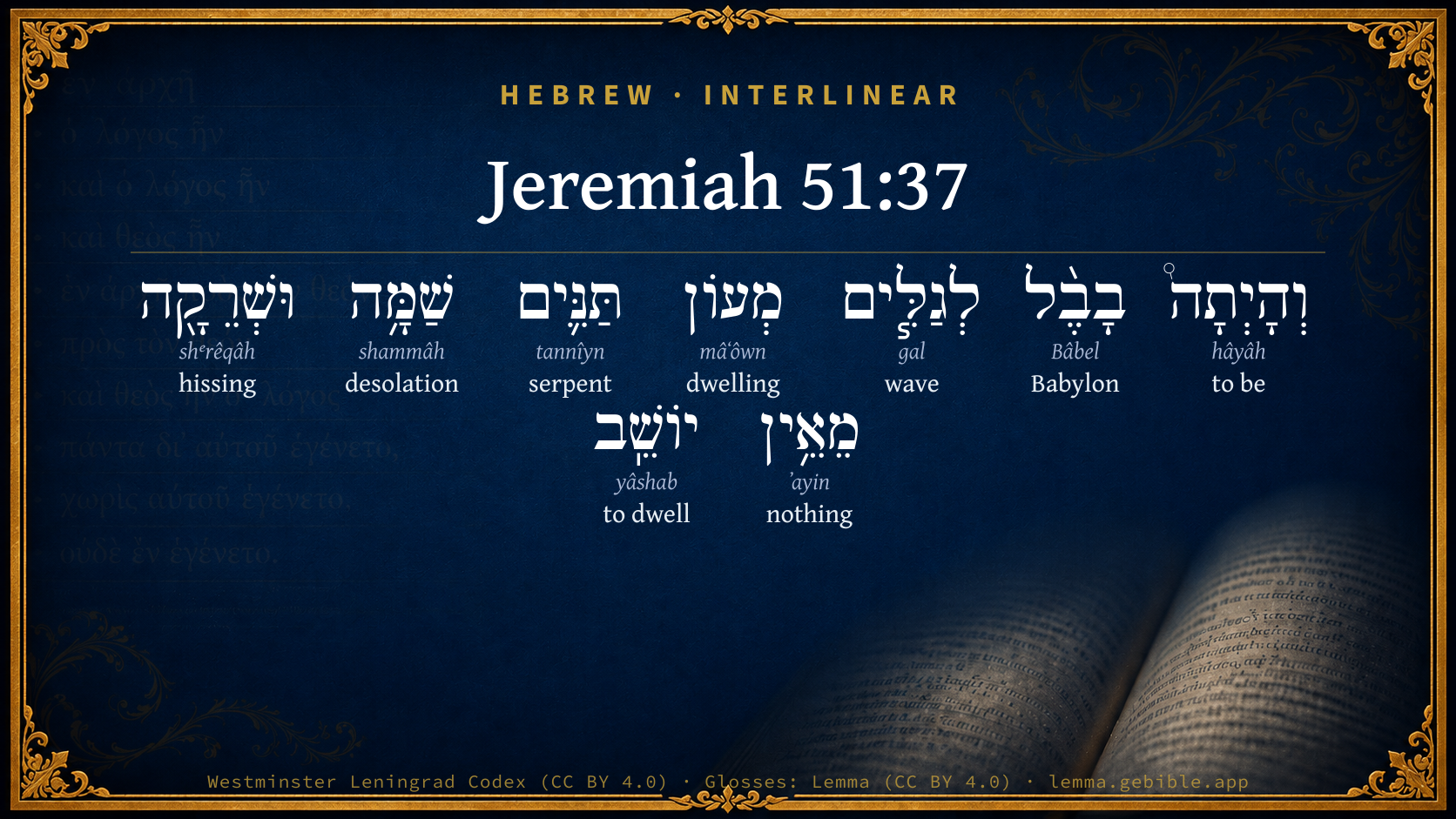
Jeremiah 51:37

Hebrew (Westminster Leningrad Codex) Jeremiah 51:37 appears in the Hebrew Old Testament. The text above is from the Westminster Leningrad Codex. Each word links to its Strong’s number, a concise gloss, and parsing drawn from the Open Scriptures Hebrew Bible morphology. Click any word for its full Brown-Driver-Briggs (BDB) entry.
Download image
Cite this verse

Jeremiah 51:37 (World English Bible). Public Domain. Lemma interlinear Bible study tool, https://lemma.gebible.app/v/jeremiah/51/37.

Show BibTeX & RIS
BibTeX
RIS
English Translation
Babylon shall become heaps, a dwelling-place for jackals, an astonishment, and a hissing, without inhabitant.
World English Bible · Public Domain
Download a study sheet

One document with this verse’s original text, its word-by-word gloss line, the meaning frame, cross-references with their text, attributed commentary, and full source and license credits — printable, and it pastes into notes with its structure intact.

This verse Autodidact and up

Study sheet (.html) Plain text (.txt)

A passage Seminary Student

Up to 50 verses in one chapter. A passage sheet keeps up to 6 commentary sources and 12 cross-references per verse, in the order this page ranks them, and says so on the sheet whenever that leaves anything out. Ask for a single verse and you get the Autodidact verse sheet above.

Everything on this page stays free to read, with no account — the sheet is a download of what is already on screen, not access to it.

Want to remove ads? Support Godless Engineer
Compare translations 3

The same verse in 3 English versions, stacked beneath the original-language interlinear above. Click any original word for its lexicon entry.

Each is an independent rendering of the whole verse — the interlinear is not word-aligned to these translations.

Highlighted words mark where these versions differ — a whole-verse word diff, not a word-by-word alignment.

  • World English Bible Public Domain
    Babylon shall become heaps, a dwelling-place for jackals, an astonishment, and a hissing, without inhabitant.
  • King James Version Public Domain
    And Babylon shall become heaps, a dwellingplace for dragons, an astonishment, and an hissing, without an inhabitant.
  • unfoldingWord Literal Text CC BY-SA 4.0
    Babylon will become heaps of rubble, a den of jackals, a horror, an object of hissing, where there are no inhabitants.

unfoldingWord Literal Text — © unfoldingWord, licensed CC BY-SA 4.0. Word-aligned USFM3 via Door43 (git.door43.org/unfoldingWord/en_ult).

Versions to compare (up to 4)

3 of 4 selected

Show all 18 translations

Every available English version of this verse, each an independent rendering of the whole verse.

  • World English Bible Public Domain
    Babylon shall become heaps, a dwelling-place for jackals, an astonishment, and a hissing, without inhabitant.
  • Berean Standard Bible Public Domain
    Babylon will become a heap of rubble, a haunt for jackals, an object of horror and scorn, without inhabitant.
  • Majority Standard Bible Public Domain
    Babylon will become a heap of rubble, a haunt for jackals, an object of horror and scorn, without inhabitant.
  • King James Version Public Domain
    And Babylon shall become heaps, a dwellingplace for dragons, an astonishment, and an hissing, without an inhabitant.
  • American Standard Version (1901) Public Domain
    And Babylon shall become heaps, a dwelling-place for jackals, an astonishment, and a hissing, without inhabitant.
  • Revised Version (1885) Public Domain
    And Babylon shall become heaps, a dwelling place for jackals, an astonishment, and an hissing, without inhabitant.
  • Geneva Bible (1599) Public Domain
    And Babel shall be as heapes, a dwelling place for dragons, an astonishment, and an hissing, without an inhabitant.
  • Douay-Rheims (1899) Public Domain
    And Babylon shall be reduced to heaps, a dwelling place for dragons, an astonishment and a hissing, because there is no inhabitant.
  • Young's Literal Translation Public Domain
    And Babylon hath been for heaps, A habitation of dragons, An astonishment, and a hissing, without inhabitant.
  • Literal Standard Version CC BY-SA 4.0
    And Babylon has been for heaps, || A habitation of dragons, || An astonishment, and a hissing, without inhabitant.
  • Unlocked Literal Bible CC BY-SA 4.0
    Babylon will become heaps of rubble, a den of jackals, a horror, an object of hissing, where there are no inhabitants.
  • unfoldingWord Literal Text CC BY-SA 4.0
    Babylon will become heaps of rubble, a den of jackals, a horror, an object of hissing, where there are no inhabitants.
  • Darby Bible Public Domain
    And Babylon shall become heaps, a dwelling-place of jackals, an astonishment, and a hissing, without inhabitant.
  • World Messianic Bible Public Domain
    Babylon will become heaps, a dwelling place for jackals, an astonishment, and a hissing, without inhabitant.
  • Webster's Bible Public Domain
    And Babylon shall become heaps, a dwelling-place for dragons, an astonishment, and a hissing, without an inhabitant.
  • Free Bible Version CC BY-SA 4.0
    Babylon will be turned into a pile of rubble, a home for jackals, a place that horrifies people, a place they jeer at, a place where no one lives.
  • Bible in Basic English Public Domain
    And Babylon will become a mass of broken walls, a hole for jackals, a cause of wonder and surprise, without a living man in it.
  • JPS Tanakh (1917) Public Domain
    And Babylon shall become heaps, a dwelling-place for jackals, an astonishment, and a hissing, without inhabitant.

Literal Standard Version (2020), Covenant Press — licensed CC BY-SA 4.0. Text via the HelloAO Bible API (eBible.org). Unlocked Literal Bible (unfoldingWord) — licensed CC BY-SA 4.0. Text via the HelloAO Bible API (eBible.org). unfoldingWord Literal Text — © unfoldingWord, licensed CC BY-SA 4.0. Word-aligned USFM3 via Door43 (git.door43.org/unfoldingWord/en_ult). Free Bible Version, Dr. Jonathan Gallagher — licensed CC BY-SA 4.0. Text via the HelloAO Bible API (eBible.org).

Word by word

More ways to search: Search by grammar → Find every occurrence → Compare this word →

Practice this passage: Drill this verse → Learn its vocabulary →

About this verse

These counts appear in no published source. They are computed here, from the morphology-tagged text and Lemma’s own curated glosses. What Lemma adds →

9
words
9
distinct lemmas
Prophets
section

Notable vocabulary

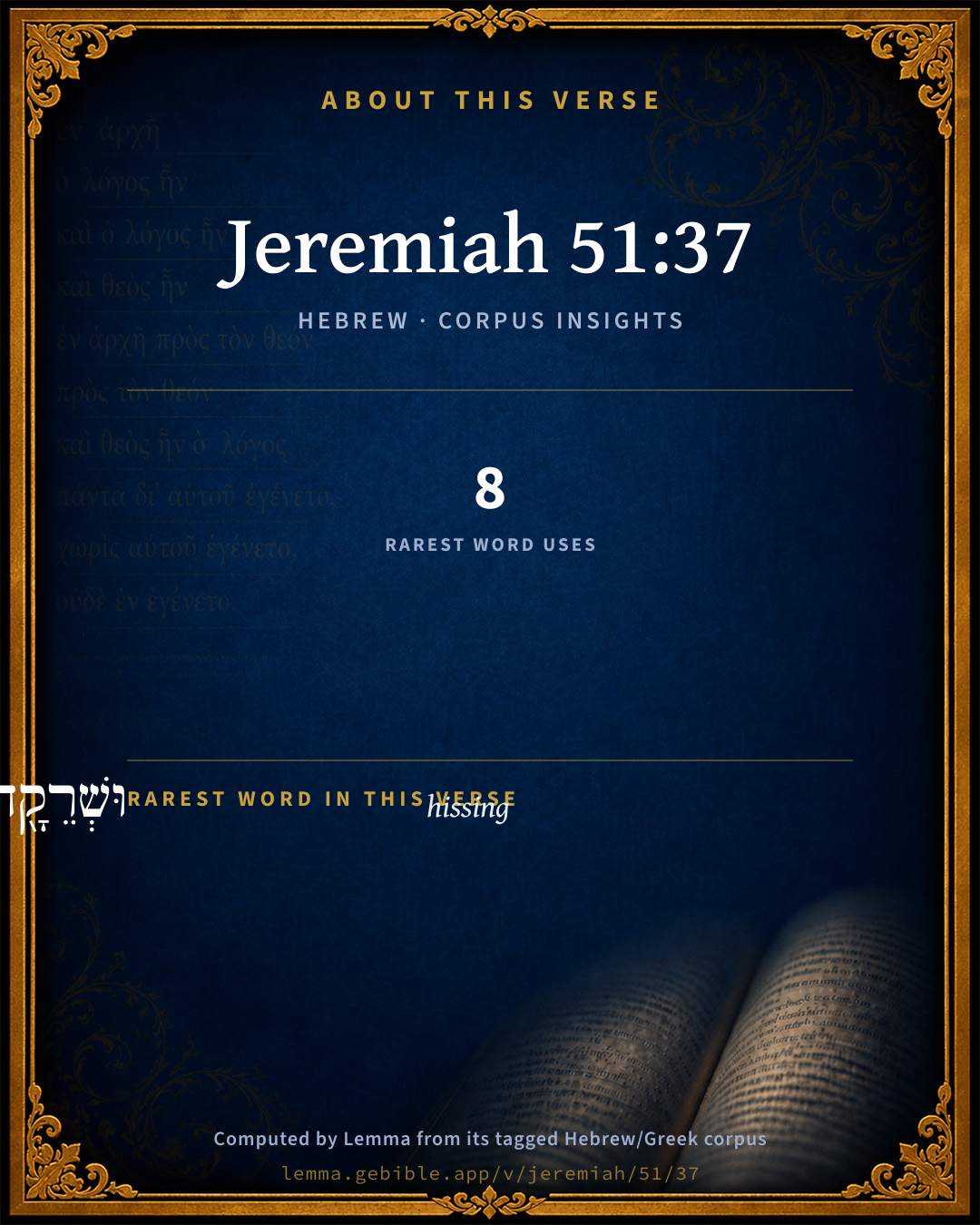
The rarest word here is וּשְׁרֵקָ֖ה hissing H8322 — appearing just 8 times in the whole Hebrew Bible.

Shared distinctive vocabulary

וּשְׁרֵקָ֖ה hissing H8322 occurs in 8 verses of the Hebrew Bible. Also found in:

Grammatical profile

  • 2 verbs
  • 6 nouns
  • 1 particle

Verb forms

  • וְהָיְתָה֩ Qal · Perfect
  • יוֹשֵֽׁב Qal · Participle Active

Cross-references

20

Topical passages linked to Jeremiah 51:37 in the Treasury of Scripture Knowledge — connected by theme and wording, ordered by reader-vote popularity; previews shown in the World English Bible.

  • Revelation 18:2 He cried with a mighty voice, saying, "Fallen, fallen is Babylon the great, and she has become a habitation of demons, a prison of every unclean spirit, and a prison of every unclean and hateful bird!
  • Jeremiah 18:16 to make their land an astonishment, and a perpetual hissing; everyone who passes thereby shall be astonished, and shake his head.
  • Jeremiah 25:9 behold, I will send and take all the families of the north, says Yahweh, and [I will send] to Nebuchadrezzar the king of Babylon, my servant, and will bring them against this land, and against the inhabitants of it, and against all these nations round about; and I will utterly destroy them, and make them an astonishment, and a hissing, and perpetual desolations.
  • Jeremiah 51:25–26 Behold, I am against you, destroying mountain, says Yahweh, which destroy all the earth; and I will stretch out my hand on you, and roll you down from the rocks, and will make you a burnt mountain.
  • Revelation 18:21–23 A mighty angel took up a stone like a great millstone and cast it into the sea, saying, "Thus with violence will Babylon, the great city, be thrown down, and will be found no more at all.
  • 2 Chronicles 29:8 Therefore the wrath of Yahweh was on Judah and Jerusalem, and he has delivered them to be tossed back and forth, to be an astonishment, and a hissing, as you see with your eyes.
  • Isaiah 13:19–22 Babylon, the glory of kingdoms, the beauty of the Chaldeans' pride, shall be as when God overthrew Sodom and Gomorrah.
  • Isaiah 14:23 I will also make it a possession for the porcupine, and pools of water: and I will sweep it with the broom of destruction, says Yahweh of Hosts.
  • Isaiah 34:8–17 For Yahweh has a day of vengeance, a year of recompense for the cause of Zion.
  • Jeremiah 19:8 I will make this city an astonishment, and a hissing; everyone who passes thereby shall be astonished and hiss because of all the plagues of it.
  • Jeremiah 25:12 It shall happen, when seventy years are accomplished, that I will punish the king of Babylon, and that nation, says Yahweh, for their iniquity, and the land of the Chaldeans; and I will make it desolate forever.
  • Jeremiah 25:18 [to wit], Jerusalem, and the cities of Judah, and the kings of it, and the princes of it, to make them a desolation, an astonishment, a hissing, and a curse, as it is this day;
  • Jeremiah 29:18 I will pursue after them with the sword, with the famine, and with the pestilence, and will deliver them to be tossed back and forth among all the kingdoms of the earth, to be an object of horror, and an astonishment, and a hissing, and a reproach, among all the nations where I have driven them;
  • Jeremiah 50:12–13 your mother shall be utterly disappointed; she who bore you shall be confounded: behold, she shall be the least of the nations, a wilderness, a dry land, and a desert.
  • Jeremiah 50:23–26 How is the hammer of the whole earth cut apart and broken! how is Babylon become a desolation among the nations!
  • Jeremiah 50:38–40 A drought is on her waters, and they shall be dried up; for it is a land of engraved images, and they are mad over idols.
  • Lamentations 2:15–16 All that pass by clap their hands at you; They hiss and wag their head at the daughter of Jerusalem, [saying], Is this the city that men called The perfection of beauty, The joy of the whole earth?
  • Zephaniah 2:15 This is the joyous city that lived carelessly, that said in her heart, "I am, and there is none besides me." How she has become a desolation, a place for animals to lie down in! Everyone who passes by her will hiss, and shake their fists.
  • Jeremiah 51:29 The land trembles and is in pain; for the purposes of Yahweh against Babylon do stand, to make the land of Babylon a desolation, without inhabitant.
  • Micah 6:16 For the statutes of Omri are kept, And all the works of the house of Ahab. You walk in their counsels, That I may make you a ruin, And her inhabitants a hissing; And you will bear the reproach of my people."

Cross-references courtesy of OpenBible.info (CC BY 4.0).

Hebrew and Greek witnesses Masoretic Hebrew ↔ Greek Septuagint

The same verse in the two great witnesses to the Old Testament, shown verse-for-verse.

These are two independent witnesses, not word-aligned to each other, and the Septuagint is shown in lemma (dictionary) form.

Hebrew Jeremiah 51:37 Masoretic · Westminster Leningrad Codex

וְהָיְתָה֩ בָבֶ֨ל לְגַלִּ֧ים מְעוֹן תַּנִּ֛ים שַׁמָּ֥ה וּשְׁרֵקָ֖ה מֵאֵ֥ין יוֹשֵֽׁב

Babylon shall become heaps, a dwelling-place for jackals, an astonishment, and a hissing, without inhabitant.

World English Bible · Public Domain

Greek LXX Structure differs

In the Septuagint, Jeremiah is about an eighth shorter than the Hebrew and arranges its material differently — the Oracles Against the Nations (Hebrew chapters 46–51) appear in the middle of the Greek book, after 25:13. Because the chapter and verse boundaries do not line up, a verse-for-verse comparison with the Hebrew is not shown.

A verse-for-verse comparison isn’t shown here because the chapters and verses don’t line up. Switch to the LXX edition with the MT / LXX toggle above to read the Greek directly.

Hebrew: Westminster Leningrad Codex (CC BY 4.0). Greek: Septuagint (public domain); English from a public-domain English Septuagint. How the Septuagint differs from the Hebrew →

Targum (Aramaic paraphrase)

1

The Targum is the ancient Jewish Aramaic paraphrase of the Hebrew Scriptures — an interpretive translation, not the Hebrew text itself. Onkelos (literal) and Pseudo-Jonathan (expansive) render the Torah, and Jonathan the Prophets. Coverage is partial: where no permissively-licensed English translation exists for a verse, only the Aramaic is shown. This is verse-level text, not a word-by-word alignment to the Hebrew.

  1. Targum Jonathan Prophets (Joshua–Malachi)
    וּתְהֵי בָּבֶל לְיַגְרִין מְדוֹר יְרוֹדִין צָדוּ וְאִשְׁתְּמָמוּ מִבְּלִי יָתֵיב:

    (no public-domain English translation for this verse)

    Targum Jonathan — Aramaic: “Mikraot Gedolot” (public domain). English: “Sefaria Community Translation” (CC0 1.0 (public-domain dedication)); “London "Chaldee Paraphrase," 1871” (public domain). Text via Sefaria.

Commentary

Notes on Jeremiah 51:37 from classic Christian and Jewish commentators (each source and its license shown beneath its notes). The classic Christian expositions comment on the surrounding passage and are grouped to its opening verse, so a note may address several verses; the Jewish commentaries on the Tanakh (Rashi and others) are per-verse, so they appear only where the commentator wrote on this verse.

Lemma curates 59 commentaries, every one of them public domain or Creative Commons licensed, each selected and text-cleaned for this edition rather than reprinted as found. About our sources →

Trapp's Complete Commentary

John Trapp

Jer 51:37 And Babylon shall become heaps, a dwellingplace for dragons, an astonishment, and an hissing, without an inhabitant.

Ver. 37. And Babylon shall become heaps.] See Jer 50:39.

John Trapp, A Commentary or Exposition upon All the Books of the Old and New Testament (1647–1656) — public domain. Text from a community e-Sword module.

Tyndale Open Study Notes

Tyndale Open Resources

51:37 The looting of the city and the damage to its structures would inspire contempt rather than awe in its visitors.

Tyndale Open Study Notes — © Tyndale Open Resources, licensed CC BY-SA 4.0. Text via the HelloAO Bible API.

Jamieson, Fausset & Brown

Robert Jamieson, A. R. Fausset & David Brown

(Jer 50:26, Jer 50:39; Rev 18:2).

Jamieson, Fausset & Brown — Commentary Critical and Explanatory on the Whole Bible (1871) — public domain (CC PDM 1.0). Text via the HelloAO Bible API.

Adam Clarke's Commentary

Verse 37. Without an inhabitant.] See Jer 50:39.

Adam Clarke's Commentary on the Bible (1810–1826) — public domain. Text from a community e-Sword/MySword module.

John Calvin's Commentaries

He confirms what he had said, that when God raised his hand against Babylon, such would be its destruction, that the splendor, which before astonished all nations, would be reduced to nothing. Perish, he says, shall all the wealth of Babylon — its towers and its walls shall fall, and its people shall disappear; in short, it shall become heaps of stones, as he said before, that it would become a mountain of burning. It is then for the same purpose that he now says that it would become heaps. But we must bear in mind what we observed yesterday, that it would become such heaps that they would not be fit for corners, that they could not be set in foundations; for the ruins would be wholly useless as to any new building.

He says that it would become an astonishment and a hissing Moses also used these words, when he threatened the people with punishment, in case they transgressed the law of God. (Deuteronomy 28:37.) But these threatenings extend to all the ungodly, and the despisers of God. Then God fulfilled as to the Babylonians what he had denounced by Moses on all the despisers of his law. It then follows, —

John Calvin's Commentaries (1540-1563) — public domain. Text from the Calvin Translation Society English edition (1840s-50s) via the Christian Classics Ethereal Library (ccel.org). Calvin's coverage is partial (roughly two-thirds of the Bible); uncommented books and verses are honest gaps, never fabricated. The 19th-century editor's footnotes and remarks are omitted so the notes are faithfully Calvin's own voice.

Ellicott's Commentary for English Readers

(37) Babylon shall become heaps . . .—It is significant, as emphasising the law of retribution, that the terms are the same as those used of Jerusalem in Jer_9:11; Jer_19:8; Jer_25:9; Jer_25:18. Nothing is more characteristic of the present aspect of Babylon than the “heaps” or mounds of brickwork, fragments of pottery and earth, that are now scattered over the plain, and are slowly yielding up their records of the past to explorers. The “dragons” here (not the same word as in Jer_51:34) are the “jackals” that howl in the ruins. (See Note on Jer_10:22.)

A Bible Commentary for English Readers, edited by Charles John Ellicott (1878–1897) — public domain. Text from a community e-Sword module.

The Cambridge Bible for Schools and Colleges

gen. ed. J. J. S. Perowne

37. heaps] “Vast ‘heaps’ or mounds, shapeless and unsightly, are scattered at intervals over the entire region where it is certain that Babylon anciently stood.” (Rawl. Anc. Mon. II. 521.)

hissing] See on Jer_18:16.

The Cambridge Bible for Schools and Colleges (gen. ed. J. J. S. Perowne; Cambridge University Press, 1878–1918) — public domain. Text from a community e-Sword module.

John Gill's Exposition

In their heat I will make their feasts,.... I will order it that their feasts shall be id the time of heat, that so they may be made drunk; so Jarchi: or when they are hot with feasting, I will disturb their feast by a handwriting on the wall; so Kimchi; see Dan 5:1; to which he directs: or when they are inflamed with wine, I will put something into their banquets, into their cups; I will mingle their potions with the wine of my wrath; and, while they are feasting, ruin shall come upon them; and so it was, according to Herodotus and Xenophon, that the city of Babylon was taken, while the inhabitants were feasting; and this account agrees with Dan 5:1. This text is quoted in the Talmud (c), where the gloss on it says,

"this is said concerning Belshazzar and his company, when they returned from a battle with Darius and Cyrus, who besieged Babylon, and Belshazzar overcame that day; and they were weary and hot, and sat down to drink, and were drunken, and on that day he was slain;''

and the Targum is,

"I will bring tribulation upon them:''

and I will make them drunken, that they may rejoice; in a riotous and revelling way; or that they may be mad and tremble, as R. Jonah, from the use of the word (d) in the Arabic language, interprets it; so drunken men are oftentimes like mad men, deprived of their senses, and their limbs tremble through the strength of liquor; and here it signifies, that the Chaldeans should be so intoxicated with the cup of divine wrath and vengeance, that they should be at their wits' end; in the utmost horror and trembling; not able to stand, or defend themselves; and so the Targum,

"they shall be like drunken men, that they may not be strong;''

but as weak as they:

and sleep a perpetual sleep, and not wake, saith the Lord; not only fall asleep as drunken men do, and awake again; but sleep, and never awake more; or die, and not live again, until the resurrection morn; no doubt many of the Chaldeans, being in a literal sense drunk and asleep when the city was taken, were slain in their sleep, and never waked again. The Targum is,

"and die the second death, and not live in the world to come;''

see Rev 21:8.

(c) T. Bab. Megilia, fol. 15. 2. (d) "furor ac repentina mors", Camus apud Golium, col. 1634. "tremor, timor mortis aegroto contingens", Giggeius apud Castel. col. 2772. So R. Sol. Urbiu. Ohel Moed, fol. 32. 1. interprets the words of trembling.

John Gill's Exposition of the Whole Bible (1746–1763) — public domain (CC PDM 1.0). Text via the HelloAO Bible API.

Albert Barnes' Notes on the Bible

Heaps - Of rubbish, formed in this case by the decay of the unburned bricks of which Babylon was built. It is these heaps which have yielded such a large wealth of historical documents in our own days.

Dragons - Jackals Jer 10:22.

Albert Barnes' Notes on the Bible (1834–1885) — public domain. Text from a community e-Sword/MySword module.

Haydock's Catholic Bible Commentary

Dragons. This has been the case for above sixteen centuries, chap. l. 31., and Isaias xiii. 21.

George Leo Haydock (1774–1849), Haydock's Catholic Family Bible and Commentary, 1859 edition — public domain. Excludes Psalms (Douay-Rheims chapter numbering differs from Protestant) and Deuterocanonical books (Catholic canon only).

Matthew Poole's English Annotations

Babylon shall become heaps; heaps of rubbish.

A dwelling-place for dragons, an astonishment, and an hissing, without an inhabitant. See Poole "Jer 50:39", See Poole "Jer 50:40", where the same thing was before said.

Matthew Poole's English Annotations on the Holy Bible (1683–1685) — public domain. Text from a community e-Sword/MySword module.

Whedon's Commentary on the Bible

Daniel D. Whedon

37. Heaps — Namely, of rubbish. How literally this has been fulfilled is shown by Rawlinson. (Ancient Monarchies, 2:521.)

Dragons — Not the word used in Jer_51:34, but one meaning jackals.

Daniel D. Whedon (gen. ed.), Commentary on the Old and New Testaments (1874–1909) — public domain. Text from a community e-Sword module.

The Pulpit Commentary

Heaps. "Vast "heaps," or mounds, shapeless and unsightly, are scattered at intervals over the entire region where it is certain that Babylon anciently stood" (Rawlinson, "Ancient Monarchies," 2:521). Dragons; rather, jackals.

The Pulpit Commentary (1880–1919), ed. H.D.M. Spence-Jones & Joseph S. Exell — public domain. Text from a community e-Sword module.

Lesson kit

Teaching starters — assembled from the data on this page, not authored interpretation. Every prompt links to the verse data it draws on. Edit before teaching.

Jeremiah, in the Prophets, opens this verse with 9 words (9 distinct Hebrew lemmas). Its most distinctive word is shᵉrêqâh (“hissing”). A historical commentator’s framing appears above. Read the whole chapter for the surrounding context.

Discussion questions

  1. How does “hissing” (shᵉrêqâh) shape what this verse is saying?
  2. How does 2 Chronicles 29:8, which shares the word «hissing», read alongside this verse?
  3. These translations render this verse differently. What is at stake in choosing one wording over another?
  4. «וְהָיְתָה֩» is a Qal Perfect verb. How does that grammatical form shape the action described?
  5. Compare how Trapp's Complete Commentary and Tyndale Open Study Notes read this verse. Where do they agree or differ?

Things to notice

Reading settings

Reading text

Shown beneath each verse's original-language words.

Old Testament
Old Testament edition

Read the OT as the Masoretic Hebrew (MT) or the Greek Septuagint (LXX).

English shown for the Greek Septuagint (in the Hebrew ↔ Greek comparison).

Comparing translations? Open the Compare panel on any verse page to stack up to four side by side.