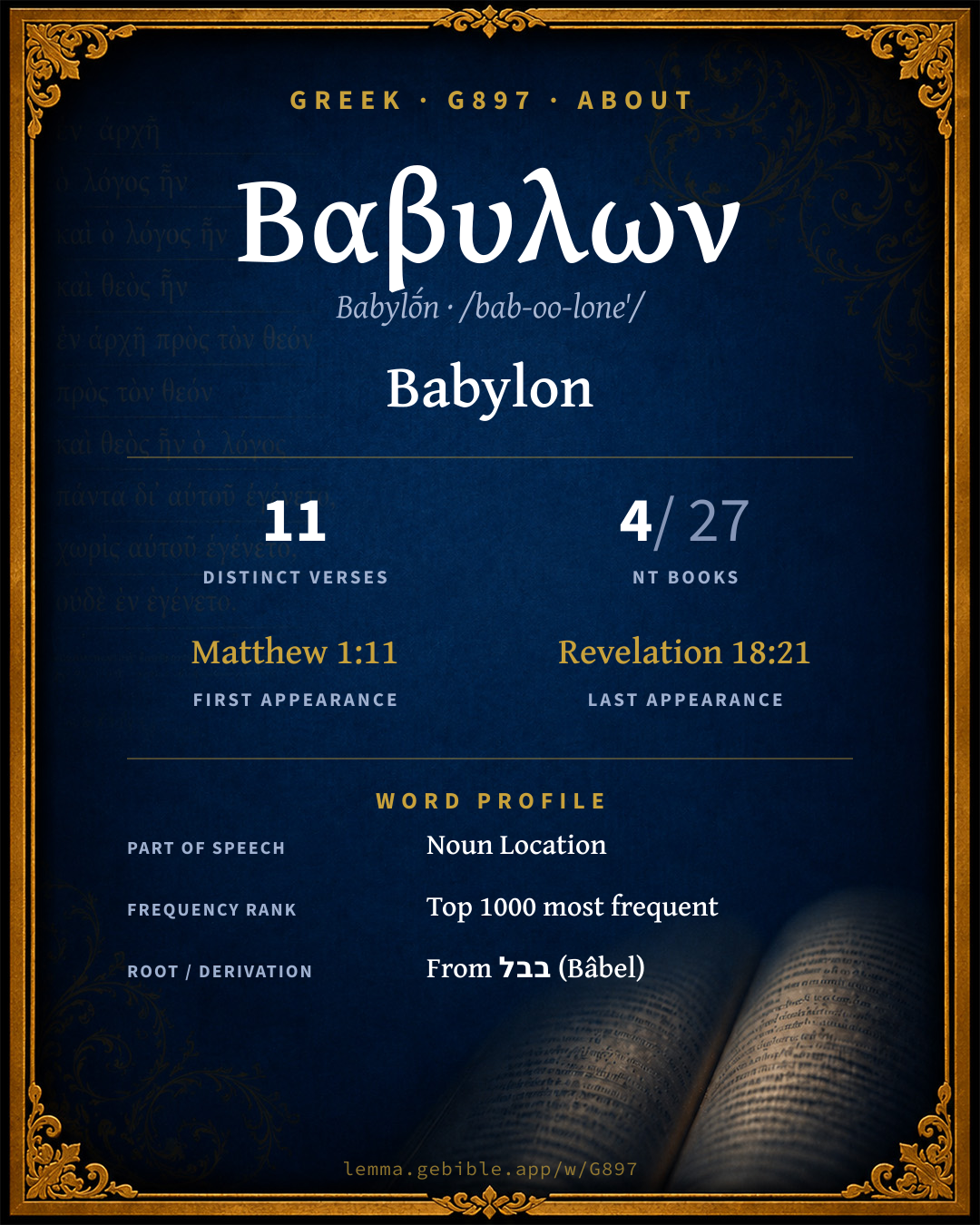
Βαβυλών
Babylon
Thayer's lists 4 entries for ‘Babylon’ fuller range ↓
Full lexicon entry — Thayer's Greek Lexicon
From Thayer's Greek Lexicon
Where this word appears
See every Nominative-case word in the Greek New Testament →
Grammar key — what these labels mean
Part of speech
- Noun
- A naming word — a person, place, thing, or idea.
Case
- Nominative
- The case of the subject (and the predicate nominative).
- Genitive
- The case of source, possession, or “of” — answers “whose / from what.”
- Dative
- The case of the indirect object, means, or location — “to / for / with / in.”
Gender
- Feminine
- Grammatically feminine.
Number
- Singular
- One.
Grammatical forms
- Noun, Nominative, Singular, Feminine 6 times (50%)
- Noun, Genitive, Singular, Feminine 5 times (42%)
- Noun, Dative, Singular, Feminine 1 time (8%)
Parsed forms decoded from the imported morphology (Robinson–Tischendorf, public domain), counted across 12 parsed occurrences — not distinct verses.
Every verse where G897 appears — 11 distinct verses across 4 books. Click any verse to open its interlinear word-by-word view. Verse text shown in the World English Bible for context — . Each verse’s Greek form is shown with its reference; the English is not keyword-highlighted, since the data carries no word-level English alignment. Use “Compare translations” on any verse to read it across multiple English versions. This concordance covers the Greek New Testament; Septuagint (Greek Old Testament) occurrences of this word are not indexed here.
Matthew 3 verses
- Matthew 1:11 Βαβυλῶνος n gen sg fem Josiah became the father of Jechoniah and his brothers, at the time of the exile to Babylon.
- Matthew 1:12 Βαβυλῶνος n gen sg fem After the exile to Babylon, Jechoniah became the father of Shealtiel. Shealtiel became the father of Zerubbabel.
- Matthew 1:17 Βαβυλῶνος Βαβυλῶνος n gen sg fem n gen sg fem So all the generations from Abraham to David are fourteen generations; from David to the exile to Babylon fourteen generations; and from the carrying away to Babylon to the Christ, fourteen generations.
Acts 1 verse
1 Peter 1 verse
Revelation 6 verses
- Revelation 14:8 Βαβυλὼν n nom sg fem Another, a second angel, followed, saying, "Babylon the great has fallen, which has made all the nations to drink of the wine of the wrath of her sexual immorality."
- Revelation 16:19 Βαβυλὼν n nom sg fem The great city was divided into three parts, and the cities of the nations fell. Babylon the great was remembered in the sight of God, to give to her the cup of the wine of the fierceness of his wrath.
- Revelation 17:5 Βαβυλὼν n nom sg fem And on her forehead a name was written, "MYSTERY, BABYLON THE GREAT, THE MOTHER OF THE PROSTITUTES AND OF THE ABOMINATIONS OF THE EARTH."
- Revelation 18:2 Βαβυλὼν n nom sg fem He cried with a mighty voice, saying, "Fallen, fallen is Babylon the great, and she has become a habitation of demons, a prison of every unclean spirit, and a prison of every unclean and hateful bird!
- Revelation 18:10 Βαβυλὼν n nom sg fem standing far away for the fear of her torment, saying, 'Woe, woe, the great city, Babylon, the strong city! For your judgment has come in one hour.'
- Revelation 18:21 Βαβυλὼν n nom sg fem A mighty angel took up a stone like a great millstone and cast it into the sea, saying, "Thus with violence will Babylon, the great city, be thrown down, and will be found no more at all.
About this entry
At a glance — auto-summarized from this page’s data, not written by a person. Every figure links to its source below. This summary describes the numbers; it doesn’t interpret them.
The Greek name Βαβυλων centers on the idea of “Babylon.” The word gravitates to Revelation (55%), then Matthew and Acts. It appears 11 verses across 4 books of the Greek New Testament, among its uncommon vocabulary. Debuting at Matthew 1:11, it then recurs through the corpus. For the data behind this summary, explore 11-verse concordance and the renderings breakdown below.
Gloss history
Strong's 1890 vs modern scholarship
About this word
Strong's G897 catalogs a Greek word from the Greek New Testament.
These counts are not copied from any lexicon or concordance. They are computed here, from the morphology-tagged Greek New Testament. What Lemma adds →
- 11
- distinct verses
- The word appears in 11 distinct verses.
- 4 / 27
- NT books
- The word appears in 4 of 27 New Testament books.
- #904
- by frequency
- Top 1000 most frequent Greek words (rank 904 of 5,347 Greek words by occurrence).
View all 11 occurrences in the concordance →
Most concentrated in
- Revelation 6 verses 55%
- Matthew 3 verses 27%
- Acts 1 verse 9%
By section of the New Testament
By traditional corpus
Conventional, traditional groupings — biblical authorship is debated, so this is a traditional corpus grouping, not an authorship claim. Some books belong to more than one corpus (Luke is in both the Gospels and the Lukan corpus, and so on), so these shares overlap and need not total 100%. Each figure is a share of the word’s 11 distinct verses.
- Johannine 6 verses · 55%
- Revelation 6 verses · 55%
- Gospels 3 verses · 27%
- Lukan (Luke–Acts) 1 verse · 9%
- General (Catholic) Epistles 1 verse · 9%
How translations render this word
Counts come from each version’s own published word-to-Strong’s tagging or interlinear alignment — an approximate guide to how each version renders this word, not a word-level alignment the data otherwise carries. Because each total is that version’s own tagged count, the per-version totals vary from one another and need not match the appearance or distinct-verse counts above. These counts may also differ from a printed concordance because Lemma counts each distinctly tagged rendering and does not collapse phrase taggings into a single head-word total. This is a fixed set of word-tagged versions (KJV, ASV, BSB, ULT) and does not change with the reading translation you choose elsewhere. Each version’s license is shown beside its name below (and on Sources).
- King James Version: Babylon 12×
- American Standard Version: Babylon 10×, Is babylon 2×
- Berean Standard Bible: Babylon 11×
- unfoldingWord Literal Text: Babylon 8×, Babylonian 4×
King James Version Public Domain
Renders G897 across 12 tagged occurrences — most commonly:
American Standard Version Public Domain
Renders G897 across 12 tagged occurrences — most commonly:
Berean Standard Bible Public Domain
Renders G897 across 11 tagged occurrences — most commonly:
Not rendered by a distinct English word in 1 further occurrence.
unfoldingWord Literal Text CC BY-SA 4.0
Renders G897 across 12 tagged occurrences — most commonly:
Senses in Thayer's
The 4 senses Thayer's distinguishes for this word, in lexicon order (not ranked by frequency or importance). The full entry — with sub-senses — is in the Lexicon Entry tab.
- Babylon = "confusion"
- a very large and famous city…
- of the territory of Babylonia
- allegorically, of Rome as the most corrupt seat of idolatry and the enemy of Christianity
Word origin
Derived from בבל (Bâbel) (H894) — Babylon.
Of hebrew origin [ H894 ]; Babylon the capital of Chaldaea (literally or figuratively as a type of tyranny): - Babylon.
— Strong’s Exhaustive Concordance (1890), public domain.
Forms in the corpus
The 3 distinct written forms G897 takes in the Greek New Testament, most frequent first — each parse links to that case’s occurrences in the concordance.
| Form | Parsing | Example | Uses |
|---|---|---|---|
| Βαβυλὼν Babylṑn | Noun, Nominative, Singular, Feminine | Revelation 14:8 | 6 |
| Βαβυλῶνος Babylō̂nos | Noun, Genitive, Singular, Feminine | Matthew 1:11 | 5 |
| Βαβυλῶνι Babylō̂ni | Noun, Dative, Singular, Feminine | 1 Peter 5:13 | 1 |
Same root — word family
Other Thayer's entries built from the same root as G897, grouped by Strong’s listed origin. These share a root / origin per the lexicon — not necessarily a shared meaning. Each links to that word’s own entry.
Derives from
Proper names from this root
People and places named from this root — a name, not an additional meaning of the word.
Compare all same-root words → 2 of the same-root words are proper names (people or places). They share a root, not necessarily a meaning.
Bible dictionary
Public-domain dictionary articles matched to this entry by name (Babylon). A biblical name can be shared by more than one person or place, so an article may treat several.
Easton's Bible Dictionary · M. G. Easton, 1897
The Greek form of BABEL; Semitic form Babilu, meaning "The Gate of God." In the Assyrian tablets it means "The city of the dispersion of the tribes." The monumental list of its kings reaches back to B.C. 2300, and includes Khammurabi, or Amraphel (q.v.), the contemporary of Abraham. It stood on the Euphrates, about 200 miles above its junction with the Tigris, which flowed through its midst and divided it into two almost equal parts. The Elamites invaded Chaldea (i.e., Lower Mesopotamia, or Shinar, and Upper Mesopotamia, or Accad, now combined into one) and held it in subjection. At length Khammu-rabi delivered it from the foreign yoke, and founded the new empire of Chaldea (q.v.), making Babylon the capital of the united kingdom. This city gradually grew in extent and grandeur, but in process of time it became subject to Assyria. On the fall of Nineveh (B.C. 606) it threw off the Assyrian yoke, and became the capital of the growing Babylonian empire. Under Nebuchadnezzar it became one of the most splendid cities of the ancient world.
After passing through various vicissitudes the city was occupied by Cyrus, "king of Elam," B.C. 538, who issued a decree permitting the Jews to return to their own land (Ezra 1). It then ceased to be the capital of an empire. It was again and again visited by hostile armies, till its inhabitants were all driven from their homes, and the city became a complete desolation, its very site being forgotten from among men.
On the west bank of the Euphrates, about 50 miles south of Bagdad, there is found a series of artificial mounds of vast extent. These are the ruins of this once famous proud city. These ruins are principally (1) the great mound called Babil by the Arabs. This was probably the noted Temple of Belus, which was a pyramid about 480 feet high. (2) The Kasr (i.e., "the palace"). This was the great palace of Nebuchadnezzar. It is almost a square, each side of which is about 700 feet long. The little town of Hillah, near the site of Babylon, is built almost wholly of bricks taken from this single mound. (3) A lofty mound, on the summit of which stands a modern tomb called Amran ibn-Ali. This is probably the most ancient portion of the remains of the city, and represents the ruins of the famous hanging-gardens, or perhaps of some royal palace. The utter desolation of the city once called "The glory of kingdoms" (Isa. 13:19) was foretold by the prophets (Isa. 13:4-22; Jer. 25:12; 50:2, 3; Dan. 2:31-38).
The Babylon mentioned in 1 Pet. 5:13 was not Rome, as some have thought, but the literal city of Babylon, which was inhabited by many Jews at the time Peter wrote.
In Rev. 14:8; 16:19; 17:5; and 18:2, "Babylon" is supposed to mean Rome, not considered as pagan, but as the prolongation of the ancient power in the papal form. Rome, pagan and papal, is regarded as one power. "The literal Babylon was the beginner and supporter of tyranny and idolatry...This city and its whole empire were taken by the Persians under Cyrus; the Persians were subdued by the Macedonians, and the Macedonians by the Romans; so that Rome succeeded to the power of old Babylon. And it was her method to adopt the worship of the false deities she had conquered; so that by her own act she became the heiress and successor of all the Babylonian idolatry, and of all that was introduced into it by the immediate successors of Babylon, and consequently of all the idolatry of the earth." Rome, or "mystical Babylon," is "that great city which reigneth over the kings of the earth" (17:18).
Smith's Bible Dictionary · William Smith, 1863
in the Apocalypse, is the symbolical name by which Rome is denoted. (Revelation 14:8; 17:18) The power of Rome was regarded by the later Jews as was that of Babylon by their forefathers. Comp. (Jeremiah 51:7) with Reve 14:8 The occurrence of this name in (1 Peter 5:13) has given rise to a variety of conjectures, many giving it the same meaning as in the Apocalypse; others refer it to Babylon in Asia, and others still to Babylon in Egypt. The most natural supposition of all is that by Babylon is intended the old Babylon of Assyria, which was largely inhabited by Jews at the time in question.
Hitchcock's Bible Names Dictionary · Roswell D. Hitchcock, 1869
same as Babel
Classic public-domain reference works; full attribution on Sources.
Septuagint usage
The same Greek word Βαβυλων appears 234 times in the Greek Old Testament (Septuagint), across 214 verses in 13 books.
- 234
- LXX occurrences
- Tagged occurrences of this Greek word in the Septuagint.
- 214
- verses
- Distinct Septuagint verses containing this word.
- 13 / 39
- OT books
- The word appears in 13 of the 39 Old Testament books.
Sample Septuagint occurrences
- Genesis 10:10 βαβυλών
- 2 Kings 17:24 βαβυλών
- 1 Chronicles 9:1 βαβυλών
- 2 Chronicles 32:31 βαβυλών
- Ezra 1:11 βαβυλών
- Esther 2:6 βαβυλών
- Psalms 86:4 βαβυλών
- Isaiah 10:9 βαβυλών
- Jeremiah 20:4 βαβυλών
- Ezekiel 12:13 βαβυλών
- Daniel 1:1 βαβυλών
- Micah 4:8 βαβυλών
Septuagint occurrences (same lexeme)
Every verse where the same Strong’s number (G897) appears in the Greek Septuagint — showing the first 50 of 214. Verse text shown in the World English Bible for context; the Greek form is the matched word — the English is not keyword-highlighted.
- Genesis 10:10 βαβυλών The beginning of his kingdom was Babel, Erech, Accad, and Calneh, in the land of Shinar.
- 2 Kings 17:24 βαβυλών The king of Assyria brought men from Babylon, and from Cuthah, and from Avva, and from Hamath and Sepharvaim, and placed them in the cities of Samaria instead of the children of Israel; and they possessed Samaria, and lived in the cities of it.
- 2 Kings 17:30 βαβυλών The men of Babylon made Succoth-benoth, and the men of Cuth made Nergal, and the men of Hamath made Ashima,
- 2 Kings 20:12 βαβυλών At that time Berodach-baladan the son of Baladan, king of Babylon, sent letters and a present to Hezekiah; for he had heard that Hezekiah had been sick.
- 2 Kings 20:14 βαβυλών Then came Isaiah the prophet to king Hezekiah, and said to him, What said these men? and from whence came they to you? Hezekiah said, They are come from a far country, even from Babylon.
- 2 Kings 20:17 βαβυλών Behold, the days come, that all that is in your house, and that which your fathers have laid up in store to this day, shall be carried to Babylon: nothing shall be left, says Yahweh.
- 2 Kings 20:18 βαβυλών Of your sons who shall issue from you, whom you shall father, shall they take away; and they shall be eunuchs in the palace of the king of Babylon.
- 2 Kings 24:1 βαβυλών In his days Nebuchadnezzar king of Babylon came up, and Jehoiakim became his servant three years: then he turned and rebelled against him.
- 2 Kings 24:7 βαβυλών The king of Egypt didn't come again out of his land any more; for the king of Babylon had taken, from the brook of Egypt to the river Euphrates, all that pertained to the king of Egypt.
- 2 Kings 24:10 βαβυλών At that time the servants of Nebuchadnezzar king of Babylon came up to Jerusalem, and the city was besieged.
- 2 Kings 24:11 βαβυλών Nebuchadnezzar king of Babylon came to the city, while his servants were besieging it;
- 2 Kings 24:12 βαβυλών and Jehoiachin the king of Judah went out to the king of Babylon, he, and his mother, and his servants, and his princes, and his officers: and the king of Babylon took him in the eighth year of his reign.
- 2 Kings 24:15 βαβυλών He carried away Jehoiachin to Babylon; and the king's mother, and the king's wives, and his officers, and the chief men of the land, carried he into captivity from Jerusalem to Babylon.
- 2 Kings 24:16 βαβυλών All the men of might, even seven thousand, and the craftsmen and the smiths one thousand, all of them strong and apt for war, even them the king of Babylon brought captive to Babylon.
- 2 Kings 24:17 βαβυλών The king of Babylon made Mattaniah, [Jehoiachin's] father's brother, king is his place, and changed his name to Zedekiah.
- 2 Kings 24:20 βαβυλών For through the anger of Yahweh did it happen in Jerusalem and Judah, until he had cast them out from his presence. Zedekiah rebelled against the king of Babylon.
- 2 Kings 25:1 βαβυλών It happened in the ninth year of his reign, in the tenth month, in the tenth day of the month, that Nebuchadnezzar king of Babylon came, he and all his army, against Jerusalem, and encamped against it; and they built forts against it round about.
- 2 Kings 25:6 βαβυλών Then they took the king, and carried him up to the king of Babylon to Riblah; and they gave judgment on him.
- 2 Kings 25:7 βαβυλών They killed the sons of Zedekiah before his eyes, and put out the eyes of Zedekiah, and bound him in fetters, and carried him to Babylon.
- 2 Kings 25:8 βαβυλών Now in the fifth month, on the seventh day of the month, which was the nineteenth year of king Nebuchadnezzar, king of Babylon, came Nebuzaradan the captain of the guard, a servant of the king of Babylon, to Jerusalem.
- 2 Kings 25:11 βαβυλών The residue of the people who were left in the city, and those who fell away, who fell to the king of Babylon, and the residue of the multitude, did Nebuzaradan the captain of the guard carry away captive.
- 2 Kings 25:13 βαβυλών The pillars of brass that were in the house of Yahweh, and the bases and the brazen sea that were in the house of Yahweh, did the Chaldeans break in pieces, and carried the brass of them to Babylon.
- 2 Kings 25:20 βαβυλών Nebuzaradan the captain of the guard took them, and brought them to the king of Babylon to Riblah.
- 2 Kings 25:21 βαβυλών The king of Babylon struck them, and put them to death at Riblah in the land of Hamath. So Judah was carried away captive out of his land.
- 2 Kings 25:22 βαβυλών As for the people who were left in the land of Judah, whom Nebuchadnezzar king of Babylon had left, even over them he made Gedaliah the son of Ahikam, the son of Shaphan, governor.
- 2 Kings 25:23 βαβυλών Now when all the captains of the forces, they and their men, heard that the king of Babylon had made Gedaliah governor, they came to Gedaliah to Mizpah, even Ishmael the son of Nethaniah, and Johanan the son of Kareah, and Seraiah the son of Tanhumeth the Netophathite, and Jaazaniah the son of the Maacathite, they and their men.
- 2 Kings 25:24 βαβυλών Gedaliah swore to them and to their men, and said to them, Don't be afraid because of the servants of the Chaldeans: dwell in the land, and serve the king of Babylon, and it shall be well with you.
- 2 Kings 25:27 βαβυλών It happened in the seven and thirtieth year of the captivity of Jehoiachin king of Judah, in the twelfth month, on the seven and twentieth day of the month, that Evilmerodach king of Babylon, in the year that he began to reign, did lift up the head of Jehoiachin king of Judah out of prison;
- 2 Kings 25:28 βαβυλών and he spoke kindly to him, and set his throne above the throne of the kings who were with him in Babylon,
- 1 Chronicles 9:1 βαβυλών So all Israel were reckoned by genealogies; and, behold, they are written in the book of the kings of Israel: and Judah was carried away captive to Babylon for their disobedience.
- 2 Chronicles 32:31 βαβυλών However in [the business of] the ambassadors of the princes of Babylon, who sent to him to inquire of the wonder that was done in the land, God left him, to try him, that he might know all that was in his heart.
- 2 Chronicles 33:11 βαβυλών Therefore Yahweh brought on them the captains of the host of the king of Assyria, who took Manasseh in chains, and bound him with fetters, and carried him to Babylon.
- 2 Chronicles 36:5 βαβυλών Jehoiakim was Twenty-five years old when he began to reign; and he reigned eleven years in Jerusalem: and he did that which was evil in the sight of Yahweh his God.
- 2 Chronicles 36:6 βαβυλών Against him came up Nebuchadnezzar king of Babylon, and bound him in fetters, to carry him to Babylon.
- 2 Chronicles 36:7 βαβυλών Nebuchadnezzar also carried of the vessels of the house of Yahweh to Babylon, and put them in his temple at Babylon.
- 2 Chronicles 36:10 βαβυλών At the return of the year king Nebuchadnezzar sent, and brought him to Babylon, with the goodly vessels of the house of Yahweh, and made Zedekiah his brother king over Judah and Jerusalem.
- 2 Chronicles 36:18 βαβυλών All the vessels of the house of God, great and small, and the treasures of the house of Yahweh, and the treasures of the king, and of his princes, all these he brought to Babylon.
- 2 Chronicles 36:20 βαβυλών Those who had escaped from the sword carried he away to Babylon; and they were servants to him and his sons until the reign of the kingdom of Persia:
- Ezra 1:11 βαβυλών All the vessels of gold and of silver were five thousand and four hundred. All these did Sheshbazzar bring up, when they of the captivity were brought up from Babylon to Jerusalem.
- Ezra 2:1 βαβυλών Now these are the children of the province, who went up out of the captivity of those who had been carried away, whom Nebuchadnezzar the king of Babylon had carried away to Babylon, and who returned to Jerusalem and Judah, everyone to his city;
- Ezra 5:12 βαβυλών But after that our fathers had provoked the God of heaven to wrath, he gave them into the hand of Nebuchadnezzar king of Babylon, the Chaldean, who destroyed this house, and carried the people away into Babylon.
- Ezra 5:17 βαβυλών Now therefore, if it seem good to the king, let there be search made in the king's treasure-house, which is there at Babylon, whether it be so, that a decree was made of Cyrus the king to build this house of God at Jerusalem; and let the king send his pleasure to us concerning this matter.
- Ezra 6:1 βαβυλών Then Darius the king made a decree, and search was made in the house of the archives, where the treasures were laid up in Babylon.
- Ezra 7:6 βαβυλών this Ezra went up from Babylon: and he was a ready scribe in the law of Moses, which Yahweh, the God of Israel, had given; and the king granted him all his request, according to the hand of Yahweh his God on him.
- Ezra 7:9 βαβυλών For on the first [day] of the first month began he to go up from Babylon; and on the first [day] of the fifth month came he to Jerusalem, according to the good hand of his God on him.
- Ezra 7:16 βαβυλών and all the silver and gold that you shall find in all the province of Babylon, with the freewill-offering of the people, and of the priests, offering willingly for the house of their God which is in Jerusalem;
- Ezra 8:1 βαβυλών Now these are the heads of their fathers' [houses], and this is the genealogy of those who went up with me from Babylon, in the reign of Artaxerxes the king:
- Ezra 17:6 βαβυλών
- Ezra 23:6 βαβυλών
- Esther 2:6 βαβυλών who had been carried away from Jerusalem with the captives who had been carried away with Jeconiah king of Judah, whom Nebuchadnezzar the king of Babylon had carried away.
These are occurrences of the same Greek lexeme (G897) in the Septuagint — not a translation of any one Hebrew word. The store carries no word-level Hebrew↔Greek alignment, so no Hebrew original is asserted here. Counts come from the recovered LXX Strong's tagging — high-frequency vocabulary is well covered, while rare or late forms may be untagged — so they reflect tagged occurrences and may slightly undercount.