
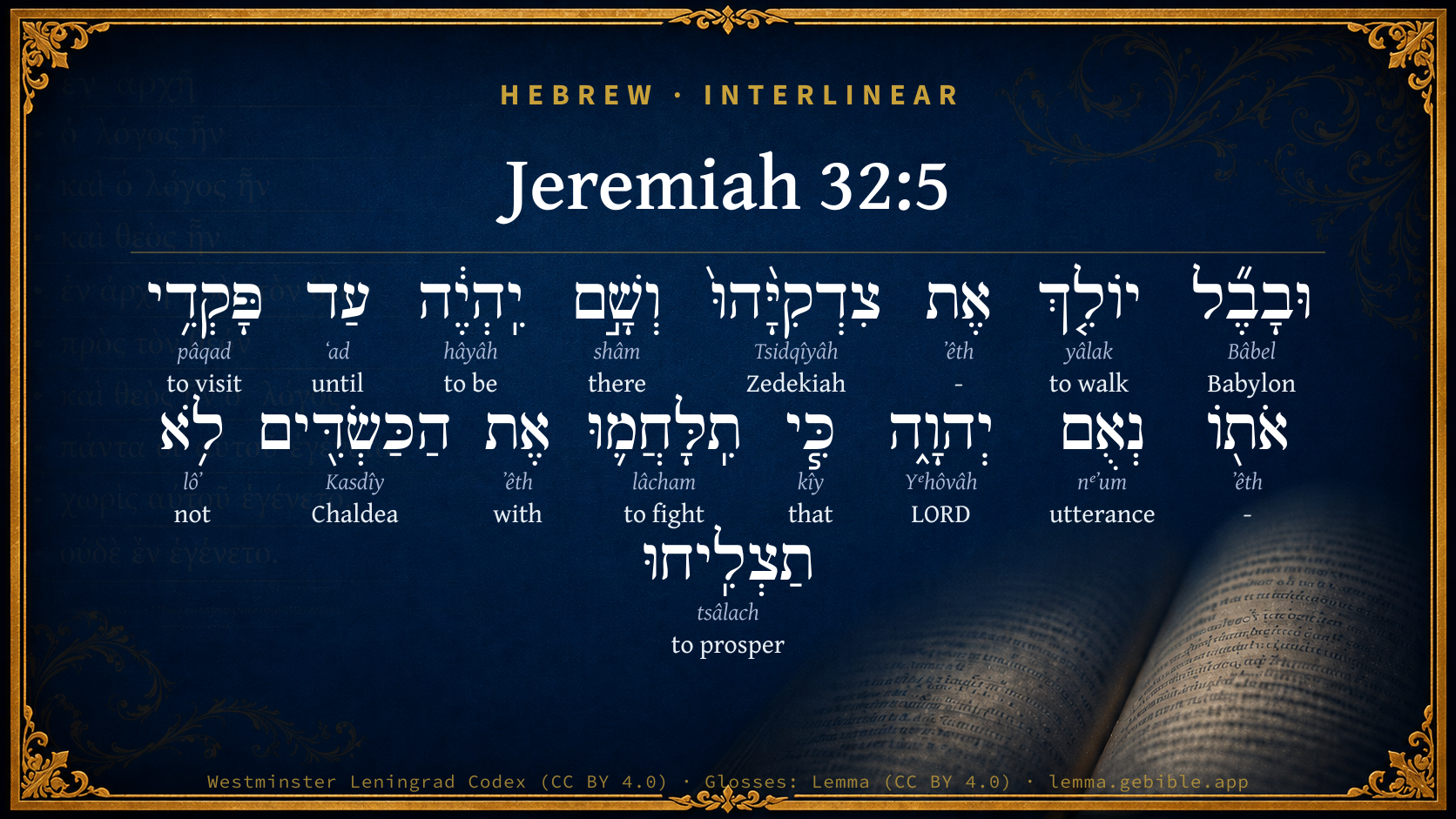
Jeremiah 32:5

Hebrew (Westminster Leningrad Codex) Jeremiah 32:5 appears in the Hebrew Old Testament. The text above is from the Westminster Leningrad Codex. Each word links to its Strong’s number, a concise gloss, and parsing drawn from the Open Scriptures Hebrew Bible morphology. Click any word for its full Brown-Driver-Briggs (BDB) entry.
Download image
Cite this verse

Jeremiah 32:5 (World English Bible). Public Domain. Lemma interlinear Bible study tool, https://lemma.gebible.app/v/jeremiah/32/5.

Show BibTeX & RIS
BibTeX
RIS
English Translation
and he shall bring Zedekiah to Babylon, and there shall he be until I visit him, says Yahweh: though you fight with the Chaldeans, you shall not prosper?
World English Bible · Public Domain
Download a study sheet

One document with this verse’s original text, its word-by-word gloss line, the meaning frame, cross-references with their text, attributed commentary, and full source and license credits — printable, and it pastes into notes with its structure intact.

This verse Autodidact and up

Study sheet (.html) Plain text (.txt)

A passage Seminary Student

Up to 50 verses in one chapter. A passage sheet keeps up to 6 commentary sources and 12 cross-references per verse, in the order this page ranks them, and says so on the sheet whenever that leaves anything out. Ask for a single verse and you get the Autodidact verse sheet above.

Everything on this page stays free to read, with no account — the sheet is a download of what is already on screen, not access to it.

Want to remove ads? Support Godless Engineer
Compare translations 3

The same verse in 3 English versions, stacked beneath the original-language interlinear above. Click any original word for its lexicon entry.

Each is an independent rendering of the whole verse — the interlinear is not word-aligned to these translations.

Highlighted words mark where these versions differ — a whole-verse word diff, not a word-by-word alignment.

  • World English Bible Public Domain
    and he shall bring Zedekiah to Babylon, and there shall he be until I visit him, says Yahweh: though you fight with the Chaldeans, you shall not prosper?
  • King James Version Public Domain
    And he shall lead Zedekiah to Babylon, and there shall he be until I visit him, saith the LORD: though ye fight with the Chaldeans, ye shall not prosper.
  • unfoldingWord Literal Text CC BY-SA 4.0
    He will take Zekediah to Babylon, and he will remain there until I have dealt with him—this is Yahweh’s declaration. Though you fight against the Chaldeans, you will not succeed.’”

unfoldingWord Literal Text — © unfoldingWord, licensed CC BY-SA 4.0. Word-aligned USFM3 via Door43 (git.door43.org/unfoldingWord/en_ult).

Versions to compare (up to 4)

3 of 4 selected

Show all 18 translations

Every available English version of this verse, each an independent rendering of the whole verse.

  • World English Bible Public Domain
    and he shall bring Zedekiah to Babylon, and there shall he be until I visit him, says Yahweh: though you fight with the Chaldeans, you shall not prosper?
  • Berean Standard Bible Public Domain
    He will take Zedekiah to Babylon, where he will stay until I attend to him, declares the LORD. If you fight against the Chaldeans, you will not succeed.’”
  • Majority Standard Bible Public Domain
    He will take Zedekiah to Babylon, where he will stay until I attend to him, declares the LORD. If you fight against the Chaldeans, you will not succeed.’”
  • King James Version Public Domain
    And he shall lead Zedekiah to Babylon, and there shall he be until I visit him, saith the LORD: though ye fight with the Chaldeans, ye shall not prosper.
  • American Standard Version (1901) Public Domain
    and he shall bring Zedekiah to Babylon, and there shall he be until I visit him, saith Jehovah: though ye fight with the Chaldeans, ye shall not prosper?
  • Revised Version (1885) Public Domain
    and he shall lead Zedekiah to Babylon, and there shall he be until I visit him, saith the LORD: though ye fight with the Chaldeans, ye shall not prosper?
  • Geneva Bible (1599) Public Domain
    And he shall lead Zedekiah to Babel, and there shall he be, vntil I visit him, saith ye Lord: though ye fight with the Caldeans, ye shall not prosper.
  • Douay-Rheims (1899) Public Domain
    And he shall lead Sedecias to Babylon: and he shall be there till I visit him, saith the Lord. But if you will fight against the Chaldeans, you shall have no success.
  • Young's Literal Translation Public Domain
    And `to' Babylon he leadeth Zedekiah, and there he is till My inspecting him, -- an affirmation of Jehovah -- because ye fight with the Chaldeans, ye do not prosper.'
  • Literal Standard Version CC BY-SA 4.0
    and he leads Zedekiah [to] Babylon, and there he is until My inspecting him—a declaration of YHWH—because you fight with the Chaldeans, you do not prosper.”
  • Unlocked Literal Bible CC BY-SA 4.0
    He will take Zekediah to Babylon, and he will remain there until I have dealt with him—this is Yahweh's declaration. Though you fight against the Chaldeans, you will not succeed.'”
  • unfoldingWord Literal Text CC BY-SA 4.0
    He will take Zekediah to Babylon, and he will remain there until I have dealt with him—this is Yahweh’s declaration. Though you fight against the Chaldeans, you will not succeed.’”
  • Darby Bible Public Domain
    and he shall lead Zedekiah to Babylon, and there shall he be until I visit him, saith Jehovah: though ye fight with the Chaldeans, ye shall not prosper?
  • World Messianic Bible Public Domain
    and he will bring Zedekiah to Babylon, and he will be there until I visit him,” says the LORD, “though you fight with the Kasdim, you will not prosper”’?”
  • Webster's Bible Public Domain
    And he shall lead Zedekiah to Babylon, and there shall he be until I visit him, saith the LORD: though ye fight with the Chaldeans, ye shall not prosper.
  • Free Bible Version CC BY-SA 4.0
    He will take Zedekiah to Babylon, where he'll remain until I deal with him, declares the Lord. You won't be successful if you fight against the Babylonians.’”
  • Bible in Basic English Public Domain
    And he will take Zedekiah away to Babylon, where he will be till I have pity on him, says the Lord: though you are fighting with the Chaldaeans, things will not go well for you?
  • JPS Tanakh (1917) Public Domain
    and he shall lead Zedekiah to Babylon, and there shall he be until I remember him, saith the LORD; though ye fight with the Chaldeans, ye shall not prosper?'

Literal Standard Version (2020), Covenant Press — licensed CC BY-SA 4.0. Text via the HelloAO Bible API (eBible.org). Unlocked Literal Bible (unfoldingWord) — licensed CC BY-SA 4.0. Text via the HelloAO Bible API (eBible.org). unfoldingWord Literal Text — © unfoldingWord, licensed CC BY-SA 4.0. Word-aligned USFM3 via Door43 (git.door43.org/unfoldingWord/en_ult). Free Bible Version, Dr. Jonathan Gallagher — licensed CC BY-SA 4.0. Text via the HelloAO Bible API (eBible.org).

Word by word

More ways to search: Search by grammar → Find every occurrence → Compare this word →

Practice this passage: Drill this verse → Learn its vocabulary →

צִדְקִיָּ֨הוּ֙
Tsidqîyâh
H6667
“Zedekiah”
Noun, Proper
Part of Speech
Noun
Type
Proper
Full BDB Definition

Origin: from H6664 and H3050

TWOT: None

Zedekiah = "Jehovah is righteous" - the last king of Judah renamed from 'Mattaniah' by Nebuchadnezzar; son of Josiah by wife Hamutal; placed on the throne by Nebuchadnezzar when he carried his nephew Jehoiakim in captivity - false prophet at the court of king Ahab of the northern kingdom of Israel - son of Maaseiah, a false prophet in Babylon - son of Hananiah, one of the princes of Judah in the time of Jeremiah - a priest who sealed the covenant with Nehemiah - son of king Jehoiakim of Judah
  1. וּבָבֶ֞ל Bâbel H894 “and · Babylon” Conjunction + Noun, Proper
  2. יוֹלִ֤ךְ yâlak H3212 “to walk” Verb, Hiphil, Imperfect, 3rd Person, Masculine, Singular
  3. אֶת ʼêth H853 “-” Particle, Direct Object
  4. וְשָׁ֣ם shâm H8033 “and · there” Conjunction + Adverb
  5. יִֽהְיֶ֔ה hâyâh H1961 “to be” Verb, Qal, Imperfect, 3rd Person, Masculine, Singular
  6. עַד ʻad H5704 “until” Preposition
  7. פָּקְדִ֥י pâqad H6485 “to visit · me” Verb, Qal, Infinitive Construct + Suffix, Personal, 1st Person, Common, Singular
  8. אֹת֖וֹ ʼêth H853 “- · him” Particle, Direct Object + Suffix, Personal, 3rd Person, Masculine, Singular
  9. נְאֻם nᵉʼum H5002 “utterance of” Noun, Common, Masculine, Singular, Construct
  10. יְהוָ֑ה Yᵉhôvâh H3068 “LORD” Noun, Proper
  11. כִּ֧י kîy H3588 “that” Conjunction
  12. תִֽלָּחֲמ֛וּ lâcham H3898 “to fight” Verb, Niphal, Imperfect, 2nd Person, Masculine, Plural
  13. אֶת ʼêth H854 “with” Preposition
  14. הַכַּשְׂדִּ֖ים Kasdîy H3778 “the · Chaldea” Particle, Definite Article + Noun, Proper
  15. לֹ֥א lôʼ H3808 “not” Particle, Negative
  16. תַצְלִֽיחוּ tsâlach H6743 “to prosper” Verb, Hiphil, Imperfect, 2nd Person, Masculine, Plural

About this verse

These counts appear in no published source. They are computed here, from the morphology-tagged text and Lemma’s own curated glosses. What Lemma adds →

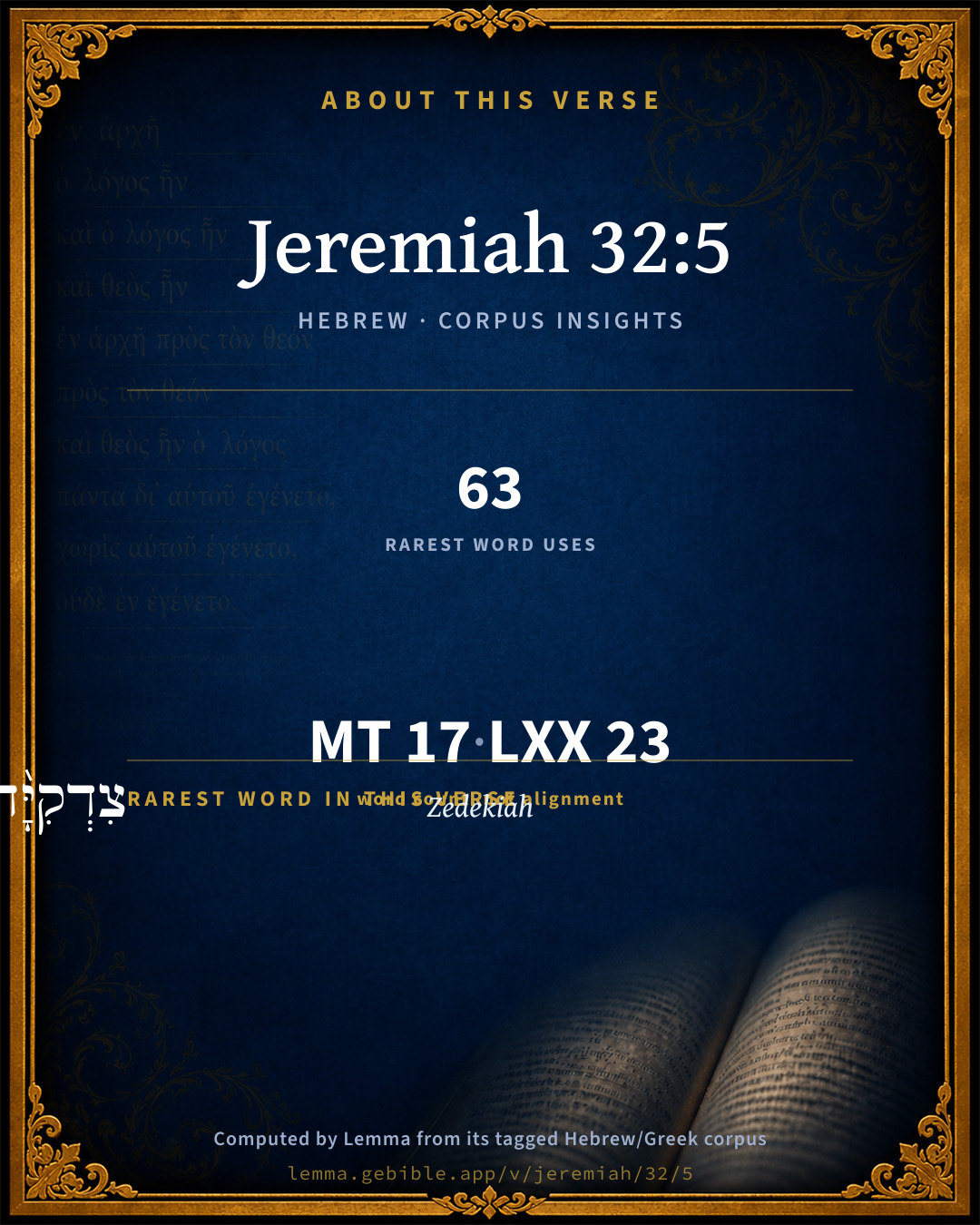
17
words
16
distinct lemmas
Prophets
section

Grammatical profile

  • 5 verbs
  • 5 nouns
  • 2 prepositions
  • 1 conjunction
  • 1 adverb
  • 3 particles

Verb forms

  • יוֹלִ֤ךְ Hiphil · Imperfect
  • יִֽהְיֶ֔ה Qal · Imperfect
  • פָּקְדִ֥י Qal · Infinitive Construct
  • תִֽלָּחֲמ֛וּ Niphal · Imperfect
  • תַצְלִֽיחוּ Hiphil · Imperfect

Hebrew & Septuagint length

In the original languages it is 17 Hebrew tokens and 23 Greek tokens — but the two are counted differently (Hebrew bundles its prefixes and suffixes into one token; the Greek is in lemma form), so that isn’t a like-for-like length.

Cross-references

14

Topical passages linked to Jeremiah 32:5 in the Treasury of Scripture Knowledge — connected by theme and wording, ordered by reader-vote popularity; previews shown in the World English Bible.

  • Jeremiah 21:4–5 Thus says Yahweh, the God of Israel, Behold, I will turn back the weapons of war that are in your hands, with which you fight against the king of Babylon, and against the Chaldeans who besiege you, without the walls; and I will gather them into the midst of this city.
  • Jeremiah 27:22 They shall be carried to Babylon, and there shall they be, until the day that I visit them, says Yahweh; then will I bring them up, and restore them to this place.
  • Jeremiah 33:5 while [men] come to fight with the Chaldeans, and to fill them with the dead bodies of men, whom I have killed in my anger and in my wrath, and for all whose wickedness I have hid my face from this city:
  • Jeremiah 39:7 Moreover he put out Zedekiah's eyes, and bound him in fetters, to carry him to Babylon.
  • Ezekiel 17:9–10 Say you, Thus says the Lord Yahweh: Shall it prosper? shall he not pull up the roots of it, and cut off the fruit of it, that it may wither; that all its fresh springing leaves may wither? and not by a strong arm or much people can it be raised from the roots of it.
  • Ezekiel 17:15 But he rebelled against him in sending his ambassadors into Egypt, that they might give him horses and much people. Shall he prosper? shall he escape who does such things? shall he break the covenant, and yet escape?
  • Numbers 14:41 Moses said, Why now do you disobey the commandment of Yahweh, seeing it shall not prosper?
  • 2 Chronicles 13:12 Behold, God is with us at our head, and his priests with the trumpets of alarm to sound an alarm against you. Children of Israel, don't you fight against Yahweh, the God of your fathers; for you shall not prosper.
  • 2 Chronicles 24:20 The Spirit of God came on Zechariah the son of Jehoiada the priest; and he stood above the people, and said to them, Thus says God, Why disobey you the commandments of Yahweh, so that you can't prosper? because you have forsaken Yahweh, he has also forsaken you.
  • Proverbs 21:30 There is no wisdom nor understanding Nor counsel against Yahweh.
  • Jeremiah 2:37 From there also shall you go forth, with your hands on your head: for Yahweh has rejected those in whom you trust, and you shall not prosper with them.
  • Jeremiah 34:4–5 Yet hear the word of Yahweh, O Zedekiah king of Judah: thus says Yahweh concerning you, You shall not die by the sword;
  • Jeremiah 37:10 For though you had struck the whole army of the Chaldeans who fight against you, and there remained but wounded men among them, yes would they rise up every man in his tent, and burn this city with fire.
  • Ezekiel 12:13 My net also will I spread on him, and he shall be taken in my snare; and I will bring him to Babylon to the land of the Chaldeans; yet shall he not see it, though he shall die there.

Cross-references courtesy of OpenBible.info (CC BY 4.0).

Hebrew and Greek witnesses Masoretic Hebrew ↔ Greek Septuagint

The same verse in the two great witnesses to the Old Testament, shown verse-for-verse.

These are two independent witnesses, not word-aligned to each other, and the Septuagint is shown in lemma (dictionary) form.

Hebrew Jeremiah 32:5 Masoretic · Westminster Leningrad Codex

וּבָבֶ֞ל יוֹלִ֤ךְ אֶת צִדְקִיָּ֨הוּ֙ וְשָׁ֣ם יִֽהְיֶ֔ה עַד פָּקְדִ֥י אֹת֖וֹ נְאֻם יְהוָ֑ה כִּ֧י תִֽלָּחֲמ֛וּ אֶת הַכַּשְׂדִּ֖ים לֹ֥א תַצְלִֽיחוּ

and he shall bring Zedekiah to Babylon, and there shall he be until I visit him, says Yahweh: though you fight with the Chaldeans, you shall not prosper?

World English Bible · Public Domain

Greek LXX Structure differs

In the Septuagint, Jeremiah is about an eighth shorter than the Hebrew and arranges its material differently — the Oracles Against the Nations (Hebrew chapters 46–51) appear in the middle of the Greek book, after 25:13. Because the chapter and verse boundaries do not line up, a verse-for-verse comparison with the Hebrew is not shown.

A verse-for-verse comparison isn’t shown here because the chapters and verses don’t line up. Switch to the LXX edition with the MT / LXX toggle above to read the Greek directly.

On this verse, The Cambridge Bible for Schools and Colleges discusses the Septuagint’s reading. Read the note in Commentary ↓

Hebrew: Westminster Leningrad Codex (CC BY 4.0). Greek: Septuagint (public domain); English from a public-domain English Septuagint. How the Septuagint differs from the Hebrew →

Targum (Aramaic paraphrase)

1

The Targum is the ancient Jewish Aramaic paraphrase of the Hebrew Scriptures — an interpretive translation, not the Hebrew text itself. Onkelos (literal) and Pseudo-Jonathan (expansive) render the Torah, and Jonathan the Prophets. Coverage is partial: where no permissively-licensed English translation exists for a verse, only the Aramaic is shown. This is verse-level text, not a word-by-word alignment to the Hebrew.

  1. Targum Jonathan Prophets (Joshua–Malachi)
    וּלְבָבֶל יוֹבִיל יַת צִדְקִיָה וְתַמָן יְהֵי עַד דְיֵעוֹל דוֹכְרָנֵיהּ קָדָמַי אֲמַר יְיָ אֲרֵי תְגִיחוּן קְרָב עִם כַּסְדָאֵי לָא תִצְלְחוּן:

    (no public-domain English translation for this verse)

    Targum Jonathan — Aramaic: “Mikraot Gedolot” (public domain). English: “Sefaria Community Translation” (CC0 1.0 (public-domain dedication)); “London "Chaldee Paraphrase," 1871” (public domain). Text via Sefaria.

Commentary

Notes on Jeremiah 32:5 from classic Christian and Jewish commentators (each source and its license shown beneath its notes). The classic Christian expositions comment on the surrounding passage and are grouped to its opening verse, so a note may address several verses; the Jewish commentaries on the Tanakh (Rashi and others) are per-verse, so they appear only where the commentator wrote on this verse.

Lemma curates 59 commentaries, every one of them public domain or Creative Commons licensed, each selected and text-cleaned for this edition rather than reprinted as found. About our sources →

Trapp's Complete Commentary

John Trapp

Jer 32:5 And he shall lead Zedekiah to Babylon, and there shall he be until I visit him, saith the LORD: though ye fight with the Chaldeans, ye shall not prosper.

Ver. 5. And there shall he be until I visit him.] sc., With death; but the prophet useth a general term, that might be taken either in good part or bad for his own safety’s sake.

John Trapp, A Commentary or Exposition upon All the Books of the Old and New Testament (1647–1656) — public domain. Text from a community e-Sword module.

Geneva Bible (1599)

Geneva Bible translators

Till I take Zedekiah away by death: for he shall not die by the sword, as Jer. 34:4.

Geneva Bible (1599) marginal notes — public domain. Text via Bolls.life.

Jamieson, Fausset & Brown

Robert Jamieson, A. R. Fausset & David Brown

visit him--in a good sense (Jer 27:22); referring to the honor paid Zedekiah at his death and burial (Jer 34:4-5). Perhaps, too, before his death he was treated by Nebuchadnezzar with some favor.

though ye fight . . . shall not prosper-- (Jer 21:4).

Jamieson, Fausset & Brown — Commentary Critical and Explanatory on the Whole Bible (1871) — public domain (CC PDM 1.0). Text via the HelloAO Bible API.

John Calvin's Commentaries

He follows the same subject, Lead, he says, will King Nebuchadnezar Zedekiah captive; and he will remain in exile until I shall visit him. Some understand this time of visiting of his death, for it is certain that he died in Babylon; and as his condition was not improved like that of Jeconiah who was taken from the filth of a prison to the table of the king, this exposition at the first view seems probable, that is, that he was worn down to death by poverty and disgrace. It, however, seems that some alleviation was promised, if indeed a certain kind of death may be deemed a favor; for he was not slain with the sword; and though he was not restored to his own country, there is yet nothing improper in this way of speaking, that he would be in exile until he was visited, for nothing particular could be hence concluded; and we shall hereafter see that when dead he was buried honorably and with mourning. It is then no wonder that God points out here a time of favor, though Zedekiah was never restored to his own Country, and we know that his eyes were plucked out by King Nebuchadnezar, after having been tried and condemned. But this favor of God, however, is not here without reason mentioned, for Nebuchadnezar at length treated him more kindly, at least as far as his burial was concerned: Lead him, then he says, shall Nebuchadnezar into Babylon, and he shall be there until I shall visit him; that is, he shall remain an exile in a filthy prison, and there he shall pine away and be destitute of all help; he shall be then as one of the lowest, and shall, in short, drag on life ignominiously until the time of my visitation.

He lastly adds, When ye fight against the Chaldeans, ye shall not succeed Here the Prophet meets those foolish notions which still filled the minds of the Jews, so that they did not submit to God nor humble themselves under his mighty hand; for there was yet a large number of men, and the city had strong fortifications. As then they saw that they were furnished with men and forces, they were still confident; and then they became hardened on account of the length of the time they had sustained the siege. When enemies make the first attack, fear fills the minds of all; but when the event disappoints them, then they who before trembled gather courage. So it was with the Jews; for when the city was first encompassed by the Chaldean army, the miserable inhabitants no doubt were greatly terrified; but when they saw their enemies stopped, and effecting nothing by their attacks, they then hardened their hearts more and more. For we must notice what I said yesterday, that they had been besieged probably six or eight months when this vision was given to Jeremiah. Hence it was that their confidence was greater. But the Prophet repels this folly by saying,

“Ye fight against the Chaldeans, but the issue will be unsuccessful; for God will lay you prostrate before your enemies, for with him ye carry on war.”

The sum of this introduction is, that Jeremiah was then shut up in prison, and that the king continued in his contumacy, though God’s hand pressed hard on him; and then the cause of this is set forth, even because he boldly threatened the king and the city, and deelard that God’s vengeance was nigh them, so that the king would be led into exile and the city taken and plundered by their enemies. It now follows, —

John Calvin's Commentaries (1540-1563) — public domain. Text from the Calvin Translation Society English edition (1840s-50s) via the Christian Classics Ethereal Library (ccel.org). Calvin's coverage is partial (roughly two-thirds of the Bible); uncommented books and verses are honest gaps, never fabricated. The 19th-century editor's footnotes and remarks are omitted so the notes are faithfully Calvin's own voice.

Ellicott's Commentary for English Readers

(5) There shall he be until I visit him . . .—The word for “visit” is ambiguous, being used elsewhere both for “punishing” and “delivering.” Its use in Jer_29:10 is in favour of the latter meaning here. The prophet looks forward to a general deliverance, or at least mitigation of suffering, for the exiles in Babylon, and, though he does not in distinct terms predict that Zedekiah will share in it, seems to cherish the hope that he will not be altogether excluded. Of his fate after he arrived in Babylon we know nothing, but the absence of his name when Jehoiachin was released from his imprisonment (Jer. Iii. 31) by Evil-merodach suggests the conclusion that he was then dead.

A Bible Commentary for English Readers, edited by Charles John Ellicott (1878–1897) — public domain. Text from a community e-Sword module.

The Cambridge Bible for Schools and Colleges

gen. ed. J. J. S. Perowne

5. until I visit him] The words are in themselves ambiguous and they with the rest of the v. are lacking in the LXX.

The Cambridge Bible for Schools and Colleges (gen. ed. J. J. S. Perowne; Cambridge University Press, 1878–1918) — public domain. Text from a community e-Sword module.

John Gill's Exposition

And he shall lead Zedekiah to Babylon,.... As he did in chains, from Riblah, where he was brought unto him after he was taken, endeavouring to make his escape, Jer 52:8;

and there shall he be until I visit him, saith the Lord; in taking him away by death; for he continued in Babylon to the time of his death, which was not violent, but natural; and, considering his circumstances, his captivity, imprisonment, and loss of sight, might be reckoned a visitation in mercy: though some understand this of God's visiting the people at the return of them from their seventy years' captivity; if Zedekiah lived till then, he must be a very old man; but of this we have no account, nor is it probable:

though ye fight with the Chaldeans, ye shall not prosper; though they should sally out upon them, in order to beat them out of their trenches, and drive them from the walls of the city, yet without success.

John Gill's Exposition of the Whole Bible (1746–1763) — public domain (CC PDM 1.0). Text via the HelloAO Bible API.

Albert Barnes' Notes on the Bible

I visit - In the sense of punishment. See Jer 39:6-7; Jer 52:11.

Albert Barnes' Notes on the Bible (1834–1885) — public domain. Text from a community e-Sword/MySword module.

Matthew Poole's English Annotations

Here the cause of the prophet’s imprisonment is expressed. The things were true which Jeremiah prophesied, and fulfilled, Jer 39:5-7, and Jeremiah could not forbear speaking them, because he was sent of God upon the errand, Jer 34:2,3; yet the king and court could not bear his words.

There shall he be until I visit him, saith the Lord: interpreters are divided whether the visitation here mentioned were a visitation of judgment, and the same with until he die; or of mercy: it is certain Zedekiah was not put to death, only his eyes put out, and he carried into Babylon, Jer 39:7, where some think he afterward found favour with the king of Babylon; certain it is that he died in Babylon, and had an honourable burial, but whether he met with any other favour, or no, the Scripture saith not. Some will have the words read, until I visit this people, and think that Zedekiah lived in prison in Babylon till the restoration; but he was twenty-one years old when he began to reign, and reigned eleven years, so as he was thirty-two years old when he was carried to Babylon, 2Ch 36:11, and must be then ninety-two years old when he died, which is hardly probable, considering the delicate education and life of princes, that he, having lost his eyes, and seen so much misery, should continue sixty years longer.

Though ye fight with the Chaldeans, ye shall not prosper; though ye make many sallies out upon the Chaldeans, that are now besieging you, yet you shall be beaten in all, and not be able to drive them from your walls, Hitherto hath been but the preface to the prophetical type and discourse in this chapter, which now followeth.

Matthew Poole's English Annotations on the Holy Bible (1683–1685) — public domain. Text from a community e-Sword/MySword module.

Whedon's Commentary on the Bible

Daniel D. Whedon

5. Until I visit him — What a fearfully pregnant meaning had this word “visit!” and how mercifully concealed from this man, who was coming to a fate darker than he could well conceive — of the murder of his sons, the putting out of his own eyes, and the sufferings and ignominy of hopeless confinement in a Babylonian prison to the day of his death. See Jer_39:6-7; Jer_52:11.

Daniel D. Whedon (gen. ed.), Commentary on the Old and New Testaments (1874–1909) — public domain. Text from a community e-Sword module.

The Pulpit Commentary

Until I visit him; i.e. until I take notice of him. "To visit" is used in a good (Jer_27:22 Jer_29:10) as well as in a bad sense, (Jer_6:15 Jer_49:8) so that no definite announcement is made respecting Zedekiah"s future. There was no object to gain by extending the scope of the revelation beyond the immediate present, and Zedekiah"s offences did not require such an anticipative punishment as the clear prediction of the details of his fate. (Jer_39:6, 7 52:11)

O blessed death!

"Until I visit him." Zedekiah does not seem to have been a bad man, though he did evil. Weak rather than wicked. One like our own Charles I or Louis XVI of France. One of those men unhappily called to places of great responsibility and difficulty, without the moral strength requisite for so arduous a post. A sadder life than that of King Zedekiah, the last king of Judah and Jerusalem, cannot be conceived. It is a piteous tale. Bereaved, a captive, blinded, he was dragged to Babylon, and there died. And it is because the prophet of God recognizes that death to such a one could not but be a sweet messenger of relief, therefore he calls it "the Lord visiting him." True, the visit of the Lord often means the wrath of the Lord. He will "visit the sins of the fathers," etc. But it yet more often means the goodness of the Lord. "The Lord hath visited and redeemed his people." He visited Hannah. He visits his flock. And this gentler meaning it has here; for the sore punishment of his sins Zedekiah had already been visited. This visit, therefore, tells of God"s merciful visitation.

I DEATH NOT ALWAYS A VISIT OF MERCY. Not to those who die in their sins. It is represented often as the judgment of God. "It is a fearful thing to fall into the hands of the living God," as they who die impenitent and unbelieving fall.

II BUT DEATH IS MORE OFTEN THE LORD"S VISIT OF MERCY. It is:

1. To those whom God punishes in this life. Zedekiah was an instance. Cf. those of whom St. Paul says. (1Co_11:33) that they were judged now that they might not be condemned with the world. And probably there are many such.

2. To the sorrowful and those whose lives are a prolonged pain. We speak of death for such as being a merciful relief; and we are right.

3. To all believers in the Lord Jesus Christ. Death for them is the Lord"s visiting them Christ"s coming again, as he said he would, and receiving them unto himself, that where he is they may be also. Which kind of visitation of the Lord shall death be to us? C.

resurrection from the dead: that was the seal.

VI WITNESSES ARE COMMISSIONED TO DECLARE THE TRUTH. (Vers. 12, 13) So Christ commanded his apostles to testify of what he had done.

VII THE TWOFOLD TESTIMONY. (Ver. 14) There was that which was sealed and that which was open. So is it of the great redemption. There is a testimony that is sealed, hidden from the world, but revealed to the believer by the Spirit of God in his inward experience, the witness of God in his soul, the Spirit bearing witness with his spirit. And there is that which is open the historic evidence of the resurrection of Christ and of the truth of Christianity.

VIII THE DEPOSITARIES OF THIS TESTIMONY. The prophet put his in an earthen vessel. We, too, have this treasure in earthen vessels. Let the literal suggest the spiritual; Jeremiah, Paul.

IX THE UNDERLYING AND EFFECTUATING WILL. (Ver. 15) The Lord would have the land to be restored, the Captivity should return. So he will have all men to be saved." Have we claimed our share in this redeeming work? C.

The Pulpit Commentary (1880–1919), ed. H.D.M. Spence-Jones & Joseph S. Exell — public domain. Text from a community e-Sword module.

John Wesley's Explanatory Notes

Until I visit him - Perhaps in mercy; it is certain Zedekiah was not put to death, only carried to Babylon, where some think he afterward found favour with the king of Babylon.

John Wesley, Explanatory Notes Upon the Whole Bible (1754–1765) — public domain. Text via the GEBible commentary corpus.

Rashi

Rabbi Shlomo Yitzchaki (Rashi)

until I remember him The remembrance of all mankind. That is death.

Rashi on the Tanakh — English translations: “The Judaica Press complete Tanach with Rashi, translated by A. J. Rosenberg” (CC BY 4.0); “Pentateuch with Rashi's commentary by M. Rosenbaum and A.M. Silbermann, 1929-1934” (public domain); “The Metsudah Tanach series, Lakewood, N.J” (CC BY 4.0); and “The Book of Joshua, Metsudah Publications, 1997” (CC BY 4.0). Text via Sefaria.

Lesson kit

Teaching starters — assembled from the data on this page, not authored interpretation. Every prompt links to the verse data it draws on. Edit before teaching.

Jeremiah, in the Prophets, opens this verse with 17 words (16 distinct Hebrew lemmas). Its most distinctive word is Tsidqîyâh (“Zedekiah”). A historical commentator’s framing appears above. Read the whole chapter for the surrounding context.

Discussion questions

  1. What does “Zedekiah” (Tsidqîyâh) contribute to the verse as a whole?
  2. How does Jeremiah 21:4–5, which shares this passage’s theme, read alongside this verse?
  3. These translations render this verse differently. What is at stake in choosing one wording over another?
  4. «יוֹלִ֤ךְ» is a Hiphil Imperfect verb. How does that grammatical form shape the action described?
  5. Compare how Trapp's Complete Commentary and Geneva Bible (1599) read this verse. Where do they agree or differ?

Things to notice

Reading settings

Reading text

Shown beneath each verse's original-language words.

Old Testament
Old Testament edition

Read the OT as the Masoretic Hebrew (MT) or the Greek Septuagint (LXX).

English shown for the Greek Septuagint (in the Hebrew ↔ Greek comparison).

Comparing translations? Open the Compare panel on any verse page to stack up to four side by side.