
Jeremiah 29:22

Hebrew (Westminster Leningrad Codex) Jeremiah 29:22 appears in the Hebrew Old Testament. The text above is from the Westminster Leningrad Codex. Each word links to its Strong’s number, a concise gloss, and parsing drawn from the Open Scriptures Hebrew Bible morphology. Click any word for its full Brown-Driver-Briggs (BDB) entry.
Download image
Cite this verse

Jeremiah 29:22 (World English Bible). Public Domain. Lemma interlinear Bible study tool, https://lemma.gebible.app/v/jeremiah/29/22.

Show BibTeX & RIS
BibTeX
RIS
English Translation
and of them shall be taken up a curse by all the captives of Judah who are in Babylon, saying, Yahweh make you like Zedekiah and like Ahab, whom the king of Babylon roasted in the fire;
World English Bible · Public Domain
Download a study sheet

One document with this verse’s original text, its word-by-word gloss line, the meaning frame, cross-references with their text, attributed commentary, and full source and license credits — printable, and it pastes into notes with its structure intact.

This verse Autodidact and up

Study sheet (.html) Plain text (.txt)

A passage Seminary Student

Up to 50 verses in one chapter. A passage sheet keeps up to 6 commentary sources and 12 cross-references per verse, in the order this page ranks them, and says so on the sheet whenever that leaves anything out. Ask for a single verse and you get the Autodidact verse sheet above.

Everything on this page stays free to read, with no account — the sheet is a download of what is already on screen, not access to it.

Want to remove ads? Support Godless Engineer
Compare translations 3

The same verse in 3 English versions, stacked beneath the original-language interlinear above. Click any original word for its lexicon entry.

Each is an independent rendering of the whole verse — the interlinear is not word-aligned to these translations.

Highlighted words mark where these versions differ — a whole-verse word diff, not a word-by-word alignment.

  • World English Bible Public Domain
    and of them shall be taken up a curse by all the captives of Judah who are in Babylon, saying, Yahweh make you like Zedekiah and like Ahab, whom the king of Babylon roasted in the fire;
  • King James Version Public Domain
    And of them shall be taken up a curse by all the captivity of Judah which are in Babylon, saying, The LORD make thee like Zedekiah and like Ahab, whom the king of Babylon roasted in the fire;
  • unfoldingWord Literal Text CC BY-SA 4.0
    Then a curse will be spoken about these persons by all the captives of Judah in Babylon. The curse will say: May Yahweh make you like Zedekiah and Ahab, whom the king of Babylon roasted in fire.

unfoldingWord Literal Text — © unfoldingWord, licensed CC BY-SA 4.0. Word-aligned USFM3 via Door43 (git.door43.org/unfoldingWord/en_ult).

Versions to compare (up to 4)

3 of 4 selected

Show all 18 translations

Every available English version of this verse, each an independent rendering of the whole verse.

  • World English Bible Public Domain
    and of them shall be taken up a curse by all the captives of Judah who are in Babylon, saying, Yahweh make you like Zedekiah and like Ahab, whom the king of Babylon roasted in the fire;
  • Berean Standard Bible Public Domain
    Because of them, all the exiles of Judah who are in Babylon will use this curse: ‘May the LORD make you like Zedekiah and Ahab, whom the king of Babylon roasted in the fire!’
  • Majority Standard Bible Public Domain
    Because of them, all the exiles of Judah who are in Babylon will use this curse: ‘May the LORD make you like Zedekiah and Ahab, whom the king of Babylon roasted in the fire!’
  • King James Version Public Domain
    And of them shall be taken up a curse by all the captivity of Judah which are in Babylon, saying, The LORD make thee like Zedekiah and like Ahab, whom the king of Babylon roasted in the fire;
  • American Standard Version (1901) Public Domain
    and of them shall be taken up a curse by all the captives of Judah that are in Babylon, saying, Jehovah make thee like Zedekiah and like Ahab, whom the king of Babylon roasted in the fire;
  • Revised Version (1885) Public Domain
    and of them shall be taken up a curse by all the captives of Judah which are in Babylon, saying, The LORD make thee like Zedekiah and like Ahab, whom the king Babylon roasted in the fire:
  • Geneva Bible (1599) Public Domain
    And al they of the captiuitie of Iudah, that are in Babel, shall take vp this curse against them, and say, The Lord make thee like Zedekiah and like Ahab, whome the King of Babel burnt in the fire,
  • Douay-Rheims (1899) Public Domain
    And of them shall be taken up a curse by all the captivity of Juda, that are in Babylon, saying: The Lord make thee like Sedecias, and like Achab, whom the king of Babylon fried in the fire:
  • Young's Literal Translation Public Domain
    And taken from them hath been a reviling by all the removed of Judah that `are' in Babylon, saying, Jehovah doth set thee as Zedekiah, and as Ahab, whom the king of Babylon roasted with fire;
  • Literal Standard Version CC BY-SA 4.0
    and because of them a reviling has been taken by all the expulsion of Judah that [are] in Babylon, saying, YHWH sets you as Zedekiah, and as Ahab, whom the king of Babylon roasted with fire;
  • Unlocked Literal Bible CC BY-SA 4.0
    Then a curse will be spoken about these persons by all the captives of Judah in Babylon. The curse will say: May Yahweh make you like Zedekiah and Ahab, whom the king of Babylon roasted in fire.
  • unfoldingWord Literal Text CC BY-SA 4.0
    Then a curse will be spoken about these persons by all the captives of Judah in Babylon. The curse will say: May Yahweh make you like Zedekiah and Ahab, whom the king of Babylon roasted in fire.
  • Darby Bible Public Domain
    And of them shall be taken up a curse by all the captivity of Judah that are in Babylon, saying, Jehovah make thee like Zedekiah and like Ahab, whom the king of Babylon roasted in the fire;
  • World Messianic Bible Public Domain
    A curse will be taken up about them by all the captives of Judah who are in Babylon, saying, ‘The LORD make you like Zedekiah and like Ahab, whom the king of Babylon roasted in the fire;’
  • Webster's Bible Public Domain
    And concerning them shall be taken up a curse by all the captivity of Judah who are in Babylon, saying, The LORD make thee like Zedekiah and like Ahab, whom the king of Babylon roasted in the fire;
  • Free Bible Version CC BY-SA 4.0
    Because of what happens to them, all the exiles of Judah in Babylon will curse others like this: “May the Lord treat you like Zedekiah and Ahab, burned alive by the king of Babylon!”
  • Bible in Basic English Public Domain
    And their fate will be used as a curse by all the prisoners of Judah who are in Babylon, who will say, May the Lord make you like Zedekiah and like Ahab, who were burned in the fire by the king of Babylon;
  • JPS Tanakh (1917) Public Domain
    and of them shall be taken up a curse by all the captivity of Judah that are in Babylon, saying: 'The LORD make thee like Zedekiah and like Ahab, whom the king of Babylon roasted in the fire';

Literal Standard Version (2020), Covenant Press — licensed CC BY-SA 4.0. Text via the HelloAO Bible API (eBible.org). Unlocked Literal Bible (unfoldingWord) — licensed CC BY-SA 4.0. Text via the HelloAO Bible API (eBible.org). unfoldingWord Literal Text — © unfoldingWord, licensed CC BY-SA 4.0. Word-aligned USFM3 via Door43 (git.door43.org/unfoldingWord/en_ult). Free Bible Version, Dr. Jonathan Gallagher — licensed CC BY-SA 4.0. Text via the HelloAO Bible API (eBible.org).

Word by word

More ways to search: Search by grammar → Find every occurrence → Compare this word →

Practice this passage: Drill this verse → Learn its vocabulary →

קָלָ֥ם
qâlâh
H7033
“to roast · them”
Verb, Qal, Perfect, 3rd Person, Masculine, Singular + Suffix, Personal, 3rd Person, Masculine, Plural
Part of Speech
Verb
Stem
Qal
Form
Perfect
Person
3rd Person
Gender
Masculine
Number
Singular
Full BDB Definition

Origin: a primitive root [rather identical with H7034 through the idea of shrinkage by heat]

TWOT: 2023

to roast, parch - (Qal) to roast - (Niphal) - to be burned - burning (participle)
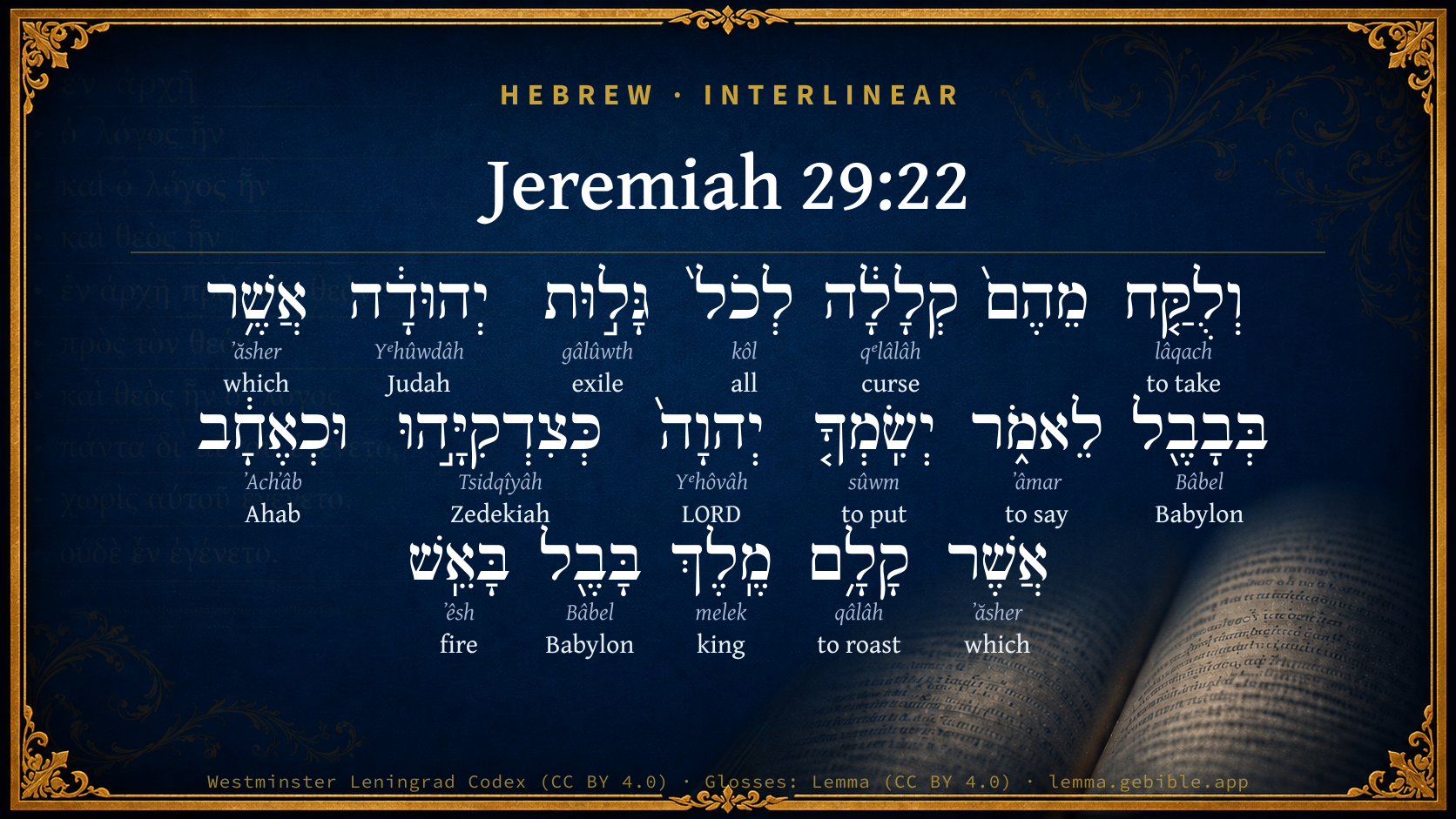
  1. וְלֻקַּ֤ח lâqach H3947 “and · to take” Conjunction + Verb, Pual, Sequential Perfect, 3rd Person, Masculine, Singular
  2. קְלָלָ֔ה qᵉlâlâh H7045 “curse” Noun, Common, Feminine, Singular, Absolute
  3. לְכֹל֙ kôl H3605 “to/for · all of” Preposition + Noun, Common, Masculine, Singular, Construct
  4. גָּל֣וּת gâlûwth H1546 “exile of” Noun, Common, Feminine, Singular, Construct
  5. יְהוּדָ֔ה Yᵉhûwdâh H3063 “Judah” Noun, Proper
  6. אֲשֶׁ֥ר ʼăsher H834 “which” Particle, Relative
  7. בְּבָבֶ֖ל Bâbel H894 “in/at · Babylon” Preposition + Noun, Proper
  8. לֵאמֹ֑ר ʼâmar H559 “to say” Preposition + Verb, Qal, Infinitive Construct
  9. יְשִֽׂמְךָ֤ sûwm H7760 “to put · you” Verb, Qal, Imperfect, 3rd Person, Masculine, Singular + Suffix, Personal, 2nd Person, Masculine, Singular
  10. יְהוָה֙ Yᵉhôvâh H3068 “LORD” Noun, Proper
  11. כְּצִדְקִיָּ֣הוּ Tsidqîyâh H6667 “like/as · Zedekiah” Preposition + Noun, Proper
  12. וּכְאֶחָ֔ב ʼAchʼâb H256 “and · like/as · Ahab” Conjunction + Preposition + Noun, Proper
  13. אֲשֶׁר ʼăsher H834 “which” Particle, Relative
  14. מֶֽלֶךְ melek H4428 “king of” Noun, Common, Masculine, Singular, Construct
  15. בָּבֶ֖ל Bâbel H894 “Babylon” Noun, Proper
  16. בָּאֵֽשׁ ʼêsh H784 “in/at the · fire” Preposition, Determined + Noun, Common, Both, Singular, Absolute

About this verse

These counts appear in no published source. They are computed here, from the morphology-tagged text and Lemma’s own curated glosses. What Lemma adds →

18
words
15
distinct lemmas
Prophets
section

Notable vocabulary

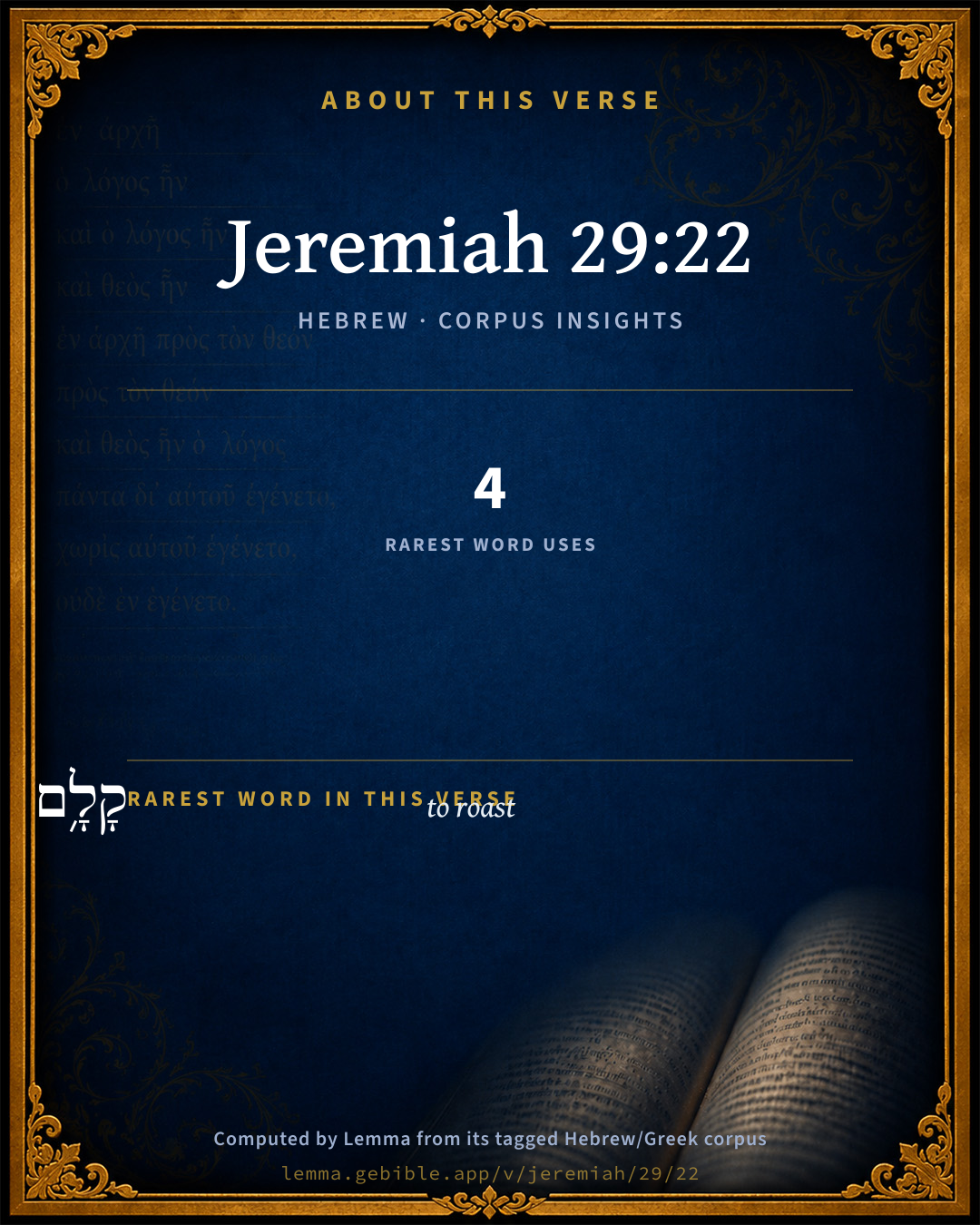
The rarest word here is קָלָ֥ם to roast H7033 — appearing just 4 times in the whole Hebrew Bible.

Shared distinctive vocabulary

קָלָ֥ם to roast H7033 occurs in 4 verses of the Hebrew Bible. Also found in:

Grammatical profile

  • 4 verbs
  • 11 nouns
  • 1 preposition
  • 2 particles

Verb forms

  • וְלֻקַּ֤ח Pual · Sequential Perfect
  • לֵאמֹ֑ר Qal · Infinitive Construct
  • יְשִֽׂמְךָ֤ Qal · Imperfect
  • קָלָ֥ם Qal · Perfect

Repetition

Words recur within this verse — often emphatic in Hebrew:

  • בְּבָבֶ֖ל Babylon H894 ×2
  • אֲשֶׁ֥ר which H834 ×2

Cross-references

6

Topical passages linked to Jeremiah 29:22 in the Treasury of Scripture Knowledge — connected by theme and wording, ordered by reader-vote popularity; previews shown in the World English Bible.

  • Isaiah 65:15 You shall leave your name for a curse to my chosen; and the Lord Yahweh will kill you; and he will call his servants by another name:
  • Daniel 3:6 and whoever doesn't fall down and worships shall the same hour be cast into the midst of a burning fiery furnace.
  • Genesis 48:20 He blessed them that day, saying, "In you will Israel bless, saying, 'God make you as Ephraim and as Manasseh'" He set Ephraim before Manasseh.
  • Daniel 3:21 Then these men were bound in their pants, their tunics, and their mantles, and their [other] garments, and were cast into the midst of the burning fiery furnace.
  • Ruth 4:11 All the people who were in the gate, and the elders, said, We are witnesses. Yahweh make the woman who has come into your house like Rachel and like Leah, which two built the house of Israel: and do you worthily in Ephrathah, and be famous in Bethlehem:
  • 1 Corinthians 16:22 If any man doesn't love the Lord Jesus Christ, let him be accursed. Come, Lord!

Cross-references courtesy of OpenBible.info (CC BY 4.0).

Hebrew and Greek witnesses Masoretic Hebrew ↔ Greek Septuagint

The same verse in the two great witnesses to the Old Testament, shown verse-for-verse.

These are two independent witnesses, not word-aligned to each other, and the Septuagint is shown in lemma (dictionary) form.

Hebrew Jeremiah 29:22 Masoretic · Westminster Leningrad Codex

וְלֻקַּ֤ח מֵהֶם֙ קְלָלָ֔ה לְכֹל֙ גָּל֣וּת יְהוּדָ֔ה אֲשֶׁ֥ר בְּבָבֶ֖ל לֵאמֹ֑ר יְשִֽׂמְךָ֤ יְהוָה֙ כְּצִדְקִיָּ֣הוּ וּכְאֶחָ֔ב אֲשֶׁר קָלָ֥ם מֶֽלֶךְ בָּבֶ֖ל בָּאֵֽשׁ

and of them shall be taken up a curse by all the captives of Judah who are in Babylon, saying, Yahweh make you like Zedekiah and like Ahab, whom the king of Babylon roasted in the fire;

World English Bible · Public Domain

Greek LXX Structure differs

In the Septuagint, Jeremiah is about an eighth shorter than the Hebrew and arranges its material differently — the Oracles Against the Nations (Hebrew chapters 46–51) appear in the middle of the Greek book, after 25:13. Because the chapter and verse boundaries do not line up, a verse-for-verse comparison with the Hebrew is not shown.

A verse-for-verse comparison isn’t shown here because the chapters and verses don’t line up. Switch to the LXX edition with the MT / LXX toggle above to read the Greek directly.

Hebrew: Westminster Leningrad Codex (CC BY 4.0). Greek: Septuagint (public domain); English from a public-domain English Septuagint. How the Septuagint differs from the Hebrew →

Targum (Aramaic paraphrase)

1

The Targum is the ancient Jewish Aramaic paraphrase of the Hebrew Scriptures — an interpretive translation, not the Hebrew text itself. Onkelos (literal) and Pseudo-Jonathan (expansive) render the Torah, and Jonathan the Prophets. Coverage is partial: where no permissively-licensed English translation exists for a verse, only the Aramaic is shown. This is verse-level text, not a word-by-word alignment to the Hebrew.

  1. Targum Jonathan Prophets (Joshua–Malachi)
    וְיִתְנְסֵיב מִנְהוֹן לְוָטָא לְכָל גָלוּת יְהוּדָה דִי בְּבָבֶל לְמֵימָר יְשַׁוִינָךְ יְיָ כְּצִדְקִיָה וּכְאֶחָב דִקְלִינוּן מַלְכָּא דְבָבֶל בְנוּרָא:

    (no public-domain English translation for this verse)

    Targum Jonathan — Aramaic: “Mikraot Gedolot” (public domain). English: “Sefaria Community Translation” (CC0 1.0 (public-domain dedication)); “London "Chaldee Paraphrase," 1871” (public domain). Text via Sefaria.

Commentary

Notes on Jeremiah 29:22 from classic Christian and Jewish commentators (each source and its license shown beneath its notes). The classic Christian expositions comment on the surrounding passage and are grouped to its opening verse, so a note may address several verses; the Jewish commentaries on the Tanakh (Rashi and others) are per-verse, so they appear only where the commentator wrote on this verse.

Lemma curates 59 commentaries, every one of them public domain or Creative Commons licensed, each selected and text-cleaned for this edition rather than reprinted as found. About our sources →

Trapp's Complete Commentary

John Trapp

Jer 29:22 And of them shall be taken up a curse by all the captivity of Judah which [are] in Babylon, saying, The LORD make thee like Zedekiah and like Ahab, whom the king of Babylon roasted in the fire;

Ver. 22. And of them shall be taken up a curse.] They had blessed themselves, though the Lord abhorred them, and sought to set up themselves in the hearts of the people, being gloriae animalia, popularis aurae vilissima mancipia, as Jerome saith of Crates the philosopher; they shall therefore "leave their names for a curse." {as Isa 65:15}

Whom the king of Babylon roasted in the fire.] Burnt them with a soft slow fire, as the Papists did John Huss, Bishop Ridley, and many other innocent martyrs; but should do rather these filthy Gergesites, their monks and friars, of whom it went for a proverb in Germany, as Luther witnesseth, Whosoever seeth any one of them, seeth the seven deadly sins.

John Trapp, A Commentary or Exposition upon All the Books of the Old and New Testament (1647–1656) — public domain. Text from a community e-Sword module.

Geneva Bible (1599)

Geneva Bible translators

Because they gave the people hope of speedy returning.

Geneva Bible (1599) marginal notes — public domain. Text via Bolls.life.

Jamieson, Fausset & Brown

Robert Jamieson, A. R. Fausset & David Brown

shall be taken . . . a curse--that is, a formula of imprecation.

Lord make thee like Zedekiah--(Compare Gen 48:20; Isa 65:15).

roasted in the fire--a Chaldean punishment (Dan 3:6).

Jamieson, Fausset & Brown — Commentary Critical and Explanatory on the Whole Bible (1871) — public domain (CC PDM 1.0). Text via the HelloAO Bible API.

John Calvin's Commentaries

Here we are to notice the circumstances; for if Jeremiah had only spoken of their death, the Jews might still have been doubtful whether he had delivered a prophecy; but when now is added what kind of punishment was inflicted on them, Jeremiah points out as by the finger what was as yet unknown, and even incredible. It might indeed have happened to the captives that the king should order them to be slain, but it could not have occurred to any man to suppose what Jeremiah declares, that they would be roasted in the fire We hence see that God here obviates the evasions of perverse minds, so that there would be no room for evading, when he specifies the very kind of death which they were to undergo.

But he says first, Taken from them shall be a curse, that is, the form of cursing. Mentioned yesterday was אלה, ale, an oath; he puts down now קללה, kolle; and קלל, koll, is to curse. The meaning then is, that they would become an exemplar of a curse to all the captives, who would say, May God make thee like Zedekiah and like Ahab whom the king of Babylon roasted The cause of their death is again repeated; and the Prophet did not without reason dwell on this, that he might turn away the eyes of the people from the immediate cause, which was commonly known, that is, that Nebuchadnezzar would not endure any tumults to be raised in his dominions; that they might therefore acknowledge God to be the author of this punishment, he says, —

John Calvin's Commentaries (1540-1563) — public domain. Text from the Calvin Translation Society English edition (1840s-50s) via the Christian Classics Ethereal Library (ccel.org). Calvin's coverage is partial (roughly two-thirds of the Bible); uncommented books and verses are honest gaps, never fabricated. The 19th-century editor's footnotes and remarks are omitted so the notes are faithfully Calvin's own voice.

Ellicott's Commentary for English Readers

(22) Of them shall be taken up a curse . . .—We note the characteristic tendency of Hebrew thought to fix on individual cases of highest blessedness, as in Rth_4:11, or of deepest shame, as here, and to bring them into formulae of blessing and of cursing.

A Bible Commentary for English Readers, edited by Charles John Ellicott (1878–1897) — public domain. Text from a community e-Sword module.

John Gill's Exposition

And of them shall be taken up a curse by all the captivity of Judah which are in Babylon,.... A form of cursing; when they cursed anyone, or wished him ill, it should be in such like manner as follows; so odious and detestable would these men be afterwards to them, whom they, at least some of them, took to be the prophets of the Lord:

saying, the Lord make thee like Zedekiah, and like Ahab, whom the king of Babylon roasted in the fire; or "burnt them" (d); not at once, but with a slow fire; so the Maccabees were roasted,

"Then the king, being in a rage, commanded pans and caldrons to be made hot: '' (2 Maccabees. 7:3)

Burning persons with fire, and casting them into a fiery furnace, were ways used by the Chaldeans in putting persons to death, Dan 3:6; and roasting men at a fire was used by the Chinese (e).

(d) "combussit", Pagninus; "ustulavit", Munster; so Ben Melech says the word signifies "burning". (e) Martin Hist. Sinic. p. 257.

John Gill's Exposition of the Whole Bible (1746–1763) — public domain (CC PDM 1.0). Text via the HelloAO Bible API.

Albert Barnes' Notes on the Bible

A curse - There is a play here of words. which probably was the cause why the death of these men passed into a proverb. One of them was named ben-Kolaiah; and they are to be made a curse (קללה qelâlâh), because Nebuchadnezzar had roasted (קלה qâlâh) them. Compare the marginal reference note.

Albert Barnes' Notes on the Bible (1834–1885) — public domain. Text from a community e-Sword/MySword module.

Haydock's Catholic Bible Commentary

Curse. Ver. 18. The malediction which has befallen the Jews, "overtake thee." (Worthington) --- Fire, in frying-pans, (see 2 Machabees vii. 5.) or cauldrons of boiling oil. This death shews that these were not the infamous judges who tempted Susanna, (Calmet) as the Jews quoted by (Haydock) St. Jerome, Salien, &c., would infer from ver. 23., and Daniel xiii. 57. They were stoned to death by the people, ibid. lxii.[Daniel xiii. 62.] (Calmet)

George Leo Haydock (1774–1849), Haydock's Catholic Family Bible and Commentary, 1859 edition — public domain. Excludes Psalms (Douay-Rheims chapter numbering differs from Protestant) and Deuterocanonical books (Catholic canon only).

Matthew Poole's English Annotations

As false teachers are of the highest sort of transgressors, speaking lies in the name and under pretence of the authority of the God of truth; so God in his providence ordinarily makes them the greatest examples of his vengeance. God threateneth to bring them to an end that should turn into a proverb, that when men had a mind to curse others, wishing them the greatest evils, they should pray to God to make them like Ahab and Zedekiah, whom the king of Babylon burnt, or roasted in the fire; the word קָלָם signifieth both, Lev 2:14; and roasting signifieth only to burn by degrees, which probably was the specifical punishment of these two false prophets, for we learn from the instance of the three children, Dan 3:19, that the consuming of persons slowly in a fiery furnace was a kind of punishment in use amongst the Chaldeans.

Matthew Poole's English Annotations on the Holy Bible (1683–1685) — public domain. Text from a community e-Sword/MySword module.

The Pulpit Commentary

A curse; i.e. a formula of cursing. (comp. Isa_65:15) There is here a play upon words, such as the Biblical writers delighted in, partly with the view of assisting the memory. "A curse" is in Hebrew kelalah, and "to roast" is kalah. Roasted in the fire. "Casting into the midst of a burning fiery furnace" was a common punishment both among the Assyrians and the Babylonians, see e.g. "Records of the Past," vol. 9. p. 56; and comp. Da 3.

The Pulpit Commentary (1880–1919), ed. H.D.M. Spence-Jones & Joseph S. Exell — public domain. Text from a community e-Sword module.

unfoldingWord translationNotes

Door43 World Missions Community

a curse will be spoken about these persons by all the captives of Judah in Babylon

This can be stated in active form. AT: "the captives of Judah in Babylon will say a curse about these persons" (See: Active or Passive)

roasted

This word usually refers to cooking food over an open fire or in a pan, not to burning completely. Possible meanings are 1) this is a euphemism. AT: "burned to death" or 2) the king's men attached them to poles over the fire close enough that the fire would slowly kill them but far enough away that it would not totally consume their bodies. (See: Euphemism)

I am the one who knows; I am the witness

These two clauses mean the same thing, and Yahweh repeats them for emphasis. (See: Parallelism)

this is Yahweh's declaration

Yahweh speaks of himself by name to express the certainty of what he is declaring. See how you translated this in Jeremiah 1:8. AT: "this is what Yahweh has declared" or "this is what I, Yahweh, have declared" (See: First, Second, or Third Person)

translationWords

curse

fire

kingdom of Israel

adultery

neighbor

command

know

testimony

unfoldingWord translationNotes — © Distant Shores Media and the Door43 World Missions Community, licensed CC BY-SA 4.0. Source: git.door43.org/Door43/en_tn.

Rashi

Rabbi Shlomo Yitzchaki (Rashi)

whom...burnt an expression of “roasted with fire” (Lev. 2:14).

Rashi on the Tanakh — English translations: “The Judaica Press complete Tanach with Rashi, translated by A. J. Rosenberg” (CC BY 4.0); “Pentateuch with Rashi's commentary by M. Rosenbaum and A.M. Silbermann, 1929-1934” (public domain); “The Metsudah Tanach series, Lakewood, N.J” (CC BY 4.0); and “The Book of Joshua, Metsudah Publications, 1997” (CC BY 4.0). Text via Sefaria.

Lesson kit

Teaching starters — assembled from the data on this page, not authored interpretation. Every prompt links to the verse data it draws on. Edit before teaching.

Jeremiah, in the Prophets, opens this verse with 18 words (15 distinct Hebrew lemmas). Its most distinctive word is qâlâh (“to roast”). A historical commentator’s framing appears above. Read the whole chapter for the surrounding context.

Discussion questions

  1. What does “to roast” (qâlâh) contribute to the verse as a whole?
  2. Leviticus 2:14 shares the word «to roast» with this verse. How do the two illuminate each other?
  3. “Babylon” occurs 2× in this one verse. What is the effect of the repetition?
  4. These translations render this verse differently; the difference is in the English rendering, not the original. What questions does that raise?
  5. The verb «וְלֻקַּ֤ח» is Pual Sequential Perfect. How does its form color the action?
  6. Reading how Trapp's Complete Commentary and Geneva Bible (1599) read this verse, where do the two commentators agree and where do they part?

Things to notice

Reading settings

Reading text

Shown beneath each verse's original-language words.

Old Testament
Old Testament edition

Read the OT as the Masoretic Hebrew (MT) or the Greek Septuagint (LXX).

English shown for the Greek Septuagint (in the Hebrew ↔ Greek comparison).

Comparing translations? Open the Compare panel on any verse page to stack up to four side by side.