

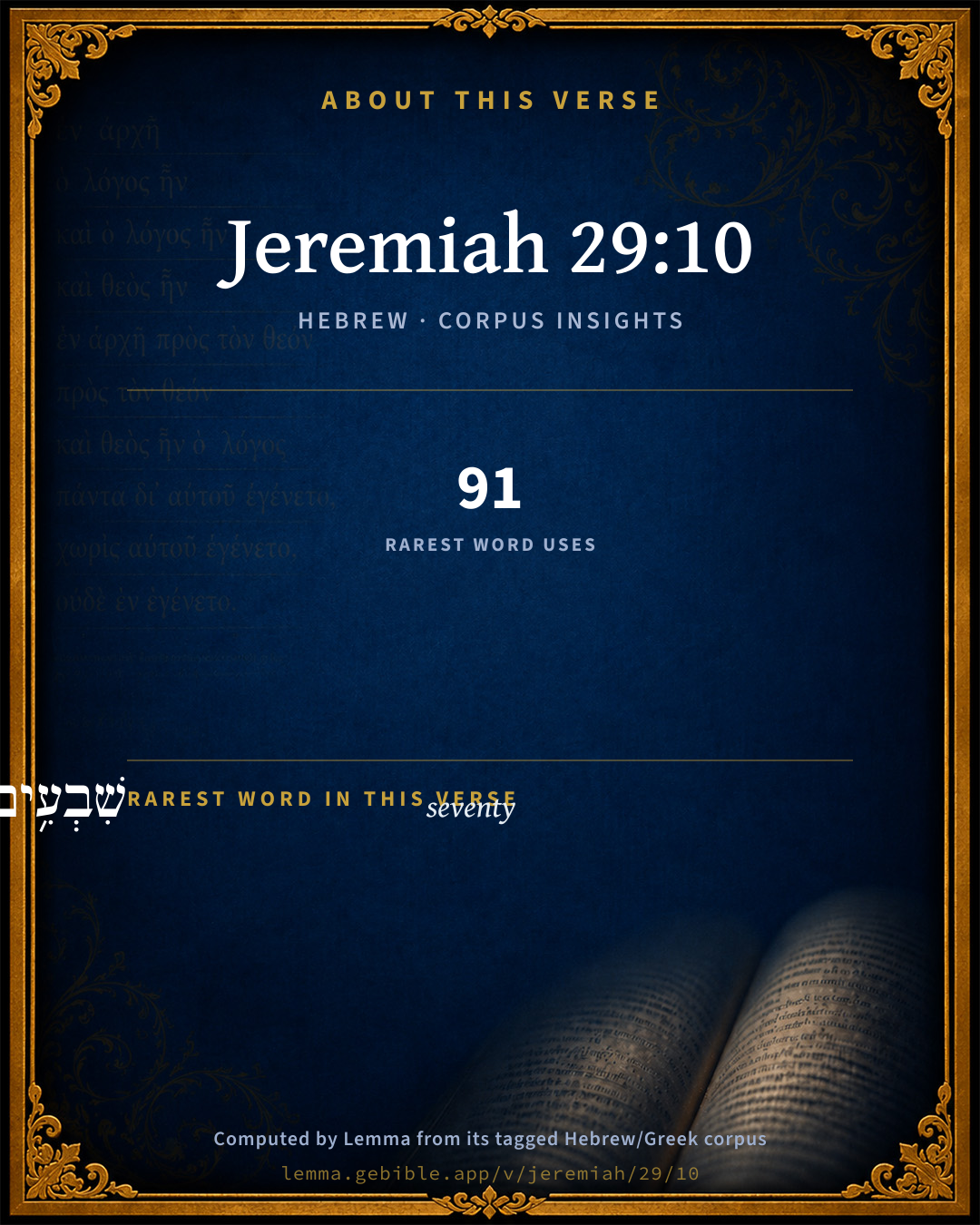
Jeremiah 29:10

Hebrew (Westminster Leningrad Codex) Jeremiah 29:10 appears in the Hebrew Old Testament. The text above is from the Westminster Leningrad Codex. Each word links to its Strong’s number, a concise gloss, and parsing drawn from the Open Scriptures Hebrew Bible morphology. Click any word for its full Brown-Driver-Briggs (BDB) entry.
Download image
Cite this verse

Jeremiah 29:10 (World English Bible). Public Domain. Lemma interlinear Bible study tool, https://lemma.gebible.app/v/jeremiah/29/10.

Show BibTeX & RIS
BibTeX
RIS
English Translation
For thus says Yahweh, After seventy years are accomplished for Babylon, I will visit you, and perform my good word toward you, in causing you to return to this place.
World English Bible · Public Domain
Download a study sheet

One document with this verse’s original text, its word-by-word gloss line, the meaning frame, cross-references with their text, attributed commentary, and full source and license credits — printable, and it pastes into notes with its structure intact.

This verse Autodidact and up

Study sheet (.html) Plain text (.txt)

A passage Seminary Student

Up to 50 verses in one chapter. A passage sheet keeps up to 6 commentary sources and 12 cross-references per verse, in the order this page ranks them, and says so on the sheet whenever that leaves anything out. Ask for a single verse and you get the Autodidact verse sheet above.

Everything on this page stays free to read, with no account — the sheet is a download of what is already on screen, not access to it.

Want to remove ads? Support Godless Engineer
Compare translations 3

The same verse in 3 English versions, stacked beneath the original-language interlinear above. Click any original word for its lexicon entry.

Each is an independent rendering of the whole verse — the interlinear is not word-aligned to these translations.

Highlighted words mark where these versions differ — a whole-verse word diff, not a word-by-word alignment.

  • World English Bible Public Domain
    For thus says Yahweh, After seventy years are accomplished for Babylon, I will visit you, and perform my good word toward you, in causing you to return to this place.
  • King James Version Public Domain
    For thus saith the LORD, That after seventy years be accomplished at Babylon I will visit you, and perform my good word toward you, in causing you to return to this place.
  • unfoldingWord Literal Text CC BY-SA 4.0
    For Yahweh says this, ‘When Babylon has ruled you for seventy years, I will help you and carry out my good word for you to bring you back to this place.

unfoldingWord Literal Text — © unfoldingWord, licensed CC BY-SA 4.0. Word-aligned USFM3 via Door43 (git.door43.org/unfoldingWord/en_ult).

Versions to compare (up to 4)

3 of 4 selected

Show all 18 translations

Every available English version of this verse, each an independent rendering of the whole verse.

  • World English Bible Public Domain
    For thus says Yahweh, After seventy years are accomplished for Babylon, I will visit you, and perform my good word toward you, in causing you to return to this place.
  • Berean Standard Bible Public Domain
    For this is what the LORD says: “When Babylon’s seventy years are complete, I will attend to you and confirm My promise to restore you to this place.
  • Majority Standard Bible Public Domain
    For this is what the LORD says: “When Babylon’s seventy years are complete, I will attend to you and confirm My promise to restore you to this place.
  • King James Version Public Domain
    For thus saith the LORD, That after seventy years be accomplished at Babylon I will visit you, and perform my good word toward you, in causing you to return to this place.
  • American Standard Version (1901) Public Domain
    For thus saith Jehovah, After seventy years are accomplished for Babylon, I will visit you, and perform my good word toward you, in causing you to return to this place.
  • Revised Version (1885) Public Domain
    For thus saith the LORD, After seventy years be accomplished for Babylon, I will visit you, and perform my good word toward you, in causing you to return to this place.
  • Geneva Bible (1599) Public Domain
    But thus saith the Lord, That after seuentie yeeres be accomplished at Babel, I will visite you, and performe my good promise toward you, and cause you to returne to this place.
  • Douay-Rheims (1899) Public Domain
    For thus saith the Lord: When the seventy years shall begin to be accomplished in Babylon, I will visit you: and I will perform my good word in your favour, to bring you again to this place.
  • Young's Literal Translation Public Domain
    `For thus said Jehovah, Surely at the fulness of Babylon -- seventy years -- I inspect you, and have established towards you My good word, to bring you back unto this place.
  • Literal Standard Version CC BY-SA 4.0
    For thus said YHWH: Surely at the fullness of Babylon—seventy years—I inspect you, and have established My good word toward you, to bring you back to this place.
  • Unlocked Literal Bible CC BY-SA 4.0
    For Yahweh says this, 'When Babylon has ruled you for seventy years, I will help you and carry out my good word for you to bring you back to this place.
  • unfoldingWord Literal Text CC BY-SA 4.0
    For Yahweh says this, ‘When Babylon has ruled you for seventy years, I will help you and carry out my good word for you to bring you back to this place.
  • Darby Bible Public Domain
    For thus saith Jehovah: When seventy years shall be accomplished for Babylon I will visit you, and perform my good word toward you, in bringing you back to this place.
  • World Messianic Bible Public Domain
    For the LORD says, “After seventy years are accomplished for Babylon, I will visit you and perform my good word toward you, in causing you to return to this place.
  • Webster's Bible Public Domain
    For thus saith the LORD, That after seventy years shall be accomplished at Babylon I will visit you, and perform my good word towards you, in causing you to return to this place.
  • Free Bible Version CC BY-SA 4.0
    This is what the Lord says: When the seventy years exile in Babylon is over, I will see to you and keep my promise to bring you back to Jerusalem.
  • Bible in Basic English Public Domain
    For this is what the Lord has said: When seventy years are ended for Babylon, I will have pity on you and give effect to my good purpose for you, causing you to come back to this place.
  • JPS Tanakh (1917) Public Domain
    For thus saith the LORD: After seventy years are accomplished for Babylon, I will remember you, and perform My good word toward you, in causing you to return to this place.

Literal Standard Version (2020), Covenant Press — licensed CC BY-SA 4.0. Text via the HelloAO Bible API (eBible.org). Unlocked Literal Bible (unfoldingWord) — licensed CC BY-SA 4.0. Text via the HelloAO Bible API (eBible.org). unfoldingWord Literal Text — © unfoldingWord, licensed CC BY-SA 4.0. Word-aligned USFM3 via Door43 (git.door43.org/unfoldingWord/en_ult). Free Bible Version, Dr. Jonathan Gallagher — licensed CC BY-SA 4.0. Text via the HelloAO Bible API (eBible.org).

Word by word

More ways to search: Search by grammar → Find every occurrence → Compare this word →

Practice this passage: Drill this verse → Learn its vocabulary →

שִׁבְעִ֥ים
shibʻîym
H7657
“seventy”
Adjective, Cardinal number, Both, Plural, Absolute
Part of Speech
Adjective
Type
Cardinal number
Gender
Both
Number
Plural
State
Absolute
Full BDB Definition

Origin: multiple of H7651

TWOT: 2318b

seventy
  1. כִּֽי kîy H3588 “that” Conjunction
  2. כֹה֙ kôh H3541 “thus” Adverb
  3. אָמַ֣ר ʼâmar H559 “to say” Verb, Qal, Perfect, 3rd Person, Masculine, Singular
  4. יְהוָ֔ה Yᵉhôvâh H3068 “LORD” Noun, Proper
  5. כִּ֠י kîy H3588 “that” Conjunction
  6. לְפִ֞י peh H6310 “to/for · mouth of” Preposition + Noun, Common, Masculine, Singular, Construct
  7. מְלֹ֧את mâlêʼ H4390 “to fill” Verb, Qal, Infinitive Construct
  8. לְבָבֶ֛ל Bâbel H894 “to/for · Babylon” Preposition + Noun, Proper
  9. שָׁנָ֖ה shâneh H8141 “year” Noun, Common, Feminine, Singular, Absolute
  10. אֶפְקֹ֣ד pâqad H6485 “to visit” Verb, Qal, Imperfect, 1st Person, Common, Singular
  11. אֶתְכֶ֑ם ʼêth H853 “- · you” Particle, Direct Object + Suffix, Personal, 2nd Person, Masculine, Plural
  12. וַהֲקִמֹתִ֤י qûwm H6965 “and · to rise” Conjunction + Verb, Hiphil, Sequential Perfect, 1st Person, Common, Singular
  13. עֲלֵיכֶם֙ ʻal H5921 “upon · you” Preposition + Suffix, Personal, 2nd Person, Masculine, Plural
  14. אֶת ʼêth H853 “-” Particle, Direct Object
  15. דְּבָרִ֣י dâbâr H1697 “word · my” Noun, Common, Masculine, Singular, Construct + Suffix, Personal, 1st Person, Common, Singular
  16. הַטּ֔וֹב ṭôwb H2896 “the · good” Particle, Definite Article + Adjective, Adjective, Masculine, Singular, Absolute
  17. לְהָשִׁ֣יב shûwb H7725 “to return” Preposition + Verb, Hiphil, Infinitive Construct
  18. אֶתְכֶ֔ם ʼêth H853 “- · you” Particle, Direct Object + Suffix, Personal, 2nd Person, Masculine, Plural
  19. אֶל ʼêl H413 “to” Preposition
  20. הַמָּק֖וֹם mâqôwm H4725 “the · place” Particle, Definite Article + Noun, Common, Masculine, Singular, Absolute
  21. הַזֶּֽה zeh H2088 “the · this” Particle, Definite Article + Pronoun, Demonstrative, Masculine, Singular

About this verse

These counts appear in no published source. They are computed here, from the morphology-tagged text and Lemma’s own curated glosses. What Lemma adds →

22
words
19
distinct lemmas
Prophets
section

Grammatical profile

  • 5 verbs
  • 6 nouns
  • 2 adjectives
  • 1 pronoun
  • 2 prepositions
  • 2 conjunctions
  • 1 adverb
  • 3 particles

Verb forms

  • אָמַ֣ר Qal · Perfect
  • מְלֹ֧את Qal · Infinitive Construct
  • אֶפְקֹ֣ד Qal · Imperfect
  • וַהֲקִמֹתִ֤י Hiphil · Sequential Perfect
  • לְהָשִׁ֣יב Hiphil · Infinitive Construct

Repetition

A word recurs within this verse — often emphatic in Hebrew:

  • כִּֽי that H3588 ×2

Cross-references

9

Topical passages linked to Jeremiah 29:10 in the Treasury of Scripture Knowledge — connected by theme and wording, ordered by reader-vote popularity; previews shown in the World English Bible.

  • Daniel 9:2 in the first year of his reign I, Daniel, understood by the books the number of the years about which the word of Yahweh came to Jeremiah the prophet, for the accomplishing of the desolations of Jerusalem, even seventy years.
  • Jeremiah 24:6–7 For I will set my eyes on them for good, and I will bring them again to this land: and I will build them, and not pull them down; and I will plant them, and not pluck them up.
  • Zechariah 7:5 "Speak to all the people of the land, and to the priests, saying, 'When you fasted and mourned in the fifth and in the seventh month for these seventy years, did you at all fast to me, really to me?
  • Jeremiah 25:12 It shall happen, when seventy years are accomplished, that I will punish the king of Babylon, and that nation, says Yahweh, for their iniquity, and the land of the Chaldeans; and I will make it desolate forever.
  • Jeremiah 27:22 They shall be carried to Babylon, and there shall they be, until the day that I visit them, says Yahweh; then will I bring them up, and restore them to this place.
  • Jeremiah 32:42–44 For thus says Yahweh: Like as I have brought all this great evil on this people, so will I bring on them all the good that I have promised them.
  • 2 Chronicles 36:21 to fulfill the word of Yahweh by the mouth of Jeremiah, until the land had enjoyed its Sabbaths: [for] as long as it lay desolate it kept Sabbath, to fulfill seventy years.
  • Zephaniah 2:7 The coast will be for the remnant of the house of Judah. They will find pasture. In the houses of Ashkelon, they will lie down in the evening, for Yahweh, their God, will visit them, and restore them.
  • Jeremiah 27:7 All the nations shall serve him, and his son, and his son's son, until the time of his own land come: and then many nations and great kings shall make him their bondservant.

Cross-references courtesy of OpenBible.info (CC BY 4.0).

Hebrew and Greek witnesses Masoretic Hebrew ↔ Greek Septuagint

The same verse in the two great witnesses to the Old Testament, shown verse-for-verse.

These are two independent witnesses, not word-aligned to each other, and the Septuagint is shown in lemma (dictionary) form.

Hebrew Jeremiah 29:10 Masoretic · Westminster Leningrad Codex

כִּֽי כֹה֙ אָמַ֣ר יְהוָ֔ה כִּ֠י לְפִ֞י מְלֹ֧את לְבָבֶ֛ל שִׁבְעִ֥ים שָׁנָ֖ה אֶפְקֹ֣ד אֶתְכֶ֑ם וַהֲקִמֹתִ֤י עֲלֵיכֶם֙ אֶת דְּבָרִ֣י הַטּ֔וֹב לְהָשִׁ֣יב אֶתְכֶ֔ם אֶל הַמָּק֖וֹם הַזֶּֽה

For thus says Yahweh, After seventy years are accomplished for Babylon, I will visit you, and perform my good word toward you, in causing you to return to this place.

World English Bible · Public Domain

Greek LXX Structure differs

In the Septuagint, Jeremiah is about an eighth shorter than the Hebrew and arranges its material differently — the Oracles Against the Nations (Hebrew chapters 46–51) appear in the middle of the Greek book, after 25:13. Because the chapter and verse boundaries do not line up, a verse-for-verse comparison with the Hebrew is not shown.

A verse-for-verse comparison isn’t shown here because the chapters and verses don’t line up. Switch to the LXX edition with the MT / LXX toggle above to read the Greek directly.

Hebrew: Westminster Leningrad Codex (CC BY 4.0). Greek: Septuagint (public domain); English from a public-domain English Septuagint. How the Septuagint differs from the Hebrew →

Targum (Aramaic paraphrase)

1

The Targum is the ancient Jewish Aramaic paraphrase of the Hebrew Scriptures — an interpretive translation, not the Hebrew text itself. Onkelos (literal) and Pseudo-Jonathan (expansive) render the Torah, and Jonathan the Prophets. Coverage is partial: where no permissively-licensed English translation exists for a verse, only the Aramaic is shown. This is verse-level text, not a word-by-word alignment to the Hebrew.

  1. Targum Jonathan Prophets (Joshua–Malachi)
    אֲרֵי כִדְנַן אֲמַר יְיָ אֲרֵי לְפוּם מִשְׁלַם לְבָבֶל שַׁבְעִין שְׁנִין יֵיעוֹל דָכְרָנְכוֹן קָדָמַי וַאֲקֵים עֲלֵיכוֹן יַת פִּתְגָמַי תַּקְנָא לַאֲתָבָא יַתְכוֹן לְאַתְרָא הָדֵין:

    (no public-domain English translation for this verse)

    Targum Jonathan — Aramaic: “Mikraot Gedolot” (public domain). English: “Sefaria Community Translation” (CC0 1.0 (public-domain dedication)); “London "Chaldee Paraphrase," 1871” (public domain). Text via Sefaria.

Commentary

Notes on Jeremiah 29:10 from classic Christian and Jewish commentators (each source and its license shown beneath its notes). The classic Christian expositions comment on the surrounding passage and are grouped to its opening verse, so a note may address several verses; the Jewish commentaries on the Tanakh (Rashi and others) are per-verse, so they appear only where the commentator wrote on this verse.

Lemma curates 59 commentaries, every one of them public domain or Creative Commons licensed, each selected and text-cleaned for this edition rather than reprinted as found. About our sources →

Trapp's Complete Commentary

John Trapp

Jer 29:10 For thus saith the LORD, That after seventy years be accomplished at Babylon I will visit you, and perform my good word toward you, in causing you to return to this place.

Ver. 10. For thus saith the Lord.] Or, But this hath the Lord said, whatever these impostors say to the contrary. Set truth against falsehood, and it will silence it, like as if a lamp be hanged over a ditch where frogs are croaking, they are forthwith hushed and made quiet.

John Trapp, A Commentary or Exposition upon All the Books of the Old and New Testament (1647–1656) — public domain. Text from a community e-Sword module.

Joseph Benson's Commentary

Jer 29:10-14. After seventy years be accomplished at Babylon — Hebrews, לפי מלאת שׁבעים שׁנה, literally, At the mouth of the accomplishment of seventy years. “And as the mouth of a river, metaphorically, denotes the extremity of its course, where it discharges its waters into the sea; so, by a farther metaphor drawn from hence, לפיseems to denote being at the full end of a certain period or limited course of time, where it is just going to lose itself in, and mix with, the ocean of eternity. Here therefore we are to understand that, ‘at the very instant of, or immediately upon, the completion of seventy years,’ the restoration of the Jews should take place.” — Blaney. These seventy years of the captivity, it appears, are to be computed from the fourth year of Jehoiakim, which, in the Scripture account, is the first year of Nebuchadnezzar’s reign: see note on Jer 25:1. I will visit you and perform my good word — My promise, in causing, rather, of causing you to return, &c. — There were but few, comparatively speaking, of those captives that returned in person into their own country, Ezr 3:12. Therefore, this promise was chiefly fulfilled in their posterity; and it is common in Scripture to speak of blessings bestowed upon the children, as if they had been actually fulfilled to their progenitors. For I know the thoughts that I think toward you — And God’s works agree exactly with his thoughts; for he doeth all things according to the counsel of his own will. Thoughts of peace, or good, and not of evil — Even that which seems evil is designed for good, and will at last appear to have actually wrought for good: to give you an expected end — Hebrew, אחרית ותקוה, literally, to give you an end and expectation, or, as Blaney translates it, to make your latter end even an object of hope: see chap. Jer 31:17. Then shall ye call upon me — That is, when you place your hope in me only, and that with assurance, and not wavering; and I will hearken unto you — A sure token of God’s favour Jer 33:3, as his rejecting men, and casting them off, is expressed by his hiding his face and refusing to hear their prayers, Jer 14:12; Lam 3:8; Lam 3:44. And ye shall seek me and find me — According to my promises made Lev 26:40-45; Deu 30:2-3; Psa 32:6. When ye shall search for me with all your heart — Observe, reader, in seeking God, we must search for him, that we may find him; must search for directions in seeking him, &c., for encouragements to our faith and hope: we must continue, and take pains in seeking him, namely, in seeking his favour, his image, and communion with him; and this we must do with our heart — That is, in sincerity and uprightness, and with all our heart, that is with vigour and fervency, putting forth all that is within us in prayer: and those who thus seek God shall find him, and know, by experience, that he is their bountiful rewarder, Heb 11:6, for he never said to such, Seek ye me in vain.

Joseph Benson's Commentary on the Old and New Testaments (1811–1818) — public domain. Text from a community e-Sword module.

Tyndale Open Study Notes

Tyndale Open Resources

29:10 The exiled people of Judah would be in Babylon for seventy years; this was not new information (see 25:11), but Jeremiah’s audiences in Jerusalem had not believed him. Now that those people were in exile, they needed to accept reality.

Tyndale Open Study Notes — © Tyndale Open Resources, licensed CC BY-SA 4.0. Text via the HelloAO Bible API.

Jamieson, Fausset & Brown

Robert Jamieson, A. R. Fausset & David Brown

(See on Jer 25:11; Jer 25:12; Dan 9:2). This proves that the seventy years date from Jeconiah's captivity, not from the last captivity. The specification of time was to curb the impatience of the Jews lest they should hasten before God's time.

good word--promise of a return.

Jamieson, Fausset & Brown — Commentary Critical and Explanatory on the Whole Bible (1871) — public domain (CC PDM 1.0). Text via the HelloAO Bible API.

Adam Clarke's Commentary

Verse 10. For thus saith the Lord] It has been supposed that a very serious transposition of verses has taken place here; and it has been proposed to read after Jer 29:9 the sixteenth to the nineteenth inclusive; then the tenth, and on to the fourteenth inclusive; then the twentieth, the fifteenth, the twenty-first, and the rest regularly to the end.

That after seventy years be accomplished] לפי מלאת lephi meloth, "at the mouth of the accomplishment," or "fill to the mouth." Seventy years is the measure which must be filled; - fill this to the brim; - complete this measure, and then you shall be visited and released. The whole seventy must be completed; expect no enlargement before that time.

Adam Clarke's Commentary on the Bible (1810–1826) — public domain. Text from a community e-Sword/MySword module.

John Calvin's Commentaries

In order to expose the dreams by which the false prophets had inebriated the people, he again repeats what he had said, that the end of their exile could not be expected until the end of seventy years. And this way of teaching ought to be particularly observed, for the truth of God will ever avail to dissipate all the mists in which Satan never ceases to envelop the pure truth. As then we have before seen, that when the people are imbued with any error, it ought to be boldly resisted; so now we see with what weapons all God’s servants ought to fight, in order to expose all those fallacies by which pure doctrine is assailed, even by setting in opposition to them the word of God: for this is the way which Jeremiah points out to us by his own example. He had spoken of the false prophets, he warned the people not to believe them; but as the minds of many were still vacillating, he confirms what he had said that they were not sent by God, because God never varies in his purpose, and never changes, and is never inconsistent with himself: “Now he has prefixed seventy years for your exile; whoever, then, tries to impugn that truth, is a professed and an open enemy to God.” We now perceive the object of the Prophet; When seventy years then shall be fulfilled, etc

The Prophet here puts a restraint on the Jews, that they might not hasten before the time; and then he gives them the hope of a return, provided they quietly rested until the end fixed on by God. There are then two things in this verse, — that the people would ill consult their own good, if they hastened and promised to themselves a return before the end of seventy years, — and that when that time was completed, the hope of a return would be certain, for God had so promised.

He adds, And I will raise up my good word towards you By good word he means what might bring joy to the Jews. Though God’s word is fatal to the unbelieving, yet it never changes its nature; it ever remains good. And hence Paul says that the Gospel is a fatal odor to many, but that it is, nevertheless, a sweet odor before God, (2 Corinthians 2:16;) for it ought to be imputed to the fault of those who perish, that they receive not the doctrine of the Gospel to their own salvation. The word of God is then always good: but this commendation is to be referred to experience, that is, when God really shews that he is propitious to us. And a shorter definition cannot be given, than that the good word denotes the promises, by which God testifies his paternal favor. But we have seen elsewhere that threatenings are called an evil word: why so? This character cannot, indeed, as it has been just said, be suitably applied to God’s word; yet God’s word which threatens destruction is called evil, as it is said,

“I am he who create good and evil,” (Isaiah 45:7)

but it is so according to our apprehension of its effects. And all this reasoning seems nearly superfluous, when we understand that God by the word of evil strikes the unbelieving with fear, but that the Prophet now means no other thing than to bear testimony to God’s favor to the Jews: and hence he says, that they would find by experience, that God had not in vain promised what he had before mentioned.

But he is said to rouse up his good word, that is, when it produced its effects before their eyes; for when God only speaks, and the thing itself does not yet appear, his word seems in a manner to he dormant and to be useless. And for seventy years the Jews could perceive no other thing than that God was displeased with them, and thus they were continually in fear; for the promise continued as it were dormant, as its effects were not as yet visible. God then is said to rouse up his word, when he proves that he has not promised anything in vain. The meaning is, that the prophecy which Jeremiah had related would not be fruitless; but if the people did not soon know this, yet God, when the time came, would really prove that he deceives not his people, nor allures them when he promises anything, by vain hopes.

And the Prophet explains himself, for he says that God would restore them to their own country: for this was the good word, the promise of deliverance, as the word, according to what the people felt, was evil, and bitter, and bad, when God had threatened that he would cast away the reprobate. But it is an accidental thing, as I have said, that men find God’s word to be evil for them or adverse to them; for it proceeds from their own fault, and not from the nature of the word. It follows —

John Calvin's Commentaries (1540-1563) — public domain. Text from the Calvin Translation Society English edition (1840s-50s) via the Christian Classics Ethereal Library (ccel.org). Calvin's coverage is partial (roughly two-thirds of the Bible); uncommented books and verses are honest gaps, never fabricated. The 19th-century editor's footnotes and remarks are omitted so the notes are faithfully Calvin's own voice.

The Cambridge Bible for Schools and Colleges

gen. ed. J. J. S. Perowne

10. After seventy years] See on Jer_25:11.

for Babylon] The announcement has respect to the duration of the empire of Nebuchadnezzar and his successors, and only secondarily to the consequent limitation of the captivity.

my good word] My gracious promise. See Jer_24:4-7.

10–14. Not till after seventy years shall they return.

The Cambridge Bible for Schools and Colleges (gen. ed. J. J. S. Perowne; Cambridge University Press, 1878–1918) — public domain. Text from a community e-Sword module.

John Gill's Exposition

For thus saith the Lord, that after seventy years be accomplished at Babylon,.... These seventy years are not to be reckoned from the last captivity under Zedekiah; nor from the precise present time; nor from the first of Jeconiah's captivity; but the fourth year of Jehoiakim, and the first of Nebuchadnezzar, when he first came up against Jerusalem; see Jer 25:1;

I will visit you; in a way of mercy, by stirring up Cyrus king of Persia to grant them their liberty:

and perform my good word towards you, in causing you to return to this place; meaning the promise of return from their captivity to their own land; which was a good word of promise, a promise of good things; which was good news to them, and of which there was no doubt of its performance, since God is faithful who has promised, and is able also to perform. It was from hence, and Jer 25:11; that Daniel learned the time of the captivity, and the return from it, Dan 9:2.

John Gill's Exposition of the Whole Bible (1746–1763) — public domain (CC PDM 1.0). Text via the HelloAO Bible API.

Albert Barnes' Notes on the Bible

After seventy years - literally, according to the measure of the fulfillment of 70 years for Babylon. The 70 years (Jer 25:11 note) are primarily the length of the Babylonian empire, and only in a secondary sense that of the Jewish exile.

Albert Barnes' Notes on the Bible (1834–1885) — public domain. Text from a community e-Sword/MySword module.

Haydock's Catholic Bible Commentary

Seventy. Dating from the 4th of Joakim to the 1st of Cyrus, the year of the world 3468. (Calmet) See chap.. xxv. 1, 11. (Haydock)

George Leo Haydock (1774–1849), Haydock's Catholic Family Bible and Commentary, 1859 edition — public domain. Excludes Psalms (Douay-Rheims chapter numbering differs from Protestant) and Deuterocanonical books (Catholic canon only).

Matthew Poole's English Annotations

From this text appears that the seventy years’ captivity was to be accounted from the first carrying into captivity in the time of Jehoiachin, so that eleven years of it were elapsed before Zedekiah was carried away. Whatever, saith the prophet, these dreamers tell you, you must abide seventy years in Babylon, accounted from your first going thither; it is therefore your wisdom to acquiesce in the will of God, and to compose yourselves; and, to encourage you, the Lord by me assureth you, that after those seventy years shall be expired, as he hath now visited you with evil, so he will visit you for good, and fulfill the promise he hath made to you, and you shall return again to Jerusalem. We have the fulfilling of this recorded in 2Ch 36:21,22; Ezr 1:1. The promise was before, Jer 25:12; 27:22. Daniel understood it from the words of this prophecy, Dan 9:2, which put him upon prayer at the expiration of that time.

Matthew Poole's English Annotations on the Holy Bible (1683–1685) — public domain. Text from a community e-Sword/MySword module.

Whedon's Commentary on the Bible

Daniel D. Whedon

10. Seventy years — See Jer_25:11.

Daniel D. Whedon (gen. ed.), Commentary on the Old and New Testaments (1874–1909) — public domain. Text from a community e-Sword module.

The Pulpit Commentary

Seventy years. (see on Jer_25:11) At Babylon; rather, for Babylon. A long period, such as seventy years, is appointed for Babylon "to enjoy" the fruits of her ambition; when this is over, (comp. Gen_15:13-16) God will pay heed to his people. Visit you. To "visit" frequently has the sense of "taking notice of," or "paying heed to". (Jer_23:2) My good word. "Word," equivalent to "praise;" the allusion is to Jer_24:6.

Seventy years.

I SEVENTY YEARS ARE A LIMITED TIME. Babylon was to tyrannize for a limited period only; the Jews were to suffer for a limited period.

1. God has set a limit to the triumph of evil. The storm rages; yet God says to it, "Hitherto shalt thou come, and no further." The lions roar, but they are chained. Wicked men fling the reins to their passions, break through all restraints of respect for the wilt of God and appear to be at liberty to work evil and revel in the fruits of sin ad libitum; but God has put bounds about their course. In due time he will lay his hand upon them and arrest them.

2. God has set a limit to the duration of trouble. The sorrow of God"s people is temporal; their blessedness will be eternal. Every trouble is weighed and measured by God. "Our times are in his hand.

II SEVENTY YEARS ARE A SHORT TIME IN THE HISTORY OF A NATION. The Captivity was to last for seventy years; prosperity had been enjoyed for hundreds of years before this, and would return and endure long after. The troublesome times are conspicuous, while the quiet times glide by unnoticed. Hence we are likely not to note how much more we have of the latter. History reads like a record of wars and commotions, because the happy but dull annals of prosperity do not contain many striking events. It is much the same in private life. For most of us the blessings greatly outnumber the troubles, the times of quiet far exceed those of distress. Yet it is difficult to recognize this, because what hurts us impresses our memory more than what pleases us.

III SEVENTY YEARS ARE A LIFETIME. Few, if any, of the first captives would survive the exile. To the individual man it was as bad as if it were perpetual. Yet if they were true patriots the national hope must have been a great comfort in the darkness of personal suffering. And the patriotic hope of Israel was one of the grandest features in the Hebrew character. We are all too selfish in our hopes. Christians should consider the cause of Christ and the interest of humanity as of far more importance than their private prosperity. If in the end Christ will triumph, and the world will be lifted out of the sin and sorrow which have overwhelmed it, should not we rejoice, though our lot may not be to live till this is accomplished? Moses rejoiced in the Pisgah-view of the land he could never enter; Simeon was glad at seeing the infant Savior, and could depart in peace with the assurance of a redemption not yet accomplished. Still, the Christian may have a great personal hope beyond this. Seventy years! but a span compared with eternity! When these swift days have flown the door will be opened to the infinite ages of eternity. What if the little life be tempest-tossed? The voyage is short , the haven is near. (2Co_4:17, 2Co_4:18)

The Pulpit Commentary (1880–1919), ed. H.D.M. Spence-Jones & Joseph S. Exell — public domain. Text from a community e-Sword module.

John Wesley's Explanatory Notes

After - From this text it appears that the seventy years captivity, were to be accounted from the first carrying into captivity in the time of Jehoiakim, so that eleven years of it were elapsed, before Zedekiah was carried away.

John Wesley, Explanatory Notes Upon the Whole Bible (1754–1765) — public domain. Text via the GEBible commentary corpus.

unfoldingWord translationNotes

Door43 World Missions Community

General Information:

Yahweh continues speaking about what will happen to the captives of Israel.

you

the captive Israelites

seventy years

"70 years" (See: Numbers)

this is Yahweh's declaration

Yahweh speaks of himself by name to express the certainty of what he is declaring. See how you translated this in Jeremiah 1:8. AT: "this is what Yahweh has declared" or "this is what I, Yahweh, have declared" (See: First, Second, or Third Person)

translationWords

rule

year

good

word of God

hope

unfoldingWord translationNotes — © Distant Shores Media and the Door43 World Missions Community, licensed CC BY-SA 4.0. Source: git.door43.org/Door43/en_tn.

Lesson kit

Teaching starters — assembled from the data on this page, not authored interpretation. Every prompt links to the verse data it draws on. Edit before teaching.

Jeremiah, in the Prophets, opens this verse with 22 words (19 distinct Hebrew lemmas). Its most distinctive word is shibʻîym (“seventy”). A historical commentator’s framing appears above. Read the whole chapter for the surrounding context.

Discussion questions

  1. The word shibʻîym carries the sense “seventy.” How does it shape the verse?
  2. How does Daniel 9:2, which shares this passage’s theme, read alongside this verse?
  3. What does the repetition of “that” (2× in this one verse) do in this verse?
  4. These translations render this verse differently; the difference is in the English rendering, not the original. What questions does that raise?
  5. «אָמַ֣ר» is a Qal Perfect verb. How does that grammatical form shape the action described?
  6. Compare how Trapp's Complete Commentary and Joseph Benson's Commentary read this verse. Where do they agree or differ?

Things to notice

Reading settings

Reading text

Shown beneath each verse's original-language words.

Old Testament
Old Testament edition

Read the OT as the Masoretic Hebrew (MT) or the Greek Septuagint (LXX).

English shown for the Greek Septuagint (in the Hebrew ↔ Greek comparison).

Comparing translations? Open the Compare panel on any verse page to stack up to four side by side.