
Ezekiel 23:15

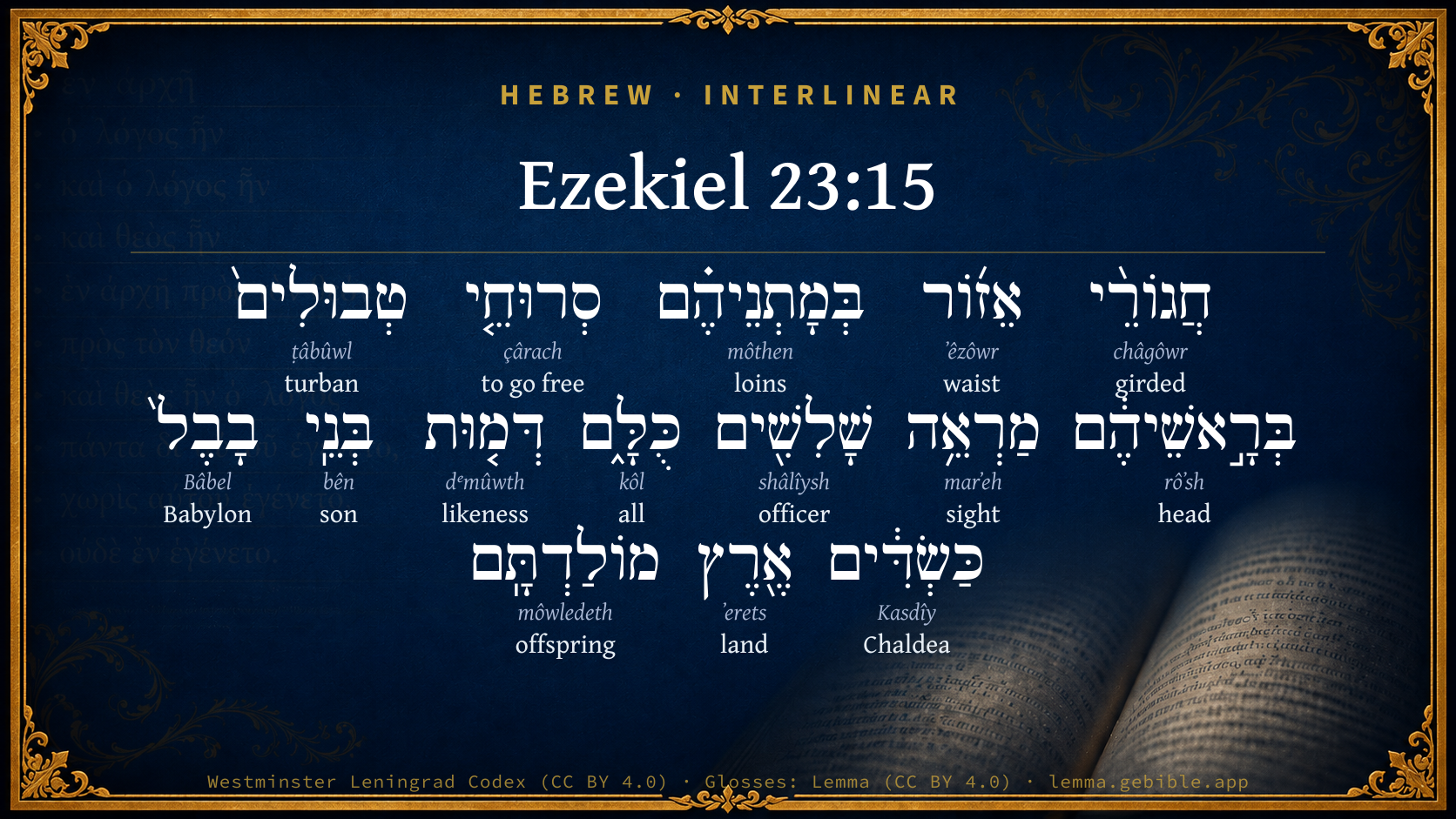
Hebrew (Westminster Leningrad Codex) Ezekiel 23:15 appears in the Hebrew Old Testament. The text above is from the Westminster Leningrad Codex. Each word links to its Strong’s number, a concise gloss, and parsing drawn from the Open Scriptures Hebrew Bible morphology. Click any word for its full Brown-Driver-Briggs (BDB) entry.
Download image
Cite this verse

Ezekiel 23:15 (World English Bible). Public Domain. Lemma interlinear Bible study tool, https://lemma.gebible.app/v/ezekiel/23/15.

Show BibTeX & RIS
BibTeX
RIS
English Translation
girded with girdles on their loins, with flowing turbans on their heads, all of them princes to look on, after the likeness of the Babylonians in Chaldea, the land of their birth.
World English Bible · Public Domain
Highlights
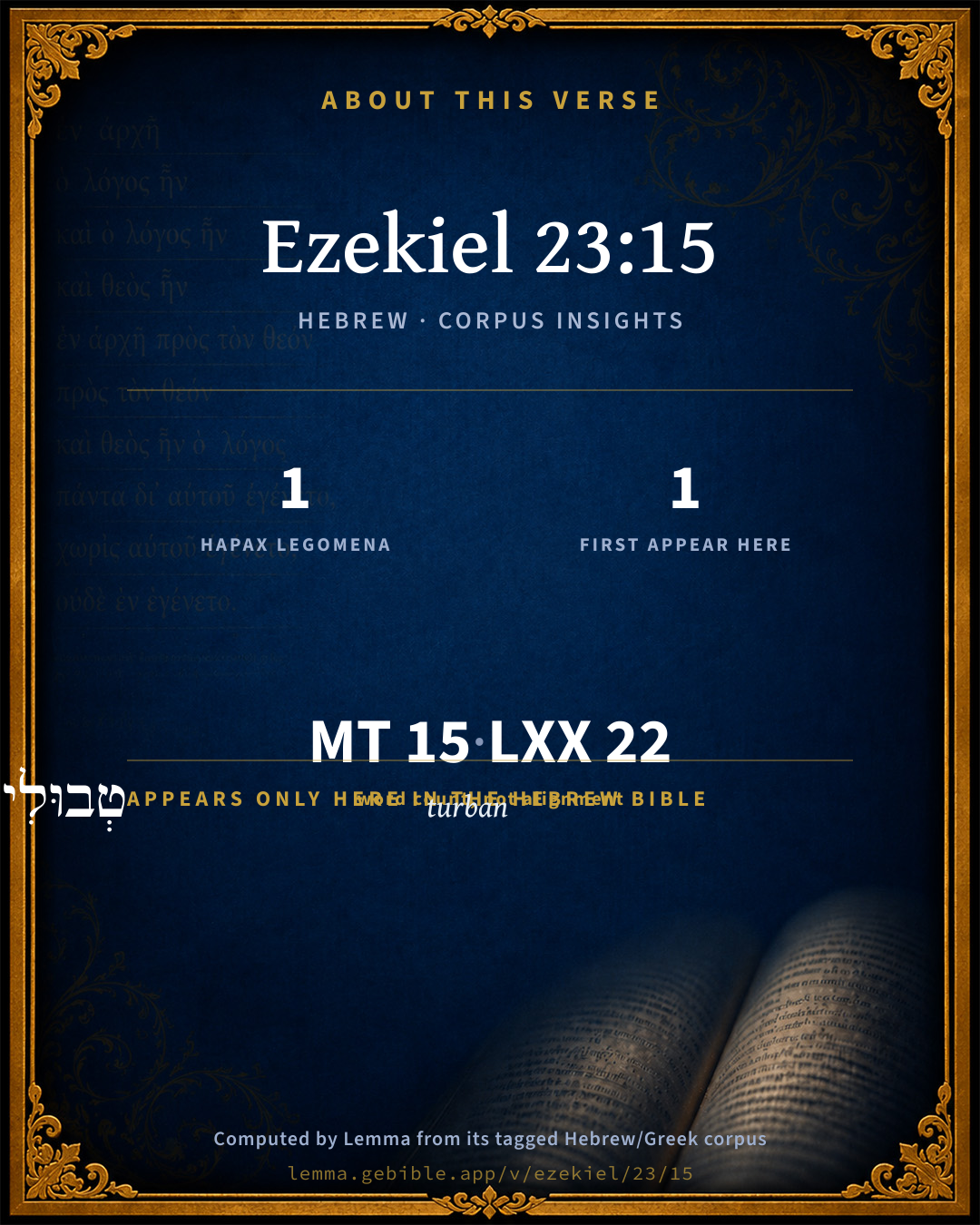
  • 1 hapax legomenon — only here in the Hebrew Bible
  • 1 first appearance in the Hebrew Bible
Full analysis ↓
Download a study sheet

One document with this verse’s original text, its word-by-word gloss line, the meaning frame, cross-references with their text, attributed commentary, and full source and license credits — printable, and it pastes into notes with its structure intact.

This verse Autodidact and up

Study sheet (.html) Plain text (.txt)

A passage Seminary Student

Up to 50 verses in one chapter. A passage sheet keeps up to 6 commentary sources and 12 cross-references per verse, in the order this page ranks them, and says so on the sheet whenever that leaves anything out. Ask for a single verse and you get the Autodidact verse sheet above.

Everything on this page stays free to read, with no account — the sheet is a download of what is already on screen, not access to it.

Want to remove ads? Support Godless Engineer
Compare translations 3

The same verse in 3 English versions, stacked beneath the original-language interlinear above. Click any original word for its lexicon entry.

Each is an independent rendering of the whole verse — the interlinear is not word-aligned to these translations.

Highlighted words mark where these versions differ — a whole-verse word diff, not a word-by-word alignment.

  • World English Bible Public Domain
    girded with girdles on their loins, with flowing turbans on their heads, all of them princes to look on, after the likeness of the Babylonians in Chaldea, the land of their birth.
  • King James Version Public Domain
    Girded with girdles upon their loins, exceeding in dyed attire upon their heads, all of them princes to look to, after the manner of the Babylonians of Chaldea, the land of their nativity:
  • unfoldingWord Literal Text CC BY-SA 4.0
    wearing belts around their waists, with flowing turbans on their heads. All of them had the appearance of officers of chariot troops, the likeness of sons of Babylonia, whose native land is Chaldea.

unfoldingWord Literal Text — © unfoldingWord, licensed CC BY-SA 4.0. Word-aligned USFM3 via Door43 (git.door43.org/unfoldingWord/en_ult).

Versions to compare (up to 4)

3 of 4 selected

Show all 18 translations

Every available English version of this verse, each an independent rendering of the whole verse.

  • World English Bible Public Domain
    girded with girdles on their loins, with flowing turbans on their heads, all of them princes to look on, after the likeness of the Babylonians in Chaldea, the land of their birth.
  • Berean Standard Bible Public Domain
    wearing belts on their waists and flowing turbans on their heads; all of them looked like officers of the Babylonians in Chaldea, the land of their birth.
  • Majority Standard Bible Public Domain
    wearing belts on their waists and flowing turbans on their heads; all of them looked like officers of the Babylonians in Chaldea, the land of their birth.
  • King James Version Public Domain
    Girded with girdles upon their loins, exceeding in dyed attire upon their heads, all of them princes to look to, after the manner of the Babylonians of Chaldea, the land of their nativity:
  • American Standard Version (1901) Public Domain
    girded with girdles upon their loins, with flowing turbans upon their heads, all of them princes to look upon, after the likeness of the Babylonians in Chaldea, the land of their nativity.
  • Revised Version (1885) Public Domain
    girded with girdles upon their loins, exceeding in dyed attire upon their heads, all of them princes to look upon, after the likeness of the Babylonians in Chaldea, the land of their nativity.
  • Geneva Bible (1599) Public Domain
    And girded with girdles vpon their loynes, and with dyed attyre vpon their heads (looking all like princes after the maner of the Babylonians in Caldea, the land of their natiuitie)
  • Douay-Rheims (1899) Public Domain
    And girded with girdles about their reins, and with dyed turbans on their heads, the resemblance of all the captains, the likeness of the sons of Babylon, and of the land of the Chaldeans wherein they were born,
  • Young's Literal Translation Public Domain
    Girded with a girdle on their loins, Dyed attire spread out on their heads, The appearance of rulers -- all of them, The likeness of sons of Babylon, Chaldea is the land of their birth.
  • Literal Standard Version CC BY-SA 4.0
    Girded with a girdle on their loins, || Dyed attire spread out on their heads, || The appearance of rulers—all of them, || The likeness of sons of Babylon, || Chaldea is the land of their birth.
  • Unlocked Literal Bible CC BY-SA 4.0
    wearing belts around their waists, with flowing turbans on their heads. All of them had the appearance of officers of chariot troops, the likeness of sons of Babylonia, whose native land is Chaldea.
  • unfoldingWord Literal Text CC BY-SA 4.0
    wearing belts around their waists, with flowing turbans on their heads. All of them had the appearance of officers of chariot troops, the likeness of sons of Babylonia, whose native land is Chaldea.
  • Darby Bible Public Domain
    girded with girdles upon their loins, with flowing turbans on their heads, all of them captains in appearance, [after] the likeness of the children of Babylon, of Chaldea, the land of their nativity.
  • World Messianic Bible Public Domain
    dressed with belts on their waists, with flowing turbans on their heads, all of them looking like princes, after the likeness of the Babylonians in Kasdim, the land of their birth.
  • Webster's Bible Public Domain
    Girded with girdles upon their loins, exceeding in dyed attire upon their heads, all of them princes to look to, after the manner of the Babylonians of Chaldea, the land of their nativity:
  • Free Bible Version CC BY-SA 4.0
    They were wearing belts on their waists and large turbans on their heads. They all looked like Babylonian officers in Chaldea, the country where they were born.
  • Bible in Basic English Public Domain
    With bands round their bodies and with head-dresses hanging round their heads, all of them looking like rulers, like the Babylonians, the land of whose birth is Chaldaea.
  • JPS Tanakh (1917) Public Domain
    girded with girdles upon their loins, with pendant turbans upon their heads, all of them captains to look upon, the likeness of the sons of Babylon, even of Chaldea, the land of their nativity.

Literal Standard Version (2020), Covenant Press — licensed CC BY-SA 4.0. Text via the HelloAO Bible API (eBible.org). Unlocked Literal Bible (unfoldingWord) — licensed CC BY-SA 4.0. Text via the HelloAO Bible API (eBible.org). unfoldingWord Literal Text — © unfoldingWord, licensed CC BY-SA 4.0. Word-aligned USFM3 via Door43 (git.door43.org/unfoldingWord/en_ult). Free Bible Version, Dr. Jonathan Gallagher — licensed CC BY-SA 4.0. Text via the HelloAO Bible API (eBible.org).

Word by word

More ways to search: Search by grammar → Find every occurrence → Compare this word →

Practice this passage: Drill this verse → Learn its vocabulary →

טְבוּלִים֙
ṭâbûwl
H2871
“turbans”
Noun, Common, Masculine, Plural, Absolute
Part of Speech
Noun
Type
Common
Gender
Masculine
Number
Plural
State
Absolute
Full BDB Definition

Origin: pass. participle of H2881

TWOT: 788a

turban
  1. חֲגוֹרֵ֨י châgôwr H2289 “girded of” Adjective, Adjective, Masculine, Plural, Construct
  2. אֵז֜וֹר ʼêzôwr H232 “waist” Noun, Common, Masculine, Singular, Absolute
  3. בְּמָתְנֵיהֶ֗ם môthen H4975 “in/at · loins · their” Preposition + Noun, Common, Masculine, Dual, Construct + Suffix, Personal, 3rd Person, Masculine, Plural
  4. סְרוּחֵ֤י çârach H5628 “gone free” Verb, Qal, Participle Passive, Masculine, Plural, Construct
  5. בְּרָ֣אשֵׁיהֶ֔ם rôʼsh H7218 “in/at · heads · their” Preposition + Noun, Common, Masculine, Plural, Construct + Suffix, Personal, 3rd Person, Masculine, Plural
  6. מַרְאֵ֥ה marʼeh H4758 “sight of” Noun, Common, Masculine, Singular, Construct
  7. שָׁלִשִׁ֖ים shâlîysh H7991 “officers” Noun, Common, Masculine, Plural, Absolute
  8. כֻּלָּ֑ם kôl H3605 “all · their” Noun, Common, Masculine, Singular, Construct + Suffix, Personal, 3rd Person, Masculine, Plural
  9. דְּמ֤וּת dᵉmûwth H1823 “likeness of” Noun, Common, Feminine, Singular, Construct
  10. בְּנֵֽי bên H1121 “sons of” Noun, Common, Masculine, Plural, Construct
  11. בָבֶל֙ Bâbel H894 “Babylon” Noun, Proper
  12. כַּשְׂדִּ֔ים Kasdîy H3778 “Chaldea” Noun, Proper
  13. אֶ֖רֶץ ʼerets H776 “land of” Noun, Common, Both, Singular, Construct
  14. מוֹלַדְתָּֽם môwledeth H4138 “offspring · their” Noun, Common, Feminine, Singular, Construct + Suffix, Personal, 3rd Person, Masculine, Plural

About this verse

These counts appear in no published source. They are computed here, from the morphology-tagged text and Lemma’s own curated glosses. What Lemma adds →

15
words
15
distinct lemmas
Prophets
section

Notable vocabulary

1 hapax legomenon — a word that appears only here in the entire Hebrew Bible:

  • טְבוּלִים֙ turban H2871

First appearance in Scripture

This word makes its first canonical appearance in the Hebrew Bible here:

  • טְבוּלִים֙ turban H2871

Shared distinctive vocabulary

חֲגוֹרֵ֨י girded H2289 occurs in 2 verses of the Hebrew Bible. Also found in:

Grammatical profile

  • 1 verb
  • 13 nouns
  • 1 adjective

Verb forms

  • סְרוּחֵ֤י Qal · Participle Passive

Hebrew & Septuagint length

In English translation the verse runs 32 words from the Hebrew and 31 from the Septuagint (LXX English) — closely comparable.

A rough comparison of the two English renderings, which tokenize alike — not a word-level alignment.

Word counts can differ between the Hebrew and the Greek without any difference in meaning — e.g. the Hebrew direct-object marker אֵת has no separate Greek word, and Greek often adds the article ὁ.

In the original languages it is 15 Hebrew tokens and 22 Greek tokens — but the two are counted differently (Hebrew bundles its prefixes and suffixes into one token; the Greek is in lemma form), so that isn’t a like-for-like length.

Cross-references

4

Topical passages linked to Ezekiel 23:15 in the Treasury of Scripture Knowledge — connected by theme and wording, ordered by reader-vote popularity; previews shown in the World English Bible.

  • Judges 8:18 Then said he to Zebah and Zalmunna, What manner of men were they whom you killed at Tabor? They answered, As you are, so were they; each one resembled the children of a king.
  • 1 Samuel 18:4 Jonathan stripped himself of the robe that was on him, and gave it to David, and his clothing, even to his sword, and to his bow, and to his sash.
  • 2 Samuel 14:25 Now in all Israel there was none to be so much praised as Absalom for his beauty: from the sole of his foot even to the crown of his head there was no blemish in him.
  • Isaiah 22:21 and I will cloth him with your robe, and strengthen him with your belt, and I will commit your government into his hand; and he shall be a father to the inhabitants of Jerusalem, and to the house of Judah.

Cross-references courtesy of OpenBible.info (CC BY 4.0).

Hebrew and Greek witnesses Masoretic Hebrew ↔ Greek Septuagint

The same verse in the two great witnesses to the Old Testament, shown verse-for-verse.

These are two independent witnesses, not word-aligned to each other, and the Septuagint is shown in lemma (dictionary) form.

Hebrew Ezekiel 23:15 Masoretic · Westminster Leningrad Codex

חֲגוֹרֵ֨י אֵז֜וֹר בְּמָתְנֵיהֶ֗ם סְרוּחֵ֤י טְבוּלִים֙ בְּרָ֣אשֵׁיהֶ֔ם מַרְאֵ֥ה שָׁלִשִׁ֖ים כֻּלָּ֑ם דְּמ֤וּת בְּנֵֽי בָבֶל֙ כַּשְׂדִּ֔ים אֶ֖רֶץ מוֹלַדְתָּֽם

girded with girdles on their loins, with flowing turbans on their heads, all of them princes to look on, after the likeness of the Babylonians in Chaldea, the land of their birth.

World English Bible · Public Domain

Greek LXX Ezekiel 23:15 Septuagint · lemma form

ζωννύω ποίκιλμα ἐπί ὁ ὀσφύς αὐτός καί τιάρα βαπτός ἐπί ὁ κεφαλή αὐτός ὄψις τρισσός πᾶς ὁμοίωμα υἱός χαλδαῖος γῆ πατρίς αὐτός

having variegated girdles on their loins, having also richly dyed attire upon their heads; all had a princely appearance, the likeness of the children of the Chaldeans, of their native land.

LXX2012 (modern English Septuagint) · Public Domain

Hebrew: Westminster Leningrad Codex (CC BY 4.0). Greek: Septuagint (public domain); English from LXX2012 (modern English Septuagint) (Public Domain). How the Septuagint differs from the Hebrew →

Targum (Aramaic paraphrase)

1

The Targum is the ancient Jewish Aramaic paraphrase of the Hebrew Scriptures — an interpretive translation, not the Hebrew text itself. Onkelos (literal) and Pseudo-Jonathan (expansive) render the Torah, and Jonathan the Prophets. Coverage is partial: where no permissively-licensed English translation exists for a verse, only the Aramaic is shown. This is verse-level text, not a word-by-word alignment to the Hebrew.

  1. Targum Jonathan Prophets (Joshua–Malachi)
    אֲסִירִין זַרְזִין בְּחַרְצֵיהוֹן מָחֲתִין קוּלְסִין בְּרֵישֵׁיהוֹן חֵיזוּ גִבָּרִין כּוּלְהוֹן דְמוּת בְּנֵי בָבֶל מְדִינַת כַּסְדָאֵי אֲרַע יַלְדוּתְהוֹן:

    (no public-domain English translation for this verse)

    Targum Jonathan — Aramaic: “Mikraot Gedolot” (public domain). English: “Sefaria Community Translation” (CC0 1.0 (public-domain dedication)); “London "Chaldee Paraphrase," 1871” (public domain). Text via Sefaria.

Commentary

Notes on Ezekiel 23:15 from classic Christian and Jewish commentators (each source and its license shown beneath its notes). The classic Christian expositions comment on the surrounding passage and are grouped to its opening verse, so a note may address several verses; the Jewish commentaries on the Tanakh (Rashi and others) are per-verse, so they appear only where the commentator wrote on this verse.

Lemma curates 59 commentaries, every one of them public domain or Creative Commons licensed, each selected and text-cleaned for this edition rather than reprinted as found. About our sources →

Trapp's Complete Commentary

John Trapp

Eze 23:15 Girded with girdles upon their loins, exceeding in dyed attire upon their heads, all of them princes to look to, after the manner of the Babylonians of Chaldea, the land of their nativity:

Ver. 15. Girded with girdles.] Rich clothes are oft but fine covers of the foulest shame. If every silken suit did cover a sanctified soul, it would be brave.

John Trapp, A Commentary or Exposition upon All the Books of the Old and New Testament (1647–1656) — public domain. Text from a community e-Sword module.

Jamieson, Fausset & Brown

Robert Jamieson, A. R. Fausset & David Brown

exceeding in dyed attire--rather, "in ample dyed turbans"; literally, "redundant with dyed turbans." The Assyrians delighted in ample, flowing, and richly colored tunics, scarfs, girdles, and head-dresses or turbans, varying in ornaments according to the rank.

Chaldea, . . . land of their nativity--between the Black and Caspian Seas (see on Isa 23:13).

princes--literally, a first-rate military class that fought by threes in the chariots, one guiding the horses, the other two fighting.

Jamieson, Fausset & Brown — Commentary Critical and Explanatory on the Whole Bible (1871) — public domain (CC PDM 1.0). Text via the HelloAO Bible API.

The Cambridge Bible for Schools and Colleges

gen. ed. J. J. S. Perowne

15. girded with girdles] The “girdles” were properly not belts or sashes, but articles of clothing, tunics or waist-cloths (Isa_11:5). “It appears, however, from the monuments that the Assyrians used what was originally the waist-cloth as an ornamental sash” (note from Prof. W. R. Smith).

exceeding in dyed attire] The word “exceeding in” means redundant; it is used of the curtains that “hung over” the sides of the tabernacle (Exo_26:12-13), and possibly “dyed attire” may mean “turbans,” from being wound (Frd. Del. Baer Ez. p. xii.). The idea would be that the high turbans folded back and hung down.

all of them princes] Or, heroes. The term is used of the choice warriors in chariots, Exo_14:7; Exo_15:4, but also more generally.

after the manner of] Perhaps: the likeness of the Babylonians. It is doubtful if the word “likeness” can ever be rendered “in the manner of” or “like” (Isa_13:4). Here “likeness” resumes “images” Eze_23:14.

The Cambridge Bible for Schools and Colleges (gen. ed. J. J. S. Perowne; Cambridge University Press, 1878–1918) — public domain. Text from a community e-Sword module.

John Gill's Exposition

Girded with girdles upon their loins,.... As a token of dignity and authority; see Isa 11:5, which was the peculiar custom of the Babylonians, as Kimchi, from the Talmudists, observes: "exceeding in dyed attire upon their heads"; having turbans of various colours upon their heads, after the manner of the Persians:

all of them princes to look to; bore the resemblance of kings, princes, and the great men of the earth, and whose images indeed they were; even of such who in their lifetime were famous for military exploits, or for some excellency or another, either real or pretended, and after death reckoned among the gods, and worshipped:

after the manner of the Babylonians of Chaldea, the land of their nativity; either where these heroes were born whose images were portrayed; or where Abraham, the father of the Jewish nation, was born, and so called from thence the land of their nativity; putting them in mind of their original, and of the idolatries of their ancestors, which they were now returning to.

John Gill's Exposition of the Whole Bible (1746–1763) — public domain (CC PDM 1.0). Text via the HelloAO Bible API.

Matthew Poole's English Annotations

With girdles upon their loins; with soldiers’ belts about their loins, which includes the rest of the garb, dress, or habit of soldiers.

Exceeding in dyed attire; both rich, comely, large, and of divers colours, and those of the choicest that art or money could prepare.

Princes to look to; of princely aspect and majesty.

After the manner, agreeable to the garments, of the rich and proud Babylonians.

Of Chaldea; which probably was the most fruitful part of that kingdom, and most pleasant, and where the pride and luxury of the inhabitants exceeded others.

Matthew Poole's English Annotations on the Holy Bible (1683–1685) — public domain. Text from a community e-Sword/MySword module.

Whedon's Commentary on the Bible

Daniel D. Whedon

15. Girdles — It was a peculiarity of the Chaldeans, as shown by the monuments, that they used as a girdle the azar, or large shawl, which other Eastern people used as a waistcloth, confining their flowing robes with this instead of a simple belt (Jewish Quarterly Review, 4:29) — so true, to the smallest detail, is this prophet’s description.

Exceeding in dyed attire — Rather, with dyed turbans pendent. The monuments often represent the headdress richly dyed red and hanging down behind. Princes (“great lords,” Eze_23:23) — Rather, knights (1Ki_9:20). Orelli well suggests that in chapter 16 the misbehavior of the false wife is emphasized, while in this chapter the fascination of the foreign world powers is in the foreground.

Daniel D. Whedon (gen. ed.), Commentary on the Old and New Testaments (1874–1909) — public domain. Text from a community e-Sword module.

The Pulpit Commentary

Exceeding in dyed attire; better, with dyed turbans, or tiaras, such as are seen on the Assyrian monuments of Nimrud, Khorsabad, and Kouyunyik.

The Pulpit Commentary (1880–1919), ed. H.D.M. Spence-Jones & Joseph S. Exell — public domain. Text from a community e-Sword module.

John Wesley's Explanatory Notes

Girded - With soldiers belts, which includes the rest of the habit of soldiers. In dyed attire - Both rich, comely, large, and of divers colours. Princes - Of princely aspect and majesty.

John Wesley, Explanatory Notes Upon the Whole Bible (1754–1765) — public domain. Text via the GEBible commentary corpus.

Rashi

Rabbi Shlomo Yitzchaki (Rashi)

Girded with girdles This was the way of the Chaldeans’ attire.

hanging turbans [Heb. סְרוּחֵי טְבוּלִים.] [סְרוּחֵי means] oversized, large hats. Menachem (p. 97) explains [טְבוּלִים] like (Gen. 37: 31) “and dipped (וַיִטְבְּלוּ) the shirt in the blood.” Thus the interpretation of סְרוּחֵי טְבוּלִים is as follows (Exod. 26:12): “The overhanging (וְסֵרַח) length” of the dyed turban. There is no [other occurrence of a word] similar to טְבוּלִים, and its meaning is derived from the context, and so did Jonathan render: helmets placed on their heads].

mighty men [Heb. שָׁלִישִׁים,] mighty men.

Rashi on the Tanakh — English translations: “The Judaica Press complete Tanach with Rashi, translated by A. J. Rosenberg” (CC BY 4.0); “Pentateuch with Rashi's commentary by M. Rosenbaum and A.M. Silbermann, 1929-1934” (public domain); “The Metsudah Tanach series, Lakewood, N.J” (CC BY 4.0); and “The Book of Joshua, Metsudah Publications, 1997” (CC BY 4.0). Text via Sefaria.

Lesson kit

Teaching starters — assembled from the data on this page, not authored interpretation. Every prompt links to the verse data it draws on. Edit before teaching.

Ezekiel, in the Prophets, opens this verse with 15 words (15 distinct Hebrew lemmas). Its most distinctive word is ṭâbûwl (“turban”). A historical commentator’s framing appears above. Read the whole chapter for the surrounding context.

Discussion questions

  1. What does “turban” (ṭâbûwl) contribute to the verse as a whole?
  2. This verse holds 1 word here found nowhere else in the Hebrew Bible. What might the rare word draw attention to?
  3. The word “turban” first appears here in Scripture. What is being introduced at this debut?
  4. Proverbs 31:24 shares the word «girded» with this verse. How do the two illuminate each other?
  5. These translations render this verse differently. What is at stake in choosing one wording over another?
  6. The verb «סְרוּחֵ֤י» is Qal Participle Passive. How does its form color the action?
  7. Reading how Trapp's Complete Commentary and Jamieson, Fausset & Brown read this verse, where do the two commentators agree and where do they part?

Things to notice

Reading settings

Reading text

Shown beneath each verse's original-language words.

Old Testament
Old Testament edition

Read the OT as the Masoretic Hebrew (MT) or the Greek Septuagint (LXX).

English shown for the Greek Septuagint (in the Hebrew ↔ Greek comparison).

Comparing translations? Open the Compare panel on any verse page to stack up to four side by side.