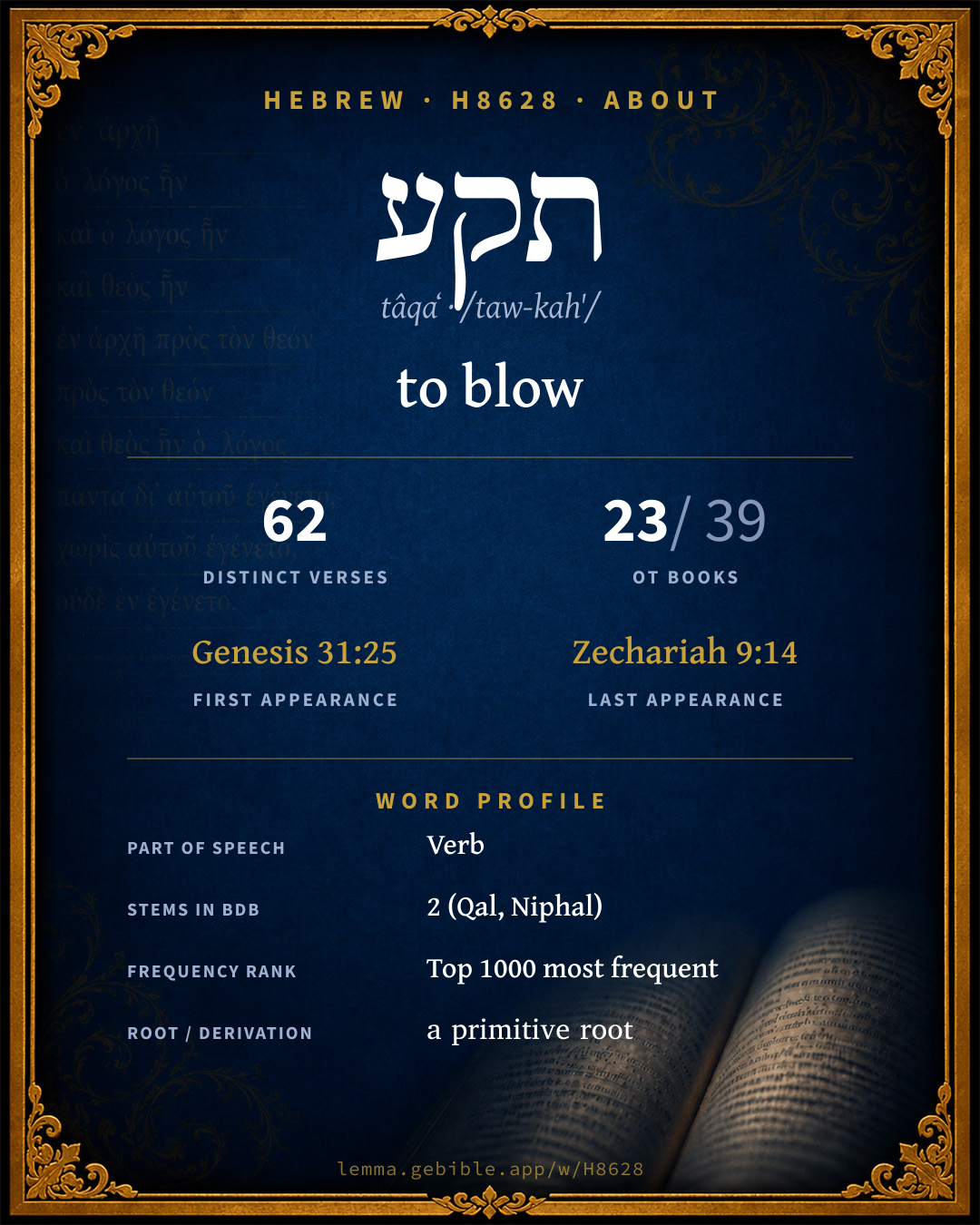
תָּקַע
to blow
also: clap, strike, sound, thrust fuller range ↓
Full lexicon entry — Brown-Driver-Briggs (BDB)
From Brown-Driver-Briggs (BDB)
Where this word appears
See every Qal verb in the Hebrew Bible →
Grammar key — what these labels mean
Part of speech
- Verb
- An action or state-of-being word.
- Noun
- A naming word — a person, place, thing, or idea.
Noun type
- Common
- A common noun — a general class of person, place, or thing (“king,” “city,” “water”), not a specific name.
Stem
- Qal
- The basic, simple active stem — the plain form of the verb (“he wrote”). Here: ‘thrust’
- Niphal
- Usually the simple passive or reflexive of the Qal (“he was written”).
Form
- Imperative
- A direct command (“write!”).
- Perfect
- A completed action or state — Hebrew marks aspect (completeness) more than strict tense (“he wrote”).
- Sequential Imperfect
- An imperfect with prefixed waw — the standard past-narrative form (waw-consecutive imperfect).
- Sequential Perfect
- A perfect with prefixed waw continuing a preceding imperfect or command (waw-consecutive perfect).
- Imperfect
- An incomplete, ongoing, or future action (“he will / would write”).
- Infinitive Absolute
- An unbound verbal noun, often intensifying or standing in for a finite verb.
- Participle Active
- A verbal adjective expressing ongoing or characteristic action (“writing / one who writes”).
- Infinitive Construct
- A bound verbal noun, frequently with prepositions (“to write / in writing”).
- Participle Passive
- A verbal adjective expressing action received (“written”).
State
- Absolute
- The independent form of a noun, not bound to a following word.
- Construct
- A noun bound to a following noun in a possessive / “of” relationship (the construct chain).
Person
- 2nd Person
- The one addressed (“you”).
- 3rd Person
- The one spoken about (“he / she / it / they”).
- 1st Person
- The speaker (“I / we”).
Gender
- Masculine
- Grammatically masculine.
- Common
- Either gender — not distinguished for this form.
- Feminine
- Grammatically feminine.
Number
- Plural
- More than one (in Hebrew, generally three or more).
- Singular
- One.
58 distinct verses where H8628 appears in the Qal stem, across 21 books. Filtered view — show all forms. Click any verse to open its interlinear word-by-word view. Verse text shown in the World English Bible for context — . Each verse’s Hebrew form is shown with its reference; the English is not keyword-highlighted, since the data carries no word-level English alignment. Use “Compare translations” on any verse to read it across multiple English versions. This concordance covers the Hebrew Bible; Septuagint (Greek Old Testament) occurrences are not indexed here.
Genesis 1 verse
Exodus 1 verse
Numbers 7 verses
- Numbers 10:3 וְ/תָקְע֖וּ conj + Qal wpf 3cp When they shall blow them, all the congregation shall gather themselves to you at the door of the tent of meeting.
- Numbers 10:4 יִתְקָ֑עוּ Qal impf 3mp If they blow but one, then the princes, the heads of the thousands of Israel, shall gather themselves to you.
- Numbers 10:5 וּ/תְקַעְתֶּ֖ם conj + Qal wpf 2mp When you blow an alarm, the camps that lie on the east side shall take their journey.
- Numbers 10:6 וּ/תְקַעְתֶּ֤ם יִתְקְע֖וּ conj + Qal wpf 2mp Qal impf 3mp When you blow an alarm the second time, the camps that lie on the south side shall take their journey: they shall blow an alarm for their journeys.
- Numbers 10:7 תִּתְקְע֖וּ Qal impf 2mp But when the assembly is to be gathered together, you shall blow, but you shall not sound an alarm.
- Numbers 10:8 יִתְקְע֖וּ Qal impf 3mp The sons of Aaron, the priests, shall blow the trumpets; and they shall be to you for a statute forever throughout your generations.
- Numbers 10:10 וּ/תְקַעְתֶּ֣ם conj + Qal wpf 2mp Also in the day of your gladness, and in your set feasts, and in the beginnings of your months, you shall blow the trumpets over your burnt offerings, and over the sacrifices of your peace-offerings; and they shall be to you for a memorial before your God: I am Yahweh your God.
Joshua 6 verses
- Joshua 6:4 יִתְקְע֖וּ Qal impf 3mp Seven priests shall bear seven trumpets of rams' horns before the ark: and the seventh day you shall compass the city seven times, and the priests shall blow the trumpets.
- Joshua 6:8 וְ/תָקְע֖וּ conj + Qal wpf 3cp It was so, that when Joshua had spoken to the people, the seven priests bearing the seven trumpets of rams' horns before Yahweh passed on, and blew the trumpets: and the ark of the covenant of Yahweh followed them.
- Joshua 6:9 תקעו תֹּקְעֵ֖י וְ/תָק֥וֹעַ Qal pf 3cp Qal ptcp.act mp cs conj + Qal inf.abs The armed men went before the priests who blew the trumpets, and the rearward went after the ark, [the priests] blowing the trumpets as they went.
- Joshua 6:13 וְ/תָקְע֖וּ וְ/תָק֥וֹעַ conj + Qal wpf 3cp conj + Qal inf.abs The seven priests bearing the seven trumpets of rams' horns before the ark of Yahweh went on continually, and blew the trumpets: and the armed men went before them; and the rearward came after the ark of Yahweh, [the priests] blowing the trumpets as they went.
- Joshua 6:16 תָּקְע֥וּ Qal pf 3cp It happened at the seventh time, when the priests blew the trumpets, Joshua said to the people, Shout; for Yahweh has given you the city.
- Joshua 6:20 וַֽ/יִּתְקְע֖וּ conj + Qal wimpf 3mp So the people shouted, and [the priests] blew the trumpets; and it happened, when the people heard the sound of the trumpet, that the people shouted with a great shout, and the wall fell down flat, so that the people went up into the city, every man straight before him, and they took the city.
Judges 9 verses
- Judges 3:21 וַ/יִּתְקָעֶ֖/הָ conj + Qal wimpf 3ms + sfx pers 3fs Ehud put forth his left hand, and took the sword from his right thigh, and thrust it into his body:
- Judges 3:27 וַ/יִּתְקַ֥ע conj + Qal wimpf 3ms It happened, when he had come, that he blew a trumpet in the hill-country of Ephraim; and the children of Israel went down with him from the hill-country, and he before them.
- Judges 4:21 וַ/תִּתְקַ֤ע conj + Qal wimpf 3fs Then Jael Heber's wife took a tent-pin, and took a hammer in her hand, and went softly to him, and struck the pin into his temples, and it pierced through into the ground; for he was in a deep sleep; so he swooned and died.
- Judges 6:34 וַ/יִּתְקַע֙ conj + Qal wimpf 3ms But the Spirit of Yahweh came on Gideon; and he blew a trumpet; and Abiezer was gathered together after him.
- Judges 7:18 וְ/תָקַעְתִּי֙ וּ/תְקַעְתֶּ֨ם conj + Qal wpf 1cs conj + Qal wpf 2mp When I blow the trumpet, I and all who are with me, then blow you the trumpets also on every side of all the camp, and say, For Yahweh and for Gideon.
- Judges 7:19 וַֽ/יִּתְקְעוּ֙ conj + Qal wimpf 3mp So Gideon, and the hundred men who were with him, came to the outermost part of the camp in the beginning of the middle watch, when they had but newly set the watch: and they blew the trumpets, and broke in pieces the pitchers that were in their hands.
- Judges 7:20 וַֽ֠/יִּתְקְעוּ לִ/תְק֑וֹעַ conj + Qal wimpf 3mp prep + Qal inf.cs The three companies blew the trumpets, and broke the pitchers, and held the torches in their left hands, and the trumpets in their right hands with which to blow; and they cried, The sword of Yahweh and of Gideon.
- Judges 7:22 וַֽ/יִּתְקְעוּ֮ conj + Qal wimpf 3mp They blew the three hundred trumpets, and Yahweh set every man's sword against his fellow, and against all the host; and the host fled as far as Beth-shittah toward Zererah, as far as the border of Abel Meholah, by Tabbath.
- Judges 16:14 וַ/תִּתְקַע֙ conj + Qal wimpf 3fs She fastened it with the pin, and said to him, The Philistines are on you, Samson. He awakened out of his sleep, and plucked away the pin of the beam, and the web.
1 Samuel 2 verses
- 1 Samuel 13:3 תָּקַ֨ע Qal pf 3ms Jonathan struck the garrison of the Philistines that was in Geba: and the Philistines heard of it. Saul blew the trumpet throughout all the land, saying, Let the Hebrews hear.
- 1 Samuel 31:10 תָּקְע֔וּ Qal pf 3cp They put his armor in the house of the Ashtaroth; and they fastened his body to the wall of Beth-shan.
2 Samuel 5 verses
- 2 Samuel 2:28 וַ/יִּתְקַ֤ע conj + Qal wimpf 3ms So Joab blew the trumpet; and all the people stood still, and pursued after Israel no more, neither fought they any more.
- 2 Samuel 18:14 וַ/יִּתְקָעֵ/ם֙ conj + Qal wimpf 3ms + sfx pers 3mp Then said Joab, I may not wait thus with you. He took three darts in his hand, and thrust them through the heart of Absalom, while he was yet alive in the midst of the oak.
- 2 Samuel 18:16 וַ/יִּתְקַ֤ע conj + Qal wimpf 3ms Joab blew the trumpet, and the people returned from pursuing after Israel; for Joab held back the people.
- 2 Samuel 20:1 וַ/יִּתְקַ֣ע conj + Qal wimpf 3ms There happened to be there a base fellow, whose name was Sheba, the son of Bichri, a Benjamite: and he blew the trumpet, and said, We have no portion in David, neither have we inheritance in the son of Jesse: every man to his tents, Israel.
- 2 Samuel 20:22 וַ/יִּתְקַע֙ conj + Qal wimpf 3ms Then the woman went to all the people in her wisdom. They cut off the head of Sheba the son of Bichri, and threw it out to Joab. He blew the trumpet, and they were dispersed from the city, every man to his tent. Joab returned to Jerusalem to the king.
1 Kings 2 verses
- 1 Kings 1:34 וּ/תְקַעְתֶּם֙ conj + Qal wpf 2mp and let Zadok the priest and Nathan the prophet anoint him there king over Israel; and blow you the trumpet, and say, [Long] live king Solomon.
- 1 Kings 1:39 וַֽ/יִּתְקְעוּ֙ conj + Qal wimpf 3mp Zadok the priest took the horn of oil out of the Tent, and anointed Solomon. They blew the trumpet; and all the people said, [Long] live king Solomon.
2 Kings 2 verses
- 2 Kings 9:13 וַֽ/יִּתְקְעוּ֙ conj + Qal wimpf 3mp Then they hurried, and took every man his garment, and put it under him on the top of the stairs, and blew the trumpet, saying, Jehu is king.
- 2 Kings 11:14 וְ/תֹקֵ֖עַ conj + Qal ptcp.act ms and she looked, and, behold, the king stood by the pillar, as the manner was, and the captains and the trumpets by the king; and all the people of the land rejoiced, and blew trumpets. Then Athaliah tore her clothes, and cried, Treason! treason!
1 Chronicles 1 verse
2 Chronicles 1 verse
Nehemiah 1 verse
Psalms 2 verses
Proverbs 3 verses
- Proverbs 6:1 תָּקַ֖עְתָּ Qal pf 2ms My son, if you have become collateral for your neighbor, If you have struck your hands in pledge for a stranger;
- Proverbs 17:18 תּוֹקֵ֣עַ Qal ptcp.act ms A man void of understanding strikes hands, And becomes collateral in the presence of his neighbor.
- Proverbs 22:26 בְ/תֹֽקְעֵי prep + Qal ptcp.act mp cs Don't you be one of those who strike hands, Of those who are collateral for debts.
Isaiah 3 verses
- Isaiah 18:3 וְ/כִ/תְקֹ֥עַ conj + prep + Qal inf.cs All you inhabitants of the world, and you dwellers on the earth, when an ensign is lifted up on the mountains, look; and when the trumpet is blown, listen.
- Isaiah 22:23 וּ/תְקַעְתִּ֥י/ו conj + Qal wpf 1cs + sfx pers 3ms I will fasten him as a nail in a sure place; and he shall be for a throne of glory to his father's house.
- Isaiah 22:25 הַ/תְּקוּעָ֖ה ptcl def.art + Qal ptcp.pass fs In that day, says Yahweh of hosts, shall the nail that was fastened in a sure place give way; and it shall be hewn down, and fall; and the burden that was on it shall be cut off; for Yahweh has spoken it.
Jeremiah 4 verses
- Jeremiah 4:5 ו/תקעו תִּקְע֥וּ conj + Qal impv 2mp Qal impv 2mp Declare you in Judah, and publish in Jerusalem; and say, Blow you the trumpet in the land: cry aloud and say, Assemble yourselves, and let us go into the fortified cities.
- Jeremiah 6:1 תִּקְע֣וּ Qal impv 2mp Flee for safety, you children of Benjamin, out of the midst of Jerusalem, and blow the trumpet in Tekoa, and raise up a signal on Beth Haccherem; for evil looks forth from the north, and a great destruction.
- Jeremiah 6:3 תָּקְע֨וּ Qal pf 3cp Shepherds with their flocks shall come to her; they shall pitch their tents against her round about; they shall feed everyone in his place.
- Jeremiah 51:27 תִּקְע֨וּ Qal impv 2mp Set up a standard in the land, blow the trumpet among the nations, prepare the nations against her, call together against her the kingdoms of Ararat, Minni, and Ashkenaz: appoint a marshal against her; cause the horses to come up as the rough canker-worm.
Ezekiel 3 verses
- Ezekiel 7:14 תָּקְע֤וּ Qal pf 3cp They have blown the trumpet, and have made all ready; but none goes to the battle; for my wrath is on all the multitude of it.
- Ezekiel 33:3 וְ/תָקַ֥ע conj + Qal wpf 3ms if, when he sees the sword come on the land, he blow the trumpet, and warn the people;
- Ezekiel 33:6 תָקַ֤ע Qal pf 3ms But if the watchman sees the sword come, and doesn't blow the trumpet, and the people aren't warned, and the sword comes, and take any person from among them; he is taken away in his iniquity, but his blood will I require at the watchman's hand.
Hosea 1 verse
Joel 2 verses
- Joel 2:1 תִּקְע֨וּ Qal impv 2mp Blow you the trumpet in Zion, And sound an alarm in my holy mountain! Let all the inhabitants of the land tremble, For the day of Yahweh comes, For it is close at hand:
- Joel 2:15 תִּקְע֥וּ Qal impv 2mp Blow the trumpet in Zion! Sanctify a fast. Call a solemn assembly.
Nahum 1 verse
Zechariah 1 verse
About this entry
At a glance — auto-summarized from this page’s data, not written by a person. Every figure links to its source below. This summary describes the numbers; it doesn’t interpret them.
תקע — transliterated tâqaʻ — is a Hebrew verb carrying the sense “to blow.” Debuting at Genesis 31:25, it then recurs through the corpus. Spanning 62 verses in 23 books, it ranks among the moderately common words of the Hebrew Bible. The verb spans 2 stems, from Qal to Niphal. From the same root come תקוע and תקע. See the sense tree, 62-verse concordance, and the renderings breakdown below.
Gloss history
Strong's 1890 vs modern scholarship
About this word
Strong's H8628 catalogs a Hebrew word from the Hebrew Old Testament.
These counts are not copied from any lexicon or concordance. They are computed here, from the morphology-tagged Hebrew Old Testament. What Lemma adds →
- 62
- distinct verses
- The word appears in 62 distinct verses.
- 23 / 39
- OT books
- The word appears in 23 of 39 Old Testament books.
- #569
- by frequency
- Top 1000 most frequent Hebrew words (rank 569 of 8,640 Hebrew words by occurrence).
View all 62 occurrences in the concordance →
By section of the Old Testament
By traditional corpus
Conventional, traditional groupings — biblical authorship is debated, so this is a traditional corpus grouping, not an authorship claim. Each share is this word’s portion of its verses in that division of the Hebrew canon. Each figure is a share of the word’s 62 distinct verses.
- Prophets (Nevi'im) 43 verses · 69%
- Writings (Ketuvim) 10 verses · 16%
- Torah (Pentateuch) 9 verses · 15%
How translations render this word
Counts come from each version’s own published word-to-Strong’s tagging or interlinear alignment — an approximate guide to how each version renders this word, not a word-level alignment the data otherwise carries. Because each total is that version’s own tagged count, the per-version totals vary from one another and need not match the appearance or distinct-verse counts above. These counts may also differ from a printed concordance because Lemma counts each distinctly tagged rendering and does not collapse phrase taggings into a single head-word total. This is a fixed set of word-tagged versions (KJV, ASV, BSB, ULT) and does not change with the reading translation you choose elsewhere. Each version’s license is shown beside its name below (and on Sources).
- King James Version: Blew 11×, Blow 9×, He blew 4×
- American Standard Version: Blew 10×, Blow 9×, He blew 3×
- Berean Standard Bible: Blow 9×, Blew 8×, Blowing 3×
- unfoldingWord Literal Text: Blew 6×, Blow 6×, They blew 6×
King James Version Public Domain
Renders H8628 across 68 tagged occurrences — most commonly:
Plus 29 renderings that appear only once — usually multi-word phrases or single function words the recovered tagging swept in, not distinct renderings. Not rendered by a distinct English word in 1 further occurrence.
American Standard Version Public Domain
Renders H8628 across 68 tagged occurrences — most commonly:
Plus 31 renderings that appear only once — usually multi-word phrases or single function words the recovered tagging swept in, not distinct renderings.
Berean Standard Bible Public Domain
Renders H8628 across 65 tagged occurrences — most commonly:
Plus 25 renderings that appear only once — usually multi-word phrases or single function words the recovered tagging swept in, not distinct renderings. Not rendered by a distinct English word in 3 further occurrences.
unfoldingWord Literal Text CC BY-SA 4.0
Renders H8628 across 72 tagged occurrences — most commonly:
Plus 29 renderings that appear only once — usually multi-word phrases or single function words the recovered tagging swept in, not distinct renderings.
7 senses and sub-senses in the full BDB
Hebrew verbs can shift meaning by stem (binyan): Qal is the basic action, Niphal is often passive or reflexive, Piel often intensifies or makes it factitive, and Hiphil is typically causative. The senses below are grouped under the stem BDB assigns to each.
What do BDB’s symbols mean?
BDB uses these scholarly abbreviations:
| Symbol | Meaning |
|---|---|
| 𝔊 | the Septuagint (the ancient Greek translation, LXX) |
| 𝔙 | the Vulgate (the Latin translation) |
| 𝔖 | the Syriac version (the Peshitta) |
| 𝔗 | the Targum (the Aramaic translation) |
| ψ | the Psalms |
| √ | root (the underlying root or stem) |
| ‖ | parallel passage (a synonymous or contrasted parallel) |
| † | the dagger: every passage where the word occurs is cited |
The 7 senses and sub-senses the full Brown-Driver-Briggs lexicon distinguishes for this word, in lexicon order (not ranked by frequency), with BDB’s own verbatim wording and sub-sense lettering. Shown in Hebrew script with BDB’s own scholarly abbreviations. The condensed entry is in the Lexicon Entry tab. See also the Forms in the corpus table below.
Qal
- Pf. 3 ms. ת׳ Gn 31:25 +, 1 s. וְתָקַעְתִּ֫י Ju 7:18, etc.; Impf. 3 ms. וַיִּתְקַע 3:27 +, sf. וַיִּתְקָעֵהוּ Ex 10:19, etc.; Imv. mpl. תִּקְעוּ Ho 5:8 +; Inf. abs. תָּקוֹעַ Jos 6:9, 13; cstr. לִתְקוֹעַ Ju 7:20, כִּת׳ Is 18:3; Pt. act. תֹּקֵעַ Pr 17:13 +, etc.; pass. f. תְּקוּעָה Is 22:25;— e.g. Genesis 31:25
- 1. thrust, drive, weapon (acc.) into (ב) a person Ju 3:21; 4:21; 2 S 18:14, peg into (ב) sthg. Is 22:23, 25 (cf. Ju 4:21); hence pitch a tent (acc.), i.e. drive its pegs: Gn 31:25a; Je 6:3 (+ עַל against, in fig.), acc. om. Gn 31:25b; thrust, drive, beat (strands of hair together) בַּיָּתֵד Ju 16:14, ins. also v 13 (so 𝔊; cf. GFMComm. and paos Oct. 1889, 176 ff.); thrust, drive locusts seaward (ה loc.), Ex 10:19 (J); cf. ת׳ בְּ 1 S 31:10 of fastening bodies to wall, and similarly 1 Ch 10:10 (but read in both הוֹקִיעוּ, √ יקע Lag We Dr and mod.). e.g. Judges 3:21
- 2. give a blast, blow (Germ. ‘stossen’), c. ב of instr. (usually horn or clarion) Jos 6:4, 8, 9, 13(×2), 16, 20 (JE), Ju 3:27; 6:34; 7:18(×2), 19, 20 + 14 times, + Nu 10:3, 4, 8, 10 (P; v. חֲצֹצְרָה), also Ez 7:14 (v. תָּקוֹעַ infr.); ת׳ alone Ju 7:20 Nu 10:7 (P; opp. חֵרִיעַ sound an alarm), c. acc. תְּרוּעָה v 5, 6(×2) (P; v. חֲצֹצְרָה); c. acc. of instrument Ju 7:22; Ho 5:8; Is 18:3; Je 4:5; 6:1; 51:27; Jo 2:1, 15 ψ 81:4, + תקעו Jos 6:9 (Kt; Qr תֹּקְעֵי). e.g. Joshua 6:4
- 3. strike, clap hands; in triumph, ת׳ כַּף עָלֶיךָ Na 3:19, ת׳ כָ֑ף ψ 47:2; also (late) of gesture ratifying a bargain, specif. pledging oneself to become surety, only Pr. (all ‖ עָרַב): ת׳ לַזָּר כַּפֶּיךָ, ת׳ כַּף 17:18; 22:26; abs. 11:15. e.g. Nahum 3:19
Niphal
- Impf. 3 ms.
- 1. יִתָּקַע שׁוֹפָר Am 3:6 if a horn be blown, cf.יִתּ׳ בְּשׁ׳ Is 27:13 it shall be blown (a blast shall be given) on a horn. e.g. Amos 3:6
- 2. מִי־הוּא לְיָדִי יִתָּקֵֽעַ׃ Jb 17:3 who is there that will strike himself (i.e. pledge himself) into my hand? e.g. Job 17:3
Senses from the full Brown-Driver-Briggs lexicon (Brown, Driver, Briggs; Oxford 1906 — public domain), digitized via Sefaria, supplemented by the OpenScriptures HebrewLexicon (CC BY 4.0). Full attribution on Sources.
Word origin
vb. thrust, clap, give a blow, blast (NH id.; J.Aram תְּקַע strike, blow horn; Ethiopic ጠቅዐ blow trumpet);—
— Brown-Driver-Briggs (Oxford 1906, public domain), digitized via Sefaria, supplemented by the OpenScriptures HebrewLexicon (CC BY 4.0). See Sources.
Origin: a primitive root
Jastrow Dictionary
A second Hebrew/Aramaic lexicon for comparison, covering Aramaic and post-biblical (Talmudic, Targumic, Midrashic) usage that the biblical-Hebrew BDB does not. Matched by lemma rather than by Strong’s number, so a lemma may carry more than one Jastrow headword (shown separately below), and the entries cover usage well beyond the Bible.
תָּקַע
- [to bring into contact, knock, insert,]
- 1. to drive a peg in, put up a tent; to fasten. Yalk. Cant. 981 הלואי יִתְקַע תורתי בלבנו וכ׳ Oh that he would drive his law into our heart as in former days. Ex. R. s. 117 Caleb is named Tekoa (I Chr. II, 24), שת׳ לבו לאביו וכ׳ because he fastened his heart on his father in heaven. Yeb. 109ᵇ תּוֹקֵעַ עצמו לדבר הלכה he who nails himself to the matter of the law, i.e. confines himself to study, and is remiss in practical conduct; ואיבעית אימא תוקע … בדיינא וכ׳ or I may explain, ‘he who nails himself to the matter of the law’ refers to a judge before whom a case comes, and he having learned a certain hălakhah decides by analogy, while there is a greater scholar than he whom he fails to consult; a. e.—Part. pass. תָּקוּעַ lodged, placed. B. Mets. 85ᵇ אצל מי אתה ת׳ next to whom art thou placed (in heaven)? Y. Sot. IX, 23ᶜ והסכין ת׳ בלבו with the knife sticking in his heart; a. e. e.g. 1 Chronicles 2:24
- 2. (cmp. רָעַע) to shout, esp. to blow (a horn). B. Kam. 18ᵇ תרנגול … ות׳ בו ושברו if a cock put his head into a glass vessel and crowed into it, and broke it; Kidd. 24ᵇ. Ib. ת׳ באזנו וכ׳ if one blew on a horn into a person’s ear, and made him deaf; a. e.—Esp. a) to blow the Shofar at services; b) to sound the plain note (תְּקִיעָה). R. Hash. III, 5 בר"ה תּוֹקְעִין בשל זכרים on New Year’s day they blow on a ram’s horn. Ib. 7 התוקע לתוך הבור וכ׳ if one blows (the Shofar) into a pit &c. Ib. IV, 1 יום טוב … תוקעים וכ׳ when New Year fell on a Sabbath, they blew in the Temple, but not in the country. Ib. 8 אין מעכבין … מלִתְקוֹעַ we do not prevent children from blowing the Shofar (on the Sabbath). Ib. 9 תוקע ומריע ותוקע, v. רוּעַ I. Taan. II, 5 תִּקְעיּ הכהנים תָּקְעוּ וכ׳ (the reader said,) sound the T’ḳiʿah, you priests, and they did so, (upon which he said,) He who has answered &c.; a. v. fr.—[
- 3. to slap with the back of the hand. B. Kam. VIII, 6 (90ᵃ) התוקע לחבירו he who slaps his neighbor on the ear; oth. opin. who shouts into his neighbor’s ear.]
- to cause to blow. R. Hash. IV, 7 השני מַתְקִיעַ the second reader orders the blowing of the Shofar.
- 1. to be driven in, be inserted. Yeb. 54ᵃ ונ׳ and his membrum was inserted.
- 2. to be lodged. Taan. 24ᵃ אוי לו לדור שנ׳ בכך Ms. M. (ed. שכן נ׳) woe to the generation that is placed in such a (bad) position.
תְּקַע
- 1. to clap. Targ. Ps. XLVII, 2.
- 2. to sound, blow. Targ. I Chr. XXV, 5. Targ. Num. X, 3, sq.; a. fr.
- to be sounded. Targ. Is. XXVII, 13.
A Dictionary of the Targumim, the Talmud Babli and Yerushalmi, and the Midrashic Literature (Marcus Jastrow; London, Luzac, 1903) — Public Domain. Digitized via Sefaria. Digitized via Sefaria. Full attribution on Sources.
Forms in the corpus
The 58 distinct written forms H8628 takes in the Hebrew Bible, most frequent first — each parse links to that stem’s occurrences in the concordance. Hebrew forms include their vowel points and cantillation, so a single lemma takes many written forms.
Same root — word family
Other BDB entries built from the same root as H8628, grouped by Strong’s listed origin. These share a root / origin per the lexicon — not necessarily a shared meaning. Each links to that word’s own entry.
Derived from this word
Compare all same-root words → They share a root, not necessarily a meaning.
Septuagint verse parallels
This word appears in 60 verses that also exist in the Greek Old Testament (Septuagint), out of the 62 Hebrew verses it occurs in. You can read those verses in Greek by switching the Old Testament edition to the Septuagint.
Read these verses in the Septuagint
- Genesis 31:25
- Exodus 10:19
- Numbers 10:3
- Joshua 6:8
- Judges 3:21
- 1 Samuel 13:3
- 2 Samuel 2:28
- 1 Kings 1:34
- 2 Kings 9:13
- 1 Chronicles 10:10
- 2 Chronicles 23:13
- Job 17:3
This is a verse-level parallel only — the same verses exist in both the Hebrew and Greek Old Testaments. No word-level Hebrew↔Greek correspondence is claimed: the data carries no such alignment, so no Greek word is shown as this Hebrew word’s translation. Coverage is not total — the Septuagint omits the deuterocanon and renumbers the Psalms, so some Hebrew verses have no direct Greek parallel.