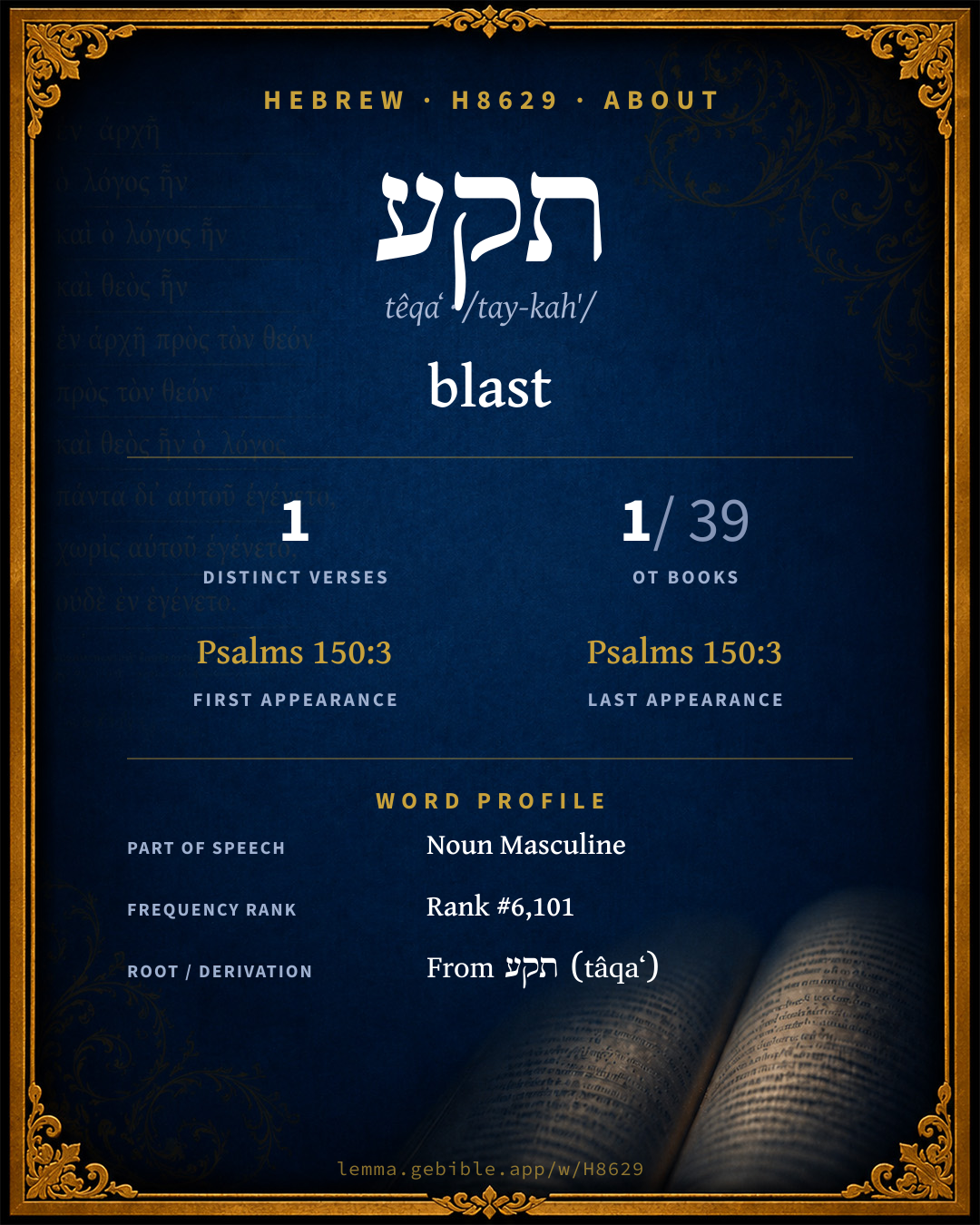
תֵּ֫קַע
blast
Full lexicon entry — Brown-Driver-Briggs (BDB)
From Brown-Driver-Briggs (BDB)
Where this word appears
Grammar key — what these labels mean
Noun type
- Common
- A common noun — a general class of person, place, or thing (“king,” “city,” “water”), not a specific name.
State
- Construct
- A noun bound to a following noun in a possessive / “of” relationship (the construct chain).
Gender
- Masculine
- Grammatically masculine.
Number
- Singular
- One.
Every verse where H8629 appears — 1 distinct verse across 1 book. Click any verse to open its interlinear word-by-word view. Verse text shown in the World English Bible for context — . Each verse’s Hebrew form is shown with its reference; the English is not keyword-highlighted, since the data carries no word-level English alignment. Use “Compare translations” on any verse to read it across multiple English versions. This concordance covers the Hebrew Bible; Septuagint (Greek Old Testament) occurrences are not indexed here.
Psalms 1 verse
About this entry
At a glance — auto-summarized from this page’s data, not written by a person. Every figure links to its source below. This summary describes the numbers; it doesn’t interpret them.
“blast” is the headline sense of the Hebrew noun תקע (têqaʻ). With only 1 verse it sits in the long tail of Hebrew Bible vocabulary. More than three-quarters of its appearances fall in Psalms. A true hapax — its single appearance is Psalms 150:3. It shares a root with תקע and תקוע. The sections below give every sense, occurrence, and version rendering.
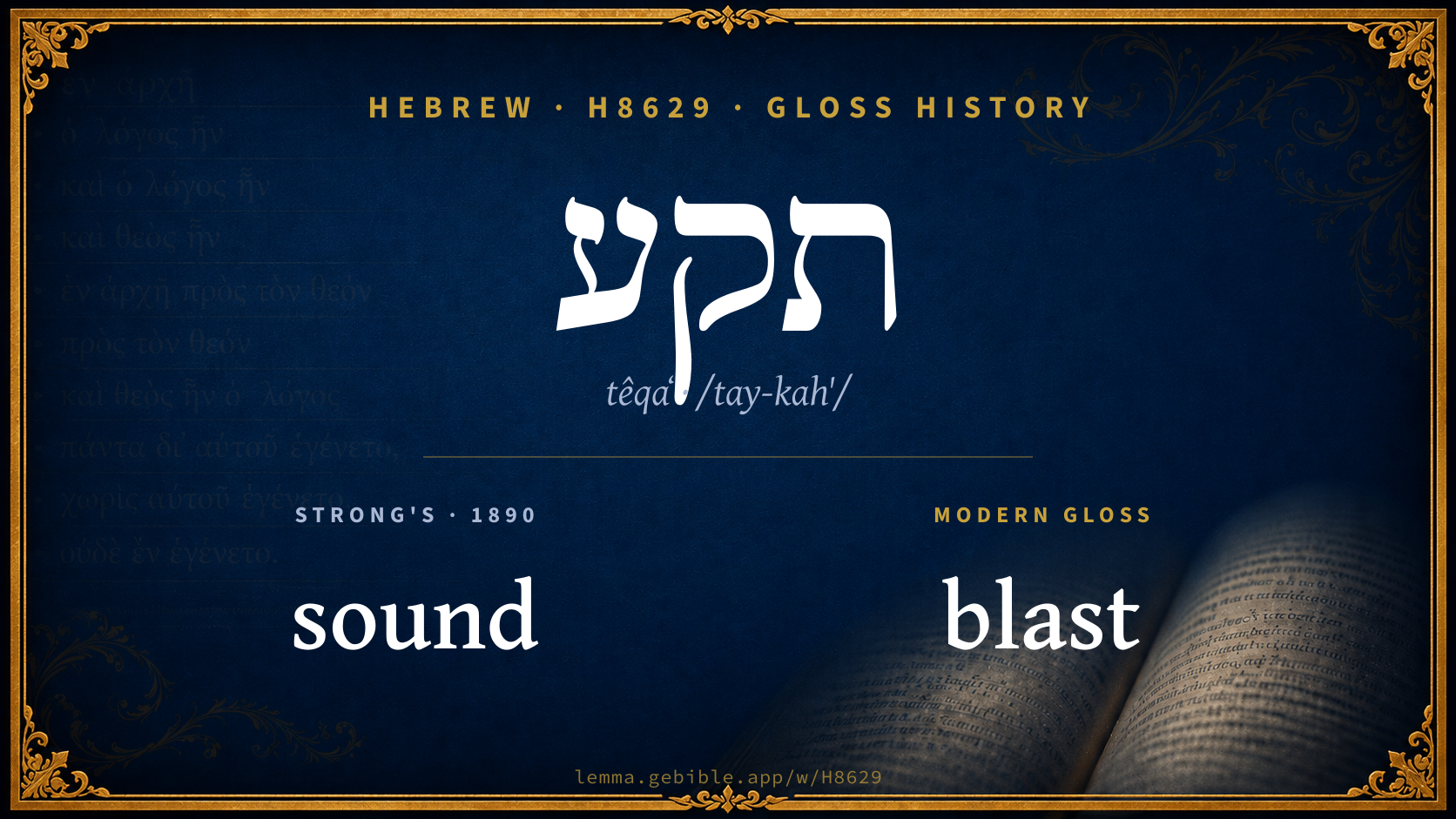
Gloss history
Strong's 1890 vs modern scholarship
About this word
Strong's H8629 catalogs a Hebrew word from the Hebrew Old Testament.
These counts are not copied from any lexicon or concordance. They are computed here, from the morphology-tagged Hebrew Old Testament. What Lemma adds →
- 1
- distinct verses
- The word appears in 1 distinct verse.
- 1 / 39
- OT books
- The word appears in 1 of 39 Old Testament books.
- #6,101
- by frequency
- Rank #6,101 (rank 6,101 of 8,640 Hebrew words by occurrence).
View all 1 occurrence in the concordance →
Most concentrated in
- Psalms 1 verse 100%
By section of the Old Testament
By traditional corpus
Conventional, traditional groupings — biblical authorship is debated, so this is a traditional corpus grouping, not an authorship claim. Each share is this word’s portion of its verses in that division of the Hebrew canon. Each figure is a share of the word’s 1 distinct verse.
- Writings (Ketuvim) 1 verse · 100%
How translations render this word
Counts come from each version’s own published word-to-Strong’s tagging or interlinear alignment — an approximate guide to how each version renders this word, not a word-level alignment the data otherwise carries. Because each total is that version’s own tagged count, the per-version totals vary from one another and need not match the appearance or distinct-verse counts above. These counts may also differ from a printed concordance because Lemma counts each distinctly tagged rendering and does not collapse phrase taggings into a single head-word total. This is a fixed set of word-tagged versions (KJV, ASV, BSB, ULT) and does not change with the reading translation you choose elsewhere. Each version’s license is shown beside its name below (and on Sources).
- King James Version: Sound 1×
- American Standard Version: Sound 1×
- Berean Standard Bible: Sound 1×
- unfoldingWord Literal Text: Blast of 1×
King James Version Public Domain
Renders H8629 across 1 tagged occurrence — most commonly:
American Standard Version Public Domain
Renders H8629 across 1 tagged occurrence — most commonly:
Berean Standard Bible Public Domain
Renders H8629 across 1 tagged occurrence — most commonly:
unfoldingWord Literal Text CC BY-SA 4.0
Renders H8629 across 1 tagged occurrence — most commonly:
Senses in BDB
The 1 sense BDB distinguishes for this word, in lexicon order (not ranked by frequency or importance). The full entry — with sub-senses — is in the Lexicon Entry tab.
- sound, blast (of horn), trumpet blast
Word origin
תֵּ֫קַע n.[m.] blast of horn;—cstr. ψ 150:3
— Brown-Driver-Briggs (Oxford 1906, public domain), digitized via Sefaria, supplemented by the OpenScriptures HebrewLexicon (CC BY 4.0). See Sources.
Derived from תקע (tâqaʻ) (H8628) — to blow.
Jastrow Dictionary
A second Hebrew/Aramaic lexicon for comparison, covering Aramaic and post-biblical (Talmudic, Targumic, Midrashic) usage that the biblical-Hebrew BDB does not. Matched by lemma rather than by Strong’s number, so a lemma may carry more than one Jastrow headword (shown separately below), and the entries cover usage well beyond the Bible.
תָּקַע
- [to bring into contact, knock, insert,]
- 1. to drive a peg in, put up a tent; to fasten. Yalk. Cant. 981 הלואי יִתְקַע תורתי בלבנו וכ׳ Oh that he would drive his law into our heart as in former days. Ex. R. s. 117 Caleb is named Tekoa (I Chr. II, 24), שת׳ לבו לאביו וכ׳ because he fastened his heart on his father in heaven. Yeb. 109ᵇ תּוֹקֵעַ עצמו לדבר הלכה he who nails himself to the matter of the law, i.e. confines himself to study, and is remiss in practical conduct; ואיבעית אימא תוקע … בדיינא וכ׳ or I may explain, ‘he who nails himself to the matter of the law’ refers to a judge before whom a case comes, and he having learned a certain hălakhah decides by analogy, while there is a greater scholar than he whom he fails to consult; a. e.—Part. pass. תָּקוּעַ lodged, placed. B. Mets. 85ᵇ אצל מי אתה ת׳ next to whom art thou placed (in heaven)? Y. Sot. IX, 23ᶜ והסכין ת׳ בלבו with the knife sticking in his heart; a. e. e.g. 1 Chronicles 2:24
- 2. (cmp. רָעַע) to shout, esp. to blow (a horn). B. Kam. 18ᵇ תרנגול … ות׳ בו ושברו if a cock put his head into a glass vessel and crowed into it, and broke it; Kidd. 24ᵇ. Ib. ת׳ באזנו וכ׳ if one blew on a horn into a person’s ear, and made him deaf; a. e.—Esp. a) to blow the Shofar at services; b) to sound the plain note (תְּקִיעָה). R. Hash. III, 5 בר"ה תּוֹקְעִין בשל זכרים on New Year’s day they blow on a ram’s horn. Ib. 7 התוקע לתוך הבור וכ׳ if one blows (the Shofar) into a pit &c. Ib. IV, 1 יום טוב … תוקעים וכ׳ when New Year fell on a Sabbath, they blew in the Temple, but not in the country. Ib. 8 אין מעכבין … מלִתְקוֹעַ we do not prevent children from blowing the Shofar (on the Sabbath). Ib. 9 תוקע ומריע ותוקע, v. רוּעַ I. Taan. II, 5 תִּקְעיּ הכהנים תָּקְעוּ וכ׳ (the reader said,) sound the T’ḳiʿah, you priests, and they did so, (upon which he said,) He who has answered &c.; a. v. fr.—[
- 3. to slap with the back of the hand. B. Kam. VIII, 6 (90ᵃ) התוקע לחבירו he who slaps his neighbor on the ear; oth. opin. who shouts into his neighbor’s ear.]
- to cause to blow. R. Hash. IV, 7 השני מַתְקִיעַ the second reader orders the blowing of the Shofar.
- 1. to be driven in, be inserted. Yeb. 54ᵃ ונ׳ and his membrum was inserted.
- 2. to be lodged. Taan. 24ᵃ אוי לו לדור שנ׳ בכך Ms. M. (ed. שכן נ׳) woe to the generation that is placed in such a (bad) position.
תְּקַע
- 1. to clap. Targ. Ps. XLVII, 2.
- 2. to sound, blow. Targ. I Chr. XXV, 5. Targ. Num. X, 3, sq.; a. fr.
- to be sounded. Targ. Is. XXVII, 13.
A Dictionary of the Targumim, the Talmud Babli and Yerushalmi, and the Midrashic Literature (Marcus Jastrow; London, Luzac, 1903) — Public Domain. Digitized via Sefaria. Digitized via Sefaria. Full attribution on Sources.
Same root — word family
Other BDB entries built from the same root as H8629, grouped by Strong’s listed origin. These share a root / origin per the lexicon — not necessarily a shared meaning. Each links to that word’s own entry.
Derives from
Shares the same root
Compare all same-root words → They share a root, not necessarily a meaning.
Septuagint verse parallels
This word appears in 1 verse that also exists in the Greek Old Testament (Septuagint), out of the 1 Hebrew verse it occurs in. You can read those verses in Greek by switching the Old Testament edition to the Septuagint.
Read these verses in the Septuagint
This is a verse-level parallel only — the same verses exist in both the Hebrew and Greek Old Testaments. No word-level Hebrew↔Greek correspondence is claimed: the data carries no such alignment, so no Greek word is shown as this Hebrew word’s translation. Coverage is not total — the Septuagint omits the deuterocanon and renumbers the Psalms, so some Hebrew verses have no direct Greek parallel.