2 Samuel 14:12

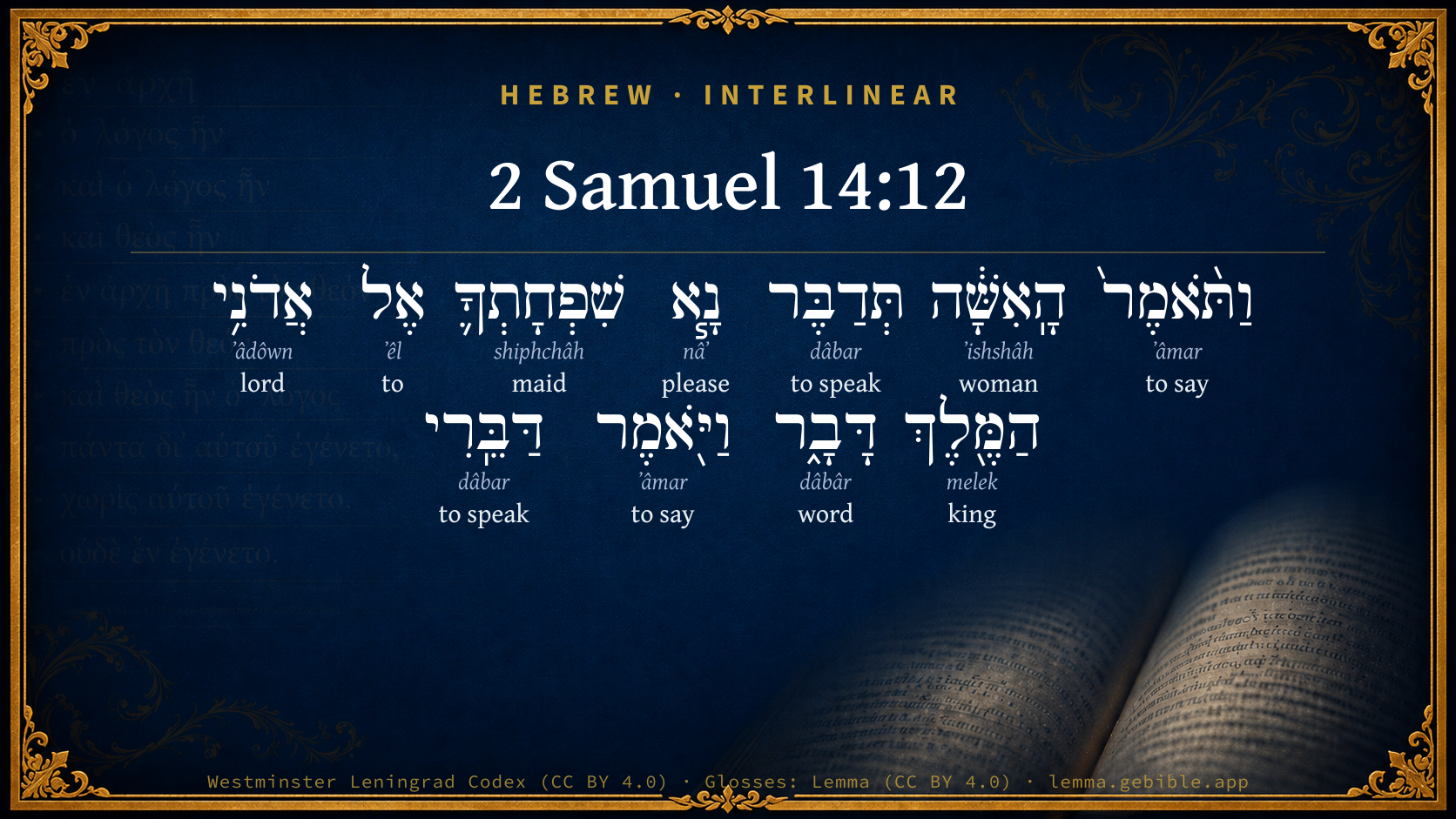
Hebrew (Westminster Leningrad Codex) 2 Samuel 14:12 appears in the Hebrew Old Testament. The text above is from the Westminster Leningrad Codex. Each word links to its Strong’s number, a concise gloss, and parsing drawn from the Open Scriptures Hebrew Bible morphology. Click any word for its full Brown-Driver-Briggs (BDB) entry.
Download image
Cite this verse

2 Samuel 14:12 (World English Bible). Public Domain. Lemma interlinear Bible study tool, https://lemma.gebible.app/v/2-samuel/14/12.

Show BibTeX & RIS
BibTeX
RIS
English Translation
Then the woman said, Please let your handmaid speak a word to my lord the king. He said, Say on.
World English Bible · Public Domain
Download a study sheet

One document with this verse’s original text, its word-by-word gloss line, the meaning frame, cross-references with their text, attributed commentary, and full source and license credits — printable, and it pastes into notes with its structure intact.

This verse Autodidact and up

Study sheet (.html) Plain text (.txt)

A passage Seminary Student

Up to 50 verses in one chapter. A passage sheet keeps up to 6 commentary sources and 12 cross-references per verse, in the order this page ranks them, and says so on the sheet whenever that leaves anything out. Ask for a single verse and you get the Autodidact verse sheet above.

Everything on this page stays free to read, with no account — the sheet is a download of what is already on screen, not access to it.

Want to remove ads? Support Godless Engineer
Compare translations 3

The same verse in 3 English versions, stacked beneath the original-language interlinear above. Click any original word for its lexicon entry.

Each is an independent rendering of the whole verse — the interlinear is not word-aligned to these translations.

Highlighted words mark where these versions differ — a whole-verse word diff, not a word-by-word alignment.

  • World English Bible Public Domain
    Then the woman said, Please let your handmaid speak a word to my lord the king. He said, Say on.
  • King James Version Public Domain
    Then the woman said, Let thine handmaid, I pray thee, speak one word unto my lord the king. And he said, Say on.
  • unfoldingWord Literal Text CC BY-SA 4.0
    And the woman said, “May your maidservant please speak a word to my lord the king.” And he said, “Speak.”

unfoldingWord Literal Text — © unfoldingWord, licensed CC BY-SA 4.0. Word-aligned USFM3 via Door43 (git.door43.org/unfoldingWord/en_ult).

Versions to compare (up to 4)

3 of 4 selected

Show all 18 translations

Every available English version of this verse, each an independent rendering of the whole verse.

  • World English Bible Public Domain
    Then the woman said, Please let your handmaid speak a word to my lord the king. He said, Say on.
  • Berean Standard Bible Public Domain
    Then the woman said, “Please, may your servant speak a word to my lord the king?” “Speak,” he replied.
  • Majority Standard Bible Public Domain
    Then the woman said, “Please, may your servant speak a word to my lord the king?” “Speak,” he replied.
  • King James Version Public Domain
    Then the woman said, Let thine handmaid, I pray thee, speak one word unto my lord the king. And he said, Say on.
  • American Standard Version (1901) Public Domain
    Then the woman said, Let thy handmaid, I pray thee, speak a word unto my lord the king. And he said, Say on.
  • Revised Version (1885) Public Domain
    Then the woman said, Let thine handmaid, I pray thee, speak a word unto my lord the king. And he said, Say on.
  • Geneva Bible (1599) Public Domain
    Then the woman said, I pray thee, let thine handmayde speake a worde to my lord the King. And he sayd, Say on.
  • Douay-Rheims (1899) Public Domain
    Then the woman said: Let thy handmaid speak one word to my lord the king. And he said: Speak.
  • Young's Literal Translation Public Domain
    And the woman saith, `Let, I pray thee, thy maid-servant speak unto my lord the king a word;' and he saith, `Speak.'
  • Literal Standard Version CC BY-SA 4.0
    And the woman says, “Please let your maidservant speak a word to my lord the king”; and he says, “Speak.”
  • Unlocked Literal Bible CC BY-SA 4.0
    Then the woman said, “Please let your servant speak a further word to my master the king.” He said, “Speak on.”
  • unfoldingWord Literal Text CC BY-SA 4.0
    And the woman said, “May your maidservant please speak a word to my lord the king.” And he said, “Speak.”
  • Darby Bible Public Domain
    And the woman said, Let thy bondmaid, I pray thee, speak a word to my lord the king. And he said, Speak.
  • World Messianic Bible Public Domain
    Then the woman said, “Please let your servant speak a word to my lord the king.” He said, “Say on.”
  • Webster's Bible Public Domain
    Then the woman said, Let thy handmaid, I pray thee, speak one word to my lord the king. And he said, Say on.
  • Free Bible Version CC BY-SA 4.0
    “Could I please ask for one other thing, Your Majesty?” the woman asked. “Go ahead,” he replied.
  • Bible in Basic English Public Domain
    Then the woman said, Will the king let his servant say one word more? And he said, Say on.
  • JPS Tanakh (1917) Public Domain
    Then the woman said: 'Let thy handmaid, I pray thee, speak a word unto my lord the king.' And he said: 'Say on.'

Literal Standard Version (2020), Covenant Press — licensed CC BY-SA 4.0. Text via the HelloAO Bible API (eBible.org). Unlocked Literal Bible (unfoldingWord) — licensed CC BY-SA 4.0. Text via the HelloAO Bible API (eBible.org). unfoldingWord Literal Text — © unfoldingWord, licensed CC BY-SA 4.0. Word-aligned USFM3 via Door43 (git.door43.org/unfoldingWord/en_ult). Free Bible Version, Dr. Jonathan Gallagher — licensed CC BY-SA 4.0. Text via the HelloAO Bible API (eBible.org).

Word by word

More ways to search: Search by grammar → Find every occurrence → Compare this word →

Practice this passage: Drill this verse → Learn its vocabulary →

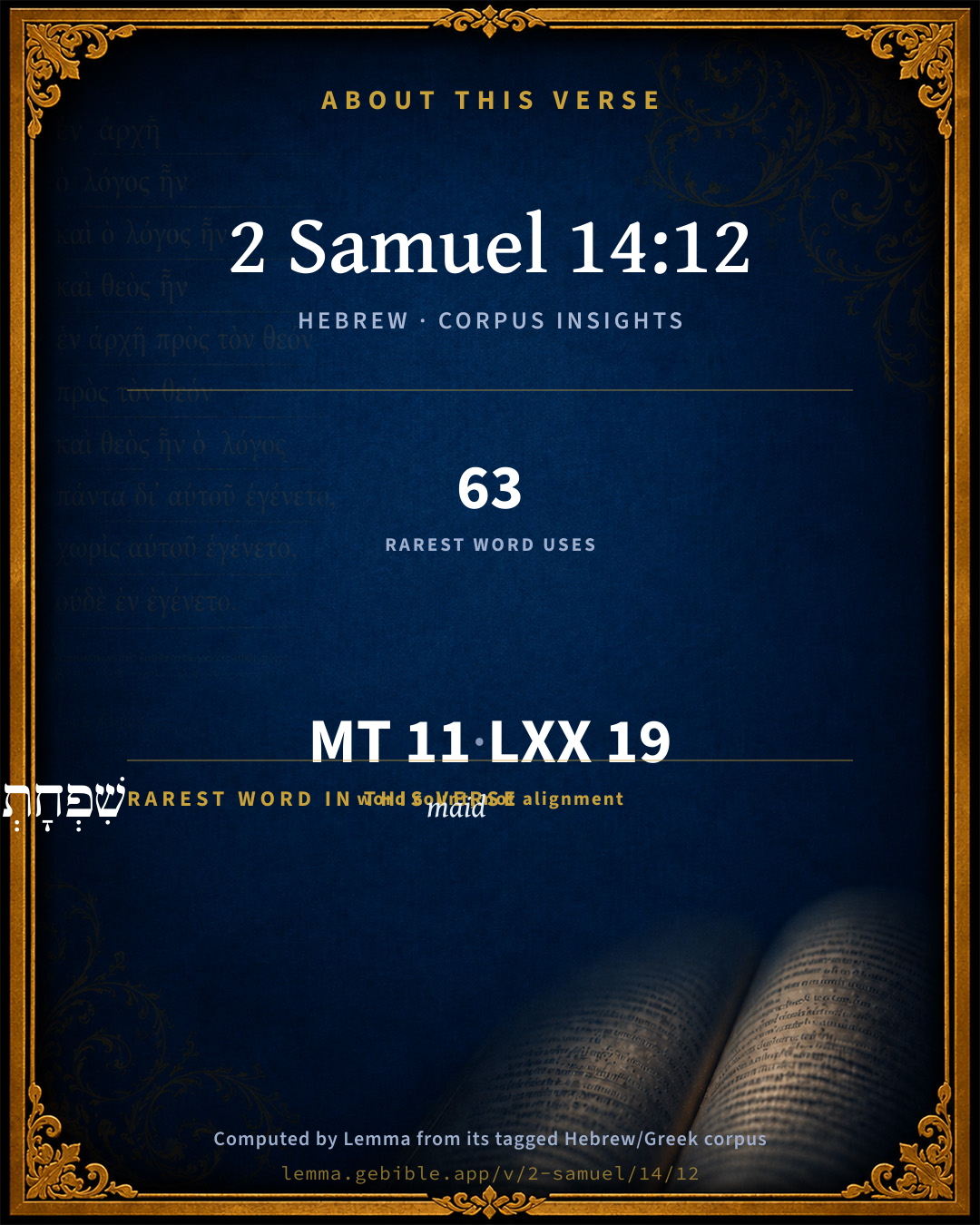
שִׁפְחָתְךָ֛
shiphchâh
H8198
“maid · your”
Noun, Common, Feminine, Singular, Construct + Suffix, Personal, 2nd Person, Masculine, Singular
Part of Speech
Noun
Type
Common
Gender
Feminine
Number
Singular
State
Construct
Full BDB Definition

Origin: from the same as H8207 ">H8207 )

TWOT: None

maid, maid-servant, slavegirl - maid, maid-servant (as belonging to a mistress) - of address, speaker, humility (figuratively)
  1. וַתֹּ֨אמֶר֙ ʼâmar H559 “and · to say” Conjunction + Verb, Qal, Sequential Imperfect, 3rd Person, Feminine, Singular
  2. הָֽאִשָּׁ֔ה ʼishshâh H802 “the · woman” Particle, Definite Article + Noun, Common, Feminine, Singular, Absolute
  3. תְּדַבֶּר dâbar H1696 “to speak” Verb, Piel, Jussive, 3rd Person, Feminine, Singular
  4. נָ֧א nâʼ H4994 “please” Particle, Exhortation
  5. אֶל ʼêl H413 “to” Preposition
  6. אֲדֹנִ֥י ʼâdôwn H113 “lord · my” Noun, Common, Masculine, Singular, Construct + Suffix, Personal, 1st Person, Common, Singular
  7. הַמֶּ֖לֶךְ melek H4428 “the · king” Particle, Definite Article + Noun, Common, Masculine, Singular, Absolute
  8. דָּבָ֑ר dâbâr H1697 “word” Noun, Common, Masculine, Singular, Absolute
  9. וַיֹּ֖אמֶר ʼâmar H559 “and · to say” Conjunction + Verb, Qal, Sequential Imperfect, 3rd Person, Masculine, Singular
  10. דַּבֵּֽרִי dâbar H1696 “speak” Verb, Piel, Imperative, 2nd Person, Feminine, Singular

About this verse

These counts appear in no published source. They are computed here, from the morphology-tagged text and Lemma’s own curated glosses. What Lemma adds →

11
words
9
distinct lemmas
Historical
section

Grammatical profile

  • 4 verbs
  • 5 nouns
  • 1 preposition
  • 1 particle

Verb forms

  • וַתֹּ֨אמֶר֙ Qal · Sequential Imperfect
  • תְּדַבֶּר Piel · Jussive
  • וַיֹּ֖אמֶר Qal · Sequential Imperfect
  • דַּבֵּֽרִי Piel · Imperative

Repetition

Words recur within this verse — often emphatic in Hebrew:

  • וַתֹּ֨אמֶר֙ to say H559 ×2
  • תְּדַבֶּר to speak H1696 ×2

Hebrew & Septuagint length

In English translation the verse runs 20 words from the Hebrew and 21 from the Septuagint (LXX English) — closely comparable.

A rough comparison of the two English renderings, which tokenize alike — not a word-level alignment.

Word counts can differ between the Hebrew and the Greek without any difference in meaning — e.g. the Hebrew direct-object marker אֵת has no separate Greek word, and Greek often adds the article ὁ.

In the original languages it is 11 Hebrew tokens and 19 Greek tokens — but the two are counted differently (Hebrew bundles its prefixes and suffixes into one token; the Greek is in lemma form), so that isn’t a like-for-like length.

Cross-references

6

Topical passages linked to 2 Samuel 14:12 in the Treasury of Scripture Knowledge — connected by theme and wording, ordered by reader-vote popularity; previews shown in the World English Bible.

  • Genesis 18:27 Abraham answered, "See now, I have taken it on myself to speak to the Lord, who am but dust and ashes.
  • Genesis 18:32 He said, "Oh don't let the Lord be angry, and I will speak yet but this once. What if ten are found there?" He said, "I will not destroy it for the ten's sake."
  • Genesis 44:18 Then Judah came near to him, and said, "Oh, my lord, please let your servant speak a word in my lord's ears, and don't let your anger burn against your servant; for you are even as Pharaoh.
  • 1 Samuel 25:24 She fell at his feet, and said, On me, my lord, on me be the iniquity; and please let your handmaid speak in your ears. Hear the words of your handmaid.
  • Jeremiah 12:1 Righteous are you, Yahweh, when I contend with you; yet would I reason the cause with you: why does the way of the wicked prosper? why are all they at ease who deal very treacherously?
  • Acts 26:1 Agrippa said to Paul, "You may speak for yourself." Then Paul stretched out his hand, and made his defense.

Cross-references courtesy of OpenBible.info (CC BY 4.0).

Hebrew and Greek witnesses Masoretic Hebrew ↔ Greek Septuagint

The same verse in the two great witnesses to the Old Testament, shown verse-for-verse.

These are two independent witnesses, not word-aligned to each other, and the Septuagint is shown in lemma (dictionary) form.

Hebrew 2 Samuel 14:12 Masoretic · Westminster Leningrad Codex

וַתֹּ֨אמֶר֙ הָֽאִשָּׁ֔ה תְּדַבֶּר נָ֧א שִׁפְחָתְךָ֛ אֶל אֲדֹנִ֥י הַמֶּ֖לֶךְ דָּבָ֑ר וַיֹּ֖אמֶר דַּבֵּֽרִי

Then the woman said, Please let your handmaid speak a word to my lord the king. He said, Say on.

World English Bible · Public Domain

Greek LXX 2 Samuel 14:12 Septuagint · lemma form

καί εἶπον ὁ γυνή λαλέω δή ὁ δούλη σύ πρός ὁ κύριος ἐγώ ὁ βασιλεύς ῥῆμα καί εἶπον λαλέω

And the woman said, Let now your servant speak a word to my lord the king. And he said, Say on.

LXX2012 (modern English Septuagint) · Public Domain

Hebrew: Westminster Leningrad Codex (CC BY 4.0). Greek: Septuagint (public domain); English from LXX2012 (modern English Septuagint) (Public Domain). How the Septuagint differs from the Hebrew →

Targum (Aramaic paraphrase)

1

The Targum is the ancient Jewish Aramaic paraphrase of the Hebrew Scriptures — an interpretive translation, not the Hebrew text itself. Onkelos (literal) and Pseudo-Jonathan (expansive) render the Torah, and Jonathan the Prophets. Coverage is partial: where no permissively-licensed English translation exists for a verse, only the Aramaic is shown. This is verse-level text, not a word-by-word alignment to the Hebrew.

  1. Targum Jonathan Prophets (Joshua–Malachi)
    וַאֲמַרַת אִתְּתָא תְּמַלֵל כְּעַן אַמְתָךְ קֳדָם רִבּוֹנִי מַלְכָּא פִתְגָמָא וַאֲמַר מַלֵילִי:

    (no public-domain English translation for this verse)

    Targum Jonathan — Aramaic: “Mikraot Gedolot” (public domain). English: “Sefaria Community Translation” (CC0 1.0 (public-domain dedication)); “London "Chaldee Paraphrase," 1871” (public domain). Text via Sefaria.

Commentary

Notes on 2 Samuel 14:12 from classic Christian and Jewish commentators (each source and its license shown beneath its notes). The classic Christian expositions comment on the surrounding passage and are grouped to its opening verse, so a note may address several verses; the Jewish commentaries on the Tanakh (Rashi and others) are per-verse, so they appear only where the commentator wrote on this verse.

Lemma curates 59 commentaries, every one of them public domain or Creative Commons licensed, each selected and text-cleaned for this edition rather than reprinted as found. About our sources →

Trapp's Complete Commentary

John Trapp

2Sa 14:12 Then the woman said, Let thine handmaid, I pray thee, speak [one] word unto my lord the king. And he said, Say on.

Ver. 12. And he said, Say on.] {See Trapp on "2Sa 14:5"}

John Trapp, A Commentary or Exposition upon All the Books of the Old and New Testament (1647–1656) — public domain. Text from a community e-Sword module.

Joseph Benson's Commentary

2Sa 14:12-13. Then the woman said — Having gained this point, she begs leave to say one word more, which being granted, she immediately proceeds to expostulate with the king upon his own conduct, and unkindness to the people of God, in not pardoning his own son, and bringing him back from exile. Wherefore then — If thou wouldest not permit the avengers of blood to molest me, or to destroy my son, who are but two persons; how unreasonable is it that thou shouldest proceed in thy endeavours to avenge Amnon’s blood upon Absalom, whose death would be grievous to the whole commonwealth of Israel, all whose eyes are upon him as the heir of the crown, and a wise, and valiant, and amiable person, unhappy only in this one act of killing Amnon, which was done upon a high provocation, and whereof thou thyself didst give the occasion by permitting Amnon to go unpunished? The king doth speak as one that is faulty — By thy word, and promise, and oath, given to me for my son, thou condemnest thyself for not allowing the same equity toward thy own son. It is true, Absalom’s case, as we have observed, was widely different from that which she had supposed. But David was too well affected to him to remark that difference, and was more desirous than she could be to apply that favourable judgment to his own son which he had given concerning hers.

Joseph Benson's Commentary on the Old and New Testaments (1811–1818) — public domain. Text from a community e-Sword module.

The Cambridge Bible for Schools and Colleges

gen. ed. J. J. S. Perowne

12. Let thine handmaid, &c.] The great object of her errand has still to be effected. Firmly and clearly, but yet to all appearance incidentally, she argues from the case of her son to that of Absalom.

The Cambridge Bible for Schools and Colleges (gen. ed. J. J. S. Perowne; Cambridge University Press, 1878–1918) — public domain. Text from a community e-Sword module.

John Gill's Exposition

Then the woman said, let thine handmaid, I pray thee, speak one word unto my Lord the king,.... Having gained her point, and gotten a decree from him confirmed by an oath, that her son though he had killed his brother should not die; she proceeds to accommodate the parable, and apply it to the case of Absalom, and improve it in his favour:

and he said, say on; gave her leave to say what she had further to observe to him; see Luk 7:40.

John Gill's Exposition of the Whole Bible (1746–1763) — public domain (CC PDM 1.0). Text via the HelloAO Bible API.

Albert Barnes' Notes on the Bible

Having at last obtained what she wanted, the king’s oath that her son should not die, she proceeds to the case of Absalom. The meaning of 2Sa 14:13 may be paraphrased thus: “If you have done right as regards my son, how is it that you harbor such a purpose of vengeance against Absalom as to keep him, one of God’s people, an outcast in a pagan country, far from the worship of the God of Israel? Upon your own showing you are guilty of a great fault in not allowing Absalom to return.”

The king doth speak ... - literally, “And from the king speaking this word (this sentence of absolution to my son) he is as one guilty; i. e. the sentence you have pronounced in favor of my son condemns your own conduct toward Absalom.”

Albert Barnes' Notes on the Bible (1834–1885) — public domain. Text from a community e-Sword/MySword module.

Matthew Poole's English Annotations

Having obliged the king by his oath in her supposed case, she now throws off the veil, and begins to apply this parable to the king’s and kingdom’s present case.

Matthew Poole's English Annotations on the Holy Bible (1683–1685) — public domain. Text from a community e-Sword/MySword module.

unfoldingWord translationNotes

Door43 World Missions Community

your servant

To show respect for the king the woman refers to herself as "your servant."

speak a further word to

"talk about something else to." The woman is requesting to speak to the king about another topic.

Speak on

This is an idiom. The king was giving her permission to continue speaking. AT: "You may speak to me" (See: Idiom)

Why then have you devised such a thing against the people of God?

The woman asks this rhetorical question to rebuke David for how he has treated Absalom. This question can be written as a statement. AT: "What you have just said proved that you did wrong." (See: Rhetorical Question)

the king is like someone who is guilty

The woman compares the king to someone who is guilty to suggest that he is guilty without saying it directly. AT: "the king has declared himself guilty"

his banished son

"his son whom he banished"

For we all must die, and we are like water spilled on the ground ... up again

Here the woman speaks of a person dying as if they were water being spilled on the ground. AT: "We all must die, and after we die we cannot be brought back to life again" (See: Simile)

God ... finds a way for those who were driven away to be restored

The woman is implying that David should bring his son back to himself. This can be stated clearly. AT: "God brings back someone whom he has driven away and you should do the same for your son" (See: Assumed Knowledge and Implicit Information)

translationWords

people of God

unfoldingWord translationNotes — © Distant Shores Media and the Door43 World Missions Community, licensed CC BY-SA 4.0. Source: git.door43.org/Door43/en_tn.

Lesson kit

Teaching starters — assembled from the data on this page, not authored interpretation. Every prompt links to the verse data it draws on. Edit before teaching.

2 Samuel, in the Historical, opens this verse with 11 words (9 distinct Hebrew lemmas). Its most distinctive word is shiphchâh (“maid”). A historical commentator’s framing appears above. Read the whole chapter for the surrounding context.

Discussion questions

  1. The word shiphchâh carries the sense “maid.” How does it shape the verse?
  2. How does Genesis 18:27, which shares this passage’s theme, read alongside this verse?
  3. What does the repetition of “to say” (2× in this one verse) do in this verse?
  4. These translations render this verse differently; the difference is in the English rendering, not the original. What questions does that raise?
  5. «וַתֹּ֨אמֶר֙» is a Qal Sequential Imperfect verb. How does that grammatical form shape the action described?
  6. Compare how Trapp's Complete Commentary and Joseph Benson's Commentary read this verse. Where do they agree or differ?

Things to notice

Reading settings

Reading text

Shown beneath each verse's original-language words.

Old Testament
Old Testament edition

Read the OT as the Masoretic Hebrew (MT) or the Greek Septuagint (LXX).

English shown for the Greek Septuagint (in the Hebrew ↔ Greek comparison).

Comparing translations? Open the Compare panel on any verse page to stack up to four side by side.