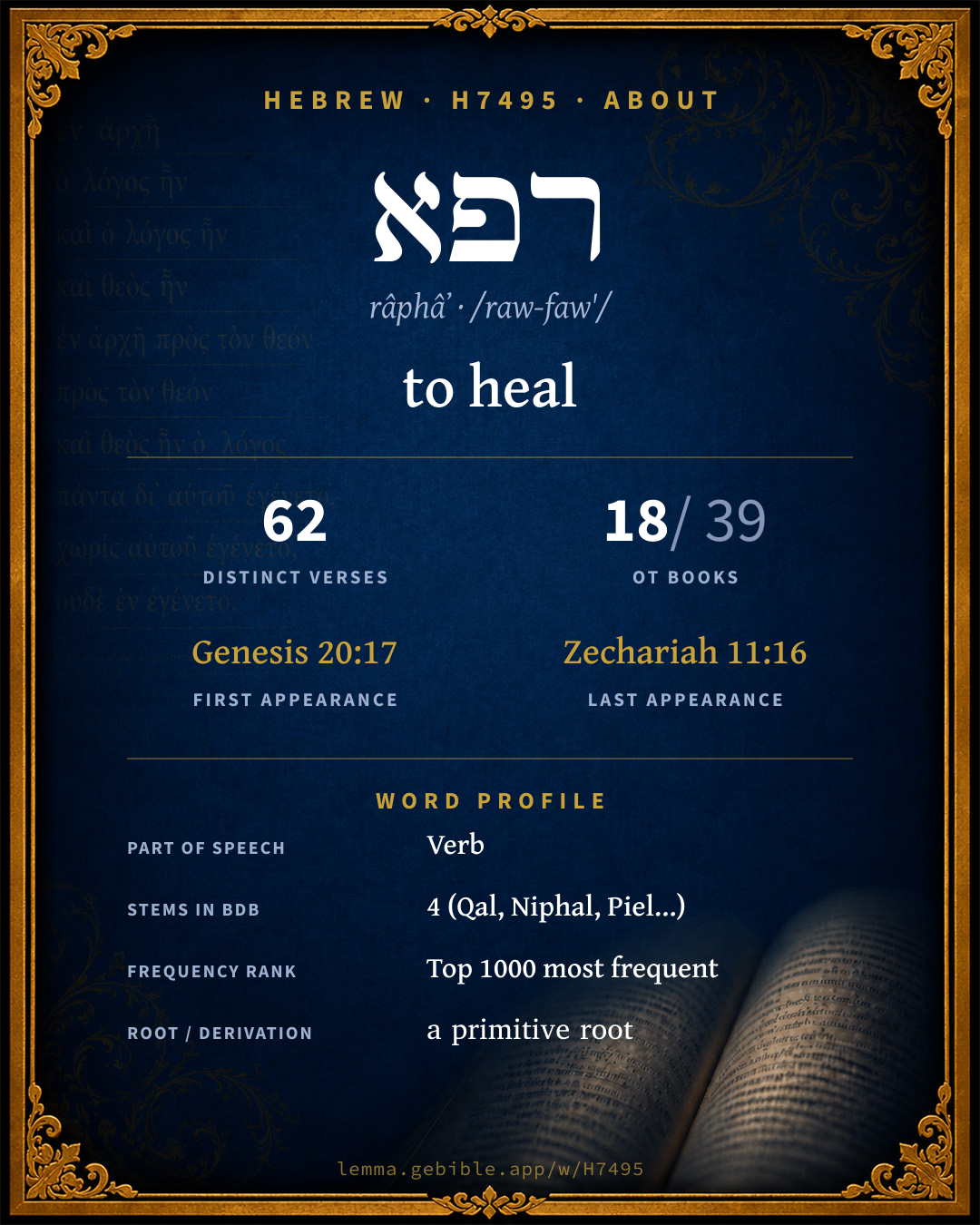
רָפָא
to heal
‘to heal’ is one of 5 main senses fuller range ↓
Full lexicon entry — Brown-Driver-Briggs (BDB)
From Brown-Driver-Briggs (BDB)
Where this word appears
See every Qal verb in the Hebrew Bible →
Grammar key — what these labels mean
Part of speech
- Verb
- An action or state-of-being word.
Stem
- Niphal
- Usually the simple passive or reflexive of the Qal (“he was written”). Here: ‘lit.’
- Hithpael
- The reflexive or reciprocal stem (the subject acts on itself).
- Qal
- The basic, simple active stem — the plain form of the verb (“he wrote”). Here: ‘lit.’
- Piel
- An intensive or resultative active stem. Here: ‘lit.’
Form
- Perfect
- A completed action or state — Hebrew marks aspect (completeness) more than strict tense (“he wrote”).
- Infinitive Construct
- A bound verbal noun, frequently with prepositions (“to write / in writing”).
- Imperfect
- An incomplete, ongoing, or future action (“he will / would write”).
- Sequential Perfect
- A perfect with prefixed waw continuing a preceding imperfect or command (waw-consecutive perfect).
- Sequential Imperfect
- An imperfect with prefixed waw — the standard past-narrative form (waw-consecutive imperfect).
- Participle Active
- A verbal adjective expressing ongoing or characteristic action (“writing / one who writes”).
- Imperative
- A direct command (“write!”).
- Cohortative
- A first-person volitional form expressing wish or resolve (“let me / let us write”).
- Infinitive Absolute
- An unbound verbal noun, often intensifying or standing in for a finite verb.
State
- Absolute
- The independent form of a noun, not bound to a following word.
- Construct
- A noun bound to a following noun in a possessive / “of” relationship (the construct chain).
Person
- 3rd Person
- The one spoken about (“he / she / it / they”).
- 1st Person
- The speaker (“I / we”).
- 2nd Person
- The one addressed (“you”).
Gender
- Masculine
- Grammatically masculine.
- Common
- Either gender — not distinguished for this form.
- Feminine
- Grammatically feminine.
Number
- Singular
- One.
- Plural
- More than one (in Hebrew, generally three or more).
Grammatical forms 33 distinct
- Verb, Qal, Imperfect, 1st Person, Common, Singular 6 times (9%)
- Verb, Qal, Imperfect, 3rd Person, Masculine, Singular 5 times (7%)
- Verb, Qal, Imperative, 2nd Person, Masculine, Singular 5 times (7%)
- Verb, Niphal, Perfect, 3rd Person, Masculine, Singular 4 times (6%)
- Verb, Niphal, Infinitive Construct 4 times (6%)
- Verb, Qal, Participle Active, Masculine, Singular, Absolute 4 times (6%)
- Verb, Hithpael, Infinitive Construct 3 times (4%)
- Verb, Qal, Infinitive Construct 3 times (4%)
+25 more forms (35 occurrences)
Parsed forms decoded from the imported morphology (morphhb / Westminster Leningrad Codex — WLC text public domain, morphhb tagging CC BY 4.0), counted across 69 parsed occurrences — not distinct verses.
Every verse where H7495 appears — 62 distinct verses across 18 books. Click any verse to open its interlinear word-by-word view. Verse text shown in the World English Bible for context — . Each verse’s Hebrew form is shown with its reference; the English is not keyword-highlighted, since the data carries no word-level English alignment. Use “Compare translations” on any verse to read it across multiple English versions. This concordance covers the Hebrew Bible; Septuagint (Greek Old Testament) occurrences are not indexed here.
Genesis 2 verses
- Genesis 20:17 וַ/יִּרְפָּ֨א conj + Qal wimpf 3ms Abraham prayed to God. God healed Abimelech, and his wife, and his maid-servants, and they bore children.
- Genesis 50:2 הָ/רֹ֣פְאִ֔ים הָ/רֹפְאִ֖ים ptcl def.art + Qal ptcp.act mp ptcl def.art + Qal ptcp.act mp Joseph commanded his servants, the physicians, to embalm his father; and the physicians embalmed Israel.
Exodus 2 verses
- Exodus 15:26 רֹפְאֶֽ/ךָ Qal ptcp.act ms cs + sfx pers 2ms and he said, "If you will diligently listen to the voice of Yahweh your God, and will do that which is right in his eyes, and will pay attention to his commandments, and keep all his statutes, I will put none of the diseases on you, which I have put on the Egyptians; for I am Yahweh who heals you."
- Exodus 21:19 וְ/רַפֹּ֥א יְרַפֵּֽא conj + Piel inf.abs Piel impf 3ms if he rises again and walks around with his staff, then he who struck him shall be cleared: only he shall pay for the loss of his time, and shall provide for his healing until he is thoroughly healed.
Leviticus 4 verses
- Leviticus 13:18 וְ/נִרְפָּֽא conj + Niphal wpf 3ms "When the body has a boil on its skin, and it has healed,
- Leviticus 13:37 נִרְפָּ֥א Niphal pf 3ms But if in his eyes the itch is arrested, and black hair has grown in it; the itch is healed, he is clean. The priest shall pronounce him clean.
- Leviticus 14:3 נִרְפָּ֥א Niphal pf 3ms and the priest shall go forth out of the camp. The priest shall examine him, and, behold, if the plague of leprosy is healed in the leper,
- Leviticus 14:48 נִרְפָּ֖א Niphal pf 3ms "If the priest shall come in, and examine it, and, behold, the plague hasn't spread in the house, after the house was plastered, then the priest shall pronounce the house clean, because the plague is healed.
Numbers 1 verse
Deuteronomy 3 verses
- Deuteronomy 28:27 לְ/הֵרָפֵֽא prep + Niphal inf.cs Yahweh will strike you with the boil of Egypt, and with the tumors, and with the scurvy, and with the itch, of which you can not be healed.
- Deuteronomy 28:35 לְ/הֵרָפֵ֑א prep + Niphal inf.cs Yahweh will strike you in the knees, and in the legs, with a sore boil, of which you can not be healed, from the sole of your foot to the crown of your head.
- Deuteronomy 32:39 אֶרְפָּ֔א Qal impf 1cs See now that I, even I, am he, There is no god with me: I kill, and I make alive; I wound, and I heal; There is none who can deliver out of my hand.
1 Samuel 1 verse
1 Kings 1 verse
2 Kings 6 verses
- 2 Kings 2:21 רִפִּ֨אתִי֙ Piel pf 1cs He went forth to the spring of the waters, and cast salt therein, and said, Thus says Yahweh, I have healed these waters; there shall not be from there any more death or miscarrying.
- 2 Kings 2:22 וַ/יֵּרָפ֣וּ conj + Niphal wimpf 3mp So the waters were healed to this day, according to the word of Elisha which he spoke.
- 2 Kings 8:29 לְ/הִתְרַפֵּ֣א prep + Hithpael inf.cs King Joram returned to be healed in Jezreel of the wounds which the Syrians had given him at Ramah, when he fought against Hazael king of Syria. Ahaziah the son of Jehoram king of Judah went down to see Joram the son of Ahab in Jezreel, because he was sick.
- 2 Kings 9:15 לְ/הִתְרַפֵּ֣א prep + Hithpael inf.cs but king Joram was returned to be healed in Jezreel of the wounds which the Syrians had given him, when he fought with Hazael king of Syria.) Jehu said, If this be your mind, then let none escape and go forth out of the city, to go to tell it in Jezreel.
- 2 Kings 20:5 רֹ֣פֶא Qal ptcp.act ms Turn back, and tell Hezekiah the prince of my people, Thus says Yahweh, the God of David your father, I have heard your prayer, I have seen your tears: behold, I will heal you; on the third day you shall go up to the house of Yahweh.
- 2 Kings 20:8 יִרְפָּ֥א Qal impf 3ms Hezekiah said to Isaiah, What shall be the sign that Yahweh will heal me, and that I shall go up to the house of Yahweh the third day?
2 Chronicles 4 verses
- 2 Chronicles 7:14 וְ/אֶרְפָּ֖א conj + Qal impf 1cs if my people, who are called by my name, shall humble themselves, and pray, and seek my face, and turn from their wicked ways; then will I hear from heaven, and will forgive their sin, and will heal their land.
- 2 Chronicles 16:12 בָּ/רֹפְאִֽים prep det + Qal ptcp.act mp In the thirty-ninth year of his reign Asa was diseased in his feet; his disease was exceeding great: yet in his disease he didn't seek Yahweh, but to the physicians.
- 2 Chronicles 22:6 לְ/הִתְרַפֵּ֣א prep + Hithpael inf.cs He returned to be healed in Jezreel of the wounds which they had given him at Ramah, when he fought against Hazael king of Syria. Azariah the son of Jehoram king of Judah went down to see Jehoram the son of Ahab in Jezreel, because he was sick.
- 2 Chronicles 30:20 וַ/יִּרְפָּ֖א conj + Qal wimpf 3ms Yahweh listened to Hezekiah, and healed the people.
Job 2 verses
Psalms 7 verses
- Psalms 6:2 רְפָאֵ֥/נִי Qal impv 2ms + sfx pers 1cs Have mercy on me, Yahweh, for I am faint. Yahweh, heal me, for my bones are troubled.
- Psalms 30:2 וַ/תִּרְפָּאֵֽ/נִי conj + Qal wimpf 2ms + sfx pers 1cs Yahweh my God, I cried to you, And you have healed me.
- Psalms 41:4 רְפָאָ֥/ה Qal impv 2ms + sfx h I said, "Yahweh, have mercy on me! Heal me, for I have sinned against you."
- Psalms 60:2 רְפָ֖/ה Qal impv 2ms + sfx h You have made the land tremble. You have torn it. Mend its fractures, For it quakes.
- Psalms 103:3 הָ֝/רֹפֵ֗א ptcl def.art + Qal ptcp.act ms Who forgives all your sins; Who heals all your diseases;
- Psalms 107:20 וְ/יִרְפָּאֵ֑/ם conj + Qal impf 3ms + sfx pers 3mp He sends his word, and heals them, And delivers them from their graves.
- Psalms 147:3 הָ֭/רֹפֵא ptcl def.art + Qal ptcp.act ms He heals the broken in heart, And binds up their wounds.
Ecclesiastes 1 verse
Isaiah 6 verses
- Isaiah 6:10 וְ/רָ֥פָא conj + Qal wpf 3ms Make the heart of this people fat; Make their ears heavy, and shut their eyes; Lest they see with their eyes, And hear with their ears, And understand with their heart, And turn again, and be healed."
- Isaiah 19:22 וְ/רָפ֑וֹא וּ/רְפָאָֽ/ם conj + Qal inf.abs conj + Qal wpf 3ms + sfx pers 3mp Yahweh will strike Egypt, smiting and healing; and they shall return to Yahweh, and he will be entreated of them, and will heal them.
- Isaiah 30:26 יִרְפָּֽא Qal impf 3ms Moreover the light of the moon shall be as the light of the sun, and the light of the sun shall be sevenfold, as the light of seven days, in the day that Yahweh binds up the hurt of his people, and heals the stroke of their wound.
- Isaiah 53:5 נִרְפָּא Niphal pf 3ms But he was pierced for our transgressions, he was crushed for our iniquities; the punishment that brought our peace was on him; and by his wounds we are healed.
- Isaiah 57:18 וְ/אֶרְפָּאֵ֑/הוּ conj + Qal impf 1cs + sfx pers 3ms I have seen his ways, and will heal him: I will lead him also, and restore comforts to him and to his mourners.
- Isaiah 57:19 וּ/רְפָאתִֽי/ו conj + Qal wpf 1cs + sfx pers 3ms I create the fruit of the lips: Peace, peace, to him who is far off and to him who is near, says Yahweh; and I will heal him.
Jeremiah 11 verses
- Jeremiah 3:22 אֶרְפָּ֖ה Qal impf 1cs Return, you backsliding children, I will heal your backsliding. Behold, we are come to you; for you are Yahweh our God.
- Jeremiah 6:14 וַֽ/יְרַפְּא֞וּ conj + Piel wimpf 3mp They have healed also the hurt of my people slightly, saying, Peace, peace; when there is no peace.
- Jeremiah 8:11 וַ/יְרַפּ֞וּ conj + Piel wimpf 3mp They have healed the hurt of the daughter of my people slightly, saying, Peace, peace; when there is no peace.
- Jeremiah 8:22 רֹפֵ֖א Qal ptcp.act ms Is there no balm in Gilead? is there no physician there? why then isn't the health of the daughter of my people recovered?
- Jeremiah 15:18 הֵֽרָפֵ֔א Niphal inf.cs Why is my pain perpetual, and my wound incurable, which refuses to be healed? will you indeed be to me as a deceitful [brook], as waters that fail?
- Jeremiah 17:14 רְפָאֵ֤/נִי וְ/אֵ֣רָפֵ֔א Qal impv 2ms + sfx pers 1cs conj + Niphal coh 1cs Heal me, O Yahweh, and I shall be healed; save me, and I shall be saved: for you are my praise.
- Jeremiah 19:11 לְ/הֵרָפֵ֖ה prep + Niphal inf.cs and shall tell them, Thus says Yahweh of Hosts: Even so will I break this people and this city, as one breaks a potter's vessel, that can't be made whole again; and they shall bury in Topheth, until there be no place to bury.
- Jeremiah 30:17 אֶרְפָּאֵ֖/ךְ Qal impf 1cs + sfx pers 2fs For I will restore health to you, and I will heal you of your wounds, says Yahweh; because they have called you an outcast, [saying], It is Zion, whom no man seeks after.
- Jeremiah 33:6 וּ/רְפָאתִ֑י/ם conj + Qal wpf 1cs + sfx pers 3mp Behold, I will bring it health and cure, and I will cure them; and I will reveal to them abundance of peace and truth.
- Jeremiah 51:8 תֵּרָפֵֽא Niphal impf 3fs Babylon is suddenly fallen and destroyed: wail for her; take balm for her pain, if so be she may be healed.
- Jeremiah 51:9 רפאנו רִפִּ֣ינוּ נִרְפָּ֔תָה Piel pf 1cp Piel pf 1cp Niphal pf 3fs We would have healed Babylon, but she is not healed: forsake her, and let us go everyone into his own country; for her judgment reaches to heaven, and is lifted up even to the skies.
Lamentations 1 verse
Ezekiel 4 verses
- Ezekiel 34:4 רִפֵּאתֶ֗ם Piel pf 2mp You haven't strengthened the diseased, neither have you healed that which was sick, neither have you bound up that which was broken, neither have you brought back that which was driven away, neither have you sought that which was lost; but with force and with rigor have you ruled over them.
- Ezekiel 47:8 ו/נרפאו וְ/נִרְפּ֥וּ conj + Niphal wpf 3cp conj + Niphal wpf 3cp Then said he to me, These waters issue forth toward the eastern region, and shall go down into the Arabah; and they shall go toward the sea; into the sea [shall the waters go] which were made to issue forth; and the waters shall be healed.
- Ezekiel 47:9 וְ/יֵרָֽפְאוּ֙ conj + Niphal impf 3mp It shall happen, that every living creature which swarms, in every place where the rivers come, shall live; and there shall be a very great multitude of fish; for these waters are come there, and [the waters of the sea] shall be healed, and everything shall live wherever the river comes.
- Ezekiel 47:11 יֵרָפְא֖וּ Niphal impf 3mp But the miry places of it, and the marshes of it, shall not be healed; they shall be given up to salt.
Hosea 5 verses
- Hosea 5:13 לִ/רְפֹּ֣א prep + Qal inf.cs When Ephraim saw his sickness, And Judah his wound, Then Ephraim went to Assyria, And sent to king Jareb: But he is not able to heal you, Neither will he cure you of your wound.
- Hosea 6:1 וְ/יִרְפָּאֵ֑/נוּ conj + Qal impf 3ms + sfx pers 1cp "Come, and let us return to Yahweh; For he has torn us to pieces, And he will heal us; He has injured us, And he will bind up our wounds.
- Hosea 7:1 כְּ/רָפְאִ֣/י prep + Qal inf.cs + sfx pers 1cs When I would heal Israel, Then the iniquity of Ephraim is uncovered, Also the wickedness of Samaria; For they commit falsehood, And the thief enters in, And the gang of robbers ravages outside.
- Hosea 11:3 רְפָאתִֽי/ם Qal pf 1cs + sfx pers 3mp Yet I taught Ephraim to walk. I took them by his arms; But they didn't know that I healed them.
- Hosea 14:4 אֶרְפָּא֙ Qal impf 1cs "I will heal their waywardness. I will love them freely; For my anger is turned away from him.
Zechariah 1 verse
About this entry
At a glance — auto-summarized from this page’s data, not written by a person. Every figure links to its source below. This summary describes the numbers; it doesn’t interpret them.
At its core, רפא (râphâʼ) means “to heal.” Across 4 stems, its meaning turns on the binyan (Qal, Niphal). With 62 verses in 18 books, it is a moderately common word in the Hebrew Bible. Scripture first uses it in Genesis 20:17. Sharing its root, it stands alongside מרפא, רפא and רפאה. Each statement above links to its evidence; the full detail follows below.
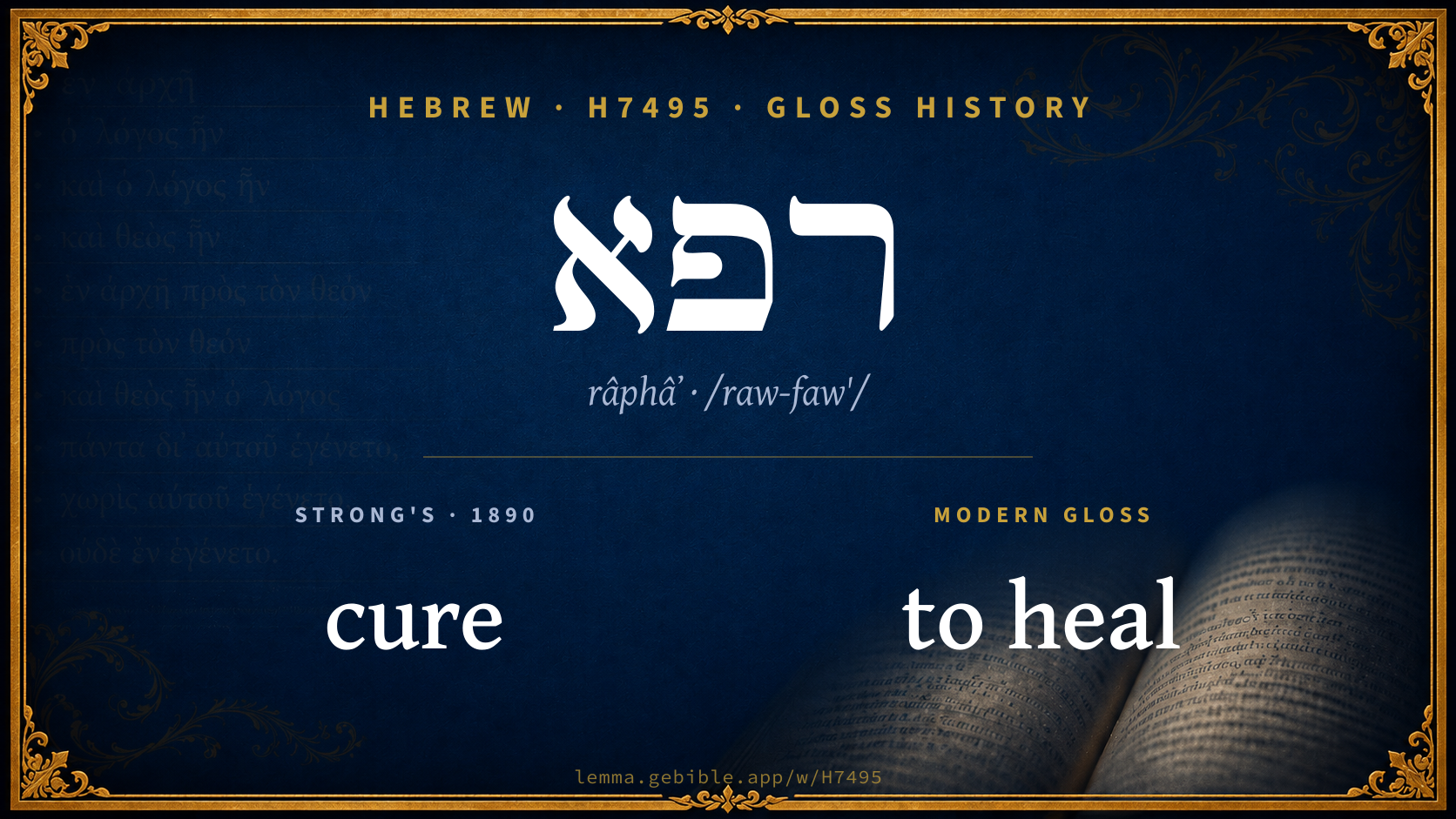
Gloss history
Strong's 1890 vs modern scholarship
About this word
Strong's H7495 catalogs a Hebrew word from the Hebrew Old Testament.
These counts are not copied from any lexicon or concordance. They are computed here, from the morphology-tagged Hebrew Old Testament. What Lemma adds →
- 62
- distinct verses
- The word appears in 62 distinct verses.
- 18 / 39
- OT books
- The word appears in 18 of 39 Old Testament books.
- #575
- by frequency
- Top 1000 most frequent Hebrew words (rank 575 of 8,640 Hebrew words by occurrence).
View all 62 occurrences in the concordance →
By section of the Old Testament
By traditional corpus
Conventional, traditional groupings — biblical authorship is debated, so this is a traditional corpus grouping, not an authorship claim. Each share is this word’s portion of its verses in that division of the Hebrew canon. Each figure is a share of the word’s 62 distinct verses.
- Prophets (Nevi'im) 35 verses · 56%
- Writings (Ketuvim) 15 verses · 24%
- Torah (Pentateuch) 12 verses · 19%
How translations render this word
Counts come from each version’s own published word-to-Strong’s tagging or interlinear alignment — an approximate guide to how each version renders this word, not a word-level alignment the data otherwise carries. Because each total is that version’s own tagged count, the per-version totals vary from one another and need not match the appearance or distinct-verse counts above. These counts may also differ from a printed concordance because Lemma counts each distinctly tagged rendering and does not collapse phrase taggings into a single head-word total. This is a fixed set of word-tagged versions (KJV, ASV, BSB, ULT) and does not change with the reading translation you choose elsewhere. Each version’s license is shown beside its name below (and on Sources).
BDB lists this Strong’s number as 3 distinct words (homographs). Each count above pools all of them and is not split by sense — see the Senses section below. A low-frequency rendering may belong to a different one of those words, not the primary meaning.
- King James Version†: Be healed 8×, Heal 8×, Healed 4×
- American Standard Version†: Be healed 7×, Heal 5×, Healed 3×
- Berean Standard Bible†: Heal 9×, Be healed 3×, Healed 3×
- unfoldingWord Literal Text†: Heal 10×, Be healed 4×, Healing 3×
King James Version Public Domain
Renders H7495 across 67† tagged occurrences — most commonly:
Plus 30 renderings that appear only once — usually multi-word phrases or single function words the recovered tagging swept in, not distinct renderings.
American Standard Version Public Domain
Renders H7495 across 67† tagged occurrences — most commonly:
Plus 35 renderings that appear only once — usually multi-word phrases or single function words the recovered tagging swept in, not distinct renderings.
Berean Standard Bible Public Domain
Renders H7495 across 65† tagged occurrences — most commonly:
Plus 29 renderings that appear only once — usually multi-word phrases or single function words the recovered tagging swept in, not distinct renderings. Not rendered by a distinct English word in 2 further occurrences.
unfoldingWord Literal Text CC BY-SA 4.0
Renders H7495 across 64† tagged occurrences — most commonly:
Plus other, less common renderings. Plus 24 renderings that appear only once — usually multi-word phrases or single function words the recovered tagging swept in, not distinct renderings.
18 senses and sub-senses in the full BDB
Hebrew verbs can shift meaning by stem (binyan): Qal is the basic action, Niphal is often passive or reflexive, Piel often intensifies or makes it factitive, and Hiphil is typically causative. The senses below are grouped under the stem BDB assigns to each.
What do BDB’s symbols mean?
BDB uses these scholarly abbreviations:
| Symbol | Meaning |
|---|---|
| 𝔊 | the Septuagint (the ancient Greek translation, LXX) |
| 𝔙 | the Vulgate (the Latin translation) |
| 𝔖 | the Syriac version (the Peshitta) |
| 𝔗 | the Targum (the Aramaic translation) |
| ψ | the Psalms |
| √ | root (the underlying root or stem) |
| ‖ | parallel passage (a synonymous or contrasted parallel) |
| † | the dagger: every passage where the word occurs is cited |
The 18 senses and sub-senses the full Brown-Driver-Briggs lexicon distinguishes for this word, in lexicon order (not ranked by frequency), with BDB’s own verbatim wording and sub-sense lettering. Shown in Hebrew script with BDB’s own scholarly abbreviations. The condensed entry is in the Lexicon Entry tab. See also the Forms in the corpus table below.
רפא I II. רָפָא as n.pr.m., always c. art. Hā-Rāphā (perhaps der. from n.pr.gent. II. רְפָאִים, q.v.)
רפא II heal (NH in deriv.
Qal
- Pf. 3 ms. consec. וְר׳ Is 6:10, sf. וּרְפָאָם 19:22, 1 s. sf. consec. וּרְפָאתִיו 57:19, etc.; Impf. 3 ms. יִרְפָּא 2 K 20:8 +, sf. יִרְפָּאֵנוּ Ho 6:1, 1 s. אֶרְפָּא Ho 14:5 +, אֶרְפָּה (Ges§ 75 pp) Je 3:22; 3 fpl. תִּרְפֶּינָה (id.ib. qq) Jb 5:18, etc.; Imv. ms. רְפָא Nu 12:13, רְפָה (id.ib. pp) ψ 60:4, רְפָאָ֫ה 41:5, etc.; inf. abs. רָפוֹא Is 19:22; cstr. לִרְפֹּא Ho 5:13, etc.; Pt. רֹפֵא (פֶ K 3) 2 K 20:5 +;—heal: e.g. Isaiah 6:10
- 1. lit.,
- a. of God, c. acc. pers. Gn 20:17 (E), ψ 107:20 (sf.), c. ל pers. Nu 12:13 (JE) 2 K 20:5, 8. e.g. Genesis 20:17
- b. of men, abs. Ec 3:3 (opp. הרג); pt. as subst. healer, physician, Gn 50:2(×2), (J) 2 Ch 16:12. e.g. Ecclesiastes 3:3
- 2. fig., heal hurts of nation, involving י׳’s (restored) favour (and, often, forgiveness):
- a. subj. י׳, c. sf. pers., Ho 6:1; 11:3 (yet cf. We Now), Ex 15:26 (J), Is 19:22b; 57:18, 19 Je 33:6 ψ 30:3, cf. 6:3; c. acc. עַם 2 Ch 30:20, c. acc. אֶרֶץ 2 Ch 7:14; c. ל of nation Ho 7:1, and (indef. subj.) Is 6:10 (lest) one heal them (= pass., they be healed); c. acc. of hurt, מַחַץ מַכָּתוֹ 30:26, שְׁבָרִים (of land) ψ 60:4, so מְשׁוּבָה Ho 14:5; Je 3:22 (incl. the consequences of backsliding); c. ל of hurt ψ 103:3; acc. nation (personif.) + מִן of hurt Je 30:17 I will heal thee of thy wounds (‖ אֶרְפָּאֵךְ); abs. Is 19:22a (opp. נגף), Dt 32:39 (opp. מחץ); pt. as subst. healer, physician Je 8:22. e.g. Hosea 6:1
- b. human subj., c. ל of nation, Ho 5:13, cf. La 2:13. e.g. Hosea 5:13
- 3.
- a. fig., heal individ. distresses, c. sf. pers. Je 17:14, c. acc. נַפְשִׁי = me ψ 41:5, c. ל pers., לִשְׁבוּרֵי לֵב ψ 147:3 (i.e. longing exiles, cf. Is 61:3); abs. Jb 5:18 (opp. מחץ); e.g. Jeremiah 17:14
- b. pt. as subst Jb 13:4. e.g. Job 13:4
Niphal
- Pf. 3 ms. נִרְפָּא Lv 13:37 +, 3 fs. נִרְפָּ֑תָה (Ges§ 75 qq) Je 51:9; 3 pl. וְנִרְפּאוּ consec. Ez 47:8; Impf. 2 ms. תֵּרָפֵא Je 51:8; 3 mpl. יֵרָֽפְאוּ Ez 47:9, 11, וַיֵּרָפוּ (Gesl.c.) 2 K 2:22, etc.; inf. cstr. הֵרָפֵא Je 15:18 +, הֵרָפֵה (id.ib.) Je 19:11;—be healed: e.g. Leviticus 13:37
- 1. lit., of pers. 1 S 6:3; + acc. of disease Dt 28:27, 35; subj. disease Lv 13:18, 37; 14:3, 48; of (bad) water 2 K 2:22, salt waters (prediction), i.e. be made fresh, Ez 47:8, 9, 11; of (broken) pottery, i.e. be made whole, Je 19:11 (in sim.). e.g. 1 Samuel 6:3
- 2. fig., be healed:
- a. of national hurts, subj. city Je 51:8, 9; involving forgiveness and י׳’s blessing, impers. c. ל of people, נִרְפָּא־לָנוּ Is 53:5 i.e. healing has come to us. e.g. Jeremiah 51:8
- b. of personal distress, subj. pers. Je 17:14, subj. the distress 15:18. e.g. Jeremiah 17:14
Piel
- Pf. 1 s. רִפִּאתִי 2 K 2:21; 2 mpl. רִפֵּאתֶם Ez 34:4; 1 pl. רִפִּאנוּ Je 51:9; Impf. 3 ms. יְרַפֵּא Ex 21:19; Zc 11:16, וַיְרַפֵּא 1 K 18:30; 3 mpl. וַיְרַפְּאוּ Je 6:14, וַיְרַפּוּ (Ges§ 75 qq) 8:11; inf. abs. רַפֹּא Ex 21:19;—have healed, heal, usually human subj.: e.g. 2 Kings 2:21
- 1. lit., רַפֹּא יְרַפֵּא Ex 21:19 he shall have (him) well healed; c. acc. of altar, = repair, 1 K 18:30; c. ל of water (subj. י׳) 2 K 2:21. e.g. Exodus 21:19
- 2. fig. of healing national defects and hurts, acc. pers., Ez 34:14; Zc 11:16; work at healing, treat (acc. of hurt) Je 6:14; 8:11 (both עַל־נְקַלָּה, v. [קָלַל] Niph. 2), 51:9. e.g. Ezekiel 34:14
Hiphil
- inf. cstr. of purpose, לְהִתְרַפֵּא, lit., in order to get healed, + מִן of wounds 2 K 8:29 = 9:15, so ‖ 2 Ch 22:6 (read with 𝔊 מִן for כִּי, cf. Be Kau Benz).—v. רָפָה relax. e.g. 2 Kings 8:29
רפא III m. in Benj., 1 Ch 8
Senses from the full Brown-Driver-Briggs lexicon (Brown, Driver, Briggs; Oxford 1906 — public domain), digitized via Sefaria, supplemented by the OpenScriptures HebrewLexicon (CC BY 4.0). Full attribution on Sources.
Word origin
III. II. רָפָא as n.pr.m., always c. art. Hā-Rāphā (perhaps der. from n.pr.gent. II. רְפָאִים, q.v.);—הָֽרָפָה 2 S 21:16, 18, c. prep. לְהָ׳ v 20:22 = לְהָרָפָא 1 Ch 20:6, 8;—only as parent, בִּילִידֵי הָר׳ 2 S 21:16, 18 (= מִילִידֵי הָֽרְפָאִים 1 Ch 20:4); יֻלַּד לְהָר׳ v 20, 22 ‖ I Ch 20:6, 8.—1. רָפָה v. sub רָפָא.
I. vb. heal (NH in deriv.; Ph. רפא, Syriac ܪܦܳܐ heal; on Aramaic n.pr. cpd. with רפא v. NöZMG xl (1886), 723 Lzb 369; Sab. n.pr. אלרפא Langer 1, 1 DHMZMG xxxvii (1883), 326; Arabic رَفَأَ (and رَفَا) darn, mend, repair, pacify; Ethiopic ረፍአ stitch together, mend; cf. Küchenmeister ZWiss. Th. xxx (1887), 257 ff.);—
II. n.pr.m. in Benj., 1 Ch 8:2, Ραφη[α].—II. רָפָא v. רפה.—Vid. also בֵּית ר׳ p. 112.
— Brown-Driver-Briggs (Oxford 1906, public domain), digitized via Sefaria, supplemented by the OpenScriptures HebrewLexicon (CC BY 4.0). See Sources.
Origin: a primitive root
Jastrow Dictionary
A second Hebrew/Aramaic lexicon for comparison, covering Aramaic and post-biblical (Talmudic, Targumic, Midrashic) usage that the biblical-Hebrew BDB does not. Matched by lemma rather than by Strong’s number, so a lemma may carry more than one Jastrow headword (shown separately below), and the entries cover usage well beyond the Bible.
רָפָא
- , v. רפי
רפי
- (b. h.) [to be or make loose, soft,] to be healed, relieved; to heal. Ber. 60ᵃ ותִרְפָּאֵנִי and do thou heal me, v. רְפוּאָה. Tanḥ. B’shall. 23 וכשרְפָאָהוּ בסערה רְפָאוֹ and when he came to heal him (Job), he healed him in a windstorm; Yalk. Ex. 235. Ber. 55ᵇ ואם צריכים רפואה רְפָאֵם וכ׳ and if they (my dreams) need remedy, remedy them as thou didst the waters of Marah &c.; a. fr.—Part. pass. רָפוּי. Sifra M’tsorʿa, Neg. ch. IV, Par. 7; a. e.
- same. Yalk. Ex. l. c. הוא רי׳ וכ׳ he healed Job in a windstorm. Ber. l. c. לפי שאין דרכן … לרַפְּאוֹת וכ׳ because it is not for man to cure, but it is the custom (to employ physicians). Ib. שניתנה … לרפאות, v. רוֹפֵא. Ned. IV, 4 (38ᵇ) ומְרַפְּאֵהוּ רפואת וכ׳ (Bab. ed. ומְרַפְּאוֹ) and he may attend to him as a physician to his body &c., v. רִיפּוּי. Pesik. R. s. 29-30-30 כל מה דאמר ירמיה ופרע אתא ישעיהו ור׳ whatever Jeremiah spoke and tore (prophesied evil), Isaiah came and healed (restored) it; a. fr.
- to be cured, be treated; to get well. Sabb. XXII, 6. Pes. 25ᵃ בכל מִתְרַפְּאִין חוץ מעצי וכ׳ you may apply anything (otherwise forbidden) as a remedy, except wood of an ăsherah. Ib. בכל מתרפאין חוץ מעבודת וכ׳ you may employ any remedy except idolatrous objects, lawless gratification, and bloodshed. Keth. 105ᵃ ספק מִתְרַפֵּא וכ׳ it is doubtful whether or not he will get well. Ab. Zar. II, 2, v. רִיפּוּי; a. fr.
- (v. next w.) to loosen (the bowels). Sabb. 147ᵇ מַרְפֵּאת (not מרפא), v. עָמֵל.
רְפֵי
- , to be lax, weak, unsteady. Yeb. 64ᵇ דרָפי דמא, v. קְמַט. Kidd. 65ᵃ אין ולא ורַפְיָא בידיה (he said) yes and no, and it was undecided in his hand; Sabb. 113ᵃ; 116ᵃ; B. Mets. 14ᵇ. Gitt. 32ᵃ שופתא … רפיא the pin of the hoe gets loose (from the heat); סיכתא בדפנא ר׳ the pin in the wall gets loose; קניא … ר׳ the reed in the basket becomes soft again (as if sprouting). Pes. 42ᵇ דרְפָא מקמיט ליה (Ms. M. דרָפֵי; Rashi דרפו, corr. acc.), v. קְמַט; Sabb. 110ᵃ. Y. Ber. II, 5ᶜ bot., v. עוּנְקְתָא; a. e.
- to loosen, break the soil (cmp. רְפַק). Ned. 41ᵇ דקא מְרַפֵּי וכ׳ he loosens the soil for him (by ploughing near him whom he has vowed not to benefit). B. Mets. 95ᵇ מרפי ואזיל קמה (Ms. F. קמא קמא, v. Rabb. D. S. a. l. note 8; Ar. מְרַפֵּישׂ, מְרַפֵּשׂ) he breaks the ground as he goes before him (that ploughs with his cow).
- 1. to let loose, let go, let alone. Targ. Y. II, Ex. IV, 26 (h. text וירף). Targ. Prov. IV, 13 (ed. Wil. תִרְפֵּא, read: תַ׳).—Y. Ber. VII, 11ᶜ אַרְפּוּנֵיה let him alone. Y. Kil. IX, 32ᵇ אַרְפּוּנוּן ורחמיו וכ׳ let them (the mice in their nest) undisturbed, it is written, ‘and his mercies are over all his creatures’ (Ps. CXLV, 9); Y. Keth. XII, 35ᵃ. Lev. R. s. 5 אַרְפּוּן להון leave them (the dogs) alone; a. e. e.g. Psalms 145:9
- 2. to act as a laxative. Pes. l. c. מַרְפֵּא ליה (not להו; Ms. M. מַרְפֵּי; Rashi מרפו, corr. acc.); Sabb. l. c. מרפי, v. קְמַט.
- ; Ithpe. אִתְרְפֵי
- 1. to be lax, slack. Targ. Prov. XVIII, 9 (ed. Wil. מִתְרַפֵּה). Ib. XXIV, 10.
- 2. to relax, to let one’s hands drop (in astonishment). Targ. Hab. I, 5. Targ. Is. XXIX, 9. e.g. Habakkuk 1:5
A Dictionary of the Targumim, the Talmud Babli and Yerushalmi, and the Midrashic Literature (Marcus Jastrow; London, Luzac, 1903) — Public Domain. Digitized via Sefaria. Digitized via Sefaria. Full attribution on Sources.
Forms in the corpus
The 66 distinct written forms H7495 takes in the Hebrew Bible, most frequent first — each parse links to that stem’s occurrences in the concordance. Hebrew forms include their vowel points and cantillation, so a single lemma takes many written forms.
The 60 most common forms are shown; 6 rarer forms follow in the full concordance.
Same root — word family
Other BDB entries built from the same root as H7495, grouped by Strong’s listed origin. These share a root / origin per the lexicon — not necessarily a shared meaning. Each links to that word’s own entry.
Derived from this word
- מרפא marpêʼ H4832 healing
- רפא râphâʼ H7496 ghosts
- רפאה rᵉphuʼâh H7499 remedy
- רפאות riphʼûwth H7500 healing
- תרפים tᵉrâphîym H8655 teraphim
Proper names from this root
People and places named from this root — a name, not an additional meaning of the word.
- ירפאל Yirpᵉʼêl H3416 Irpeel
- רפא râphâʼ H7497 giants
- רפאל Rᵉphâʼêl H7501 Rephael
- רפוא Râphûwʼ H7505 Raphu
- רפיה Rᵉphâyâh H7509 Rephaiah
Compare all same-root words → Showing 4 of 11 — not the complete family. 5 of the same-root words are proper names (people or places). They share a root, not necessarily a meaning.
Septuagint verse parallels
This word appears in 60 verses that also exist in the Greek Old Testament (Septuagint), out of the 62 Hebrew verses it occurs in. You can read those verses in Greek by switching the Old Testament edition to the Septuagint.
Read these verses in the Septuagint
- Genesis 20:17
- Exodus 15:26
- Leviticus 13:18
- Numbers 12:13
- Deuteronomy 28:27
- 1 Samuel 6:3
- 1 Kings 18:30
- 2 Kings 2:21
- 2 Chronicles 7:14
- Job 5:18
- Psalms 6:2
- Ecclesiastes 3:3
This is a verse-level parallel only — the same verses exist in both the Hebrew and Greek Old Testaments. No word-level Hebrew↔Greek correspondence is claimed: the data carries no such alignment, so no Greek word is shown as this Hebrew word’s translation. Coverage is not total — the Septuagint omits the deuterocanon and renumbers the Psalms, so some Hebrew verses have no direct Greek parallel.