
2 Chronicles 30:20

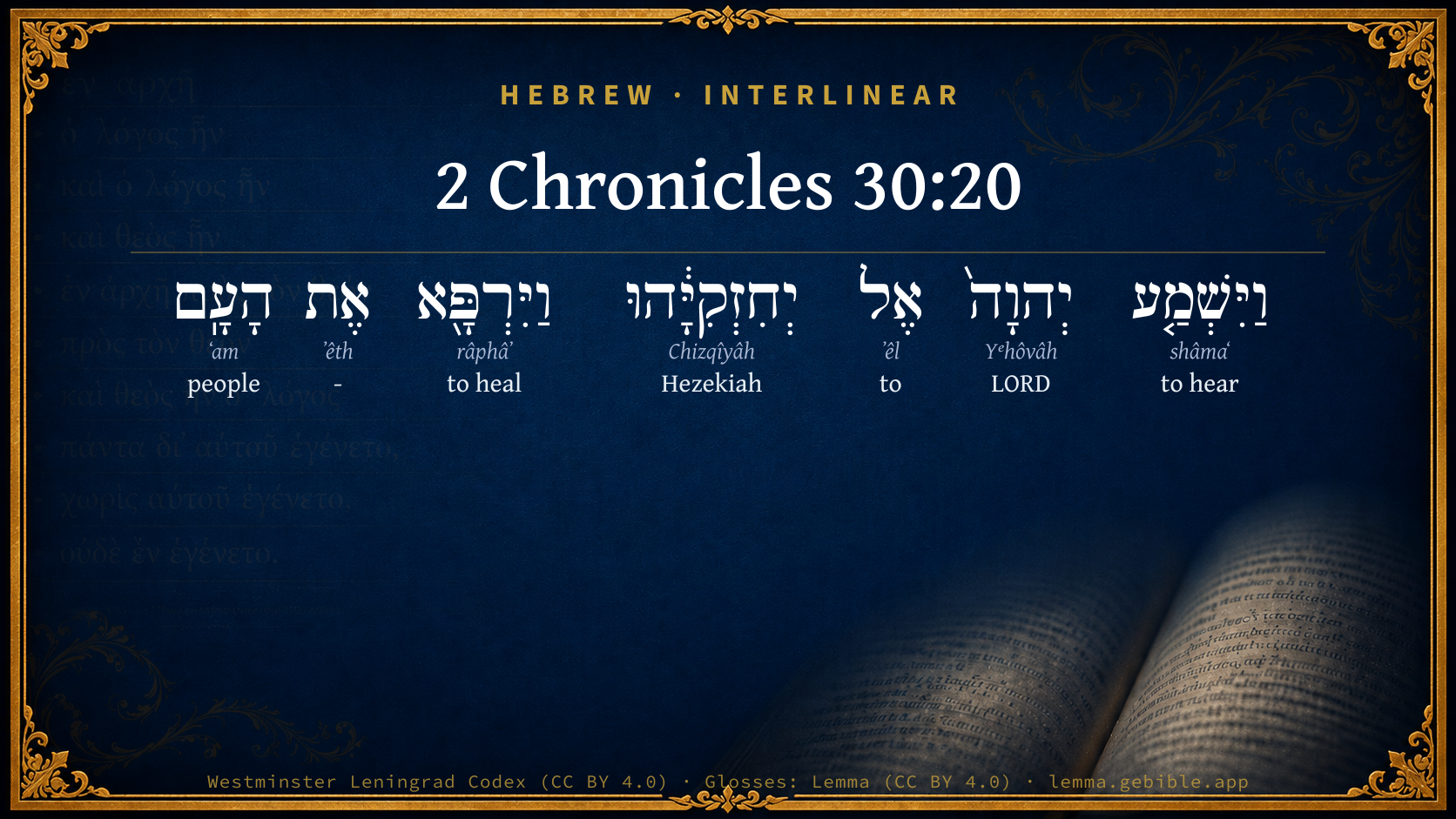
Hebrew (Westminster Leningrad Codex) 2 Chronicles 30:20 appears in the Hebrew Old Testament. The text above is from the Westminster Leningrad Codex. Each word links to its Strong’s number, a concise gloss, and parsing drawn from the Open Scriptures Hebrew Bible morphology. Click any word for its full Brown-Driver-Briggs (BDB) entry.
Download image
Cite this verse

2 Chronicles 30:20 (World English Bible). Public Domain. Lemma interlinear Bible study tool, https://lemma.gebible.app/v/2-chronicles/30/20.

Show BibTeX & RIS
BibTeX
RIS
English Translation
Yahweh listened to Hezekiah, and healed the people.
World English Bible · Public Domain
Download a study sheet

One document with this verse’s original text, its word-by-word gloss line, the meaning frame, cross-references with their text, attributed commentary, and full source and license credits — printable, and it pastes into notes with its structure intact.

This verse Autodidact and up

Study sheet (.html) Plain text (.txt)

A passage Seminary Student

Up to 50 verses in one chapter. A passage sheet keeps up to 6 commentary sources and 12 cross-references per verse, in the order this page ranks them, and says so on the sheet whenever that leaves anything out. Ask for a single verse and you get the Autodidact verse sheet above.

Everything on this page stays free to read, with no account — the sheet is a download of what is already on screen, not access to it.

Want to remove ads? Support Godless Engineer
Compare translations 3

The same verse in 3 English versions, stacked beneath the original-language interlinear above. Click any original word for its lexicon entry.

Each is an independent rendering of the whole verse — the interlinear is not word-aligned to these translations.

Highlighted words mark where these versions differ — a whole-verse word diff, not a word-by-word alignment.

  • World English Bible Public Domain
    Yahweh listened to Hezekiah, and healed the people.
  • King James Version Public Domain
    And the LORD hearkened to Hezekiah, and healed the people.
  • unfoldingWord Literal Text CC BY-SA 4.0
    And Yahweh listened to Hezekiah, and he healed the people.

unfoldingWord Literal Text — © unfoldingWord, licensed CC BY-SA 4.0. Word-aligned USFM3 via Door43 (git.door43.org/unfoldingWord/en_ult).

Versions to compare (up to 4)

3 of 4 selected

Show all 18 translations

Every available English version of this verse, each an independent rendering of the whole verse.

  • World English Bible Public Domain
    Yahweh listened to Hezekiah, and healed the people.
  • Berean Standard Bible Public Domain
    And the LORD heard Hezekiah and healed the people.
  • Majority Standard Bible Public Domain
    And the LORD heard Hezekiah and healed the people.
  • King James Version Public Domain
    And the LORD hearkened to Hezekiah, and healed the people.
  • American Standard Version (1901) Public Domain
    And Jehovah hearkened to Hezekiah, and healed the people.
  • Revised Version (1885) Public Domain
    And the LORD hearkened to Hezekiah, and healed the people.
  • Geneva Bible (1599) Public Domain
    And the Lord heard Hezekiah, and healed the people.
  • Douay-Rheims (1899) Public Domain
    To all them, who with their whole heart, seek the Lord the God of their fathers: and will not impute it to them that they are not sanctified.
  • Young's Literal Translation Public Domain
    and Jehovah hearkeneth unto Hezekiah, and healeth the people.
  • Literal Standard Version CC BY-SA 4.0
    and YHWH listens to Hezekiah and heals the people.
  • Unlocked Literal Bible CC BY-SA 4.0
    So Yahweh listened to Hezekiah and healed the people.
  • unfoldingWord Literal Text CC BY-SA 4.0
    And Yahweh listened to Hezekiah, and he healed the people.
  • Darby Bible Public Domain
    And Jehovah hearkened to Hezekiah, and healed the people.
  • World Messianic Bible Public Domain
    The LORD listened to Hezekiah, and healed the people.
  • Webster's Bible Public Domain
    And the LORD hearkened to Hezekiah, and healed the people.
  • Free Bible Version CC BY-SA 4.0
    The Lord accepted Hezekiah's prayer and permitted them this violation.
  • Bible in Basic English Public Domain
    And the Lord gave ear to Hezekiah, and made the people well.
  • JPS Tanakh (1917) Public Domain
    And the LORD hearkened to Hezekiah, and healed the people.

Literal Standard Version (2020), Covenant Press — licensed CC BY-SA 4.0. Text via the HelloAO Bible API (eBible.org). Unlocked Literal Bible (unfoldingWord) — licensed CC BY-SA 4.0. Text via the HelloAO Bible API (eBible.org). unfoldingWord Literal Text — © unfoldingWord, licensed CC BY-SA 4.0. Word-aligned USFM3 via Door43 (git.door43.org/unfoldingWord/en_ult). Free Bible Version, Dr. Jonathan Gallagher — licensed CC BY-SA 4.0. Text via the HelloAO Bible API (eBible.org).

Word by word

More ways to search: Search by grammar → Find every occurrence → Compare this word →

Practice this passage: Drill this verse → Learn its vocabulary →

וַיִּרְפָּ֖א
râphâʼ
H7495
“and · to heal”
Conjunction + Verb, Qal, Sequential Imperfect, 3rd Person, Masculine, Singular
Part of Speech
Conjunction + Verb
Stem
Qal
Form
Sequential Imperfect
Person
3rd Person
Gender
Masculine
Number
Singular
Full BDB Definition

Origin: a primitive root

TWOT: 2196

to heal, make healthful - (Qal) to heal - of God - healer, physician (of men) - of hurts of nations involving restored favour (figuratively) - of individual distresses (figuratively) - (Niphal) to be healed - literal (of persons) - of water, pottery - of national hurts (figuratively) - of personal distress (figuratively) - (Piel) to heal - literal - of national defects or hurts (figuratively) - (Hithpael) in order to get healed (infinitive)
  1. וַיִּשְׁמַ֤ע shâmaʻ H8085 “and · to hear” Conjunction + Verb, Qal, Sequential Imperfect, 3rd Person, Masculine, Singular
  2. יְהוָה֙ Yᵉhôvâh H3068 “LORD” Noun, Proper
  3. אֶל ʼêl H413 “to” Preposition
  4. יְחִזְקִיָּ֔הוּ Chizqîyâh H2396 “Hezekiah” Noun, Proper
  5. אֶת ʼêth H853 “-” Particle, Direct Object
  6. הָעָֽם ʻam H5971 “the · people” Particle, Definite Article + Noun, Common, Masculine, Singular, Absolute

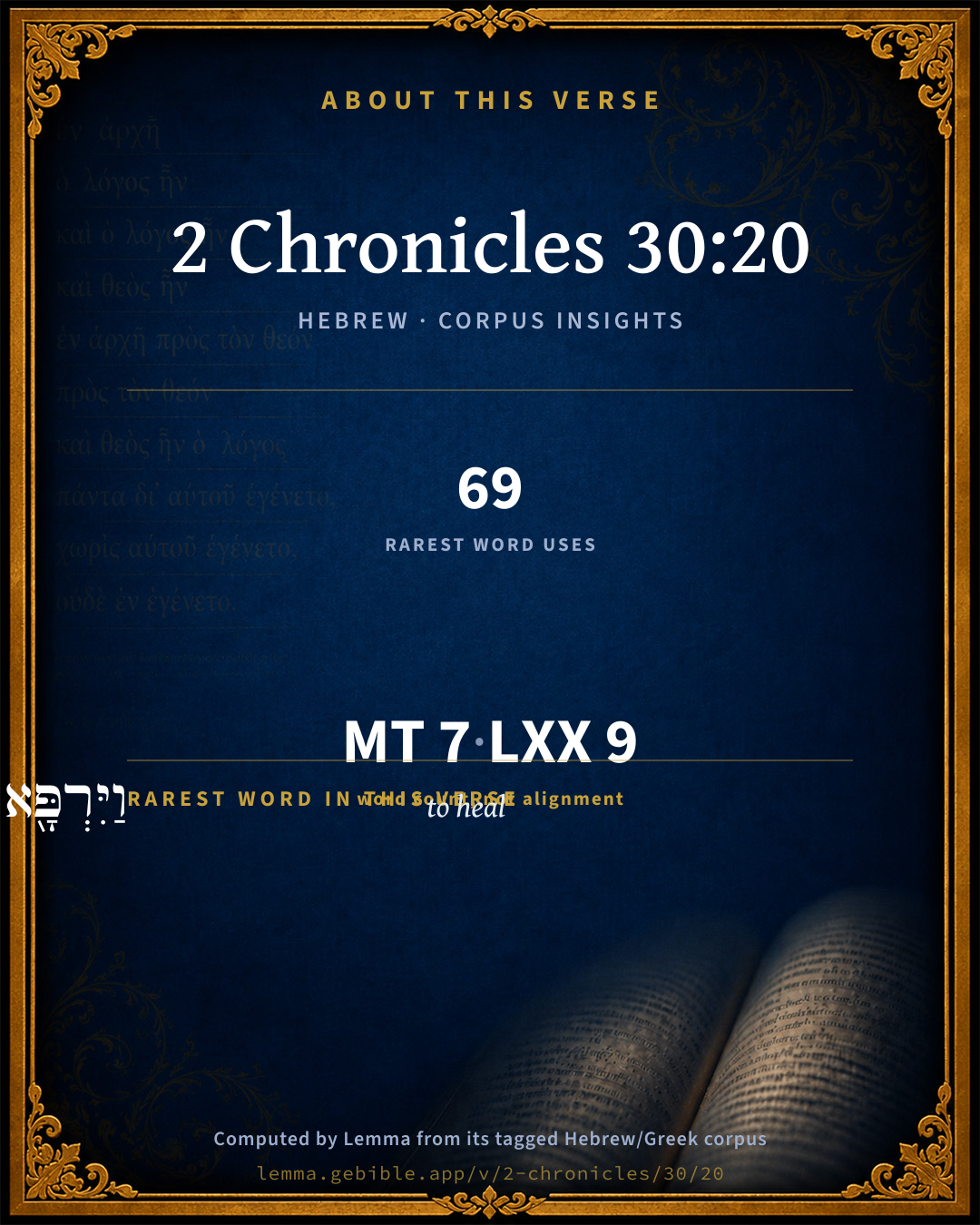
About this verse

These counts appear in no published source. They are computed here, from the morphology-tagged text and Lemma’s own curated glosses. What Lemma adds →

7
words
7
distinct lemmas
Historical
section

Grammatical profile

  • 2 verbs
  • 3 nouns
  • 1 preposition
  • 1 particle

Verb forms

  • וַיִּשְׁמַ֤ע Qal · Sequential Imperfect
  • וַיִּרְפָּ֖א Qal · Sequential Imperfect

Hebrew & Septuagint length

In English translation the verse runs 8 words from the Hebrew and 10 from the Septuagint (LXX English) — closely comparable.

A rough comparison of the two English renderings, which tokenize alike — not a word-level alignment.

Word counts can differ between the Hebrew and the Greek without any difference in meaning — e.g. the Hebrew direct-object marker אֵת has no separate Greek word, and Greek often adds the article ὁ.

In the original languages it is 7 Hebrew tokens and 9 Greek tokens — but the two are counted differently (Hebrew bundles its prefixes and suffixes into one token; the Greek is in lemma form), so that isn’t a like-for-like length.

Cross-references

3

Topical passages linked to 2 Chronicles 30:20 in the Treasury of Scripture Knowledge — connected by theme and wording, ordered by reader-vote popularity; previews shown in the World English Bible.

  • Exodus 15:26 and he said, "If you will diligently listen to the voice of Yahweh your God, and will do that which is right in his eyes, and will pay attention to his commandments, and keep all his statutes, I will put none of the diseases on you, which I have put on the Egyptians; for I am Yahweh who heals you."
  • Psalms 103:3 Who forgives all your sins; Who heals all your diseases;
  • James 5:15–16 and the prayer of faith will heal him who is sick, and the Lord will raise him up. If he has committed sins, he will be forgiven.

Cross-references courtesy of OpenBible.info (CC BY 4.0).

Hebrew and Greek witnesses Masoretic Hebrew ↔ Greek Septuagint

The same verse in the two great witnesses to the Old Testament, shown verse-for-verse.

These are two independent witnesses, not word-aligned to each other, and the Septuagint is shown in lemma (dictionary) form.

Hebrew 2 Chronicles 30:20 Masoretic · Westminster Leningrad Codex

וַיִּשְׁמַ֤ע יְהוָה֙ אֶל יְחִזְקִיָּ֔הוּ וַיִּרְפָּ֖א אֶת הָעָֽם

Yahweh listened to Hezekiah, and healed the people.

World English Bible · Public Domain

Greek LXX 2 Chronicles 30:20 Septuagint · lemma form

καί ἐπιἀκούω κύριος ὁ εζεκιας καί ἰάομαι ὁ λαός

And the Lord listened to Ezekias, and healed the people.

LXX2012 (modern English Septuagint) · Public Domain

Hebrew: Westminster Leningrad Codex (CC BY 4.0). Greek: Septuagint (public domain); English from LXX2012 (modern English Septuagint) (Public Domain). How the Septuagint differs from the Hebrew →

Commentary

Notes on 2 Chronicles 30:20 from classic Christian and Jewish commentators (each source and its license shown beneath its notes). The classic Christian expositions comment on the surrounding passage and are grouped to its opening verse, so a note may address several verses; the Jewish commentaries on the Tanakh (Rashi and others) are per-verse, so they appear only where the commentator wrote on this verse.

Lemma curates 59 commentaries, every one of them public domain or Creative Commons licensed, each selected and text-cleaned for this edition rather than reprinted as found. About our sources →

Trapp's Complete Commentary

John Trapp

2Ch 30:20 And the LORD hearkened to Hezekiah, and healed the people.

Ver. 20. And healed the people.] He healed them on both sides: "he forgave all their iniquities, and healed all their diseases." {Psa 103:3}

John Trapp, A Commentary or Exposition upon All the Books of the Old and New Testament (1647–1656) — public domain. Text from a community e-Sword module.

Joseph Benson's Commentary

2Ch 30:20. The Lord hearkened to Hezekiah — Was greatly pleased with his pious concern for the congregation; and, in answer to his prayer, healed the people — That is, pardoned this their sin, and accepted them and their services, as if they had been clean.

Joseph Benson's Commentary on the Old and New Testaments (1811–1818) — public domain. Text from a community e-Sword module.

Tyndale Open Study Notes

Tyndale Open Resources

30:20 God’s response to Hezekiah’s prayer showed that he is more concerned with the attitude of the heart than with strict attention to ritual details. • healed the people: Cp. 7:14.

Tyndale Open Study Notes — © Tyndale Open Resources, licensed CC BY-SA 4.0. Text via the HelloAO Bible API.

Geneva Bible (1599)

Geneva Bible translators

That is, did accept them as purified.

Geneva Bible (1599) marginal notes — public domain. Text via Bolls.life.

Jamieson, Fausset & Brown

Robert Jamieson, A. R. Fausset & David Brown

the Lord . . . healed the people--We imagine the whole affair to have been the following: In consequence of their transgressions they had cause to fear disease and even death (Lev 15:31). Hezekiah prayed for the nation, which was on the point of being diseased, and might therefore be regarded as sick already [BERTHEAU].

Jamieson, Fausset & Brown — Commentary Critical and Explanatory on the Whole Bible (1871) — public domain (CC PDM 1.0). Text via the HelloAO Bible API.

Ellicott's Commentary for English Readers

(20) And the Lord hearkened to Hezekiah.-Comp. Gen_20:17, “And Abraham prayed unto God; and God healed Abimelech and his wife,” &c. In the present instance the prayer of Hezekiah is thought of as averting a visitation of Divine wrath in the shape of disease and death. (Comp. Lev_15:31, “Thus shall ye separate the children of Israel from their uncleanness; that they die not in their uncleanness, when they defile my dwelling-place, that is among them.”)

For the word heal in connection with uncleanness comp. Isa_6:5; Isa_6:10. See also 2Ch_7:14, supra; Hos_5:13; Hos_14:4.

A Bible Commentary for English Readers, edited by Charles John Ellicott (1878–1897) — public domain. Text from a community e-Sword module.

The Cambridge Bible for Schools and Colleges

gen. ed. J. J. S. Perowne

20. healed the people] By prevention; no plague was allowed to break out among them, although uncleanness in the sanctuary had been threatened with death; Lev_15:31.

The Cambridge Bible for Schools and Colleges (gen. ed. J. J. S. Perowne; Cambridge University Press, 1878–1918) — public domain. Text from a community e-Sword module.

John Gill's Exposition

And the children of Israel that were present at Jerusalem kept the feast of unleavened bread seven days with great gladness,.... Which, according to the law of Moses, were always to follow the passover, Exo 12:18.

and the Levites and the priests praised the Lord day by day, singing with loud instruments unto the Lord; or instruments of strength (t); so called not from the matter of them, or manner in which they were made, but either from the sound of them, as our version, or from the strength and power of God, which they set forth in praise; the Targum is,"with instruments of praise,''and so the word is sometimes used, see Psa 8:2 compared with Mat 21:16, the priests blew with trumpets, and the Levites played on harps, psalteries, &c. and this they did every day when the sacrifices were offered, during the seven days of unleavened bread.

(t) "cum instrumentis fortitudinis", Vatablus.

John Gill's Exposition of the Whole Bible (1746–1763) — public domain (CC PDM 1.0). Text via the HelloAO Bible API.

Haydock's Catholic Bible Commentary

Merciful; literally, "appeased." Heb. and Sept. "healed." S. Jerom (Trad.) says, "It was asserted that no unclean person could taste the Phase, but death presently ensued; and they understood that the Lord was appeased, because those who eat did not die." H. --- Heb. girpa may, however, denote that God "pardoned," or did not impute the uncleanness to the people. Schindler, and C. xxxvi. 16., and Isaias vi. 10.

George Leo Haydock (1774–1849), Haydock's Catholic Family Bible and Commentary, 1859 edition — public domain. Excludes Psalms (Douay-Rheims chapter numbering differs from Protestant) and Deuterocanonical books (Catholic canon only).

Matthew Poole's English Annotations

From their uncleanness; which itself was a spiritual disease, and which probably produced a disease, or distemper, or trouble in their minds and consciences; which also had formerly brought, and might justly now bring, even outward diseases upon the body, or, at least, guilt, which is a disease upon the soul; from all which the Lord was pleased now to heal them, by pardoning this their sin, and accepting them and their services, as if they had been clean; which it is likely God was pleased to manifest by some outward sign, possibly by fire from heaven consuming the sacrifices; which was the usual token of God’s approbation, as hath been formerly noted more than once.

Matthew Poole's English Annotations on the Holy Bible (1683–1685) — public domain. Text from a community e-Sword/MySword module.

Whedon's Commentary on the Bible

Daniel D. Whedon

20. Healed the people — Their ceremonial and moral defilement is spoken of as a sickness. They were healed of their religious infirmity.

Daniel D. Whedon (gen. ed.), Commentary on the Old and New Testaments (1874–1909) — public domain. Text from a community e-Sword module.

The Pulpit Commentary

Healed the people. The Hebrew word here is the strict word for physical healing, and is a slight but significant indication of the reality of the spiritual view contemplated in Moses" Law in this matter.

The Pulpit Commentary (1880–1919), ed. H.D.M. Spence-Jones & Joseph S. Exell — public domain. Text from a community e-Sword module.

John Wesley's Explanatory Notes

Healed - That is, pardoned this their sin, and accepting them and their services, as if they had been clean.

John Wesley, Explanatory Notes Upon the Whole Bible (1754–1765) — public domain. Text via the GEBible commentary corpus.

Lesson kit

Teaching starters — assembled from the data on this page, not authored interpretation. Every prompt links to the verse data it draws on. Edit before teaching.

2 Chronicles, in the Historical, opens this verse with 7 words (7 distinct Hebrew lemmas). Its most distinctive word is râphâʼ (“to heal”). A historical commentator’s framing appears above. Read the whole chapter for the surrounding context.

Discussion questions

  1. The word râphâʼ carries the sense “to heal.” How does it shape the verse?
  2. How does Exodus 15:26, which shares this passage’s theme, read alongside this verse?
  3. These translations render this verse differently; the difference is in the English rendering, not the original. What questions does that raise?
  4. «וַיִּשְׁמַ֤ע» is a Qal Sequential Imperfect verb. How does that grammatical form shape the action described?
  5. Compare how Trapp's Complete Commentary and Joseph Benson's Commentary read this verse. Where do they agree or differ?

Things to notice

Reading settings

Reading text

Shown beneath each verse's original-language words.

Old Testament
Old Testament edition

Read the OT as the Masoretic Hebrew (MT) or the Greek Septuagint (LXX).

English shown for the Greek Septuagint (in the Hebrew ↔ Greek comparison).

Comparing translations? Open the Compare panel on any verse page to stack up to four side by side.