
Job 5:18

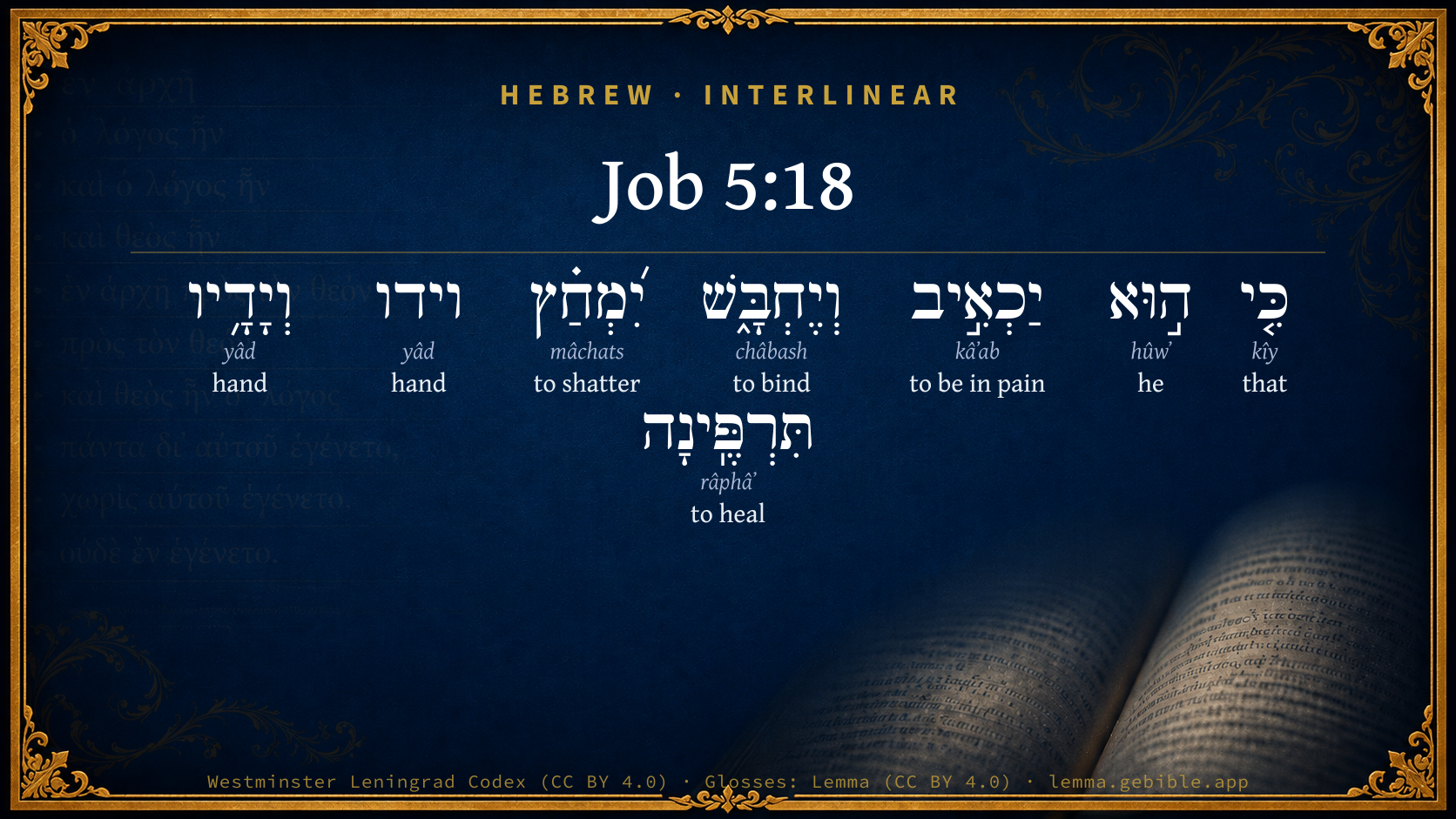
Hebrew (Westminster Leningrad Codex) Job 5:18 appears in the Hebrew Old Testament. The text above is from the Westminster Leningrad Codex. Each word links to its Strong’s number, a concise gloss, and parsing drawn from the Open Scriptures Hebrew Bible morphology. Click any word for its full Brown-Driver-Briggs (BDB) entry.
Download image
Cite this verse

Job 5:18 (World English Bible). Public Domain. Lemma interlinear Bible study tool, https://lemma.gebible.app/v/job/5/18.

Show BibTeX & RIS
BibTeX
RIS
English Translation
For he wounds, and binds up; He injures, and his hands make whole.
World English Bible · Public Domain
Download a study sheet

One document with this verse’s original text, its word-by-word gloss line, the meaning frame, cross-references with their text, attributed commentary, and full source and license credits — printable, and it pastes into notes with its structure intact.

This verse Autodidact and up

Study sheet (.html) Plain text (.txt)

A passage Seminary Student

Up to 50 verses in one chapter. A passage sheet keeps up to 6 commentary sources and 12 cross-references per verse, in the order this page ranks them, and says so on the sheet whenever that leaves anything out. Ask for a single verse and you get the Autodidact verse sheet above.

Everything on this page stays free to read, with no account — the sheet is a download of what is already on screen, not access to it.

Want to remove ads? Support Godless Engineer
Compare translations 3

The same verse in 3 English versions, stacked beneath the original-language interlinear above. Click any original word for its lexicon entry.

Each is an independent rendering of the whole verse — the interlinear is not word-aligned to these translations.

Highlighted words mark where these versions differ — a whole-verse word diff, not a word-by-word alignment.

  • World English Bible Public Domain
    For he wounds, and binds up; He injures, and his hands make whole.
  • King James Version Public Domain
    For he maketh sore, and bindeth up: he woundeth, and his hands make whole.
  • unfoldingWord Literal Text CC BY-SA 4.0
    For he injures and binds up, he wounds and his hands heal.

unfoldingWord Literal Text — © unfoldingWord, licensed CC BY-SA 4.0. Word-aligned USFM3 via Door43 (git.door43.org/unfoldingWord/en_ult).

Versions to compare (up to 4)

3 of 4 selected

Show all 18 translations

Every available English version of this verse, each an independent rendering of the whole verse.

  • World English Bible Public Domain
    For he wounds, and binds up; He injures, and his hands make whole.
  • Berean Standard Bible Public Domain
    For He wounds, but He also binds; He strikes, but His hands also heal.
  • Majority Standard Bible Public Domain
    For He wounds, but He also binds; He strikes, but His hands also heal.
  • King James Version Public Domain
    For he maketh sore, and bindeth up: he woundeth, and his hands make whole.
  • American Standard Version (1901) Public Domain
    For he maketh sore, and bindeth up; He woundeth, and his hands make whole.
  • Revised Version (1885) Public Domain
    For he maketh sore, and bindeth up; he woundeth, and his hands make whole.
  • Geneva Bible (1599) Public Domain
    For he maketh the wound, and bindeth it vp: he smiteth, and his handes make whole.
  • Douay-Rheims (1899) Public Domain
    For he woundeth, and cureth: he striketh, and his hands shall heal.
  • Young's Literal Translation Public Domain
    For He doth pain, and He bindeth up, He smiteth, and His hands heal.
  • Literal Standard Version CC BY-SA 4.0
    For He pains, and He binds up, || He strikes, and His hands heal.
  • Unlocked Literal Bible CC BY-SA 4.0
    For he wounds and then binds up; he wounds and then his hands heal.
  • unfoldingWord Literal Text CC BY-SA 4.0
    For he injures and binds up, he wounds and his hands heal.
  • Darby Bible Public Domain
    For he maketh sore, and bindeth up; he woundeth, and his hands make whole.
  • World Messianic Bible Public Domain
    For he wounds and binds up. He injures and his hands make whole.
  • Webster's Bible Public Domain
    For he maketh sore, and bindeth up: he woundeth, and his hands make whole.
  • Free Bible Version CC BY-SA 4.0
    For he causes pain but he provides relief; he wounds but his hands heal.
  • Bible in Basic English Public Domain
    For after his punishment he gives comfort, and after wounding, his hands make you well.
  • JPS Tanakh (1917) Public Domain
    For He maketh sore, and bindeth up; He woundeth, and His hands make whole.

Literal Standard Version (2020), Covenant Press — licensed CC BY-SA 4.0. Text via the HelloAO Bible API (eBible.org). Unlocked Literal Bible (unfoldingWord) — licensed CC BY-SA 4.0. Text via the HelloAO Bible API (eBible.org). unfoldingWord Literal Text — © unfoldingWord, licensed CC BY-SA 4.0. Word-aligned USFM3 via Door43 (git.door43.org/unfoldingWord/en_ult). Free Bible Version, Dr. Jonathan Gallagher — licensed CC BY-SA 4.0. Text via the HelloAO Bible API (eBible.org).

Word by word

More ways to search: Search by grammar → Find every occurrence → Compare this word →

Practice this passage: Drill this verse → Learn its vocabulary →

יַכְאִ֣יב
kâʼab
H3510
“to be in pain”
Verb, Hiphil, Imperfect, 3rd Person, Masculine, Singular
Part of Speech
Verb
Stem
Hiphil
Form
Imperfect
Person
3rd Person
Gender
Masculine
Number
Singular
Full BDB Definition

Origin: a primitive root

TWOT: 940

to be in pain, be sore, have pain, be sorrowful - (Qal) - to be in pain (physical) - to be in pain (mental) - (Hiphil) - to cause pain, hurt, mar - pain, mar (participle)
  1. כִּ֤י kîy H3588 “that” Conjunction
  2. ה֣וּא hûwʼ H1931 “he” Pronoun, Personal, 3rd Person, Masculine, Singular
  3. וְיֶחְבָּ֑שׁ châbash H2280 “and · to bind” Conjunction + Verb, Qal, Imperfect, 3rd Person, Masculine, Singular
  4. יִ֝מְחַ֗ץ mâchats H4272 “to shatter” Verb, Qal, Imperfect, 3rd Person, Masculine, Singular
  5. וידו yâd H3027 “and · hands · his” Conjunction + Noun, Common, Both, Dual, Construct + Suffix, Personal, 3rd Person, Masculine, Singular
  6. וְיָדָ֥יו yâd H3027 “and · hands · his” Conjunction + Noun, Common, Both, Dual, Construct + Suffix, Personal, 3rd Person, Masculine, Singular
  7. תִּרְפֶּֽינָה râphâʼ H7495 “to heal” Verb, Qal, Imperfect, 3rd Person, Feminine, Plural

About this verse

These counts appear in no published source. They are computed here, from the morphology-tagged text and Lemma’s own curated glosses. What Lemma adds →

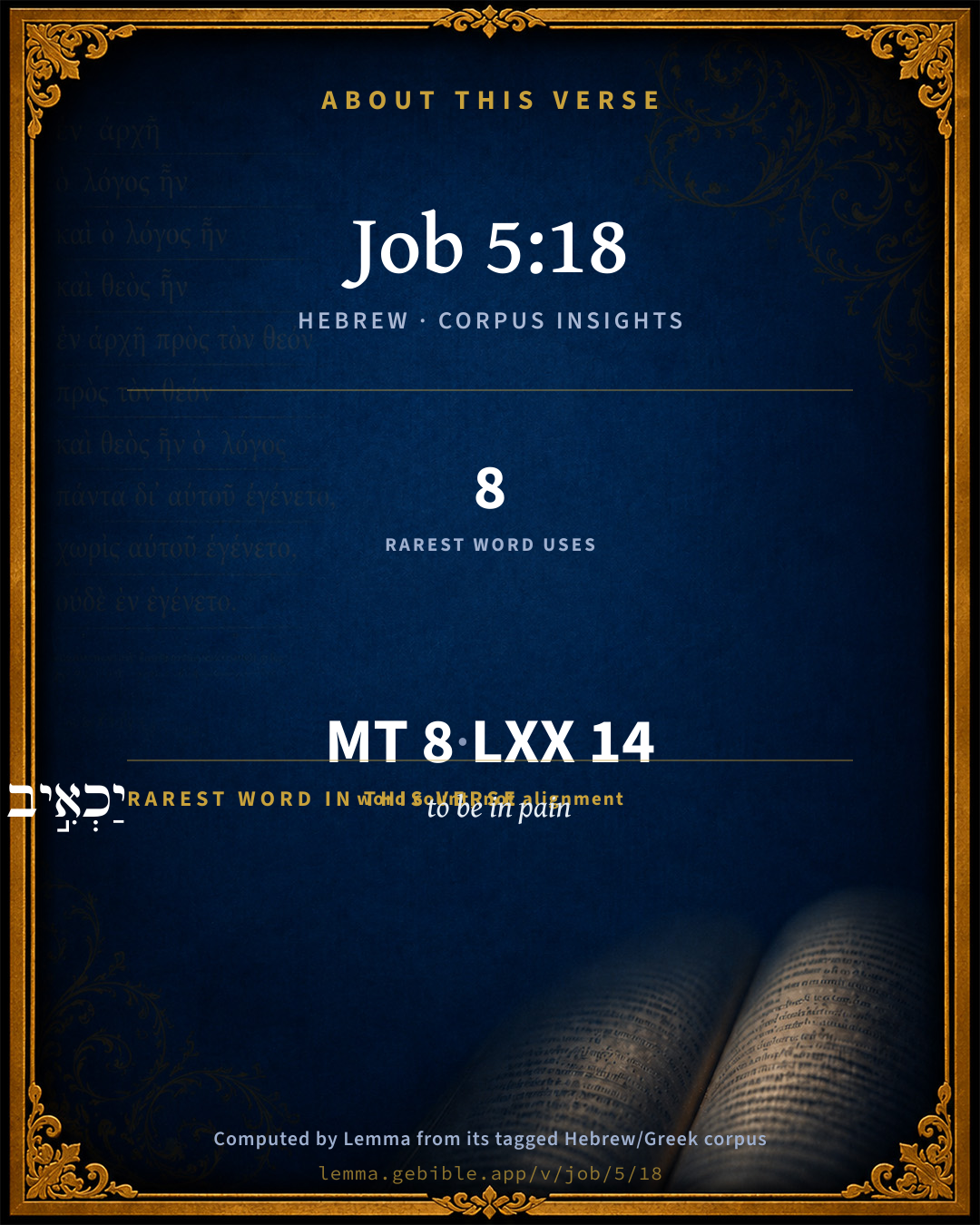
8
words
7
distinct lemmas
Wisdom
section

Notable vocabulary

The rarest word here is יַכְאִ֣יב to be in pain H3510 — appearing just 8 times in the whole Hebrew Bible.

Shared distinctive vocabulary

יַכְאִ֣יב to be in pain H3510 occurs in 8 verses of the Hebrew Bible. Also found in:

Grammatical profile

  • 4 verbs
  • 2 nouns
  • 1 pronoun
  • 1 conjunction

Verb forms

  • יַכְאִ֣יב Hiphil · Imperfect
  • וְיֶחְבָּ֑שׁ Qal · Imperfect
  • יִ֝מְחַ֗ץ Qal · Imperfect
  • תִּרְפֶּֽינָה Qal · Imperfect

Repetition

A word recurs within this verse — often emphatic in Hebrew:

  • וידו hand H3027 ×2

Hebrew & Septuagint length

In English translation the verse runs 13 words from the Hebrew and 19 from the Septuagint (LXX English) — the Septuagint runs noticeably longer here. See the side-by-side →

A rough comparison of the two English renderings, which tokenize alike — not a word-level alignment.

Word counts can differ between the Hebrew and the Greek without any difference in meaning — e.g. the Hebrew direct-object marker אֵת has no separate Greek word, and Greek often adds the article ὁ.

In the original languages it is 8 Hebrew tokens and 14 Greek tokens — but the two are counted differently (Hebrew bundles its prefixes and suffixes into one token; the Greek is in lemma form), so that isn’t a like-for-like length.

Cross-references

5

Topical passages linked to Job 5:18 in the Treasury of Scripture Knowledge — connected by theme and wording, ordered by reader-vote popularity; previews shown in the World English Bible.

  • Hosea 6:1 "Come, and let us return to Yahweh; For he has torn us to pieces, And he will heal us; He has injured us, And he will bind up our wounds.
  • Deuteronomy 32:39 See now that I, even I, am he, There is no god with me: I kill, and I make alive; I wound, and I heal; There is none who can deliver out of my hand.
  • Psalms 147:3 He heals the broken in heart, And binds up their wounds.
  • Isaiah 30:26 Moreover the light of the moon shall be as the light of the sun, and the light of the sun shall be sevenfold, as the light of seven days, in the day that Yahweh binds up the hurt of his people, and heals the stroke of their wound.
  • 1 Samuel 2:6 Yahweh kills, and makes alive: He brings down to Sheol, and brings up.

Cross-references courtesy of OpenBible.info (CC BY 4.0).

Hebrew and Greek witnesses Masoretic Hebrew ↔ Greek Septuagint

The same verse in the two great witnesses to the Old Testament, shown verse-for-verse.

Here the Septuagint runs noticeably longer than the Hebrew — LXX2012 (modern English Septuagint) 19 words vs World English Bible 13. A rough length comparison of the two English translations, not a word-level alignment — read both below.

These are two independent witnesses, not word-aligned to each other, and the Septuagint is shown in lemma (dictionary) form.

Hebrew Job 5:18 Masoretic · Westminster Leningrad Codex

כִּ֤י ה֣וּא יַכְאִ֣יב וְיֶחְבָּ֑שׁ יִ֝מְחַ֗ץ וידו וְיָדָ֥יו תִּרְפֶּֽינָה

For he wounds, and binds up; He injures, and his hands make whole.

World English Bible · Public Domain

Greek LXX Job 5:18 Septuagint · lemma form

αὐτός γάρ ἀλγέω ποιέω καί πάλιν ἀπο καταἵστημι παίω καί ὁ χείρ αὐτός ἰάομαι

for he causes a man to be in pain, and restores him again: he smites, and his hands heal.

LXX2012 (modern English Septuagint) · Public Domain

Hebrew: Westminster Leningrad Codex (CC BY 4.0). Greek: Septuagint (public domain); English from LXX2012 (modern English Septuagint) (Public Domain). How the Septuagint differs from the Hebrew →

Commentary

Notes on Job 5:18 from classic Christian and Jewish commentators (each source and its license shown beneath its notes). The classic Christian expositions comment on the surrounding passage and are grouped to its opening verse, so a note may address several verses; the Jewish commentaries on the Tanakh (Rashi and others) are per-verse, so they appear only where the commentator wrote on this verse.

Lemma curates 59 commentaries, every one of them public domain or Creative Commons licensed, each selected and text-cleaned for this edition rather than reprinted as found. About our sources →

Trapp's Complete Commentary

John Trapp

Job 5:18 For he maketh sore, and bindeth up: he woundeth, and his hands make whole.

Ver. 18. For he maketh sore, and bindeth up] As a surgeon maketh an incision to let out the imposthumed matter, and then heals up the wound again. God hath a salve for every sore, a medicine for every malady; he is both a Father and a Physician, he lanceth us not unless need be, 1Pe 1:6. We are judged of the Lord, that we may not be condemned with the world. Would we that God should let us alone to perish in our corruptions (as he did Ephraim, Hos 4:14), and not meddle with us? or that he should scarf our bones before they are set, and lap up our sores before they are searched? this were a mercy more cruel than any cruelty, as a Father calls it. And yet most people are of that countryman’s mind, spoken of by Luther, who being on his sick-bed advised by his minister to take in good part his present pain, as a token of God’s love, answered, Ah quam velim alios amare, non me! If this be his love, I could wish he would love others, and not me (Luth. in Gen.).

He woundeth] This is more than to make sore or sick, like as Heb 12:6. Scourging is worse than chastening. God sometimes makes bloody wales upon the backs of his best children; he wounds them with the wound of an enemy, Psa 68:21; Psa 110:5, and leaves them all gore blood, as the word here used importeth, מחץ cruentavit. stained with blood.

And his hands make whole] He hath, as a chirurgeon should have, a lady’s hand, soft and tender, a father’s heart, relenting over his pained Ephraims, Hos 11:8. He afflicteth not willingly, or from the heart, Lam 3:33; it goeth as much against the heart with him as against the hair with us; and evermore

Deiecit ut relevet, premit ut solatia praestet:

Enecat, ut possit vivificare Deus.

John Trapp, A Commentary or Exposition upon All the Books of the Old and New Testament (1647–1656) — public domain. Text from a community e-Sword module.

Joseph Benson's Commentary

Job 5:18-19. For he maketh sore, &c. — God’s usual method is first to wound and then to heal, first to convince and then to comfort, first to humble and then to exalt. And he never makes a wound too great, too deep, for himself to cure. He will deliver thee — If thou seek to him by prayer and repentance; in six troubles — In distresses, manifold and repeated. Here he applies himself to Job directly. Yea, in seven there shall no evil touch thee — Thou shalt have a good issue out of all thy troubles, though they be both great and many.

Joseph Benson's Commentary on the Old and New Testaments (1811–1818) — public domain. Text from a community e-Sword module.

Jamieson, Fausset & Brown

Robert Jamieson, A. R. Fausset & David Brown

he maketh sore, and bindeth up-- (Deu 32:39; Hos 6:1; Sa1 2:6). An image from binding up a wound. The healing art consisted much at that time in external applications.

Jamieson, Fausset & Brown — Commentary Critical and Explanatory on the Whole Bible (1871) — public domain (CC PDM 1.0). Text via the HelloAO Bible API.

Adam Clarke's Commentary

Verse 18. For he maketh sore, and bindeth up. Thus nervously rendered by Coverdale, For though he make a wounde, he giveth a medicyne agayne; though he smyte, his honde maketh whole agayne.

Adam Clarke's Commentary on the Bible (1810–1826) — public domain. Text from a community e-Sword/MySword module.

Ellicott's Commentary for English Readers

(18) He maketh sore, and bindeth up.—The sentiment here expressed is one of those obvious ones which lose all their force from familiarity with them, but which come home sometimes in sorrow with a power that is boundless, because Divine.

A Bible Commentary for English Readers, edited by Charles John Ellicott (1878–1897) — public domain. Text from a community e-Sword module.

The Cambridge Bible for Schools and Colleges

gen. ed. J. J. S. Perowne

18. maketh sore and bindeth up] Maketh sore in order to bind up, smiteth in order more perfectly to heal. If this physician induce disease, it is in order to procure a sounder health.

The Cambridge Bible for Schools and Colleges (gen. ed. J. J. S. Perowne; Cambridge University Press, 1878–1918) — public domain. Text from a community e-Sword module.

John Gill's Exposition

For he maketh sore, and bindeth up,.... Or, "though he maketh sore, yet he bindeth up" (d); as a surgeon, who makes a wound the sorer by probing and opening it, to let out the matter and make way for his medicine, and then lays on the plaster, and binds it up: so God causes grief and puts his people to pain, by diseases of body, or by making breaches in, their families and estates, and such like cutting providences; and then he binds up their breach, and heals the stroke of their wound, and in the issue makes all whole again: so in spiritual things; he cuts and wounds, and gives pain and uneasiness, by the sharp twoedged sword of the word, and by his Spirit making use of it; and lays open all the corruption of nature, and brings to repentance and humiliation for all transgressions; and then pours in the oil and wine of pardoning grace and mercy, and binds up the wounds that are made:

he woundeth, and his hands make whole; or "heal" (e); the same thing is meant, expressed by different words; and the whole suggests, that every afflicted man, and particularly Job, should he behave well, and as he ought, under the afflicting hand of God, would be healed, and become sound and whole again, in body, mind, family, and estate; for, though God for the present caused grief, yet he would have compassion, since he did not willingly grieve the children of men; did not do it for his own pleasure, but for their good; as a skilful surgeon cuts and wounds in order to heal; see Deu 32:39.

(d) Assembly's Annotations. (e) "sanabunt", V. L. Pagninus, Montanus, &c.

John Gill's Exposition of the Whole Bible (1746–1763) — public domain (CC PDM 1.0). Text via the HelloAO Bible API.

Albert Barnes' Notes on the Bible

For he maketh sore - That is, he afflicts.

And bindeth up - He heals. The phrase is taken from the custom of binding up a wound; see Isa 1:6, note; Isa 38:21, note. This was a common mode of healing among the Hebrews; and the practice of medicine appears to have been confined much to external applications. The meaning of this verse is, that afflictions come from God, and that he only can support, comfort, and restore. Health is his gift; and all the consolation which we need, and for which we can look, must come from him.

Albert Barnes' Notes on the Bible (1834–1885) — public domain. Text from a community e-Sword/MySword module.

Matthew Poole's English Annotations

Bindeth up, to wit, the wounds, as good surgeons use to do when they have dressed them, in order to their healing. Compare Psa 147:3; Eze 34:4. The sense is, Though he hath seen it fit to wound thee, yet he will not always grieve thee, but will in due time release thee from all thy miseries. Therefore despair not.

Matthew Poole's English Annotations on the Holy Bible (1683–1685) — public domain. Text from a community e-Sword/MySword module.

Whedon's Commentary on the Bible

Daniel D. Whedon

18. Bindeth up — Among the ancients the healing art was for the most part confined to external applications. They seem generally to have attributed the curing of diseases to supernatural agency; hence priests were resorted to for healing purposes, since they were supposed to possess peculiar powers of propitiating their deities. On the medical resources of the ancients, see PLINY, Nat. Hist., Books 23-29. Also Leviticus 13, which Kitto calls the most ancient medical treatise in the world.

Daniel D. Whedon (gen. ed.), Commentary on the Old and New Testaments (1874–1909) — public domain. Text from a community e-Sword module.

The Pulpit Commentary

For he maketh sore, and bindeth up. Metaphors drawn from the healing art. He "maketh sore applies the scalpel and the cautery when and where they are needed; and then, after a while, "bindeth up employs his lint and bandages; in both cases alike seeking the good of the sufferer. He woundeth, and his hands make whole. (Deu_32:39 Hos_6:1)

The Pulpit Commentary (1880–1919), ed. H.D.M. Spence-Jones & Joseph S. Exell — public domain. Text from a community e-Sword module.

John Wesley's Explanatory Notes

For he, &c. - God's usual method is, first to humble, and then to exalt. And he never makes a wound too great, too deep for his own cure.

John Wesley, Explanatory Notes Upon the Whole Bible (1754–1765) — public domain. Text via the GEBible commentary corpus.

Lesson kit

Teaching starters — assembled from the data on this page, not authored interpretation. Every prompt links to the verse data it draws on. Edit before teaching.

Job, in the Wisdom, opens this verse with 8 words (7 distinct Hebrew lemmas). Its most distinctive word is kâʼab (“to be in pain”). The Greek Septuagint runs longer here. A historical commentator’s framing appears above. Read the whole chapter for the surrounding context.

Discussion questions

  1. How does “to be in pain” (kâʼab) shape what this verse is saying?
  2. How does Genesis 34:25, which shares the word «to be in pain», read alongside this verse?
  3. What does the repetition of “hand” (2× in this one verse) do in this verse?
  4. The Septuagint runs longer here than the Hebrew. What might account for the difference?
  5. These translations render this verse differently; the difference is in the English rendering, not the original. What questions does that raise?
  6. «יַכְאִ֣יב» is a Hiphil Imperfect verb. How does that grammatical form shape the action described?
  7. Compare how Trapp's Complete Commentary and Joseph Benson's Commentary read this verse. Where do they agree or differ?

Things to notice

Reading settings

Reading text

Shown beneath each verse's original-language words.

Old Testament
Old Testament edition

Read the OT as the Masoretic Hebrew (MT) or the Greek Septuagint (LXX).

English shown for the Greek Septuagint (in the Hebrew ↔ Greek comparison).

Comparing translations? Open the Compare panel on any verse page to stack up to four side by side.