
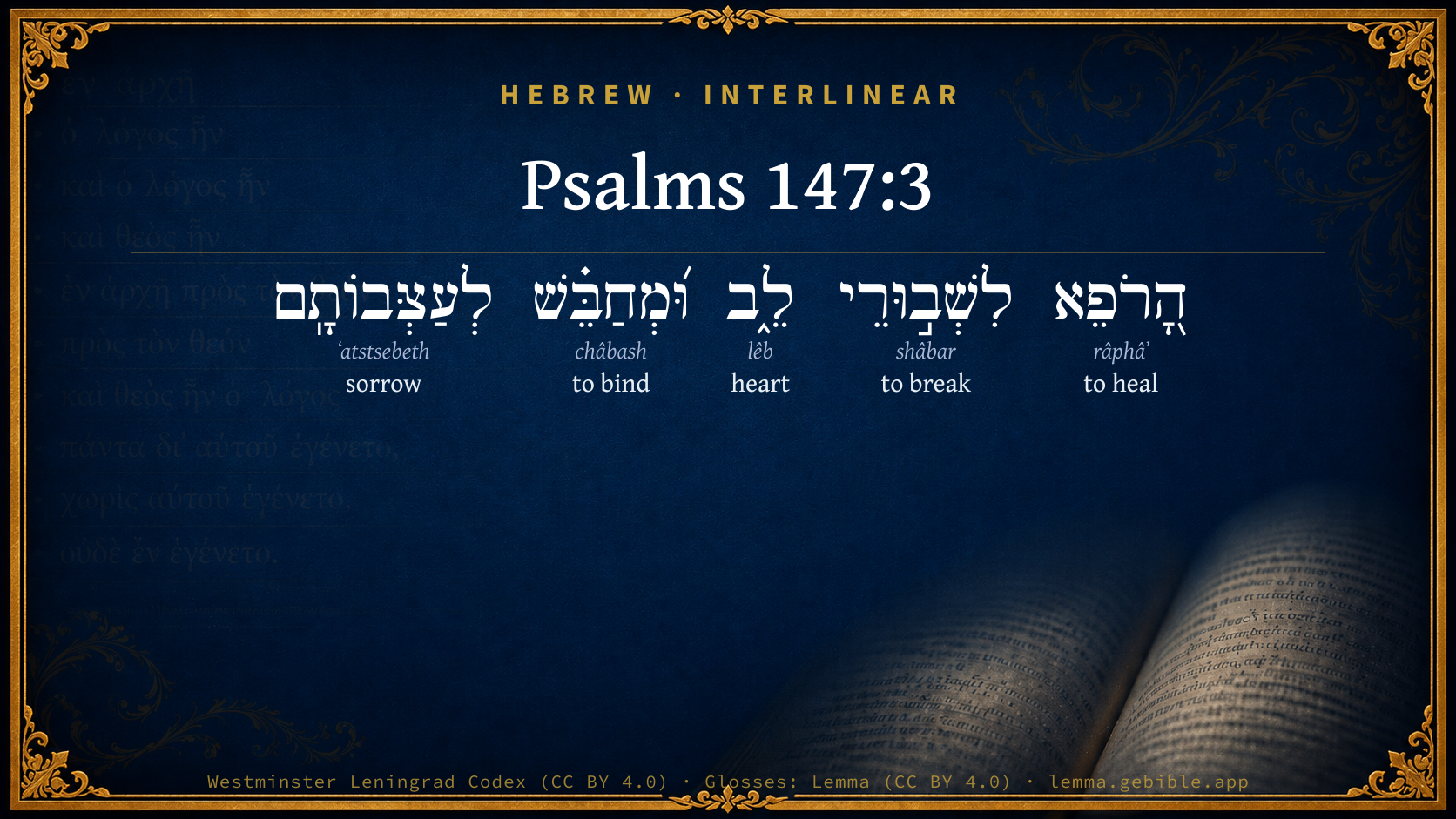
Psalms 147:3

Hebrew (Westminster Leningrad Codex) Psalms 147:3 appears in the Hebrew Old Testament. The text above is from the Westminster Leningrad Codex. Each word links to its Strong’s number, a concise gloss, and parsing drawn from the Open Scriptures Hebrew Bible morphology. Click any word for its full Brown-Driver-Briggs (BDB) entry.
Download image
Cite this verse

Psalms 147:3 (World English Bible). Public Domain. Lemma interlinear Bible study tool, https://lemma.gebible.app/v/psalms/147/3.

Show BibTeX & RIS
BibTeX
RIS
English Translation
He heals the broken in heart, And binds up their wounds.
World English Bible · Public Domain
Download a study sheet

One document with this verse’s original text, its word-by-word gloss line, the meaning frame, cross-references with their text, attributed commentary, and full source and license credits — printable, and it pastes into notes with its structure intact.

This verse Autodidact and up

Study sheet (.html) Plain text (.txt)

A passage Seminary Student

Up to 50 verses in one chapter. A passage sheet keeps up to 6 commentary sources and 12 cross-references per verse, in the order this page ranks them, and says so on the sheet whenever that leaves anything out. Ask for a single verse and you get the Autodidact verse sheet above.

Everything on this page stays free to read, with no account — the sheet is a download of what is already on screen, not access to it.

Want to remove ads? Support Godless Engineer
Compare translations 3

The same verse in 3 English versions, stacked beneath the original-language interlinear above. Click any original word for its lexicon entry.

Each is an independent rendering of the whole verse — the interlinear is not word-aligned to these translations.

Highlighted words mark where these versions differ — a whole-verse word diff, not a word-by-word alignment.

  • World English Bible Public Domain
    He heals the broken in heart, And binds up their wounds.
  • King James Version Public Domain
    He healeth the broken in heart, and bindeth up their wounds.
  • unfoldingWord Literal Text CC BY-SA 4.0
    healing the broken of heart and binding up their wounds;

unfoldingWord Literal Text — © unfoldingWord, licensed CC BY-SA 4.0. Word-aligned USFM3 via Door43 (git.door43.org/unfoldingWord/en_ult).

Versions to compare (up to 4)

3 of 4 selected

Show all 18 translations

Every available English version of this verse, each an independent rendering of the whole verse.

  • World English Bible Public Domain
    He heals the broken in heart, And binds up their wounds.
  • Berean Standard Bible Public Domain
    He heals the brokenhearted and binds up their wounds.
  • Majority Standard Bible Public Domain
    He heals the brokenhearted and binds up their wounds.
  • King James Version Public Domain
    He healeth the broken in heart, and bindeth up their wounds.
  • American Standard Version (1901) Public Domain
    He healeth the broken in heart, And bindeth up their wounds.
  • Revised Version (1885) Public Domain
    He healeth the broken in heart, and bindeth up their wounds.
  • Geneva Bible (1599) Public Domain
    He healeth those that are broken in heart, and bindeth vp their sores.
  • Douay-Rheims (1899) Public Domain
    in the children of men, in whom there is no salvation.
  • Young's Literal Translation Public Domain
    Who is giving healing to the broken of heart, And is binding up their griefs.
  • Literal Standard Version CC BY-SA 4.0
    Who is giving healing to the broken of heart, || And is binding up their griefs.
  • Unlocked Literal Bible CC BY-SA 4.0
    He heals the brokenhearted and binds up their wounds.
  • unfoldingWord Literal Text CC BY-SA 4.0
    healing the broken of heart and binding up their wounds;
  • Darby Bible Public Domain
    He healeth the broken in heart, and bindeth up their wounds.
  • World Messianic Bible Public Domain
    He heals the broken in heart, and binds up their wounds.
  • Webster's Bible Public Domain
    He healeth the broken in heart, and bindeth up their wounds.
  • Free Bible Version CC BY-SA 4.0
    He heals the broken-hearted, and bandages the wounded.
  • Bible in Basic English Public Domain
    He makes the broken-hearted well, and puts oil on their wounds.
  • JPS Tanakh (1917) Public Domain
    Who healeth the broken in heart, and bindeth up their wounds.

Literal Standard Version (2020), Covenant Press — licensed CC BY-SA 4.0. Text via the HelloAO Bible API (eBible.org). Unlocked Literal Bible (unfoldingWord) — licensed CC BY-SA 4.0. Text via the HelloAO Bible API (eBible.org). unfoldingWord Literal Text — © unfoldingWord, licensed CC BY-SA 4.0. Word-aligned USFM3 via Door43 (git.door43.org/unfoldingWord/en_ult). Free Bible Version, Dr. Jonathan Gallagher — licensed CC BY-SA 4.0. Text via the HelloAO Bible API (eBible.org).

Word by word

More ways to search: Search by grammar → Find every occurrence → Compare this word →

Practice this passage: Drill this verse → Learn its vocabulary →

About this verse

These counts appear in no published source. They are computed here, from the morphology-tagged text and Lemma’s own curated glosses. What Lemma adds →

5
words
5
distinct lemmas
Wisdom
section

Notable vocabulary

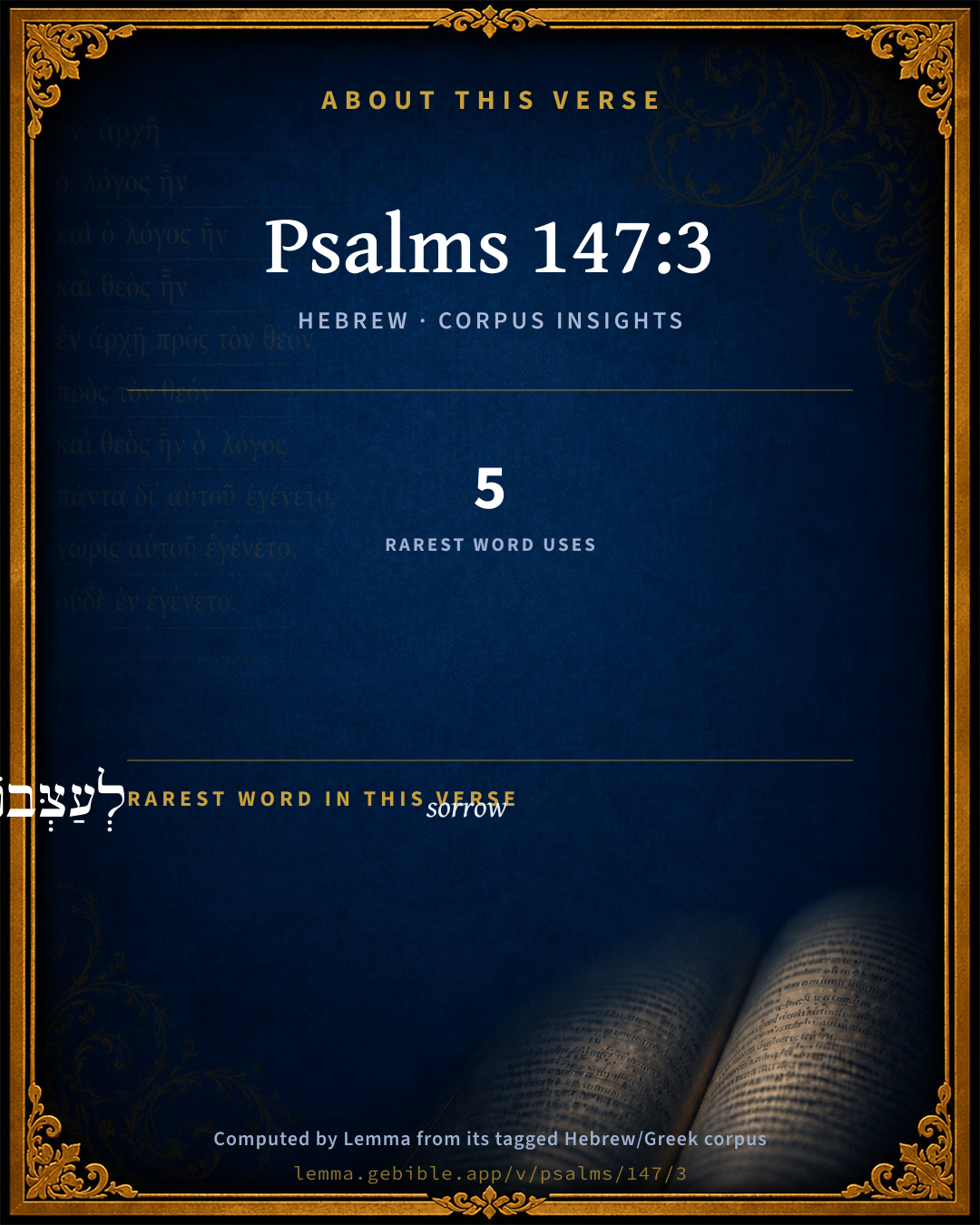
The rarest word here is לְעַצְּבוֹתָֽם sorrow H6094 — appearing just 5 times in the whole Hebrew Bible.

Shared distinctive vocabulary

לְעַצְּבוֹתָֽם sorrow H6094 occurs in 5 verses of the Hebrew Bible. Also found in:

Grammatical profile

  • 3 verbs
  • 2 nouns

Verb forms

  • הָ֭רֹפֵא Qal · Participle Active
  • לִשְׁב֣וּרֵי Qal · Participle Passive
  • וּ֝מְחַבֵּ֗שׁ Piel · Participle Active

Hebrew & Septuagint length

In English translation the verse runs 11 words from the Hebrew and 11 from the Septuagint (LXX English) — the same length.

A rough comparison of the two English renderings, which tokenize alike — not a word-level alignment.

Word counts can differ between the Hebrew and the Greek without any difference in meaning — e.g. the Hebrew direct-object marker אֵת has no separate Greek word, and Greek often adds the article ὁ.

Cross-references

11

Topical passages linked to Psalms 147:3 in the Treasury of Scripture Knowledge — connected by theme and wording, ordered by reader-vote popularity; previews shown in the World English Bible.

  • Psalms 34:18 Yahweh is near to those who have a broken heart, And saves those who have a crushed spirit.
  • Job 5:18 For he wounds, and binds up; He injures, and his hands make whole.
  • Jeremiah 33:6 Behold, I will bring it health and cure, and I will cure them; and I will reveal to them abundance of peace and truth.
  • Luke 4:18 "The Spirit of the Lord is on me, Because he has anointed me to preach good news to the poor. He has sent me to heal the brokenhearted, To proclaim release to the captives, Recovering of sight to the blind, To deliver those who are crushed,
  • Isaiah 61:1 The Spirit of the Lord Yahweh is on me; because Yahweh has anointed me to preach good news to the humble; he has sent me to bind up the broken-hearted, to proclaim liberty to the captives, and the opening [of the prison] to those who are bound;
  • Hosea 6:1–2 "Come, and let us return to Yahweh; For he has torn us to pieces, And he will heal us; He has injured us, And he will bind up our wounds.
  • Psalms 51:17 The sacrifices of God are a broken spirit. A broken and contrite heart, O God, you will not despise.
  • Isaiah 57:15 For thus says the high and lofty One who inhabits eternity, whose name is Holy: I dwell in the high and holy place, with him also who is of a contrite and humble spirit, to revive the spirit of the humble, and to revive the heart of the contrite.
  • Malachi 4:2 But to you who fear my name shall the sun of righteousness arise with healing in its wings. You will go out, and leap like calves of the stall.
  • Ezekiel 34:16 I will seek that which was lost, and will bring back that which was driven away, and will bind up that which was broken, and will strengthen that which was sick: but the fat and the strong I will destroy; I will feed them in justice.
  • Isaiah 1:5–6 Why should you be beaten more, That you revolt more and more? The whole head is sick, And the whole heart faint.

Cross-references courtesy of OpenBible.info (CC BY 4.0).

Hebrew and Greek witnesses Masoretic Hebrew ↔ Greek Septuagint

The same verse in the two great witnesses to the Old Testament, shown verse-for-verse.

You’re reading Greek Psalm 146 (Hebrew Psalm 147). The Septuagint counts the superscription, so verse numbers can differ from the Hebrew — chapter-level alignment, not verse-by-verse. Numbering follows Rahlfs.

These are two independent witnesses, not word-aligned to each other, and the Septuagint is shown in lemma (dictionary) form.

Hebrew Psalms 147:3 Masoretic · Westminster Leningrad Codex

הָ֭רֹפֵא לִשְׁב֣וּרֵי לֵ֑ב וּ֝מְחַבֵּ֗שׁ לְעַצְּבוֹתָֽם

He heals the broken in heart, And binds up their wounds.

World English Bible · Public Domain

Greek LXX Greek Psalm 146:3 Septuagint · lemma form

ὁ ἰάομαι ὁ συντρίβω ὁ καρδία καί δεσμεύω ὁ σύντριμμα αὐτός

He heals the broken in heart, and binds up their wounds.

LXX2012 (modern English Septuagint) · Public Domain

Hebrew: Westminster Leningrad Codex (CC BY 4.0). Greek: Septuagint (public domain); English from LXX2012 (modern English Septuagint) (Public Domain). How the Septuagint differs from the Hebrew →

Commentary

Notes on Psalms 147:3 from classic Christian and Jewish commentators (each source and its license shown beneath its notes). The classic Christian expositions comment on the surrounding passage and are grouped to its opening verse, so a note may address several verses; the Jewish commentaries on the Tanakh (Rashi and others) are per-verse, so they appear only where the commentator wrote on this verse.

Lemma curates 59 commentaries, every one of them public domain or Creative Commons licensed, each selected and text-cleaned for this edition rather than reprinted as found. About our sources →

Trapp's Complete Commentary

John Trapp

Psa 147:3 He healeth the broken in heart, and bindeth up their wounds.

Ver. 3. He healeth the broken in heart] Pouring the oil of his grace into none but those broken vessels.

And bindeth up their wounds] As a good shepherd, Zec 11:4, that good Samaritan, Luk 10:34, and as a good surgeon dealeth by his patient. But let no man ever think that God will lap up his sores before they be searched, or scarf his bones before they be set.

John Trapp, A Commentary or Exposition upon All the Books of the Old and New Testament (1647–1656) — public domain. Text from a community e-Sword module.

The Biblical Illustrator

Joseph S. Exell

Psa_147:3-4

He healeth the broken in heart.

Gods relation to sorrowing souls and to starry systems

I. His relation to sorrowing souls. He healeth the broken in heart. There are broken hearts and wounded souls in this world. The whole human creation is groaning. God works here to heal and restore. Christianity is the restorative element He applies--the Balm of Gilead--the tree whose fruit is for the healing of the nations.

II. His relation to starry systems. He telleth the number of the stars.

1. Those who deny Gods active relation to both souls and stars. These comprehend those who deny the existence of God altogether, and those who admit His existence, but deny His superintendence in the universe; the latter regard all the phenomena and changes of nature as taking place not by the agency of God, but by the principles or laws which He impressed upon it at first. The universe is to them like a plant,: all the vital forces of action are in itself, and it will go on until they exhaust and die.

2. Those who admit Gods active relation to stars, but, deny it to souls. They say that it is derogatory to Infinite Majesty to suppose His taking any notice of broken hearts. He has to do with the great, but not with the little. There are two or three thoughts which make this objection appear very childish.

(1) One is that mans great and small are but notions. When I say that a thing is great, all I mean is that it is great to me. To God there is nothing great nor small

(2) Another is that what we consider small are influential parts of the whole. Science proves that the motion of an atom must propagate an influence to remotest orbs; that all created being is but one great chain, of which the corpuscle is a link, which, if touched, will send its vibration to the ultimate points. In the moral system facts show that the solitary thought of an obscure man can shake empires, produce revolutions, and reform society.

(3) Another thought is that--even on the assumption of our conception of magnitudes being correct--we have as much evidence to believe that God is as truly at work in the Small as the great.

(4) Human souls, though in suffering, are greater than the stars in all their splendour.

(5) There is higher evidence to believe that God restores souls than that He takes care of stars. The highest proof is consciousness. I infer, from my understanding, that God governs the heavenly bodies, but I feel that He healeth the broken in heart, and bindeth up their wounds. This thought gives to its objection a contemptible insignificance.

3. Those who profess faith in Gods active relation to both, but who are destitute of the suitable spiritual feeling. Antecedently, we should infer that, wherever there could be found a thinking moral nature like mans fully believing in this twofold relation of God--His connection with the heavenly bodies, and with all pertaining to the history of itself--there would be developed in that nature, as the necessary consequence of that faith, life, humility, and devotion. It is said that an undevout astronomer is mad; but an undevout believer in Gods connection with the universe and man is impossible. Wherever, then, we find apathetic, proud, undevout men professing this belief, we find hypocrites.

4. To what class, in relation to this subject, dost thou belong? Thou wouldst probably revolt at the idea of belonging to either of the former two; but the latter, for many reasons, is worse than either: it is to play the hypocrite, and disgrace religion. Get, then, the true faith in the subject--the faith that will produce this true quickening, humbling, devotionalizing effect--and thou shalt catch the true meaning of life. (Homilist.)

Healing for the wounded

I. A great ill--a broken heart. The heart broken not by distress or disappointment, but on account of sin, is the heart which God peculiarly delights to heal. All other sufferings may find a fearful centre in one breast, and yet the subject of them may be unpardoned and unsaved; but if the heart be broken by the Holy Ghost for sin, salvation will be ire ultimate issue, and heaven its result. A broken heart implies--

1. A very deep and poignant sorrow on account of sin.

2. Utter inability to get rid of it.

II. A great mercy. He healeth The broken in heart.

1. He alone does it.

2. He alone can do it.

3. He alone may do it.

4. He will do it. Did Saul of Tarsus rejoice after three days of blindness?

Yes, and you shall be delivered also. Oh, it is a theme for eternal gratitude, that the same God who in His loftiness and omnipotence stooped down in olden times to soothe, cherish, relieve, and bless the mourner, is even now taking His journeys of mercy among the penitent sons of men. Oh, I beseech Him to come where thou art sitting, and put His hand inside thy soul, and, if He finds there a broken heart, to bind it up. (C. H. Spurgeon.)

Christs hospital

I. The patients and their sickness.

1. Those whose hearts are broken through sorrow. The text does not say the spiritually broken in heart, therefore I will not insert an adverb where there is none in the passage. Come hither, ye that are burdened, all ye that labour and are heavy laden; come hither, all ye that sorrow, be your sorrow what it may; come hither, all ye whose hearts are broken, be the heart-break what it may, for He healeth the broken in heart.

2. Those whose hearts are broken for sin.

3. Hearts that are broken from sin. When you and sin have quarrelled, never let the quarrel be made up again.

II. The Physician and His medicine.

1. Jesus was anointed of God for this work.

2. Jesus was sent of God on purpose to do this work.

3. He was educated for this work. He had a broken heart Himself.

4. He is experienced in this work.

5. His medicine is His own flesh and blood. There is no cure like it.

III. The testimonial to the Great Physician which is emblazoned in the text. I understand it to mean this.

1. He does it effectually.

2. He does it constantly.

3. He does it invariably.

4. He glories in doing it.

IV. What we ought to do.

1. Resort to Him.

2. Trust Him.

3. Praise Him. (C. H. Spurgeon.)

Power and tenderness

A great deal of what we call the scepticism of the present day is merely the protest of the human mind for unity. The spiritual world has so often been described as being so utterly unlike this, its laws have been so persistently spoken of as contradictory to the laws of this; warring continually against it, that you could almost think sometimes that if these two worlds are governed at all they must be governed by two different, contradictory, and even antagonistic deities. Man does not like this. It perplexes him. His allegiance becomes divided. He does not like to feel that he belongs to one world, and that he lives with one set of facts, whilst he is working and thinking and studying, and that he is in another world and with another set of facts when he worships and prays. Now, these words start from the fullest recognition of both. The reality of both is implied.

I. The same God holds sway in both worlds. He healeth the broken in heart. He telleth the number of the stars. The revelation of God is twofold. There is the revelation that He gives in the spirits of men--the revelation that comes to us of Gods handling of the souls of men; and there is the revelation which God gives in this material creation outside. Now, let me ask you, shall we not understand God better by keeping the two together? Is it not a loss to separate them? Let me say that the best commentary upon the Bible is science, and the best commentary upon science is the Bible. There are scientific questions being discussed in England at this present moment that never will be settled until people approach them from the spiritual standpoint. And, let me add, our religious conceptions would be strengthened, would rest upon a firmer foundation, and would be healthier and sweeter, if we always remembered the things that have come to us through the physiologist, through the biologist, through the geologist, and through all the men of science. The complete, true understanding of God comes through remembering that He who telleth the stars is also the same who healeth the broken in heart.

II. There are certain great principles that prevail in both worlds. Oh, there is a difference! There is plenty of difference. Why, I have only to read my text again. Broken hearts belong only to one sphere. The shadow of a great disaster is upon our souls. There is nothing like it elsewhere. The sunshine has a heart of care, said the great English novelist who tried to write poetry and failed; but the care was in her own heart. The whole creation groaneth and travaileth together in pain until now, said the Apostle Paul. The song of creation is set in the minor key. There is a little bit of something there besides poetry. Suffering is everywhere. Ask the doctor, and he will tell you that pathology is as broad as physiology. One is the shadow of the other. But let us steady our hearts. The same hand that keeps and helps and soothes the poor, bewildered, sorrowing creature, is the Hand that keeps the stars. If we could impress upon ourselves that the soul is as much under law as the body, that the well-being of the soul is determined by conditions as fixed and inexorable as the conditions that determine the well-being of the body, we could command spiritual influences with the same absolute certainty that we could command physical influences. There is a law of gravitation, you say; there is a law of the combination of chemical elements. Do not talk nonsense in a church. There is a law of pardon, there is a law of prayer, there is a law of spiritual health and sanctification. In an instant this morning you can, if you like, bring yourself into the current of help which will carry you up to the feet of God. Oh, if we but believed that all spiritual felicity is as much within our reach as the nearest law of nature! Wilt thou be made whole? I saw a young boy, the other day, making experiments with an electric battery. The place was full of electricity; but the connection was not established. Just one thing, and the current was complete. Wilt thou be made whole? Yes. Then the current is complete. Cast yourself on the promises of God like a strong man casting himself into the tide. As truly as God leads the stars, can He, will He, heal the brokenhearted. (J. Morlais Jones.)

The Biblical Illustrator, edited by Joseph S. Exell (c. 1880s–1900s) — public domain. Text from a community e-Sword module.

J. A. Alexander on Psalms

Joseph Addison Alexander

3. (Psa 147:3) The (one) healing the broken-hearted and binding up their wounds. This was true as a general description, and specially exemplified in the deliverance which Israel had experienced. See above, on Psa 34:18; Psa 103:3, and compare Isa 61:1.

Joseph Addison Alexander, The Psalms Translated and Explained (1850) — public domain. Text from a community e-Sword module.

Geneva Bible (1599)

Geneva Bible translators

With affliction, or sorrow for sin.

Geneva Bible (1599) marginal notes — public domain. Text via Bolls.life.

Jamieson, Fausset & Brown

Robert Jamieson, A. R. Fausset & David Brown

Though applicable to the captive Israelites, this is a general and precious truth.

wounds--(Compare Margin).

Jamieson, Fausset & Brown — Commentary Critical and Explanatory on the Whole Bible (1871) — public domain (CC PDM 1.0). Text via the HelloAO Bible API.

Adam Clarke's Commentary

Verse 3. He healeth the broken in heart] שבורי, the shivered in heart. From the root שבר shabar, to break in pieces, we have our word shiver, to break into splinters, into shivers. The heart broken in pieces by a sense of God's displeasure.

Adam Clarke's Commentary on the Bible (1810–1826) — public domain. Text from a community e-Sword/MySword module.

Ellicott's Commentary for English Readers

(3) Broken in heart.—As in Psa_34:18. (Comp. Isa_61:1.)

Wounds.—See margin, and comp. Job_9:28; Pro_15:13.

A Bible Commentary for English Readers, edited by Charles John Ellicott (1878–1897) — public domain. Text from a community e-Sword module.

The Cambridge Bible for Schools and Colleges

gen. ed. J. J. S. Perowne

3. Cp. Isa_59:1; Hos_6:1. Israel, crushed with grief and despair, wounded with sorrow and shame in its exile, is meant. Nehemiah’s feelings (Psa_1:4; Psa_2:3) represent those of every true Israelite. Cp. Psalms 137. Possibly the further thought is implied that sorrow had wrought contrition (Psa_51:17) and made restoration possible.

The Cambridge Bible for Schools and Colleges (gen. ed. J. J. S. Perowne; Cambridge University Press, 1878–1918) — public domain. Text from a community e-Sword module.

John Gill's Exposition

He healeth the broken in heart,.... Christ is a physician; many are the diseases of his people; he heals them all by his blood, stripes, wounds; and among the rest their broken hearts, which none can cure but himself; hearts broken by the word, as a hammer, accompanied with a divine power; which have a true sense of sin, and godly sorrow for it; are truly contrite, such as the Lord has a respect unto, dwells with, and accepts of; and these he heals, and only he, by pouring in oil and wine, as the good Samaritan; or by applying pardoning grace and mercy to them, streaming through his blood;

and bindeth up their wounds; or "griefs" (n); and so gives them ease, health, and peace, for which they have abundant reason to call upon their souls to bless his name and sing his praise; see Psa 103:1; compare with this Isa 61:1.

(n) "dolores eorum", Pagninus, Montanus, Cocceius, Gejerus.

John Gill's Exposition of the Whole Bible (1746–1763) — public domain (CC PDM 1.0). Text via the HelloAO Bible API.

Albert Barnes' Notes on the Bible

He healeth the broken in heart - Referrring primarily to the fact that he had healed those who were crushed and broken in their long captivity, and that he had given them comfort by returning them to their native land. At the same time, however, the language is made general, as describing a characteristic of God that he does this; that it is his character to do this. See the notes at Psa 34:18. See also Psa 51:17. Compare Isa 61:1; Luk 4:18.

And bindeth up their wounds - See the notes at Isa 1:6. Margin, griefs. The word refers to those who are afflicted with griefs and troubles. The reference is to mental sorrows; to a troubled spirit; to a heart made sad in any way. God has provided healing for such; on such he bestows peace.

Albert Barnes' Notes on the Bible (1834–1885) — public domain. Text from a community e-Sword/MySword module.

Matthew Poole's English Annotations

The broken in heart, either with the sense of their sins, or with their sorrows and grievous calamities. He seems to speak peculiarly of the captive Israelites now returned.

Matthew Poole's English Annotations on the Holy Bible (1683–1685) — public domain. Text from a community e-Sword/MySword module.

The Treasury of David

Charles H. Spurgeon

Ver. 3. He healeth the broken in heart, and bindeth up their wounds. This the Holy Spirit mentions as a part of the glory of God, and a reason for our declaring his praise: the Lord is not only a Builder, but a Healer; he restores broken hearts as well as broken walls. The kings of the earth think to be great through their loftiness; but Jehovah becomes really so by his condescension. Behold, the Most High has to do with the sick and the sorry, with the wretched and the wounded! He walks the hospitals as the good Physician! His deep sympathy with mourners is a special mark of his goodness. Few will associate with the despondent, but Jehovah chooses their company, and abides with them till he has healed them by his comforts. He deigns to handle and heal broken hearts: he himself lays on the ointment of grace, and the soft bandages of love, and thus binds up the bleeding wounds of those convinced of sin. This is compassion like a God. Well may those praise him to whom he has acted o gracious a part. The Lord is always healing and binding: this is no new work to him, he has done it of old; and it is not a thing of the past of which he is now weary, for he is still healing and still binding, as the original hath it. Come, broken hearts, come to the Physician who never fails to heal: uncover your wounds to him who so tenderly binds them up!

Ver. 3. He healeth the broken in heart, etc. Here are two things contained in this text; the patients and the physician. The patients are the broken in heart. The physician is Christ; it is he who bindeth up their wounds.

The patients here are felt and discerned to have two wounds or maladies; brokenness of heart, and woundedness: he binds up such. Brokenness of heart presupposes a former wholeness of heart. Wholeness of heart is twofold; either wholeness of heart in sin, or wholeness of heart from sin. First, wholeness of heart from sin is when the heart is without sin; and so the blessed angels have whole hearts, and so Adam and Eve, and we in them, before the fall, had whole hearts. Secondly, wholeness of heart in sin; so the devils have whole hearts, and all men since the fall, from their conception till their conversion, have whole hearts; and these are they that our Saviour intends, "The whole need not the physician, but they that are sick".

Brokenness of heart may be considered two ways; first, in relation to wholeness of heart in sin: so brokenness of heart is not a malady, but the commencement of the cure of a desperate disease. Secondly, in relation to wholeness of heart from sin; and so it is a malady or sickness, and yet peculiar to one blood alone, namely, God's elect; for though the heart be made whole in its desire towards God, yet it is broken for its sins. As a man that hath a barbed arrow shot into his side, and the arrow is plucked out of the flesh, yet the wound is not presently healed; so sin may be plucked out of the heart, but the scar that was made with plucking it out is not yet cured. The wounds that are yet under cure are the plagues and troubles of conscience, the sighs and groans of a hungering soul after grace, the stinging poison that the serpent's fang hath left behind it; these are the wounds.

Now the heart is broken three ways. First, by the law; as it breaks the heart of a thief to hear the sentence of the law, that he must be hanged for his robbery; so it breaks the heart of the soul, sensibly to understand the sentence of the law, Thou shalt not sin; if thou do, thou shalt be damned. If ever the heart come to be sensible of this sentence, "Thou art a damned man", it is impossible to stand out under it, but it must break. "Is not my word like a hammer, that breaketh the rock in pieces?" (Jer 23:29). Can any rock heart hold out and not be broken with the blows of it? Indeed, thus far a man may be broken, and yet be a reprobate; for they shall all be thus broken in hell, and therefore this breaking is not enough.

Secondly, by the Gospel; for if ever the heart come to be sensible of the love of the Gospel, it will break all to shatters. "Rend your heart; for the Lord is gracious", etc.: Joe 2:13. When all the shakes of God's mercy come, they all cry "Rend." Indeed, the heart cannot stand out against them, if it once feel them. Beat thy soul upon the gospel: if any way under heaven can break it, this is the way.

Thirdly, the heart is broken by the skill of the minister in the handling of these two, the law and the gospel: God furnishes him with skill to press the law home, and gives him understanding how to put the gospel, and by this means doth God break the heart: for, alas, though the law be never so good a hammer, and although the gospel be never so fit an anvil, yet if the minister lay not the soul upon it the heart will not break: he must fetch a full stroke with the law, and he must set the full power of the gospel at the back of the soul, or else the heart will not break.

He healeth the broken in heart. Hence observe, that Christ justifies and sanctifies; for that is the meaning.

1. First, because God hath gives Christ grace to practise for the sake of the broken in, heart; and therefore if this be his grace, to heal the broken hearted, certainly he will heal them. "The Spirit of the Lord is upon me", etc. "He hath sent me to heal the broken hearted", etc.: Lu 4:18. If he be created master of this art, even for this purpose, to heal the broken in heart, he will verily heal them, and none but them. It is not like Hosander and Hippocrates, whose father appointed them both to be physicians; he appointed his son Hippocrates to be a physician of horses, yet he proved a physician for men; he appointed Hosander to be a physician for men, and he proved a physical for horses. Jesus is not like these; no, no; he will heal those whom he was appointed to heal.

2. Because Christ hath undertaken to do it. When a skilful Physician hath undertaken a cure, he will surely do it: indeed, sometimes a good physician may fail, as Trajan's physician did, for he died under his hands; on whose tomb this was written, "Here lies Trajan the emperor, that may thank his physician that be died." But if Christ undertake it, thou mayest be sure of it; for he tells thee that art broken in heart that he hath undertaken it, he hath felt thy pulse already. Isa 57:15. He doth not only undertake it, but he saith he will go visit his sick patient, he will come to thy bedside, yea, he will come and dwell with thee all the time of thy sickness; thou shalt never want anything, but he will be ready to help thee: thou needest not complain and say, "Oh, the physician is too far off, he will not come at me." I dwell in the high places indeed, saith God, but yet I will come and dwell with thee that art of an humble spirit. Thou needest not fear, saying, "Will a man cure his enemies? I have been an enemy to God's glory, and will he yet cure me?" Yea, saith Christ, if thou be broken in heart I will bind thee up.

3. Thirdly, because this is Christ's charge, and he will look to his own calling: "The Lord hath sent me to bind up the broken hearted" (Isa 61:1) ...Neither needest thou fear thine own poverty, because thou hast not a fee to give him; for thou mayest come to him by way of begging; he will look to thee for nothing; for, "To him will I look that is poor", etc.: Isa 66:2.

4. Fourthly, none but the broken in heart will take physic of Christ. Now this is a physician's desire, that his patient would cast himself upon him; if he will not, the physician hath no desire to meddle with him. Now none but the broken in heart will take such physic as Christ gives, and therefore he saith, "To him will I look that is of a broken heart, and trembles at any words": Isa 56:2. When I bid him take such a purge, saith God, he trembles, and he takes it. William Fenner, in a Sermon entitled, "The Sovereign Virtue of the Gospel", 1647.

Ver. 3.

O Thou who dry'st the mourner's tear,

How dark this world would be,

If, when deceived and wounded here,

We could not fly to Thee!

The friends, who in our sunshine live,

When winter comes are flown;

And he who has but tears to give

Must weep those tears alone.

But Thou wilt heal that broken heart,

Which, like the plants that throw

Their fragrance from the wounded part,

Breathes sweetness out of woe.

When joy no longer soothes or cheers,

And e'en the hope that threw

A moment's sparkle o'er our tears

Is dimmed and vanished too;

Oh! who would bear life's stormy doom,

Did not Thy wing of love

Come, brightly wafting through the gloom

Our peace branch from above?

Then sorrow, touched by Thee, grows bright

With more than rapture's ray;

As darkness shows us worlds of light

We never saw by day! Thomas Moore, 1779-1852.

Ver. 3. He healeth the broken in heart. The broken in heart is one whose heart is affected with the evil of sin, and weeps bitter tears on account of it; one who feels sorrow, shame, and anguish, on the review of his past sinful life, and his base rebellion against a righteous God. Such a one has a broken heart. His heart is broken at the sight of his own ingratitudethe despite done by him to the strivings of the Holy Spirit. His heart is broken when he considers the numberless invitations made to him in the Scriptures, all of which he has wickedly slighted and despised. His heart is broken at the recollection of a thousand kind providences to him and to his family, by day and by night, all sent by God, and intended for his moral, spiritual, and eternal benefit, but by him basely and wantonly abused. His heart is broken at the consideration of the love and compassion of the adorable Redeemer; the humiliation of his birth; the devotedness of his life; the reproach, the indignity of his sufferings; the ignominy and anguish of his death. His heart is broken when his conscience assures him that all this humiliation, this suffering, this death, was for him, who had so deliberately and repeatedly refused the grace which the blood and righteousness of Christ has purchased. It is the sight of Calvary that fills him with anguish of spirit, that overwhelms him with confusion and self abasement. While he contemplates the amazing scene, he stands, he weeps, he prays, he smites upon his breast, he exclaims", God be merciful to me a sinner!" And adds, "O wretched man that I am, who shall deliver me from the body of this death?"

The broken in heart must further be understood as one who seeks help from God alone, and will not be comforted till he speaks peace to his soul.

The act of God, in the scripture before us, is the moral and spiritual health of manof man, who had brought disease on himself of man, by his own rebellion against his Creator of man, who had, in ten thousand ways, provoked the justice of heaven, and deserved only indignation and eternal wraththe health of man, whom, in an instant, he could hurl to utter destruction. The saving health here proposed is the removal of all guilt, however contracted, and of all pollution, however rooted. It is the communication of God's favour, the riches of his grace, the implantation of his righteousness.

To effect the healing of the broken heart, God has, moreover, appointed a Physician, whose skill is infallible, whose goodness and care are equal to his skill. That Physician is none other than the Son of God. In that character has he been made known to us. "They that be whole need not a physician, but they that be sick." The prophet Isaiah introduces his advent in the most sublime language: "He hath sent me to bind up the broken hearted, to proclaim liberty to the captives, and the opening of the prison to them that are bound."

The health, the moral and spiritual soundness of the soul, my brethren, is derived from the atoning sacrifice of Christ. The grace of God flows to the broken in heart through his manhood, his godhead, his righteousness, his truth; through his patience, his humility, his death and passion; through his victory over sin, his resurrection, and ascension into heaven. Here, thou broken in heart, thou sorrowing, watching penitent; here is the medicine, here the Physician, here the cure, here the health thou art seeking.

The healing of the broken in heart must be further understood as effected through the agency of the Holy Spirit. It is done by the Spirit of God, that it may be done, and that it may be well done; and that all the praise, the glory of that which is done, may be ascribed to the plenitude, the freeness, the sovereignty of his grace. The Spirit of God, however, uses means. The means of grace are appointed expressly for this purpose; the blessing of health is there applied. There, under the sound of the everlasting gospel, while looking by faith to Christ, and appropriating his merits, he healeth the broken in heart. There, while commemorating the dying love of Christ, and applying its benefits by faith to the soul, he healeth the broken in heart. There, while the soul, sensible of his goodness, is offering up the song of praise, and trusting alone in his mercy, he healeth the broken in heart. There, while prostrate at his footstool, supplicating his grace, resting on his finished redemption, he healeth the broken in heart. In the private acts of devotion the Spirit of God also is near to bless and save. There, while reading and believing his holy Word, while meditating on its meaning; there, while in secret, solemn prayer, the soul takes hold on God in Christ Jesus; he healeth the broken in heart. Condensed from a Sermon by Thomas Blackley, 1826.

Ver. 3. He healeth the broken in, heart. I do indeed most sincerely sympathise with you in this fresh sorrow. "Thy breaking waves pass over me." The trial, so much the heavier that it is not the first breaking in, but the waters continuing still, and continuing to rise, until deep calleth unto deep at the noise of God's water spouts, "Yea, and thy billows all." In such circumstances, we are greatly tempted to wonder if it be true, of the Holy One in the midst of us, that a bruised reed he will not break, that the smoking flax he will not quench. We may not, however, doubt it, nor even in the day of our grief and our desperate sorrow, are we at liberty to call it in question. Our God is the God of the broken heart. The deeper such a heart is smitten, and the more it bleeds, the more precious it is in his sight, the nearer he draws to it, the longer he stays there. "I dwell with him who is of a contrite heart." The more abundantly will he manifest the kindness and the glory of his power, in tenderly carrying it in his bosom, and at last binding up its painful wounds. "He healeth the broken in heart." "O, thou afflicted, tossed with tempest, and not comforted, behold, I will lay thy stones with fair colours, and lay thy foundations with sapphires." Weeping Naomi said, "Call me Marah, for the Lord hath dealt very bitterly with me." Afterwards, happy Naomi took the child of her own Ruth, and laid it in her bosom, and sweetly found that the days of her mourning were ended.

My dear friend, this new gash of deep sorrow was prepared for you by the Ancient of Days. His Sonand that Son is lovewatched over the counsels of old, to keep and to perform them to the minutest circumstance. John Jameson, 1838.

Ver. 3. See "Spurgeon's Sermons", No. 53: "Healing for the Wounded."

Ver. 3. God a true physician, and a tender nurse. J.F.

Ver. 3-4. Heaven's Brilliants, and Earth's Broken Hearts.

1. The Proprietor of the Stars with the Wounded. The stars left kingless for broken hearts. Jehovah! with lint and liniment and a woman's hand. Who binds together the stars, shall bind firmly grieved hearts.

2. The Gentle Heart healer with the Stars. Be all power intrusted to such tenderness. Its comely splendour. God guides the stars with an eye on wounded hearts. The hopefulness of prayer.

3. Hearts, Stars, and Eternity. Some hearts shall "shine as the stars." Some stars shall expire in "blackness of darkness." God's hand and eye are everywhere making justice certain. Trust and sing. W.B.H.

Ver. 3-4. God's Compassion and Power.

1. Striking diversity of God's cares: "hearts" and "stars."

2. Wonderful variety of God's operations. Gently caring for human hearts. Preserving the order, regularity, and stability of creation.

3. Blessed results of God's work. Broken hearts healed; wounds bound up. Light, harmony, and beauty in the heavens.

4. Mighty encouragement to trust in God. God takes care of the universe; may I not entrust my life, my soul, to him? Where he rules unquestioned there is light and harmony; let me not resist his will in my life.

C.A.D.

Psalms 147:4*

Charles H. Spurgeon's The Treasury of David (1869–1885) — public domain. Psalms only. Text from a community e-Sword/MySword module.

Whedon's Commentary on the Bible

Daniel D. Whedon

3. Broken in heart—This was their sad state in exile, but now they are comforted.

Daniel D. Whedon (gen. ed.), Commentary on the Old and New Testaments (1874–1909) — public domain. Text from a community e-Sword module.

The Pulpit Commentary

He healeth the broken in heart. (comp. Psa_51:17 Isa_57:15) Israel in exile was broken-hearted, wretched, miserable. (see Psa_137:1-4 Isa_64:6-12) Their restoration to their own land "healed" them. And bindeth up their wounds. (comp. Isa_61:1, "He hath sent me to bind up the broken-hearted

God"s help for the suffering ones.

"It takes a brave soul to bear all this so grandly," said a tender-hearted doctor, stooping over his suffering patient. She lifted her heavy eyelids, and, looking into the doctor"s face, replied, "It is not the brave soul at all; God does it all for me." "He healeth the broken in heart, and bindeth up their wounds." The second clause of this sentence may but repeat the first with a slight variety, according to the Hebrew fashion of composition which we have had several times to observe. But we may meditatively recognize a distinction between the clauses, referring the first to the heart-sphere, and the second to the bodily.

I MAN"S SUFFERINGS BELONG TO TWO SPHERES. Answering to man as a dual being. He"s a spirit. He has a body. So he has the possibility of suffering in the spirit that he is and in the body that he has. Bodily wounds bring before us the whole sphere of sufferings which relate to the bodily organization and relations. It may be true that bodily pain directly affects the spirit, but it is equally true, if more subtle, that pain in the spirit affects the body. Still we can keep the two separate in thought. What an accumulation and variety of pains and woes can affect the human body! How tempted we are to think that these are the supreme woes! They are not. The broken heart is the woe of woes. The distresses of the spirit are the supreme distresses. Afflict a man"s body, and body-sphere, even as Job was afflicted, the man does not know what suffering is until he suffers in his soul. This is impressively seen on Calvary, where was the very height of bodily woe. There we see the transcendent woe of the suffering soul.

II GOD"S HELP BELONGS TO THE TWO SPHERES, "Who forgiveth all our iniquities, and healeth all our diseases;" "He healeth the broken in heart, and bindeth up their wounds." This is no less true, because for his healings in the bodily sphere God uses agencies that we can recognize. He uses agencies also for his healings in the spirit-sphere, though they often are such as we cannot recognize. Even when we are willing to pray to God for the healing of our bodily pains, we are mournfully unwilling or it may be we do not think it right to seek God"s help in our suffering mental and spiritual states. God for our woes of feeling we all but very imperfectly realize. R.T.

The Pulpit Commentary (1880–1919), ed. H.D.M. Spence-Jones & Joseph S. Exell — public domain. Text from a community e-Sword module.

Ibn Ezra

Rabbi Abraham ibn Ezra

"He who heals the broken-hearted" - They are the mourners of Zion.

"And bandages" - [this word is] like that [which it says]: "...they were not sprinkled [with medicinal herbs] and they were not bandaged/wrapped up..." (Isaiah 1:6). And Rabbi Yitzchak the Spaniard says that [this phrase is referring] to [how God "bandages" and fashions] their design, like the expression used by Yishmael and others like him: "Your hands designed me..." (Iyov 10:8). And in my opinion, [the meaning is] that He is like one who touches them, that he touches that which is very saddening for them.

Ibn Ezra on the Tanakh — English translations: “Sefaria Community Translation” (CC0 1.0 (public-domain dedication)); “Yalkut, Sifsei Chachomim Chumash, Metsudah Publications, 2009” (CC BY 4.0); and “Commentary of Ibn Ezra on Isaiah - trans. by M. Friedlander, 1873” (public domain). Text via Sefaria.

Lesson kit

Teaching starters — assembled from the data on this page, not authored interpretation. Every prompt links to the verse data it draws on. Edit before teaching.

Psalms, in the Wisdom, opens this verse with 5 words (5 distinct Hebrew lemmas). Its most distinctive word is ʻatstsebeth (“sorrow”). A historical commentator’s framing appears above. Read the whole chapter for the surrounding context.

Discussion questions

  1. How does “sorrow” (ʻatstsebeth) shape what this verse is saying?
  2. How does Job 9:28, which shares the word «sorrow», read alongside this verse?
  3. These translations render this verse differently; the difference is in the English rendering, not the original. What questions does that raise?
  4. «הָ֭רֹפֵא» is a Qal Participle Active verb. How does that grammatical form shape the action described?
  5. Compare how Trapp's Complete Commentary and The Biblical Illustrator read this verse. Where do they agree or differ?

Things to notice

Reading settings

Reading text

Shown beneath each verse's original-language words.

Old Testament
Old Testament edition

Read the OT as the Masoretic Hebrew (MT) or the Greek Septuagint (LXX).

English shown for the Greek Septuagint (in the Hebrew ↔ Greek comparison).

Comparing translations? Open the Compare panel on any verse page to stack up to four side by side.