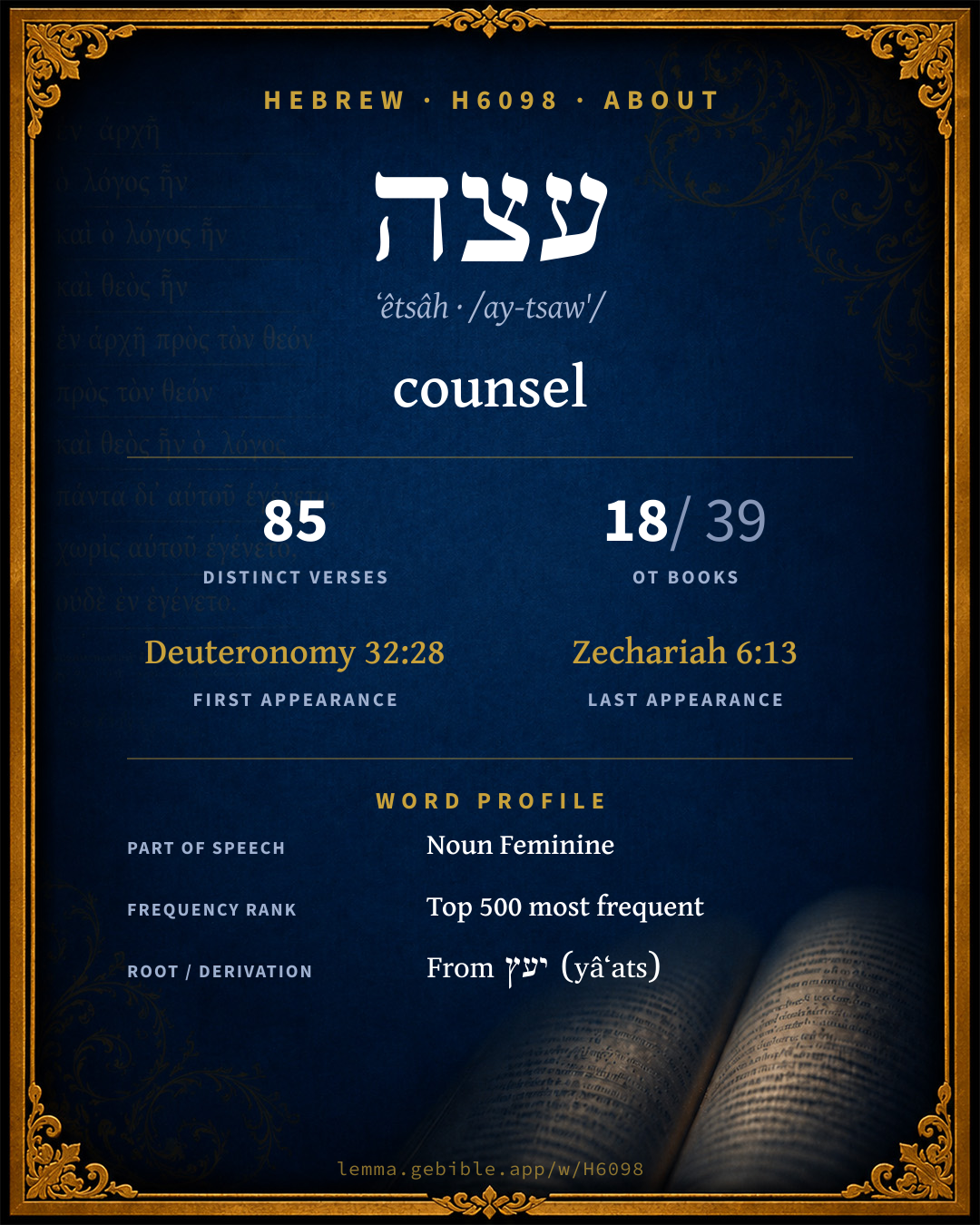
עֵצָה
counsel
Full lexicon entry — Brown-Driver-Briggs (BDB)
From Brown-Driver-Briggs (BDB)
Where this word appears
See every Construct-state word in the Hebrew Bible →
Grammar key — what these labels mean
Part of speech
- Noun
- A naming word — a person, place, thing, or idea.
- Verb
- An action or state-of-being word.
Noun type
- Common
- A common noun — a general class of person, place, or thing (“king,” “city,” “water”), not a specific name.
Stem
- Qal
- The basic, simple active stem — the plain form of the verb (“he wrote”).
Form
- Participle Active
- A verbal adjective expressing ongoing or characteristic action (“writing / one who writes”).
State
- Absolute
- The independent form of a noun, not bound to a following word.
- Construct
- A noun bound to a following noun in a possessive / “of” relationship (the construct chain).
Gender
- Feminine
- Grammatically feminine.
- Masculine
- Grammatically masculine.
Number
- Singular
- One.
- Plural
- More than one (in Hebrew, generally three or more).
3 verses where H6098 appears in the Construct state in the Book of 1 Kings. Filtered view — show all forms. Click any verse to open its interlinear word-by-word view. Verse text shown in the World English Bible for context — . Each verse’s Hebrew form is shown with its reference; the English is not keyword-highlighted, since the data carries no word-level English alignment. Use “Compare translations” on any verse to read it across multiple English versions. This concordance covers the Hebrew Bible; Septuagint (Greek Old Testament) occurrences are not indexed here.
1 Kings
- 1 Kings 12:8 עֲצַ֥ת n c fs cs But he forsook the counsel of the old men which they had given him, and took counsel with the young men who had grown up with him, who stood before him.
- 1 Kings 12:13 עֲצַ֥ת n c fs cs The king answered the people roughly, and forsook the counsel of the old men which they had given him,
- 1 Kings 12:14 כַּ/עֲצַ֤ת prep + n c fs cs and spoke to them after the counsel of the young men, saying, My father made your yoke heavy, but I will add to your yoke: my father chastised you with whips, but I will chastise you with scorpions.
About this entry
At a glance — auto-summarized from this page’s data, not written by a person. Every figure links to its source below. This summary describes the numbers; it doesn’t interpret them.
At its core, עצה (ʻêtsâh) means “counsel.” Scripture first uses it in Deuteronomy 32:28. It appears 85 verses across 18 books of the Hebrew Bible, among its moderately common vocabulary. It clusters with יעץ, יעט and מועצה under a shared root. Dig into 85-verse concordance and the renderings breakdown below.
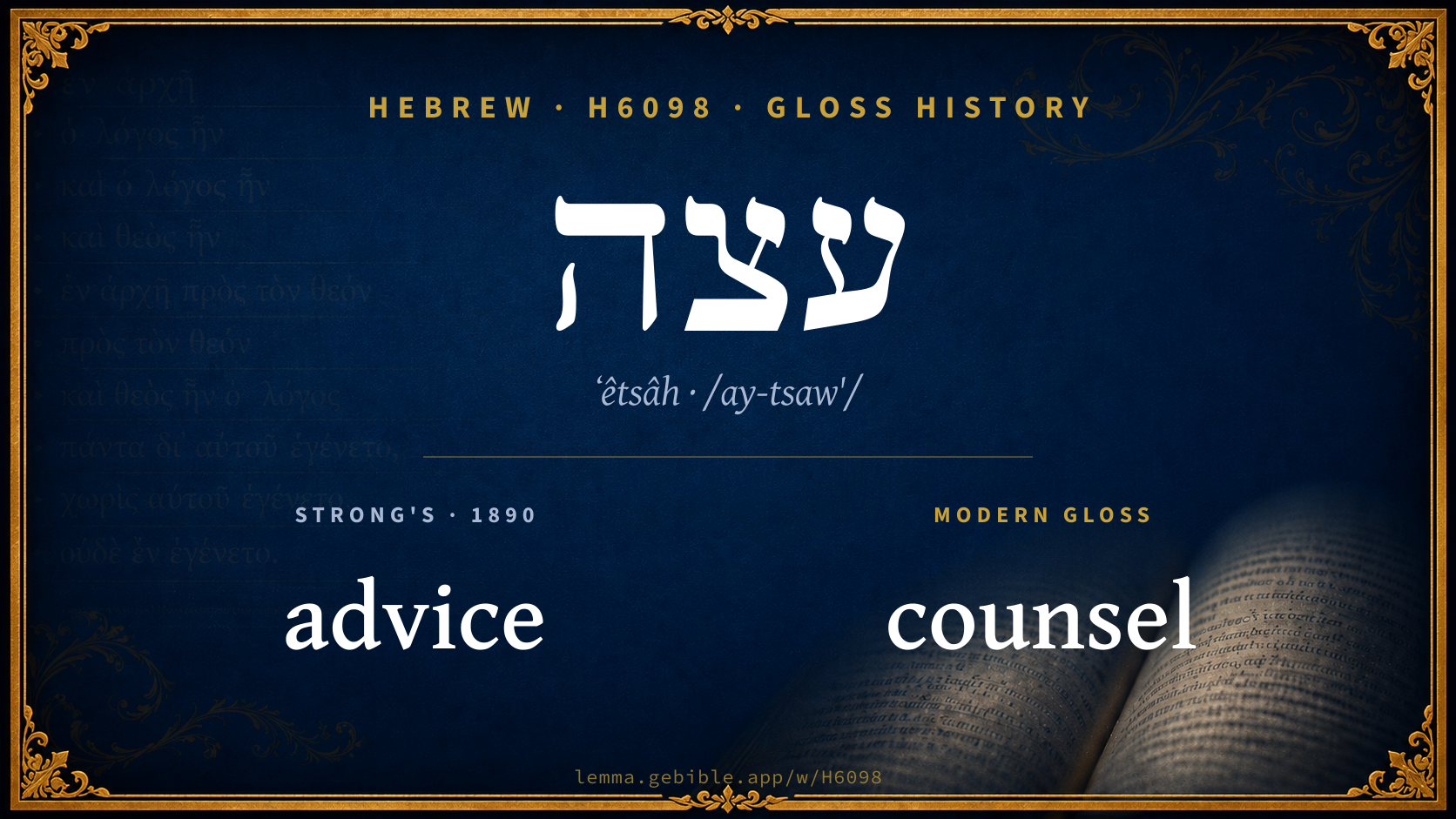
Gloss history
Strong's 1890 vs modern scholarship
About this word
Strong's H6098 catalogs a Hebrew word from the Hebrew Old Testament.
These counts are not copied from any lexicon or concordance. They are computed here, from the morphology-tagged Hebrew Old Testament. What Lemma adds →
- 85
- distinct verses
- The word appears in 85 distinct verses.
- 18 / 39
- OT books
- The word appears in 18 of 39 Old Testament books.
- #462
- by frequency
- Top 500 most frequent Hebrew words (rank 462 of 8,640 Hebrew words by occurrence).
View all 85 occurrences in the concordance →
By section of the Old Testament
By traditional corpus
Conventional, traditional groupings — biblical authorship is debated, so this is a traditional corpus grouping, not an authorship claim. Each share is this word’s portion of its verses in that division of the Hebrew canon. Each figure is a share of the word’s 85 distinct verses.
- Prophets (Nevi'im) 44 verses · 52%
- Writings (Ketuvim) 40 verses · 47%
- Torah (Pentateuch) 1 verse · 1%
How translations render this word
Counts come from each version’s own published word-to-Strong’s tagging or interlinear alignment — an approximate guide to how each version renders this word, not a word-level alignment the data otherwise carries. Because each total is that version’s own tagged count, the per-version totals vary from one another and need not match the appearance or distinct-verse counts above. These counts may also differ from a printed concordance because Lemma counts each distinctly tagged rendering and does not collapse phrase taggings into a single head-word total. This is a fixed set of word-tagged versions (KJV, ASV, BSB, ULT) and does not change with the reading translation you choose elsewhere. Each version’s license is shown beside its name below (and on Sources).
BDB lists this Strong’s number as 2 distinct words (homographs). Each count above pools all of them and is not split by sense — see the Senses section below. A low-frequency rendering may belong to a different one of those words, not the primary meaning.
- King James Version†: Counsel 55×, According to the counsel 2×, I have counsel 2×
- American Standard Version†: Counsel 52×, After the counsel 2×, Is counsel 2×
- Berean Standard Bible†: Counsel 31×, Advice 11×, Plans 10×
- unfoldingWord Literal Text†: Counsel 39×, Counsel of 19×, Advice of 3×
King James Version Public Domain
Renders H6098 across 85† tagged occurrences — most commonly:
Plus 24 renderings that appear only once — usually multi-word phrases or single function words the recovered tagging swept in, not distinct renderings. Not rendered by a distinct English word in 3 further occurrences.
American Standard Version Public Domain
Renders H6098 across 85† tagged occurrences — most commonly:
Plus 23 renderings that appear only once — usually multi-word phrases or single function words the recovered tagging swept in, not distinct renderings.
Berean Standard Bible Public Domain
Renders H6098 across 88† tagged occurrences — most commonly:
Plus 21 renderings that appear only once — usually multi-word phrases or single function words the recovered tagging swept in, not distinct renderings. Not rendered by a distinct English word in 1 further occurrence.
unfoldingWord Literal Text CC BY-SA 4.0
Renders H6098 across 90† tagged occurrences — most commonly:
Plus 14 renderings that appear only once — usually multi-word phrases or single function words the recovered tagging swept in, not distinct renderings.
Senses in the full BDB
What do BDB’s symbols mean?
BDB uses these scholarly abbreviations:
| Symbol | Meaning |
|---|---|
| 𝔊 | the Septuagint (the ancient Greek translation, LXX) |
| 𝔙 | the Vulgate (the Latin translation) |
| 𝔖 | the Syriac version (the Peshitta) |
| 𝔗 | the Targum (the Aramaic translation) |
| ψ | the Psalms |
| √ | root (the underlying root or stem) |
| ‖ | parallel passage (a synonymous or contrasted parallel) |
| † | the dagger: every passage where the word occurs is cited |
The 0 senses and sub-senses the full Brown-Driver-Briggs lexicon distinguishes for this word, in lexicon order (not ranked by frequency), with BDB’s own verbatim wording and sub-sense lettering. Shown in Hebrew script with BDB’s own scholarly abbreviations. The condensed entry is in the Lexicon Entry tab. See also the Forms in the corpus table below.
עצה I counsel, advice ( = (יְ)עֵצָה)
עצה II coll. trees Je 6
Senses from the full Brown-Driver-Briggs lexicon (Brown, Driver, Briggs; Oxford 1906 — public domain), digitized via Sefaria, supplemented by the OpenScriptures HebrewLexicon (CC BY 4.0). Full attribution on Sources.
Word origin
I. n.f. counsel, advice ( = (יְ)עֵצָה)—ע׳ Ju 20:7 + 28 times; cstr. עֲצַת Is 5:19 + 33 times; sf. עֲצָתִי Pr 1:25 + 5 times (+ Is 46:11 Qr; Kt עצתו better); עֲצָֽתְךָ ψ 20:5; 73:24; עֲצָתוֹ Ho 10:6 + 7 times (incl. Is 46:10 Kt v. supr.); עֲצָתָם Je 18:23 + 4 times; pl. עֵצוֹת Dt 32:28 + 2 times; עֲצָתָ֑יִךְ Is 47:13;—counsel, advice 2 S 15:31, 34; 16:23(×2); 17:14(×3), 23 1 K 12:8, 13, 14 = 2 Ch 10:8, 13, 14, 2 Ch 22:5; 25:16; Ezr 10:3 (where read ע׳ אֲדֹנִי Reuss Ry), v 8 Jb 29:21; political consultation Is 47:13; as acc. cogn. 2 S 17:7; 1 K 1:12; Is 8:10; Ez 11:2 (עצת־רָע, ‖ אָוֶן); c. הָב֫וּ give counsel Ju 20:7; 2 S 16:20; חֵבִיא ע׳ Is 16:3; עשׂה ע׳ 30:1; אָשִׁית עֵצוֹת בְּנַפְשִׁי ψ 13:3; = design, purpose Ezr 4:5; Ne 4:9; 1 Ch 12:20 (Baer), ψ 14:6; 20:5; Je 18:23 (sq. עַל = against), 49:30 (‖ מַחֲשָׁבָה); עֲצַת־גּוֹיִם ψ 33:10; suitable counsel for war (= generalship) 2 K 18:20 = Is 36:5 (cf. Pr 20:18 infr.); also עֲצַת שָׁלוֹם Zc 6:13 counsel of peace; practical wisdom, sagacity Is 19:3, cf. v 11, Je 19:7 Dt 32:28 (‖ תְּבוּנָה) Ho 10:6. Especially in WisdLt and proph.; counsel = good counsel, wisdom Jb 38:2; 42:3; Pr 12:5; 20:5 (its seat בְּלֶב־אִישׁ) ‖ תּוּשִׁיָּה Pr 8:14; Is 28:29 (of י׳); ‖ חָכְמָה Je 49:7; ‖ חָכְמָה and תְּבוּנָה Jb 12:13 Pr 21:30; ‖ מוּסָר 19:20; ‖ תַּחְבֻּלוֹת 20:18 (cf. Is 36:5 supr.); ע׳ נִפְתָּלִים Jb 5:13; רוּחַ ע׳ וּגְבוּרָה Is 11:2 (‖ ר׳ חָכְמָה וּבִינָה); hearty counsel ע׳ נֶפֶשׁ Pr 27:9; counsel of wisdom, when wisdom is personif. Pr 1:25, 30 (‖ תּוֹכַחַת); in bad sense ע׳ רשׁעים Jb 10:3; 21:16; 22:18; ψ 1:1, cf. Jb 18:7 ψ 106:43 Is 29:15; of plan of י׳; ע׳ י׳ ψ 33:11; Pr 19:21; Is 19:17; 14:26 (הע׳ הַיְּעוּצָה), 25:1; 46:10, 11; ע׳ קדושׁ ישׂראל 5:19; also Mi 4:12; Je 32:19 (גְּדֹל הָעֵצָה), 49:20; 50:45 ψ 106:13; ע׳ עֶלְיוֹן ψ 107:11; instruction, guiding wisdom of י׳ ψ 73:24; אִישׁ־עֲצָתוֹ i.e. counsellor of י׳ Is 40:13; in fig. אַנְשֵׁי עֲצָתִי ψ 119:24 = my counsellors, said of testimonies of God; = prophecy, ע׳ מלאכיו Is 44:26 (‖ דְּבַר עַבְדּוֹ); תֹּאבַד ע׳ מִזְּקִנִים Ez 7:26 (cf. 1 K 12:8; ‖ חָזוֹן, תּוֹרָה), מֵחָכָם Je 18:18 (‖ דָּבָר, תּוֹרָה).
II. n.f.coll. trees Je 6:6, but read עֵצָהּ (עֵץ c. sf. 3 fs.), so Orient. Codd. 𝔊 𝔖 𝔙 𝔗 Hi Gf—1. עֵצָה v. sub. יָעַץ.
— Brown-Driver-Briggs (Oxford 1906, public domain), digitized via Sefaria, supplemented by the OpenScriptures HebrewLexicon (CC BY 4.0). See Sources.
Derived from יעץ (yâʻats) (H3289) — to counsel.
Jastrow Dictionary
A second Hebrew/Aramaic lexicon for comparison, covering Aramaic and post-biblical (Talmudic, Targumic, Midrashic) usage that the biblical-Hebrew BDB does not. Matched by lemma rather than by Strong’s number, so a lemma may carry more than one Jastrow headword (shown separately below), and the entries cover usage well beyond the Bible.
עֵצָה I
- v. עֵץ)
- 1. trees, plantation. Y. Sabb. III, 6ᵃ; Y. Succ. I, end, 52ᶜ התיר ע׳ שבים allowed the carrying of things on the Sabbath from trees in the water (on an island) to the water and vice versa (cmp. Erub. 67ᵇ סלע שבים); Y. Erub. VIII, end, 25ᵇ
- 2. pea-stalks. Sabb. VII, 4, expl. ib. 76ᵃ תבן של מיני קיטניות. Ohol. XVIII, 2, contrad. to קש.
עֵצָה II
- counsel, advice, plan, consultation, council. Gen. R. s. 74 נוטלין ע׳ they hold council, v. רֶוַוח. Sot. 11ᵃ (ref. to Ex. I, 10) הוא התחיל בע׳ תחלה he was the first to propose (the destruction of Israel). Ib. שלשה היו באותה ע׳ three men took part in that consultation. Meg. 12ᵇ ניטלה ע׳ ממנו counsel (legal wisdom) has been taken away from us. Sot. 11ᵇ שפנה מעֲצַת מרגלים he turned away from the council of the spies. Gitt. 58ᵃ, a. e. אם אתה שומע לעֲצָתִי if thou wouldst listen to my advice. Tanḥ. Haăz. 8 ובעצתי אל וכ׳ and if you follow my advice, do not risk your life for her. B. Bath. 118ᵃ, a. fr. ע׳ טובה קמשמע לן good advice is meant by it (not a law); a. fr.—Pl. עֵצוֹת. Kidd. 80ᵇ (in Chald. dict.), v. עוּץ. Midr. Till. to Ps. I, 3 שהיה יועץ ע׳ ומתקיימות וכ׳ who suggested plans which were executed, and which turned out well; a. e. e.g. Exodus 1:10
עֵצָה
- ch., v. עֵצָא
עָצֶה
- v. עֲצֵי) backbone, spine. Sifra Vayikra, N’dab., Par. 14, ch. XIX (ref. to Lev. IV, 9) יכנס לפנים מן הע׳ he must go inside of the backbone, i.e. cut off a portion of the spine; Yalk. Lev. 462. e.g. Leviticus 4:9
עֲצָה
- , v. עֲצֵי
עֲצֵי
- 1. to press, squeeze; to oppress, esp. (= h. עָשַׁק) to withhold what is due to a neighbor. Targ. Y. Lev. V, 23. Targ. Y. II ib. 21 עֲצָה some ed. (not עֵ׳). Targ. Y. II, Deut. XXIV, 14; a. e.—Part. pass. עָצֵי, pl. עַצְיָין. Targ. Y. ib. XXVIII, 29.
- 2. to be hard, dry; sapless. Part. pl. עֶצְיָין. Targ. Y. II, Num. XIII, 20 (21).
A Dictionary of the Targumim, the Talmud Babli and Yerushalmi, and the Midrashic Literature (Marcus Jastrow; London, Luzac, 1903) — Public Domain. Digitized via Sefaria. Digitized via Sefaria. Full attribution on Sources.
Forms in the corpus
The 57 distinct written forms H6098 takes in the Hebrew Bible, most frequent first — each parse links to that state’s occurrences in the concordance. Hebrew forms include their vowel points and cantillation, so a single lemma takes many written forms.
Same root — word family
Other BDB entries built from the same root as H6098, grouped by Strong’s listed origin. These share a root / origin per the lexicon — not necessarily a shared meaning. Each links to that word’s own entry.
Derives from
Shares the same root
Compare all same-root words → They share a root, not necessarily a meaning.
Septuagint verse parallels
This word appears in 79 verses that also exist in the Greek Old Testament (Septuagint), out of the 85 Hebrew verses it occurs in. You can read those verses in Greek by switching the Old Testament edition to the Septuagint.
Read these verses in the Septuagint
- Deuteronomy 32:28
- Judges 20:7
- 2 Samuel 15:31
- 1 Kings 1:12
- 2 Kings 18:20
- 1 Chronicles 12:19
- 2 Chronicles 10:8
- Ezra 4:5
- Job 5:13
- Psalms 1:1
- Proverbs 1:25
- Isaiah 5:19
This is a verse-level parallel only — the same verses exist in both the Hebrew and Greek Old Testaments. No word-level Hebrew↔Greek correspondence is claimed: the data carries no such alignment, so no Greek word is shown as this Hebrew word’s translation. Coverage is not total — the Septuagint omits the deuterocanon and renumbers the Psalms, so some Hebrew verses have no direct Greek parallel.