
Proverbs 20:5

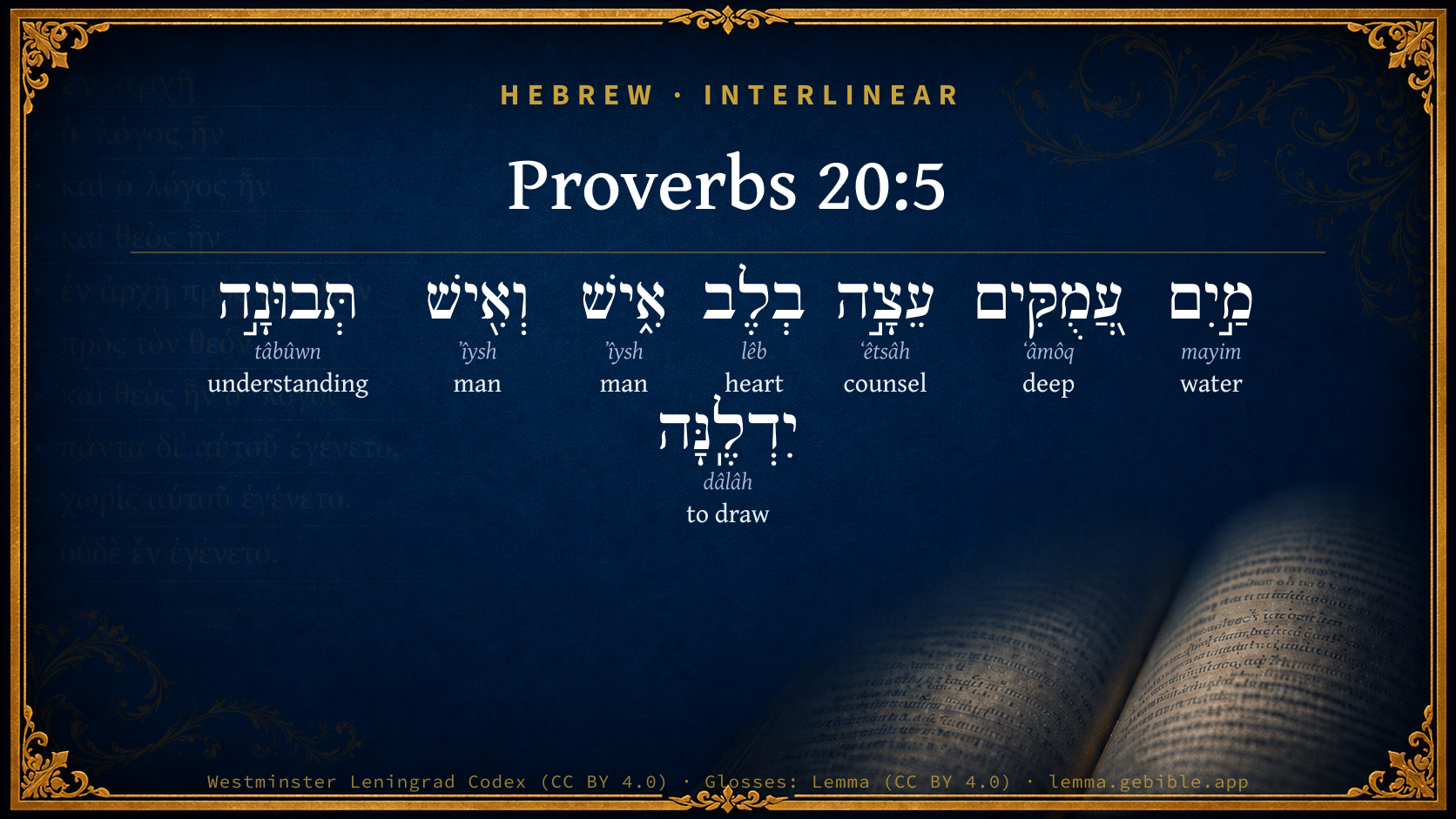
Hebrew (Westminster Leningrad Codex) Proverbs 20:5 appears in the Hebrew Old Testament. The text above is from the Westminster Leningrad Codex. Each word links to its Strong’s number, a concise gloss, and parsing drawn from the Open Scriptures Hebrew Bible morphology. Click any word for its full Brown-Driver-Briggs (BDB) entry.
Download image
Cite this verse

Proverbs 20:5 (World English Bible). Public Domain. Lemma interlinear Bible study tool, https://lemma.gebible.app/v/proverbs/20/5.

Show BibTeX & RIS
BibTeX
RIS
English Translation
Counsel in the heart of man is like deep water; But a man of understanding will draw it out.
World English Bible · Public Domain
Download a study sheet

One document with this verse’s original text, its word-by-word gloss line, the meaning frame, cross-references with their text, attributed commentary, and full source and license credits — printable, and it pastes into notes with its structure intact.

This verse Autodidact and up

Study sheet (.html) Plain text (.txt)

A passage Seminary Student

Up to 50 verses in one chapter. A passage sheet keeps up to 6 commentary sources and 12 cross-references per verse, in the order this page ranks them, and says so on the sheet whenever that leaves anything out. Ask for a single verse and you get the Autodidact verse sheet above.

Everything on this page stays free to read, with no account — the sheet is a download of what is already on screen, not access to it.

Want to remove ads? Support Godless Engineer
Compare translations 3

The same verse in 3 English versions, stacked beneath the original-language interlinear above. Click any original word for its lexicon entry.

Each is an independent rendering of the whole verse — the interlinear is not word-aligned to these translations.

Highlighted words mark where these versions differ — a whole-verse word diff, not a word-by-word alignment.

  • World English Bible Public Domain
    Counsel in the heart of man is like deep water; But a man of understanding will draw it out.
  • King James Version Public Domain
    Counsel in the heart of man is like deep water; but a man of understanding will draw it out.
  • unfoldingWord Literal Text CC BY-SA 4.0
    Counsel in the heart of a man deep waters, but a man of understanding will draw it out.

unfoldingWord Literal Text — © unfoldingWord, licensed CC BY-SA 4.0. Word-aligned USFM3 via Door43 (git.door43.org/unfoldingWord/en_ult).

Versions to compare (up to 4)

3 of 4 selected

Show all 18 translations

Every available English version of this verse, each an independent rendering of the whole verse.

  • World English Bible Public Domain
    Counsel in the heart of man is like deep water; But a man of understanding will draw it out.
  • Berean Standard Bible Public Domain
    The intentions of a man’s heart are deep waters, but a man of understanding draws them out.
  • Majority Standard Bible Public Domain
    The intentions of a man’s heart are deep waters, but a man of understanding draws them out.
  • King James Version Public Domain
    Counsel in the heart of man is like deep water; but a man of understanding will draw it out.
  • American Standard Version (1901) Public Domain
    Counsel in the heart of man is `like' deep water; But a man of understanding will draw it out.
  • Revised Version (1885) Public Domain
    Counsel in the heart of man is like deep water; but a man of understanding will draw it out.
  • Geneva Bible (1599) Public Domain
    The counsell in the heart of man is like deepe waters: but a man that hath vnderstanding, will drawe it out.
  • Douay-Rheims (1899) Public Domain
    Counsel in the heart of a man is like deep water: but a wise man will draw it out.
  • Young's Literal Translation Public Domain
    Counsel in the heart of a man `is' deep water, And a man of understanding draweth it up.
  • Literal Standard Version CC BY-SA 4.0
    Counsel in the heart of a man [is] deep water, || And a man of understanding draws it up.
  • Unlocked Literal Bible CC BY-SA 4.0
    The purpose in a human heart is like deep water, but someone with understanding will draw it out.
  • unfoldingWord Literal Text CC BY-SA 4.0
    Counsel in the heart of a man deep waters, but a man of understanding will draw it out.
  • Darby Bible Public Domain
    Counsel in the heart of man is deep water, and a man of understanding draweth it out.
  • World Messianic Bible Public Domain
    Counsel in the heart of man is like deep water, but a man of understanding will draw it out.
  • Webster's Bible Public Domain
    Counsel in the heart of man is like deep water; but a man of understanding will draw it out.
  • Free Bible Version CC BY-SA 4.0
    Discovering what someone is planning in their mind is like looking at deep water, but a person who has understanding will find out.
  • Bible in Basic English Public Domain
    The purpose in the heart of a man is like deep water, but a man of good sense will get it out.
  • JPS Tanakh (1917) Public Domain
    Counsel in the heart of man is like deep water; but a man of understanding will draw it out.

Literal Standard Version (2020), Covenant Press — licensed CC BY-SA 4.0. Text via the HelloAO Bible API (eBible.org). Unlocked Literal Bible (unfoldingWord) — licensed CC BY-SA 4.0. Text via the HelloAO Bible API (eBible.org). unfoldingWord Literal Text — © unfoldingWord, licensed CC BY-SA 4.0. Word-aligned USFM3 via Door43 (git.door43.org/unfoldingWord/en_ult). Free Bible Version, Dr. Jonathan Gallagher — licensed CC BY-SA 4.0. Text via the HelloAO Bible API (eBible.org).

Word by word

More ways to search: Search by grammar → Find every occurrence → Compare this word →

Practice this passage: Drill this verse → Learn its vocabulary →

About this verse

These counts appear in no published source. They are computed here, from the morphology-tagged text and Lemma’s own curated glosses. What Lemma adds →

8
words
7
distinct lemmas
Wisdom
section

Notable vocabulary

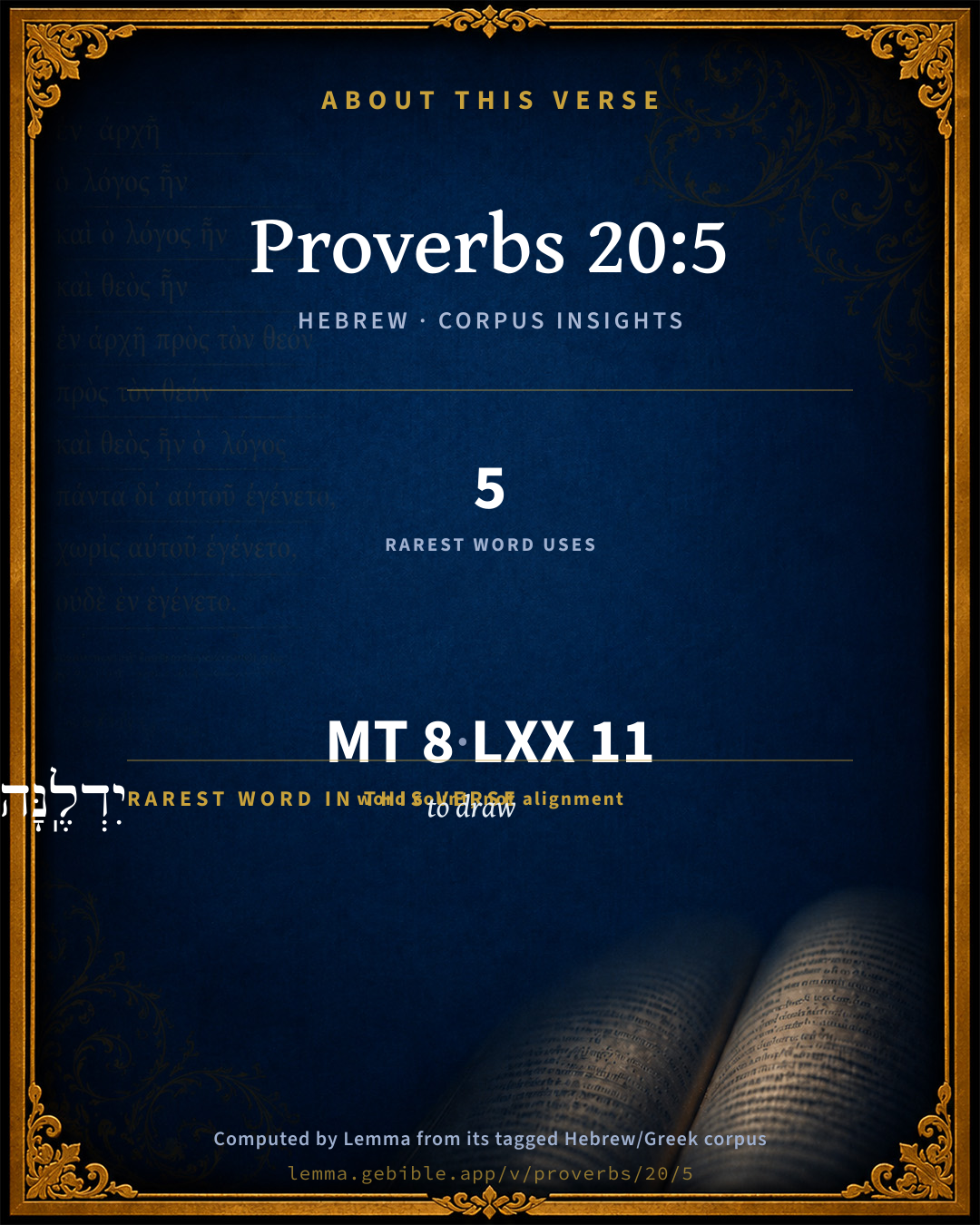
The rarest word here is יִדְלֶֽנָּה to draw H1802 — appearing just 5 times in the whole Hebrew Bible.

Shared distinctive vocabulary

יִדְלֶֽנָּה to draw H1802 occurs in 4 verses of the Hebrew Bible. Also found in:

Grammatical profile

  • 1 verb
  • 6 nouns
  • 1 adjective

Verb forms

  • יִדְלֶֽנָּה Qal · Imperfect

Repetition

A word recurs within this verse — often emphatic in Hebrew:

  • אִ֑ישׁ man H376 ×2

Hebrew & Septuagint length

In English translation the verse runs 19 words from the Hebrew and 16 from the Septuagint (LXX English) — closely comparable.

A rough comparison of the two English renderings, which tokenize alike — not a word-level alignment.

Word counts can differ between the Hebrew and the Greek without any difference in meaning — e.g. the Hebrew direct-object marker אֵת has no separate Greek word, and Greek often adds the article ὁ.

In the original languages it is 8 Hebrew tokens and 11 Greek tokens — but the two are counted differently (Hebrew bundles its prefixes and suffixes into one token; the Greek is in lemma form), so that isn’t a like-for-like length.

Cross-references

3

Topical passages linked to Proverbs 20:5 in the Treasury of Scripture Knowledge — connected by theme and wording, ordered by reader-vote popularity; previews shown in the World English Bible.

  • Proverbs 18:4 The words of a man's mouth are like deep waters. The fountain of wisdom is like a flowing brook.
  • 1 Corinthians 2:11 For who among men knows the things of a man, except the spirit of the man, which is in him? Even so, no one knows the things of God, except God's Spirit.
  • Psalms 64:6 They plot injustice, saying, "We have made a perfect plan!" Surely man's mind and heart are cunning.

Cross-references courtesy of OpenBible.info (CC BY 4.0).

Hebrew and Greek witnesses Masoretic Hebrew ↔ Greek Septuagint

The same verse in the two great witnesses to the Old Testament, shown verse-for-verse.

These are two independent witnesses, not word-aligned to each other, and the Septuagint is shown in lemma (dictionary) form.

Hebrew Proverbs 20:5 Masoretic · Westminster Leningrad Codex

מַ֣יִם עֲ֭מֻקִּים עֵצָ֣ה בְלֶב אִ֑ישׁ וְאִ֖ישׁ תְּבוּנָ֣ה יִדְלֶֽנָּה

Counsel in the heart of man is like deep water; But a man of understanding will draw it out.

World English Bible · Public Domain

Greek LXX Proverbs 20:5 Septuagint · lemma form

ὕδωρ βαθύς βουλή ἐν καρδία ἀνήρ ἀνήρ δέ φρόνιμος ἐκἀντλέω αὐτός

Counsel in a man's heart is deep water; but a prudent man will draw it out.

LXX2012 (modern English Septuagint) · Public Domain

On this verse, The Pulpit Commentary discusses the Septuagint’s reading. Read the note in Commentary ↓

Hebrew: Westminster Leningrad Codex (CC BY 4.0). Greek: Septuagint (public domain); English from LXX2012 (modern English Septuagint) (Public Domain). How the Septuagint differs from the Hebrew →

Commentary

Notes on Proverbs 20:5 from classic Christian and Jewish commentators (each source and its license shown beneath its notes). The classic Christian expositions comment on the surrounding passage and are grouped to its opening verse, so a note may address several verses; the Jewish commentaries on the Tanakh (Rashi and others) are per-verse, so they appear only where the commentator wrote on this verse.

Lemma curates 59 commentaries, every one of them public domain or Creative Commons licensed, each selected and text-cleaned for this edition rather than reprinted as found. About our sources →

Trapp's Complete Commentary

John Trapp

Pro 20:5 Counsel in the heart of man [is like] deep water; but a man of understanding will draw it out.

Ver. 5. Counsel in the heart of man is like deep water.] See Pro 18:4. As the red rose, though outwardly not so fragrant, is inwardly far more cordial than the damask rose, being more thrifty of its sweetness, and reserving it in itself; so it is with many good Christians.

But a man of understanding will draw it out.] And surely this is a fine skill to be able to pierce a man that is like a vessel full of wine, and to set him a running.

John Trapp, A Commentary or Exposition upon All the Books of the Old and New Testament (1647–1656) — public domain. Text from a community e-Sword module.

The Biblical Illustrator

Joseph S. Exell

Pro_20:5

Counsel in the heart of man is like deep water; but a man of understanding will draw it out.

The getting of wisdom from the wise:

I. Wisdom to man is a very valuable thing.

1. It improves the sphere of his being.

2. It improves the power of his being.

II. Sane men are favoured with more wisdom than others. The difference in the amount of mens intelligence arises from the difference in their capacities, proclivities, and opportunities for mental improvement.

III. Those who have the most wisdom are generally the most reserved. Where knowledge dwells in large quantities, it is not like water on the surface that you can get at easily; it is rather like water that lies fathoms under earth--clear, beautiful, and refreshing--got at only by the pump, or the windlass and bucket. It has to be drawn out.

IV. In consequence of this reservedness of the most wise, it requires sagacity in others to draw it forth. Even Christ Himself felt that He could not unfold what was in Him, on account of the ignorance and the prejudice of His auditory. (D. Thomas, D. D.)

The Biblical Illustrator, edited by Joseph S. Exell (c. 1880s–1900s) — public domain. Text from a community e-Sword module.

Joseph Benson's Commentary

Pro 20:5. Counsel in the heart of man — Either, 1st, Ability to give counsel; or, 2d, The design or purpose of doing something of importance; for the word עצה, here rendered counsel, is frequently used in both senses, but the latter seems most proper here; it is like deep water — Is there in great abundance, or is secret and hard to be discovered; but a man of understanding will draw it out — By prudent questions and discourses, and a diligent observation of his words and actions. In other words, “Though the designs and intentions of another man, especially one who hath a deep understanding, are as hard to be found out as waters which lie in the secret caverns of the earth; yet there are persons of such penetration, that they will find means to discover them and draw them out.” “There are six ways,” says Lord Bacon, in his Advancement of Learning, lib. 8. cap. 2, “whereby the knowledge of men may be drawn out and disclosed; by their faces and countenances, by words, by deeds, by their nature, by their ends, and by the relations of others.”

Joseph Benson's Commentary on the Old and New Testaments (1811–1818) — public domain. Text from a community e-Sword module.

The Preacher's Complete Homiletical Commentary

Joseph S. Exell (gen. ed.)

CRITICAL NOTES.—

Pro_20:5. Counsel. Delitzsch translates this word “purpose,” and understands it to refer to a secret plan.

MAIN HOMILETICS OF Pro_20:5

DEEP SEA DREDGING

I. Much that is good, or much that is bad, may lie hidden in a man’s heart without its existence being suspected by the majority of his acquaintance. The word here rendered counsel may be taken in a twofold sense. It may be used of knowledge, or of great mental ability, which is hidden either because its possessor is exceedingly modest or exceedingly reserved—either because he lacks the will or the power to make it known. Or it may refer to deeply-laid schemes or well-planned purposes which a man intends shall one day become facts, but which at present exist only in his own mind. And according to the nature of the counsel it may be compared to the wealth of beauty and riches which lie hidden in the depth of the ocean, unsuspected by the majority of those who sail above, or to the deadly torpedo which makes no ripple upon the surface of the water, and which its victims approach without dreaming of what is concealed beneath.

II. The difficulty of one man’s obtaining what another wishes to conceal will depend upon the comparative wisdom of both. For many ages the deep sea seemed to defy all the efforts of man to explore its depths and to find out its secrets, but now even the ocean has to own him master in this respect, and to submit to have its treasures brought to light. There has been, as it were, a struggle between the sea and the man of science as to which should possess the treasures of the deep, and the issue has depended upon the ability of the man in comparison with the depth of the ocean. So there is sometimes a struggle between men—the one desiring to conceal his knowledge or his plans within his own breast, and the other desiring to discover them. The issue will depend upon the comparative mental power of the two men. If both be “men of understanding,” the resistance on the one side and the effort on the other will be continuous and long, and the “deep waters” may prove too deep for the bucket or the dredging net. But if the balance of wisdom is in favour of the seeker—if there is one spot where his line can reach—he will “draw out” the counsel and proclaim himself the master.

OUTLINES AND SUGGESTIVE COMMENTS

The whole emblem finely illustrates what is true of the “inward light” as held by the “Friends.” All men have light which, if they would follow, would lead them (granting that they persevere) into the light of the gospel (Rom_1:20). What better name for this than counsel? Alas! it lies “deep.” No man will follow it but by the Spirit of God … Nevertheless it is there! How solemn that fact at the judgment day! “The word is nigh” (Rom_10:8). “A man of discernment,” or “understanding,” i.e., the Christian … Only the illuminated man, getting his light from its great fountain, will be moved to go down into his “heart,” where the counsel lies waiting, and “draw” the “deep waters.”—Miller.

Every question is, as it were, a turn of the windlass.—Plumptre.

He is an expert fisher … But man can but draw them out; God seeth them in the heart, man can see no more than he draws out, but God seeth all; man draws and labours for the knowledge he getteth, but all things are naked and open unto God’s sight. Jermin.

The Preacher's Complete Homiletical Commentary (gen. ed. Joseph S. Exell; Funk & Wagnalls, c. 1892) — public domain (pre-1929). A full-Bible homiletical/sermon-outline anthology covering 65 of 66 books (2 John is absent from the source module). Text from a community e-Sword module.

Geneva Bible (1599)

Geneva Bible translators

It is hard to find out: for it is as deep waters, whose bottom cannot be found: yet the wise man will know a man either by his words or manners.

Geneva Bible (1599) marginal notes — public domain. Text via Bolls.life.

Matthew Henry's Commentary

A man's wisdom is here said to be of use to him for the pumping of other people, and diving into them, 1. To get the knowledge of them. Though men's counsels and designs are ever so carefully concealed by them, so that they are as deep water which one cannot fathom, yet there are those who by sly insinuations, and questions that seem foreign, will get out of them both what they have done and what they intend to do. Those therefore who would keep counsel must not only put on resolution, but stand upon their guard. 2. To get knowledge by them. Some are very able and fit to give counsel, having an excellent faculty of cleaving a hair, hitting the joint of a difficulty, and advising pertinently, but they are modest, and reserved, and not communicative; they have a great deal in them, but it is loth to come out. In such a case a man of understanding will draw it out, as wine out of a vessel. We lose the benefit we might have by the conversation of wise men for want of the art of being inquisitive.

Matthew Henry's Commentary on the Whole Bible (1708–1710) — public domain (CC PDM 1.0). Text via the HelloAO Bible API.

Jamieson, Fausset & Brown

Robert Jamieson, A. R. Fausset & David Brown

Counsel . . . water--that is, deeply hidden (Pro 18:4; Psa 13:2). The wise can discern well.

Jamieson, Fausset & Brown — Commentary Critical and Explanatory on the Whole Bible (1871) — public domain (CC PDM 1.0). Text via the HelloAO Bible API.

Adam Clarke's Commentary

Verse 5. Counsel in the heart of man] Men of the deepest and most comprehensive minds are rarely apt, unsolicited, to join in any discourse, in which they might appear even to the greatest advantage; but a man of understanding will elicit this, by questions framed for the purpose, and thus pump up the salubrious waters from the deep and capacious well. The metaphor is fine and expressive.

Adam Clarke's Commentary on the Bible (1810–1826) — public domain. Text from a community e-Sword/MySword module.

Ellicott's Commentary for English Readers

(5) Counsel in the heart of man is like deep water.—The wise thoughts of a “man,” fitly so-called (comp. Pro_18:4), may be hid deep in his breast, like the waters of a well, but a man of understanding knows how to draw them out as by a windlass and bucket (Exo_2:16).

A Bible Commentary for English Readers, edited by Charles John Ellicott (1878–1897) — public domain. Text from a community e-Sword module.

The Cambridge Bible for Schools and Colleges

gen. ed. J. J. S. Perowne

5. will draw it out] as from a well, as the Queen of Sheba did, 1 Kings 10.

The Cambridge Bible for Schools and Colleges (gen. ed. J. J. S. Perowne; Cambridge University Press, 1878–1918) — public domain. Text from a community e-Sword module.

John Gill's Exposition

Counsel in the heart of man is like deep water,.... Pure and undisturbed, but secret, hidden, and hard to be come at: such are the things of the spirit of a man, the thoughts of his mind, the devices of his heart; which, though easily known by the searcher of hearts, are not easily penetrated into by men; or it is not easily got out of them what is in them, especially in some men, who are very close and reserved. This is true of wicked men, who seek sleep to hide their counsel; and of good men, especially studious men, who have got a great deal of wisdom and knowledge in them, but not very communicative, being slow of speech, and silent in conversation;

but a man of understanding will draw it out; he will find ways and means to discover the secret designs of wicked men, whether against church or state; and, by asking proper questions, an understanding man will get out useful things from men of knowledge, the most reserved: some men must be pumped, and a good deal of pains must be taken with them, to get out anything of them, as in getting water out of a deep well, and which when got is very good; and so is that wisdom and knowledge which is gotten by an inquisitive man from another of superior knowledge, but not very diffusive of it.

John Gill's Exposition of the Whole Bible (1746–1763) — public domain (CC PDM 1.0). Text via the HelloAO Bible API.

Albert Barnes' Notes on the Bible

The contest between reticence on the one side and pertinacity in search on the other is represented as by a parable. The well may be very deep (compare the marginal reference), but the man of understanding” has enough skill to draw up the water even to the last drop. Every question is, as it were, a turning of the windlass.

Albert Barnes' Notes on the Bible (1834–1885) — public domain. Text from a community e-Sword/MySword module.

Haydock's Catholic Bible Commentary

Out. So David discovered the meaning of the Thecuite, 2 Kings xiv. 18. A wise politician carefully examines everything in a foreign court.

George Leo Haydock (1774–1849), Haydock's Catholic Family Bible and Commentary, 1859 edition — public domain. Excludes Psalms (Douay-Rheims chapter numbering differs from Protestant) and Deuterocanonical books (Catholic canon only).

Matthew Poole's English Annotations

Counsel; either,

1. Wisdom or ability to give good counsel; or,

2. Designs or purposes of doing something of moment; for this word is frequently used in both senses, but the last seems fittest here.

Is like deep water; either,

1. Is there in great abundance; or,

2. Is secret and hard to be discovered.

Will draw it out, by prudent questions and discourses, and a diligent observation of his words and actions.

Matthew Poole's English Annotations on the Holy Bible (1683–1685) — public domain. Text from a community e-Sword/MySword module.

Whedon's Commentary on the Bible

Daniel D. Whedon

5. Counsel in the heart — The purposes, plans, which a man may form and keep secret.

Is like deep water — Difficult to be fathomed, or found out.

But a man of understanding — An intelligent, prudent, shrewd man.

Will draw it out — Will discover it. It may need to be gently and wisely drawn from him by sagacious inquiries, thus eliciting his secret designs.

The figure of thus “drawing out” the man’s plans is taken from the practice of drawing water from a deep well. Compare Pro_18:4; Exo_2:16; Exo_2:19; Joh_4:11.

Daniel D. Whedon (gen. ed.), Commentary on the Old and New Testaments (1874–1909) — public domain. Text from a community e-Sword module.

The Pulpit Commentary

Counsel in the heart of man is like deep water. The thoughts and purposes of a man are hidden in his breast like deep water (Pro_18:4) in the bosom of the earth, hard to fathom, hard to get. But a man of understanding will draw it out. One who is intelligent and understands human nature penetrates the secret, and, by judicious questions and remarks, draws out (exantlhsei , Septuagint) the hidden thought.

The Pulpit Commentary (1880–1919), ed. H.D.M. Spence-Jones & Joseph S. Exell — public domain. Text from a community e-Sword module.

John Wesley's Explanatory Notes

Counsel - Designs of doing something of moment. Deep water - Is secret and hard to be discovered.

John Wesley, Explanatory Notes Upon the Whole Bible (1754–1765) — public domain. Text via the GEBible commentary corpus.

Keil & Delitzsch

C. F. Keil & F. Delitzsch

5 The purpose in the heart of a man is deep water;

But a man of understanding draweth it out.

"Still waters are deep." Like such deep waters (Pro 18:4) is that which a man hath secretly (Isa 29:15) planned in his heart. He keeps it secret, conceals it carefully, craftily misleads those who seek to draw it out; but the man of תּבוּנה, i.e., one who possesses the right criteria for distinguishing between good and bad, true and false, and at the same time has the capacity to look through men and things, draws out (the Venet. well, ἀνέλξει) the secret עצה, for he penetrates to the bottom of the deep water. Such an one does not deceive himself with men, he knows how to estimate their conduct according to its last underlying motive and aim; and if the purpose is one that is pernicious to him, he meets it in the process of realization. What is here said is applicable not only to the subtle statesman and the general, but also the pragmatical historian and the expositor, as, e.g., of a poem such as the book of Job, the idea of which lies like a pearl at the bottom of deep water.

Keil & Delitzsch — Biblical Commentary on the Old Testament (1861–1891) — public domain (CC PDM 1.0). Text via the HelloAO Bible API. (Old Testament only.)

Bridges on Proverbs

Charles Bridges

The depths in the heart of man are not easily fathomed. Often are they the subtilty of evil.†1 David was duped by the smooth promises of Saul,†2 and afterwards by the religious hypocrisy of his ungodly son.†3 The counsel of Daniel’s enemies was too deep for Darius to see the bottom of it.†4 The counsel of Herod probably blinded the wise men as to his real intentions.†5 And yet a man of understanding will often draw out the subtle counsel, and set it in its true light. David described the deep counsels of his enemies, as one who had penetrated the bottom.†6 Job accurately discovered the true, but indirect, counsel of his mistaken friends. (Job 21:27-28 .) Paul drew out the secret counsel of selfishness in the schismatical preachers of the gospel. (Php 1:15 .)

But let us look at the bright side. Observe a man of God, instructed by God. Natural sagacity of intellect is deepened and enlarged by spiritual light. His mind is enriched with the fruits of scriptural study and meditation. Here are the deep waters of heavenly counsel.†7 The talkative professor in his superficial judgment sees nothing. But a man of understanding will discover and draw out valuable instruction. The Queen of Sheba thus drew out from the wise man’s capacious well deep and wholesome water. (1Ki 10:1-7 .) Often, however, men of comprehensive mind have little sympathy with general society. We may be in contact with them, without consciousness of their worth. The waters are deep; but there is no bubbling up. Yet a well-directed excitement will draw out flowing water from the well-spring of wisdom. And often the intercourse, hitherto lost, with a godly and experienced minister, or a soundly-instructed Christian, becomes most precious — "He that walketh with wise men shall be wise." (Pro 13:20 .) But above all is to be prized familiarity with the deep waters of the counsel of God. Say not — "I have nothing to draw with, and the well is deep." (Joh 4:11 .) A thinking habit in the exercise of prayer will enable you "with joy to draw water from the wells of salvation." (Isa 12:3 .) Nay — will it not bring into your own soul "a well of water, springing up unto everlasting life"? (Joh 4:14 .)

Footnotes:

†1 Jer 17:9.

†2 1Sa 18:17-26 .

†3 2Sa 15:7-9 .

†4 Dan 6:4-9.

†5 Mat 2:8.

†6 Psa 64:5-6; Psa 119:98 .

†7 Pro 18:4. Contrast Pro 26:7, Pro 26:9 .

Charles Bridges, An Exposition of the Book of Proverbs (1846) — public domain. Text from a community e-Sword module.

MacLaren's Expositions of Holy Scripture

Alexander MacLaren

Proverbs

A STRING OF PEARLS

Pro 20:1 - Pro 20:7.

The connection between the verses of this passage is only in their common purpose to set forth some details of a righteous life, and to brand the opposite vices. A slight affinity may be doubtfully traced in one or two adjacent proverbs, but that is all.

First comes temperance, enforced by the picture of a drunkard. Wine and strong drink are, as it were, personified, and their effects on men are painted as their own characters. And an ugly picture it is, which should hang in the gallery of every young man and woman. ‘Wine is a mocker.’ Intemperance delights in scoffing at all pure, lofty, sacred things. It is the ally of wild profanity, which sends up its tipsy and clumsy ridicule against Heaven itself. If a man wants to lose his sense of reverence, his susceptibility for what is noble, let him take to drink, and the thing is done. If he would fain keep these fresh and quick, let him eschew what is sure to deaden them. Of course there are other roads to the same end, but there is no other end to this road. Nobody ever knew a drunkard who did not scoff at things that should be reverenced, and that because he knew that he was acting in defiance of them.

‘A brawler,’ or, as Delitzsch renders it, ‘boisterous’-look into a liquor-store if you want to verify that, or listen to a drunken party coming back from an excursion and making night hideous with their bellowings, or go to any police court on a Monday morning. We in England are familiar with the combination on police charge-sheets, ‘drunk and disorderly.’ So does the old proverb-maker seem to have been. Drink takes off the brake, and every impulse has its own way, and makes as much noise as it can.

The word rendered in Authorised Version ‘is deceived,’ and in Revised Version ‘erreth,’ is literally ‘staggers’ or ‘reels,’ and it is more graphic to keep that meaning. There is a world of quiet irony in the unexpectedly gentle close of the sentence, ‘is not wise.’ How much stronger the assertion might have been! Look at the drunkard as he staggers along, scoffing at everything purer and higher than himself, and ready to fight with his own shadow, and incapable of self-control. He has made himself the ugly spectacle you see. Will anybody call him wise?

The next proverb applies directly to a state of things which most nations have outgrown. Kings who can give full scope to their anger, and who inspire mainly terror, are anomalies in civilised countries now. The proverb warns that it is no trifle to rouse the lion from his lair, and that when he begins to growl there is danger. The man who stirs him ‘forfeits his own life,’ or, at all events, imperils it.

The word rendered ‘sins’ has for its original meaning ‘misses,’ and seems to be so used here, as also in Pro 8:36. ‘Against’ is a supplement. The maxim inculcates the wisdom of avoiding conduct which might rouse an anger so sure to destroy its object. And that is a good maxim for ordinary times in all lands, monarchies or republics. For there is in constitutional kingdoms and in republics an uncrowned monarch, to the full as irresponsible, as easily provoked, and as relentless in hunting its opponents to destruction, as any old-world tyrant. Its name is Public Opinion. It is not well to provoke it. If a man does, let him well understand that he takes his life, or what is sometimes dearer than life, in his hand. Not only self-preservation, which the proverb and Scripture recognise as a legitimate motive, but higher considerations, dictate compliance with the ruling forces of our times, as far as may be. Conscience only has the right to limit this precept, and to say, ‘Let the brute roar, and never mind if you do forfeit your life. It is your duty to say “No,” though all the world should be saying “Yes.”‘

A slight thread of connection may be established between the second and third proverbs. The latter, like the former, commends peacefulness and condemns pugnacity. Men talk of ‘glory’ as the warrior’s meed, and the so-called Christian world has not got beyond the semi-barbarous stage which regards ‘honour’ as mainly secured by fighting. But this ancient proverb-maker had learned a better conception of what ‘honour’ or ‘glory’ was, and where it grew.

‘Peace hath her victories

No less renowned than war,’

said Milton. But our proverb goes farther than ‘no less,’ and gives greater glory to the man who never takes up arms, or who lays them down. The saying is true, not only about warfare, but in all regions of life. Fighting is generally wasted time. Controversialists of all sorts, porcupine-like people, who go through the world all sharp quills sticking out to pierce, are less to be admired than peace-loving souls. Any fool can ‘show his teeth,’ as the word for ‘quarrelling’ means. But it takes a wise man, and a man whose spirit has been made meek by dwelling near God in Christ, to withhold the angry word, the quick retort. It is generally best to let the glove flung down lie where it is. There are better things to do than to squabble.

Pro 20:4 is a parable as well as a proverb. If a man sits by the fireside because the north wind is blowing, when he ought to be out in the field holding the plough with frost-nipped fingers, he will beg {or, perhaps, seek for a crop} in harvest, and will find nothing, when others are rejoicing in the slow result of winter showers and of their toilsome hours. So, in all life, if the fitting moments for preparation are neglected, late repentance avails nothing. The student who dawdles when he should be working, will be sure to fail when the examination comes on. It is useless to begin ploughing when your neighbours are driving their reaping machines into the fields. ‘There is a time to sow, and a time to reap.’ The law is inexorable for this life, and not less certainly so for the life to come. The virgins who cried in vain, ‘Lord, Lord, open to us!’ and were answered, ‘Too late, too late, ye cannot enter now!’ are sisters of the man who was hindered from ploughing because it was cold, and asked in vain for bread when harvest time had come. ‘To-day, if ye will to hear His voice, harden not your hearts.’

The next proverb is a piece of shrewd common sense. It sets before us two men, one reticent, and the other skilful in worming out designs which he wishes to penetrate. The former is like a deep draw-well; the latter is like a man who lets down a bucket into it, and winds it up full. ‘Still waters are deep.’ The faculty of reading men may be abused to bad ends, but is worth cultivating, and may be allied to high aims, and serve to help in accomplishing these. It may aid good men in detecting evil, in knowing how to present God’s truth to hearts that need it, in pouring comfort into closely shut spirits. Not only astute business men or politicians need it, but all who would help their fellows to love God and serve Him-preachers, teachers, and the like. And there would be more happy homes if parents and children tried to understand one another. We seldom dislike a man when we come to know him thoroughly. We cannot help him till we do.

The proverb in Pro 20:6 is susceptible of different renderings in the first clause. Delitzsch and others would translate, ‘Almost every man meets a man who is gracious to him.’ The contrast will then be between partial ‘grace’ or kindness, and thoroughgoing reliableness or trustworthiness. The rendering of the Authorised and Revised Versions, on the other hand, makes the contrast between talk and reality, professions of goodwill and acts which come up to these. In either case, the saying is the bitter fruit of experience. Even charity, which ‘believeth all things,’ cannot but admit that soft words are more abundant than deeds which verify them. It is no breach of the law of love to open one’s eyes to facts, and so to save oneself from taking paper money for gold, except at a heavy discount. Perhaps the reticence, noted in the previous proverb, led to the thought of a loose-tongued profession of kindliness as a contrast. Neither the one nor the other is admirable. The practical conclusion from the facts in this proverb is double-do not take much heed of men’s eulogiums on their own benevolence; do not trumpet your own praises. Caution and modesty are parts of Christian perfection.

The last saying points to the hereditary goodness which sometimes, for our comfort, we do see, as well as to the halo from a saintly parent which often surrounds his children. Note that there may be more than mere succession in time conveyed by the expression ‘after him.’ It may mean following in his footsteps. Such children are blessed, both in men’s benedictions and in their own peaceful hearts. Weighty responsibilities lie upon the children of parents who have transmitted to them a revered name. A Christian’s children are doubly bound to continue the parental tradition, and are doubly criminal if they depart from it. There is no sadder sight than that of a godly father wailing over an ungodly son, unless it be that of the ungodly son who makes him wail. Absalom hanging by his curls in the oak-tree, and David groaning, ‘My son, my son!’ touch all hearts. Alas that the tragedy should be so often repeated in our homes to-day!

Alexander MacLaren, Expositions of Holy Scripture (1904–1910) — public domain. Text from a community e-Sword module.

Kretzmann's Popular Commentary

Paul E. Kretzmann

v. 5. Counsel in the heart of man is like deep water, for his plans are hidden in his innermost heart; but a man of understanding, one who knows how to deal with men, will draw it out, he will judge the actions of men according to their motives and objects and draw the right conclusions.

Paul E. Kretzmann, Popular Commentary of the Bible (1921–1924) — public domain. Text from a community e-Sword module.

unfoldingWord translationNotes

Door43 World Missions Community

The purpose in a human heart is like deep water

This speaks of how difficult it is to understand the reasons for a person's actions by comparing it to the difficulty of reaching the water in a deep well. AT: "It is as difficult to understand the purpose in the human heart as it is to reach the water in a deep well" or "The purpose of in the human heart is very difficult to understand" (See: Simile)

someone with understanding

"a person who has understanding"

will draw it out

This speaks of figuring out the purpose of the human heart as if it was water being drawn from a deep well. AT: "will cause the purpose to be known" or "will figure it out" (See: Metaphor)

is loyal

"is faithful" or "is trustworthy"

but who can find one who is faithful?

The implicit answer is "few can find someone like that." This rhetorical question can be written as a statement. AT: "but few men can find a person who is faithful!" or "but it is hard to find a person who really is faithful!" (See: Rhetorical Question)

translationWords

heart

water

preach

faithful

unfoldingWord translationNotes — © Distant Shores Media and the Door43 World Missions Community, licensed CC BY-SA 4.0. Source: git.door43.org/Door43/en_tn.

Rashi

Rabbi Shlomo Yitzchaki (Rashi)

Counsel in man’s heart is like deep water A halachah in a wise man’s heart is sealed.

but a man of understanding will draw it out An understanding pupil comes and draws it out of his innards.

Rashi on the Tanakh — English translations: “The Judaica Press complete Tanach with Rashi, translated by A. J. Rosenberg” (CC BY 4.0); “Pentateuch with Rashi's commentary by M. Rosenbaum and A.M. Silbermann, 1929-1934” (public domain); “The Metsudah Tanach series, Lakewood, N.J” (CC BY 4.0); and “The Book of Joshua, Metsudah Publications, 1997” (CC BY 4.0). Text via Sefaria.

Lesson kit

Teaching starters — assembled from the data on this page, not authored interpretation. Every prompt links to the verse data it draws on. Edit before teaching.

Proverbs, in the Wisdom, opens this verse with 8 words (7 distinct Hebrew lemmas). Its most distinctive word is dâlâh (“to draw”). A historical commentator’s framing appears above. Read the whole chapter for the surrounding context.

Discussion questions

  1. The word dâlâh carries the sense “to draw.” How does it shape the verse?
  2. Exodus 2:16 shares the word «to draw» with this verse. How do the two illuminate each other?
  3. “man” occurs 2× in this one verse. What is the effect of the repetition?
  4. These translations render this verse differently. What is at stake in choosing one wording over another?
  5. The verb «יִדְלֶֽנָּה» is Qal Imperfect. How does its form color the action?
  6. Reading how Trapp's Complete Commentary and The Biblical Illustrator read this verse, where do the two commentators agree and where do they part?

Things to notice

Reading settings

Reading text

Shown beneath each verse's original-language words.

Old Testament
Old Testament edition

Read the OT as the Masoretic Hebrew (MT) or the Greek Septuagint (LXX).

English shown for the Greek Septuagint (in the Hebrew ↔ Greek comparison).

Comparing translations? Open the Compare panel on any verse page to stack up to four side by side.