
Proverbs 21:30

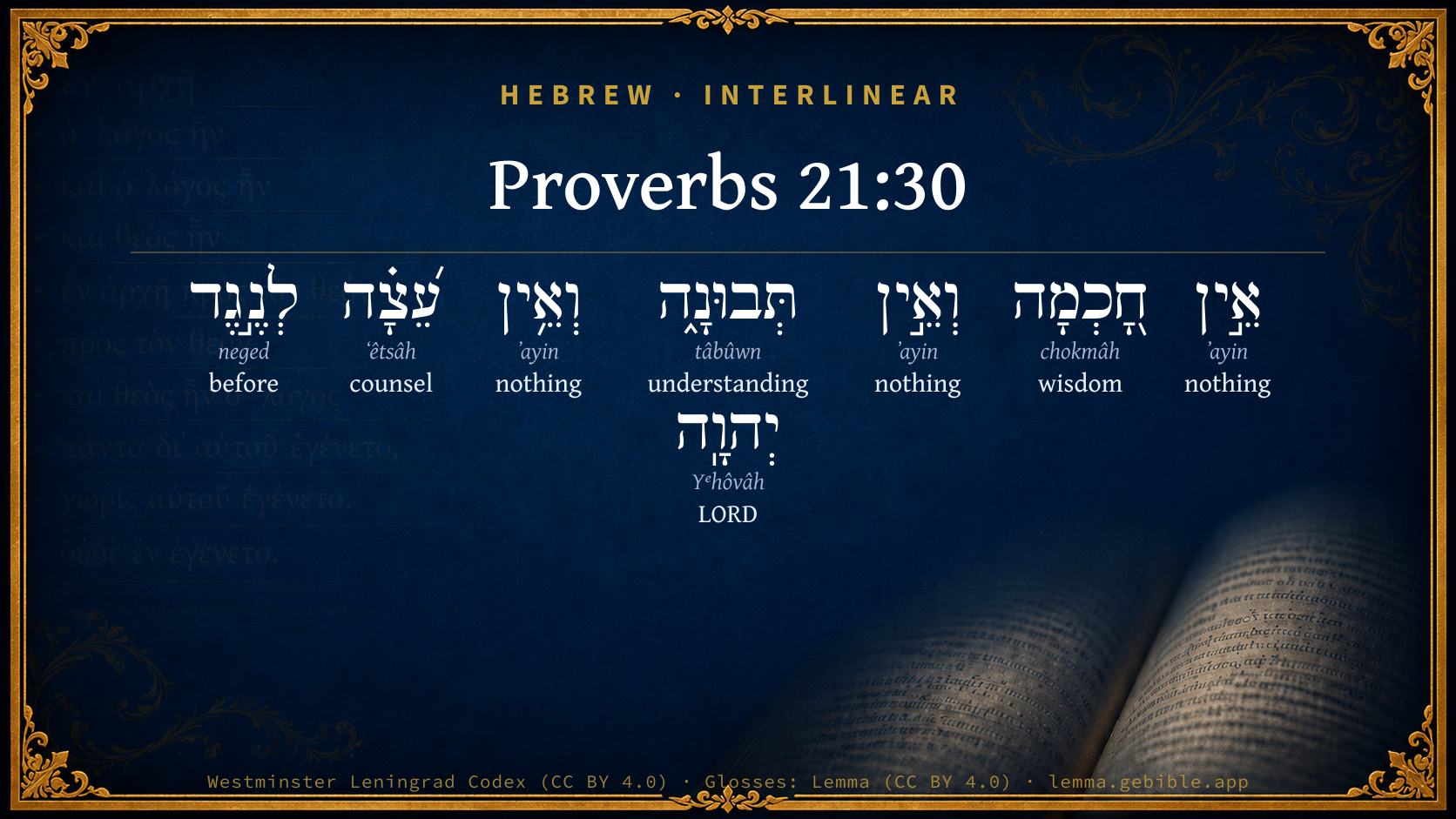
Hebrew (Westminster Leningrad Codex) Proverbs 21:30 appears in the Hebrew Old Testament. The text above is from the Westminster Leningrad Codex. Each word links to its Strong’s number, a concise gloss, and parsing drawn from the Open Scriptures Hebrew Bible morphology. Click any word for its full Brown-Driver-Briggs (BDB) entry.
Download image
Cite this verse

Proverbs 21:30 (World English Bible). Public Domain. Lemma interlinear Bible study tool, https://lemma.gebible.app/v/proverbs/21/30.

Show BibTeX & RIS
BibTeX
RIS
English Translation
There is no wisdom nor understanding Nor counsel against Yahweh.
World English Bible · Public Domain
Download a study sheet

One document with this verse’s original text, its word-by-word gloss line, the meaning frame, cross-references with their text, attributed commentary, and full source and license credits — printable, and it pastes into notes with its structure intact.

This verse Autodidact and up

Study sheet (.html) Plain text (.txt)

A passage Seminary Student

Up to 50 verses in one chapter. A passage sheet keeps up to 6 commentary sources and 12 cross-references per verse, in the order this page ranks them, and says so on the sheet whenever that leaves anything out. Ask for a single verse and you get the Autodidact verse sheet above.

Everything on this page stays free to read, with no account — the sheet is a download of what is already on screen, not access to it.

Want to remove ads? Support Godless Engineer
Compare translations 3

The same verse in 3 English versions, stacked beneath the original-language interlinear above. Click any original word for its lexicon entry.

Each is an independent rendering of the whole verse — the interlinear is not word-aligned to these translations.

Highlighted words mark where these versions differ — a whole-verse word diff, not a word-by-word alignment.

  • World English Bible Public Domain
    There is no wisdom nor understanding Nor counsel against Yahweh.
  • King James Version Public Domain
    There is no wisdom nor understanding nor counsel against the LORD.
  • unfoldingWord Literal Text CC BY-SA 4.0
    There is no wisdom and there is no understanding and there is no counsel in front of Yahweh.

unfoldingWord Literal Text — © unfoldingWord, licensed CC BY-SA 4.0. Word-aligned USFM3 via Door43 (git.door43.org/unfoldingWord/en_ult).

Versions to compare (up to 4)

3 of 4 selected

Show all 18 translations

Every available English version of this verse, each an independent rendering of the whole verse.

  • World English Bible Public Domain
    There is no wisdom nor understanding Nor counsel against Yahweh.
  • Berean Standard Bible Public Domain
    There is no wisdom, no understanding, no counsel that can prevail against the LORD.
  • Majority Standard Bible Public Domain
    There is no wisdom, no understanding, no counsel that can prevail against the LORD.
  • King James Version Public Domain
    There is no wisdom nor understanding nor counsel against the LORD.
  • American Standard Version (1901) Public Domain
    There is no wisdom nor understanding Nor counsel against Jehovah.
  • Revised Version (1885) Public Domain
    There is no wisdom nor understanding nor counsel against the LORD.
  • Geneva Bible (1599) Public Domain
    There is no wisedome, neither vnderstanding, nor counsell against the Lord.
  • Douay-Rheims (1899) Public Domain
    There is no wisdom, there is no prudence, there is no counsel against the Lord.
  • Young's Literal Translation Public Domain
    There is no wisdom, nor understanding, Nor counsel, over-against Jehovah.
  • Literal Standard Version CC BY-SA 4.0
    There is no wisdom, nor understanding, || Nor counsel against YHWH.
  • Unlocked Literal Bible CC BY-SA 4.0
    There is no wisdom, there is no understanding, and there is no advice that can stand against Yahweh.
  • unfoldingWord Literal Text CC BY-SA 4.0
    There is no wisdom and there is no understanding and there is no counsel in front of Yahweh.
  • Darby Bible Public Domain
    There is no wisdom, nor understanding, nor counsel against Jehovah.
  • World Messianic Bible Public Domain
    There is no wisdom nor understanding nor counsel against the LORD.
  • Webster's Bible Public Domain
    There is no wisdom nor understanding nor counsel against the LORD.
  • Free Bible Version CC BY-SA 4.0
    Whatever wisdom, understanding, or guidance you may have is nothing before the Lord.
  • Bible in Basic English Public Domain
    Wisdom and knowledge and wise suggestions are of no use against the Lord.
  • JPS Tanakh (1917) Public Domain
    There is no wisdom nor understanding nor counsel against the LORD.

Literal Standard Version (2020), Covenant Press — licensed CC BY-SA 4.0. Text via the HelloAO Bible API (eBible.org). Unlocked Literal Bible (unfoldingWord) — licensed CC BY-SA 4.0. Text via the HelloAO Bible API (eBible.org). unfoldingWord Literal Text — © unfoldingWord, licensed CC BY-SA 4.0. Word-aligned USFM3 via Door43 (git.door43.org/unfoldingWord/en_ult). Free Bible Version, Dr. Jonathan Gallagher — licensed CC BY-SA 4.0. Text via the HelloAO Bible API (eBible.org).

Word by word

More ways to search: Search by grammar → Find every occurrence → Compare this word →

Practice this passage: Drill this verse → Learn its vocabulary →

About this verse

These counts appear in no published source. They are computed here, from the morphology-tagged text and Lemma’s own curated glosses. What Lemma adds →

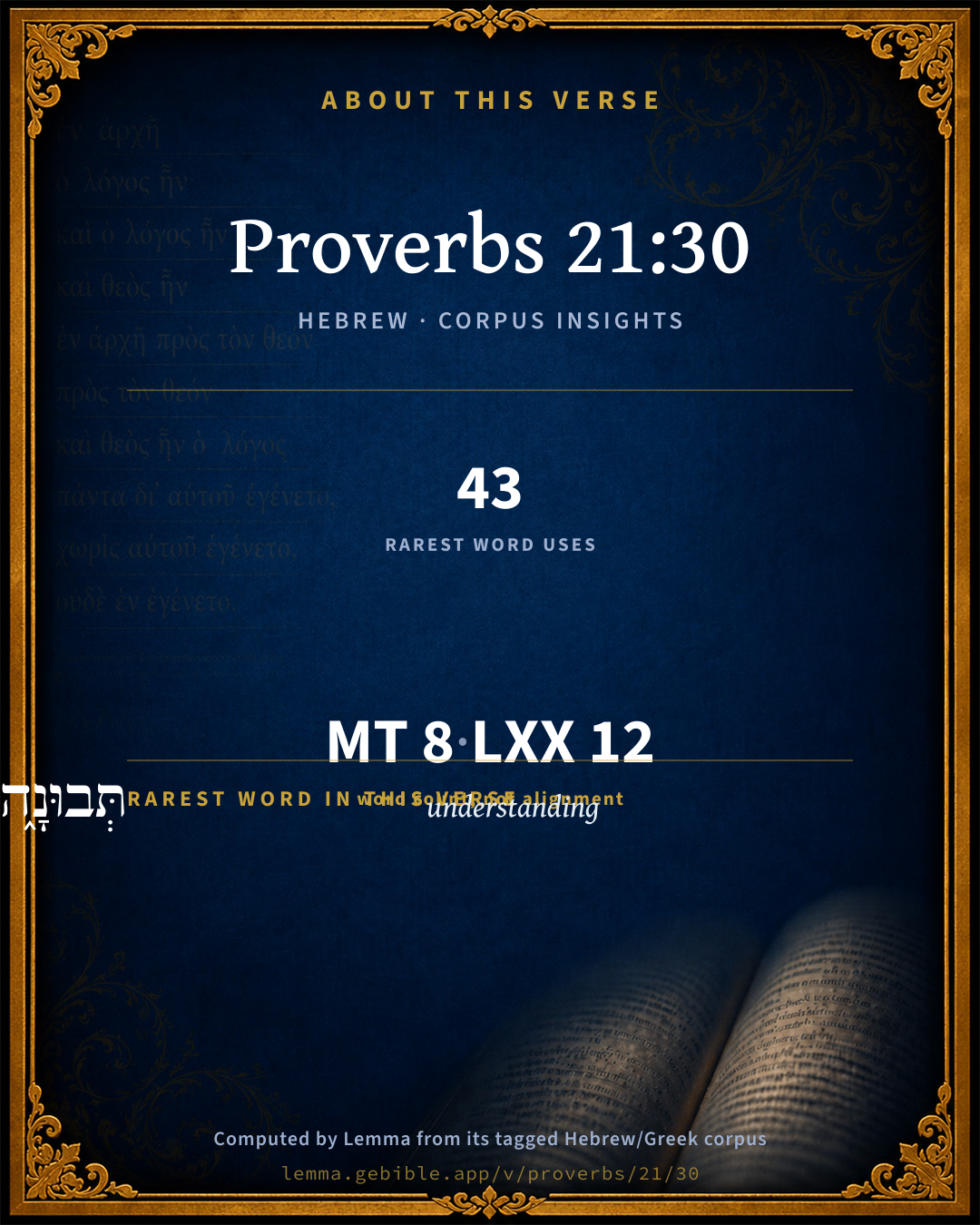
8
words
6
distinct lemmas
Wisdom
section

Shared distinctive vocabulary

תְּבוּנָ֑ה understanding H8394 occurs in 42 verses of the Hebrew Bible. Also found in:

Grammatical profile

  • 4 nouns
  • 1 preposition
  • 3 particles

Repetition

A word recurs within this verse — often emphatic in Hebrew:

  • אֵ֣ין nothing H369 ×3

Hebrew & Septuagint length

In English translation the verse runs 10 words from the Hebrew and 15 from the Septuagint (LXX English) — the Septuagint runs noticeably longer here. See the side-by-side →

A rough comparison of the two English renderings, which tokenize alike — not a word-level alignment.

Word counts can differ between the Hebrew and the Greek without any difference in meaning — e.g. the Hebrew direct-object marker אֵת has no separate Greek word, and Greek often adds the article ὁ.

In the original languages it is 8 Hebrew tokens and 12 Greek tokens — but the two are counted differently (Hebrew bundles its prefixes and suffixes into one token; the Greek is in lemma form), so that isn’t a like-for-like length.

Cross-references

10

Topical passages linked to Proverbs 21:30 in the Treasury of Scripture Knowledge — connected by theme and wording, ordered by reader-vote popularity; previews shown in the World English Bible.

  • Proverbs 19:21 There are many plans in a man's heart, But Yahweh's counsel will prevail.
  • Acts 5:39 But if it is of God, you will not be able to overthrow it, and you would be found even to be fighting against God!"
  • Jeremiah 9:23 Thus says Yahweh, Don't let the wise man glory in his wisdom, neither let the mighty man glory in his might, don't let the rich man glory in his riches;
  • Isaiah 14:27 For Yahweh of Hosts has purposed, and who shall annul it? and his hand is stretched out, and who shall turn it back?
  • 1 Corinthians 3:19–20 For the wisdom of this world is foolishness with God. For it is written, "He has taken the wise in their craftiness."
  • Isaiah 8:9–10 Make an uproar, O you peoples, and be broken in pieces! And give ear, all you of far countries: gird yourselves, and be broken in pieces! Gird yourselves, and be broken in pieces!
  • Isaiah 46:10–11 declaring the end from the beginning, and from ancient times things that are not [yet] done; saying, My counsel shall stand, and I will do all my pleasure;
  • Acts 4:27–28 For truly, in this city against your holy servant, Jesus, whom you anointed, both Herod and Pontius Pilate, with the Gentiles and the people of Israel, were gathered together
  • Isaiah 7:5–7 Because Syria, Ephraim, and the son of Remaliah, have plotted evil against you, saying,
  • 1 Peter 2:8 and, "A stone of stumbling, and a rock of offense." For they stumble at the word, being disobedient, whereunto also they were appointed.

Cross-references courtesy of OpenBible.info (CC BY 4.0).

Hebrew and Greek witnesses Masoretic Hebrew ↔ Greek Septuagint

The same verse in the two great witnesses to the Old Testament, shown verse-for-verse.

Here the Septuagint runs noticeably longer than the Hebrew — LXX2012 (modern English Septuagint) 15 words vs World English Bible 10. A rough length comparison of the two English translations, not a word-level alignment — read both below.

These are two independent witnesses, not word-aligned to each other, and the Septuagint is shown in lemma (dictionary) form.

Hebrew Proverbs 21:30 Masoretic · Westminster Leningrad Codex

אֵ֣ין חָ֭כְמָה וְאֵ֣ין תְּבוּנָ֑ה וְאֵ֥ין עֵ֝צָ֗ה לְנֶ֣גֶד יְהוָֽה

There is no wisdom nor understanding Nor counsel against Yahweh.

World English Bible · Public Domain

Greek LXX Proverbs 21:30 Septuagint · lemma form

οὐ εἰμί σοφία οὐ εἰμί ἀνδρεία οὐ εἰμί βουλή πρός ὁ ἀσεβής

There is no wisdom, there is no courage, there is no counsel against the ungodly.

LXX2012 (modern English Septuagint) · Public Domain

On this verse, Keil & Delitzsch discusses the Septuagint’s reading. Read the note in Commentary ↓

Hebrew: Westminster Leningrad Codex (CC BY 4.0). Greek: Septuagint (public domain); English from LXX2012 (modern English Septuagint) (Public Domain). How the Septuagint differs from the Hebrew →

Commentary

Notes on Proverbs 21:30 from classic Christian and Jewish commentators (each source and its license shown beneath its notes). The classic Christian expositions comment on the surrounding passage and are grouped to its opening verse, so a note may address several verses; the Jewish commentaries on the Tanakh (Rashi and others) are per-verse, so they appear only where the commentator wrote on this verse.

Lemma curates 59 commentaries, every one of them public domain or Creative Commons licensed, each selected and text-cleaned for this edition rather than reprinted as found. About our sources →

Trapp's Complete Commentary

John Trapp

Pro 21:30 [There is] no wisdom nor understanding nor counsel against the LORD.

Ver. 30. There is no wisdom against the Lord.] That is, they are all to no purpose. If God deny concourse, and influence, the arm of human power and policy, as Jeroboam’s, shrinks up presently. {Psa 2:1-3; Psa 33:10-11; Psa 62:3} {See Trapp on "Pro 19:21"} Excellently Gregory - Divinum consilium dum devitatur impletur; humana sapientia dum reluctatur, comprehenditur. God’s decree is fulfilled by those that have least mind to it. Human wisdom, while it strives for masteries, is overmastered.

John Trapp, A Commentary or Exposition upon All the Books of the Old and New Testament (1647–1656) — public domain. Text from a community e-Sword module.

The Biblical Illustrator

Joseph S. Exell

Pro_21:30

There is no wisdom nor understanding nor counsel against the Lord.

The vanity of attempting to oppose God

One of the most formidable methods of attacking religion is to exhibit it as a contrivance fit for narrow geniuses and mean souls. One of the most proper means to establish irreligion is to represent it as suited to great and generous minds.

I. Consider the text is regard to worldly grandeur. We sometimes see those who are called grandees in the world resist God, pretend to compel Him by superior force, or by greater knowledge. How often is grandeur even now in our times a patent for insolence against God!

II. Worldly policy is a second obstacle which some men set against the laws of heaven. We sometimes see men forget that they are Christians, when they deliberate on the public good.

III. The voluptuous resist God. One of the most inviolable laws of God is, that felicity should be the reward of virtue, and misery the punishment of vice. What does a voluptuous man oppose against the execution of this law? Noise, company, diversions, the refinements of lasciviousness. Examine the system of the voluptuary at the bar of reason, and at the bar of conscience. Consider it in the declining time of life, and in view of death and punishment.

IV. A stoical obstinacy is an obstacle which some place against the purposes of God. Hath Zeno any disciples now? Yes, there are yet people who, under another name, maintain the same sentiments, affect an unshaken firmness, and glory in preserving their tranquillity under all the extremes of fortune. (J. Saurin.)

.

The Biblical Illustrator, edited by Joseph S. Exell (c. 1880s–1900s) — public domain. Text from a community e-Sword module.

The Preacher's Complete Homiletical Commentary

Joseph S. Exell (gen. ed.)

MAIN HOMILETICS OF Pro_21:30-31

COUNSEL AGAINST THE LORD

I. Only those plans succeed which harmonise with the will of God. This is of course true only in regard to the ultimate and final issue of men’s plans and purposes. Sometimes, and indeed oftentimes, counsel against the Lord is very successful for a season, and for a very long season, but it is only for a season.

1. This is obvious if we consider God’s knowledge of the future. It is inseparable from His Divine nature that He shall be able to “declare the end from the beginning,” and therefore He says “My counsel shall stand, and I will do all my pleasure:” “yea, I have spoken it, I will also bring it to pass; I have purposed it, I will also do it” (Isa_46:10-11). Imagine the general of a vast army being confronted with a handful of blind men, would there be any room to doubt who would have the victory? If a traveller whose eyesight is so dim that he can only see a step or two before him has to travel an unknown road, will he not do well to take the arm and avail himself of the guidance of a man whose sight is perfect? The plan or purpose of our life is the road we desire to walk upon, and as we “know not what shall be on the morrow” (Jas_5:14) we can only hope to attain our desire if we enlist the All-seeing God on our side, and in order to do this our counsel must be in harmony with His.

2. God’s Almighty power, also, ensures the success of His counsel. “The horse is prepared against the day of battle,” but what is the united force of a world compared with the might of Him “who hath comprehended the dust in a measure, and weighed the mountains in scales and the hills in a balance?” … The prophet answers the question, “The nations are as a drop of a bucket, and are counted as the small dust of a balance” (Isa_40:12; Isa_40:15). The knowledge that our guide has of a dangerous path—the fact that he is acquainted with it from the beginning to the end—may not ensure our arrival at the desired goal. He and we may together be attacked by powerful foes, and power to protect is as needful as knowledge to guide. When we commit our way to God we have omnipotence as well as omniscience on our side.

II. Yet men are ever opposing their finite wisdom and strength to the almightiness and infinite knowledge of God. The proverb embodies a truth so palpable to any who will look facts plainly in the face—it contains an inference so obvious to an unprejudiced mind that it would seem unnecessary to write it if we did not know that sin has so distorted men’s mental vision—so biassed their reason—that they are ever imagining a “vain thing” and taking “counsel against the Lord and against His anointed, saying, Let us break their bands asunder and cast away their cords from us” (Psa_2:2-3). The world is full of confirmations of the fact, and it also contains abundant evidence of the truth of the inspired word. “He that sitteth in the heavens shall laugh, the Lord shall have them in derision.”

OUTLINES AND SUGGESTIVE COMMENTS

It would be a strong sentence if he declared that counsel against the Lord could never amount to anything.… But he does something more clear than that. There is no (such thing as) wisdom, etc., against the Most High. They could do nothing if they were; but wisdom never could be enticed to that side. The sentence embodies both ideas. There is no wisdom that could avail against God; but secondly, there is none that would ever attempt it. The expressions are peculiar. There is nothing of wisdom. The word is repeated: “Nothing, nothing, nothing.”—Miller.

We may, perhaps, consider the wise man as pointing out three modes of covering and effecting evil purposes: in the twenty-seventh verse, the mask of religion; in the twenty-eighth, false testimony; in the twenty-ninth, the assumed boldness and look of innocence. But (Pro_21:30) “there is no wisdom, nor understanding, nor counsel, against the Lord.” There may be against men. In one, or other, or all of these ways they may be deceived. There may, in many cases, be “wisdom, and understanding, and counsel” more than sufficient to impose upon and outwit them. But God knows all. His eye cannot be eluded; His designs cannot be thwarted; neither His promises nor His threatenings can be falsified, by any artifice, or policy, or might of the children of men—no, nor of any created being.—Wardlaw.

Wisdom is that which is gotten by experience, understanding that which is gotten by study, counsel that which is gotten by advice … but let all be put in the scales against the Lord, they are but as the dust of the balance unto Him … For if wisdom be gotten by experience, He is the Ancient of days; He was ancient when days began. If understanding come by study, He hath all understanding of Himself at once.… And the whole world is His common council, and that not to give at all, but to receive counsel from Him.—Jermin.

The Preacher's Complete Homiletical Commentary (gen. ed. Joseph S. Exell; Funk & Wagnalls, c. 1892) — public domain (pre-1929). A full-Bible homiletical/sermon-outline anthology covering 65 of 66 books (2 John is absent from the source module). Text from a community e-Sword module.

Keil & Delitzsch

C. F. Keil & F. Delitzsch

If we further seek for the boundaries, the proverbs regarding the rich and the poor, Pro 22:2, Pro 22:7, Pro 22:16, present themselves as such, and this the more surely as Pro 22:16 is without contradiction the terminus. Thus we take first together 21:30-22:2.

Pro 21:30

30 No wisdom and no understanding,

And no counsel is there against Jahve.

The expression might also be 'לפני ה; but the predominating sense would then be, that no wisdom appears to God as such, that He values none as such. With לנגד the proverb is more objective: there is no wisdom which, compared with His, can be regarded as such (cf. Co1 3:19), none which can boast itself against Him, or can at all avail against Him (לנגד, as Dan 10:12; Neh. 3:37); whence it follows (as Job 28:28) that the wisdom of man consists in the fear of God the Alone-wise, or, which is the same thing, the All-wise. Immanuel interprets חכמה of theology, תּבוּנה of worldly science, עצה of politics; but חכמה is used of the knowledge of truth, i.e., of that which truly is and continues; תבונה of criticism, and עצה of system and method; vid., at Pro 1:2; Pro 8:14, from which latter passage the lxx has substituted here גבורה instead of תבונה. Instead of 'לנגד ה it translates πρὸς τὸν ἀσεβῆ, i.e., for that which is 'נגד ה against Jahve.

Pro 21:31

31 The horse is harnessed for the day of battle;

But with Jahve is the victory,

i.e., it remains with Him to give the victory or not, for the horse is a vain means of victory, Isa 33:17; the battle is the Lord's, Sa1 17:47, i.e., it depends on Him how the battle shall issue; and king and people who have taken up arms in defence of their rights have thus to trust nothing in the multitude of their war-horses (סוּס, horses, including their riders), and generally in their preparations for the battle, but in the Lord (cf. Psa 20:8, and, on the contrary, Isa 31:1). The lxx translates התּשׁוּעה by ἡ βοήθεια, as if the Arab. name of victory, naṣr, proceeding from this fundamental meaning, stood in the text; תשׁועה (from ישׁע, Arab. ws', to be wide, to have free space for motion) signifies properly prosperity, as the contrast of distress, oppression, slavery, and victory (cf. e.g., Psa 144:10, and ישׁוּעה, Sa1 14:45). The post-bibl. Heb. uses נצח (נצּחון) for victory; but the O.T. Heb. has no word more fully covering this idea than תשׁועה (ישׁועה).

(Note: In the old High German, the word for war is urlag (urlac), fate, because the issue is the divine determination, and nt (as in "der Nibelunge Not"), as binding, confining, restraint; this nt is the correlate to תשׁועה, victory; מלחמה corresponds most to the French guerre, which is not of Romanic, but of German origin: the Werre, i.e., the Gewirre [complication, confusion], for נלחם signifies to press against one another, to be engaged in close conflict; cf. the Homeric κλόνος of the turmoil of battle.)

Keil & Delitzsch — Biblical Commentary on the Old Testament (1861–1891) — public domain (CC PDM 1.0). Text via the HelloAO Bible API. (Old Testament only.)

Tyndale Open Study Notes

Tyndale Open Resources

21:30-31 Human wisdom is impotent if it stands against the Lord (see 16:1, 3, 9, 33). Similarly, military power (represented by the horse) is impotent without the Lord’s blessing.

Tyndale Open Study Notes — © Tyndale Open Resources, licensed CC BY-SA 4.0. Text via the HelloAO Bible API.

Matthew Henry's Commentary

The designing busy part of mankind are directed, in all their counsels and undertakings, to have their eye to God, and to believe, 1. That there can be no success against God, and therefore they must never act in opposition to him, in contempt of his commands, or in contradiction to his counsels. Though they think they have wisdom, and understanding, and counsel, the best politics and politicians, on their side, yet, if it be against the Lord, it cannot prosper long; it shall not prevail at last. He that sits in heaven laughs at men's projects against him and his anointed, and will carry his point in spite of them, Psa 2:1-6. Those that fight against God are preparing shame and ruin for themselves; whoever make war with the Lamb, he will certainly overcome them, Rev 17:14. 2. That there can be no success without God, and therefore they must never act but in dependence on him. Be the cause ever so good, and the patrons of it ever so strong, and wise, and faithful, and the means of carrying it on, and gaining the point, ever so probable, still they must acknowledge God and take him along with them. Means indeed are to be used; the horse must be prepared against the day of battle, and the foot too; they must be armed and disciplined. In Solomon's time even Israel's kings used horses in war, though they were forbidden to multiply them. But, after all, safety and salvation are of the Lord; he can save without armies, but armies cannot save without him; and therefore he must be sought to and trusted in for success, and when success is obtained he must have all the glory. When we are preparing for the day of battle our great concern must be to make God our friend and secure his favour.

Matthew Henry's Commentary on the Whole Bible (1708–1710) — public domain (CC PDM 1.0). Text via the HelloAO Bible API.

Jamieson, Fausset & Brown

Robert Jamieson, A. R. Fausset & David Brown

Men's best devices and reliances are vain compared with God's, or without His aid (Pro 19:21; Psa 20:7; Psa 33:17).

Next: Proverbs Chapter 22

Jamieson, Fausset & Brown — Commentary Critical and Explanatory on the Whole Bible (1871) — public domain (CC PDM 1.0). Text via the HelloAO Bible API.

Ellicott's Commentary for English Readers

(30) There is no wisdom . . . against the Lord—Comp. 1Co_3:19; Isa_54:17; Psa_2:4.

A Bible Commentary for English Readers, edited by Charles John Ellicott (1878–1897) — public domain. Text from a community e-Sword module.

The Cambridge Bible for Schools and Colleges

gen. ed. J. J. S. Perowne

30. Even more forcible is the Hebrew: There is no wisdom and there is no understanding and there is no counsel against Jehovah.

The Cambridge Bible for Schools and Colleges (gen. ed. J. J. S. Perowne; Cambridge University Press, 1878–1918) — public domain. Text from a community e-Sword module.

John Gill's Exposition

There is no wisdom nor understanding, nor counsel against the Lord. No human schemes whatever, formed with the greatest wisdom and prudence, can ever prevail against God, or set aside or hinder the execution of any design of his; nothing that is pointed against his church, his cause, and interest, his truths and ordinances, in the issue shall succeed; all that are found fighters against him shall not prosper, let them be men of ever so much sagacity and wisdom; though there may be ever so many devices in a man's heart, and these ever so well planned, they shall never defeat the counsel of the Lord; see Pro 19:21. The Targum is,

"there is no wisdom, &c. as God's;''

and so the Syriac version, "as the Lord's"; there is none like his, there is none to be compared with his; there is none of any value and worth but his; all is folly in comparison of that: or there is none "before the Lord" (n); no wisdom of the creature can stand before him, it presently vanishes and disappears.

(n) "in conspectu Jehovae", Gejerus; "coram Domino", Gussetius, p. 495.

John Gill's Exposition of the Whole Bible (1746–1763) — public domain (CC PDM 1.0). Text via the HelloAO Bible API.

Albert Barnes' Notes on the Bible

Two companion proverbs. Nothing avails against, nothing without, God. The horse is the type of warlike strength, used chiefly or exclusively in battle. 1Ki 4:26; 1Ki 10:26-28, may be thought of as having given occasion to the latter of the two proverbs.

Albert Barnes' Notes on the Bible (1834–1885) — public domain. Text from a community e-Sword/MySword module.

Haydock's Catholic Bible Commentary

CHAPTER XXI.

George Leo Haydock (1774–1849), Haydock's Catholic Family Bible and Commentary, 1859 edition — public domain. Excludes Psalms (Douay-Rheims chapter numbering differs from Protestant) and Deuterocanonical books (Catholic canon only).

Matthew Poole's English Annotations

Which can prevail against the counsel and will of God.

Matthew Poole's English Annotations on the Holy Bible (1683–1685) — public domain. Text from a community e-Sword/MySword module.

Whedon's Commentary on the Bible

Daniel D. Whedon

30. There is no wisdom, etc. — The proverb is understood to teach that it is vain to hope for success in any enterprise, however well planned and well fortified by counsel, if its accomplishment is against the will of Jehovah; that is, unless he either wills it or permits it. Some understand it to mean, there is no wisdom, counsel, etc.; like that of Jehovah.

Against — Some read, Before Jehovah; others, as Lange, prefer the rendering of the text. Compare Jer_9:23.

Daniel D. Whedon (gen. ed.), Commentary on the Old and New Testaments (1874–1909) — public domain. Text from a community e-Sword module.

The Pulpit Commentary

There is no wisdom, nor understanding, nor counsel against the Lord; i.e. in opposition to him, which can be compared with his, or which can avail against him. (comp. Job_5:13 Psa_33:10, 11 Isa_29:14 1Co_1:20 1Co_3:19) Septuagint, "There is no wisdom, there is no courage (andreia ), there is no counsel, in respect of the ungodly;" pro , neged Jahve, being taken as "that which is against Jahve," equivalent to "impious." Wordsworth quotes Horace, "Carm.," 3:6. 5, etc. "Dis te minorem quod geris, imperus: Hino omne principium, huc refer exitum.

The following verse carries on and applies the import of this one: As men"s wisdom is nothing worth, equally vain is all trust in external means and appliances.

The Pulpit Commentary (1880–1919), ed. H.D.M. Spence-Jones & Joseph S. Exell — public domain. Text from a community e-Sword module.

Bridges on Proverbs

Charles Bridges

This proverb is not true in the strict letter. All the wisdom and policy of earth and hell are in active operation. But all is in vain against the LORD. The history of the Church abundantly proves this. ’The decrees and counsels of God are firm as adamant; immovable, notwithstanding all human machinations; no more to be stayed than the course of the sun.’†1 Wisdom and understanding and the best-contrived counsel, when against the LORD, come to foolishness. (Psa 33:10-11 .) "He taketh the wise," not in their ignorance, but "in their craftiness;"†2 not when their wisdom was fading, but when it was at the utmost zenith. Ahithophel’s counsel was befooled at the time, when "it was as if a man had inquired at the oracle of God."†3 Pharaoh’s counsel to depress the chosen nation issued in their increase. (Exo 1:8-12 .) His murderous decree, as a link in the chain of Providence, nurtured the Leader and Lawgiver of the people. (Exo 1:15, Exo 1:22, with Exo 1:2 :1-10.) Balak’s desire to curse Israel was overruled for blessing.†4 The wise man vainly set up in his darker days his own wisdom against the declared purpose of God.†5 Ahab’s project to ward off the threatened stroke against his life;†6 his determination to avert the extinction of his family;†7 Athaliah’s deep-laid plot to exterminate the family of David,†8 and so to frustrate the Divine promise; the enmity against the builders of the temple†9 — all this diversified mass of wisdom, and counsel, and understanding against the LORD — what was it? — a thing of nought.†10 ’They all signify nothing, if they oppose the counsels and decrees of heaven.’†11

Mark the history of our LORD. It would seem, as if nothing could have hindered the success of Herod’s wisdom and counsel against his infancy. (Mat 2:8, Mat 2:16 .) What a combination of wisdom from all quarters vainly to "entangle him in his talk!" (Mat 22:15-46 .) How near to failure were the prophecies connected with his death, burial, and resurrection! Stoning was the sentence for the charge laid against him! (Lev 24:16 .) His burial was appointed among the wicked. (Isa 53:9 .) His resurrection, so far as man could do, was effectually prevented.†12 But God had ordained crucifixion for his death,†13 his burial among the rich,†14 his resurrection as the confusion of all their counsel. (Mat 28:1-15 .) The event proved that there was no wisdom, nor understanding, nor counsel against the LORD. ’God’s desire is fulfilled to those who have the least mind to it. All man’s wisdom, while it strives for masteries, is overmatched.’†15

Let us look at that kingdom of Providence, so finely represented by "the wheels full of eyes round about them." (Eze 1:18 .) To deny an absolute superintending control, is to ’place and idle scepter in the hands of Him, who governs the universe’†16 How many movements baffle alike previous calculation and subsequent inquiry; effects, for which no adequate cause is producible; anomalies, manifestly intended to remove our eyes from second causes to the First Great Spring of agency, moving alone all, and in despite of all opposition! The raging Dioclesian struck his medal — ’Christianity is extinguished.’ The Great Author brings out from the very fire the palpable proof that ’the blood of the martyrs is the seed of the church.’ ’Oh! the folly and blindness of men, that think to carry all to their minds, and walk as masters of their own designs, and never have any serious thought of him, in whose hands both they, and all their business, and all the affairs of states and kingdoms of this world, are as a piece of wax, to frame them to what he pleases!’†17 And do not some of us remember with shame our "striving with our Maker" (Isa 45:9 ) — how long we endeavored to defeat his purposes of love, until at length we were brought to cast our weapons at his feet, and to acknowledge, that there is no wisdom, nor understanding, nor counsel against the LORD?

But putting away rebellion — beware of vain confidence, scarcely less displeasing to the LORD. The horse was a forbidden confidence in the day of battle.†18 The most glorious days of victory were, when that veto was regarded.†19 Declension commenced from the transgression of the law; defeat from the very quarter of confidence.†20 The after-renunciation of this confidence was a time of gracious acceptance.†21 The horse indeed may be legitimately employed as a means of defense. But never let the material of warfare be our confidence. Use the means, but idolize them not. They that "trust in them fall." Those that remember that safety is of the LORD, "are risen, and stand upright."†22 "The horse is a vain thing for safety."†23 "The remembrance of the name of the LORD" was mightier to the young warrior than the strength of the giant. (1Sa 17:45 .) Much more — in the spiritual warfare, let us have the active exercise of dependence. "Salvation is of the LORD"†24 — free, complete, triumphant and everlasting victory over all the powers of hell.

Footnotes:

†1 Lavater in loco.

†2 Job 5:13. 1Co 3:19 .

†3 2Sa 16:23 ; 2Sa 17:7, 2Sa 17:14, 2Sa 17:23, with 2Sa 15:31 .

†4 Num 24:10.

†5 1Ki 11:11, 1Ki 11:40 .

†6 1Ki 22:30-34 .

†7 1Ki 21:21 . 2Ki 10:1-7 .

†8 2Ki 11:2 .

†9 Neh 6:1-19.

†10 Isa 8:10; Isa 14:27 ; Isa 46:10 .

†11 Bishop Patrick.

†12 Mat 27:62-66.

†13 Gal 3:13.

†14 Isa 53:9. Bp. Lowth. Compare Mat 27:57-60 .

†15 Trapp. Compare Act 2:23-24 ; Act 4:27-28 .

†16 Abp. Magee’s interesting Sermon on this text. Works, ii. 354. Compare Job 12:21-22 . Isa 44:25 .

†17 Leighton’s Sermon on Jer 10:23-24 .

†18 Deu 17:16.

†19 Jos 11:6, Jos 11:9 . Jdg 4:3-15 . 2Sa 8:4 .

†20 1Ki 10:26-28 . 2Ch 12:8-9 . Compare Isa 31:1-3 .

†21 Hos 14:3-4.

†22 Psa 20:7-8.

†23 Psa 33:17.

†24 Psa 3:8; Psa 37:39-40 ; Psa 68:20 . Jon 2:9 .

Charles Bridges, An Exposition of the Book of Proverbs (1846) — public domain. Text from a community e-Sword module.

Kretzmann's Popular Commentary

Paul E. Kretzmann

v. 30. There is no wisdom nor understanding nor counsel against the Lord, all human wisdom which would set itself over against the truth of God’s eternal Word is folly.

Paul E. Kretzmann, Popular Commentary of the Bible (1921–1924) — public domain. Text from a community e-Sword module.

unfoldingWord translationNotes

Door43 World Missions Community

There is no wisdom, there is no understanding, and there is no advice that

The words "there is" are repeated to emphasize the abstract nouns "wisdom," "understanding," and "advice." Yahweh is greater than anything that anyone can know or think or say. Your language may require that you not repeat "there is no." The abstract nouns can be translated as adjectives or verbs. AT: "There is no wise person, there is no one who understands anything, and there is no one who tells others what to do who" or "There is no wisdom, understanding, or advice that" (See: Abstract Nouns)

stand against Yahweh

"defeat Yahweh" or "work against what Yahweh wants to do" or "show that he is right and Yahweh is wrong"

The horse is prepared for the day of battle

These words can be translated in active form. AT: "Soldiers prepare horses for the day of battle" (See: Active or Passive)

the day of battle

The word "day" refers to time that may be longer or shorter than a day. AT: "when there is a battle" (See: Idiom)

translationWords

wise

advice

Yahweh

horse

unfoldingWord translationNotes — © Distant Shores Media and the Door43 World Missions Community, licensed CC BY-SA 4.0. Source: git.door43.org/Door43/en_tn.

Rashi

Rabbi Shlomo Yitzchaki (Rashi)

There is neither wisdom, etc. No wise or understanding man is of any importance against the Lord. Wherever there is a desecration of the Name, we do not pay regard to a teacher.

Rashi on the Tanakh — English translations: “The Judaica Press complete Tanach with Rashi, translated by A. J. Rosenberg” (CC BY 4.0); “Pentateuch with Rashi's commentary by M. Rosenbaum and A.M. Silbermann, 1929-1934” (public domain); “The Metsudah Tanach series, Lakewood, N.J” (CC BY 4.0); and “The Book of Joshua, Metsudah Publications, 1997” (CC BY 4.0). Text via Sefaria.

Lesson kit

Teaching starters — assembled from the data on this page, not authored interpretation. Every prompt links to the verse data it draws on. Edit before teaching.

Proverbs, in the Wisdom, opens this verse with 8 words (6 distinct Hebrew lemmas). Its most distinctive word is tâbûwn (“understanding”). The Greek Septuagint runs longer here. A historical commentator’s framing appears above. Read the whole chapter for the surrounding context.

Discussion questions

  1. What does “understanding” (tâbûwn) contribute to the verse as a whole?
  2. How does Exodus 31:3, which shares the word «understanding», read alongside this verse?
  3. What does the repetition of “nothing” (3× in this one verse) do in this verse?
  4. The Septuagint runs longer here than the Hebrew. What might account for the difference?
  5. These translations render this verse differently. What is at stake in choosing one wording over another?
  6. Compare how Trapp's Complete Commentary and The Biblical Illustrator read this verse. Where do they agree or differ?

Things to notice

Reading settings

Reading text

Shown beneath each verse's original-language words.

Old Testament
Old Testament edition

Read the OT as the Masoretic Hebrew (MT) or the Greek Septuagint (LXX).

English shown for the Greek Septuagint (in the Hebrew ↔ Greek comparison).

Comparing translations? Open the Compare panel on any verse page to stack up to four side by side.