2 Samuel 15:31

Hebrew (Westminster Leningrad Codex) 2 Samuel 15:31 appears in the Hebrew Old Testament. The text above is from the Westminster Leningrad Codex. Each word links to its Strong’s number, a concise gloss, and parsing drawn from the Open Scriptures Hebrew Bible morphology. Click any word for its full Brown-Driver-Briggs (BDB) entry.
Download image
Cite this verse

2 Samuel 15:31 (World English Bible). Public Domain. Lemma interlinear Bible study tool, https://lemma.gebible.app/v/2-samuel/15/31.

Show BibTeX & RIS
BibTeX
RIS
English Translation
One told David, saying, Ahithophel is among the conspirators with Absalom. David said, Yahweh, please turn the counsel of Ahithophel into foolishness.
World English Bible · Public Domain
Download a study sheet

One document with this verse’s original text, its word-by-word gloss line, the meaning frame, cross-references with their text, attributed commentary, and full source and license credits — printable, and it pastes into notes with its structure intact.

This verse Autodidact and up

Study sheet (.html) Plain text (.txt)

A passage Seminary Student

Up to 50 verses in one chapter. A passage sheet keeps up to 6 commentary sources and 12 cross-references per verse, in the order this page ranks them, and says so on the sheet whenever that leaves anything out. Ask for a single verse and you get the Autodidact verse sheet above.

Everything on this page stays free to read, with no account — the sheet is a download of what is already on screen, not access to it.

Want to remove ads? Support Godless Engineer
Compare translations 3

The same verse in 3 English versions, stacked beneath the original-language interlinear above. Click any original word for its lexicon entry.

Each is an independent rendering of the whole verse — the interlinear is not word-aligned to these translations.

Highlighted words mark where these versions differ — a whole-verse word diff, not a word-by-word alignment.

  • World English Bible Public Domain
    One told David, saying, Ahithophel is among the conspirators with Absalom. David said, Yahweh, please turn the counsel of Ahithophel into foolishness.
  • King James Version Public Domain
    And one told David, saying, Ahithophel is among the conspirators with Absalom. And David said, O LORD, I pray thee, turn the counsel of Ahithophel into foolishness.
  • unfoldingWord Literal Text CC BY-SA 4.0
    And David one declared, saying, “Ahithophel among the conspirators with Absalom.” And David said, “Please, Yahweh, make foolish the counsel of Ahithophel.”

unfoldingWord Literal Text — © unfoldingWord, licensed CC BY-SA 4.0. Word-aligned USFM3 via Door43 (git.door43.org/unfoldingWord/en_ult).

Versions to compare (up to 4)

3 of 4 selected

Show all 18 translations

Every available English version of this verse, each an independent rendering of the whole verse.

  • World English Bible Public Domain
    One told David, saying, Ahithophel is among the conspirators with Absalom. David said, Yahweh, please turn the counsel of Ahithophel into foolishness.
  • Berean Standard Bible Public Domain
    Now someone told David: “Ahithophel is among the conspirators with Absalom.” So David pleaded, “O LORD, please turn the counsel of Ahithophel into foolishness!”
  • Majority Standard Bible Public Domain
    Now someone told David: “Ahithophel is among the conspirators with Absalom.” So David pleaded, “O LORD, please turn the counsel of Ahithophel into foolishness!”
  • King James Version Public Domain
    And one told David, saying, Ahithophel is among the conspirators with Absalom. And David said, O LORD, I pray thee, turn the counsel of Ahithophel into foolishness.
  • American Standard Version (1901) Public Domain
    And one told David, saying, Ahithophel is among the conspirators with Absalom. And David said, O Jehovah, I pray thee, turn the counsel of Ahithophel into foolishness.
  • Revised Version (1885) Public Domain
    And one told David, saying, Ahithophel is among the conspirators with Absalom. And David said, O LORD, I pray thee, turn the counsel of Ahithophel into foolishness.
  • Geneva Bible (1599) Public Domain
    Then one tolde Dauid, saying, Ahithophel is one of them that haue cospired with Absalom: and Dauid sayde, O Lord, I pray thee, turne the counsell of Ahithophel into foolishnesse.
  • Douay-Rheims (1899) Public Domain
    And it was told David that Achitophel also was in the conspiracy with Absalom, and David said: Infatuate, O Lord, I beseech thee, the counsel of Achitophel.
  • Young's Literal Translation Public Domain
    and David declared, saying, `Ahithophel `is' among the conspirators with Absalom;' and David saith, `Make foolish, I pray Thee, the counsel of Ahithophel, O Jehovah.'
  • Literal Standard Version CC BY-SA 4.0
    and David declared, saying, “Ahithophel [is] among the conspirators with Absalom”; and David says, “Please make the counsel of Ahithophel foolish, O YHWH.”
  • Unlocked Literal Bible CC BY-SA 4.0
    Someone told David saying, “Ahithophel is among the conspirators with Absalom.” So David prayed, “O Yahweh, please turn Ahithophel's advice into foolishness.”
  • unfoldingWord Literal Text CC BY-SA 4.0
    And David one declared, saying, “Ahithophel among the conspirators with Absalom.” And David said, “Please, Yahweh, make foolish the counsel of Ahithophel.”
  • Darby Bible Public Domain
    And one told David saying, Ahithophel is among the conspirators with Absalom. Then said David, Jehovah, I pray thee, turn the counsel of Ahithophel into foolishness.
  • World Messianic Bible Public Domain
    Someone told David, saying, “Ahithophel is among the conspirators with Absalom.” David said, “LORD, please turn the counsel of Ahithophel into foolishness.”
  • Webster's Bible Public Domain
    And one told David, saying, Ahithophel is among the conspirators with Absalom. And David said, O LORD, I pray thee, turn the counsel of Ahithophel into foolishness.
  • Free Bible Version CC BY-SA 4.0
    David was told, “Ahithophel is one of the people conspiring with Absalom.” So David prayed, “Lord, please make Ahithophel's advice worthless.”
  • Bible in Basic English Public Domain
    And word came to David, saying, Ahithophel is among those who are joined to Absalom. And David said, O Lord, let the wisdom of Ahithophel be made foolish.
  • JPS Tanakh (1917) Public Domain
    And one told David, saying: 'Ahithophel is among the conspirators with Absalom.' And David said: 'O LORD, I pray Thee, turn the counsel of Ahithophel into foolishness.'

Literal Standard Version (2020), Covenant Press — licensed CC BY-SA 4.0. Text via the HelloAO Bible API (eBible.org). Unlocked Literal Bible (unfoldingWord) — licensed CC BY-SA 4.0. Text via the HelloAO Bible API (eBible.org). unfoldingWord Literal Text — © unfoldingWord, licensed CC BY-SA 4.0. Word-aligned USFM3 via Door43 (git.door43.org/unfoldingWord/en_ult). Free Bible Version, Dr. Jonathan Gallagher — licensed CC BY-SA 4.0. Text via the HelloAO Bible API (eBible.org).

Word by word

More ways to search: Search by grammar → Find every occurrence → Compare this word →

Practice this passage: Drill this verse → Learn its vocabulary →

סַכֶּל
çâkal
H5528
“be foolish”
Verb, Piel, Imperative, 2nd Person, Masculine, Singular
Part of Speech
Verb
Stem
Piel
Form
Imperative
Person
2nd Person
Gender
Masculine
Number
Singular
Full BDB Definition

Origin: for H3688

TWOT: 1493

to be foolish, be a fool - (Piel) to make foolish, turn into foolishness - (Niphal) to act or do foolishly - (Hiphil) to do foolishly, play the fool
  1. וְדָוִד֙ Dâvid H1732 “and · David” Conjunction + Noun, Proper
  2. הִגִּ֣יד nâgad H5046 “to make known” Verb, Hiphil, Perfect, 3rd Person, Masculine, Singular
  3. לֵאמֹ֔ר ʼâmar H559 “to say” Preposition + Verb, Qal, Infinitive Construct
  4. אֲחִיתֹ֥פֶל ʼĂchîythôphel H302 “Ahithophel” Noun, Proper
  5. בַּקֹּשְׁרִ֖ים qâshar H7194 “in/at the · binding” Preposition, Determined + Verb, Qal, Participle Active, Masculine, Plural, Absolute
  6. עִם ʻim H5973 “with” Preposition
  7. אַבְשָׁל֑וֹם ʼĂbîyshâlôwm H53 “Absalom” Noun, Proper
  8. וַיֹּ֣אמֶר ʼâmar H559 “and · to say” Conjunction + Verb, Qal, Sequential Imperfect, 3rd Person, Masculine, Singular
  9. דָּוִ֔ד Dâvid H1732 “David” Noun, Proper
  10. נָ֛א nâʼ H4994 “please” Particle, Exhortation
  11. אֶת ʼêth H853 “-” Particle, Direct Object
  12. עֲצַ֥ת ʻêtsâh H6098 “counsel of” Noun, Common, Feminine, Singular, Construct
  13. אֲחִיתֹ֖פֶל ʼĂchîythôphel H302 “Ahithophel” Noun, Proper
  14. יְהוָֽה Yᵉhôvâh H3068 “LORD” Noun, Proper

About this verse

These counts appear in no published source. They are computed here, from the morphology-tagged text and Lemma’s own curated glosses. What Lemma adds →

15
words
12
distinct lemmas
Historical
section

Notable vocabulary

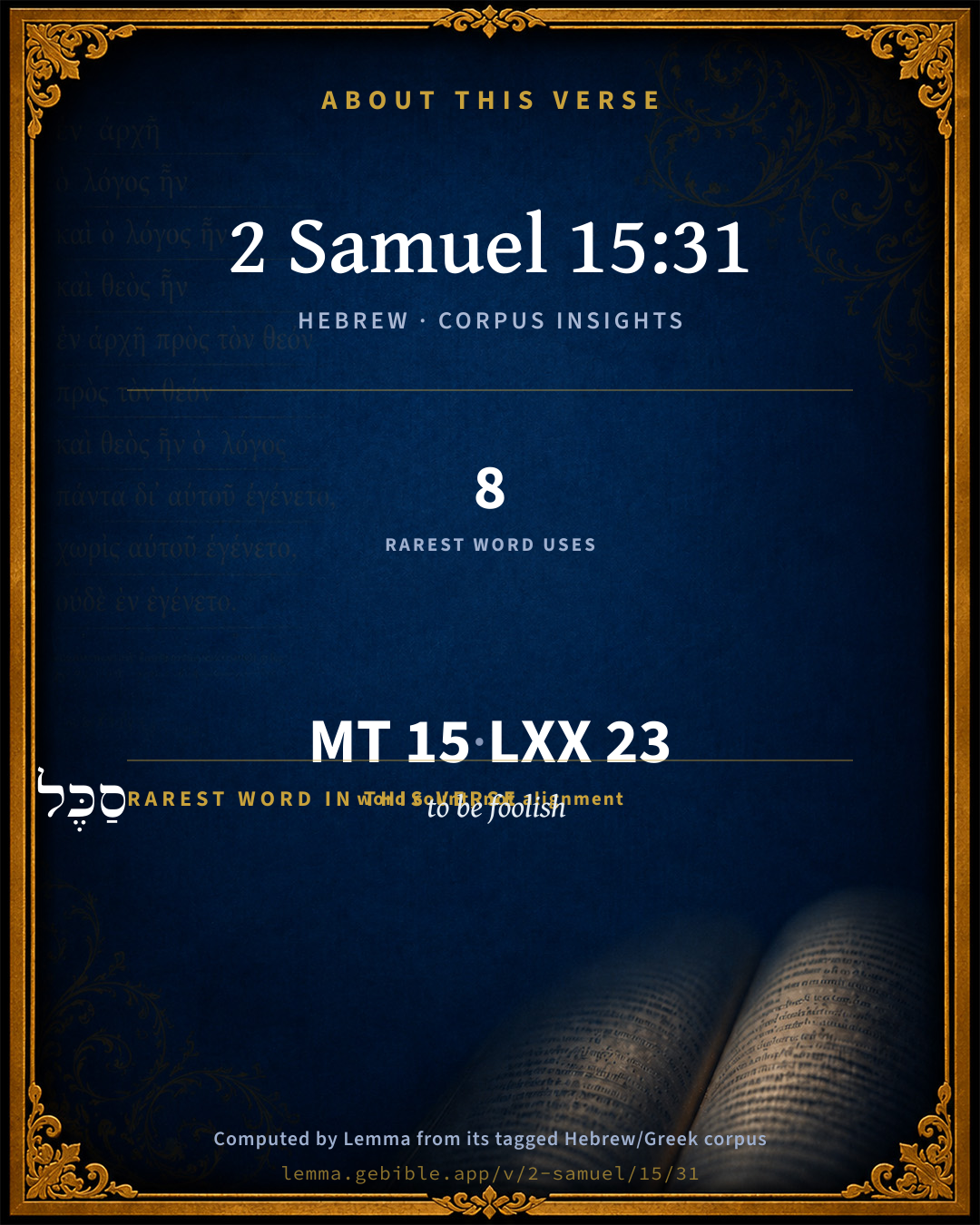
The rarest word here is סַכֶּל to be foolish H5528 — appearing just 8 times in the whole Hebrew Bible.

Shared distinctive vocabulary

סַכֶּל to be foolish H5528 occurs in 8 verses of the Hebrew Bible. Also found in:

Grammatical profile

  • 5 verbs
  • 7 nouns
  • 1 preposition
  • 2 particles

Verb forms

  • הִגִּ֣יד Hiphil · Perfect
  • לֵאמֹ֔ר Qal · Infinitive Construct
  • בַּקֹּשְׁרִ֖ים Qal · Participle Active
  • וַיֹּ֣אמֶר Qal · Sequential Imperfect
  • סַכֶּל Piel · Imperative

Repetition

Words recur within this verse — often emphatic in Hebrew:

  • וְדָוִד֙ David H1732 ×2
  • לֵאמֹ֔ר to say H559 ×2
  • אֲחִיתֹ֥פֶל Ahithophel H302 ×2

Hebrew & Septuagint length

In English translation the verse runs 22 words from the Hebrew and 30 from the Septuagint (LXX English) — closely comparable.

A rough comparison of the two English renderings, which tokenize alike — not a word-level alignment.

Word counts can differ between the Hebrew and the Greek without any difference in meaning — e.g. the Hebrew direct-object marker אֵת has no separate Greek word, and Greek often adds the article ὁ.

In the original languages it is 15 Hebrew tokens and 23 Greek tokens — but the two are counted differently (Hebrew bundles its prefixes and suffixes into one token; the Greek is in lemma form), so that isn’t a like-for-like length.

Cross-references

19

Topical passages linked to 2 Samuel 15:31 in the Treasury of Scripture Knowledge — connected by theme and wording, ordered by reader-vote popularity; previews shown in the World English Bible.

  • 2 Samuel 17:14 Absalom and all the men of Israel said, The counsel of Hushai the Archite is better than the counsel of Ahithophel. For Yahweh had ordained to defeat the good counsel of Ahithophel, to the intent that Yahweh might bring evil on Absalom.
  • 2 Samuel 17:23 When Ahithophel saw that his counsel was not followed, he saddled his donkey, and arose, and got him home, to his city, and set his house in order, and hanged himself; and he died, and was buried in the tomb of his father.
  • Psalms 41:9 Yes, my own familiar friend, in whom I trusted, Who ate bread with me, Has lifted up his heel against me.
  • James 3:15 This wisdom is not that which comes down from above, but is earthly, sensual, and demonic.
  • Job 5:12 He frustrates the devices of the crafty, So that their hands can't perform their enterprise.
  • 1 Corinthians 1:20 Where is the wise? Where is the scribe? Where is the lawyer of this world? Hasn't God made foolish the wisdom of this world?
  • 1 Corinthians 3:18–20 Let no one deceive himself. If anyone thinks that he is wise among you in this world, let him become a fool, that he may become wise.
  • 2 Samuel 15:12 Absalom sent for Ahithophel the Gilonite, David's counselor, from his city, even from Giloh, while he was offering the sacrifices. The conspiracy was strong; for the people increased continually with Absalom.
  • 2 Samuel 16:23 The counsel of Ahithophel, which he gave in those days, was as if a man inquired at the oracle of God: so was all the counsel of Ahithophel both with David and with Absalom.
  • Job 12:16–20 With him is strength and wisdom; The deceived and the deceiver are his.
  • Isaiah 19:11–25 The princes of Zoan are utterly foolish; the counsel of the wisest counselors of Pharaoh is become brutish: how do you say to Pharaoh, I am the son of the wise, the son of ancient kings?
  • Psalms 3:1 Yahweh, how my adversaries have increased! Many are those who rise up against me.
  • Psalms 109:3 They have also surrounded me with words of hatred, And fought against me without a cause.
  • Isaiah 19:3 The spirit of Egypt shall fail in the midst of it; and I will destroy the counsel of it: and they shall seek to the idols, and to the charmers, and to those who have familiar spirits, and to the wizards.
  • Jeremiah 8:8–9 How do you say, We are wise, and the law of Yahweh is with us? But, behold, the false pen of the scribes has worked falsely.
  • Matthew 26:14–15 Then one of the twelve, who was called Judas Iscariot, went to the chief priests,
  • John 13:18 I don't speak concerning all of you. I know whom I have chosen. But that the Scripture may be fulfilled, 'He who eats bread with me has lifted up his heel against me.'
  • Psalms 55:12 For it was not an enemy who insulted me, Then I could have endured it. Neither was it he who hated me who raised himself up against me, Then I would have hid myself from him.
  • Psalms 55:14–15 We took sweet fellowship together. We walked in God's house with company.

Cross-references courtesy of OpenBible.info (CC BY 4.0).

Hebrew and Greek witnesses Masoretic Hebrew ↔ Greek Septuagint

The same verse in the two great witnesses to the Old Testament, shown verse-for-verse.

These are two independent witnesses, not word-aligned to each other, and the Septuagint is shown in lemma (dictionary) form.

Hebrew 2 Samuel 15:31 Masoretic · Westminster Leningrad Codex

וְדָוִד֙ הִגִּ֣יד לֵאמֹ֔ר אֲחִיתֹ֥פֶל בַּקֹּשְׁרִ֖ים עִם אַבְשָׁל֑וֹם וַיֹּ֣אמֶר דָּוִ֔ד סַכֶּל נָ֛א אֶת עֲצַ֥ת אֲחִיתֹ֖פֶל יְהוָֽה

One told David, saying, Ahithophel is among the conspirators with Absalom. David said, Yahweh, please turn the counsel of Ahithophel into foolishness.

World English Bible · Public Domain

Greek LXX 2 Samuel 15:31 Septuagint · lemma form

καί ἀναἀγγέλλω δαυίδ λέγω καί αχιτοφελ ἐν ὁ συστρέφω μετά αβεσσαλωμ καί εἶπον δαυίδ διασκεδάζω δή ὁ βουλή αχιτοφελ κύριος ὁ θεός ἐγώ

And it was reported to David, saying, Achitophel also is among the conspirators with Abessalom. And David said, O Lord my God, disconcert, I pray you, the counsel of Achitophel.

LXX2012 (modern English Septuagint) · Public Domain

On this verse, Haydock's Catholic Bible Commentary discusses the Septuagint’s reading. Read the note in Commentary ↓

Hebrew: Westminster Leningrad Codex (CC BY 4.0). Greek: Septuagint (public domain); English from LXX2012 (modern English Septuagint) (Public Domain). How the Septuagint differs from the Hebrew →

Targum (Aramaic paraphrase)

1

The Targum is the ancient Jewish Aramaic paraphrase of the Hebrew Scriptures — an interpretive translation, not the Hebrew text itself. Onkelos (literal) and Pseudo-Jonathan (expansive) render the Torah, and Jonathan the Prophets. Coverage is partial: where no permissively-licensed English translation exists for a verse, only the Aramaic is shown. This is verse-level text, not a word-by-word alignment to the Hebrew.

  1. Targum Jonathan Prophets (Joshua–Malachi)
    וְדָוִד אִתְחַוָא לְמֵימָר אֲחִיתוֹפֶל בִּמְרוֹדַיָא עִם אַבְשָׁלוֹם וַאֲמַר דָוִד קַלְקֵל כְּעַן יַת מִלְכָּא דַאֲחִיתוֹפֶל יְיָ:

    (no public-domain English translation for this verse)

    Targum Jonathan — Aramaic: “Mikraot Gedolot” (public domain). English: “Sefaria Community Translation” (CC0 1.0 (public-domain dedication)); “London "Chaldee Paraphrase," 1871” (public domain). Text via Sefaria.

Commentary

Notes on 2 Samuel 15:31 from classic Christian and Jewish commentators (each source and its license shown beneath its notes). The classic Christian expositions comment on the surrounding passage and are grouped to its opening verse, so a note may address several verses; the Jewish commentaries on the Tanakh (Rashi and others) are per-verse, so they appear only where the commentator wrote on this verse.

Lemma curates 59 commentaries, every one of them public domain or Creative Commons licensed, each selected and text-cleaned for this edition rather than reprinted as found. About our sources →

Matthew Henry's Commentary

Nothing, it seems, appeared to David more threatening in Absalom's plot than that Ahithophel was in it; for one good head, in such a design, is worth a thousand good hands. Absalom was himself no politician, but he had got one entirely in his interest that was, and would be the more dangerous because he had been all along acquainted with David's counsels and affairs; if therefore he can be baffled, Absalom is as good as routed and the head of the conspiracy cut off. This David endeavours to do.

I. By prayer. When he heard that Ahithophel was in the plot he lifted up his heart to God in this short prayer: Lord, turn the counsel of Ahithophel into foolishness, Sa2 15:31. He had not opportunity for a long prayer, but he was not one of those that thought he should be heard for his much speaking. It was a fervent prayer: "Lord, I pray thee, do this." God is well pleased with the importunity of those that come to him with their petitions. David is particular in this prayer; he names the person whose counsels he prays against. God gives us leave, in prayer, to be humbly and reverently free with him, and to mention the particular care, and fear, and grief, that lies heavily upon us. David prayed not against Ahithophel's person, but against his counsel, that God would turn it into foolishness, that, though he was a wise man, he might at this time give foolish counsel, or, if he gave wise counsel, that it might be rejected as foolish, or, if it were followed, that by some providence or other it might be defeated, and not attain the end. David prayed this in a firm belief that God has all hearts in his hand, and tongues too, that, when he pleases, he can take away the understanding of the aged and make the judges fools, (Job 12:17; Isa 3:2, Isa 3:3), and in hope that God would own and plead his just and injured cause. Note, We may pray in faith, and should pray with fervency, that God will turn that counsel into foolishness which is taken against his people.

II. By policy. We must second our prayer with our endeavours, else we tempt God. It is good service to countermine the policy of the church's enemies. When David came to the top of the mount, he worshipped God, Sa2 15:32. Note, Weeping must not hinder worshipping, but quicken it rather. Now he penned the third Psalm, as appears by the title; and some think that his singing this was the worship he now paid to God. Just now Providence brought Hushai to him. While he was yet speaking, God heard, and sent him the person that should be instrumental to befool Ahithophel. He came to condole with David on his present trouble, with his coat rent and earth upon his head; but David, having a great deal of confidence in his conduct and faithfulness, resolved to employ him as a spy upon Absalom. He would not take him with him (Sa2 15:33), for he had now more need of soldiers than counsellors, but sent him back to Jerusalem, to wait for Absalom's arrival, as a deserter from David, and to offer him his service, Sa2 15:34. Thus he might insinuate himself into his counsels, and defeat Ahithophel, either by dissuading Absalom from following his advice or by discovering it to David, that he might know where to stand upon his guard. How this gross dissimulation, which David put Hushai upon, can be justified, as a stratagem in war, I do not see. The best that can be made of it is that Absalom, if he rebel against his father, must stand upon his guard against all mankind, and, if he will be deceived, let him be deceived. David recommended Hushai to Zadok and Abiathar, as persons proper to be consulted with (Sa2 15:35), and to their two sons, as trusty men to be sent on errands to David, Sa2 15:36. Hushai, thus instructed, came to Jerusalem (Sa2 15:37), whither also Absalom soon after came with his forces. How soon do royal palaces and royal cities change their masters! But we look for a kingdom which cannot be thus shaken and in the possession of which we cannot be disturbed.

Matthew Henry's Commentary on the Whole Bible (1708–1710) — public domain (CC PDM 1.0). Text via the HelloAO Bible API.

Trapp's Complete Commentary

John Trapp

2Sa 15:31 And [one] told David, saying, Ahithophel [is] among the conspirators with Absalom. And David said, O LORD, I pray thee, turn the counsel of Ahithophel into foolishness.

Ver. 31. Turn the counsel of Ahithophel into foolishness.] This was done accordingly: great is the power of faithful prayer, The queen-mother of Scotland was heard to say, that she more feared the prayers of John Knox than an army of fighting men.

John Trapp, A Commentary or Exposition upon All the Books of the Old and New Testament (1647–1656) — public domain. Text from a community e-Sword module.

The Biblical Illustrator

Joseph S. Exell

2Sa_15:31

O Lord, I pray Thee, turn the counsel of Ahithophel into foolishness.

Conspirators

Unfortunately for mankind the time of religious conspirators is not at an end. Under the fair robe of Christianity, there are men who are plotting to take away from us the liberty of conscience. There is steadily growing in number and power a party whose object is to play into the hands of that church which proclaims itself to be infallible. Let us mention that great conspirator whose name is temptation. Mr. Ruskin says that the human soul is not a machine, the wheels of which you can scrape and polish, and set it going at the rate of, twenty or thirty miles an hour. The human soul is not a machine; it is a living thing which has to grow. Converts who begin to turn over a fresh leaf and to serve the Lord Jesus are often much distressed because they are still inclined to their old sins. Let all such young believers bear in mind that they are not a perfected machine, but are rather like a seed which has to grow, or a child that has to be trained. Like the conspirators who would hand our free country over to the chains of Rome, so the tempter in your heart, is working very gradually. When I was a boy I tried to light a thick piece of wood with a match, but failed to do so. Had I taken some shavings and lit, them, and then a few chips and placed them against the log it would soon have been in a blaze. So the inward conspirator works on, little by little. If we could see the devil in every temptation, no doubt we should act as old Dunstan is said to have done; but we have a tendency to sin, and when the inward conspirator makes our besetting sin very tempting, none of us can resist it without the grace of God. (W. Birch, jun.)

Prayer for the defeat of Chose who attempt to subvert good government

I. Briefly describe a good government. Some suppose that one form of government is as good as another, provided it be equally well administered. If this opinion could be admitted all observations upon this head would be entirely superseded. But there is no foundation to imagine that the goodness or badness of any government depends solely upon its administration. It must be allowed that the ultimate design of civil government is to restrain the corruptions of human nature. And since human nature is the same at all times and in all places, the same form of government which is best for one nation is best for all nations, if they would only agree to adopt it. Hence politicians may arrive at as great perfection in the art of government as in any other art which is founded on the principles of human nature. A civil constitution ought to resemble a good time-piece: A good clock, for instance, will constantly and regularly move of itself, if it be only wound up, from day to day, or from week to week. So a good constitution will support itself, without requiring anything more of the people than barely their setting it in motion, and choosing their own rulers, at a prescribed time, and in a prescribed manner.

II. To inquire who may be said to be aiming to overthrow a good government, There is such a great diversity in the natural abilities, acquired knowledge, local situations, and temporal interests of mankind, that it is not to be expected they should be perfectly agreed in their political sentiments. Individuals, therefore, may be good subjects of a good government, though they should really think that its constitution is not so perfect as it might be; or that those in administration do not in all cases conduct public affairs so well as they might conduct them. But we may justly consider those as aiming to subvert the government, who endeavour to alienate the affections of the people from it. This was the method which Absalom pursued, in order to take the kingdom out of his fathers hands into his own. Accordingly, when we find any description of men insidiously endeavouring to alienate the affections of the people from their government, we have no room to doubt of their malevolent and traitorous designs. They are certainly seeking the power of bringing about a revolution of government; and should they attain that power, we may presume they will employ it for that purpose.

III. The propriety of praying that God would disconcert the counsels of such designing and dangerous men. And this will appear, if we consider,

1. That the subversion of a good government is one of the greatest calamities than can fair upon a people. A good government is the security of everything which they hold most dear and valuable in life. It protects their persons, their property, and all their civil and religious privileges. And if this foundation of their public safety and happiness should be taken away they would be completely ruined. Hence David demands, If the foundations be destroyed, what can the righteous do?

2. It is the prerogative of God to frustrate the most secret and destructive counsels of men. He knows their down-sittings and up-risings. He understands their thoughts afar off. He looks on their hearts and ponders all their purposes. They cannot conceive an evil thought nor concert a malignant design which he cannot perfectly penetrate and comprehend. He is able therefore to discover and disconcert the most subtile and secret counsels against the peace and prosperity of any people. This the inspired writers firmly believed and abundantly taught.

3. That God has often defeated the most destructive and deep-laid designs of men, in answer to prayer. David entreated God to confound the designs of Ahithophel. O Lord, I pray thee, turn the counsel of Ahithophel into foolishness. This prayer was graciously heard and answered. (N. Emmons, D. D.)

The Biblical Illustrator, edited by Joseph S. Exell (c. 1880s–1900s) — public domain. Text from a community e-Sword module.

Joseph Benson's Commentary

2Sa 15:31. One told David — Or, David told; that is, being informed that Ahithophel was among the conspirators, he mentioned it to his friends, to excite them to join with him in the following prayer against him. Turn the counsel of Ahithophel into foolishness. Either infatuate him, that he may give foolish counsel; or let his counsel be contemned and rejected as foolish; or let it miscarry in the execution. Thus David’s constant recourse, in all his dangers and difficulties, was unto God by prayer.

Joseph Benson's Commentary on the Old and New Testaments (1811–1818) — public domain. Text from a community e-Sword module.

Whedon's Commentary on the Bible

Daniel D. Whedon

HUSHAI SENT TO DEFEAT THE COUNSEL OF AHITHOPHEL, 2Sa_15:31-37.

31. Turn the counsel of Ahithophel into foolishness — This was spoken in allusion to the meaning of the name Ahithophel — brother of folly. David dreaded the far-reaching counsel of this wisest of his former friends. See note on 2Sa_15:12.

Daniel D. Whedon (gen. ed.), Commentary on the Old and New Testaments (1874–1909) — public domain. Text from a community e-Sword module.

Tyndale Open Study Notes

Tyndale Open Resources

15:31 let Ahithophel give . . . foolish advice: David also sent a double-agent, Hushai, to confound Ahithophel’s advice (15:32-37; 17:1-14).

Tyndale Open Study Notes — © Tyndale Open Resources, licensed CC BY-SA 4.0. Text via the HelloAO Bible API.

Geneva Bible (1599)

Geneva Bible translators

The counsel of the crafty worldlings doth more harm than the open force of the enemy.

Geneva Bible (1599) marginal notes — public domain. Text via Bolls.life.

Jamieson, Fausset & Brown

Robert Jamieson, A. R. Fausset & David Brown

David said, Turn, O Lord, . . . the counsel of Ahithophel--this senator being the mainstay of the conspiracy.

Jamieson, Fausset & Brown — Commentary Critical and Explanatory on the Whole Bible (1871) — public domain (CC PDM 1.0). Text via the HelloAO Bible API.

Adam Clarke's Commentary

Verse 31. Turn the counsel of Ahithophel into foolishness.] Ahithophel was a wise man, and well versed in state affairs; and God alone could confound his devices.

Adam Clarke's Commentary on the Bible (1810–1826) — public domain. Text from a community e-Sword/MySword module.

Ellicott's Commentary for English Readers

(31) One told David.—This is no doubt the meaning, but the preposition has dropped out of the Hebrew text, leaving it unintelligible, and reading literally, and David told.

A Bible Commentary for English Readers, edited by Charles John Ellicott (1878–1897) — public domain. Text from a community e-Sword module.

John Gill's Exposition

And one told David,.... That came either from Hebron or from Jerusalem:

Ahithophel is among the conspirators with Absalom; Absalom sent for him, and it seems he came to him, and continued with him, see Sa2 15:12,

and David said, O Lord, I pray thee, turn the counsel of Ahithophel into foolishness; either suffer him to give foolish counsel, or confound the schemes projected by him, and let them not be carried into execution; for God can, and sometimes does, disappoint crafty counsellors, that they cannot perform what they devise, but they are taken in their own craftiness, and their counsel is carried headlong, Job 5:12; this prayer was answered, Sa2 17:14.

John Gill's Exposition of the Whole Bible (1746–1763) — public domain (CC PDM 1.0). Text via the HelloAO Bible API.

Haydock's Catholic Bible Commentary

Infatuate: "render useless;" (Theodotion) "dissipate," Septuagint. (Calmet) --- God hindered the wise counsel of Achitophel from being regarded. (Haydock)

George Leo Haydock (1774–1849), Haydock's Catholic Family Bible and Commentary, 1859 edition — public domain. Excludes Psalms (Douay-Rheims chapter numbering differs from Protestant) and Deuterocanonical books (Catholic canon only).

Matthew Poole's English Annotations

One told David, or, David told, i.e. David being hereof informed, acquaints his friends and followers with it, to stir them up to join with him in the following prayer against him.

Turn the counsel of Ahithophel into foolishness; either infatuate him, that he may give foolish counsel; or let his counsel be rejected as foolish, or spoiled by the foolish execution of it.

Matthew Poole's English Annotations on the Holy Bible (1683–1685) — public domain. Text from a community e-Sword/MySword module.

The Pulpit Commentary

And one told David. The Hebrew literally is, and David told. But we cannot suppose that David had previously known of Ahithophel"s defection. The text is evidently corrupt, and the Authorized Version gives the right sense. On hearing of the defection of a man so famous for practical sound judgment, David prays to God to frustrate his counsel, and the opportunity for devising means for this end quickly follows.

Vers. 31-37.

Prayer for Divine intervention.

The facts are:

1. David, hearing that Ahithophel was among the conspirators, prays that God would turn his counsel into foolishness.

2. On reaching the top of the Mount of Olives, the aged Hushai expresses his desire to go with David into exile, but David declines his offer on account of his infirmities.

3. On the other hand, David suggests that he can render him good serviceby returning to the city and living as a servant of Absalom, and he advises him to act in concert with Zadok and Abiathar.

4. Acting on this suggestion, Hushai returns to the city, and, some time after, Absalom also enters. There passed a pang through the heart of David as he beard of the treachery of his trusty counsellor Ahithophel, bitter because he had relied so much on this wise man"s honesty and sagacity, and more bitter still as he remembered the cruel conspiracy which he once entered into with Joab against the life of Uriah. Yet the forgiven and renewed king, in the fulness of his anguish, was true to his revived religious instincts in at once raising his heart to God with the prayer that he would bring his own wisdom to bear so as to defeat the wisdom of this man. We see here

I THAT THERE IS IN THIS WORLD A CONFLICT BETWEEN HUMAN AND DIVINE WISDOM. David was well acquainted with two great facts:

(1) that the wisdom of God had designed him to be king over Israel to the end of his days; (2Sa_7:11-16, 2Sa_7:28, 2Sa_7:29)

(2) that the wisest man in the land was devising means to frustrate this purpose, not perhaps consciously, yet practically. This is an epitome of the history of mankind. God has a purpose to carry out, and employs good men as his instruments, all is arranged according to his infinite wisdom; but, on the other hand, there are men who bring their powers to bear so as to frustrate thin purpose. They may not know that they are setting their wisdom against the wisdom of God, but the facts are to that effect. Adam and Eve went against wisdom in the exercise of their wisdom. Pharaoh contrived to prevent what wisdom had ordained. The wisdom of scribes and Pharisees was arrayed against him who was the "Wisdom of God." In the antagonism of men to the gospel the apostle saw a case of the "wisdom of the world" striving against the wisdom which was so far above theirs that their wisdom was more properly folly. (1Co_1:18-25) Men who live in sin, who try to dispense with Christ, really set their wisdom against the great and blessed order which is founded on eternal wisdom. The attitude of the world to the Church may be expressed in the terms just stated. Oh that men were wise!

II THAT A GOOD MAN BELIEVES IN GOD"S POWER TO COUNTERACT THE WISDOM OF MEN. This was the intellectual basis of David"s prayer for intervention against the devices of Ahithophel. Faith in God"s appointment of prayer is associated with a perception of the fact that God can and does so control human action as to restrain it within definite lines, and to secure in spite of it certain issues that are for the good of the world. A theism that renders God inactive, or bound in the unbreakable chains of a physical necessity, had better be frank and renounce the sacred name, and say once for all, "Force is in eternal motion along lines eternally fixed." God is a Spirit, and as such has free access to the spirits of men. His unseen and unconscious contact may paralyze or divert thought, and render possible ideas which, when carried out, will prove to be subversive of the very ends which the wicked thinker once had set his heart upon. We don"t know how much we owe to this silent action of God on evil men. He also, as a free Spirit, is in contact with the ultimate elements of things, and can act on them without dislocation of the order of nature, more perfectly than we can in the effort of our will. Many Christian people do not, it is feared, half believe in this great truth, and do not sufficiently see its ample bearing on the great stress of life. God not only looks into men and sees them through and through; he is an Actor, and brings his wisdom to put to nought the wisdom of the wise.

III THAT A GOOD MAN IN EXTREMITY NATURALLY PUTS THIS BELIEF INTO PRACTICE. David felt that he could not cope with the combination against him. His heart fainted at the thought of the sagacity of the counsellor uniting with the daring and dash of the ambitious usurper. His prayer was true to nature. We do not in ordinary circumstances allow our faith to have sufficient influence over our lives. Trouble brings us straight to God. Our vast resources are drawn upon when heart and flesh begin to fail. All prayer is a cry for God"s help, or it is nothing; hut the earnestness and intensity of the cry are proportioned to the perception of peril.

IV THAT PRAYER FOR HELP, IN THE CASE OF A GOOD MAN, IS ATTENDED WITH A DISCREET USE OF MEANS TO SECURE THE END IN VIEW. The practical character of David"s religion is seen in this that, as soon as he had committed his desperate case to God, he tooksteps, through Hushai, to counteract the wisdom of Ahithophel. He knew that God worked on the minds of men partly by the agency of other men, to whom he secretly imparts wisdom and discretion. Not only would secret unconscious influences operate within Ahithophel to cause him to blunder in advice, hut thoughts would be directed in the minds of Hushai and Zadok so that they would act at the right season and in the right way. This combination of trust in God and action among men is characteristic of all true religious life. "The effectual fervent prayer of the righteous man availeth much," and his labour also "is not in vain in the Lord.

GENERAL LESSONS.

1. In all our dealings with men, and efforts to get them to act, we shouldremember that we can get at them through God.

2. The Church, in its conflict with the world, should rest in the consolationthat the wisdom of God can never fail.

3. Much of our success in Christian work depends on our assigning men toduties suited to their character, age, and position.

4. Good men who are compelled by force of circumstances to live amongmen of evil purpose may use their knowledge of the world and its ways so as to promote the best interests of the kingdom of God.

Ver. 31. (MOUNT OLIVET.)

The counsel of Ahithophel.

I pray thee, the counsel of Ahithophel into foolishness, O Jehovah." (References: (2Sa_15:12, 34 16:15, 20-23 17:1-7, 15, 23; 1Ch_27:33) While ascending the Mount of Olives, David received intelligence that his counsellor, Ahithophel the Gilonite, had gone over to Absalom. He was the wisest statesman in Israel, and nothing was more adapted than his counsel to ensure the success of the revolt. The effect which his defection produced upon David is evident from the prayer (suggested probably by his name, "brother of a fool") that forthwith broke from his lips. As he continued his, journey, he, perhaps, reflected on the former course of Ahithophel (the Old Testament Judas) in the light of present knowledge, and indulged some such sentiments as are expressed in Psalm 41., "The comfort of the afflicted and betrayed;" Ps 55, "Prayer against a treacherous friend;" Ps 69 Ps 109. Observe that

I A FAMILIAR FRIEND MAY BECOME A DEADLY FOE.

Also my friend literally, "man of my peace", whom I trusted, Who did eat of my bread, Hath lifted up his heel against me. (Psa_41:10; Joh_13:18)

For it is not an enemy, etc. But thou wast a man on an equality with me, My companion and familiar friend," etc. (Psa_55:13-15)

The motives of Ahithophel are not expressly stated; but they were probably:

1. Dislike of the religious earnestness and theocratic policy of David.

2. Ambition to be the sole adviser and prime minister of Absalom. "There may have been jealousy of Joab, or the natural tendency to worship the rising instead of the setting sun, or the impatience of a hypocrite at the round of religious services in which he was compelled to bear a part, affecting a devotion he did not feel." (Psa_55:13, Psa_55:14) (Plumptre)

3. Revenge "for the dishonour done to his family in the person of Bathsheba, which no subsequent marriage could repair or efface" (Delany). "He was urged by the desire of punishing David"s greatest crime, if he were not at the bottom of the movement. It is but reasonable to trace in the conspiring Ahithophel one of the intricate methods by which the judicial providence of God works out its own ends; suffering a great offender, notwithstanding his penitence, to eat the fruit of his deeds; yet reserving for treachery in time its reward" (R. Williams). "This text is a glass wherein God"s justice is plainly to be seen. David had formerly forsaken Uriah, and now God suffers Ahithophel to forsake David.

(1) Let us learn, when our friends forsake us, to enter into a serious scrutiny with our own souls.

(2) The most politic heads have not always the faithfullest hearts.

(3) False friends will forsake thee in times of adversity" (T. Fuller). "My brethren have dealt deceitfully as a brook," etc.. (Job_6:15; Jacox, "Stray Side-Lights on Scripture Texts

II GREAT GIFTS ARE SOMETIMES PERVERTED TO UNGODLY USES. "That oracular wisdom which made his house a kind of shrine (2Sa_16:23) seems to move the spirit of the sacred writer with an involuntary admiration" (Stanley). "His great crimes were enhanced by his immense talents, of which God gave him the use and the devil the application." His criminality appears not only in

(1) his sanctioning and promoting rebellion against the authority of the king; but also in

(2) his lawless and shameless advice against his honour, (2Sa_16:21, 2Sa_16:22) whereby he sought to make reconciliation and compromise impossible in the view of all, and to gratify his revenge in the most effective and significant manner; (2Sa_11:2, 2Sa_11:4, 2Sa_11:11) becoming, consciously or unconsciously, an instrument of retribution. "This cursed policy showed him rather an oracle of the devil than of God" (Matthew Henry).

(3) His malicious and cruel proposal to take away his life. (2Sa_17:2) None but a man devoid of all moral and religious principle could have given such counsel. A powerful intellect is, alas! too often united with a depraved heart. "It is often found true by experience that persons of superior penetration and wisdom are of bad intentions; they see further than other men, and are under a temptation to turn their minds to the overreaching of others, and effecting mischief; their ability in accomplishing wickedness is a snare and a temptation to them; they find they can do it, and therefore are ready and willing to do it" (W. Jones, of Nayland). "This man, while he was one of David"s deep counsellors, was one of David"s fools, that said in their hearts, "There is no God;" else he could not have hoped to make good an evil with worse, to build the success of treason upon incest." "Oh the policy of this Machiavelli of Israel, no less deep than hell itself! Oh the wisdom of the Almighty, that can use the worst evils well, and most justly make the sins of man his executioners!" (Hall).

III GOD IS ABLE TO FRUSTRATE THE CRAFTIEST COUNSELS. "Turn," etc., "either infatuate him, that he may give foolish counsel; or, let his counsel be rejected as foolish, or spoiled by the foolish execution of it" (Poole). "He taketh the wise in their own craftiness," etc. (Job_5:13; 1Co_3:19) Of this David was persuaded from:

1. His supreme and infinite wisdom, in comparison with which the highesthuman wisdom is foolishness.

2. His abundant and varied resources for the direction and control of men"spurposes and actions, so that they are made of none effect, or turn out contrary to what was intended and expected.

3. His frequent and extraordinary interpositions for that end. History is full of such instances. (Act_4:28) So are individual lives. (1Sa 23) "Though Ahithophel spoke as an oracle of God (as we often see statesmen wiser than priests), yet as he turned to treachery his counsel turned to foolishness.

IV A GOOD MAN HAS AN UNFAILING RESOURCE IN EVERY TROUBLE, viz. sincere, believing, fervent prayer. "Call upon me," etc. (Psa_1:1-5)

1. However beset by the craft and power of his adversaries, he cannot bedeprived of this privilege, but has access to God in all circumstances, at all times, and in all places (ver. 32). "A Christian cannot always hear, or always read, or always communicate, but he may pray continually. If he be on the top of a house with Peter, he may pray; if he he in the bottom of the ocean with Jonah, he may pray; if he be walking in the field with Isaac, he may pray when no eye seeth him; if he be waiting at table with Nehemiah, he may pray when no ear heareth him; if he be in the mountains with our Saviour, he may pray; if he be in the prison with Paul, he may pray; wherever he is, prayer will help him to find God out. Every saint is God"s temple; and he that carrieth his temple about him, saith Austin, may go to prayer when he pleaseth. Indeed, to a Christian every house is a house of

2. prayer; every closet a chamber of presence; and every place he comes to an altar whereon he may offer the sacrifice of prayer" (Swinnock, "The Christian Man"s Calling").

3. The depth of his helplessness and peril is an incentive to higherearnestness and an argument for the fulfilment of Divine promises. "Ejaculations are short prayers darted up to God on emergent occasions. When we are time bound, place bound, or person bound, so that we cannot compose ourselves to make a large solemn prayer, this is the right instant for ejaculations, whether orally uttered or only poured forth inwardly in the heart" (T. Fuller).

1. And his prayer is not offered in vain. Sometimes while he is "yetspeaking" (Isa_65:24) the answer comes (ver. 32). "In answer to a single emphatical ejaculation the counsel of the prudent is carried headlong" (Scott).

As for me unto God will I cry, And Jehovah will save me. Evening and morning and at noon will I complain and groan, And he will hear my voice. Cast thy burden upon Jehovah, He he will sustain thee. (Psa_55:16, Psa_55:17, Psa_55:22)

D.

The Pulpit Commentary (1880–1919), ed. H.D.M. Spence-Jones & Joseph S. Exell — public domain. Text from a community e-Sword module.

Rashi

Rabbi Shlomo Yitzchaki (Rashi)

Dovid was told [by an informer]. Dovid was told by the informer.

Ruin. Ruin as we find "The tool talks too much".

Rashi on the Tanakh — English translations: “The Judaica Press complete Tanach with Rashi, translated by A. J. Rosenberg” (CC BY 4.0); “Pentateuch with Rashi's commentary by M. Rosenbaum and A.M. Silbermann, 1929-1934” (public domain); “The Metsudah Tanach series, Lakewood, N.J” (CC BY 4.0); and “The Book of Joshua, Metsudah Publications, 1997” (CC BY 4.0). Text via Sefaria.

Lesson kit

Teaching starters — assembled from the data on this page, not authored interpretation. Every prompt links to the verse data it draws on. Edit before teaching.

2 Samuel, in the Historical, opens this verse with 15 words (12 distinct Hebrew lemmas). Its most distinctive word is çâkal (“to be foolish”). A historical commentator’s framing appears above. Read the whole chapter for the surrounding context.

Discussion questions

  1. How does “to be foolish” (çâkal) shape what this verse is saying?
  2. How does Genesis 31:28, which shares the word «to be foolish», read alongside this verse?
  3. What does the repetition of “David” (2× in this one verse) do in this verse?
  4. These translations render this verse differently; the difference is in the English rendering, not the original. What questions does that raise?
  5. «הִגִּ֣יד» is a Hiphil Perfect verb. How does that grammatical form shape the action described?
  6. Compare how Matthew Henry's Commentary and Trapp's Complete Commentary read this verse. Where do they agree or differ?

Things to notice

Reading settings

Reading text

Shown beneath each verse's original-language words.

Old Testament
Old Testament edition

Read the OT as the Masoretic Hebrew (MT) or the Greek Septuagint (LXX).

English shown for the Greek Septuagint (in the Hebrew ↔ Greek comparison).

Comparing translations? Open the Compare panel on any verse page to stack up to four side by side.